REVIEW 4 major objections 6 minor 66 references
SD-Acc: Accelerating Stable Diffusion through Phase-aware Sampling and Hardware Co-Optimizations
T0 review · 4 major / 6 minor · reviewed 2026-08-06 · deepseek-v4-flash
Pith's one-line read Phase-aware sampling lets Stable Diffusion skip most of the U-Net in the later denoising phase, cutting compute up to 5.7x without retraining while a co-designed FPGA raises energy efficiency up to 6.0x over a V100 GPU.
desk verdict A credible co-design paper with a genuinely useful phase-aware sampling scheme, but the 'no quality compromise' headline is only proven in-sample; deserves peer review with revisions. read the letter →
The pith
A machine-rendered reading of the paper's core claim, the machinery that carries it, and where it could break.
The reading
What carries the argument
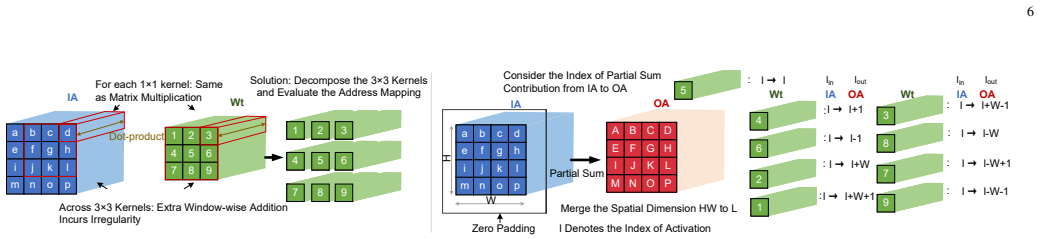
The load-bearing object is the normalized shift score $\bar{S}_t$ derived from Eq. (1), averaged over calibration prompts and min-max scaled per U-Net block; it is the evidence that high-level features stabilize while the top blocks remain outliers, and Eq. (2) converts it into the phase boundary $D^*$. Phase-aware sampling is the schedule built on that boundary: the full U-Net runs at the start and periodically in the sketching phase, and in the refinement phase only the first $L_{\mathrm{refine}} = 2$ blocks run, fed by activations reused from the nearest complete timestep. On the hardware side, the carry mechanism is the address-centric dataflow, which decomposes each convolution into $1\times1$ kernels that behave as matrix multiplications and routes partial sums to output addresses through fixed offsets such as $l \to l+1$, removing im2col's irregular memory traffic and letting one systolic array handle convolution and attention together. The two-stage streaming unit then hides nonlinear operations by splitting softmax and layernorm into numeric-characteristic acquisition and normalization and scheduling those stages inside the systolic array's streaming writes and reads.
What would settle it
Recompute the phase boundary of Eq. (2) on many random 5% subsets of the MS-COCO prompt set for StableDiff v1.4: if the argmin $D^*$ varies by more than a few timesteps across subsets, or if the top-two outlier blocks differ for v2.1 or XL, the fixed PAS schedule is an artifact of one calibration run. A second decisive experiment is to run the most aggressive tested schedule on a prompt set dominated by fine-grained text and measure CLIP and FID; a sharp drop would show that the refinement phase needs more than the top two blocks when local texture carries semantic content.
Extended reading notes
Core claim
Phase-aware sampling is the paper's answer to the observation that Stable Diffusion's denoising is not uniformly redundant. The authors define a shift score $S_i^t = \frac{\|A_i^t - A_i^{t-1}\|_2}{\|A_i^{t-1}\|_2}$ on the main-branch activations of each upsampling block, min-max normalize it per block, average over 100 PartiPrompts prompts using the 50-timestep scheduler, and find that most blocks settle into low variation after roughly the first half of denoising while the top blocks stay active. They read this as a sketching phase followed by a refinement phase, locate the boundary $D^*$ with a k-means-style sweep, and then execute only the first $L_{\mathrm{sketch}} = L_{\mathrm{refine}} = 2$ blocks during most of the refinement timesteps, using activations from the nearest complete timestep as the entry point. Across StableDiff v1.4, v2.1, and XL this removes a factor of 2.4x to 5.7x of the MAC work at nearly unchanged CLIP score and no retraining. The hardware half of the paper shows that the same saving can be realized: an address-centric dataflow maps convolution onto a plain systolic array as decomposed 1x1 matrix products, the two-stage streaming unit hides softmax/layernorm/GELU latency in the data stream, and adaptive reuse and fusion cut off-chip traffic, yielding 2.7x to 6.0x lower energy per image than an Nvidia V100 GPU.
Load-bearing premise
The load-bearing premise is that the two-phase pattern seen in activation changes on 100 calibration prompts with one scheduler is stable enough that the phase boundary and the choice to keep only the top two U-Net blocks transfer to the target prompts and to all three StableDiff versions.
Editorial extensions
If this is right
- Across StableDiff v1.4, v2.1, and XL, the PAS schedules of Table II remove a factor of 2.4x to 5.7x of multiply-accumulate work while keeping CLIP scores within about 0.005 of the original, with FID slightly improved on v1.4 and v2.1 and slightly worse on XL.
- Because the schedule hyperparameters are searched against user-specified quality and performance targets, the same framework can tune StableDiff for a desired speed/quality trade-off instead of applying one fixed pruning recipe.
- The co-designed FPGA converts the algorithm savings into 2.7x to 6.0x lower energy per image than an Nvidia V100 GPU and 14.7x to 44.9x lower than the tested CPUs.
- The address-centric dataflow lets one static systolic array execute both convolutions and attention with high PE utilization, and the two-stage streaming unit hides most nonlinear-operator latency, so the hardware gains are largely orthogonal to the phase-aware sampling gains.
- Because the retained top blocks run at the largest resolutions, the pruned workload has higher operational intensity, moving StableDiff toward the compute-bound region where the systolic array is most effective.
Reading between the lines
- The shift-score analysis is reported for one scheduler and one calibration distribution; if the same two-phase boundary appears under faster solvers such as DDIM or DPM-Solver, PAS could be combined with step distillation to compound the savings, but the paper does not test this.
- The fixed choice of the top two blocks as the only refinement-phase survivors is a statistical choice; a stress test with text-heavy prompts, where local texture carries semantic information, would reveal whether the phase division is a general property of denoising or an artifact of the MS-COCO distribution.
- Because the FPGA is estimated to consume over five times the power of an ASIC at the same node, the reported energy savings are a lower bound for a production ASIC implementation; the paper notes this but does not quantify it.
- The address-centric convolution decomposition is a generic way to make one systolic array handle mixed CNN-Transformer workloads, so the hardware mechanism could transfer to other U-Net-like backbones such as video diffusion models, though the paper evaluates only text-to-image generation.
Editorial analysis
A structured set of objections, weighed in public.
Referee Report
Summary. The paper proposes SD-Acc, an algorithm-hardware co-design for accelerating Stable Diffusion U-Net inference. At the algorithm level, it analyzes shift scores of U-Net activations across denoising timesteps (Eq. 1) and identifies a two-phase structure: a sketching phase and a refinement phase, separated by a transition timestep D* computed via a K-means-style objective (Eq. 2). During refinement, the method executes only the top Lrefine blocks of the U-Net, reusing activations from the nearest complete timestep, which yields reported MAC reductions of 2.39x to 5.68x across StableDiff v1.4, v2.1, and XL (Table II). A general framework (Sec. III-C) searches hyperparameters {Tsketch, Tcomplete, Tsparse, Lsketch, Lrefine} under quality and performance constraints. At the hardware level, the paper introduces an address-centric dataflow that maps convolutions onto a simple systolic array, a 2-stage streaming scheme for nonlinear operations, a reconfigurable vector processing unit, and adaptive reuse/fusion strategies (Secs. IV and V). The accelerator is synthesized on a VCU118 FPGA, and the paper reports up to 2.7x-6.0x energy savings over an NVIDIA V100 GPU (Fig. 19) and projected speedups of 2.2x-4.7x over V100 after scaling to 1 GHz and 4096 MACs (Fig. 20). The hardware claims are supported by per-optimization ablations and a roofline analysis, while the algorithm-level quality claim is the main load-bearing concern.
Significance. If the central claims hold, this is a useful retraining-free approximate-inference scheme for a widely deployed generative model, combined with a working FPGA implementation. The hardware work is substantial: the design is synthesized on VCU118, the ablations isolate each hardware optimization (address-centric dataflow, adaptive dataflow, 2-stage streaming), and the roofline accounting is internally consistent, with measured speedup reaching about 95% of the theoretical value for PAS-25/4. The phase-aware sampling idea is interesting and plausibly generalizable. However, the significance of the algorithm-level contribution depends on whether the 'without compromising image quality' claim survives evaluation on held-out prompt distributions and with proper statistical treatment, which the current manuscript does not provide. The comparison with prior accelerators and with CPU/GPU baselines is generally fair in its energy metrics, though the speed comparison in Fig. 20 is explicitly a projection rather than a measured result.
major comments (4)
- [Sec. III-C and Table II] The headline claim of preserving image quality is evaluated in-sample. The hyperparameters are calibrated on 5% of the MS-COCO prompt set (Sec. III-C), and Table II reports CLIP/FID/IS on the same MS-COCO validation split, with no held-out prompt distribution, no variance across calibration seeds, and no variance across image generations. Since every schedule parameter (Tsketch, Tcomplete, Tsparse, Lsketch, Lrefine, D*) is derived from this calibration, the absence of a transfer experiment leaves the 'without compromising image quality' claim unsupported for new prompts, schedulers, or model variants. Please add an evaluation on a disjoint prompt dataset (e.g., PartiPrompts or DrawBench) and report confidence intervals over multiple calibration seeds and generated images.
- [Table II and Sec. VI-A] The quality metrics in Table II are mutually inconsistent with the 'no quality compromise' claim. For every model, CLIP score monotonically decreases with MAC reduction (e.g., StableDiff v1.4: 0.3004 -> 0.2966 for PAS-25/5), while FID improves. The paper does not state a pre-specified acceptance criterion for quality preservation, and the monotone CLIP decline is evidence of quality loss under any fixed tolerance. The FID improvement is explained only post hoc as a regularization effect, which is not substantiated. Please specify a quality tolerance (e.g., ΔCLIP within measurement noise, FID not statistically worse) and report per-configuration error bars or a paired statistical test.
- [Sec. III-A, Eq. (2), Table II] The phase boundary D* is a single point estimate derived from averaged min-max-normalized shift scores over 100 PartiPrompts prompts with one scheduler (Sec. III-A), yet Tsketch=25 is applied uniformly to StableDiff v1.4, v2.1, and XL in Table II. No sensitivity analysis around D* or Tsketch is reported for any model. This is load-bearing because if the true transition timestep for a given model or prompt distribution differs from 25, the quality/complexity trade-off reported in Table II is not the one that a user would obtain in practice. Please report the computed D* for each model and a sweep over nearby Tsketch values for at least one model, together with the resulting quality metrics.
- [Sec. VI-F and Fig. 20] The speedups over the NVIDIA V100 reported in Fig. 20 (2.2x-4.7x) are projections obtained by scaling the accelerator from 200 MHz and 1024 MACs to 1 GHz and 4096 MACs, not measured results. The DRAM bandwidth (38.4 GB/s) is not scaled correspondingly, which is important because the roofline position of the projected design changes with the compute-to-memory ratio. Please label Fig. 20 as a projected speedup, state whether the memory system is also scaled, and discuss the sensitivity of the reported speedup to this assumption.
minor comments (6)
- [Sec. III-A vs. Sec. VI-A] Eq. (1) cites [21] for the 50-timestep scheduler used in the shift-score analysis, but Sec. VI-A states that the PNDM scheduler [33] is used for sampling; please reconcile this citation inconsistency.
- [Sec. III-C] The statement that 'D* is quite robust to the randomness of the prompt' is currently unsupported; please provide the supporting data, for example the distribution of D* across multiple calibration subsets.
- [Fig. 4 caption] The caption states '100 x 100 image generations'; please clarify whether this means 100 prompts with 100 images per prompt, and report the exact number of images used in the shift-score averaging.
- [Fig. 16 (right)] The y-axis label 'Layer Buffer' appears to refer to the global buffer size; please correct the label and state the normalization point explicitly.
- [Table II] The table would be easier to interpret if the hyperparameters for each model were included as columns or in the row labels, since Tcomplete differs between v1.4 (4) and v2.1/XL (3).
- [Conclusion] There are several typos, e.g., 'approiate' for 'approximate' and 'Deepcahe' for 'Deepcache' in Sec. III-B; a final proofread is recommended.
Circularity Check
PAS quality claim is partly in-sample: hyperparameters are fitted on a 5% slice of the same MS-COCO benchmark that later reports the quality-preservation numbers, but the phase-division observation and hardware design retain independent content.
-
fitted input called prediction
[Sec. III-C (General Optimization Framework) and Sec. VI-B (Evaluation, Table II)]
"we also employ a calibration prompt dataset to optimize the hyperparameters offline. The calibration dataset is generated by randomly selecting 5% of the targeted prompt dataset. ... We benchmark our method using the MS-COCO dataset validation split [32]. ... We randomly sample 5000 captions from it as the prompt input for StableDiff, thus generating 5000 images with one prompt per image."
The framework's solution search (Fig. 7) uses a quality checker with thresholds (delta-FID < 1.0, delta-CLIP < 0.01) on a calibration subset of the target prompt dataset, and the example output is the exact schedule {Tsketch=25, Tcomplete=4, Tsparse=5, Lsketch=2, Lrefine=2} evaluated in Table II. That table then reports 'CLIP scores similar to those of the original model' on the full MS-COCO validation split, which contains the same calibration distribution. The quality metric used to select the schedule is therefore the same quality metric used to claim success, with no held-out split or variance analysis; the 'preserves image quality' result is at least partly fitted rather than predicted. This is not a pure construction, but it is an in-sample evaluation of a fitted schedule.
full rationale
The derivation of PAS itself (shift-score Eq. (1), phase boundary Eq. (2), outlier-block selection) is an empirical observation about trained-model activations on PartiPrompts and is not logically identical to the quality claim. The hardware contributions (address-centric dataflow, 2-stage streaming, adaptive reuse/fusion) are compared against independent baselines and do not rely on author self-citations or imported uniqueness theorems. The only circular element is the quality-gated hyperparameter search: 5% of the MS-COCO target set is used to fit {Tsketch, Tcomplete, Tsparse, Lsketch, Lrefine}, and Table II reports quality on the same MS-COCO validation distribution with no held-out transfer or error bars. This weakens the 'without compromising image quality' claim from a prediction to an in-sample result, but it does not reduce the entire co-design to its inputs, hence the moderate score 4.
Assumptions & free parameters
free parameters (6)
- Tsketch (sketching phase duration) =
25 (all reported configs)
- Tcomplete (initial full-U-Net timesteps) =
4 (SD1.4), 3 (SD2.1, SDXL)
- Tsparse (period of full U-Net runs within sketching) =
swept over 2, 3, 4, 5 (PAS-25/2 through PAS-25/5)
- Lsketch (top blocks kept on sparse sketching steps) =
2
- Lrefine (top blocks kept in refinement phase) =
2
- D* (optimal phase transition timestep) =
model-dependent, not reported numerically
assumptions (6)
- ad hoc to paper K-means-style objective in Eq. (2) with K=2 correctly splits the 50-step schedule into sketching and refinement phases at the optimal transition timestep D*.
- domain assumption Min-max-normalized, image-averaged shift scores measured with the 50-step PNDM scheduler on 100 PartiPrompts prompts are representative of the target prompts, schedulers, and model variants used in evaluation.
- domain assumption Reusing the activation from the nearest complete timestep as the entry point for retained blocks yields outputs that approximately match the true values.
- domain assumption fp16 arithmetic on the FPGA datapath preserves the image quality measured in the algorithm-level evaluation.
- domain assumption The self-built simulators of Cambricon-D and SDP faithfully reproduce the published accelerators' performance.
- standard math The online softmax normalizer (Eqs. 5-6, from [40]) and the streaming variance formula (Eq. 4, E[x^2] minus E[x]^2) are valid and numerically acceptable in fp16.
Cite this review
Pith. "Pith review of SD-Acc: Accelerating Stable Diffusion through Phase-aware Sampling and Hardware Co-Optimizations." pith.science (2026). https://pith.science/paper/BBEA3YBA
@misc{pith2026250701309,
  author       = {Pith},
  title        = {Pith review of: SD-Acc: Accelerating Stable Diffusion through Phase-aware Sampling and Hardware Co-Optimizations},
  year         = {2026},
  howpublished = {\url{https://pith.science/paper/BBEA3YBA}},
  note         = {Machine review of arXiv:2507.01309}
}
read the original abstract
The emergence of diffusion models has significantly advanced generative AI, improving the quality, realism, and creativity of image and video generation. Among them, Stable Diffusion (StableDiff) stands out as a key model for text-to-image generation and a foundation for next-generation multi-modal algorithms. However, its high computational and memory demands hinder inference speed and energy efficiency. To address these challenges, we identify three core issues: (1) intensive and often redundant computations, (2) heterogeneous operations involving convolutions and attention mechanisms, and (3) diverse weight and activation sizes. We present SD-Acc, a novel algorithm and hardware co-optimization framework. At the algorithm level, we observe that high-level features in certain denoising phases show significant similarity, enabling approximate computation. Leveraging this, we propose an adaptive, phase-aware sampling strategy that reduces compute and memory loads. This framework automatically balances image quality and complexity based on the StableDiff model and user requirements. At the hardware level, we design an address-centric dataflow to efficiently handle heterogeneous operations within a simple systolic array. We address the bottleneck of nonlinear functions via a two-stage streaming architecture and a reconfigurable vector processing unit. Additionally, we implement adaptive dataflow optimizations by combining dynamic reuse and operator fusion tailored to StableDiff workloads, significantly reducing memory access. Across multiple StableDiff models, our method achieves up to a 3x reduction in computational demand without compromising image quality. Combined with our optimized hardware accelerator, SD-Acc delivers higher speed and energy efficiency than traditional CPU and GPU implementations.
Figures


Figures from the paper (15 more)




Reference graph
Works this paper leans on
-
[1]
M. Alwani, H. Chen, M. Ferdman, and P. Milder, “Fused-layer cnn accelerators,” in 2016 49th Annual IEEE/ACM International Symposium on Microarchitecture. IEEE, 2016, pp. 1–12
work page 2016
-
[2]
Diannao: A small-footprint high-throughput accelerator for ubiqui- tous machine-learning,
T. Chen, Z. Du, N. Sun, J. Wang, C. Wu, Y . Chen, and O. Temam, “Diannao: A small-footprint high-throughput accelerator for ubiqui- tous machine-learning,” ACM SIGARCH Computer Architecture News , vol. 42, no. 1, pp. 269–284, 2014
work page 2014
-
[3]
Eyeriss: An energy- efficient reconfigurable accelerator for deep convolutional neural net- works,
Y .-H. Chen, T. Krishna, J. S. Emer, and V . Sze, “Eyeriss: An energy- efficient reconfigurable accelerator for deep convolutional neural net- works,” IEEE Journal of Solid-State Circuits , vol. 52, no. 1, pp. 127– 138, 2016
work page 2016
-
[4]
Eyeriss v2: A flexible accelerator for emerging deep neural networks on mobile devices,
Y .-H. Chen, T.-J. Yang, J. Emer, and V . Sze, “Eyeriss v2: A flexible accelerator for emerging deep neural networks on mobile devices,” IEEE Journal on Emerging and Selected Topics in Circuits and Systems, vol. 9, no. 2, pp. 292–308, 2019
2019
-
[5]
J. Choi, W. Jo, S. Hong, B. Kwon, W. Park, and H.-J. Yoo, “A 28.6 mj/iter stable diffusion processor for text-to-image generation with patch similarity-based sparsity augmentation and text-based mixed-precision,” in 2024 IEEE International Symposium on Circuits and Systems (IS- CAS), 2024, pp. 1–5
work page 2024
-
[6]
Flashattention-2: Faster attention with better parallelism and work partitioning,
T. Dao, “Flashattention-2: Faster attention with better parallelism and work partitioning,” 2023. [Online]. Available: https://arxiv.org/abs/2307 .08691
work page 2023
-
[7]
Flashattention: Fast and memory-efficient exact attention with io-awareness,
T. Dao, D. Y . Fu, S. Ermon, A. Rudra, and C. R ´e, “Flashattention: Fast and memory-efficient exact attention with io-awareness,” 2022. [Online]. Available: https://arxiv.org/abs/2205.14135
arXiv 2022
-
[8]
Bert: Pre-training of deep bidirectional transformers for language understanding,
J. Devlin, M.-W. Chang, K. Lee, and K. Toutanova, “Bert: Pre-training of deep bidirectional transformers for language understanding,” 2019. [Online]. Available: https://arxiv.org/abs/1810.04805
arXiv 2019
Show all 66 references
-
[9]
Adaptable butterfly accelerator for attention-based nns via hardware and algorithm co-design,
H. Fan, T. Chau, S. I. Venieris, R. Lee, A. Kouris, W. Luk, N. D. Lane, and M. S. Abdelfattah, “Adaptable butterfly accelerator for attention-based nns via hardware and algorithm co-design,” in 2022 55th IEEE/ACM International Symposium on Microarchitecture. IEEE, 2022, pp. 599–615
2022
-
[10]
Structural pruning for diffusion models,
G. Fang, X. Ma, and X. Wang, “Structural pruning for diffusion models,” Advances in Neural Information Processing Systems , vol. 36, 2024
2024
-
[11]
Gemmini: Enabling systematic deep- learning architecture evaluation via full-stack integration,
H. Genc, S. Kim, A. Amid, A. Haj-Ali, V . Iyer, P. Prakash, J. Zhao, D. Grubb, H. Liew, H. Mao et al., “Gemmini: Enabling systematic deep- learning architecture evaluation via full-stack integration,” in 2021 58th ACM/IEEE Design Automation Conference. IEEE, 2021, pp. 769–774
2021
-
[12]
Aˆ 3: Accelerating attention mechanisms in neural networks with approximation,
T. J. Ham, S. J. Jung, S. Kim, Y . H. Oh, Y . Park, Y . Song, J.-H. Park, S. Lee, K. Park, J. W. Lee et al. , “Aˆ 3: Accelerating attention mechanisms in neural networks with approximation,” in 2020 IEEE International Symposium on High Performance Computer Architecture . IEEE,...
2020
-
[13]
A k-means clustering algorithm,
J. A. Hartigan, M. A. Wong et al. , “A k-means clustering algorithm,” Applied statistics, vol. 28, no. 1, pp. 100–108, 1979
1979
-
[14]
Ptqd: Accurate post-training quantization for diffusion models,
Y . He, L. Liu, J. Liu, W. Wu, H. Zhou, and B. Zhuang, “Ptqd: Accurate post-training quantization for diffusion models,” Advances in Neural Information Processing Systems , vol. 36, 2024
2024
-
[15]
Gaussian error linear units (gelus),
D. Hendrycks and K. Gimpel, “Gaussian error linear units (gelus),” arXiv preprint arXiv:1606.08415, 2016
2016 arXiv
-
[16]
Denoising diffusion probabilistic models,
J. Ho, A. Jain, and P. Abbeel, “Denoising diffusion probabilistic models,” Advances in Neural Information Processing Systems , vol. 33, pp. 6840– 6851, 2020
2020
-
[17]
Flashdecoding++: Faster large language model inference on gpus,
K. Hong, G. Dai, J. Xu, Q. Mao, X. Li, J. Liu, K. Chen, Y . Dong, and Y . Wang, “Flashdecoding++: Faster large language model inference on gpus,” 2024. [Online]. Available: https://arxiv.org/abs/2311.01282
2024 arXiv
-
[18]
In-datacenter performance analysis of a tensor processing unit,
N. P. Jouppi, C. Young, N. Patil, D. Patterson, G. Agrawal, R. Bajwa, S. Bates, S. Bhatia, N. Boden, A. Borchers et al. , “In-datacenter performance analysis of a tensor processing unit,” in Proceedings of the 44th annual international symposium on computer architecture , 2017...
2017
-
[19]
Stripes: Bit-serial deep neural network computing,
P. Judd, J. Albericio, T. Hetherington, T. M. Aamodt, and A. Moshovos, “Stripes: Bit-serial deep neural network computing,” in 2016 49th An- nual IEEE/ACM International Symposium on Microarchitecture. IEEE, 2016, pp. 1–12
2016
-
[20]
Flat: An optimized dataflow for mitigating attention bottlenecks,
S.-C. Kao, S. Subramanian, G. Agrawal, A. Yazdanbakhsh, and T. Kr- ishna, “Flat: An optimized dataflow for mitigating attention bottlenecks,” in Proceedings of the 28th ACM International Conference on Archi- tectural Support for Programming Languages and Operating Systems, Vol...
2023
-
[21]
Elucidating the design space of diffusion-based generative models,
T. Karras, M. Aittala, T. Aila, and S. Laine, “Elucidating the design space of diffusion-based generative models,” Advances in Neural Infor- mation Processing Systems , vol. 35, pp. 26 565–26 577, 2022
2022
-
[22]
Bk-sdm: Archi- tecturally compressed stable diffusion for efficient text-to-image gen- eration,
B.-K. Kim, H.-K. Song, T. Castells, and S. Choi, “Bk-sdm: Archi- tecturally compressed stable diffusion for efficient text-to-image gen- eration,” in Workshop on Efficient Systems for Foundation Models@ ICML2023, 2023
2023
-
[23]
I-bert: Integer-only bert quantization,
S. Kim, A. Gholami, Z. Yao, M. W. Mahoney, and K. Keutzer, “I-bert: Integer-only bert quantization,” 2021. [Online]. Available: https://arxiv.org/abs/2101.01321
2021 arXiv
-
[24]
Full stack optimization of transformer inference: a survey,
S. Kim, C. Hooper, T. Wattanawong, M. Kang, R. Yan, H. Genc, G. Dinh, Q. Huang, K. Keutzer, M. W. Mahoney, Y . S. Shao, and A. Gholami, “Full stack optimization of transformer inference: a survey,” 2023. [Online]. Available: https://arxiv.org/abs/2302.14017
2023 arXiv
-
[25]
Cambricon-D: Full-network differential acceleration for diffusion models,
W. Kong et al. , “Cambricon-D: Full-network differential acceleration for diffusion models,” in 2024 ACM/IEEE 48th Annual International Symposium on Computer Architecture (ISCA) . IEEE, 2024
2024
-
[26]
Packing sparse convolutional neural networks for efficient systolic array implementations: Column combining under joint optimization,
H. Kung, B. McDanel, and S. Q. Zhang, “Packing sparse convolutional neural networks for efficient systolic array implementations: Column combining under joint optimization,” in Proceedings of the Twenty- Fourth International Conference on Architectural Support for Program- min...
2019
-
[27]
Measuring the gap between fpgas and asics,
I. Kuon and J. Rose, “Measuring the gap between fpgas and asics,” in Proceedings of the 2006 ACM/SIGDA 14th international symposium on Field programmable gate arrays , 2006, pp. 21–30
2006
-
[28]
Maeri: Enabling flexible dataflow mapping over dnn accelerators via reconfigurable intercon- nects,
H. Kwon, A. Samajdar, and T. Krishna, “Maeri: Enabling flexible dataflow mapping over dnn accelerators via reconfigurable intercon- nects,” ACM SIGPLAN Notices , vol. 53, no. 2, pp. 461–475, 2018
2018
-
[29]
Q-diffusion: Quantizing diffusion models,
X. Li, Y . Liu, L. Lian, H. Yang, Z. Dong, D. Kang, S. Zhang, and K. Keutzer, “Q-diffusion: Quantizing diffusion models,” in Proceedings of the IEEE/CVF International Conference on Computer Vision , 2023, pp. 17 535–17 545
2023
-
[30]
Snapfusion: Text-to-image diffusion model on mobile devices within two seconds,
Y . Li, H. Wang, Q. Jin, J. Hu, P. Chemerys, Y . Fu, Y . Wang, S. Tulyakov, and J. Ren, “Snapfusion: Text-to-image diffusion model on mobile devices within two seconds,”Advances in Neural Information Processing Systems, vol. 36, 2024
2024
-
[31]
Davinci: A scalable architecture for neural network computing
H. Liao, J. Tu, J. Xia, and X. Zhou, “Davinci: A scalable architecture for neural network computing.” in Hot Chips Symposium , 2019, pp. 1–44
2019
-
[32]
Microsoft coco: Common objects in context,
T.-Y . Lin, M. Maire, S. Belongie, J. Hays, P. Perona, D. Ramanan, P. Doll ´ar, and C. L. Zitnick, “Microsoft coco: Common objects in context,” in Computer Vision–ECCV 2014: 13th European Conference, Zurich, Switzerland, September 6-12, 2014, Proceedings, Part V 13 . Springer,...
2014
-
[33]
Pseudo numerical methods for diffusion models on manifolds,
L. Liu, Y . Ren, Z. Lin, and Z. Zhao, “Pseudo numerical methods for diffusion models on manifolds,” arXiv preprint arXiv:2202.09778, 2022
2022 arXiv
-
[34]
Dpm-solver: A fast ode solver for diffusion probabilistic model sampling in around 10 steps,
C. Lu, Y . Zhou, F. Bao, J. Chen, C. Li, and J. Zhu, “Dpm-solver: A fast ode solver for diffusion probabilistic model sampling in around 10 steps,” Advances in Neural Information Processing Systems , vol. 35, pp. 5775–5787, 2022
2022
-
[35]
Sanger: A co-design framework for enabling sparse attention using reconfigurable architecture,
L. Lu, Y . Jin, H. Bi, Z. Luo, P. Li, T. Wang, and Y . Liang, “Sanger: A co-design framework for enabling sparse attention using reconfigurable architecture,” in MICRO-54: 54th Annual IEEE/ACM International Symposium on Microarchitecture, 2021, pp. 977–991
2021
-
[36]
Flexflow: A flexible dataflow accelerator architecture for convolutional neural networks,
W. Lu, G. Yan, J. Li, S. Gong, Y . Han, and X. Li, “Flexflow: A flexible dataflow accelerator architecture for convolutional neural networks,” in 2017 IEEE International Symposium on High Performance Computer Architecture (HPCA). IEEE, 2017, pp. 553–564
2017
-
[37]
Accelerating diffu- sion models via early stop of the diffusion process,
Z. Lyu, X. Xu, C. Yang, D. Lin, and B. Dai, “Accelerating diffu- sion models via early stop of the diffusion process,” arXiv preprint arXiv:2205.12524, 2022
2022 arXiv
-
[38]
Deepcache: Accelerating diffusion models for free,
X. Ma, G. Fang, and X. Wang, “Deepcache: Accelerating diffusion models for free,” in IEEE/CVF Conference on Computer Vision and Pattern Recognition, 2024
2024
-
[39]
On distillation of guided diffusion models,
C. Meng, R. Rombach, R. Gao, D. Kingma, S. Ermon, J. Ho, and T. Salimans, “On distillation of guided diffusion models,” in IEEE/CVF Conference on Computer Vision and Pattern Recognition , 2023, pp. 14 297–14 306
2023
-
[40]
Online normalizer calculation for softmax,
M. Milakov and N. Gimelshein, “Online normalizer calculation for softmax,” 2018. [Online]. Available: https://arxiv.org/abs/1805.02867
2018 arXiv
-
[41]
A white paper on neural network quantization,
M. Nagel, M. Fournarakis, R. A. Amjad, Y . Bondarenko, M. Van Baalen, and T. Blankevoort, “A white paper on neural network quantization,” arXiv preprint arXiv:2106.08295 , 2021. 16
2021 arXiv
-
[42]
Vitality: Pro- moting serendipitous discovery of academic literature with transformers & visual analytics,
A. Narechania, A. Karduni, R. Wesslen, and E. Wall, “Vitality: Pro- moting serendipitous discovery of academic literature with transformers & visual analytics,” IEEE Transactions on Visualization and Computer Graphics, vol. 28, no. 1, pp. 486–496, 2021
2021
-
[43]
Nvidia deep learning accelerator
Nvidia., “Nvidia deep learning accelerator.” http://nvdla.org/, 2018
2018
-
[44]
T-stitch: Accelerating sampling in pre-trained diffu- sion models with trajectory stitching,
Z. Pan, B. Zhuang, D.-A. Huang, W. Nie, Z. Yu, C. Xiao, J. Cai, and A. Anandkumar, “T-stitch: Accelerating sampling in pre-trained diffu- sion models with trajectory stitching,” arXiv preprint arXiv:2402.14167, 2024
2024 arXiv
-
[45]
Hybrid memory cube (hmc),
J. T. Pawlowski, “Hybrid memory cube (hmc),” in 2011 IEEE Hot chips 23 symposium. IEEE, 2011, pp. 1–24
2011
-
[46]
Sigma: A sparse and irregular gemm ac- celerator with flexible interconnects for dnn training,
E. Qin, A. Samajdar, H. Kwon, V . Nadella, S. Srinivasan, D. Das, B. Kaul, and T. Krishna, “Sigma: A sparse and irregular gemm ac- celerator with flexible interconnects for dnn training,” in 2020 IEEE International Symposium on High Performance Computer Architecture (HPCA). IE...
2020
-
[47]
Dota: detect and omit weak attentions for scalable transformer acceleration,
Z. Qu, L. Liu, F. Tu, Z. Chen, Y . Ding, and Y . Xie, “Dota: detect and omit weak attentions for scalable transformer acceleration,” in Proceedings of the 27th ACM International Conference on Architectural Support for Programming Languages and Operating Systems , 2022, pp. 14–26
2022
-
[48]
Zero-shot text-to-image generation,
A. Ramesh, M. Pavlov, G. Goh, S. Gray, C. V oss, A. Radford, M. Chen, and I. Sutskever, “Zero-shot text-to-image generation,” in International Conference on Machine Learning . PMLR, 2021, pp. 8821–8831
2021
-
[49]
High- resolution image synthesis with latent diffusion models,
R. Rombach, A. Blattmann, D. Lorenz, P. Esser, and B. Ommer, “High- resolution image synthesis with latent diffusion models,” in IEEE/CVF Conference on Computer Vision and Pattern Recognition , 2022, pp. 10 684–10 695
2022
-
[50]
Fast high-resolution image synthesis with latent adversarial diffusion distillation,
A. Sauer, F. Boesel, T. Dockhorn, A. Blattmann, P. Esser, and R. Rom- bach, “Fast high-resolution image synthesis with latent adversarial diffusion distillation,” arXiv preprint arXiv:2403.12015 , 2024
2024 arXiv
-
[51]
Adversarial diffusion distillation,
A. Sauer, D. Lorenz, A. Blattmann, and R. Rombach, “Adversarial diffusion distillation,” arXiv preprint arXiv:2311.17042 , 2023
2023 arXiv
-
[52]
Deep unsupervised learning using nonequilibrium thermodynamics,
J. Sohl-Dickstein, E. Weiss, N. Maheswaranathan, and S. Ganguli, “Deep unsupervised learning using nonequilibrium thermodynamics,” in International Conference on Machine Learning , 2015, pp. 2256–2265
2015
-
[53]
An accelerator for sparse convolutional neural networks leveraging systolic general matrix- matrix multiplication,
M. Soltaniyeh, R. P. Martin, and S. Nagarakatte, “An accelerator for sparse convolutional neural networks leveraging systolic general matrix- matrix multiplication,” ACM Transactions on Architecture and Code Optimization (TACO), vol. 19, no. 3, pp. 1–26, 2022
2022
-
[54]
Drq: dynamic region-based quantization for deep neural network acceleration,
Z. Song, B. Fu, F. Wu, Z. Jiang, L. Jiang, N. Jing, and X. Liang, “Drq: dynamic region-based quantization for deep neural network acceleration,” in Proceedings of the ACM/IEEE 47th Annual International Symposium on Computer Architecture , ser. ISCA ’20. IEEE Press, 2020, p. 10...
2020
-
[55]
Softermax: Hardware/software co-design of an efficient softmax for transformers,
J. R. Stevens, R. Venkatesan, S. Dai, B. Khailany, and A. Raghunathan, “Softermax: Hardware/software co-design of an efficient softmax for transformers,” in 2021 58th ACM/IEEE Design Automation Conference (DAC), 2021, pp. 469–474
2021
-
[56]
Sze, Y .-H
V . Sze, Y .-H. Chen, T.-J. Yang, and J. S. Emer, Efficient processing of deep neural networks . Springer, 2020
2020
-
[57]
Feather: A reconfigurable accelerator with data reordering support for low-cost on-chip dataflow switching,
J. Tong, A. Itagi, P. Chatarasi, and T. Krishna, “Feather: A reconfigurable accelerator with data reordering support for low-cost on-chip dataflow switching,” arXiv preprint arXiv:2405.13170 , 2024
2024 arXiv
-
[58]
Spatten: Efficient sparse attention architecture with cascade token and head pruning,
H. Wang, Z. Zhang, and S. Han, “Spatten: Efficient sparse attention architecture with cascade token and head pruning,” in 2021 IEEE International Symposium on High-Performance Computer Architecture . IEEE, 2021, pp. 97–110
2021
-
[59]
Automated systolic array architecture synthesis for high throughput cnn inference on fpgas,
X. Wei, C. H. Yu, P. Zhang, Y . Chen, Y . Wang, H. Hu, Y . Liang, and J. Cong, “Automated systolic array architecture synthesis for high throughput cnn inference on fpgas,” in Proceedings of the 54th Annual Design Automation Conference 2017 , 2017, pp. 1–6
2017
-
[60]
Cache me if you can: Accelerating diffusion models through block caching,
F. Wimbauer, B. Wu, E. Schoenfeld, X. Dai, J. Hou, Z. He, A. Sanakoyeu, P. Zhang, S. Tsai, J. Kohler et al., “Cache me if you can: Accelerating diffusion models through block caching,” in Proceedings of the IEEE/CVF Conference on Computer Vision and Pattern Recognition, 2024, ...
2024
-
[61]
Denoising diffusion step-aware models,
S. Yang, Y . Chen, L. Wang, S. Liu, and Y . Chen, “Denoising diffusion step-aware models,” arXiv preprint arXiv:2310.03337 , 2023
2023 arXiv
-
[62]
Vitcod: Vision transformer acceleration via dedicated algorithm and accelerator co-design,
H. You, Z. Sun, H. Shi, Z. Yu, Y . Zhao, Y . Zhang, C. Li, B. Li, and Y . Lin, “Vitcod: Vision transformer acceleration via dedicated algorithm and accelerator co-design,” in 2023 IEEE International Symposium on High-Performance Computer Architecture. IEEE, 2023, pp. 273–286
2023
-
[63]
Scaling autoregres- sive models for content-rich text-to-image generation,
J. Yu, Y . Xu, J. Y . Koh, T. Luong, G. Baid, Z. Wang, V . Va- sudevan, A. Ku, Y . Yang, B. K. Ayan et al. , “Scaling autoregres- sive models for content-rich text-to-image generation,” arXiv preprint arXiv:2206.10789, vol. 2, no. 3, p. 5, 2022
2022 arXiv
-
[64]
Nn-lut: Neural approximation of non-linear operations for efficient transformer inference,
J. Yu, J. Park, S. Park, M. Kim, S. Lee, D. H. Lee, and J. Choi, “Nn-lut: Neural approximation of non-linear operations for efficient transformer inference,” 2021. [Online]. Available: https://arxiv.org/abs/2112.02191
2021 arXiv
-
[65]
Optimizing fpga-based accelerator design for deep convolutional neural networks,
C. Zhang, P. Li, G. Sun, Y . Guan, B. Xiao, and J. Cong, “Optimizing fpga-based accelerator design for deep convolutional neural networks,” in Proceedings of the 2015 ACM/SIGDA international symposium on field-programmable gate arrays, 2015, pp. 161–170
2015
-
[66]
Zhu, https://github.com/Lyken17/pytorch-OpCounter, 2018
L. Zhu, https://github.com/Lyken17/pytorch-OpCounter, 2018
2018
Reviewed August 6, 2026 · model on record in the stance chip above.
Discussion (0). Continue with ORCID to comment.