REVIEW 4 minor 33 references
The Effect of Weak Cosmic Ray Heating Events on the Desorption of $\rm H_2$
T0 review · 0 major / 4 minor · reviewed 2026-08-06 · deepseek-v4-flash
Pith's one-line read Frequent weak cosmic-ray heating events do not desorb H2 from interstellar grains fast enough to prevent its accumulation on 0.1 µm dust.
desk verdict A solid, clearly-scoped negative result: weak cosmic-ray heating events do not solve the H2 freeze-out problem for 0.1 micron grains, and the paper's new treatment of the full Tmax distribution is worth engaging with. read the letter →
The pith
A machine-rendered reading of the paper's core claim, the machinery that carries it, and where it could break.
The reading
What carries the argument
The central object is the discretized cosmic-ray desorption rate coefficient of Eq. (5), $$k_{\rm CRD}(i)=\sum_j \min\!\left[f(a,$T_j^{{\max}}$)\,k_{\rm therm}(i,$T_j^{{\max}}$),\;(\tau_{\rm heat}^j)^{-1}\right],$$ which replaces the single fixed $T_{\max}=70$ K value of earlier models with a sum over a spectrum of peak temperatures. The minimum enforces the physical constraint that desorption cannot occur more often than the grain is struck by a cosmic ray. The load-bearing comparison is that for $T_{\max} \gtrsim 14$ K the uncapped H2 coefficient exceeds $\tau_{\rm heat}^{-1}$, so every potentially effective strike is capped, while strikes with $T_{\max}<14$ K are too cold to matter. The grain cooling time that enters through $f(a,T_j^{\max})$ is itself time-dependent, being set by the evolving ice composition via Eq. (2).
What would settle it
Extend the sum in Eq. (5) over a realistic grain size distribution that includes sub-0.1 µm grains; if the size-averaged H2 desorption rate then exceeds the adsorption rate at 10 K, the null result rests on the monodisperse assumption rather than on the physics of weak heating events.
Extended reading notes
Core claim
This paper's central claim is that weak cosmic-ray heating events—the frequent hits that warm a grain only to a few tens of kelvin—do not desorb H2 from interstellar grains often enough to keep it from accumulating, at least for the canonical grain radius of 0.1 µm. The reason is the cap built into Eq. (5): for peak temperatures above roughly 14 K the uncapped H2 desorption coefficient $k_{\rm H_2}$ is already larger than the grain heating frequency $\tau_{\rm heat}^{-1}$, so the physical rate is pinned at $\tau_{\rm heat}^{-1}$; for temperatures below 14 K the strikes are too cold to desorb H2 efficiently. Summing over the full distribution of $T_{\max}$ therefore leaves the total H2 desorption rate below the adsorption rate, so including weak events changes the predicted H2 ice abundance very little compared with earlier strong-event-only models. The cap is shown to be the controlling factor: removing it lets the model destroy H2 ice rapidly, but those solutions are unphysical because a molecule cannot desorb more often than the grain is struck.
Load-bearing premise
The load-bearing premise is that the grain population is monodisperse spherical dust with radius 0.1 µm; if smaller grains dominate the population and reach desorbing temperatures often enough, the conclusion that weak cosmic-ray events cannot desorb H2 would break down.
Editorial extensions
If this is right
- The paper's result implies that cosmic-ray desorption cannot resolve the longstanding H2 freeze-out problem for 0.1 µm dust, so the H2 ice population must be controlled by other physics, such as coverage-dependent binding energies.
- Chemical models that omit the strike-frequency cap overestimate cosmic-ray desorption for weakly bound species, with the error growing as binding energy decreases; the cap should be included even in treatments that use a single fixed peak temperature of 70 K.
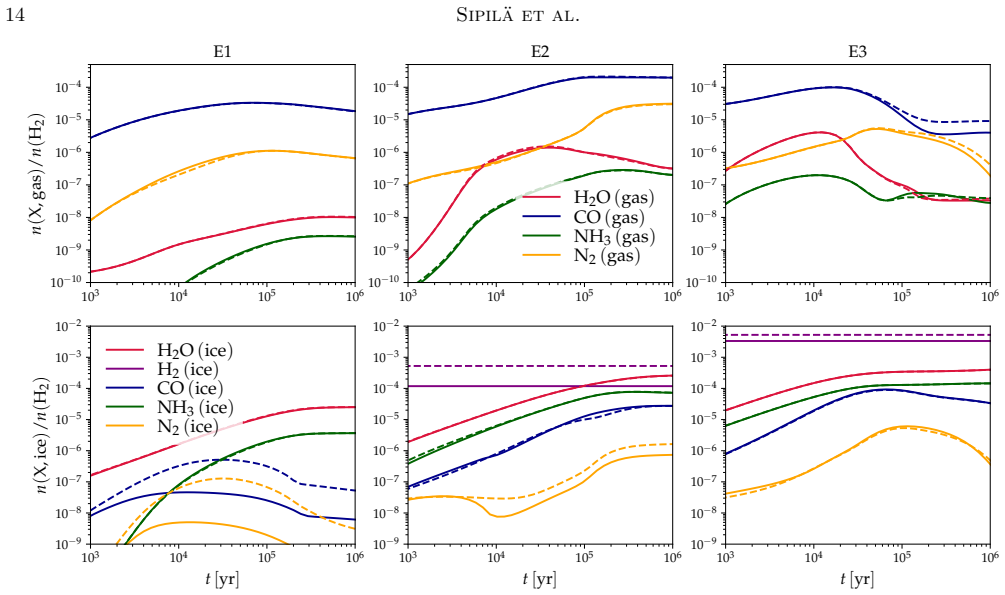
- Weak heating events still matter for other lightly bound ice species: at low column densities they reduce N2 and CO ice abundances, and at high densities they produce small gas-phase abundance shifts, so cloud chemistry models may need the full temperature spectrum.
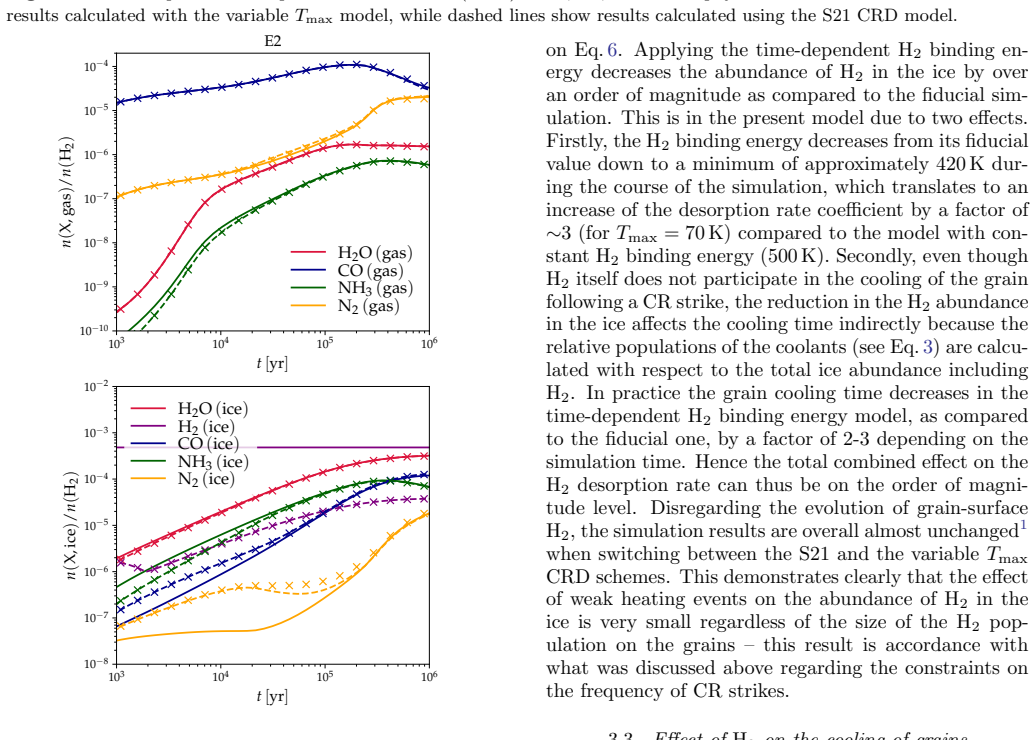
- If H2 is allowed to act as a grain coolant, the grain cooling time shortens dramatically and N2 (and hence N2H+) is heavily depleted, which conflicts with observations; the authors take this as evidence that the real H2 ice content must be low.
- Using a higher cosmic-ray flux raises H2 desorption somewhat, but the effect remains small and decreases with density, so a stronger CR flux alone does not overturn the central conclusion.
Reading between the lines
- A natural next step the authors leave open is to run Eq. (5) over a grain size distribution: sub-0.1 µm grains reach a given peak temperature with less deposited energy and are more numerous, so size-averaged H2 desorption could beat adsorption even though monodisperse 0.1 µm grains fail; this is the most direct way to test whether the null result generalizes.
- Because the crossover near 14 K is set by the assumed H2 binding energy of about 500 K on water ice, a laboratory measurement of that binding energy on realistic amorphous ice would directly constrain whether weak events can ever be effective.
- Applied to neighboring problems, the same machinery suggests that isotopic or spin-state variants of H2, whose binding energies differ slightly, could be desorbed at different rates by weak heating events; gas-phase ortho/para or HD abundance patterns might then carry a signature of the desorption mechanism.
Editorial analysis
A structured set of objections, weighed in public.
Referee Report
Summary. This paper presents an updated cosmic-ray desorption (CRD) treatment for gas-grain chemical models in which the maximum grain temperature Tmax after a CR hit is drawn from a distribution of deposited energies, rather than fixed at 70 K as in the classic HH93 model. The authors apply the new treatment to three cloud environments (E1-E3) using heating frequencies from Kalvāns & Kalnin (2022) and the P18 low and high CR spectra. The central finding is that for the adopted monodisperse 0.1 μm grains, weak CR heating events (Tmax of a few tens of K) do not significantly enhance H2 desorption: for Tmax ≳ 14 K, the uncapped H2 desorption coefficient exceeds the CR strike frequency, so the rate is capped at the strike frequency, and the summed CRD rate remains below the adsorption rate. Weak events do affect other weakly bound species, mainly at low column densities. The paper also stresses the necessity of the physical cap in Eq. (5) and demonstrates that removing it yields unphysical results.
Significance. The paper makes a useful and falsifiable contribution: it generalizes the CRD formalism beyond the single-Tmax HH93 model, independently verifies the KK22 input data (Appendix A), and shows that the frequency cap, not the thermal desorption formula, controls H2 CRD for canonical 0.1 μm grains. The negative result is internally consistent and clearly demonstrated via Fig. 3 and Eq. (5). The authors are transparent about the main limitation — the monodisperse grain-size assumption — and explicitly defer size-distribution simulations to future work. Taken as a statement about 0.1 μm monodisperse grains, the result is solid; the abstract and conclusions would benefit from stating this qualifier more prominently so that readers do not overgeneralize the finding to interstellar grain populations.
minor comments (4)
- [Abstract and Section 5] The sentences "even the weak heating events do not occur often enough to lead to significant H2 desorption" (Abstract) and "Other ways of keeping the H2 ice population in check remain necessary" (Section 5) should carry the qualifier "for the adopted 0.1 μm monodisperse grains" in the same sentence. Section 4 and Appendix B state that smaller grains may overturn this conclusion, so placing the qualifier after the claim invites overgeneralization by readers.
- [Section 2.1, Eq. (5)] Please clarify that (τ^j_heat)^-1 in each term of Eq. (5) is the per-bin strike frequency for the discrete bin j, not the cumulative frequency of all events with Tmax above the bin value. The surrounding text in Section 3.1 is consistent with per-bin frequencies, but a one-sentence definition would remove ambiguity relative to the cumulative-looking curve in Fig. 3.
- [Reproducibility] The pyRate code and the processed KK22 tables underlying the simulations are not provided. Because the abundance curves in Figs. 2, 4, 6, 7, and 9 depend on a large chemical network, a data-availability statement or supplementary material for the input tables would improve reproducibility; the rate-cap argument itself is transparent enough to be checked independently.
- [Figure 8] The caption contains typographical errors: "T emperature" should be "Temperature" and "Kelvins" should be "Kelvin".
Circularity Check
No significant circularity: the central claim is a simulation outcome bounded by a physically motivated strike-frequency cap, not a restatement of the model inputs.
full rationale
The paper's derivation chain is self-contained in the relevant sense. The input Tmax distributions and deposited energies are taken from Kalvāns & Kalnin (2022) and independently checked in Appendix A; the CRD rate in Eq. (5) is a sum over Tmax bins of the min of the nonlimited desorption coefficient and the strike frequency tau_heat^-1; and the conclusion that weak heating events do not significantly desorb H2 follows from comparing the capped, summed rate with the independently computed adsorption rate in the chemical model. The cap itself is not equivalent to the conclusion: it merely imposes the physical upper bound that desorption cannot occur more often than strikes, and the paper shows (Fig. 4) that removing it yields unphysical results. The self-citations to Sipilä et al. (2021) and Padovani et al. (2018) supply model components and CR spectra, but the target result is not asserted by those citations; the strike-frequency cap is justified by explicit physical reasoning in the text. The paper also explicitly flags its scope limitation: Section 4 states 'It is conceivable that in the case of a grain size distribution, weak heating events could provide a boost to H2 desorption coming off small grains,' and Appendix B restricts the conclusion to 'monodisperse and relatively large' grains. That is an admitted conditional scope, not a circular definition. No equation is fitted to the quantity it later predicts, and no load-bearing claim reduces by construction to its inputs.
Assumptions & free parameters
free parameters (2)
- Cosmic-ray ionization rate zeta =
1.3e-17 s^-1 (P18 Low); 1.0e-16 s^-1 (P18 High)
- Ice mantle thickness per environment =
0 μm (E1); 0.01 μm (E2); 0.025 μm (E3)
assumptions (6)
- domain assumption Monodisperse spherical grains with radius 0.1 μm
- domain assumption CRD rate coefficient capped by the CR strike frequency (Eq. 4 and Eq. 5)
- domain assumption KK22 heating frequencies and deposited energies as functions of Tmax for the P18 Low and High CR spectra
- domain assumption Binding energies: H2 on water ice 500 K; CO 1150 K; N2 1000 K
- standard math Rate-equation chemistry through pyRate with the KIDA 2014 network
- domain assumption CRD proportionality k_CRD = f(a, Tmax) k_therm(i, Tmax)
Cite this review
Pith. "Pith review of The Effect of Weak Cosmic Ray Heating Events on the Desorption of $\rm H_2$." pith.science (2026). https://pith.science/paper/ROFKW6H7
@misc{pith2026250701612,
  author       = {Pith},
  title        = {Pith review of: The Effect of Weak Cosmic Ray Heating Events on the Desorption of $\rm H_2$},
  year         = {2026},
  howpublished = {\url{https://pith.science/paper/ROFKW6H7}},
  note         = {Machine review of arXiv:2507.01612}
}
abstract
The typical amount of molecular hydrogen (${\rm H_2}$) in interstellar ices is not known, but significant freeze-out of ${\rm H_2}$ on dust grains is not expected. However, chemical models ubiquitously predict large amounts of $\rm H_2$ freeze-out in dense cloud conditions, and specialized treatments are needed to control the $\rm H_2$ population on grains. Here we present a numerical desorption model where the effect of weak heating events induced by cosmic rays (CRs) that heat grains to temperatures of a few tens of Kelvin at high frequencies is included, improving upon earlier desorption models that only consider strong heating events (maximum grain temperature close to 100 K) that occur at a low frequency. A temperature of a few tens of Kelvin is high enough to induce efficient desorption of $\rm H_2$, but we find that even the weak heating events do not occur often enough to lead to significant $\rm H_2$ desorption. Taking the weak heating events into account does affect the predicted abundances of other lightly-bound species, but the effect is restricted to low column densities. We make here the canonical assumption that the grains are spherical with a radius of 0.1 $\mu$m. It is conceivable that in the case of a grain size distribution, weak heating events could provide a boost to $\rm H_2$ desorption coming off small grains, which are the most numerous. Further studies are still required to better quantify the role of CRs in the desorption of $\rm H_2$ and other weakly bound species.
Figures


Figures from the paper (6 more)




Reference graph
Works this paper leans on
-
[1]
Black , J. H. 1994, in The First Symposium on the Infrared CASP Conf. Ser., 58, 355
work page 1994
-
[2]
J., Fedoseev , G., Qasim , D., et al
Chuang , K. J., Fedoseev , G., Qasim , D., et al. 2018, , 617, A87, 10.1051/0004-6361/201833439
-
[3]
Cuppen , H. M., van Dishoeck , E. F., Herbst , E., & Tielens , A. G. G. M. 2009, , 508, 275, 10.1051/0004-6361/200913119
-
[4]
Draine , B. T., & Bertoldi , F. 1996, , 468, 269, 10.1086/177689
doi:10.1086/177689 1996
-
[5]
Garrod , R. T., & Herbst , E. 2006, , 457, 927, 10.1051/0004-6361:20065560
-
[6]
Garrod , R. T., & Pauly , T. 2011, , 735, 15, 10.1088/0004-637X/735/1/15
- [7]
- [8]
Show all 33 references
-
[9]
2015, , 574, A24, 10.1051/0004-6361/201424807
Hincelin , U., Chang , Q., & Herbst , E. 2015, , 574, A24, 10.1051/0004-6361/201424807
2015 doi
-
[10]
V., et al
Hornek r, L., Baurichter, A., Petrunin, V. V., et al. 2005, The Journal of Chemical Physics, 122, 124701, 10.1063/1.1874934
2005 doi
-
[11]
2018, , 615, A20, 10.1051/0004-6361/201732486
Iqbal , W., & Wakelam , V. 2018, , 615, A20, 10.1051/0004-6361/201732486
2018 doi
-
[12]
Kalv \= a ns , J., & Kalnin , J. R. 2019, , 486, 2050, 10.1093/mnras/stz1010
2019 doi
-
[13]
2020, , 641, A49, 10.1051/0004-6361/202037906
---. 2020, , 641, A49, 10.1051/0004-6361/202037906
2020 doi
- [14]
-
[15]
1999, , 522, 305, 10.1086/307642
Katz , N., Furman , I., Biham , O., Pirronello , V., & Vidali , G. 1999, , 522, 305, 10.1086/307642
1999 doi
-
[16]
I., & Rajappan , M
Mart \' n-Dom \'e nech , R., DelFranco , A., \"O berg , K. I., & Rajappan , M. 2024, , 962, 107, 10.3847/1538-4357/ad187e
2024 doi
-
[17]
I., & Rajappan , M
Mart \' n-Dom \'e nech , R., Maksiutenko , P., \"O berg , K. I., & Rajappan , M. 2020, , 902, 116, 10.3847/1538-4357/abb59f
2020 doi
-
[18]
2021, , 648, A84, 10.1051/0004-6361/202040023
Molpeceres , G., Zaverkin , V., Watanabe , N., & K \"a stner , J. 2021, , 648, A84, 10.1051/0004-6361/202040023
2021 doi
-
[19]
A., Welty , D
Neufeld , D. A., Welty , D. E., Ivlev , A. V., et al. 2024, , 973, 143, 10.3847/1538-4357/ad7264
2024 doi
-
[20]
V., Silsbee , K., et al
Obolentseva , M., Ivlev , A. V., Silsbee , K., et al. 2024, , 973, 142, 10.3847/1538-4357/ad71ce
2024 doi
-
[21]
V., Galli , D., & Caselli , P
Padovani , M., Ivlev , A. V., Galli , D., & Caselli , P. 2018, , 614, A111, 10.1051/0004-6361/201732202
2018 doi
-
[22]
E., et al
Punanova , A., Caselli , P., Pineda , J. E., et al. 2018, , 617, A27, 10.1051/0004-6361/201731159
2018 doi
-
[23]
A., Allamandola , L
Sandford , S. A., Allamandola , L. J., & Geballe , T. R. 1993, Science, 262, 400, 10.1126/science.11542874
1993 doi
-
[24]
Silsbee , K., Caselli , P., & Ivlev , A. V. 2021, , 507, 6205, 10.1093/mnras/stab2546
2021 doi
-
[25]
2015, , 578, A55, 10.1051/0004-6361/201424364
Sipil \"a , O., Caselli , P., & Harju , J. 2015, , 578, A55, 10.1051/0004-6361/201424364
2015 doi
-
[26]
2019, , 487, 1269, 10.1093/mnras/stz1344
Sipil \"a , O., Caselli , P., Redaelli , E., Juvela , M., & Bizzocchi , L. 2019, , 487, 1269, 10.1093/mnras/stz1344
2019 doi
-
[27]
2021, , 922, 126, 10.3847/1538-4357/ac23ce
Sipil \"a , O., Silsbee, K., & Caselli, P. 2021, , 922, 126, 10.3847/1538-4357/ac23ce
2021 doi
-
[28]
2020, , 640, A94, 10.1051/0004-6361/202038353
Sipil \"a , O., Zhao , B., & Caselli , P. 2020, , 640, A94, 10.1051/0004-6361/202038353
2020 doi
-
[29]
B., & Sipil \"a , O
Taquet , V., Charnley , S. B., & Sipil \"a , O. 2014, , 791, 1, 10.1088/0004-637X/791/1/1
2014 doi
-
[30]
Vidali , G., Ihm , G., Kim , H.-Y., & Cole , M. W. 1991, Surface Science Reports, 12, 135, 10.1016/0167-5729(91)90012-M
1991 doi
-
[31]
2015, , 217, 20, 10.1088/0067-0049/217/2/20
Wakelam , V., Loison , J.-C., Herbst , E., et al. 2015, , 217, 20, 10.1088/0067-0049/217/2/20
2015 doi
-
[32]
2018, , 478, 2723, 10.1093/mnras/sty1165
Zhao , B., Caselli , P., & Li , Z.-Y. 2018, , 478, 2723, 10.1093/mnras/sty1165
2018 doi
-
[33]
[ q=Ů j hi䈍
thebibliography [1] 20pt to REFERENCES 6pt =0pt 10pt plus 3pt =0pt =0pt =1pt plus 1pt =0pt =0pt -12pt =13pt plus 1pt =20pt =13pt plus 1pt \@M =10000 =-1.0em =0pt =0pt 0pt =0pt =1.0em @enumiv\@empty 10000 10000 `\.\@m \@noitemerr \@latex@warning Empty `thebibliography' environm...
2019
Reviewed August 6, 2026 · model on record in the stance chip above.
Discussion (0). Sign in to comment.