REVIEW 4 major objections 5 minor 15 references
Measurement-based Evaluation of CNN-based Detection and Estimation for ISAC Systems
T0 review · 4 major / 5 minor · reviewed 2026-08-06 · deepseek-v4-flash
Pith's one-line read A convolutional neural network trained only on synthetic channel data can detect and estimate a real UAV's delay and Doppler in outdoor ISAC measurements, with detection probabilities of 0.48 to 0.55 and delay RMSE of about 16 to 18 ns.
desk verdict A real sim-to-real transfer evaluation with RTK ground truth that is worth citing for its data, but whose quantitative claims are weakened by conditional RMSE, missing false-alarm analysis, and inconsistent training specs. read the letter →
The pith
A machine-rendered reading of the paper's core claim, the machinery that carries it, and where it could break.
The reading
What carries the argument
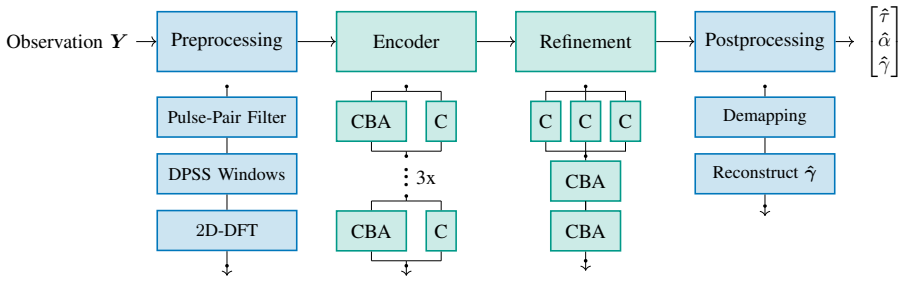
The carrying mechanism is the CNN architecture plus its deterministic preprocessing chain, originally introduced in [5]. Preprocessing converts raw channel observations into six-channel delay-Doppler images using a pulse-pair filter, orthogonal DPSS (Discrete Prolate Spheroidal Sequences) multitaper windows, a two-dimensional DFT, and a log-magnitude/phase mapping; the CNN then maps these images to estimates of delay and Doppler for an unknown number of paths. The synthetic training set is generated by randomly sampling the number of paths, their delays, Dopplers, magnitudes, phases, and the noise level, so that the network learns a mapping from noisy delay-Doppler patterns to target parameters rather than memorizing a fixed scenario. That combination is what allows the model to be evaluated on real measurements of a different environment from a single-target UAV flight.
What would settle it
Compute the per-snapshot SNR of the UAV return in the recorded data; if the CNN detects the UAV only in snapshots whose SNR falls in the upper part of the synthetic training range, rather than across the full range, the claim of broad-SNR transfer would be undermined.
Extended reading notes
Core claim
The central claim is that a convolutional neural network trained on synthetic data from a physics-inspired channel model can detect and estimate real radar targets in an OFDM-based ISAC measurement. The paper demonstrates this by training the CNN on randomly generated snapshots with an unknown number of paths, broad SNR range, and uniform delay/Doppler parameters, and then applying it without retraining to three receiver links from a suburban outdoor UAV measurement. Using ground truth delay and Doppler computed from RTK positions, the authors compute a detection probability of 0.48–0.55 and RMSE of 16.2–18.2 ns in delay and 7.9–10.4 Hz in Doppler. The point estimates cluster on the delay-Doppler peaks of both the UAV and automotive targets of opportunity, which the paper takes as evidence that the synthetic-trained model transferred successfully to measurement data.
Load-bearing premise
The approach works only if the synthetic channel data used for training is sufficiently similar to the real measured channel, a similarity the paper states as a requirement but does not measure directly.
Editorial extensions
If this is right
- A CNN trained on synthetic data alone can be dropped into a real ISAC receiver and produce usable target detections without site-specific retraining.
- The reported RMSE of roughly 16–18 ns in delay is close to the 12.5 ns delay resolution of the 80 MHz measurement signal, indicating the CNN partially achieves super-resolution.
- The method handles an unknown number of propagation paths, since the synthetic data generator samples the model order randomly, which is required for realistic clutter-rich environments.
- The drop in detection probability when the UAV leaves the antenna main beam shows that the CNN's performance is bounded by the same front-end directivity limits as conventional radar processing.
- Extending the same network to classify targets via micro-Doppler or spectral features is a stated next step, since the delay-Doppler estimates already isolate target returns.
Reading between the lines
- The paper's two descriptions of the synthetic training distribution (Table I versus Section II.C) differ in the number of paths and the SNR range; retraining under each setting would reveal how sensitive the transfer is to those specific choices.
- Because the measurement SNR of the UAV returns is not reported, the results leave open which part of the synthetic SNR range actually does the work; measuring the UAV peak power relative to noise would let future work condition the detection probability on SNR.
- The qualitative detection of automotive targets of opportunity suggests the method is not limited to the single UAV and could be scored against a multi-target ground truth if one were available.
- A direct distribution-distance check between synthetic and measured preprocessed snapshots would convert the stated similarity requirement from an assumption into a measurable quantity.
Editorial analysis
A structured set of objections, weighed in public.
Referee Report
Summary. The paper evaluates a CNN trained on synthetic OFDM channel data for joint delay-Doppler detection and estimation, using real outdoor measurement data from the isac-uav dataset. The CNN is trained entirely on synthetic snapshots and tested on measured channels, with RTK-derived UAV positions providing independent ground truth for delay and Doppler. After filtering estimates through a groundtruth gate, the authors report detection probabilities around 0.48 to 0.55 and RMSE values of roughly 16 to 18 ns in delay and 8 to 10 Hz in Doppler, and conclude that the synthetically trained approach transfers to measurement data and is suitable for joint detection and estimation in ISAC systems.
Significance. The manuscript addresses an important practical bottleneck: machine-learning sensing methods are often only evaluated on synthetic data, so external validation on real measurements is genuinely valuable. The use of a public measurement campaign with independent RTK ground truth is a clear strength, and the qualitative alignment of estimates with measured delay-Doppler peaks in Figs. 3 to 5 is encouraging. However, the quantitative claims rest on a conditional evaluation protocol, an unquantified synthetic-to-measurement similarity assumption, and no comparison with classical baselines. If the requested revisions are made, this would be a useful benchmark for sim-to-real transfer in ISAC sensing; in its current form, the central claim is plausible but not fully established.
major comments (4)
- [Section II.C / Table I] The synthetic training distribution is specified inconsistently: Table I states SNR in [0, 50] dB and P ~ U[1, 10], while Section II.C states SNR in [-30, 50] dB and P ~ U[1, 30]. Because the central transfer claim rests on the synthetic data being representative of the measurement operating point, this discrepancy is load-bearing. Please correct the specification and report the actual SNR range, path-count range, and the measured SNR/operating point of the evaluation data.
- [Section IV.B / Eqs. (7)-(8) / Table II] The quantitative evaluation is conditional on the groundtruth filter: PD is the fraction of snapshots with at least one estimate inside the gate, and RMSE is computed only over estimates inside the gate. This makes PD not a false-alarm-aware detection probability and makes the RMSE optimistic. Please report the raw numbers, including the total number of detections outside the gate, the number of snapshots Nmeas and N∅ per Rx, and ideally a detection/false-alarm tradeoff (e.g., ROC) or at least the false-alarm rate.
- [Section V] No baseline comparison is provided; the conclusion explicitly defers comparison with CFAR and iterative maximum likelihood to future work. Without a baseline, the claim that the CNN is 'suitable' for joint detection and estimation in ISAC cannot be assessed. Please add a classical detection/estimation baseline (e.g., CFAR thresholding plus peak picking) and report the same PD/RMSE metrics for it.
- [Section II.C / Section IV] The 'sufficiently similar' premise for sim-to-real transfer is asserted but never quantified. No measured SNR is reported, no comparison of the measured delay-Doppler distribution to the synthetic prior is given, and no check of the number of significant paths versus the trained range is provided. Given that the measurement scenario contains strong line-of-sight/static clutter and targets of opportunity, the network may be evaluated out-of-distribution. Please quantify the operating point (SNR, path count, clutter structure) or provide a domain-shift/ablation analysis (e.g., retraining at the measured SNR) to support the transfer claim.
minor comments (5)
- [Fig. 3 caption] The word 'Cummulative' should be 'Cumulative'.
- [Section II.A] The notation 'θp = {γp ηp}' should be 'θp = {γp, ηp}', and 'η[i] = [ τ [i]α[i]]T' is missing a comma between the two components.
- [Fig. 3 caption] The phrase 'quantitative proof' overstates what the figure shows; the figure is qualitative evidence, so please rephrase.
- [Table I] The entry 'Trainingset Size 200 × 103' is ambiguous; please write it as 200 × 10^3 or 200k.
- [Section III / Table I] The measurement uses Nf = 1280 subcarriers, but Table I lists Nf = 1024 for the network input; please clarify how the 1280-subcarrier measurements are cropped, resampled, or otherwise reduced to the network input size.
Circularity Check
No significant circularity: the CNN is trained on synthetic data and is evaluated against independent RTK groundtruth on real outdoor measurements, so the central claim is externally tested.
full rationale
The paper's central claim is that a CNN trained only on synthetic channel data can detect and estimate delay and Doppler on real outdoor measurements. The evaluation chain is external: network parameters are learned from synthetic data generated from the signal model in Eq. (2), and the reported detection probability and RMSE are computed from the CNN's outputs on measured data using an independent RTK-based groundtruth (Eqs. (4)-(5), (7)-(8), Table II). No measured result is used to set the network weights, the thresholds eps_tau and eps_alpha are derived from the sampling grid rather than fitted to the data, and the groundtruth filter is a standard gating operation. The reliance on the authors' prior architecture [5] is a self-citation, but it is not load-bearing in a circular sense: the measurement-based evaluation is new, and the architecture's output is precisely what is being tested against external groundtruth. The paper's own Section II.C notes that the synthetic data 'must be sufficiently similar' to the measurement data, but this is an unquantified domain-transfer assumption; a failure of this assumption would make the method fail empirically, not make the result true by construction. Likewise, the internal inconsistency between the SNR/path-count ranges in Table I and Section II.C is a reproducibility or correctness concern, not a circularity. The derivation chain is therefore self-contained against external benchmarks, and no step reduces by definition or by self-citation to its own inputs.
Assumptions & free parameters
free parameters (4)
- Groundtruth filter thresholds epsilon_tau and epsilon_alpha =
epsilon_tau = 37.5 ns, epsilon_alpha = 93.75 Hz
- Synthetic data distribution ranges =
tau_max = 0.02, alpha_max = 0.05, magnitudes U[0.001,1], path count U[1,10] or U[1,30] (inconsistent)
- Training SNR range =
0 to 50 dB (Table I) or -30 to 50 dB (Section II.C)
- DPSS window parameters =
NW = 2, Nw = 3
assumptions (6)
- domain assumption Narrowband assumption B << fc for the signal model in Eq. (2)
- domain assumption Specular multipath channel with an unknown, discrete number of paths
- domain assumption Complex, zero-mean, uncorrelated Gaussian noise in Eq. (3)
- domain assumption RTK ground truth positions and the analytic delay/Doppler formulas (4) and (5) are accurate
- domain assumption The CNN architecture and postprocessing from [5] are suitable for this measurement task
- domain assumption The synthetic data distribution is sufficiently similar to the real measurement distribution
Cite this review
Pith. "Pith review of Measurement-based Evaluation of CNN-based Detection and Estimation for ISAC Systems." pith.science (2026). https://pith.science/paper/EST74FLS
@misc{pith2026250701799,
  author       = {Pith},
  title        = {Pith review of: Measurement-based Evaluation of CNN-based Detection and Estimation for ISAC Systems},
  year         = {2026},
  howpublished = {\url{https://pith.science/paper/EST74FLS}},
  note         = {Machine review of arXiv:2507.01799}
}
read the original abstract
In wireless sensing applications, such as ISAC, one of the first crucial signal processing steps is the detection and estimation targets from a channel estimate. Effective algorithms in this context must be robust across a broad SNR range, capable of handling an unknown number of targets, and computationally efficient for real-time implementation. During the last decade, different Machine Learning methods have emerged as promising solutions, either as standalone models or as complementing existing techniques. However, since models are often trained and evaluated on synthetic data from existing models, applying them to measurement is challenging. All the while, training directly on measurement data is prohibitive in complex propagation scenarios as a groundtruth is not available. Therefore, in this paper, we train a CNN approach for target detection and estimation on synthetic data and evaluate it on measurement data from a suburban outdoor measurement. Using knowledge of the environment as well as available groundtruth positions, we study the detection probability and accuracy of our approach. The results demonstrate that our approach works on measurement data and is suitable for joint detection and estimation of sensing targets in ISAC systems.
Figures


Figures from the paper (2 more)


Reference graph
Works this paper leans on
-
[1]
Robust DoA Estimation Using Denoising Autoencoder and Deep Neural Networks,
D. Chen, S. Shi, X. Gu, et al., “Robust DoA Estimation Using Denoising Autoencoder and Deep Neural Networks,” IEEE Access, 2022, Conference Name: IEEE Access. DOI: 10.1109/ ACCESS.2022.3164897
-
[2]
Z.-M. Liu, C. Zhang, and P. S. Yu, “Direction-of-Arrival Estimation Based on Deep Neural Networks With Robustness to Array Imperfections,” IEEE Transactions on Antennas and Propagation, no. 12, 2018. DOI: 10.1109/TAP.2018.2874430
-
[3]
Deep Networks for Direction-of-Arrival Estimation in Low SNR,
G. Papageorgiou, M. Sellathurai, and Y . Eldar, “Deep Networks for Direction-of-Arrival Estimation in Low SNR,” IEEE Trans- actions on Signal Processing , 2021. DOI: 10.1109/TSP.2021. 3089927
-
[4]
SubspaceNet: Deep Learning-Aided Subspace Methods for DoA Estimation,
D. H. Shmuel, J. P. Merkofer, G. Revach, et al., “SubspaceNet: Deep Learning-Aided Subspace Methods for DoA Estimation,” IEEE Transactions on Vehicular Technology , 2024. DOI: 10. 1109/TVT.2024.3496119
arXiv 2024
-
[5]
Grid-free Harmonic Retrieval and Model Order Selection using Deep Convolutional Neural Networks,
S. Schieler, S. Semper, R. Faramarzahangari, et al., “Grid-free Harmonic Retrieval and Model Order Selection using Deep Convolutional Neural Networks,” en, in 2024 18th European Conference on Antennas and Propagation (EuCAP) , 2024
work page 2024
-
[6]
Cooperative Passive Coherent Location: A Promising 5G Service to Support Road Safety,
R. S. Thom ¨a, C. Andrich, G. D. Galdo, et al., “Cooperative Passive Coherent Location: A Promising 5G Service to Support Road Safety,” IEEE Communications Magazine , no. 9, 2019, Conference Name: IEEE Communications Magazine. DOI: 10. 1109/MCOM.001.1800242
work page 2019
-
[7]
Feasibility of Non-Line-of-Sight Integrated Sensing and Communication at mmWave,
P. Tosi, M. Henninger, L. G. de Oliveira, et al., “Feasibility of Non-Line-of-Sight Integrated Sensing and Communication at mmWave,” in2024 IEEE 25th International Workshop on Signal Processing Advances in Wireless Communications (SPAWC) ,
-
[8]
Joint Optimization of Geometric and Probabilistic Constellation Shaping for OFDM-ISAC Systems,
B. Geiger, F. Liu, S. Lu, et al., “Joint Optimization of Geometric and Probabilistic Constellation Shaping for OFDM-ISAC Systems,” in 2025 IEEE 5th International Symposium on Joint Communications & Sensing (JC&S) , 2025. DOI: 10 . 1109 / JCS64661.2025.10880638
arXiv 2025
Show all 15 references
-
[9]
Joint Radar and Communications: Architectures, Use Cases, Aspects of Radio Access, Signal Processing, and Hardware,
V . Shatov, B. Nuss, S. Schieler, et al. , “Joint Radar and Communications: Architectures, Use Cases, Aspects of Radio Access, Signal Processing, and Hardware,” IEEE Access, 2024. DOI: 10.1109/ACCESS.2024.3383771
2024
- [10]
-
[11]
Spectrum estimation and harmonic analysis,
D. Thomson, “Spectrum estimation and harmonic analysis,” Proceedings of the IEEE , no. 9, 1982. DOI: 10.1109/PROC. 1982.12433
1982
-
[12]
Measurement Testbed for Radar and Emitter Localization of UA V at 3.75 GHz,
J. Beuster, C. Andrich, M. D ¨obereiner, et al., “Measurement Testbed for Radar and Emitter Localization of UA V at 3.75 GHz,” in 2023 17th European Conference on Antennas and Propagation (EuCAP) , IEEE, 2023. DOI: 10 . 23919 / EuCAP57121.2023.10133118
2023
-
[13]
A dataset for the study of ISAC-based UA V sensing in U-Space,
S. Schieler, C. Smeenk, R. Faramarzahangari, et al., “A dataset for the study of ISAC-based UA V sensing in U-Space,” English, 01/2024, 2024
2024
-
[14]
Scalable Undersized Dataset RF Classification: Using convolutional multistage training,
K. Youssef, G. Schuette, Y . Cai, et al., “Scalable Undersized Dataset RF Classification: Using convolutional multistage training,” IEEE Antennas and Propagation Magazine , no. 2, 2023, Conference Name: IEEE Antennas and Propagation Magazine. DOI: 10.1109/MAP.2022.3208813
2023
-
[2024]
DOI: 10.1109/SPAWC60668.2024.10694426
2024
Reviewed August 6, 2026 · model on record in the stance chip above.
Discussion (0). Sign in to comment.