REVIEW 4 major objections 6 minor 27 references
Low-Complexity Neural Wind Noise Reduction for Audio Recordings
T0 review · 4 major / 6 minor · reviewed 2026-08-06 · deepseek-v4-flash
Pith's one-line read WindNetLite, with 249K parameters and 73 MHz, matches ULCNet-quality wind noise reduction at a fraction of the compute by splitting the spectrum into a high-capacity low-frequency encoder and a light high-frequency encoder.
desk verdict Solid low-complexity WNR engineering with a dual-encoder split; plausible results but evaluation has a few fixable soft spots. read the letter →
The pith
A machine-rendered reading of the paper's core claim, the machinery that carries it, and where it could break.
The reading
What carries the argument
The load-bearing mechanism is the frequency-split dual encoder. Channel-wise feature reorientation divides the power-law-compressed STFT magnitude into $N=10$ sub-bands; the first five, which are assumed to contain essentially all wind energy below about 4 kHz, feed a high-capacity convolutional encoder with a GRU, while the remaining sub-bands are average-pooled and fed to a much smaller encoder. This asymmetry is what buys the complexity reduction. Both streams are concatenated into an intermediate magnitude mask, which a lightweight two-layer CNN refines into a complex mask applied either to the desired signal (wind rejection) or to the wind component (wind extraction), with the power-law factor $\alpha$ tuned separately for the two modes.
What would settle it
Compute the spectral energy distribution of the recorded wind corpus: if the fraction of wind energy above 4 kHz is non-negligible (for example, more than a few percent), or if a held-out set of high-frequency-dominant wind recordings such as fan blast, propeller wash, or wind gust against a microphone grill pushes WindNetLite's leakage or SI-SDR clearly below WindNet's, the central assumption is falsified.
Extended reading notes
Core claim
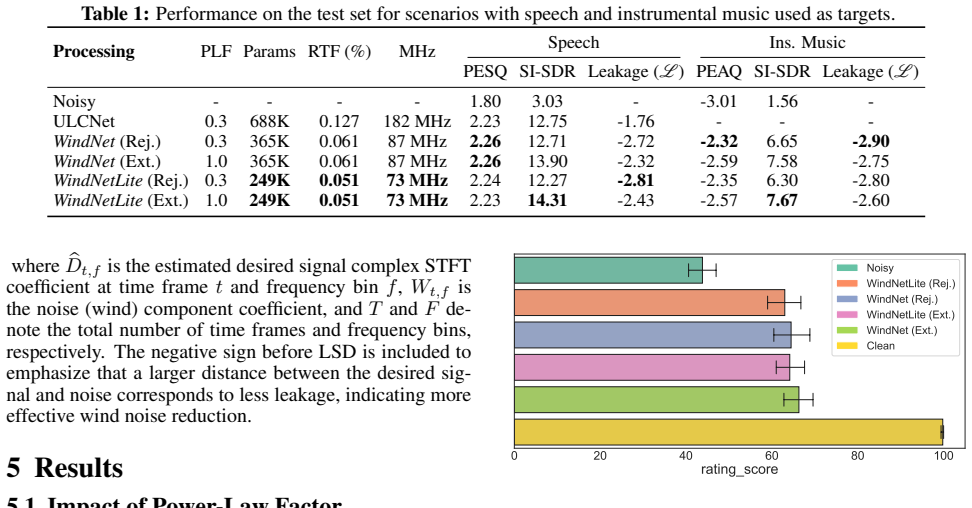
WindNetLite is a causal, single-channel, frequency-split refinement of the ULCNet architecture. It maps the power-law-compressed STFT magnitude into ten sub-bands, sends the first five through a four-layer convolutional encoder followed by a temporal GRU, and sends the remaining sub-bands through a pooled three-layer encoder, then combines the two feature streams to produce an intermediate real mask that a lightweight CNN sharpens into a complex mask. With 249K parameters and roughly 73 MHz, it attains a real-time factor of 0.051 on an embedded-class single core, which is 40% of ULCNet's 0.127 and 84% of the 365K-parameter WindNet baseline's 0.061. On the speech test set it reaches PESQ 2.23 and SI-SDR 14.31 dB in extraction mode and leakage -2.81 in rejection mode; on instrumental music it reaches PEAQ -2.35 in rejection mode and SI-SDR 7.67 dB in extraction mode, close to WindNet on every metric. The paper also reports that rejection suppresses wind more strongly while extraction distorts the desired signal less, and that the optimal power-law compression factor is mode-dependent: 0.3 for rejection and 1.0 for extraction.
Load-bearing premise
The architecture assumes wind noise is concentrated below roughly 4 kHz with negligible energy above it; if real wind or microphone setups produce substantial high-frequency wind energy, the small high-frequency encoder would miss it and the performance claim would weaken.
Editorial extensions
If this is right
- WindNetLite runs at a real-time factor of 0.051 on an embedded-class single core, so causal wind-noise reduction fits within the compute budget of phones, wearables, action cameras, and hearables.
- The extraction mode consistently yields higher SI-SDR, meaning less distortion to the desired audio, while the rejection mode yields lower leakage, meaning stronger wind suppression, giving system designers a direct knob to trade one objective against the other.
- The same dual-encoder idea should transfer to other noise types with a known spectral footprint: put capacity in the sub-bands where the noise lives and keep the rest cheap.
- The mode-dependent power-law factor means a single universal $\alpha$ is not optimal for wind-noise reduction; tuning $\alpha$ per reconstruction strategy is part of the performance gain.
- Because the model is causal and single-channel, it can be inserted into existing audio capture chains without requiring multiple microphones or look-ahead buffering.
Reading between the lines
- A direct spectral measurement of the 10-hour wind corpus is the natural check on the 4 kHz assumption; if high-frequency wind energy is non-negligible, the frequency split should be moved or made adaptive, an extension the paper leaves untested.
- An ablation that gives the HF encoder the same capacity as the LF encoder would quantify how much of the quality parity comes from the frequency split itself rather than from overall model design.
- The extraction/subtraction result suggests that for very low SNR wind, a two-stage pipeline that estimates wind first and then applies a post-filter, rather than direct masking, may generalize to other non-stationary noises.
Editorial analysis
A structured set of objections, weighed in public.
Referee Report
Summary. The paper proposes WindNetLite, a low-complexity single-channel neural network for wind noise reduction, built by modifying the ULCNet architecture with separate low-frequency and high-frequency encoder branches. The design is motivated by the assumption that wind noise energy is concentrated below 4 kHz. The authors train and evaluate the model in two modes, termed wind rejection (direct estimation of the desired signal) and wind extraction (estimation and subtraction of the wind component), using a self-recorded 10-hour wind noise database mixed with AudioSet content and tested on VCTK speech and MUSDB18 music. They report objective metrics (PESQ, SI-SDR, PEAQ, and a leakage metric) and a MUSHRA listening test, and claim that WindNetLite, with 249K parameters and roughly 73 MHz of computational cost, achieves performance comparable to ULCNet and to the WindNet baseline while requiring only 40% of ULCNet's real-time factor and 84% of WindNet's real-time factor.
Significance. If the performance claims hold, the paper would make a useful contribution to real-time wind noise reduction on embedded and mobile devices. The dual-encoder frequency-aware design is a sensible way to reduce complexity, and the authors provide a concrete parameter count, real-time factor, and computational-cost estimate, as well as a newly recorded wind noise database and a public listening demo. These are valuable assets for reproducible comparison in a field where such details are often missing. However, the central claim of parity with ULCNet and WindNet is not yet fully established, because the evaluation contains methodological gaps: hyperparameter selection is not separated from test data, the ULCNet comparison is not trained on the same task, and no statistical significance or variance information is provided for the reported metrics.
major comments (4)
- [Section 5.1 and Figure 3] The power-law compression factor alpha is selected per mode as the value that minimizes the leakage metric in Figure 3, and the same value is then used in all experiments reported in Table 1. The manuscript does not describe a held-out validation split for this selection; if the optimization was performed on the test set, the reported results are optimistically biased. Please describe the validation procedure, or re-run the comparison with a fixed alpha or with a nested validation protocol, and state which results are affected.
- [Section 4.2 and Table 1] The comparison to ULCNet is not apples-to-apples: the ULCNet row in Table 1 comes from a model trained for general speech enhancement, not for wind noise reduction, as the authors themselves note in Section 5.2. Since the abstract and conclusions claim parity with ULCNet, this comparison should be based on a ULCNet model retrained on the same wind-noise training data, or the claim should be restricted to the WindNet baseline. As written, the ULCNet comparison does not support the central claim.
- [Section 4.4 and Table 1] All objective metrics are reported as single point estimates without error bars, confidence intervals, or significance tests. Several differences that the text interprets as comparable or superior are small (e.g., PESQ 2.26 vs. 2.23, SI-SDR 12.71 vs. 12.27 in rejection mode). The MUSHRA test in Section 5.3 uses only 10 listeners and reports no statistical analysis. To support the claim of comparable performance, please report the variance across test items or training runs and apply appropriate significance testing.
- [Section 3.1 and Section 4.2] The dual-encoder design and the resulting complexity savings rest on the assumption that wind noise has negligible energy above 4 kHz. Although the paper recorded a 10-hour wind database, it does not report the spectral statistics of that database to validate this cutoff. If real wind or microphone scenarios contain non-negligible high-frequency energy, the lightweight high-frequency encoder may be unable to suppress it, and the performance parity shown in Table 1 would not generalize. Please provide spectral evidence from the recorded wind data (e.g., average power spectra, energy ratio below and above 4 kHz) and, ideally, an evaluation on wind segments with stronger high-frequency content.
minor comments (6)
- [Section 3.1, around Eq. (7)] The split into rXc-low and rXc-high is described in words but never defined with dimensions; please specify the exact shapes and sub-band indices of the two tensors.
- [Section 4.2] The SNR set in the text is typeset with stray characters: "t´20,dB,´10,dB,0,dB,10,dB,20,dBu" should read {-20, -10, 0, 10, 20} dB.
- [Table 1] The ULCNet row has no PEAQ or leakage entries for the instrumental music test set; please either report those values or state explicitly why they are omitted.
- [Figure 2 caption] The caption "limited to the 2´ 3 kHz frequency range" is ambiguous: it is not clear whether the wind spectrogram is shown only for the 2-3 kHz band or whether the authors claim wind energy is confined to that band, which would conflict with the text in Section 3.1. Please rephrase.
- [Section 5.3] The test is called a MUSHRA test, but the description does not mention the use of the ITU-R BS.1534 anchors (low anchor, hidden reference). If anchors were not used, the method should be described as a graded listening test rather than MUSHRA.
- [Table 1 and Section 4.1] The unit "MHz" is used for computational cost; if this refers to mega operations per second or clock cycles, please state the definition explicitly to avoid confusion with clock frequency.
Circularity Check
No significant circularity: WindNetLite's performance claims rest on independent empirical benchmarks, not on definitions or self-citation chains.
full rationale
The paper's central claim—that WindNetLite matches ULCNet and WindNet at lower complexity—is an empirical comparison against published or independently measured models, not a derivation from its own assumptions. The architecture is based on the authors' earlier ULCNet [13], and the WindNet baseline is a modified ULCNet, but the comparison itself is external: ULCNet results are reported as a separate baseline, and WindNetLite is an extension with different encoder costs. No equation in the paper defines WindNetLite's outputs in terms of ULCNet's, and no fitted parameter is renamed as a prediction. The power-law factor alpha in Section 5.1 is a hyperparameter selected by the leakage metric L; even if that selection uses the same test sets as Table 1 (an evaluation-bias concern), it is not a circular step because L is not equal to alpha by construction and the final metrics are not algebraically forced. The 4 kHz wind-energy assumption in Section 3.1 is unvalidated, but an unproven physical premise is a correctness risk, not circularity. The self-citations to ULCNet and related low-complexity SE work are load-bearing in the sense of architectural lineage, but they do not function as an unverified premise that forces the reported result; the paper is self-contained against external benchmarks.
Assumptions & free parameters
free parameters (2)
- Power-law compression factor alpha =
0.3 (rejection mode), 1.0 (extraction mode)
- LF sub-band split count (5 of 10 sub-bands) =
5
assumptions (3)
- domain assumption Wind noise is concentrated in low frequencies with negligible energy above 4 kHz.
- domain assumption The microphone signal is an additive mixture of desired sound and wind noise (Eq. 1).
- domain assumption Training on synthetic mixtures of recorded wind noise and AudioSet audio transfers to real recordings.
Cite this review
Pith. "Pith review of Low-Complexity Neural Wind Noise Reduction for Audio Recordings." pith.science (2026). https://pith.science/paper/XNC3FDDW
@misc{pith2026250701821,
  author       = {Pith},
  title        = {Pith review of: Low-Complexity Neural Wind Noise Reduction for Audio Recordings},
  year         = {2026},
  howpublished = {\url{https://pith.science/paper/XNC3FDDW}},
  note         = {Machine review of arXiv:2507.01821}
}
read the original abstract
Wind noise significantly degrades the quality of outdoor audio recordings, yet remains difficult to suppress in real-time on resource-constrained devices. In this work, we propose a low-complexity single-channel deep neural network that leverages the spectral characteristics of wind noise. Experimental results show that our method achieves performance comparable to the state-of-the-art low-complexity ULCNet model. The proposed model, with only 249K parameters and roughly 73 MHz of computational power, is suitable for embedded and mobile audio applications.
Figures


Reference graph
Works this paper leans on
-
[1]
Single-microphone wind noise reduction by adaptive postfiltering,
E. Nemer and W. Leblanc, “Single-microphone wind noise reduction by adaptive postfiltering,” in Proc. IEEE Work- shop on Applications of Signal Processing to Audio and Acoustics (WASPAA), pp. 177–180, 2009
work page 2009
-
[2]
Single microphone wind noise reduction using techniques of artificial bandwidth extension,
C. M. Nelke, N. Nawroth, M. Jeub, C. Beaugeant, and P. Vary, “Single microphone wind noise reduction using techniques of artificial bandwidth extension,” inProc. Euro- pean Signal Processing Conf. (EUSIPCO) , pp. 2328–2332, 2012
work page 2012
-
[3]
Corpus based re- construction of speech degraded by wind noise,
C. M. Nelke, P. A. Naylor, and P. Vary, “Corpus based re- construction of speech degraded by wind noise,” in Proc. European Signal Processing Conf. (EUSIPCO) , pp. 864– 868, 2015
work page 2015
-
[4]
Sin- gle microphone wind noise PSD estimation using signal centroids,
C. M. Nelke, N. Chatlani, C. Beaugeant, and P. Vary, “Sin- gle microphone wind noise PSD estimation using signal centroids,” in Proc. IEEE Intl. Conf. on Acoustics, Speech and Signal Processing (ICASSP), pp. 7063–7067, 2014
work page 2014
-
[5]
Deep bi-directional long short-term memory based speech en- hancement for wind noise reduction,
J. Lee, K. Kim, T. Shabestary, and H.-G. Kang, “Deep bi-directional long short-term memory based speech en- hancement for wind noise reduction,” in Proc. Hands- free Speech Communications and Microphone Arrays (HSCMA), pp. 41–45, 2017
work page 2017
-
[6]
DNN-based speech enhance- ment using soft audible noise masking for wind noise reduc- tion,
H. Bai, F. Ge, and Y . Yan, “DNN-based speech enhance- ment using soft audible noise masking for wind noise reduc- tion,” China Communications, vol. 15, no. 9, pp. 235–243, 2018
work page 2018
-
[7]
U-Net-based single-channel wind noise reduction in outdoor environ- ments,
G. W. Lee, K. M. Jeon, and H. K. Kim, “U-Net-based single-channel wind noise reduction in outdoor environ- ments,” in Proc. IEEE Intl. Conf. on Consumer Electronics (ICCE), pp. 1–2, 2020
work page 2020
-
[8]
K.-Y . Lin, F.-M. Lai, and H.-Y . Chang, “Wind noise reduc- tion strategy in hearing aids through U-Net deep learning and microphone enclosure design,” IEEE Sensors Journal , vol. 24, no. 11, pp. 18307–18316, 2024
work page 2024
Show all 27 references
-
[9]
Multi-channel algorithms for wind noise reduction and signal compensation in binaural hearing aids,
S. Franz and J. Bitzer, “Multi-channel algorithms for wind noise reduction and signal compensation in binaural hearing aids,” in Proc. Intl. Workshop Acoust. Signal Enhancement (IWAENC), 2010
2010
-
[10]
Maximum-likelihood approach to adaptive multichannel-wiener postfiltering for wind- noise reduction,
P. Thuene and G. Enzner, “Maximum-likelihood approach to adaptive multichannel-wiener postfiltering for wind- noise reduction,” in ITG Symp. on Speech Communication , pp. 1–5, 2016
2016
-
[11]
Spatial coherence-aware multi-channel wind noise reduction,
D. Mirabilii and E. A. P. Habets, “Spatial coherence-aware multi-channel wind noise reduction,”IEEE/ACM Trans. Au- dio, Speech, Lang. Process., vol. 28, pp. 1974–1987, 2020
1974
-
[12]
"U-Net: Convo- lutional Networks for Biomedical Image Segmentation
O. Ronneberger, P. Fischer, and T. Brox, “"U-Net: Convo- lutional Networks for Biomedical Image Segmentation",” in Medical Image Computing and Computer-Assisted Inter- vention – MICCAI, (Cham), pp. 234–241, Springer Interna- tional Publishing, 2015
2015
-
[13]
Ultra low complexity deep learning based noise suppres- sion,
S. S. Shetu, S. Chakrabarty, O. Thiergart, and E. Mabande, “Ultra low complexity deep learning based noise suppres- sion,” in Proc. IEEE Intl. Conf. on Acoustics, Speech and Signal Processing (ICASSP), Apr. 2024
2024
-
[14]
Comparative Analysis of Discriminative Deep Learning-Based Noise Re- duction Methods in Low SNR Scenarios,
S. S. Shetu, E. A. Habets, and A. Brendel, “Comparative Analysis of Discriminative Deep Learning-Based Noise Re- duction Methods in Low SNR Scenarios,” in Proc. Intl. Workshop Acoust. Signal Enhancement (IWAENC), 2024
2024
-
[15]
Sixty years of frequency-domain monaural speech enhancement: From traditional to deep learning methods,
C. Zheng, H. Zhang, W. Liu, X. Luo, A. Li, X. Li, and B. C. Moore, “Sixty years of frequency-domain monaural speech enhancement: From traditional to deep learning methods,” Trends in Hearing, vol. 27, 2023
2023
-
[16]
Masking and inpainting: A two-stage speech enhancement approach for low SNR and non- stationary noise,
X. Hao, X. Su, S. Wen, Z. Wang, Y . Pan, F. Bao, and W. Chen, “Masking and inpainting: A two-stage speech enhancement approach for low SNR and non- stationary noise,”IEEE International Conference on Acous- tics, Speech and Signal Processing (ICASSP) , pp. 6959– 6963, 2020
2020
-
[17]
Wind noise reduction method for speech recording using multiple noise templates and observed spectrum fine struc- ture,
S. Kuroiwa, Y . Mori, S. Tsuge, M. Takashina, and F. Ren, “Wind noise reduction method for speech recording using multiple noise templates and observed spectrum fine struc- ture,” in 2006 International Conference on Communication Technology, pp. 1–5, 2006
2006
-
[18]
A hybrid approach for low-complexity joint acoustic echo and noise reduction,
S. S. Shetu, N. K. Desiraju, J. M. M. Aponte, E. A. Habets, and E. Mabande, “A hybrid approach for low-complexity joint acoustic echo and noise reduction,” inProc. Intl. Work- shop Acoust. Signal Enhancement (IWAENC) , 2024
2024
-
[19]
Align-ULCNet: Towards Low-Complexity and Ro- bust Acoustic Echo and Noise Reduction,
S. S. Shetu, N. K. Desiraju, W. Mack, and E. A. Ha- bets, “Align-ULCNet: Towards Low-Complexity and Ro- bust Acoustic Echo and Noise Reduction,” arXiv preprint arXiv:2410.13620, 2024
2024 arXiv
-
[20]
Low-complexity neural speech dereverber- ation with adaptive target control,
N. K. Rao, S. R. Chetupalli, S. S. Shetu, E. A. Habets, and O. Thiergart, “Low-complexity neural speech dereverber- ation with adaptive target control,” in ICASSP 2025-2025 IEEE International Conference on Acoustics, Speech and Signal Processing (ICASSP), pp. 1–5, IEEE, 2025
2025
-
[21]
Au- dio set: An ontology and human-labeled dataset for audio events,
J. F. Gemmeke, D. P. Ellis, D. Freedman, A. Jansen, W. Lawrence, R. C. Moore, M. Plakal, and M. Ritter, “Au- dio set: An ontology and human-labeled dataset for audio events,” in 2017 IEEE international conference on acous- tics, speech and signal processing (ICASSP) , pp. 776–...
2017
-
[22]
CSTR VCTK Corpus: English Multi-speaker Corpus for CSTR V oice Cloning Toolkit (version 0.92), [sound].,
J. Yamagishi, C. Veaux, and K. MacDonald, “CSTR VCTK Corpus: English Multi-speaker Corpus for CSTR V oice Cloning Toolkit (version 0.92), [sound].,” University of Edinburgh. The Centre for Speech Technology Research (CSTR), 2019
2019
-
[23]
The MUSDB18 corpus for music separation,
Z. Rafii, A. Liutkus, F.-R. Stöter, S. I. Mimilakis, and R. Bittner, “The MUSDB18 corpus for music separation,” Dec. 2017
2017
-
[24]
PEAQ-The ITU standard for objective measurement of perceived audio quality,
T. Thiede, W. C. Treurniet, R. Bitto, C. Schmidmer, T. Sporer, J. G. Beerends, and C. Colomes, “PEAQ-The ITU standard for objective measurement of perceived audio quality,”Journal Audio Eng. Soc., vol. 48, no. 1/2, pp. 3–29, 2000
2000
-
[25]
Perceptual evaluation of speech quality (PESQ)- a new method for speech quality assessment of tele- phone networks and codecs,
A. W. Rix, J. G. Beerends, M. P. Hollier, and A. P. Hekstra, “Perceptual evaluation of speech quality (PESQ)- a new method for speech quality assessment of tele- phone networks and codecs,” IEEE international confer- ence on acoustics, speech, and signal processing. Proceed- i...
2001
-
[26]
SDR–half-baked or well done?,
J. Le Roux, S. Wisdom, H. Erdogan, and J. R. Hershey, “SDR–half-baked or well done?,” in Proc. IEEE Intl. Conf. on Acoustics, Speech and Signal Processing (ICASSP) , pp. 626–630, 2019
2019
-
[27]
Towards the next generation of web-based experiments: A case study assessing basic audio quality following the itu-r recommen- dation bs. 1534 (mushra),
M. Schoeffler, F.-R. Stöter, B. Edler, and J. Herre, “Towards the next generation of web-based experiments: A case study assessing basic audio quality following the itu-r recommen- dation bs. 1534 (mushra),” in 1st Web Audio Conference , pp. 1–6, 2015
2015
Reviewed August 6, 2026 · model on record in the stance chip above.
Discussion (0). Sign in to comment.