REVIEW 3 major objections 6 minor 23 references
REDUS: Adaptive Resampling for Efficient Deep Learning in Centralized and Federated IoT Networks
T0 review · 3 major / 6 minor · reviewed 2026-08-06 · deepseek-v4-flash
Pith's one-line read The paper claims that an AdaBoost-inspired per-epoch resampling scheme can cut deep-learning training time by 72.6% on the CICIoT2023 IoT attack dataset while reducing accuracy by only 1.62 percentage points.
desk verdict A plausible but unproven efficiency claim: the time model omits the full-dataset forward pass, so the 72.6% speedup is not supported by the algorithm as written. read the letter →
The pith
A machine-rendered reading of the paper's core claim, the machinery that carries it, and where it could break.
The reading
What carries the argument
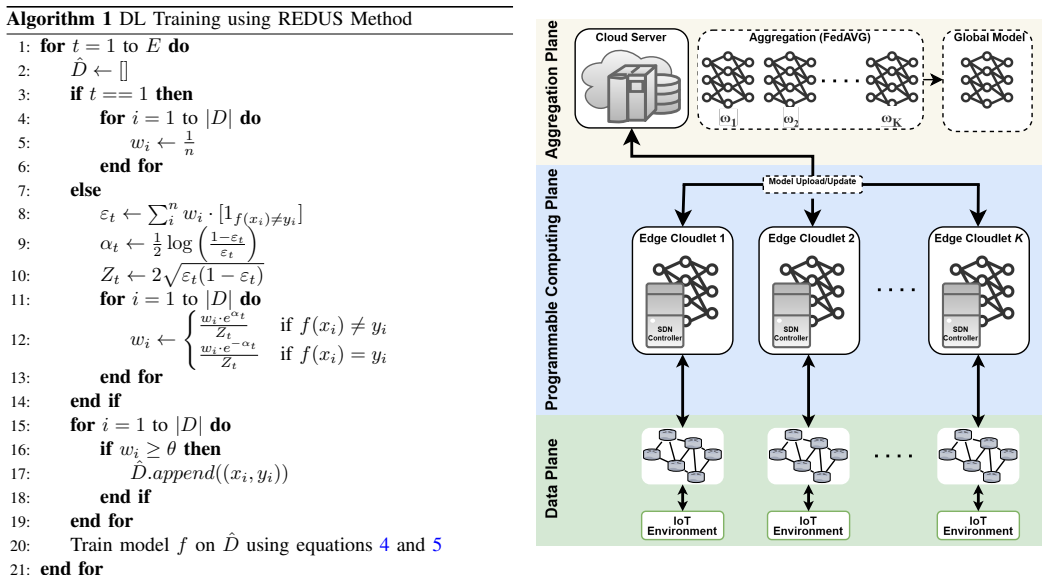
The central object is the sample-weight update and thresholded inclusion mechanism in Algorithm 1. Each sample starts at weight $w_i = 1/n$; at every epoch after the first, the weighted misclassification rate $\varepsilon_t$ is computed, and every sample's weight is updated by an AdaBoost-style factor, increasing for misclassified samples and decreasing for correctly classified ones, then normalized by $Z_t$. Samples whose updated weight falls below $\theta$ are excluded from the next epoch's training set $\hat{D}$, but their weights keep being updated so they can re-enter if they become hard again. This mechanism converts an AdaBoost ensemble-building procedure into a per-epoch sample selector for a single deep network, defining the claimed trade-off between training time and accuracy.
What would settle it
Measure the wall-clock time of one REDUS epoch at $\theta = 1.5\times10^{-6}$ on CICIoT2023 with the same hardware and split it into the subset back-propagation time and the time spent computing $\varepsilon_t$ and updating all $n$ weights (including the full forward pass over excluded samples). If the latter is non-negligible, the observed 72.6% reduction relative to vanilla training will shrink correspondingly; a direct comparison of per-epoch times with and without the full-dataset forward pass would settle whether the claimed savings are attainable.
Extended reading notes
Core claim
The central claim is that a single strong deep-learning model can be trained efficiently by repeatedly reweighting samples with an AdaBoost-style update and discarding, each epoch, the samples whose weights fall below a fixed threshold $\theta$; the model is then trained only on the surviving subset $\hat{D}$. The weight of a misclassified sample is multiplied by $e^{\alpha_t}/Z_t$ and that of a correctly classified sample by $e^{-\alpha_t}/Z_t$, with $\alpha_t = \frac{1}{2}\log\frac{1-\varepsilon_t}{\varepsilon_t}$ and $Z_t = 2\sqrt{\varepsilon_t(1-\varepsilon_t)}$, so hard samples dominate the next epoch while already-learned samples drop out. Since the gradient updates are applied only to samples in $\hat{D}$, the per-epoch back-propagation cost falls as training proceeds, which the authors express through the time model $L_{TT} = |D| \cdot \tau \cdot E$ and the reported wall-clock savings. Evaluated on CICIoT2023 within a five-client federated setup, REDUS at the optimized thresholds achieves 59.84% and 72.60% training-time reductions with 0.68% and 1.62% accuracy reductions respectively, which the paper presents as evidence that the method preserves model performance while substantially cutting computational load.
Load-bearing premise
The method's claimed savings depend on the assumption that recomputing weights for all $n$ samples each epoch, including the excluded ones, is so cheap that total time is dominated by back-propagation on the surviving subset; if that full-dataset pass is counted, worst-case per-epoch cost remains linear in $n$ and the 72.6% savings do not follow as written.
Editorial extensions
If this is right
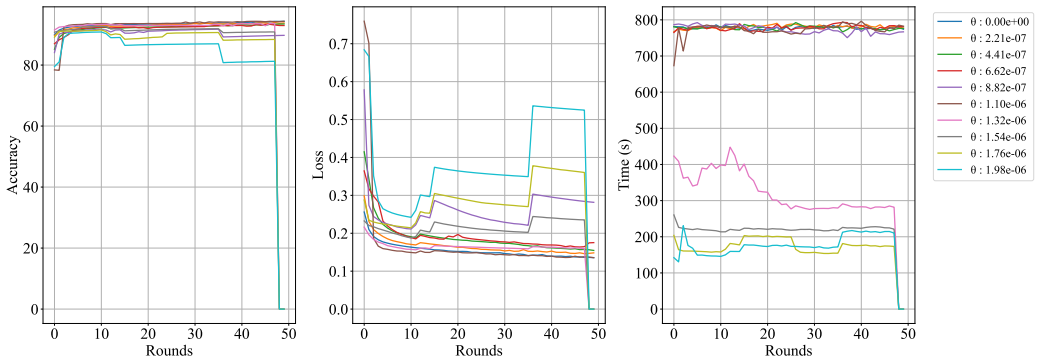
- At $\theta = 1.3\times 10^{-6}$, training time drops 59.84% with only 0.68% accuracy loss, showing a favorable operating point.
- At $\theta = 1.5\times 10^{-6}$, training time drops 72.60% with only 1.62% accuracy loss.
- Because REDUS runs locally on each client before FedAvg aggregation, it reduces the per-client training time $L_{TT_i}$ and thus the round time in federated learning without changing communication rounds.
- The threshold $\theta$ provides a tunable knob between computational savings and accuracy, with high thresholds ($1.7\times10^{-6}$ and above) cutting time by about 78% but losing 2.82 to 3.48% accuracy.
- REDUS preserves the model's final accuracy within a couple of points on the tested dataset, supporting its use in resource-limited IoT and edge settings.
Reading between the lines
- The reported time savings assume the cost of computing $\varepsilon_t$ and updating weights for all $n$ samples each epoch is negligible; if the full-dataset forward pass required for those updates is included, the worst-case per-epoch cost remains linear in $n$, and the savings depend on forward passes being much cheaper than back-propagation.
- REDUS is essentially a hard-example mining schedule; one could test it against simpler heuristics like keeping a fixed top-$k$ fraction per epoch to see whether the AdaBoost weighting, rather than the subset selection, drives the observed gains.
- The accuracy recovery at $\theta = 1.1\times10^{-6}$ (94.33%, same as baseline, with 0.52% time reduction) suggests non-monotonic behavior worth investigating; the re-inclusion dynamics may occasionally improve generalization.
- In a federated setting, the threshold could be adapted per client based on local data difficulty or resource budget, but the paper does not explore this.
Editorial analysis
A structured set of objections, weighed in public.
Referee Report
Summary. The paper proposes REDUS, an AdaBoost-inspired resampling technique that maintains per-sample weights during deep learning training and, at each epoch, trains only on the subset of samples whose weights exceed a threshold θ. The authors claim that this reduces the number of training samples per epoch, thereby reducing training time and energy consumption in both centralized and federated settings. The method is evaluated on the CICIoT2023 dataset for IoT attack detection in a federated learning setup, reporting a training time reduction of up to 72.6% at θ=1.5e-6 with an accuracy reduction of 1.62% relative to a baseline ANN. The paper also sketches an extension of REDUS to federated learning with FedAvg-style aggregation.
Significance. If the efficiency claim were rigorously supported, REDUS would be a simple and practical tool for reducing DL training budgets on resource-constrained IoT/edge devices, and the federated extension would be a natural fit for the paper's target scenario. The algorithmic idea is clearly stated in Algorithm 1, the equations are straightforward, and the use of a standard public dataset (CICIoT2023) is a strength. However, the manuscript does not provide code, timing logs, or a validation-based threshold selection procedure, and the central time-reduction argument omits an operation that the algorithm itself requires. As it stands, the headline result is not established, and the experimental protocol is circular in its selection of the reported operating point.
major comments (3)
- [Section IV-A, Eq. (6), and Algorithm 1 lines 8-13] The total-training-time model omits the full-dataset forward pass required by the algorithm. After the first epoch, computing ε_t in Eq. (9) and updating every w_i in Eqs. (10)-(11) requires evaluating f(x_i) for all i ∈ D, including samples excluded from the subset D_hat. Since Eq. (6) counts only |D|·τ·E, with τ defined as the back-propagation time per sample, the derived reduction is not justified. Including the forward pass, the per-epoch cost is n·t_f + |D_hat|·(t_f + t_b) for REDUS versus n·(t_f + t_b) for vanilla training; the maximum reduction when |D_hat|=0 is t_b/(t_f + t_b), which is only about 50-67% for typical t_b/t_f ratios of 2-3 and is lower for positive |D_hat|. The paper itself states two paragraphs below Eq. (11) that "the time complexity of the REDUS method is O(E · n)", which concedes the same asymptotic order as vanilla training. The measured times in Table I therefore need to be supported by an implementation description or timing profiles that account for the forward pass, or the algorithm and claims need to be revised.
- [Section V, Table I] The thresholds θ = 1.3×10^-6 and θ = 1.5×10^-6 are selected as "optimized" after evaluating test-set accuracy and time over the ten scanned threshold values. Because the same test evaluation is used both to select θ and to report the resulting accuracy, the advertised 1.62% accuracy reduction is a post-hoc selected value rather than an unbiased estimate of the method's generalization performance. The authors should use a validation split for threshold selection and then report test performance at the selected threshold, along with the variance across the five experimental repetitions.
- [Section IV-A, Eq. (10)] The weight-update rule is undefined when ε_t = 0 or ε_t = 1 because α_t = 0.5·log((1-ε_t)/ε_t) involves a division by zero and a logarithm of zero. Since REDUS progressively excludes correctly classified samples and concentrates on harder samples, a state with ε_t = 0 can plausibly occur after several epochs; the algorithm needs a fallback (for example, skip the weight update or set α_t = 0) to remain well-defined over the full training run.
minor comments (6)
- [Section III, Eq. (1)] The denominator is typeset as "P i = 1nwi" and should be Σ_{i=1}^n w_i; also, "wether" should be "whether".
- [Section IV-A, Eq. (6)] The symbols "LLT" and "LT T" appear to be typographical errors for the total training time L_TT.
- [Section IV-B, Eq. (12)] The summation index is written as K=1 to K; it should be i=1 to K.
- [Section V] The text says the threshold ranges from 0 to 1/n, but the experimental sweep goes from 0 to 2/3 × 1/n; please clarify the allowed range and the number of sampled steps.
- [Section V, Table I] No standard deviations or confidence intervals are reported for the five repetitions; because the accuracy differences of interest are small (e.g., 92.71% vs. 93.65%), variance information is needed to assess whether the reported accuracy drops are significant.
- [After Section VI (Fig. 4)] The text following the conclusion contains undecodable character sequences; the figure and its caption need to be regenerated in the manuscript.
Circularity Check
REDUS's headline speedup is an artifact of a backprop-only time definition that omits the full forward pass in Algorithm 1, plus a threshold selected from the same test-set evaluation.
-
self definitional
[Section IV-A, Eq. (6) and Algorithm 1, lines 8-15]
"Then, the total training time (LLT ) is given by: LT T= |D| ·τ · E, (6) ... The goal of our proposed resampling approach is to gradually reduce the number of samples used in training during each epoch, thereby reducing the total training time as defined by LT T. ... The time complexity of the REDUS method is O(E · n)."
Eq. (6) defines total training time solely as back-propagation on all |D| samples. Algorithm 1, however, evaluates f(x_i) for every sample in D each epoch (lines 8-13) to update weights, which requires a full forward pass not counted in L_TT. The claimed speedup is therefore exactly the reduction in the defined quantity, not a consequence of the algorithm's actual per-epoch cost; the paper's own O(E·n) complexity statement acknowledges the full pass remains. The 72.6% reduction is thus an artifact of defining time to exclude the one operation that the algorithm still performs on all samples.
-
fitted input called prediction
[Section V, Table I and following paragraph]
"Threshold values for REDUS were sampled across 10 steps from 0 to 2/3 × 1/n ... Upon analysis, it's shown that the optimized threshold values θ = 1.3 × 10⁻⁶ and θ = 1.5 × 10⁻⁶ significantly reduce the training time by 59.84% and 72.60%, respectively ... The optimized thresholds ... are therefore ideal."
The threshold θ is a free parameter scanned over ten values, and the two thresholds highlighted as 'optimized' are chosen from the same test-set evaluation whose accuracy and training time are then reported as REDUS's performance. The advertised trade-off (72.60% time reduction, 1.62% accuracy loss) is a post-hoc selected operating point rather than a parameter-free prediction. The conclusion that REDUS 'effectively balances computational demands and model performance' is inferred from the same data used to pick θ, so the headline result is a fitted input presented as an outcome of the method.
full rationale
The paper's central efficiency claim reduces to its own cost definition and to a selected operating point. Eq. (6) defines total training time as backprop-only on the full dataset, while Algorithm 1 still requires a full forward pass over D each epoch to update sample weights; the claimed savings follow from that definition, not from the algorithm's actual operations. Separately, the threshold θ is swept over ten values and the two best rows of Table I are then labeled 'optimized,' so the headline speedup/accuracy trade-off is chosen from the same test-set evaluation rather than predicted independently. The experimental benchmark is external (CICIoT2023) and the algorithm has independent content beyond self-citation; references [22] and [23] are self-citations but only supply preprocessing partitioning and future-work context, not the load-bearing derivation. Nonetheless, the main quantitative claim is partially circular: it depends on a definitional time model and on thresholds fitted to the reported evaluation.
Assumptions & free parameters
free parameters (1)
- threshold θ =
1.3e-6 and 1.5e-6 chosen as optimized; grid from 0 to (2/3) * (1/n)
assumptions (3)
- domain assumption Exponential AdaBoost-style weight updates remain valid for a single deep network trained with SGD, so low-weight samples are safely learned and can be excluded.
- ad hoc to paper Correctly classified samples below θ are redundant, and excluding them does not materially change accuracy.
- ad hoc to paper The full-dataset forward pass needed for weight updates is negligible relative to training on the selected subset.
Cite this review
Pith. "Pith review of REDUS: Adaptive Resampling for Efficient Deep Learning in Centralized and Federated IoT Networks." pith.science (2026). https://pith.science/paper/DQEM6HZY
@misc{pith2026250702021,
  author       = {Pith},
  title        = {Pith review of: REDUS: Adaptive Resampling for Efficient Deep Learning in Centralized and Federated IoT Networks},
  year         = {2026},
  howpublished = {\url{https://pith.science/paper/DQEM6HZY}},
  note         = {Machine review of arXiv:2507.02021}
}
read the original abstract
With the rise of Software-Defined Networking (SDN) for managing traffic and ensuring seamless operations across interconnected devices, challenges arise when SDN controllers share infrastructure with deep learning (DL) workloads. Resource contention between DL training and SDN operations, especially in latency-sensitive IoT environments, can degrade SDN's responsiveness and compromise network performance. Federated Learning (FL) helps address some of these concerns by decentralizing DL training to edge devices, thus reducing data transmission costs and enhancing privacy. Yet, the computational demands of DL training can still interfere with SDN's performance, especially under the continuous data streams characteristic of IoT systems. To mitigate this issue, we propose REDUS (Resampling for Efficient Data Utilization in Smart-Networks), a resampling technique that optimizes DL training by prioritizing misclassified samples and excluding redundant data, inspired by AdaBoost. REDUS reduces the number of training samples per epoch, thereby conserving computational resources, reducing energy consumption, and accelerating convergence without significantly impacting accuracy. Applied within an FL setup, REDUS enhances the efficiency of model training on resource-limited edge devices while maintaining network performance. In this paper, REDUS is evaluated on the CICIoT2023 dataset for IoT attack detection, showing a training time reduction of up to 72.6% with a minimal accuracy loss of only 1.62%, offering a scalable and practical solution for intelligent networks.
Figures


Figures from the paper (1 more)
Reference graph
Works this paper leans on
-
[1]
S. Hashima, Z. M. Fadlullah, M. M. Fouda, E. M. Mohamed, K. Hatano, B. M. ElHalawany, and M. Guizani, “On softwarization of intelligence in 6G networks for ultra-fast optimal policy selection: Challenges and opportunities,” IEEE Network , vol. 37, no. 2, pp. 190–197, 2023
work page 2023
-
[2]
M. M. Fouda et al. , “Privacy-preserving data-driven learning mod- els for emerging communication networks: A comprehensive sur- vey,” IEEE Communications Surveys & Tutorials , early access, doi: 10.1109/COMST.2024.3486690
arXiv 2024
-
[3]
A survey on federated learning,
C. Zhang, Y . Xie, H. Bai, B. Yu, W. Li, and Y . Gao, “A survey on federated learning,” Knowledge-Based Systems , vol. 216, article no. 106775, 2021
work page 2021
-
[4]
Z. Md. Fadlullah and N. Kato, “HCP: heterogeneous computing platform for federated learning based collaborative content caching towards 6g networks,” IEEE Transactions on Emerging Topics in Computing, vol. 10, no. 1, pp. 112–123, 2022
work page 2022
-
[5]
Privacy-preserving federated- learning-based net-energy forecasting,
M. M. Badr, M. I. Ibrahem, M. Mahmoud, W. Alasmary, M. M. Fouda, K. H. Almotairi, and Z. M. Fadlullah, “Privacy-preserving federated- learning-based net-energy forecasting,” in SoutheastCon 2022, 2022, pp. 133–139
work page 2022
-
[6]
Privacy-preserving and efficient decentralized federated learning-based energy theft detector,
M. I. Ibrahem, M. Mahmoud, M. M. Fouda, B. M. ElHalawany, and W. Alasmary, “Privacy-preserving and efficient decentralized federated learning-based energy theft detector,” in GLOBECOM 2022 - 2022 IEEE Global Communications Conference , 2022, pp. 287–292
work page 2022
-
[7]
S. Sakib et al., “On COVID-19 prediction using asynchronous federated learning-based agile radiograph screening booths,” in ICC 2021 - IEEE International Conference on Communications , 2021
work page 2021
-
[8]
Asynchronous federated learning-based ECG analysis for arrhythmia detection,
S. Sakib, M. M. Fouda, Z. M. Fadlullah, K. Abualsaud, E. Yaacoub, and M. Guizani, “Asynchronous federated learning-based ECG analysis for arrhythmia detection,” in 2021 IEEE International Mediterranean Conference on Communications and Networking (MeditCom) , 2021
work page 2021
Show all 23 references
-
[9]
Toward asynchronously weight updating federated learning for AI-on-edge IoT systems,
Y . Gupta, Z. M. Fadlullah, and M. M. Fouda, “Toward asynchronously weight updating federated learning for AI-on-edge IoT systems,” in 2022 IEEE International Conference on Internet of Things and Intelligence Systems (IoTaIS), 2022
2022
-
[10]
A lightweight federated learning based privacy preserving B5G pandemic response network using unmanned aerial vehicles: A proof-of-concept,
N. Nasser, Z. M. Fadlullah, M. M. Fouda, A. Ali, and M. Imran, “A lightweight federated learning based privacy preserving B5G pandemic response network using unmanned aerial vehicles: A proof-of-concept,” Computer Networks , vol. 205, article no. 108672, 2022
2022
-
[11]
Adaboost-based security level classification of mobile intelligent terminals,
F. Wang, D. Jiang, H. Wen et al. , “Adaboost-based security level classification of mobile intelligent terminals,”Journal of Supercomputing, vol. 75, pp. 7460–7478, 2019
2019
-
[12]
Joint provisioning of QoS and se- curity in IoD networks: Classical optimization meets AI,
Z. M. Fadlullah and A. Benslimane, “Joint provisioning of QoS and se- curity in IoD networks: Classical optimization meets AI,” IEEE Internet of Things Magazine , vol. 4, no. 4, pp. 40–46, 2021
2021
-
[13]
CICIoT2023: A real-time dataset and benchmark for large- scale attacks in IoT environment,
E. C. P. Neto, S. Dadkhah, R. Ferreira, A. Zohourian, R. Lu, and A. A. Ghorbani, “CICIoT2023: A real-time dataset and benchmark for large- scale attacks in IoT environment,” Sensors, vol. 23, no. 13, article no. 5941, 2023
2023
-
[14]
Data resampling for federated learning with non-IID labels,
Z. Tang, Z. Hu, S. Shi, Y .-m. Cheung, Y . Jin, Z. Ren, and X. Chu, “Data resampling for federated learning with non-IID labels,” in FTL-IJCAI’21, 2021
2021
-
[15]
AdaBoost-CNN: an adaptive boosting algorithm for convolutional neural networks to classify multi-class imbalanced datasets using transfer learning,
A. Taherkhani, G. Cosma, and T. McGinnity, “AdaBoost-CNN: an adaptive boosting algorithm for convolutional neural networks to classify multi-class imbalanced datasets using transfer learning,” Neurocomput- ing, vol. 404, pp. 351–366, 2020
2020
-
[16]
LoAdaBoost: loss-based AdaBoost federated machine learning with reduced computa- tional complexity on IID and non-IID intensive care data,
L. Huang, Y . Yin, Z. Fu, S. Zhang, H. Deng, and D. Liu, “LoAdaBoost: loss-based AdaBoost federated machine learning with reduced computa- tional complexity on IID and non-IID intensive care data,” 2020
2020
-
[17]
Differential privacy for deep and federated learning: A survey,
A. El Ouadrhiri and A. Abdelhadi, “Differential privacy for deep and federated learning: A survey,” IEEE Access , vol. 10, pp. 22 359–22 380, 2022
2022
-
[18]
Federated learning with differential privacy: Algorithms and performance analysis,
K. Wei, J. Li, M. Ding, C. Ma, H. H. Yang, F. Farokhi, S. Jin, T. Q. S. Quek, and H. Vincent Poor, “Federated learning with differential privacy: Algorithms and performance analysis,” IEEE Transactions on Information F orensics and Security, vol. 15, pp. 3454–3469, 2020
2020
-
[19]
Evaluating differentially private machine learning in practice,
B. Jayaraman and D. Evans, “Evaluating differentially private machine learning in practice,” in Proceedings of the 28th USENIX Conference on Security Symposium , 2019, p. 1895–1912
2019
-
[20]
Communication and computation efficiency in federated learning: A survey,
O. R. A. Almanifi, C.-O. Chow, M.-L. Tham, J. H. Chuah, and J. Kane- san, “Communication and computation efficiency in federated learning: A survey,” Internet of Things , vol. 22, p. 100742, 2023
2023
-
[21]
Communication-efficient federated learning via quantized compressed sensing,
Y . Oh, N. Lee, Y .-S. Jeon, and H. V . Poor, “Communication-efficient federated learning via quantized compressed sensing,” IEEE Transactions on Wireless Communications , vol. 22, no. 2, pp. 1087–1100, 2022
2022
-
[22]
A robust federated learning approach for combating attacks against IoT systems under non-IID challenges,
E. Gad, Z. M. Fadlullah, and M. M. Fouda, “A robust federated learning approach for combating attacks against IoT systems under non-IID challenges,” in 2024 International Conference on Smart Applications, Communications and Networking (SmartNets) , 2024
2024
-
[23]
Combating IoT attacks in AI-driven networks via robust and resource-efficient federated learning,
E. Gad, “Combating IoT attacks in AI-driven networks via robust and resource-efficient federated learning,” Master’s thesis, Western University, 2024. [Online]. Available: https://ir.lib.uwo.ca/etd/10580/
2024
Reviewed August 6, 2026 · model on record in the stance chip above.
Discussion (0). Sign in to comment.