REVIEW 4 major objections 5 minor 65 references
Constraining compact dark matter with time-varying quasar equivalent widths
T0 review · 4 major / 5 minor · reviewed 2026-08-06 · deepseek-v4-flash
Pith's one-line read This paper claims that time-varying equivalent widths of the [OIII] line in 19 archival quasars are decisively explained by microlensing by compact objects of mass between $5\times 10^{-5}$ and $2\times 10^{-2}$ solar masses, implying a…
desk verdict Clever new time-domain EW lensing probe, but the 19-lens detection claim is undercut by selection on the same mass, weak Bayes factors, and an unvalidated DRW null. read the letter →
The pith
A machine-rendered reading of the paper's core claim, the machinery that carries it, and where it could break.
The reading
What carries the argument
The load-bearing object is Eq. (3), the probability distribution of the equivalent-width ratio $W_0/W$ given the time separation $\Delta t$, obtained by marginalizing over the initial magnification $\mu_0$; this converts a measured spectral ratio into a model comparison. For the intrinsic model, the magnification factor follows a damped random walk with parameters taken from the population fit of [61], while for the lensing model a point-mass lens at unknown redshift magnifies a point-source continuum while the [OIII] narrow line remains unmagnified, with the source displacement over $\Delta t$ described by a Rice distribution built from the CMB dipole and peculiar velocities. The Bayesian factor $K$ of Eq. (C6) weighs the combined model against intrinsic variability using Poisson priors from the lensing optical depth, and fitting the combined model to the 19 selected quasars yields the lens mass posterior.
What would settle it
Re-measure the 19 quasars' equivalent-width ratios using an intrinsic variability model calibrated on each quasar's own decade-long photometric light curve rather than population-averaged damped random walk parameters; if the intrinsic model alone reproduces most of the observed changes, the Bayesian factors would fall below the evidence threshold. Alternatively, a third-epoch spectrum showing the line flux varying in step with the continuum, or an equivalent-width change that reverses on a timescale inconsistent with a single caustic crossing, would contradict the lensing interpretation.
Extended reading notes
Core claim
The central claim is that time-varying equivalent widths in non-strongly-lensed quasars can be, and in 19 archival cases are, caused by gravitational microlensing by compact objects rather than by intrinsic quasar variability. Because the continuum-emitting region is effectively a point source while the narrow-line region is too large to be magnified, a foreground compact object changes the continuum flux without changing the line flux, so the measured [OIII] equivalent width ratio $W_0/W$ carries the lensing signature. Comparing a damped-random-walk intrinsic model against a combined intrinsic-plus-lensing model through a Bayesian factor, the paper finds 19 quasars where the combined model is favored, and fits a monochromatic lens population with mass between $5\times 10^{-5}$ and $2\times 10^{-2}$ solar masses at 99% confidence. The paper frames this as evidence that free-floating planet-mass compact objects can constitute at least $10^{-5.5}$ of the dark matter density.
Load-bearing premise
The detection assumes that the damped-random-walk model, with parameters fit to a population of quasars, correctly predicts how much each quasar's continuum would vary on its own over a decade; if real quasars can vary more than the model allows, intrinsic variability could masquerade as lensing.
Editorial extensions
If this is right
- A population of compact objects with masses around $10^{-2}$ to $10^{-4}$ solar masses can be probed by decade-baseline quasar spectroscopy, a mass range inaccessible to gravitational-wave detectors.
- The measured mass range overlaps predictions for primordial black holes from the QCD phase transition, so the result is a direct test of that formation channel.
- The detection rate of 19 out of 183 cleanly measured quasars is consistent with lensing being rare and implies a lower bound on the compact-object fraction of dark matter near $10^{-5.5}$.
- Multi-epoch spectroscopic surveys that revisit quasars after roughly ten years could turn this method into a statistical measurement of the mass function and abundance of compact lenses.
Reading between the lines
- If the lensing interpretation holds, applying the same method to other narrow lines or to broad lines with known size ratios could break the velocity-mass degeneracy that currently weakens individual lens mass measurements.
- A decisive extension would be a third epoch of spectroscopy for the 19 quasars: a single compact lens predicts a smooth, continuum-only magnification change returning to baseline, whereas intrinsic variability predicts stochastic, wavelength-dependent fluctuations.
- The $10^{-5.5}$ dark-matter fraction is a floor set partly by the Bayesian prior on optical depth; a larger archival sample with denser time sampling could raise this floor or rule out the planet-mass interpretation.
- Linking the inferred lens population to galaxy halos along the line of sight, as the paper notes for future work, would distinguish Galactic self-lensing from truly free-floating intergalactic objects.
Editorial analysis
A structured set of objections, weighed in public.
Referee Report
Summary. The manuscript proposes using time variations of the [O III] λ5007 equivalent width ratio between two SDSS epochs as a probe of microlensing by compact dark matter. From 777 quasars with spectra separated by at least 7 years, the authors measure W0/W for 183 objects after quality cuts and compare a DRW-only intrinsic-variability model with a combined intrinsic plus point-mass lensing model via a Bayesian factor K. They select 19 quasars with log K > 0 at a fixed lens mass M = 0.01 Msun, fit a common lens mass to those same data, and report a 99% range 5e-5 < M/Msun < 2e-2 and compatibility with a population of free-floating planet-mass objects. The paper includes detailed analytic derivations of the lensing displacement and magnification distributions in Appendix F and a Bayesian mass-fitting procedure in Appendix D.
Significance. If the detection were robust, the result would be important: it would extend compact-dark-matter searches to planetary masses and complement microlensing, strong-lensing, and gravitational-wave constraints. The modeling machinery is a genuine strength: the point-mass magnification, the Rice-distributed source displacement, and the use of equivalent-width ratios rather than absolute fluxes are carefully and clearly derived, and the paper is transparent about the prior choices in Appendix D. However, the statistical support for the detection is weak, the selection procedure is circular, and the quoted mass interval is prior-dependent; as a result, the central claim of a decisive detection is not established by the current analysis.
major comments (4)
- [Section VI and Appendix D] The 19 quasars are selected by requiring log K > 0 for a fixed lens mass of M = 0.01 Msun, which the text identifies as 'the mass value with the highest K,' and the same W0/W measurements are then used in Eq. (D3) to infer the common lens mass. This selection truncates the sample on a function of the very data used in the posterior, and the truncation is not accounted for in the likelihood or prior. The uniform-prior peak at 0.014 Msun is therefore expected to be close to the selection mass even if the 'detected' objects are merely the tail of the intrinsic-variability distribution. A valid mass measurement would require either a hierarchical model that includes the selection or an independent sample selected without using the lensing model.
- [Appendix F and Eq. (4)] The Intrinsic null model is a damped random walk whose parameters are taken from MacLeod et al. (2010) fits to SDSS Stripe 82 photometric light curves, but the data being modeled are [O III] equivalent-width ratios over decade-long baselines. No validation is shown that this DRW distribution, with ensemble parameters and unpropagated uncertainties, reproduces the intrinsic scatter of W0/W for the 777 quasars in this sample. If the true intrinsic variability has a heavier tail, secular continuum changes, or wavelength dependence not captured by the DRW, the Bayesian factors in Fig. 3 are inflated and the 19 objects may simply be the tail of the intrinsic distribution. This is load-bearing because K is the only statistic separating the two hypotheses; the manuscript should at least include a sensitivity test or a calibration of pIN against a null sample.
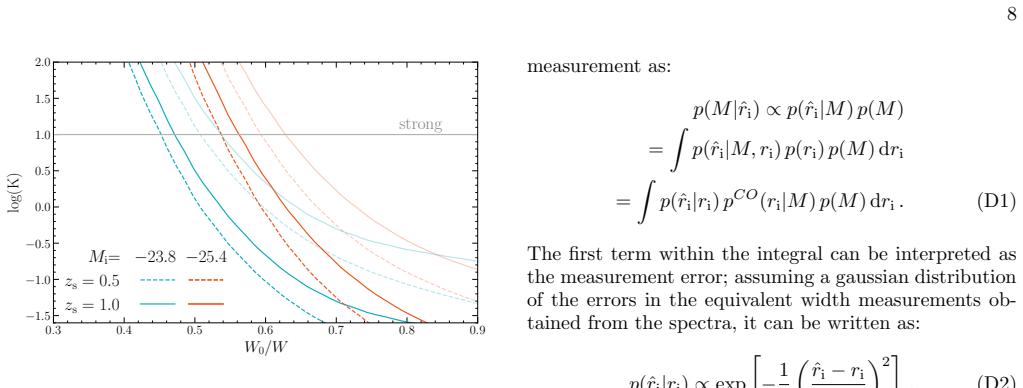
- [Table I, Sections V-VI, Abstract] The abstract claims 'decisive evidence' for lensing, but Table I shows that 10 of the 19 selected quasars have log K < 1, and the selection threshold is log K > 0, which the paper's own cited Jeffreys scale [55] would rate as weak evidence. The statement in the text that 'strong evidence' corresponds to log K > 1 is inconsistent with the adopted selection threshold. The individual Bayes factors are thus not decisive, and the aggregate claim would require accounting for the selection and for the look-elsewhere effect of scanning over mass; otherwise the 19 objects are better described as candidates.
- [Appendix D] The mass measurement is strongly prior-dependent: the uniform prior gives 0.014+0.005-0.004 Msun, the logarithmic prior gives 0.00032+0.00053-0.00023 Msun, and Jeffreys' prior gives 0.0056+0.002-0.0014 Msun. The abstract's 99% range, 5e-5 to 2e-2 Msun, is a union of these prior-dependent intervals rather than a posterior from a single model. Because the likelihood evidently does not dominate the prior, the quoted mass range is not a robust measurement, and the conclusion that the lenses have 'masses measured' in that range is not supported. The mass estimate also inherits the assumed velocity dispersion through Eq. (F19), and the text acknowledges the velocity-mass degeneracy in Section VII, which further weakens the mass claim.
minor comments (5)
- [Section VI and Fig. 3] The threshold nomenclature is inconsistent: the Fig. 3 caption defines substantial evidence at log K > 0.5, Section VI defines strong evidence at log K > 1, and the actual selection uses log K > 0; please define a single scale and use it consistently.
- [Fig. 4] The vertical line for the combined measurement and the shaded 99% interval should be labeled with numerical values in the caption, since the text quotes them.
- [Section II] Please report how many quasars were removed by each of the four refinement criteria, so the reader can assess the impact of the line-flux and broad-line cuts on the final sample.
- [General] The manuscript would benefit from a machine-readable table of the 183 measured W0/W ratios and the 19 selected candidates, along with the DRW parameters used for each object, to facilitate reproduction.
- [Reference [40]] Reference [40] is a placeholder for supplemental material that is not yet available; the derivations of Eqs. (4) and (5) should be included in the paper or in an accessible supplement.
Circularity Check
The quoted lens-mass measurement is selection-conditioned: the 19 quasars are chosen by log K > 0 at the data-preferred mass 0.01 M⊙, then the same Combined likelihood is re-fit to the same 19 ratios to 'measure' the mass, with the 99% range being a union of priors whose peaks differ by a factor of 44.
-
fitted input called prediction
[Section VI 'Measuring the lens mass', with Appendix D 'Fitting the Combined model to the data'; see also Fig. 3 caption and Table I.]
"Hence, we select a sub-sample of quasars with log K >0 for M = 0.01 M⊙, the mass value with the highest K. The resulting 19 quasars are then fitted using the Combined model and a choice of prior on the lens mass, as described in Appendix D, in order to obtain the posterior probability distribution of the lens mass that we show in Fig. 4."
The selection mass is data-driven: Fig. 3 shows 0.01 M⊙ has the highest K per quasar, and the 19 quasars are retained precisely because the Combined likelihood at M = 0.01 beats the Intrinsic likelihood. Appendix D then multiplies the identical Combined likelihood pCO(r|M) over the identical 19 ratios (Eqs. D1-D3), so the posterior peak at 0.014 M⊙ (uniform prior) reflects the same likelihood that defined the sample rather than an independent measurement. The prior-dependence is disclosed: the three priors peak at 0.014, 0.00032, and 0.0056 M⊙ (a ~44x spread), so the abstract's 99% range (5e-5 to 2e-2) is a union of prior-specific intervals applied to a sample already conditioned at M = 0.01 M⊙.
full rationale
The technical derivation chain is largely self-contained and the self-citations are not load-bearing: Eqs. (4)-(5) are re-derived in Appendix F; the DRW parameters come from the external MacLeod et al. (2010) fits; the velocity dispersion (235 km/s) and CMB dipole terms trace to Kochanek (2004) and COBE, not to this paper's authors. No uniqueness theorem is imported. The circular step is in the detection-to-mass pipeline. Section VI fixes the selection at log K > 0 for M = 0.01 M⊙, a mass chosen from the same data ('the mass value with the highest K'), then Appendix D re-fits the same Combined likelihood to the same 19 ratios, so the posterior peaks near 0.014 M⊙ by construction rather than by fresh evidence; the abstract's 5e-5-2e-2 range with '99% confidence' is a union over three priors whose peaks span a factor ~44. The manuscript itself flags the weakening circumstances: 'There is a degeneracy here between the velocity and mass of the lens' (Sec. VII), 'There is a dependence on the prior' (Sec. VI), and the Fig. 3 caption concedes that for Ωl/ΩDM = 10^-5.5 'the density of compact objects in the Universe is too low to justify lensing in our sample of quasars under any circumstance' — meaning the 19-detection claim is partly conditioned on assuming Ωl/ΩDM = 1. Separately, the load-bearing Intrinsic null (DRW with MacLeod parameters) is not validated for [OIII] equivalent-width ratios over decade baselines and its parameter uncertainties are not propagated; an underestimated intrinsic scatter would inflate the Fig. 3 Bayesian factors — but since the DRW is an external benchmark this is a robustness risk, not circularity. Overall the EW-ratio measurements and model comparison have independent content, but the headline mass 'measurement' reduces substantially to the prior- and selection-conditioned likelihood, giving a partial circularity score of 6.
Assumptions & free parameters
free parameters (3)
- Selection mass M_sel =
0.01 M_sun
- Magnification threshold mu_thres =
1.061
- Mass priors =
uniform, logarithmic, Jeffreys
assumptions (6)
- domain assumption Flat Lambda CDM cosmology with Omega_m=0.3, Omega_Lambda=0.7, H0=70
- domain assumption DRW model with parameters from MacLeod et al. 2010
- domain assumption Single point-mass lens, no shear, point-source continuum, NLR unaffected
- domain assumption Constant comoving number density of lenses
- domain assumption Peculiar velocity distribution with sigma_pec(0)=235 km/s and f(z) approximation
- domain assumption Poisson statistics for lensing with P_k = tau^k e^{-tau}/k! |d tau/dz_s|
Cite this review
Pith. "Pith review of Constraining compact dark matter with time-varying quasar equivalent widths." pith.science (2026). https://pith.science/paper/CUST5ING
@misc{pith2026250702046,
  author       = {Pith},
  title        = {Pith review of: Constraining compact dark matter with time-varying quasar equivalent widths},
  year         = {2026},
  howpublished = {\url{https://pith.science/paper/CUST5ING}},
  note         = {Machine review of arXiv:2507.02046}
}
abstract
One of the possible explanations for dark matter is that of compact dark objects of baryonic origin, such as black holes or even planets. Accumulating evidence, including the discovery of merging stellar mass black holes through gravitational waves, point to a population of such objects making up at least some fraction of dark matter. We revisit a historically heavily used probe, quasar spectra, from the new perspective of time variability and gravitational lensing. From a sample of 777 quasars selected from archival data we identify 19 that show decisive evidence of lensing by compact objects with masses measured in the range $5\times 10^{-5} < M/\mathrm{M}_{\odot} < 2\times 10^{-2}$ with 99\% confidence. This is much lower than what is hoped to be detected by even the most futuristic gravitational wave detectors and analysis strategies, but is crucial for theories of compact dark matter, such as primordial black holes predicted from quantum phase transitions in the early Universe.
Figures


Figures from the paper (3 more)


Reference graph
Works this paper leans on
-
[55]
A. Kogut, et al. , Dipole Anisotropy in the COBE Dif- ferential Microwave Radiometers First-Year Sky Maps. Astrophysical Journal 419, 1 (1993)
work page 1993
-
[1]
We perform a visual inspection of the goodness- of-fit of our model to each spectrum. If the line profile is too complicated to fit or if the spectrum in general shows features beyond a simple shift in the continuum flux, then we remove the quasar from the sample
-
[2]
Such high uncertainty is a direct result of large errors in the observations
We remove quasars with measurements of equiva- lent width ratios with an uncertainty of more than 50%. Such high uncertainty is a direct result of large errors in the observations
-
[3]
We remove quasars whose emission line flux changed by more than 10% between the two spec- tra, as this would indicate some sort of intrinsic variability
-
[4]
We ensure that none of the other broad lines dis- appears between the two chosen epochs - a typical characteristic of Changing State quasars (see fig. 1 of [54]). We apply this criterion quite strictly 4 and remove quasars with any significant variation of broad line flux. The resulting sample of 183 quasars has robust equivalent width ratio measurements,...
-
[5]
our chosen [OIII] narrow line would remain in the ob- served wavelength range out to zs = 0.7, and 3) available spectra in at least two epochs separated by ∼ 10 years, a time scale corresponding roughly to the Einstein ra- dius crossing time of a stellar mass lens. The sample was further refined by removing quasars displaying spectral changes that did not...
work page 2020
-
[7]
G. Bertone, D. Hooper, History of dark mat- ter. Reviews of Modern Physics 90 (2018), doi: 10.1103/RevModPhys.90.045002
-
[8]
G. R. Blumenthal, S. M. Faber, J. R. Primack, M. J. Rees, Formation of galaxies and large-scale structure with cold dark matter. 311, 517–525 (1984), doi: 10.1038/311517a0
doi:10.1038/311517a0 1984
Show all 65 references
-
[9]
Ricotti, A
M. Ricotti, A. Gould, A new probe of dark matter and high-energy universe using microlensing. Astrophys- ical Journal 707, 979–987 (2009), doi:10.1088/0004- 637X/707/2/979
2009 doi
-
[10]
Blinov, M
N. Blinov, M. J. Dolan, P. Draper, J. Shelton, Dark matter microhalos from simplified models 103, 103514 (2021), doi:10.1103/PhysRevD.103.103514
2021 doi
-
[11]
Visinelli, Boson stars and oscillatons: A review
L. Visinelli, Boson stars and oscillatons: A review. In- 13 ternational Journal of Modern Physics D 30, 2130006– 2130293 (2021), doi:10.1142/S0218271821300068
2021 doi
-
[12]
G. D. Kribs, E. T. Neil, Review of strongly-coupled com- posite dark matter models and lattice simulations. In- ternational Journal of Modern Physics A 31, 1643004– 1643764 (2016), doi:10.1142/S0217751X16430041
2016 doi
-
[13]
B. J. Carr, S. Clesse, J. Garcia-Bellido, M. R. S. Hawkins, F. K¨ uhnel, Observational evidence for primordial black holes: A positivist perspective 1054, 1–68 (2024), doi: 10.1016/j.physrep.2023.11.005
2024 doi
-
[14]
Villanueva-Domingo, O
P. Villanueva-Domingo, O. Mena, S. Palomares-Ruiz, A Brief Review on Primordial Black Holes as Dark Matter. Frontiers in Astronomy and Space Sciences 8, 87 (2021), doi:10.3389/fspas.2021.681084
2021
-
[15]
Alcock, et al., Possible gravitational microlensing of a star in the Large Magellanic Cloud 365, 621–623 (1993), doi:10.1038/365621a0
C. Alcock, et al., Possible gravitational microlensing of a star in the Large Magellanic Cloud 365, 621–623 (1993), doi:10.1038/365621a0
1993 doi
-
[16]
Aubourg, et al., Evidence for gravitational microlens- ing by dark objects in the Galactic halo 365, 623–625 (1993), doi:10.1038/365623a0
E. Aubourg, et al., Evidence for gravitational microlens- ing by dark objects in the Galactic halo 365, 623–625 (1993), doi:10.1038/365623a0
1993 doi
-
[17]
Udalski, et al., The Optical Gravitational Lensing Ex- periment
A. Udalski, et al., The Optical Gravitational Lensing Ex- periment. Discovery of the First Candidate Microlensing Event in the Direction of the Galactic Bulge 43, 289–294 (1993)
1993
-
[18]
Paczynski, Gravitational Microlensing by the Galactic Halo 304, 1 (1986), doi:10.1086/164140
B. Paczynski, Gravitational Microlensing by the Galactic Halo 304, 1 (1986), doi:10.1086/164140
1986 doi
-
[19]
Mr´ oz,et al., No massive black holes in the Milky Way halo
P. Mr´ oz,et al., No massive black holes in the Milky Way halo. Nature 632, 749–751 (2024), doi:10.1038/s41586- 024-07704-6
2024 doi
-
[20]
B. P. Abbott, et al. , Observation of gravitational waves from a binary black hole merger. Physical Review Letters 116 (2016), doi:10.1103/PhysRevLett.116.061102
2016 doi
-
[21]
H¨ utsi, M
G. H¨ utsi, M. Raidal, V. Vaskonen, H. Veerm¨ ae, Two populations of LIGO-Virgo black holes (2020), doi:10.1088/1475-7516/2021/03/068, http://arxiv.org/abs/2012.02786http://dx.doi. org/10.1088/1475-7516/2021/03/068
2020 arXiv
-
[22]
K. C. Sahu, et al. , An Isolated Stellar-mass Black Hole Detected through Astrometric Microlensing 933, 83 (2022), doi:10.3847/1538-4357/ac739e
2022 doi
-
[23]
and Kim, J
Bramante, Joseph and Diamond, Melissa D. and Kim, J. Leo, Dimming Starlight with Dark Compact Objects, Phys. Rev. Lett. 134, 141001 (2025), doi: 10.1103/PhysRevLett.134.141001
2025 doi
-
[24]
Oguri, J
M. Oguri, J. M. Diego, N. Kaiser, P. L. Kelly, T. Broad- hurst, Understanding caustic crossings in giant arcs: Characteristic scales, event rates, and constraints on compact dark matter. Physical Review D 97 (2018), doi: 10.1103/PhysRevD.97.023518
2018 doi
-
[25]
C. V. M¨ uller, J. Miralda-Escud´ e, Limits on dark matter compact objects implied by supermagnified stars in lensing clusters. Monthly Notices of the Royal Astronomical Society 536, 1579–1585 (2024), doi: 10.1093/mnras/stae2652, https://academic.oup.com/ mnras/article/536/2/1...
2024 doi
-
[26]
Zumalac´ arregui, U
M. Zumalac´ arregui, U. Seljak, Limits on Stellar-Mass Compact Objects as Dark Matter from Gravitational Lensing of Type Ia Supernovae. Physical Review Letters 121 (2018), doi:10.1103/PhysRevLett.121.141101
2018 doi
-
[27]
Dhawan, E
S. Dhawan, E. M¨ orstell, Type Ia supernova constraints on compact object dark matter. Monthly Notices of the Royal Astronomical Society 524, 5762–5767 (2023), doi: 10.1093/mnras/stad2166
2023 doi
-
[28]
Paynter, R
J. Paynter, R. Webster, E. Thrane, Evidence for an intermediate-mass black hole from a gravitationally lensed gamma-ray burst. Nature Astronomy 5, 560–568 (2021), doi:10.1038/s41550-021-01307-1
2021 doi
-
[29]
Leung, et al
C. Leung, et al. , Constraining primordial black holes using fast radio burst gravitational-lens interferom- etry with CHIME/FRB 106, 43017 (2022), doi: 10.1103/PhysRevD.106.043017
2022 doi
-
[30]
D. Wen, A. J. Kemball, Testing Primordial Black Hole Dark Matter with ALMA Observations of the Gravitational Lens B1422+231. arXiv e-prints p. arXiv:2210.16444 (2022)
2022 arXiv
-
[31]
V. Dike, D. Gilman, T. Treu, Strong lensing constraints on primordial black holes as a dark matter candidate. Monthly Notices of the Royal Astronomical Society 522, 5434–5441 (2023), doi:10.1093/mnras/stad1313
2023 doi
-
[32]
W. H. Press, J. E. Gunn, METHOD FOR DETECTING A COSMOLOGICAL DENSITY OF CONDENSED OBJECTS*. The Astrophysical Journal 185, 397–412 (1973)
1973
-
[33]
C. R. Ca˜ nizares, MANIFESTATIONS OF A COSMO- LOGICAL DENSITY OF COMPACT OBJECTS IN QUASAR LIGHT. The Astrophysical Journal 263, 508– 517 (1982)
1982
-
[34]
M. R. S. Hawkins, Gravitational microlensing, quasar variability and missing matter. Nature 366, 242–245 (1993)
1993
-
[35]
M. R. Hawkins, The case for primordial black holes as dark matter. Monthly Notices of the Royal Astronomi- cal Society 415, 2744–2757 (2011), doi:10.1111/j.1365- 2966.2011.18890.x
2011
-
[36]
Schneider, Upper bounds on the cosmological density of compact objects with sub-solar masses from the vari- ability of QSOs
P. Schneider, Upper bounds on the cosmological density of compact objects with sub-solar masses from the vari- ability of QSOs. Astronomy and Astrophysics 279, 1–20 (1993)
1993
-
[37]
Zackrisson, N
E. Zackrisson, N. Bergvall, Constraining the cosmological density of compact objects with the long-term variabil- ity of quasars. Astronomy and Astrophysics 399, 23–32 (2003), doi:10.1051/0004-6361:20021762
2003 doi
-
[39]
M. R. S. Hawkins, New evidence for a cosmological dis- tribution of stellar mass primordial black holes. Monthly Notices of the Royal Astronomical Society 512, 5706– 5714 (2022), doi:10.1093/mnras/stac863
2022 doi
-
[40]
Y. Luo, Y. Shen, Q. Yang, Characterization of op- tical light curves of extreme variability quasars over a ∼16-yr baseline. Monthly Notices of the Royal Astronomical Society 494, 3686–3698 (2020), doi: 10.1093/MNRAS/STAA972
2020 doi
-
[41]
Vernardos, et al
G. Vernardos, et al. , Microlensing of Strongly Lensed Quasars. Space Science Reviews 220 (2024), doi: 10.1007/s11214-024-01043-8
2024 doi
-
[42]
J. J. Dalcanton, C. R. Canizares, A. Granados, C. C. Steidel, J. T. Stocke, Observational Limits on Omega in Stars, Brown Dwarfs, and Stellar Remnants from Gravitational Microlensing 424, 550 (1994), doi: 10.1086/173914
1994 doi
-
[43]
C. C. Wiegert, Constraining compact dark matter with quasar equivalent widths from the Sloan Digital Sky Sur- vey Early Data Release (2003)
2003
-
[44]
P. J. Francis, A. Koratkar, The Evolution of QSO Spec- tra: Evidence for Microlensing?, in Astrophysical Appli- 14 cations of Gravitational Lensing , C. S. Kochanek, J. N. Hewitt, Eds., vol. 173 (1996), p. 289
1996
-
[45]
See Supplemental Material at [URL will be inserted by publisher] for detailed derivations of equations (4) and (5), which includes Refs. [41-53]
-
[46]
Bosc´ a, P
V. Bosc´ a, P. Fleury, J. Garc ´ ıa-Bellido, Accurate mod- elling of extragalactic microlensing by compact objects. Journal of Cosmology and Astroparticle Physics 2022 (2022), doi:10.1088/1475-7516/2022/10/098
2022 doi
-
[47]
Schneider, J
P. Schneider, J. Ehlers, E. E. Falco, Gravitational lenses (Springer) (1992)
1992
-
[48]
Kayser, S
R. Kayser, S. Refsdal, R. Stabell, Astrophysical aplica- tions of gravitational micro-lensing. Astronomy and As- trophysics 166, 36 (1986)
1986
-
[49]
Antonucci, UNIFIED MODELS FOR ACTIVE GALACTIC NUCLEI AND QUASARS
R. Antonucci, UNIFIED MODELS FOR ACTIVE GALACTIC NUCLEI AND QUASARS. Annual Review of Astronomy and Astrophysics 31, 473 (1993)
1993
-
[50]
Sluse, J
D. Sluse, J. F. Claeskens, D. Hutsem´ ers, J. Surdej, Multi- wavelength study of the gravitational lens system RXS J1131-1231 III. Long slit spectroscopy: Micro-lensing probes the QSO structure. Astronomy and Astrophysics 468, 885–901 (2007), doi:10.1051/0004-6361:20066821
2007 doi
-
[51]
Sluse, D
D. Sluse, D. Hutsem´ ekers, F. Courbin, G. Meylan, J. Wambsganss, Microlensing of the broad line region in 17 lensed quasars. Astronomy and Astrophysics 544, A62 (2012), doi:10.1051/0004-6361/201219125, http:// www.aanda.org/10.1051/0004-6361/201219125
2012 doi
-
[52]
L. A. Moustakas, R. B. Metcalf, Detecting dark mat- ter substructure spectroscopically in strong gravita- tional lenses. Monthly Notices of the Royal Astronom- ical Society 339, 607–615 (2003), doi:10.1046/j.1365- 8711.2003.06055.x
2003
-
[53]
A. M. Nierenberg, et al. , Probing dark matter sub- structure in the gravitational lens HE 0435-1223 with the WFC3 grism. Monthly Notices of the Royal Astronomical Society 471, 2224–2236 (2017), doi: 10.1093/mnras/stx1400
2017 doi
-
[54]
Neira, T
F. Neira, T. Anguita, G. Vernardos, A quasar microlens- ing light-curve generator for LSST. Monthly Notices of the Royal Astronomical Society 495, 544–553 (2020), doi: 10.1093/mnras/staa1208
2020 doi
-
[56]
Monthly Notices of the Royal As- tronomical Society 251, 128–136 (1991)
Lahav, Lilje, Primack, Rees, Dynamical effects of the cosmological constant. Monthly Notices of the Royal As- tronomical Society 251, 128–136 (1991)
1991
-
[57]
C. S. Kochanek, Quantitative Interpretation of Quasar Microlensing Light Curves. The Astrophysical Journal 605, 58–77 (2004), doi:10.1086/382180, http://stacks. iop.org/0004-637X/605/i=1/a=58
2004 doi
-
[58]
J. A. Blackburne, Zooming in on Quasar Accretion Disks using Chromatic Microlensing (2009)
2009
-
[59]
Ricci, B
C. Ricci, B. Trakhtenbrot, Changing-look active galac- tic nuclei. Nature Astronomy 7, 1282–1294 (2023), doi: 10.1038/s41550-023-02108-4
2023 doi
-
[60]
Jeffreys, The theory of probability , 3 ed
H. Jeffreys, The theory of probability , 3 ed. (1998)
1998
-
[61]
C. T. Byrnes, M. Hindmarsh, S. Young, M. R. S. Hawkins, Primordial black holes with an accurate QCD equation of state 2018, 41 (2018), doi:10.1088/1475- 7516/2018/08/041
2018 doi
-
[62]
Bird, et al
S. Bird, et al. , Did LIGO Detect Dark Matter? 116, 201301 (2016), doi:10.1103/PhysRevLett.116.201301
2016 doi
-
[63]
I. K. Chen, M. Kongsore, K. V. Tilburg, Detecting dark compact objects in Gaia DR4: A data analysis pipeline for transient astrometric lensing searches 2023, 37 (2023), doi:10.1088/1475-7516/2023/07/037
2023 doi
-
[64]
J. S. B. Wyithe, E. L. Turner, ON THE PROBABILITY DISTRIBUTION OF COSMOLOGICAL MICROLENS- ING OPTICAL DEPTHS (2002)
2002
-
[65]
Zackrisson, T
E. Zackrisson, T. Riehm, High-redshift microlensing and the spatial distribution of dark matter in the form of MACHOs 475, 453–465 (2007), doi:10.1051/0004- 6361:20066707
2007 doi
-
[66]
C. L. MacLeod, et al. , Modeling the time variability of SDSS Stripe 82 quasars as a damped random walk. The Astrophysical Journal 721, 1014–1033 (2010), doi: 10.1088/0004-637X/721/2/1014
2010 doi
-
[67]
Schneider, C
P. Schneider, C. S. Kochanek, J. Wambsganss, Gravita- tional Lensing: Strong, Weak, Micro, in Saas-Fee Ad- vanced Course vol. 33 , G. Meylan, P. Jetzer, P. North, Eds. (Springer) (2006)
2006
Reviewed August 6, 2026 · model on record in the stance chip above.
Discussion (0). Sign in to comment.