REVIEW 3 major objections 5 minor 1 cited by
The effects of the orbital configurations of mergers on reshaping galaxy structures
T0 review · 3 major / 5 minor · reviewed 2026-08-06 · deepseek-v4-flash
Pith's one-line read Merger orbital geometry systematically reshapes remnant galaxies, with spiral-in orbits preserving disks and head-on collisions building hot inner halos.
desk verdict A careful systematic study of merger orbits and remnant structure in TNG100; the headline correlation is plausible but the causal claim needs a cleaner pre-merger control. read the letter →
The pith
A machine-rendered reading of the paper's core claim, the machinery that carries it, and where it could break.
The reading
What carries the argument
There are two pieces of machinery. The first is a dynamic decomposition of each galaxy into four components using the circularity $\lambda_z = J_z/J_{\max}(E)$ and radius: disk ($\lambda_z > 0.8$), warm component ($0.8 > \lambda_z > 0.5$ outside the bulge radius), bulge ($\lambda_z < 0.8$, $r < 3.5$ kpc), and hot inner stellar halo ($\lambda_z < 0.5$ outside the bulge radius). The second is a three-angle description of the merger: $\langle \theta_{r,v}\rangle$ measures how radial the infall is (zero for head-on, ninety degrees for spiral-in), while $\langle \theta'_{L_{\rm main},L_{\rm orbit}}\rangle$ and $\langle \theta'_{L_{\rm sat},L_{\rm orbit}}\rangle$ give the orientations of the two galactic spins relative to the orbital plane, folded to 0–90 degrees and summed into $\theta_{\rm sum}$. The orbital angle $\langle \theta_{r,v}\rangle$ does the main carrying: it correlates most strongly with the remnant's disk and warm fractions, and it also correlates with $\theta_{\rm sum}$, showing that orbital geometry and galaxy orientation are tied together in the merger population.
What would settle it
Recompute the component fractions for the same 531 merger pairs at $t_{\rm merger}+2$ Gyr and $t_{\rm merger}+3$ Gyr. If the ordering of remnants by orbital configuration changes materially between one and three gigayears after the merger, or if the $t-1$ Gyr progenitors show tidal distortions that grow with the radiality of the orbit, the claimed orbit–structure relation is an artifact of the chosen snapshot times.
Extended reading notes
Core claim
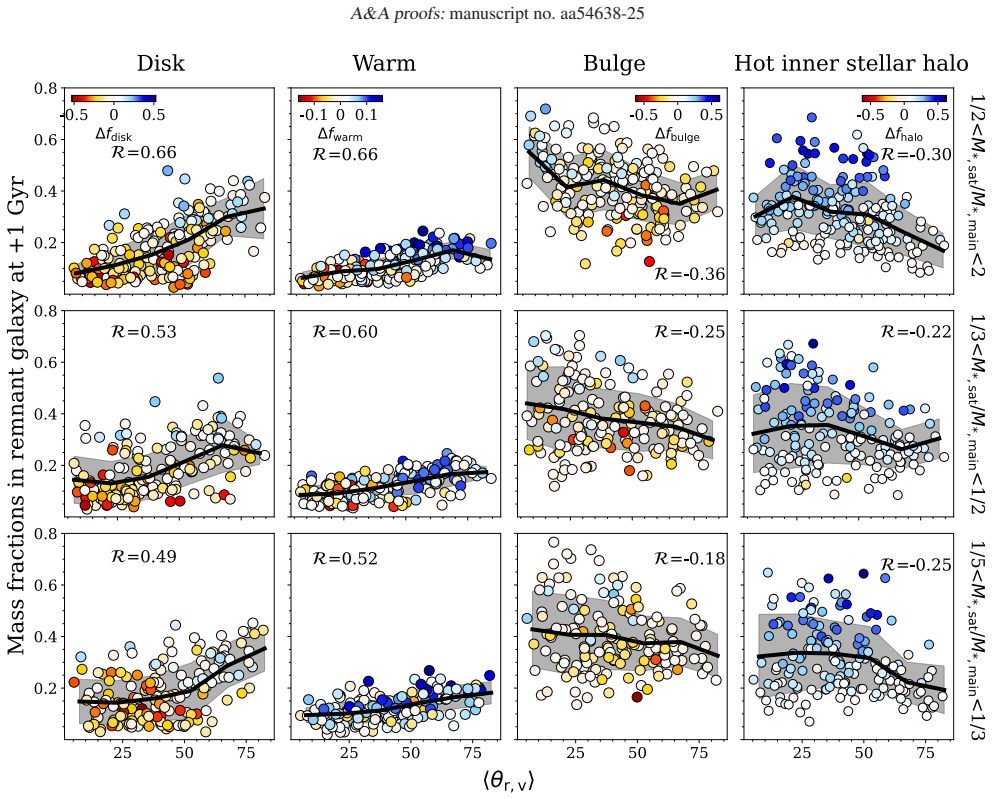
The paper's central claim is that the orbital configuration of a merger is a first-order determinant of the remnant's structure. For mergers on spiral-in orbits the disk planes of both galaxies tend to lie nearly parallel to the orbital plane, and the remnant retains higher fractions of disk and warm components and lower fractions of bulge and hot inner stellar halo; for mergers on head-on collision orbits the disk planes tend to lie perpendicular to the orbital plane, producing the opposite outcome. The correlation between the orbital angle $\langle \theta_{r,v}\rangle$ and remnant disk fraction reaches $R=0.66$ for major mergers, comparable in strength to mass-ratio effects. A second load-bearing result is that mergers almost always grow the hot inner stellar halo, increasing its fraction in 93% of cases, so after several mergers a galaxy's inner-halo fraction becomes a faithful record of its total accreted stellar mass. This is offered as an explanation for the observed correlation between inner-halo luminosity and ex situ stellar mass at $z=0$, and as a caution that disk or bulge mass fractions cannot be read as universal merger counters.
Load-bearing premise
The analysis assumes that one gigayear before a merger the two galaxies are still unperturbed and that one gigayear after it the remnant has already settled into equilibrium; if either timescale is wrong, the measured structural changes would not reflect the merger's permanent outcome.
Editorial extensions
If this is right
- Remnant disk survival in the simulation is predictable from the orbital angle: tangential, spiral-in accretion preserves disks, radial head-on accretion destroys them, with correlation $R=0.66$ for major mergers.
- Because the hot inner stellar halo fraction rises after nearly every merger, it accumulates accreted mass across a galaxy's whole history, making it a more dependable indicator of ex situ stellar mass than bulge fraction.
- The $z=0$ correlation between inner-halo fraction and ex situ stellar mass emerges from the averaging of many individual mergers, each of which scatters widely around the relation.
- Spiral-in mergers can produce red but HI-rich galaxies by depositing HI at large radius with high angular momentum while the stellar body remains quenched.
- Disk and bulge fractions should not be used as simple merger counters, since a merger can raise or lower them depending on orbit.
Reading between the lines
- Beyond the paper: if orbit is this influential, semi-analytic and zoom-in merger models that track only mass ratio and gas fraction will mispredict remnant structure; adding the three angles as inputs would sharpen morphology predictions without new physics.
- Beyond the paper: the angle–structure relations could be tested observationally by classifying mergers as prograde versus retrograde from stellar kinematics and comparing the resulting halo and disk properties in the local universe.
- Beyond the paper: the 93% hot-halo increase suggests that measuring the hot inner stellar halo of a galaxy could serve as a practical single-number proxy for accumulated merger mass, even when the full merger tree is unavailable.
- Beyond the paper: a direct check would be to rerun a subset of the same mergers at higher time resolution or in a different simulation code; if the orbit–structure ordering survives, the result is robust to numerical details.
Editorial analysis
A structured set of objections, weighed in public.
Referee Report
Summary. The manuscript analyzes 531 merger pairs from IllustrisTNG-100, restricting to mergers with mass ratio above 1/5 and main progenitors with disk fraction above 0.1. It decomposes galaxies into disk, warm, bulge, and hot inner stellar halo components using circularity and radius cuts, defines three merger orbital angles (θr,v, θLmain,Lorbit, θLsat,Lorbit), and reports correlations between these angles and the structural fractions of the remnant measured 1 Gyr after the merger. The main claims are that spiral-in/tangential mergers produce remnants with higher disk and warm fractions and lower bulge and hot inner halo fractions, while head-on/radial mergers do the opposite; that the hot inner halo fraction increases in nearly all mergers; and that this accumulated behavior explains the z=0 correlation between inner halo fraction and total ex situ stellar mass. The paper also proposes spiral-in mergers as a possible formation channel for red but HI-rich galaxies, based on two simulated counterparts.
Significance. If the causal interpretation is upheld, the paper would establish orbital configuration, not only mass ratio or gas fraction, as a first-order determinant of merger-driven structural transformation, and would connect single-merger orbital properties to the scatter in structural indicators of ex situ mass at z=0. The work is based on a public simulation, uses a clearly defined sample and explicitly defines merger-induced changes Δf* even though the headline correlations are not computed on those changes. The proposed RR-galaxy channel is interesting but rests on two objects and is appropriately framed as a possibility. The main weakness is that the causal reading of the central correlations is underdetermined without controlling for progenitor structure, so the significance is conditional on additional analysis.
major comments (3)
- [Section 3.2, Figs. 6 and 8] The central causal claim—that orbital configuration reshapes remnant structure—is based on correlations between the orbital angle ⟨θr,v⟩ and the post-merger fractions f*+1Gyr (R = 0.66, 0.66, −0.36, −0.30 for major mergers), not on correlations with the merger-induced change Δf* = f*+1Gyr − f*main,-1Gyr that is defined in Section 3.2. This distinction matters because Section 3.1 and Summary item 1 show that the orbital configuration is itself correlated with the pre-merger disk orientation: for major mergers, θsum averages 116° on radial orbits versus 81° on spiral-in orbits. If high-disk-fraction progenitors preferentially end up on spiral-in orbits, the reported f*+1Gyr–angle relations could simply reflect initial conditions rather than the merger itself. Please add (i) plots and Pearson/Spearman correlations of Δfdisk, Δfwarm, Δfbulge, and Δfhalo versus ⟨θr,v⟩; (ii) partial correlations of f*+1Gyr with ⟨θr,v⟩ controlling for f*,-1Gyr, merger mass ratio, and gas fraction; and (iii) fdisk,-1Gyr versus ⟨θr,v⟩ and θsum. Without these, the abstract's 'lead to higher fractions' is not supported by the presented statistics.
- [Section 2.3 and Appendix A] The visual filter that excludes pairs with pre-merger disturbance or post-merger substructure is described only by four representative examples and no count. Because the t+1Gyr snapshot is the operational definition of the settled remnant for all 531 pairs, and because the likelihood of being out of equilibrium could plausibly depend on orbital configuration, this subjective filter can bias all of the reported correlations. Please quantify the filter: report how many pairs were excluded, give the distribution of the three angles for excluded versus included pairs, and test sensitivity to an automated equilibrium criterion such as the substructure mass fraction or the convergence of the component fractions between t+1Gyr and t+2Gyr.
- [Section 3.2 and 3.3, Figs. 6 and 8] The Pearson correlation coefficients are reported without uncertainties, p-values, or a statement about whether they are computed on individual points or on the binned running medians. Given the modest values for bulge and halo (R = −0.36 and −0.30) and the highly non-Gaussian angle distributions shown in Fig. 6, the paper should provide bootstrap confidence intervals and Spearman rank coefficients so that the relative strength of the correlations, and in particular the claim that 'the correlations are much weaker in minor mergers', is quantitatively grounded.
minor comments (5)
- [Section 2.2] The disk component is defined as λz > 0.8 without a radial restriction, while warm, bulge, and halo are confined to rcut < r < rmax or r < rcut. Please clarify whether the four fractions are normalized to total stellar mass and whether they are intended to partition the galaxy; as written, stellar mass outside rmax with λz > 0.8 is counted only in fdisk, so the four fractions need not sum to unity.
- [Abstract and Section 3.3] The abstract quotes 93% for the hot inner stellar halo increase, but Section 3.3 only says 'nearly always increases'; please state where the 93% is obtained or remove the number from the abstract.
- [Fig. 9 bottom panels] The claimed strong positive correlation between fhalo,z=0 and the ex situ stellar mass fraction is not quantified; please add a correlation coefficient, a fit, or a scatter estimate so that the strength of the relation can be compared with the scatter shown in the panel.
- [Figs. 3 and 5] The captions contain non-English placeholder text ('给Sample exhibition添加Redshift z' and '* theta_r,v调整为被90度折叠后的') that should be removed before submission.
- [Section 3.1] Equation 5 and the citation to Cai et al. (2013) appear questionable as the source for the isotropic PDF p(θ) = sin θ; please verify the reference or cite a standard source for the isotropic distribution of 3D angles.
Circularity Check
No significant circularity: the orbit-structure correlations are direct measurements of independently defined quantities, and the only self-citations are transparent, non-load-bearing method and consistency references.
full rationale
The paper's central claim is an empirical correlation between merger orbital angles (⟨θr,v⟩, ⟨θ′_Lmain,Lorbit⟩, ⟨θ′_Lsat,Lorbit⟩) and dynamically decomposed structural fractions in the remnant. These quantities are measured independently from TNG100 kinematics and merger trees; no parameter is fitted, and no equation defining an angle or a fraction presupposes the target correlation. The only self-citations are to Zhu et al. (2022a), which supplies the four-component decomposition thresholds (λz > 0.8 for disk, etc.) and previously reported the hot-inner-halo/ex-situ-mass relation. Neither is load-bearing here: the decomposition is applied as a fixed, stated algorithm, and the halo–ex-situ correlation is re-derived directly in Fig. 9 rather than assumed from the citation. The skeptical concern that post-merger fractions partly inherit pre-merger progenitor structure is a possible confounding or control issue, not circularity; the paper also defines and plots Δf* = f*,+1Gyr − f*,main@−1Gyr and reports orbit-dependent changes. Manual exclusion of substructured remnants is a selection choice, not a definitional reduction. No step reduces to its own input, so the circularity score is 0.
Assumptions & free parameters
free parameters (4)
- rcut =
3.5 kpc
- rmax rule =
2Re for Re > 3.5 kpc, else 7 kpc
- progenitor/remnant sampling times =
1 Gyr before and after merger
- main progenitor disk fraction cut =
fdisk > 0.1
assumptions (4)
- domain assumption TNG100 simulation faithfully represents galaxy formation physics
- domain assumption Sublink-gal merger trees correctly identify true merger pairs
- domain assumption Instantaneous lambda_z values are valid for orbital decomposition
- domain assumption Subhalo spin direction represents the stellar disk orientation
Cite this review
Pith. "Pith review of The effects of the orbital configurations of mergers on reshaping galaxy structures." pith.science (2026). https://pith.science/paper/DZ2Z5IUX
@misc{pith2026250702051,
  author       = {Pith},
  title        = {Pith review of: The effects of the orbital configurations of mergers on reshaping galaxy structures},
  year         = {2026},
  howpublished = {\url{https://pith.science/paper/DZ2Z5IUX}},
  note         = {Machine review of arXiv:2507.02051}
}
abstract
We performed a systematic analysis of how the orbital configuration of a merger can influence the structural formation of remnant galaxies using 531 merger pairs selected from IllustrisTNG-100. We comprehensively described the merger orbital configuration, considering the relative orbital motion of the merger pair and their disk orientations. We quantified the galaxy structures by dynamically defining four components: bulge, disk, warm component, and hot inner stellar halo. For mergers on spiral-in orbits, the disk planes of the two merging galaxies tend to be aligned with the orbital plane, leading to higher fractions for the disk and warm components, as well as lower fractions for the bulge and hot inner stellar halo components in the remnant galaxy. For mergers on direct collision orbits, the disk planes of the two galaxies tend to be perpendicular to the orbital plane, leading to lower fractions for disk and warm components, as well as higher fractions of the bulge and hot inner stellar halo in the remnant. Mergers can lead to either an increase or decrease in the disk and bulge mass fraction in the remnant compared to the progenitor galaxy, depending on the merger orbital configurations; however, in 93% of cases, mergers cause an increase in the hot inner stellar halo. As a result, the luminosity fraction of the hot inner stellar halo (but not the bulge) in galaxies at $z=0$ is highly correlated with its total ex situ stellar mass. In addition, we find that merger on spiral-in orbits is one of the possible reasons for the formation of recently discovered red but HI-rich (RR) galaxies.
Figures


Figures from the paper (6 more)




Forward citations
Cited by 1 Pith paper
-
The Formation of Dwarf Galaxy Disks
In 39 simulated isolated dwarfs, extended galaxies grow via merger-built stellar disks that form from high-angular-momentum gas-rich satellites.
Reference graph
Works this paper leans on
-
[1]
2017, Monthly Notices of the Royal Astronomical Society, 464, 2882
Amorisco, N. 2017, Monthly Notices of the Royal Astronomical Society, 464, 2882
work page 2017
-
[2]
D., Naab, T., & Scannapieco, C
Aumer, M., White, S. D., Naab, T., & Scannapieco, C. 2013, Monthly Notices of the Royal Astronomical Society, 434, 3142
work page 2013
-
[3]
2011, Monthly Notices of the Royal Astronomical Society, 416, 1654
Bois, M., Emsellem, E., Bournaud, F., et al. 2011, Monthly Notices of the Royal Astronomical Society, 416, 1654
work page 2011
-
[4]
Bournaud, F., Jog, C. J., & Combes, F. 2007, Astronomy & Astrophysics, 476, 1179
work page 2007
-
[5]
Cai, T. T., Fan, J., & Jiang, T. 2013, Journal of Machine Learning Research, 14, 1837
work page 2013
-
[6]
Conselice, C. J., Yang, C., & Bluck, A. F. 2009, Monthly Notices of the Royal Astronomical Society, 394, 1956
work page 2009
-
[7]
Cox, T. J., Dutta, S. N., Di Matteo, T., et al. 2006, The Astrophysical Journal, 650, 791
work page 2006
-
[8]
Davison, T. A., Norris, M. A., Pfe ffer, J. L., Davies, J. J., & Crain, R. A. 2020, Monthly Notices of the Royal Astronomical Society, 497, 81 De Lucia, G. & Blaizot, J. 2007, Monthly Notices of the Royal Astronomical Society, 375, 2
work page 2020
Show all 62 references
-
[9]
J., Cunnama, D., et al
Deeley, S., Drinkwater, M. J., Cunnama, D., et al. 2017, Monthly Notices of the Royal Astronomical Society, 467, 3934
2017
-
[10]
2009, The Astrophysical Journal, 703, 785 Di Matteo, P., Combes, F., Melchior, A.-L., & Semelin, B
Dekel, A., Ceverino, D., et al. 2009, The Astrophysical Journal, 703, 785 Di Matteo, P., Combes, F., Melchior, A.-L., & Semelin, B. 2007, Astronomy & Astrophysics, 468, 61
2009
-
[11]
M., Belokurov, V ., Font, A
Dillamore, A. M., Belokurov, V ., Font, A. S., & McCarthy, I. G. 2022, MNRAS, 513, 1867
2022
-
[12]
& Stasyszyn, F
Dolag, K. & Stasyszyn, F. 2009, Monthly Notices of the Royal Astronomical Society, 398, 1678
2009
-
[13]
2015, Monthly Notices of the Royal Astronomical Society, 446, 1957
Fiacconi, D., Feldmann, R., & Mayer, L. 2015, Monthly Notices of the Royal Astronomical Society, 446, 1957
2015
-
[14]
M., Hernquist, L., et al
Genel, S., Fall, S. M., Hernquist, L., et al. 2015, The Astrophysical Journal Let- ters, 804, L40
2015
-
[15]
2018, Monthly Notices of the Royal Astronomical Society, 474, 3976
Genel, S., Nelson, D., Pillepich, A., et al. 2018, Monthly Notices of the Royal Astronomical Society, 474, 3976
2018
-
[16]
2014, Monthly Notices of the Royal Astronomical Society, 445, 175
Genel, S., V ogelsberger, M., Springel, V ., et al. 2014, Monthly Notices of the Royal Astronomical Society, 445, 175
2014
-
[17]
M., Armus, L., & Miley, G
Heckman, T. M., Armus, L., & Miley, G. K. 1990, Astrophysical Journal Sup- plement Series (ISSN 0067-0049), vol. 74, Dec. 1990, p. 833-868. Research supported by NSF and NASA., 74, 833
1990
-
[18]
F., Hernquist, L., Cox, T
Hopkins, P. F., Hernquist, L., Cox, T. J., Dutta, S. N., & Rothberg, B. 2008, The Astrophysical Journal, 679, 156
2008
-
[19]
2024, MNRAS, 529, 4565
Hu, J., Wang, L., Ge, J., Zhu, K., & Zeng, G. 2024, MNRAS, 529, 4565
2024
-
[20]
Hubble, E. P. 1926, ApJ, 63, 236
1926
-
[21]
Lagos, C. d. P., Stevens, A. R., Bower, R. G., et al. 2018, Monthly Notices of the Royal Astronomical Society, 473, 4956
2018
-
[22]
2024, The Astrophysical Journal, 963, 86
Li, X., Li, C., Mo, H., et al. 2024, The Astrophysical Journal, 963, 86
2024
-
[23]
2020, The Astrophysical Journal, 905, 177
Li, Z.-Z., Zhao, D.-H., Jing, Y ., Han, J., & Dong, F.-Y . 2020, The Astrophysical Journal, 905, 177
2020
-
[24]
& Belli, S
Man, A. & Belli, S. 2018, Nature Astronomy, 2, 695
2018
-
[25]
2014, Monthly Notices of the Royal Astronomical Society, 437, 1750
Marinacci, F., Pakmor, R., & Springel, V . 2014, Monthly Notices of the Royal Astronomical Society, 437, 1750
2014
-
[26]
2018, Monthly Notices of the Royal Astronomical Society, 480, 5113
Marinacci, F., V ogelsberger, M., Pakmor, R., et al. 2018, Monthly Notices of the Royal Astronomical Society, 480, 5113
2018
-
[27]
2018, Monthly Notices of the Royal Astronomical Society, 480, 2266
Martin, G., Kaviraj, S., Devriendt, J., Dubois, Y ., & Pichon, C. 2018, Monthly Notices of the Royal Astronomical Society, 480, 2266
2018
- [28]
-
[29]
Mihos, J. C. & Hernquist, L. 1996, ApJ, 464, 641
1996
-
[30]
2006, Monthly Notices of the Royal Astro- nomical Society, 372, 839
Naab, T., Jesseit, R., & Burkert, A. 2006, Monthly Notices of the Royal Astro- nomical Society, 372, 839
2006
-
[31]
H., & Ostriker, J
Naab, T., Johansson, P. H., & Ostriker, J. P. 2009, The Astrophysical Journal, 699, L178
2009
-
[32]
2014, Monthly Notices of the Royal Astronomical Society, 444, 3357
Naab, T., Oser, L., Emsellem, E., et al. 2014, Monthly Notices of the Royal Astronomical Society, 444, 3357
2014
-
[33]
P., Pillepich, A., Springel, V ., et al
Naiman, J. P., Pillepich, A., Springel, V ., et al. 2018, Monthly Notices of the Royal Astronomical Society, 477, 1206
2018
-
[34]
& White, S
Negroponte, J. & White, S. D. 1983, Monthly Notices of the Royal Astronomical Society, 205, 1009
1983
-
[35]
2015, Astronomy and Computing, 13, 12
Nelson, D., Pillepich, A., Genel, S., et al. 2015, Astronomy and Computing, 13, 12
2015
-
[36]
2018, Monthly Notices of the Royal Astronomical Society, 475, 624
Nelson, D., Pillepich, A., Springel, V ., et al. 2018, Monthly Notices of the Royal Astronomical Society, 475, 624
2018
-
[37]
2019, Computational Astrophysics and Cosmology, 6, 1
Nelson, D., Springel, V ., Pillepich, A., et al. 2019, Computational Astrophysics and Cosmology, 6, 1
2019
-
[38]
J., Tacchella, S., Diemer, B., et al
Nelson, E. J., Tacchella, S., Diemer, B., et al. 2021, Monthly Notices of the Royal Astronomical Society, 508, 219
2021
-
[39]
P., Naab, T., Johansson, P
Oser, L., Ostriker, J. P., Naab, T., Johansson, P. H., & Burkert, A. 2010, ApJ, 725, 2312
2010
-
[40]
2015, The Astrophysical Journal, 799, 184
Pillepich, A., Madau, P., & Mayer, L. 2015, The Astrophysical Journal, 799, 184
2015
-
[41]
2018, Monthly Notices of the Royal Astronomical Society, 475, 648
Pillepich, A., Nelson, D., Hernquist, L., et al. 2018, Monthly Notices of the Royal Astronomical Society, 475, 648
2018
-
[42]
2019, Monthly Notices of the Royal Astronomical Society, 490, 3196
Pillepich, A., Nelson, D., Springel, V ., et al. 2019, Monthly Notices of the Royal Astronomical Society, 490, 3196
2019
-
[43]
2020, Astronomy & Astrophysics, 641, A60
Pulsoni, C., Gerhard, O., Arnaboldi, M., et al. 2020, Astronomy & Astrophysics, 641, A60
2020
-
[44]
2009, Monthly No- tices of the Royal Astronomical Society, 397, 44
Read, J., Mayer, L., Brooks, A., Governato, F., & Lake, G. 2009, Monthly No- tices of the Royal Astronomical Society, 397, 44
2009
-
[45]
& Forbes, D
Remus, R.-S. & Forbes, D. A. 2022, The Astrophysical Journal, 935, 37
2022
-
[46]
2015, Monthly Notices of the Royal Astronomical Society, 449, 49
Rodriguez-Gomez, V ., Genel, S., V ogelsberger, M., et al. 2015, Monthly Notices of the Royal Astronomical Society, 449, 49
2015
-
[47]
V ., et al
Rodriguez-Gomez, V ., Pillepich, A., Sales, L. V ., et al. 2016, Monthly Notices of the Royal Astronomical Society, 458, 2371
2016
-
[48]
2022, Monthly Notices of the Royal Astronomical Society, 516, 5404
Sotillo-Ramos, D., Pillepich, A., Donnari, M., et al. 2022, Monthly Notices of the Royal Astronomical Society, 516, 5404
2022
-
[49]
& Hernquist, L
Springel, V . & Hernquist, L. 2005, The Astrophysical Journal, 622, L9
2005
-
[50]
2018, Monthly Notices of the Royal Astronomical Society, 475, 676
Springel, V ., Pakmor, R., Pillepich, A., et al. 2018, Monthly Notices of the Royal Astronomical Society, 475, 676
2018
-
[51]
D., Tormen, G., & Kauffmann, G
Springel, V ., White, S. D., Tormen, G., & Kauffmann, G. 2001, Monthly Notices of the Royal Astronomical Society, 328, 726
2001
-
[52]
2019, Monthly Notices of the Royal Astronomical Society, 487, 5416
Tacchella, S., Diemer, B., Hernquist, L., et al. 2019, Monthly Notices of the Royal Astronomical Society, 487, 5416
2019
-
[53]
2018, Monthly Notices of the Royal Astronomical Society, 479, 141
Taylor, P., Federrath, C., & Kobayashi, C. 2018, Monthly Notices of the Royal Astronomical Society, 479, 141
2018
-
[54]
1977, Evolution of Galaxies and Stellar Populations
Toomre, A., Tinsley, B., & Larson, R. 1977, Evolution of Galaxies and Stellar Populations
1977
-
[55]
Vasiliev, E., Belokurov, V ., & Evans, N. W. 2022, The Astrophysical Journal, 926, 203 V ogelsberger, M., Genel, S., Springel, V ., et al. 2014a, Nature, 509, 177 V ogelsberger, M., Genel, S., Springel, V ., et al. 2014b, Monthly Notices of the Royal Astronomical Society, 444, 1518
2022
-
[56]
2014, Monthly Notices of the Royal Astronomical Society: Letters, 445, L46
Welker, C., Devriendt, J., Dubois, Y ., Pichon, C., & Peirani, S. 2014, Monthly Notices of the Royal Astronomical Society: Letters, 445, L46
2014
-
[57]
2016, Monthly Notices of the Royal Astronomical Society, stw2778
Welker, C., Dubois, Y ., Devriendt, J., et al. 2016, Monthly Notices of the Royal Astronomical Society, stw2778
2016
-
[58]
White, S. D. & Rees, M. J. 1978, Monthly Notices of the Royal Astronomical Society, 183, 341
1978
-
[59]
2019, Monthly Notices of the Royal Astronom- ical Society, 489, 842
Xu, D., Zhu, L., Grand, R., et al. 2019, Monthly Notices of the Royal Astronom- ical Society, 489, 842
2019
-
[60]
2021, Monthly Notices of the Royal Astronomical Society, 507, 3301
Zeng, G., Wang, L., & Gao, L. 2021, Monthly Notices of the Royal Astronomical Society, 507, 3301
2021
-
[61]
2025, arXiv preprint arXiv:2501.07151
Zhang, L., Zhu, L., Pillepich, A., et al. 2025, arXiv preprint arXiv:2501.07151
2025 arXiv
-
[62]
2015, Monthly Notices of the Royal Astronomical Society, 450, 2327 Article number, page 11 of 13 A&A proofs: manuscript no
Zolotov, A., Dekel, A., Mandelker, N., et al. 2015, Monthly Notices of the Royal Astronomical Society, 450, 2327 Article number, page 11 of 13 A&A proofs: manuscript no. aa54638-25 Appendix A: Manually excluded samples In Fig. A.1, we present the Y-Z image and the correspondin...
2015
Reviewed August 6, 2026 · model on record in the stance chip above.
Discussion (0). Sign in to comment.