REVIEW 3 major objections 6 minor 1 cited by
On the rapid growth of SMBHs in high-z galaxies: the aftermath of Population III.1 stars
T0 review · 3 major / 6 minor · reviewed 2026-08-06 · deepseek-v4-flash
Pith's one-line read In cosmological simulations, 10^5 solar-mass seeds of Population III.1 origin grow to roughly 10^7 solar masses by z=8 under every AGN feedback model tested, with radiative feedback driving outflows beyond 2500 km/s.
desk verdict A solid simulation study with a genuinely useful feedback decomposition; the masses rest on an untested Bondi-Hoyle assumption and a single halo, but the qualitative conclusions should survive a serious referee. read the letter →
The pith
A machine-rendered reading of the paper's core claim, the machinery that carries it, and where it could break.
The reading
What carries the argument
The argument is carried by a suite of zoom-in cosmological simulations that follow a single dark matter minihalo from z=100 to z=8 with roughly 14 pc maximum cell size, resolving the Bondi radius around the black hole. The seed is a $10^{5}$ solar-mass sink particle whose progenitor is a Population III.1 star; the star's ionizing feedback is modelled self-consistently before collapse, capturing the preheating that sets the initial accretion environment. Black hole growth uses the Bondi-Hoyle-Lyttleton rate computed from cloud particles within roughly 40 pc, and AGN feedback is injected as thermal energy, kinetic winds, and radiation through a radiative transfer scheme with three photon groups. The decisive comparison is across model variants that build up feedback components one at a time, isolating which mechanism regulates accretion and which launches outflows.
What would settle it
Repeat the most complete feedback simulation with an accretion model that accounts for angular momentum transport at scales below about 40 pc, for example by limiting accretion to the rate at which a resolved nuclear disk can lose angular momentum; if the black hole then ends z=8 below roughly $10^{7}$ solar masses, the central claim is refuted. An observational counterpart would be long-cadence monitoring of z~8 overmassive black holes: if sustained super-Eddington accretion, rather than short episodic bursts, is required to explain their masses, the simulated feedback cycle is disfavoured.
Extended reading notes
Core claim
The central claim is that heavy seeds of $10^{5}$ solar masses, formed from the collapse of Population III.1 stars after their ionizing radiation preheats the host minihalo, grow efficiently to roughly $10^{7}$ solar masses by z=8 regardless of how AGN feedback is modelled. The growth is not a single sustained burst: it proceeds through cycles in which super-Eddington accretion episodes, reaching up to about 86 times the Eddington rate, trigger AGN feedback that temporarily suppresses accretion before the next inflow. Across the feedback-regulated models the black hole-to-stellar mass ratio stays between 0.01 and 1, consistent with the overmassive black holes that JWST finds in low-mass galaxies at z>4. The authors conclude that AGN feedback, especially the radiative component, shapes the host galaxy by driving high-velocity winds and slightly suppressing star formation, while allowing the seed to reach supermassive scales within the reionisation era.
Load-bearing premise
The whole result rests on the assumption that gas measured about 40 parsecs from the black hole is actually available to fall in at the computed accretion rate, with no unresolved angular momentum or small-scale feedback withholding it.
Editorial extensions
If this is right
- Seeds of 10^5 solar masses reach roughly 10^7 solar masses by z=8 even with strong AGN feedback, so no artificially boosted accretion is needed to explain moderate-luminosity high-redshift quasars.
- AGN feedback regulates black hole growth through high-accretion, strong-feedback, low-accretion cycles rather than shutting it off, keeping accretion near the Eddington limit.
- Radiative feedback, not thermal or kinetic feedback alone, is required to launch the fastest outflows, which exceed 2500 km/s and extend to about 50 kpc.
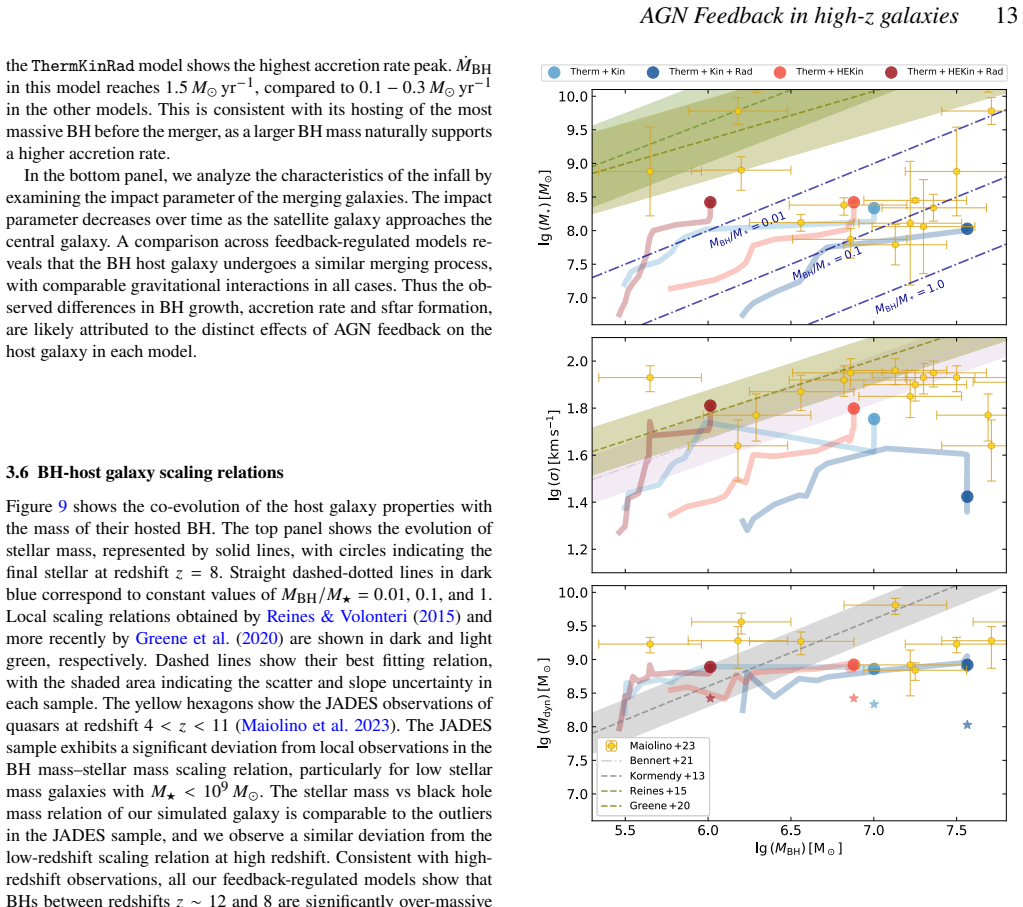
- The simulated black-hole-to-stellar-mass ratios, from 0.01 to 1, reproduce the overmassive black holes seen by JWST and deviate from local scaling relations in the same direction.
- Super-Eddington episodes are short-lived and often merger-triggered, leaving average Eddington ratios of about 0.2 to 0.3 over the full growth history.
Reading between the lines
- If the Bondi prescription overestimates the gas supply because unresolved angular momentum keeps gas in a disc around the black hole, the same seeds would grow more slowly; a direct test would be to repeat one run with accretion limited by resolved angular momentum transport and check whether 10^7 solar masses by z=8 survives.
- The preheating result extends beyond Pop III.1 seeds: any formation pathway in which the host halo is heated before the black hole forms, such as externally irradiated direct-collapse halos, should show a similar short delay followed by rapid Eddington-limited growth.
- The predicted outflow velocities and mass-loading factors give a concrete target for future observations: the fastest outflows should appear in galaxies where the black hole is undergoing a post-merger super-Eddington episode.
- Because the simulations reach 10^7 solar masses by z=8, the same model could be run forward to test whether these black holes end up as the central engines of local dwarf galaxies or grow into the seeds of more massive systems.
Editorial analysis
A structured set of objections, weighed in public.
Referee Report
Summary. NA
Significance. If the central growth claim is robust, this is a valuable contribution: it provides a physically motivated pathway from Pop III.1 seeds to the overmassive BHs seen by JWST at z>8, and it isolates the role of radiative AGN feedback in driving galaxy-scale outflows. Strengths include the systematic variation of feedback physics in a consistent code framework, self-consistent modeling of the Pop III.1 progenitor and its preheating effect, a freely moving BH with resolved dynamical friction, and direct comparison to current JWST samples. The growth predictions are not circular: the feedback efficiencies and seed mass are not tuned to the JWST data. However, the conclusions rest on a single halo and on a Bondi-Hoyle accretion prescription with no angular-momentum-aware subgrid model, and the paper lacks resolution or convergence tests. These gaps make the quantitative claims (e.g., ~10^7 Msun by z=8, outflow velocities and extents) less secure than the presentation suggests.
major comments (3)
- [Sec. 2, Eqs. (4)-(9)] The Bondi-Hoyle accretion prescription is the load-bearing element for the central growth claim, but it contains no subgrid angular-momentum limiter and the claim that the resolution is sufficient to capture the Bondi radius is only marginal. For a 10^5 Msun seed, the Bondi radius is ~4 pc for c_s = 10 km/s and ~0.5 pc for c_s = 30 km/s, while the physical cell size at z~8 is about 1.6 pc and r_cloud = 4 Delta x is only a few pc. If gas at the sink-kernel scale is rotationally supported, the true accretion rate can be much lower than the Bondi rate, and a factor-of-several reduction would pull the final masses below the claimed ~10^7 Msun by z=8. The paper provides no convergence study, no sink-radius sensitivity test, and no comparison with an angular-momentum-aware accretion model. I ask the authors to include at least one resolution test and one test with a rotational-support limiter (e.g., the prescriptions of Rosas-Guevara et al. 2015 or Tremmel et al. 2017) to establish that the central growth result is not an artifact of the unresolved accretion model.
- [Sec. 3.4 and Fig. 5] The outflow claim is attributed to 'AGN-driven radiation pressure' (Sec. 3.4, Fig. 5 caption), but Sec. 2's description of AGN radiation only states that ionizing photon energy is released (Eq. 11, based on Bieri et al. 2017). No radiation-pressure or photon-momentum deposition term is described in the methods. If the code does include radiation pressure, this should be stated explicitly; if it does not, the attribution should be revised to photoionization heating and the resulting pressure gradients, which is the mechanism actually supported by the equations presented. This matters because the fast, kpc-scale outflows in ThermKinRad are a headline result.
- [Sec. 2 (Initial conditions) and Sec. 3.1] All conclusions are drawn from a single zoom-in halo, and the paper acknowledges (Sec. 3.1) that differences among the four feedback-regulated models are 'comparable to those arising from stochastic effects.' Without at least one resolution test and ideally a second halo or an explicit discussion of halo-to-halo variance, the broad claims 'across all our models' and the quantitative agreement with JWST samples in Figs. 3 and 9 are not fully supported. This is not a request for a full statistical sample, but the lack of any convergence test leaves the central claim vulnerable to numerical resolution effects.
minor comments (6)
- [Abstract and Sec. 3.1] The abstract states that seeds reach ~10^7 Msun by z=8 across all models, but the Edd_lim model reaches ~5x10^8 Msun by z~9, and the NoAGN and Therm runs are stopped at z~11, so their z=8 values are not shown. Please qualify the statement to reflect the actual model sample and final redshift.
- [Throughout] The model names are used inconsistently: ThermHEKin/ThermHEKinRad vs ThermHKin/ThermHKinRad, and ThermKinRT vs ThermKinRad. Please adopt a single naming convention in the text, tables, figures, and captions.
- [Sec. 2] The quoted cell width of ~14 pc and cloud radius of ~40 pc should specify whether they are comoving or physical; this is directly relevant to the Bondi-radius resolution argument. At z=8, the physical cell size is ~1.6 pc, which is important for evaluating the claim in Sec. 2.
- [Fig. 1 caption] The caption contains sentence fragments and a typo ('ThemKinRad'); it also lists symbols without defining them in the caption. Please make the caption self-contained and grammatically complete.
- [Sec. 3.5] There is a typo 'sftar formation' in the last paragraph; also, 'ThermHEKinRad' appears where 'ThermHKinRad' or 'ThermHEKinRad' should be used consistently.
- [Abstract and Sec. 4] The abstract reports stellar masses of ~10^8.5 Msun, while Sec. 4 states a host galaxy stellar mass of ~5x10^8 Msun; please reconcile these values or clarify which mass (e.g., within 0.15 Rvir vs total) is being quoted.
Circularity Check
No significant circularity: the claimed BH growth and JWST comparison emerge from the simulations rather than being imposed by construction or by load-bearing self-citations.
full rationale
The paper's central claims are the BH mass growth to ~1e7 Msun by z=8 and the AGN-feedback-driven outflow properties. These are outputs of the simulation pipeline, not inputs. The Bondi-Hoyle accretion rate (Eqs. 4-9) is a stated physical prescription with fixed kernel choices; no parameter is fitted to the JWST data used for comparison, and the AGN feedback efficiencies (Table 1) are fixed model variations, not calibrated to reproduce the observed BH masses or Eddington ratios. The Pop III.1 seed mass (1e5 Msun) and the feedback efficiencies are adopted from prior work, including self-citations (Banik et al. 2019; Sanati et al. submitted), but they serve as initial conditions and experimental parameters; the growth outcome is integrated dynamically and, as Appendix A states, "all memory of the seeding scenario is deleted from the growth rate in less than ~100 Myr", showing that the final masses are not forced by the seed choice. Neither the self-citations nor the cited Pop III.1 framework are used to forbid alternatives or to invoke an external theorem that would make the conclusions definitional; the paper itself generalizes to other preheating scenarios. The reader's concern about missing sub-grid angular momentum in the Bondi prescription is a modeling assumption and a possible robustness limitation, but it is not a circularity: the accretion rate is not constructed to equal the observed target masses. The comparison with JWST quasars is an a posteriori consistency check, and the scaling relations are measured outputs, so no fitted-input-called-prediction pattern is present. Overall, the derivation chain is self-contained with respect to the claims being made.
Assumptions & free parameters
free parameters (7)
- AGN thermal feedback efficiency =
eps_f,therm = 0.15
- AGN kinetic feedback efficiency (weak) =
eps_f,kin = 0.15
- AGN kinetic feedback efficiency (strong) =
eps_f,kin = 0.85
- AGN radiative feedback efficiency =
eps_f,rt = 0.70
- BH seed mass =
10^5 M_sun
- Reduced speed of light =
0.2c
- Kinetic feedback injection velocity =
10^4 km/s
assumptions (5)
- domain assumption Bondi-Hoyle accretion formula describes the BH gas supply at unresolved scales
- domain assumption Pop III.1 stars collapse into SMBH seeds of 10^5 M_sun with high efficiency
- domain assumption AGN feedback energy deposition follows Eq. 10 with chosen efficiencies
- domain assumption Reduced speed of light approximation (0.2c) is sufficient for ISM RT
- domain assumption Ideal MHD with primordial seed field 10^-21 G is adequate
Cite this review
Pith. "Pith review of On the rapid growth of SMBHs in high-z galaxies: the aftermath of Population III.1 stars." pith.science (2026). https://pith.science/paper/7MLQEQX3
@misc{pith2026250702058,
  author       = {Pith},
  title        = {Pith review of: On the rapid growth of SMBHs in high-z galaxies: the aftermath of Population III.1 stars},
  year         = {2026},
  howpublished = {\url{https://pith.science/paper/7MLQEQX3}},
  note         = {Machine review of arXiv:2507.02058}
}
abstract
The vast amount of energy released by active galactic nuclei (AGN) is increasingly recognized as a key driver of evolution not only in massive galaxies and clusters, but also in low-mass dwarf galaxies. Despite this, their role in the early stages of galaxy formation and in self-regulating the rapid growth of the first and abundant supermassive black holes (SMBHs) remains poorly understood. Through new high-resolution zoom-in cosmological simulations, we follow the co-evolution of $10^5 M_\odot$ black hole seeds with their host galaxy. The simulated suite progressively spans physics ranging from no AGN feedback and Eddington-limited thermal feedback, to more complex setups including non-Eddington-limited thermal, kinetic and radiative feedback. Across all our models, we find that black hole seeds efficiently reach masses of $\sim10^7 M_\odot$ by z=8. Although they exhibit notably different mass growth histories, these latter seem unimpeded by the presence of AGN feedback. The simulation including radiative feedback is the most distinct, with super-Eddington episodes driving fast and mass-loaded gas outflows (exceeding 2500 km $s^{-1}$) up to $\sim$50 kpc, along with minor stellar mass suppression in the host galaxy. Our measurements are in broad agreement with moderate luminosity quasars recently observed by JWST, producing overmassive black holes, dynamical masses of $\sim10^{9.5} M_\odot$, and high, though short-lived, Eddington fraction accretion rates. These results advocate for a scenario where AGN feedback allows for rapid SMBH growth during the reionisation era, while driving winds that extend deep into the intergalactic medium - shaping host galaxies as well as more distant surroundings.
Figures


Figures from the paper (6 more)


Forward citations
Cited by 1 Pith paper
-
Supermassive Black Hole Growth in Massive Galaxies at Cosmic Dawn
In a simulated ~1e11 Msun halo at z 15-9, stellar feedback starves the central black hole about 50% of the time, and AGN feedback never quenches star formation.
Reference graph
Works this paper leans on
-
[1]
Adachi K., Kodama T., P \'e rez-Mart \' nez J. M., Suzuki T. L., Onodera M., 2025, @doi [arXiv e-prints] 10.48550/arXiv.2506.01088 , https://ui.adsabs.harvard.edu/abs/2025arXiv250601088A p. arXiv:2506.01088
-
[2]
Agertz O., et al., 2020, @doi [ ] 10.1093/mnras/stz3053 , https://ui.adsabs.harvard.edu/abs/2020MNRAS.491.1656A 491, 1656
-
[3]
T., Bogd \'a n \'A ., Kov \'a cs O
Ananna T. T., Bogd \'a n \'A ., Kov \'a cs O. E., Natarajan P., Hickox R. C., 2024, @doi [ ] 10.3847/2041-8213/ad5669 , https://ui.adsabs.harvard.edu/abs/2024ApJ...969L..18A 969, L18
-
[4]
T., et al., 2024, @doi [Astronomy & Astrophysics] 10.1051/0004-6361/202349025 , 685, A25
Andika I. T., et al., 2024, @doi [Astronomy & Astrophysics] 10.1051/0004-6361/202349025 , 685, A25
-
[5]
Aravindan A., Liu W., Canalizo G., Veilleux S., Bohn T., Sexton R. O., Rupke D. S. N., U V., 2023, @doi [ ] 10.3847/1538-4357/acca7c , https://ui.adsabs.harvard.edu/abs/2023ApJ...950...33A 950, 33
-
[6]
Arjona-G \'a lvez E., Di Cintio A., Grand R. J. J., 2024, @doi [ ] 10.1051/0004-6361/202449439 , https://ui.adsabs.harvard.edu/abs/2024A&A...690A.286A 690, A286
-
[7]
Banik N., Tan J. C., Monaco P., 2019, @doi [Monthly Notices of the Royal Astronomical Society] 10.1093/mnras/sty3298 , 483, 3592
-
[8]
Barai P., Gallerani S., Pallottini A., Ferrara A., Marconi A., Cicone C., Maiolino R., Carniani S., 2018, @doi [ ] 10.1093/mnras/stx2563 , https://ui.adsabs.harvard.edu/abs/2018MNRAS.473.4003B 473, 4003
Show all 204 references
-
[9]
J., Desmond H., Devriendt J., Ferreira P
Bartlett D. J., Desmond H., Devriendt J., Ferreira P. G., Slyz A., 2021, @doi [ ] 10.1093/mnras/staa3516 , https://ui.adsabs.harvard.edu/abs/2021MNRAS.500.4639B 500, 4639
2021 doi
-
[10]
D., Gilmore G., eds, , Vol
Beck R., Wielebinski R., 2013, in Oswalt T. D., Gilmore G., eds, , Vol. 5, Planets, Stars and Stellar Systems. Volume 5: Galactic Structure and Stellar Populations. p. 641, @doi 10.1007/978-94-007-5612-0_13
2013 doi
-
[11]
S., Slyz A., Devriendt J., 2018, @doi [ ] 10.1093/mnras/sty931 , https://ui.adsabs.harvard.edu/abs/2018MNRAS.478..995B 478, 995
Beckmann R. S., Slyz A., Devriendt J., 2018, @doi [ ] 10.1093/mnras/sty931 , https://ui.adsabs.harvard.edu/abs/2018MNRAS.478..995B 478, 995
2018 doi
-
[13]
Belli S., et al., 2024, @doi [ ] 10.1038/s41586-024-07412-1 , https://ui.adsabs.harvard.edu/abs/2024Natur.630...54B 630, 54
2024 doi
-
[14]
N., Auger M
Bennert V. N., Auger M. W., Treu T., Woo J.-H., Malkan M. A., 2011, @doi [ ] 10.1088/0004-637X/742/2/107 , https://ui.adsabs.harvard.edu/abs/2011ApJ...742..107B 742, 107
2011 doi
-
[15]
N., et al., 2021, @doi [ ] 10.3847/1538-4357/ac151a , https://ui.adsabs.harvard.edu/abs/2021ApJ...921...36B 921, 36
Bennert V. N., et al., 2021, @doi [ ] 10.3847/1538-4357/ac151a , https://ui.adsabs.harvard.edu/abs/2021ApJ...921...36B 921, 36
2021 doi
-
[16]
S., Sijacki D., Costa T., Laporte N., Witten C., 2024, @doi [ ] 10.1093/mnras/stad3179 , https://ui.adsabs.harvard.edu/abs/2024MNRAS.527.1033B 527, 1033
Bennett J. S., Sijacki D., Costa T., Laporte N., Witten C., 2024, @doi [ ] 10.1093/mnras/stad3179 , https://ui.adsabs.harvard.edu/abs/2024MNRAS.527.1033B 527, 1033
2024 doi
-
[17]
A., 2017, @doi [ ] 10.1093/mnras/stw2380 , https://ui.adsabs.harvard.edu/abs/2017MNRAS.464.1854B 464, 1854
Bieri R., Dubois Y., Rosdahl J., Wagner A., Silk J., Mamon G. A., 2017, @doi [ ] 10.1093/mnras/stw2380 , https://ui.adsabs.harvard.edu/abs/2017MNRAS.464.1854B 464, 1854
2017 doi
-
[18]
Biernacki P., Teyssier R., Bleuler A., 2017, @doi [ ] 10.1093/mnras/stx845 , https://ui.adsabs.harvard.edu/abs/2017MNRAS.469..295B 469, 295
2017 doi
- [19]
-
[20]
Bluck A. F. L., et al., 2024, @doi [ ] 10.3847/1538-4357/ad0a98 , https://ui.adsabs.harvard.edu/abs/2024ApJ...961..163B 961, 163
2024 doi
-
[21]
Blunier J., Neronov A., 2024, @doi [Astronomy & Astrophysics] 10.1051/0004-6361/202450138 , 691, A34
2024 doi
-
[22]
Bogd \'a n \'A ., et al., 2024, @doi [Nature Astronomy] 10.1038/s41550-023-02111-9 , https://ui.adsabs.harvard.edu/abs/2024NatAs...8..126B 8, 126
2024 doi
-
[23]
Bondi H., Hoyle F., 1944, @doi [ ] 10.1093/mnras/104.5.273 , https://ui.adsabs.harvard.edu/abs/1944MNRAS.104..273B 104, 273
1944 doi
- [24]
-
[25]
Bromm V., Loeb A., 2003, @doi [ ] 10.1038/nature02071 , https://ui.adsabs.harvard.edu/abs/2003Natur.425..812B 425, 812
2003 doi
-
[26]
M., Governato F., Booth C
Brooks A. M., Governato F., Booth C. M., Willman B., Gardner J. P., Wadsley J., Stinson G., Quinn T., 2007, @doi [ ] 10.1086/511765 , https://ui.adsabs.harvard.edu/abs/2007ApJ...655L..17B 655, L17
2007 doi
-
[27]
Butsky I., Zrake J., Kim J.-h., Yang H.-I., Abel T., 2017, @doi [ ] 10.3847/1538-4357/aa799f , https://ui.adsabs.harvard.edu/abs/2017ApJ...843..113B 843, 113
2017 doi
- [28]
-
[29]
C., Singh J., Fontanot F., De Lucia G., Hirschmann M., Xie L., 2025b, @doi [ ] 10.1093/mnras/stae2663 , https://ui.adsabs.harvard.edu/abs/2025MNRAS.536..851C 536, 851
Cammelli V., Monaco P., Tan J. C., Singh J., Fontanot F., De Lucia G., Hirschmann M., Xie L., 2025b, @doi [ ] 10.1093/mnras/stae2663 , https://ui.adsabs.harvard.edu/abs/2025MNRAS.536..851C 536, 851
-
[30]
Carniani S., et al., 2024, @doi [Astronomy & Astrophysics] 10.1051/0004-6361/202347230 , 685, A99
2024 doi
-
[31]
Chiaki G., Chon S., Omukai K., Trinca A., Schneider R., Valiante R., 2023, @doi [ ] 10.1093/mnras/stad689 , https://ui.adsabs.harvard.edu/abs/2023MNRAS.521.2845C 521, 2845
2023 doi
-
[32]
A., Leitherer C., Chen Y., Wofford A., Lundgren B., 2015, @doi [ ] 10.1088/0004-637X/811/2/149 , https://ui.adsabs.harvard.edu/abs/2015ApJ...811..149C 811, 149
Chisholm J., Tremonti C. A., Leitherer C., Chen Y., Wofford A., Lundgren B., 2015, @doi [ ] 10.1088/0004-637X/811/2/149 , https://ui.adsabs.harvard.edu/abs/2015ApJ...811..149C 811, 149
2015 doi
-
[33]
G., 2014, @doi [Monthly Notices of the Royal Astronomical Society] 10.1093/mnras/stu1632 , 444, 2355
Costa T., Sijacki D., Haehnelt M. G., 2014, @doi [Monthly Notices of the Royal Astronomical Society] 10.1093/mnras/stu1632 , 444, 2355
2014 doi
-
[34]
G., 2018, @doi [Monthly Notices of the Royal Astronomical Society] 10.1093/mnras/sty1514 , 479, 2079
Costa T., Rosdahl J., Sijacki D., Haehnelt M. G., 2018, @doi [Monthly Notices of the Royal Astronomical Society] 10.1093/mnras/sty1514 , 479, 2079
2018 doi
-
[35]
A., et al., 2015, @doi [ ] 10.1093/mnras/stv725 , https://ui.adsabs.harvard.edu/abs/2015MNRAS.450.1937C 450, 1937
Crain R. A., et al., 2015, @doi [ ] 10.1093/mnras/stv725 , https://ui.adsabs.harvard.edu/abs/2015MNRAS.450.1937C 450, 1937
2015 doi
-
[36]
Curtis M., Sijacki D., 2015, @doi [ ] 10.1093/mnras/stv2246 , https://ui.adsabs.harvard.edu/abs/2015MNRAS.454.3445C 454, 3445
2015 doi
-
[37]
D'Eugenio F., et al., 2024, @doi [Nature Astronomy] 10.1038/s41550-024-02345-1 , https://ui.adsabs.harvard.edu/abs/2024NatAs...8.1443D 8, 1443
2024 doi
-
[38]
Dashyan G., Dubois Y., 2020, @doi [ ] 10.1051/0004-6361/201936339 , https://ui.adsabs.harvard.edu/abs/2020A&A...638A.123D 638, A123
2020 doi
-
[39]
H., Appleby S., 2019, @doi [ ] 10.1093/mnras/stz937 , https://ui.adsabs.harvard.edu/abs/2019MNRAS.486.2827D 486, 2827
Dav \'e R., Angl \'e s-Alc \'a zar D., Narayanan D., Li Q., Rafieferantsoa M. H., Appleby S., 2019, @doi [ ] 10.1093/mnras/stz937 , https://ui.adsabs.harvard.edu/abs/2019MNRAS.486.2827D 486, 2827
2019 doi
-
[40]
L., et al., 2024, @doi [ ] 10.1093/mnras/stae327 , https://ui.adsabs.harvard.edu/abs/2024MNRAS.528.4976D 528, 4976
Davies R. L., et al., 2024, @doi [ ] 10.1093/mnras/stae327 , https://ui.adsabs.harvard.edu/abs/2024MNRAS.528.4976D 528, 4976
2024 doi
-
[41]
Davis F., et al., 2022, @doi [ ] 10.1093/mnras/stac068 , https://ui.adsabs.harvard.edu/abs/2022MNRAS.511.4109D 511, 4109
2022 doi
-
[42]
D \' az-Santos T., et al., 2017, @doi [ ] 10.3847/1538-4357/aa81d7 , https://ui.adsabs.harvard.edu/abs/2017ApJ...846...32D 846, 32
2017 doi
-
[43]
Ding X., et al., 2020, @doi [ ] 10.3847/1538-4357/ab5b90 , https://ui.adsabs.harvard.edu/abs/2020ApJ...888...37D 888, 37
2020 doi
-
[44]
Dome T., Martin-Alvarez S., Tacchella S., Yuan Y., Sijacki D., 2025, @doi [ ] 10.1093/mnras/staf006 , https://ui.adsabs.harvard.edu/abs/2025MNRAS.537..629D 537, 629
2025 doi
-
[45]
Dubois Y., Devriendt J., Slyz A., Teyssier R., 2010, @doi [ ] 10.1111/j.1365-2966.2010.17338.x , https://ui.adsabs.harvard.edu/abs/2010MNRAS.409..985D 409, 985
2010
-
[47]
Dubois Y., et al., 2014, @doi [ ] 10.1093/mnras/stu1227 , https://ui.adsabs.harvard.edu/abs/2014MNRAS.444.1453D 444, 1453
2014 doi
-
[48]
Dubroca B., Feugeas J., 1999, @doi [Academie des Sciences Paris Comptes Rendus Serie Sciences Mathematiques] 10.1016/S0764-4442(00)87499-6 , https://ui.adsabs.harvard.edu/abs/1999CRASM.329..915D 329, 915
1999 doi
-
[49]
Edgar R., 2004, @doi [ ] 10.1016/j.newar.2004.06.001 , https://ui.adsabs.harvard.edu/abs/2004NewAR..48..843E 48, 843
2004 doi
-
[51]
P., Whitler L., Topping M
Endsley R., Stark D. P., Whitler L., Topping M. W., Chen Z., Plat A., Chisholm J., Charlot S., 2023, @doi [ ] 10.1093/mnras/stad1919 , https://ui.adsabs.harvard.edu/abs/2023MNRAS.524.2312E 524, 2312
2023 doi
-
[52]
Endsley R., et al., 2024, @doi [ ] 10.1093/mnras/stae1857 , https://ui.adsabs.harvard.edu/abs/2024MNRAS.533.1111E 533, 1111
2024 doi
-
[53]
Farcy M., Rosdahl J., Dubois Y., Blaizot J., Martin-Alvarez S., 2022, @doi [ ] 10.1093/mnras/stac1196 , https://ui.adsabs.harvard.edu/abs/2022MNRAS.513.5000F 513, 5000
2022 doi
-
[54]
arXiv:2504.08041
Farcy M., et al., 2025, @doi [arXiv e-prints] 10.48550/arXiv.2504.08041 , https://ui.adsabs.harvard.edu/abs/2025arXiv250408041F p. arXiv:2504.08041
2025 doi
-
[55]
Farrah D., et al., 2023, @doi [ ] 10.3847/1538-4357/acac2e , https://ui.adsabs.harvard.edu/abs/2023ApJ...943..133F 943, 133
2023 doi
-
[56]
Faucher-Gigu \`e re C.-A., 2018, @doi [ ] 10.1093/mnras/stx2595 , https://ui.adsabs.harvard.edu/abs/2018MNRAS.473.3717F 473, 3717
2018 doi
-
[57]
S., 2012, @doi [Astrophysical Journal] 10.1088/0004-637X/761/2/156 , 761, 156
Federrath C., Klessen R. S., 2012, @doi [Astrophysical Journal] 10.1088/0004-637X/761/2/156 , 761, 156
2012 doi
-
[58]
J., Korista K
Ferland G. J., Korista K. T., Verner D. A., Ferguson J. W., Kingdon J. B., Verner E. M., 1998, @doi [Publications of the Astronomical Society of the Pacific] 10.1086/316190 , 110, 761
1998 doi
-
[59]
Ferrara A., Salvadori S., Yue B., Schleicher D., 2014, @doi [ ] 10.1093/mnras/stu1280 , https://ui.adsabs.harvard.edu/abs/2014MNRAS.443.2410F 443, 2410
2014 doi
-
[60]
A., Spolyar D., 2009, @doi [ ] 10.1088/0004-637X/693/2/1563 , https://ui.adsabs.harvard.edu/abs/2009ApJ...693.1563F 693, 1563
Freese K., Gondolo P., Sellwood J. A., Spolyar D., 2009, @doi [ ] 10.1088/0004-637X/693/2/1563 , https://ui.adsabs.harvard.edu/abs/2009ApJ...693.1563F 693, 1563
2009 doi
-
[62]
Fromang S., Hennebelle P., Teyssier R., 2006b, @doi [Astronomy & Astrophysics] 10.1051/0004-6361:20065371 , 457, 371
-
[63]
J., et al., 2024, @doi [ ] 10.1038/s41586-024-07184-8 , https://ui.adsabs.harvard.edu/abs/2024Natur.628...57F 628, 57
Furtak L. J., et al., 2024, @doi [ ] 10.1038/s41586-024-07184-8 , https://ui.adsabs.harvard.edu/abs/2024Natur.628...57F 628, 57
2024 doi
-
[64]
A., Bondarenko K., Boyarsky A., Nelson D., Pillepich A., Sokolenko A., 2021, @doi [Monthly Notices of the Royal Astronomical Society] 10.1093/mnras/stab1632 , 505, 5038
Garcia A. A., Bondarenko K., Boyarsky A., Nelson D., Pillepich A., Sokolenko A., 2021, @doi [Monthly Notices of the Royal Astronomical Society] 10.1093/mnras/stab1632 , 505, 5038
2021 doi
-
[65]
Garg D., Durrer R., Schober J., 2025, Are magnetic fields in cosmic voids primordial?, @doi 10.48550/arXiv.2505.14774 , http://arxiv.org/abs/2505.14774
2025 doi
-
[66]
Genel S., et al., 2014, @doi [ ] 10.1093/mnras/stu1654 , https://ui.adsabs.harvard.edu/abs/2014MNRAS.445..175G 445, 175
2014 doi
-
[67]
Y., Abel T., 2001, @doi [ ] 10.1016/S1384-1076(01)00068-9 , https://ui.adsabs.harvard.edu/abs/2001NewA....6..437G 6, 437
Gnedin N. Y., Abel T., 2001, @doi [ ] 10.1016/S1384-1076(01)00068-9 , https://ui.adsabs.harvard.edu/abs/2001NewA....6..437G 6, 437
2001 doi
-
[68]
Go M., et al., 2025, @doi [ ] 10.3847/1538-4357/add2fa , https://ui.adsabs.harvard.edu/abs/2025ApJ...986..214G 986, 214
2025 doi
-
[69]
K., 2003, @doi [Journal of Astrophysics and Astronomy] 10.1007/BF02702312 , 24, 51
Gopal R., Sethi S. K., 2003, @doi [Journal of Astrophysics and Astronomy] 10.1007/BF02702312 , 24, 51
2003 doi
-
[70]
H., Bluck A
Goubert P. H., Bluck A. F. L., Piotrowska J. M., Maiolino R., 2024, @doi [ ] 10.1093/mnras/stae269 , https://ui.adsabs.harvard.edu/abs/2024MNRAS.528.4891G 528, 4891
2024 doi
-
[71]
W., Sahu N., 2023, @doi [ ] 10.1093/mnras/stac2019 , https://ui.adsabs.harvard.edu/abs/2023MNRAS.518.2177G 518, 2177
Graham A. W., Sahu N., 2023, @doi [ ] 10.1093/mnras/stac2019 , https://ui.adsabs.harvard.edu/abs/2023MNRAS.518.2177G 518, 2177
2023 doi
-
[72]
E., Strader J., Ho L
Greene J. E., Strader J., Ho L. C., 2020, @doi [ ] 10.1146/annurev-astro-032620-021835 , https://ui.adsabs.harvard.edu/abs/2020ARA&A..58..257G 58, 257
2020 doi
-
[73]
E., et al., 2024, @doi [ ] 10.3847/1538-4357/ad1e5f , https://ui.adsabs.harvard.edu/abs/2024ApJ...964...39G 964, 39
Greene J. E., et al., 2024, @doi [ ] 10.3847/1538-4357/ad1e5f , https://ui.adsabs.harvard.edu/abs/2024ApJ...964...39G 964, 39
2024 doi
-
[74]
Y., Guszejnov D., Hopkins P
Grudi \'c M. Y., Guszejnov D., Hopkins P. F., Offner S. S. R., Faucher-Gigu \`e re C.-A., 2021, @doi [ ] 10.1093/mnras/stab1347 , https://ui.adsabs.harvard.edu/abs/2021MNRAS.506.2199G 506, 2199
2021 doi
-
[75]
Haardt F., Madau P., 1996, @doi [The Astrophysical Journal] 10.1086/177035 , 461, 20
1996 doi
-
[76]
Hahn O., Abel T., 2011, @doi [ ] 10.1111/j.1365-2966.2011.18820.x , https://ui.adsabs.harvard.edu/abs/2011MNRAS.415.2101H 415, 2101
2011
-
[77]
Harikane Y., et al., 2023a, A JWST / NIRSpec First Census of Broad - Line AGNs at z=4-7: Detection of 10 Faint AGNs with M \_BH 10 6-10 8 M \_sun and Their Host Galaxy Properties , http://arxiv.org/abs/2303.11946
-
[78]
Harikane Y., et al., 2023b, @doi [ ] 10.3847/1538-4365/acaaa9 , https://ui.adsabs.harvard.edu/abs/2023ApJS..265....5H 265, 5
-
[79]
J., et al., 2024, Glimmers in the Cosmic Dawn : A Census of the Youngest Supermassive Black Holes by Photometric Variability , http://arxiv.org/abs/2403.16138
Hayes M. J., et al., 2024, Glimmers in the Cosmic Dawn : A Census of the Youngest Supermassive Black Holes by Photometric Variability , http://arxiv.org/abs/2403.16138
2024 arXiv
-
[80]
C., Hopkins P
Hayward C. C., Hopkins P. F., 2017, @doi [ ] 10.1093/mnras/stw2888 , https://ui.adsabs.harvard.edu/abs/2017MNRAS.465.1682H 465, 1682
2017 doi
-
[81]
M., Alexandroff R
Heckman T. M., Alexandroff R. M., Borthakur S., Overzier R., Leitherer C., 2015, @doi [ ] 10.1088/0004-637X/809/2/147 , https://ui.adsabs.harvard.edu/abs/2015ApJ...809..147H 809, 147
2015 doi
-
[82]
F., Raives M
Hopkins P. F., Raives M. J., 2016, @doi [ ] 10.1093/mnras/stv2180 , https://ui.adsabs.harvard.edu/abs/2016MNRAS.455...51H 455, 51
2016 doi
-
[83]
F., Chan T
Hopkins P. F., Chan T. K., Ji S., Hummels C. B., Kere s D., Quataert E., Faucher-Gigu \`e re C.-A., 2021, @doi [ ] 10.1093/mnras/staa3690 , https://ui.adsabs.harvard.edu/abs/2021MNRAS.501.3640H 501, 3640
2021 doi
-
[84]
A., 1939, @doi [Proceedings of the Cambridge Philosophical Society] 10.1017/S0305004100021150 , https://ui.adsabs.harvard.edu/abs/1939PCPS...35..405H 35, 405
Hoyle F., Lyttleton R. A., 1939, @doi [Proceedings of the Cambridge Philosophical Society] 10.1017/S0305004100021150 , https://ui.adsabs.harvard.edu/abs/1939PCPS...35..405H 35, 405
1939 doi
-
[85]
Hu C.-Y., et al., 2023, @doi [ ] 10.3847/1538-4357/accf9e , https://ui.adsabs.harvard.edu/abs/2023ApJ...950..132H 950, 132
2023 doi
-
[86]
G., Roper W
Hu s ko F., Lacey C. G., Roper W. J., Schaye J., Briggs J. M., Schaller M., 2025, @doi [ ] 10.1093/mnras/staf146 , https://ui.adsabs.harvard.edu/abs/2025MNRAS.537.2559H 537, 2559
2025 doi
-
[87]
Inayoshi K., Visbal E., Haiman Z., 2020, @doi [Annual Review of Astronomy and Astrophysics] 10.1146/annurev-astro-120419-014455 , 58, 27
2020 doi
-
[88]
Irodotou D., et al., 2022, @doi [ ] 10.1093/mnras/stac1143 , https://ui.adsabs.harvard.edu/abs/2022MNRAS.513.3768I 513, 3768
2022 doi
-
[89]
Jahnke K., et al., 2009, @doi [ ] 10.1088/0004-637X/706/2/L215 , https://ui.adsabs.harvard.edu/abs/2009ApJ...706L.215J 706, L215
2009 doi
-
[90]
L., Bromm V., 2006, @doi [ ] 10.1111/j.1365-2966.2005.09846.x , https://ui.adsabs.harvard.edu/abs/2006MNRAS.366..247J 366, 247
Johnson J. L., Bromm V., 2006, @doi [ ] 10.1111/j.1365-2966.2005.09846.x , https://ui.adsabs.harvard.edu/abs/2006MNRAS.366..247J 366, 247
2006
-
[91]
L., Bromm V., 2007, @doi [ ] 10.1111/j.1365-2966.2006.11275.x , https://ui.adsabs.harvard.edu/abs/2007MNRAS.374.1557J 374, 1557
Johnson J. L., Bromm V., 2007, @doi [ ] 10.1111/j.1365-2966.2006.11275.x , https://ui.adsabs.harvard.edu/abs/2007MNRAS.374.1557J 374, 1557
2007
-
[92]
Juod z balis I., et al., 2024, @doi [ ] 10.1038/s41586-024-08210-5 , https://ui.adsabs.harvard.edu/abs/2024Natur.636..594J 636, 594
2024 doi
-
[93]
arXiv:2504.03551
Juod z balis I., et al., 2025, @doi [arXiv e-prints] 10.48550/arXiv.2504.03551 , https://ui.adsabs.harvard.edu/abs/2025arXiv250403551J p. arXiv:2504.03551
2025 doi
-
[94]
V., Rosner R., 1996, @doi [ ] 10.1086/177667 , https://ui.adsabs.harvard.edu/abs/1996ApJ...468...28K 468, 28
Kim E.-J., Olinto A. V., Rosner R., 1996, @doi [ ] 10.1086/177667 , https://ui.adsabs.harvard.edu/abs/1996ApJ...468...28K 468, 28
1996 doi
-
[95]
Kimm T., Cen R., 2014, @doi [ ] 10.1088/0004-637X/788/2/121 , https://ui.adsabs.harvard.edu/abs/2014ApJ...788..121K 788, 121
2014 doi
-
[96]
Kimm T., Katz H., Haehnelt M., Rosdahl J., Devriendt J., Slyz A., 2017, @doi [Monthly Notices of the Royal Astronomical Society] 10.1093/mnras/stx052 , 466, stx052
2017 doi
-
[97]
Knebe A., Wagner C., Knollmann S., Diekershoff T., Krause F., 2009, @doi [ ] 10.1088/0004-637X/698/1/266 , https://ui.adsabs.harvard.edu/abs/2009ApJ...698..266K 698, 266
2009 doi
-
[98]
D., et al., 2023, @doi [ ] 10.3847/2041-8213/ace5a0 , https://ui.adsabs.harvard.edu/abs/2023ApJ...954L...4K 954, L4
Kocevski D. D., et al., 2023, @doi [ ] 10.3847/2041-8213/ace5a0 , https://ui.adsabs.harvard.edu/abs/2023ApJ...954L...4K 954, L4
2023 doi
-
[99]
Kokorev V., et al., 2023, @doi [ ] 10.3847/2041-8213/ad037a , https://ui.adsabs.harvard.edu/abs/2023ApJ...957L...7K 957, L7
2023 doi
-
[100]
C., 2013, @doi [Annual Review of Astronomy and Astrophysics] 10.1146/annurev-astro-082708-101811 , 51, 511
Kormendy J., Ho L. C., 2013, @doi [Annual Review of Astronomy and Astrophysics] 10.1146/annurev-astro-082708-101811 , 51, 511
2013 doi
-
[101]
A., Smith M
Koudmani S., Sijacki D., Bourne M. A., Smith M. C., 2019, @doi [ ] 10.1093/mnras/stz097 , https://ui.adsabs.harvard.edu/abs/2019MNRAS.484.2047K 484, 2047
2019 doi
-
[102]
S., Hayward C
Koudmani S., Rennehan D., Somerville R. S., Hayward C. C., Angl \'e s-Alc \'a zar D., Orr M. E., Sands I. S., Wellons S., 2025, @doi [ ] 10.1093/mnras/staf778 , https://ui.adsabs.harvard.edu/abs/2025MNRAS.540.1928K 540, 1928
2025 doi
-
[103]
E., et al., 2024, @doi [ ] 10.3847/2041-8213/ad391f , https://ui.adsabs.harvard.edu/abs/2024ApJ...965L..21K 965, L21
Kov \'a cs O. E., et al., 2024, @doi [ ] 10.3847/2041-8213/ad391f , https://ui.adsabs.harvard.edu/abs/2024ApJ...965L..21K 965, L21
2024 doi
-
[104]
Kroupa P., 2001, @doi [Monthly Notices of the Royal Astronomical Society] 10.1046/j.1365-8711.2001.04022.x , 322, 231
2001
-
[105]
R., McKee C
Krumholz M. R., McKee C. F., Klein R. I., 2004, @doi [ ] 10.1086/421935 , https://ui.adsabs.harvard.edu/abs/2004ApJ...611..399K 611, 399
2004 doi
-
[106]
arXiv:2504.18620
Lah \'e n N., Naab T., Rantala A., Partmann C., 2025, @doi [arXiv e-prints] 10.48550/arXiv.2504.18620 , https://ui.adsabs.harvard.edu/abs/2025arXiv250418620L p. arXiv:2504.18620
2025 doi
-
[107]
L., et al., 2023, @doi [ ] 10.3847/2041-8213/ace619 , https://ui.adsabs.harvard.edu/abs/2023ApJ...953L..29L 953, L29
Larson R. L., et al., 2023, @doi [ ] 10.3847/2041-8213/ace619 , https://ui.adsabs.harvard.edu/abs/2023ApJ...953L..29L 953, L29
2023 doi
-
[108]
T., Cunningham A
Lee A. T., Cunningham A. J., McKee C. F., Klein R. I., 2014, @doi [ ] 10.1088/0004-637X/783/1/50 , https://ui.adsabs.harvard.edu/abs/2014ApJ...783...50L 783, 50
2014 doi
-
[109]
D., 1984, @doi [ ] 10.1016/0022-4073(84)90112-2 , https://ui.adsabs.harvard.edu/abs/1984JQSRT..31..149L 31, 149
Levermore C. D., 1984, @doi [ ] 10.1016/0022-4073(84)90112-2 , https://ui.adsabs.harvard.edu/abs/1984JQSRT..31..149L 31, 149
1984 doi
-
[110]
Li J. I. H., et al., 2023, @doi [ ] 10.3847/1538-4357/acddda , https://ui.adsabs.harvard.edu/abs/2023ApJ...954..173L 954, 173
2023 doi
-
[111]
Liu W., Veilleux S., Canalizo G., Rupke D. S. N., Manzano-King C. M., Bohn T., U V., 2020, @doi [ ] 10.3847/1538-4357/abc269 , https://ui.adsabs.harvard.edu/abs/2020ApJ...905..166L 905, 166
2020 doi
-
[112]
J., et al., 2025, @doi [ ] 10.1051/0004-6361/202347102 , https://ui.adsabs.harvard.edu/abs/2025A&A...697A..88L 697, A88
Looser T. J., et al., 2025, @doi [ ] 10.1051/0004-6361/202347102 , https://ui.adsabs.harvard.edu/abs/2025A&A...697A..88L 697, A88
2025 doi
-
[113]
Lupi A., Haardt F., Dotti M., Fiacconi D., Mayer L., Madau P., 2016, @doi [ ] 10.1093/mnras/stv2877 , https://ui.adsabs.harvard.edu/abs/2016MNRAS.456.2993L 456, 2993
2016 doi
-
[114]
A., 2024, @doi [ ] 10.1051/0004-6361/202348788 , https://ui.adsabs.harvard.edu/abs/2024A&A...686A.256L 686, A256
Lupi A., Quadri G., Volonteri M., Colpi M., Regan J. A., 2024, @doi [ ] 10.1051/0004-6361/202348788 , https://ui.adsabs.harvard.edu/abs/2024A&A...686A.256L 686, A256
2024 doi
-
[115]
The diverse population of infant Black Holes at 4 z 11: merging, tiny, poor, but mighty, http://arxiv.org/abs/2308.01230
Maiolino R., et al., 2023, JADES . The diverse population of infant Black Holes at 4 z 11: merging, tiny, poor, but mighty, http://arxiv.org/abs/2308.01230
2023 arXiv
-
[116]
Maiolino R., et al., 2024a, @doi [ ] 10.1038/s41586-024-07052-5 , https://ui.adsabs.harvard.edu/abs/2024Natur.627...59M 627, 59
-
[117]
Maiolino R., et al., 2024b, @doi [ ] 10.1051/0004-6361/202347640 , https://ui.adsabs.harvard.edu/abs/2024A&A...691A.145M 691, A145
-
[118]
M., Canalizo G., Sales L
Manzano-King C. M., Canalizo G., Sales L. V., 2019, @doi [ ] 10.3847/1538-4357/ab4197 , https://ui.adsabs.harvard.edu/abs/2019ApJ...884...54M 884, 54
2019 doi
-
[119]
Martin-Alvarez S., Slyz A., Devriendt J., G \' o mez-Guijarro C., 2020, @doi [Monthly Notices of the Royal Astronomical Society] 10.1093/mnras/staa1438 , 495, 4475
2020 doi
-
[120]
Martin-Alvarez S., Katz H., Sijacki D., Devriendt J., Slyz A., 2021, @doi [ ] 10.1093/mnras/stab968 , https://ui.adsabs.harvard.edu/abs/2021MNRAS.504.2517M 504, 2517
2021 doi
-
[121]
G., Farcy M., Dubois Y., Belokurov V., Rosdahl J., Lopez-Rodriguez E., 2022, The Pandora project
Martin-Alvarez S., Sijacki D., Haehnelt M. G., Farcy M., Dubois Y., Belokurov V., Rosdahl J., Lopez-Rodriguez E., 2022, The Pandora project. I : the impact of radiation and cosmic rays on baryonic and dark matter properties of dwarf galaxies, http://arxiv.org/abs/2211.09139
2022 arXiv
-
[122]
Martin-Alvarez S., et al., 2023, Extragalactic Magnetism with SOFIA ( SALSA Legacy Program ). VII . A tomographic view of far infrared and radio polarimetric observations through MHD simulations of galaxies, http://arxiv.org/abs/2311.06356
2023 arXiv
-
[123]
arXiv:2506.03245
Martin-Alvarez S., et al., 2025, @doi [arXiv e-prints] 10.48550/arXiv.2506.03245 , https://ui.adsabs.harvard.edu/abs/2025arXiv250603245M p. arXiv:2506.03245
2025 doi
-
[124]
Martizzi D., Teyssier R., Moore B., 2013, @doi [ ] 10.1093/mnras/stt297 , https://ui.adsabs.harvard.edu/abs/2013MNRAS.432.1947M 432, 1947
2013 doi
-
[125]
S., 2023, @doi [ ] 10.1051/0004-6361/202243170 , https://ui.adsabs.harvard.edu/abs/2023A&A...670A.180M 670, A180
Massonneau W., Volonteri M., Dubois Y., Beckmann R. S., 2023, @doi [ ] 10.1051/0004-6361/202243170 , https://ui.adsabs.harvard.edu/abs/2023A&A...670A.180M 670, A180
2023 doi
-
[126]
H., et al., 2023, @doi [ ] 10.1093/mnras/stad2895 , https://ui.adsabs.harvard.edu/abs/2023MNRAS.526.3967M 526, 3967
Matthews J. H., et al., 2023, @doi [ ] 10.1093/mnras/stad2895 , https://ui.adsabs.harvard.edu/abs/2023MNRAS.526.3967M 526, 3967
2023 doi
-
[127]
Merloni A., et al., 2010, @doi [ ] 10.1088/0004-637X/708/1/137 , https://ui.adsabs.harvard.edu/abs/2010ApJ...708..137M 708, 137
2010 doi
-
[128]
Mountrichas G., Buat V., 2023, @doi [ ] 10.1051/0004-6361/202347392 , https://ui.adsabs.harvard.edu/abs/2023A&A...679A.151M 679, A151
2023 doi
-
[129]
Narayan R., Quataert E., 2023, @doi [ ] 10.1038/s41586-023-05768-4 , https://ui.adsabs.harvard.edu/abs/2023Natur.615..597N 615, 597
2023 doi
-
[130]
C., O'Shea B
Natarajan A., Tan J. C., O'Shea B. W., 2009, @doi [ ] 10.1088/0004-637X/692/1/574 , https://ui.adsabs.harvard.edu/abs/2009ApJ...692..574N 692, 574
2009 doi
-
[131]
D., Cappelluti N., 2024, @doi [ ] 10.3847/2041-8213/ad0e76 , https://ui.adsabs.harvard.edu/abs/2024ApJ...960L...1N 960, L1
Natarajan P., Pacucci F., Ricarte A., Bogd \'a n \'A ., Goulding A. D., Cappelluti N., 2024, @doi [ ] 10.3847/2041-8213/ad0e76 , https://ui.adsabs.harvard.edu/abs/2024ApJ...960L...1N 960, L1
2024 doi
-
[132]
Nelson D., et al., 2019, First Results from the TNG50 Simulation : Galactic outflows driven by supernovae and black hole feedback, @doi 10.1093/mnras/stz2306 , http://arxiv.org/abs/1902.05554
2019 arXiv
-
[133]
Ni Y., et al., 2022, @doi [ ] 10.1093/mnras/stac351 , https://ui.adsabs.harvard.edu/abs/2022MNRAS.513..670N 513, 670
2022 doi
-
[134]
S., Hopkins P
O \ n orbe J., Boylan-Kolchin M., Bullock J. S., Hopkins P. F., Kere s D., Faucher-Gigu \`e re C.-A., Quataert E., Murray N., 2015, @doi [ ] 10.1093/mnras/stv2072 , http://adsabs.harvard.edu/abs/2015MNRAS.454.2092O 454, 2092
2015 doi
-
[135]
Pacucci F., Narayan R., 2024, @doi [ ] 10.3847/1538-4357/ad84f7 , https://ui.adsabs.harvard.edu/abs/2024ApJ...976...96P 976, 96
2024 doi
-
[136]
Pacucci F., Nguyen B., Carniani S., Maiolino R., Fan X., 2023, @doi [The Astrophysical Journal Letters] 10.3847/2041-8213/ad0158 , 957, L3
2023 doi
-
[137]
Padoan P., Nordlund A ., 2011, @doi [ ] 10.1088/0004-637X/730/1/4010.48550/arXiv.0907.0248 , https://ui.adsabs.harvard.edu/abs/2011ApJ...730...40P 730, 40
2011
-
[138]
A., 2006, @doi [ ] 10.1051/0004-6361:20064985 , https://ui.adsabs.harvard.edu/abs/2006A&A...453..387P 453, 387
Parizot E., Marcowith A., Ballet J., Gallant Y. A., 2006, @doi [ ] 10.1051/0004-6361:20064985 , https://ui.adsabs.harvard.edu/abs/2006A&A...453..387P 453, 387
2006 doi
-
[139]
Peebles P. J. E., 1980, The large-scale structure of the universe
1980
-
[140]
J., et al., 2018, @doi [ ] 10.1093/mnras/sty202 , https://ui.adsabs.harvard.edu/abs/2018MNRAS.476..979P 476, 979
Penny S. J., et al., 2018, @doi [ ] 10.1093/mnras/sty202 , https://ui.adsabs.harvard.edu/abs/2018MNRAS.476..979P 476, 979
2018 doi
-
[141]
arXiv:2504.08035
Petersson J., et al., 2025, @doi [arXiv e-prints] 10.48550/arXiv.2504.08035 , https://ui.adsabs.harvard.edu/abs/2025arXiv250408035P p. arXiv:2504.08035
2025 doi
-
[142]
Pfister H., Volonteri M., Dubois Y., Dotti M., Colpi M., 2019, @doi [ ] 10.1093/mnras/stz822 , https://ui.adsabs.harvard.edu/abs/2019MNRAS.486..101P 486, 101
2019 doi
-
[144]
Planck Collaboration et al., 2016, @doi [ ] 10.1051/0004-6361/201525830 , https://ui.adsabs.harvard.edu/abs/2016A&A...594A..13P 594, A13
2016 doi
-
[145]
Pontzen A., Governato F., 2012, @doi [ ] 10.1111/j.1365-2966.2012.20571.x , https://ui.adsabs.harvard.edu/abs/2012MNRAS.421.3464P 421, 3464
2012
-
[146]
Rasera Y., Teyssier R., 2006, @doi [Astronomy & Astrophysics] 10.1051/0004-6361:20053116 , 445, 1
2006 doi
-
[147]
E., Volonteri M., 2015, @doi [ ] 10.1088/0004-637X/813/2/82 , https://ui.adsabs.harvard.edu/abs/2015ApJ...813...82R 813, 82
Reines A. E., Volonteri M., 2015, @doi [ ] 10.1088/0004-637X/813/2/82 , https://ui.adsabs.harvard.edu/abs/2015ApJ...813...82R 813, 82
2015 doi
-
[148]
Revaz Y., 2023, @doi [Astronomy & Astrophysics] 10.1051/0004-6361/202347239 , 679, A2
2023 doi
-
[149]
P., Katz H
Rey M. P., Katz H. B., Cameron A. J., Devriendt J., Slyz A., 2024, @doi [ ] 10.1093/mnras/stae388 , https://ui.adsabs.harvard.edu/abs/2024MNRAS.528.5412R 528, 5412
2024 doi
- [150]
-
[151]
H., Freese K., Winget D
Rindler-Daller T., Montgomery M. H., Freese K., Winget D. E., Paxton B., 2015, @doi [ ] 10.1088/0004-637X/799/2/210 , https://ui.adsabs.harvard.edu/abs/2015ApJ...799..210R 799, 210
2015 doi
-
[152]
Rodr \' guez Montero F., Martin-Alvarez S., Slyz A., Devriendt J., Dubois Y., Sijacki D., 2024, @doi [ ] 10.1093/mnras/stae1083 , https://ui.adsabs.harvard.edu/abs/2024MNRAS.530.3617R 530, 3617
2024 doi
-
[153]
Rodr \' guez Morales V., Mezcua M., Dom \' nguez S \'a nchez H., Audibert A., M \"u ller-S \'a nchez F., Siudek M., Er \'o stegui A., 2025, @doi [ ] 10.1051/0004-6361/202453481 , https://ui.adsabs.harvard.edu/abs/2025A&A...697A.235R 697, A235
2025 doi
-
[154]
Rosdahl J., Teyssier R., 2015, @doi [ ] 10.1093/mnras/stv567 , https://ui.adsabs.harvard.edu/abs/2015MNRAS.449.4380R 449, 4380
2015 doi
-
[155]
Rosdahl J., Blaizot J., Aubert D., Stranex T., Teyssier R., 2013, @doi [Monthly Notices of the Royal Astronomical Society] 10.1093/mnras/stt1722 , 436, 2188
2013 doi
-
[156]
Rosdahl J., Schaye J., Teyssier R., Agertz O., 2015, @doi [ ] 10.1093/mnras/stv937 , https://ui.adsabs.harvard.edu/abs/2015MNRAS.451...34R 451, 34
2015 doi
-
[157]
Rosdahl J., et al., 2018, @doi [ ] 10.1093/mnras/sty1655 , https://ui.adsabs.harvard.edu/abs/2018MNRAS.479..994R 479, 994
2018 doi
-
[159]
Rosdahl J., et al., 2022a, @doi [ ] 10.1093/mnras/stac1942 , https://ui.adsabs.harvard.edu/abs/2022MNRAS.515.2386R 515, 2386
-
[160]
N., 1995, @doi [The Astrophysical Journal] 10.1086/175303 , 440, 634
Rosen A., Bregman J. N., 1995, @doi [The Astrophysical Journal] 10.1086/175303 , 440, 634
1995 doi
-
[161]
arXiv:2501.17145
Saldana-Lopez A., et al., 2025a, @doi [arXiv e-prints] 10.48550/arXiv.2501.17145 , https://ui.adsabs.harvard.edu/abs/2025arXiv250117145S p. arXiv:2501.17145
-
[162]
arXiv:2504.07074
Saldana-Lopez A., et al., 2025b, @doi [arXiv e-prints] 10.48550/arXiv.2504.07074 , https://ui.adsabs.harvard.edu/abs/2025arXiv250407074S p. arXiv:2504.07074
-
[163]
E., Jablonka P., 2020, @doi [Astronomy & Astrophysics] 10.1051/0004-6361/202038382 , 643, A54
Sanati M., Revaz Y., Schober J., Kunze K. E., Jablonka P., 2020, @doi [Astronomy & Astrophysics] 10.1051/0004-6361/202038382 , 643, A54
2020 doi
-
[164]
Sanati M., Jeanquartier F., Revaz Y., Jablonka P., 2023, @doi [Astronomy & Astrophysics] 10.1051/0004-6361/202244309 , 669, A94
2023 doi
-
[165]
Sanati M., Martin-Alvarez S., Schober J., Revaz Y., Slyz A., Devriendt J., 2024, @doi [Astronomy & Astrophysics] 10.1051/0004-6361/202449822 , 690, A59
2024 doi
-
[166]
R., Mayer L., Schneider R., Valiante R., 2023, @doi [ ] 10.1093/mnras/stac3608 , https://ui.adsabs.harvard.edu/abs/2023MNRAS.519.1837S 519, 1837
Sassano F., Capelo P. R., Mayer L., Schneider R., Valiante R., 2023, @doi [ ] 10.1093/mnras/stac3608 , https://ui.adsabs.harvard.edu/abs/2023MNRAS.519.1837S 519, 1837
2023 doi
-
[167]
Y., Ostriker J
Sazonov S. Y., Ostriker J. P., Sunyaev R. A., 2004, @doi [ ] 10.1111/j.1365-2966.2004.07184.x , https://ui.adsabs.harvard.edu/abs/2004MNRAS.347..144S 347, 144
2004
-
[168]
Schaye J., et al., 2015, @doi [ ] 10.1093/mnras/stu2058 , https://ui.adsabs.harvard.edu/abs/2015MNRAS.446..521S 446, 521
2015 doi
-
[169]
Schmidt M., 1959, @doi [The Astrophysical Journal] 10.1086/146614 , 129, 243
1959 doi
-
[170]
Schneider R., Valiante R., Trinca A., Graziani L., Volonteri M., Maiolino R., 2023, @doi [ ] 10.1093/mnras/stad2503 , https://ui.adsabs.harvard.edu/abs/2023MNRAS.526.3250S 526, 3250
2023 doi
-
[171]
S., Brooks A
Sharma R. S., Brooks A. M., Tremmel M., Bellovary J., Quinn T. R., 2023, @doi [ ] 10.3847/1538-4357/ace046 , https://ui.adsabs.harvard.edu/abs/2023ApJ...957...16S 957, 16
2023 doi
-
[172]
Shen Y., et al., 2015, @doi [ ] 10.1088/0004-637X/805/2/96 , https://ui.adsabs.harvard.edu/abs/2015ApJ...805...96S 805, 96
2015 doi
- [173]
-
[174]
A., Gebhardt K., Salviander S., Wills B
Shields G. A., Gebhardt K., Salviander S., Wills B. J., Xie B., Brotherton M. S., Yuan J., Dietrich M., 2003, @doi [ ] 10.1086/345348 , https://ui.adsabs.harvard.edu/abs/2003ApJ...583..124S 583, 124
2003 doi
-
[175]
C., Bourne M
Shin E.-j., Sijacki D., Smith M. C., Bourne M. A., Koudmani S., 2025, @doi [arXiv e-prints] 10.48550/arXiv.2504.18384 , https://ui.adsabs.harvard.edu/abs/2025arXiv250418384S p. arXiv:2504.18384
2025 doi
-
[176]
Sijacki D., Springel V., Di Matteo T., Hernquist L., 2007, @doi [ ] 10.1111/j.1365-2966.2007.12153.x , https://ui.adsabs.harvard.edu/abs/2007MNRAS.380..877S 380, 877
2007
-
[177]
F., Nelson D., Hernquist L., 2015, @doi [ ] 10.1093/mnras/stv1340 , https://ui.adsabs.harvard.edu/abs/2015MNRAS.452..575S 452, 575
Sijacki D., Vogelsberger M., Genel S., Springel V., Torrey P., Snyder G. F., Nelson D., Hernquist L., 2015, @doi [ ] 10.1093/mnras/stv1340 , https://ui.adsabs.harvard.edu/abs/2015MNRAS.452..575S 452, 575
2015 doi
-
[178]
C., 2023, @doi [Monthly Notices of the Royal Astronomical Society] 10.1093/mnras/stad2346 , 525, 969
Singh J., Monaco P., Tan J. C., 2023, @doi [Monthly Notices of the Royal Astronomical Society] 10.1093/mnras/stad2346 , 525, 969
2023 doi
-
[179]
Singha M., et al., 2025, @doi [ ] 10.3847/1538-4357/adb979 , https://ui.adsabs.harvard.edu/abs/2025ApJ...984..155S 984, 155
2025 doi
-
[180]
D., Regan J
Smith B. D., Regan J. A., Downes T. P., Norman M. L., O'Shea B. W., Wise J. H., 2018, @doi [ ] 10.1093/mnras/sty2103 , https://ui.adsabs.harvard.edu/abs/2018MNRAS.480.3762S 480, 3762
2018 doi
-
[181]
Spolyar D., Freese K., Gondolo P., 2008, @doi [Physical Review Letters] 10.1103/PhysRevLett.100.051101 , 100, 051101
2008 doi
-
[182]
R., Eldridge J
Stanway E. R., Eldridge J. J., Becker G. D., 2016, @doi [ ] 10.1093/mnras/stv2661 , https://ui.adsabs.harvard.edu/abs/2016MNRAS.456..485S 456, 485
2016 doi
-
[183]
A., Lyu J., Rieke G
Stone M. A., Lyu J., Rieke G. H., Alberts S., Hainline K. N., 2024, @doi [ ] 10.3847/1538-4357/ad2a57 , https://ui.adsabs.harvard.edu/abs/2024ApJ...964...90S 964, 90
2024 doi
-
[184]
Subramanian K., 2016, @doi [Reports on Progress in Physics] 10.1088/0034-4885/79/7/076901 , 79, 076901
2016 doi
-
[185]
B., Allevato V., 2020, @doi [ ] 10.3847/1538-4357/ab5f5f , https://ui.adsabs.harvard.edu/abs/2020ApJ...889...32S 889, 32
Suh H., Civano F., Trakhtenbrot B., Shankar F., Hasinger G., Sanders D. B., Allevato V., 2020, @doi [ ] 10.3847/1538-4357/ab5f5f , https://ui.adsabs.harvard.edu/abs/2020ApJ...889...32S 889, 32
2020 doi
-
[186]
C., Shen X., Wetzel A., Cochrane R
Sun G., Faucher-Gigu \`e re C.-A., Hayward C. C., Shen X., Wetzel A., Cochrane R. K., 2023, @doi [ ] 10.3847/2041-8213/acf85a , https://ui.adsabs.harvard.edu/abs/2023ApJ...955L..35S 955, L35
2023 doi
-
[187]
C., Caplar N., 2020, @doi [ ] 10.1093/mnras/staa1838 , https://ui.adsabs.harvard.edu/abs/2020MNRAS.497..698T 497, 698
Tacchella S., Forbes J. C., Caplar N., 2020, @doi [ ] 10.1093/mnras/staa1838 , https://ui.adsabs.harvard.edu/abs/2020MNRAS.497..698T 497, 698
2020 doi
-
[188]
C., 2008, in Hunt L
Tan J. C., 2008, in Hunt L. K., Madden S. C., Schneider R., eds, IAU Symposium Vol. 255, Low-Metallicity Star Formation: From the First Stars to Dwarf Galaxies. pp 24--32 ( @eprint arXiv 0808.3918 ), @doi 10.1017/S174392130802454X
2008 arXiv
- [189]
- [190]
-
[191]
Teyssier R., 2002, @doi [Astronomy & Astrophysics] 10.1051/0004-6361:20011817 , 385, 337
2002 doi
-
[193]
Teyssier R., Fromang S., Dormy E., 2006b, @doi [Journal of Computational Physics] 10.1016/j.jcp.2006.01.042 , 218, 44
2006 doi
-
[194]
Torrey P., Vogelsberger M., Genel S., Sijacki D., Springel V., Hernquist L., 2014, @doi [ ] 10.1093/mnras/stt2295 , https://ui.adsabs.harvard.edu/abs/2014MNRAS.438.1985T 438, 1985
2014 doi
-
[195]
T \'o th G., 2000, @doi [Journal of Computational Physics] 10.1006/jcph.2000.6519 , https://ui.adsabs.harvard.edu/abs/2000JCoPh.161..605T 161, 605
2000
-
[196]
Trebitsch M., Blaizot J., Rosdahl J., Devriendt J., Slyz A., 2017, @doi [Monthly Notices of the Royal Astronomical Society] 10.1093/mnras/stx1060 , 470, 224
2017 doi
-
[197]
Trebitsch M., et al., 2021, @doi [ ] 10.1051/0004-6361/202037698 , https://ui.adsabs.harvard.edu/abs/2021A&A...653A.154T 653, A154
2021 doi
-
[198]
R., Pontzen A., Anderson L., Bellovary J., 2017, @doi [ ] 10.1093/mnras/stx1160 , https://ui.adsabs.harvard.edu/abs/2017MNRAS.470.1121T 470, 1121
Tremmel M., Karcher M., Governato F., Volonteri M., Quinn T. R., Pontzen A., Anderson L., Bellovary J., 2017, @doi [ ] 10.1093/mnras/stx1160 , https://ui.adsabs.harvard.edu/abs/2017MNRAS.470.1121T 470, 1121
2017 doi
- [199]
-
[200]
\"U bler H., et al., 2024, @doi [ ] 10.1093/mnras/stae943 , https://ui.adsabs.harvard.edu/abs/2024MNRAS.531..355U 531, 355
2024 doi
-
[201]
W., Br \"u ggen M., Brunetti G., Gheller C., Porter D., Ryu D., 2017, @doi [ ] 10.1093/mnras/stw2351 , https://ui.adsabs.harvard.edu/abs/2017MNRAS.464..210V 464, 210
Vazza F., Jones T. W., Br \"u ggen M., Brunetti G., Gheller C., Porter D., Ryu D., 2017, @doi [ ] 10.1093/mnras/stw2351 , https://ui.adsabs.harvard.edu/abs/2017MNRAS.464..210V 464, 210
2017 doi
-
[202]
D., Aalto S., 2020, @doi [ ] 10.1007/s00159-019-0121-9 , https://ui.adsabs.harvard.edu/abs/2020A&ARv..28....2V 28, 2
Veilleux S., Maiolino R., Bolatto A. D., Aalto S., 2020, @doi [ ] 10.1007/s00159-019-0121-9 , https://ui.adsabs.harvard.edu/abs/2020A&ARv..28....2V 28, 2
2020 doi
-
[203]
Vogelsberger M., Genel S., Sijacki D., Torrey P., Springel V., Hernquist L., 2013, @doi [ ] 10.1093/mnras/stt1789 , https://ui.adsabs.harvard.edu/abs/2013MNRAS.436.3031V 436, 3031
2013 doi
-
[204]
Vogelsberger M., Zavala J., Simpson C., Jenkins A., 2014, @doi [ ] 10.1093/mnras/stu1713 , http://adsabs.harvard.edu/abs/2014MNRAS.444.3684V 444, 3684
2014 doi
-
[205]
Volonteri M., Dubois Y., Pichon C., Devriendt J., 2016, @doi [ ] 10.1093/mnras/stw1123 , https://ui.adsabs.harvard.edu/abs/2016MNRAS.460.2979V 460, 2979
2016 doi
-
[206]
M., 1978a, PhD thesis, HARVARD UNIVERSITY
Wasserman I. M., 1978a, PhD thesis, HARVARD UNIVERSITY
-
[207]
Wasserman I., 1978b, @doi [ ] 10.1086/156381 , https://ui.adsabs.harvard.edu/abs/1978ApJ...224..337W 224, 337
-
[208]
Wellons S., et al., 2023, @doi [ ] 10.1093/mnras/stad511 , https://ui.adsabs.harvard.edu/abs/2023MNRAS.520.5394W 520, 5394
2023 doi
-
[209]
Wittor D., Vazza F., Br \"u ggen M., 2017, @doi [ ] 10.1093/mnras/stw2631 , https://ui.adsabs.harvard.edu/abs/2017MNRAS.464.4448W 464, 4448
2017 doi
-
[210]
F., Zurek K
Xiao H., Shen X., Hopkins P. F., Zurek K. M., 2021, @doi [ ] 10.1088/1475-7516/2021/07/039 , https://ui.adsabs.harvard.edu/abs/2021JCAP...07..039X 2021, 039
2021 doi
-
[211]
Zheng Y., et al., 2024, @doi [ ] 10.3847/1538-4357/acfe6b , https://ui.adsabs.harvard.edu/abs/2024ApJ...960...55Z 960, 55
2024 doi
Reviewed August 6, 2026 · model on record in the stance chip above.
Discussion (0). Sign in to comment.