REVIEW 2 major objections 3 minor 43 references
Three-dimensional crustal deformation analysis using physics-informed deep learning
T0 review · 2 major / 3 minor · reviewed 2026-08-06 · deepseek-v4-flash
Pith's one-line read Physics-informed neural networks with four subdomain networks solve and invert 3-D crustal deformation, recovering the 2008 Iwate–Miyagi fault slip from surface GNSS data.
desk verdict First credible 3-D PINN treatment of coseismic deformation with real GNSS data, but the heterogeneous-structure claim is not yet supported because the loss omits interface conditions. read the letter →
The pith
A machine-rendered reading of the paper's core claim, the machinery that carries it, and where it could break.
The reading
What carries the argument
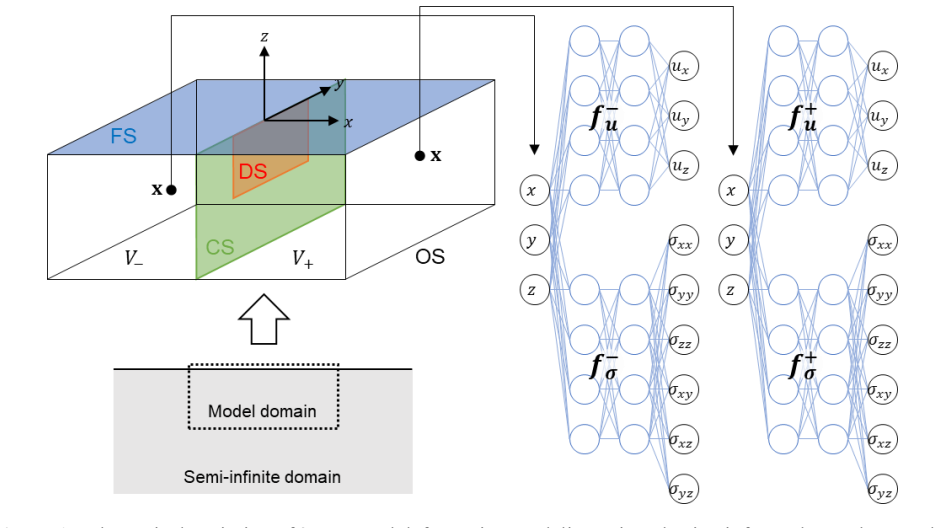
The load-bearing object is a displacement–stress PINN built from four fully connected networks: one for displacement and one for stress in each of two subdomains divided by the fault plane and its extension. Treating displacement and stress as independent outputs keeps the governing system first-order and makes the boundary conditions algebraic, at the cost of satisfying Hooke's law only approximately through a dedicated loss term. The loss function is a sum of residuals for equilibrium, the constitutive law, the displacement discontinuity and traction continuity on the fault, the free-surface condition, continuity across the artificial contact surface, and, in forward runs, zero displacement and stress on the outer surface; in inversion mode the prescribed-slip term is replaced by a shear-only normal-continuity constraint plus a data-misfit term at observation sites.
What would settle it
Run the synthetic inversion with the same 51-station geometry and noise level as the real GNSS data: if the PINN systematically returns a moment magnitude more than 0.1 below the truth while an independent conventional slip inversion on identical synthetic data returns the truth, the underestimation is a property of the PINN method; if both are low, the discrepancy is a data-resolution effect.
Extended reading notes
Core claim
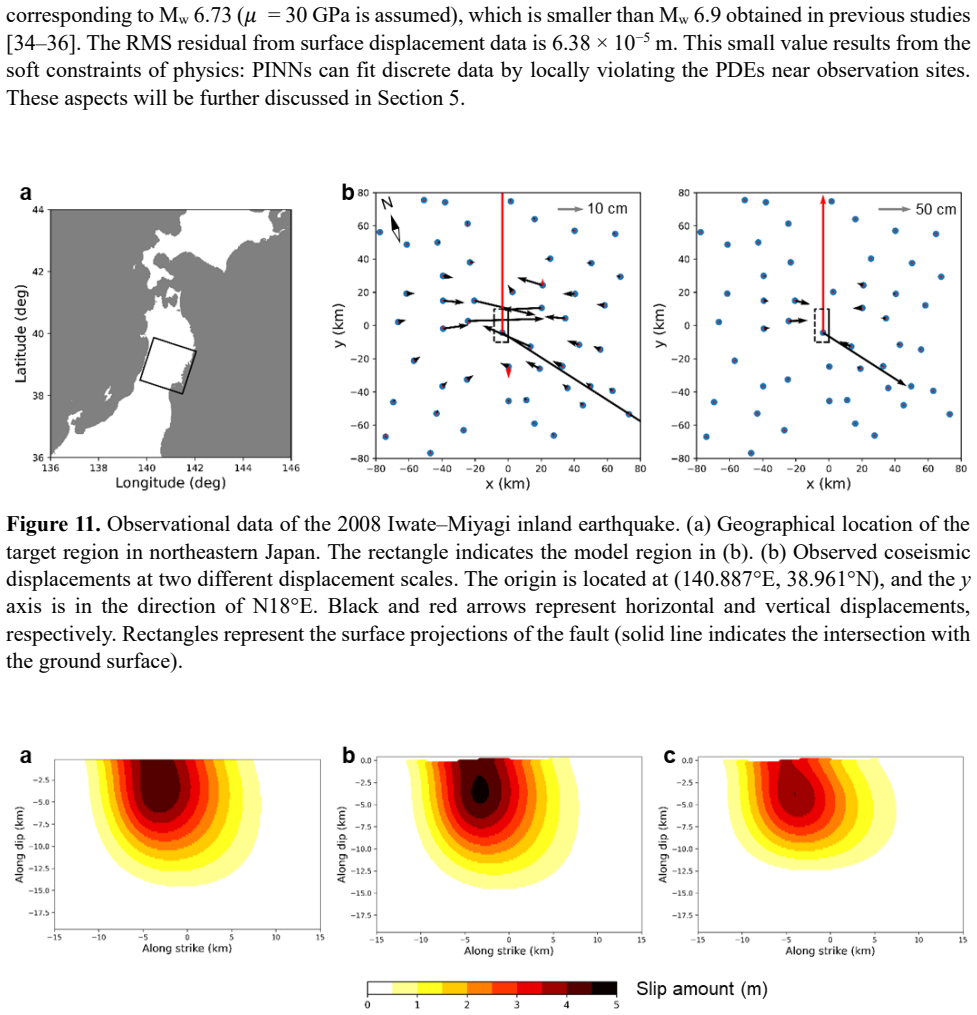
Working with the linear-elastic equilibrium equations and representing the fault as a displacement discontinuity, the paper shows that four fully connected networks (displacement and stress on each side of a fault-bounded split of the domain) can solve the 3-D forward problem in a homogeneous half-space, in a heterogeneous structure with topography, and—after removing the prescribed-slip loss and adding a surface data-misfit term—can invert surface displacements for slip. In the homogeneous half-space, forward surface-displacement errors are about 2–3% near the fault, and once rigid-body motion is anchored by a few known displacement values the errors fall below 1%. The paper itself documents the central caveat: the elastic equations determine internal deformation but not rigid translation or rotation, so forward solutions inherit offsets from the finite outer boundary, whereas in inversion the observed displacements resolve the ambiguity. Applied to satellite-positioning (GNSS) data from the 2008 Iwate–Miyagi inland earthquake, the inversion gives a reverse-dominated slip with a peak of 4.50 m, consistent with the 3.5–6.2 m range from previous studies, but a moment magnitude of about 6.73, below the previously reported 6.9. The paper concludes that PINNs are capable of 3-D crustal deformation analysis and can incorporate realistic layered velocity structure, making large-scale modeling with real observations feasible.
Load-bearing premise
The load-bearing premise is that an artificial outer boundary at 100 times the fault depth, with zero displacement and stress, adequately stands in for the semi-infinite Earth; the paper's own forward tests show rigid-body offsets there, and in the real-data inversion that term is removed, so the observed surface data alone must fix the rigid motion.
Editorial extensions
If this is right
- The displacement–stress PINN solves 3-D static elastic problems with finite faults in a semi-infinite domain without meshing, with accuracy in the homogeneous half-space adequate for modeling internal deformation.
- Static equilibrium equations alone leave rigid translation and rotation unconstrained, so any forward model needs anchors—either observed displacements or an exact far-field condition—to remove the resulting offsets.
- In slip-inversion mode, sparse and noisy surface data can halve the inferred peak slip, but the total seismic moment is still recovered within about 8%.
- For the 2008 Iwate–Miyagi earthquake, the PINN inversion yields a reverse-slip pattern with a peak of 4.50 m in a half-space model, matching the 3.5–6.2 m range reported earlier; the estimated moment magnitude of 6.73 is lower than earlier values around 6.9.
- Adding realistic topography and a layered velocity structure changes the inferred slip: topography narrows and sharpens the peak, while the heterogeneous model lowers both peak slip and moment magnitude.
Reading between the lines
- If rigid motion is fixed only by observed surface displacements, any reference-frame error or common-mode bias shared by all stations would be absorbed into the slip estimate; this follows from the paper's rigid-motion finding but is not quantified there.
- The same four-network construction should extend to multi-segment or nonplanar faults and to time-dependent deformation, because the domain split follows the fault geometry and the loss is boundary-driven; that extension is not tested in the paper.
- The stability of total moment alongside unstable peak slip suggests aggregate quantities are the more trustworthy output of PINN slip inversions; a checkerboard-resolution study on the same station geometry could make this explicit.
- The larger loss value for the layered heterogeneous model hints that sharp material boundaries are hard for smooth activation functions, pointing toward piecewise parameterizations or explicit interface constraints as a testable improvement.
Editorial analysis
A structured set of objections, weighed in public.
Referee Report
Summary. The paper presents a physics-informed neural network (PINN) approach for three-dimensional coseismic crustal deformation. The model uses four neural networks to represent displacement and stress in two subdomains separated by a fault surface and its extension, with loss terms for the equilibrium equations, Hooke's law, fault conditions, free-surface and contact-surface conditions, and outer-surface conditions. The authors validate forward simulations against Okada half-space solutions and PyLith finite-element solutions, examine the effect of constraining rigid motion, and then perform slip inversions using surface displacement data, first on synthetic data and then on GNSS data from the 2008 Iwate-Miyagi inland earthquake. They also incorporate realistic topography and the JIVSM layered velocity structure into the inversion. The main claims are that the method can model 3-D crustal deformation, that inversion recovers a slip distribution consistent with previous studies, and that realistic crustal structures can be incorporated into the analysis.
Significance. If the central claims are established, this would be a useful contribution to the growing literature on applying PINNs to geophysical inverse problems. The homogeneous forward results are quantitatively benchmarked against independent Okada and PyLith references, with relative surface-displacement errors below 5% in the unconstrained forward problem and below 1% when rigid motion is supervised. The synthetic inversions are also assessed against known slip distributions, including noisy and sparse data cases. The real-data application to the 2008 Iwate-Miyagi earthquake is a meaningful first demonstration of a PINN-based 3-D coseismic slip inversion using actual GNSS observations, and the authors are transparent about the underestimation of seismic moment and about the role of soft physics constraints. These strengths make the core of the paper worth considering. However, as detailed in the major comments, the paper's broader claim about incorporating realistic crustal structures is not supported by the heterogeneous-layer experiment, which lacks the necessary interface conditions and shows a two-order-of-magnitude loss increase.
major comments (2)
- [Section 4.3, Eqs. (10), (17), Table 6] The Het-Top inversion is not a valid solution of the stated physical problem. Equations (1)-(2) hold only inside homogeneous layers; at the JIVSM layer boundaries listed in Table 6, the correct conditions are continuity of displacement and continuity of normal traction. The inversion loss (17) contains no interface loss terms for those layer boundaries, and Lcon in Eq. (10) evaluates a single smooth tanh network's derivatives at points where layer-dependent mu and lambda are assigned. A C-infinity network cannot represent the discontinuous strain gradient required at a sharp modulus contrast, so the minimizer of (17) is not constrained by a well-posed transmission problem. The numerical signature is the reported loss: 9.73e-5 for Het-Top versus 7.98e-7 for Hom-Top. Attributing this gap to 'difficulty in optimization' is not sufficient; it is the expected consequence of missing interface conditions. Section 3.3 does not cover this case because Eq. (27) defines a smooth mu. Consequently, Figure 12c and the abstract/conclusion claim of recovering slip with realistic crustal structure are not supported. The fix is to add explicit displacement and traction-continuity losses on the fitted layer surfaces (or use a layered domain decomposition) and validate against a layered PyLith or Okada reference.
- [Section 3.3] The validation of heterogeneous structure in Section 3.3 is limited to smooth heterogeneity. The elastic modulus in Eq. (27) is a smooth logistic-plus-Gaussian function, so the PyLith comparison in Figure 8 tests only a smoothly varying medium. It does not test the discontinuous layered medium used in the Het-Top inversion of Section 4.3. The claim that the method is 'adaptable to heterogeneous structures' should be restricted to smooth heterogeneity unless the layered case is separately validated.
minor comments (3)
- [Eq. (14)] The contact-surface loss Lcs appears to contain six identical terms of the form (sigma_xx^+ - sigma_xx^-)^2. This is presumably a typesetting error: the intended expression should include the squared differences of sigma_yy, sigma_zz, sigma_xy, sigma_xz, and sigma_yz. Please correct the equation.
- [Section 3.2] The text states that 'the loss function is modified from equation 1 as follows' before Eq. (24). It should refer to equation (8), the forward loss function, rather than equation (1).
- [Section 4.2] The inversion result for the real earthquake is reported as the average over five random seeds, and the loss value is given, but no seed-to-seed variability or uncertainty estimate for the slip distribution is reported. A brief statement of the spread across seeds would help the reader assess robustness.
Circularity Check
No significant circularity: the forward and inversion derivations are validated against independent references and no fitted quantity is renamed as a prediction.
full rationale
The paper's derivation chain is self-contained with respect to the claims actually made. The forward PINN is trained by minimizing residuals of the equilibrium equation (1), Hooke's law (2), and boundary conditions (3)-(7); accuracy is assessed against the independent semi-analytical Okada solution [31] and the PyLith FEM reference [32], so no fitted data quantity is renamed as a prediction. The supervised forward test (Section 3.2) uses four ground-truth displacement values only to fix the six rigid-body degrees of freedom, while the rest of the surface field is still determined by the PDE loss; this is a diagnostic, not a circular fitted-input prediction. The synthetic inversions generate data from the Okada solution and invert for slip through equations (20), with agreement checked against the known synthetic truth. The real-data inversion uses GEONET displacements as input and compares the estimated slip to published source models [34-36]; although those models partly use the same GNSS data and the fault geometry is taken from [34], this is an external benchmark rather than a circular reduction. The self-citations [24-26] motivate the domain-decomposition and displacement-stress representation, but the 3-D extension is validated independently in this paper, so those citations are contextual rather than load-bearing in a circular sense. The acknowledged limitations in Section 4.3, including the large Het-Top loss and the possibility of locally violating PDEs near observation sites, are correctness and robustness concerns, not evidence of circularity. No step of the derivation reduces to its own inputs by construction.
Assumptions & free parameters
free parameters (5)
- Relative loss weights =
all set to 1
- Network architecture and training schedule =
10 hidden layers x 64 neurons, tanh, Adam, lr 1e-3 x0.9 per 10k steps, 500k steps
- Outer surface distance =
100x fault depth
- Fault extension for real-data inversion =
length 30 km, depth 10 km (width 19.416 km)
- Shear modulus for seismic moment =
mu = 30 GPa
assumptions (6)
- domain assumption Linear isotropic elasticity: equilibrium equation (1) and generalized Hooke's law (2) govern coseismic deformation.
- domain assumption Semi-infinite domain with zero displacement and stress at infinity (equation 7).
- domain assumption The fault is a planar dislocation surface with pure shear slip in the inversion (equation 16).
- standard math The Okada semi-analytical solution is the correct reference for homogeneous half-space deformation.
- domain assumption The Japan Integrated Velocity Structure Model Version 1 represents the actual crustal structure for the real-data case.
- domain assumption Neural network optimization over 500k steps minimizes the composite loss to an acceptable solution.
Cite this review
Pith. "Pith review of Three-dimensional crustal deformation analysis using physics-informed deep learning." pith.science (2026). https://pith.science/paper/O4EO5R7P
@misc{pith2026250702272,
  author       = {Pith},
  title        = {Pith review of: Three-dimensional crustal deformation analysis using physics-informed deep learning},
  year         = {2026},
  howpublished = {\url{https://pith.science/paper/O4EO5R7P}},
  note         = {Machine review of arXiv:2507.02272}
}
read the original abstract
Earthquake-related phenomena such as seismic waves and crustal deformation impact broad regions, requiring large-scale modeling with careful treatment of artificial outer boundaries. Physics-informed neural networks (PINNs) have been applied to analyze wavefront propagation, acoustic and elastic waveform propagations, and crustal deformation in semi-infinite domains. In this study, we investigated the capability of PINNs for modeling earthquake crustal deformation in 3-D structures. To improve modeling accuracy, four neural networks were constructed to represent the displacement and stress fields in two subdomains divided by a fault surface and its extension. Forward simulations exhibited high accuracy for internal deformation but yielded errors for rigid motions, underscoring the inherent difficulty in constraining static deformation at an infinite distance. In the inversion analysis, fault slip distributions were estimated using surface observational data. Application to real data from the 2008 Iwate-Miyagi inland earthquake showed a fault slip consistent with previous studies, despite underestimation of the magnitude. This study demonstrates the capability of PINNs to analyze 3-D crustal deformation, thereby offering a flexible approach for large-scale earthquake modeling using real-world observations and crustal structures.
Figures

Figures from the paper (1 more)

Reference graph
Works this paper leans on
-
[1]
Raissi, M., Perdikaris, P., & Karniadakis, G. E. (2019). Physics-informed neural networks: A deep learning framework for solving forward and inverse problems involving nonlinear partial differential equations. Journal of Computational Physics, 378, 686–707. https://doi.org/10.1016/j.jcp.2018.10.045
-
[2]
Rao, C., Sun, H., & Liu, Y . (2020). Physics-informed deep learning for incompressible laminar flows. Theoretical and Applied Mechanics Letters, 10(3), 207-212. https://doi.org/10.1016/j.taml.2020.01.039
-
[3]
Sun, L., Gao, H., Pan, S., & Wang, J. X. (2020). Surrogate modeling for fluid flows based on physics - constrained deep learning without simulation data. Computer Methods in Applied Mechanics and Engineering, 361, 112732. https://doi.org/10.1016/j.cma.2019.112732
arXiv 2020
-
[4]
Abueidda, D. W., Lu, Q., & Koric, S. (2021). Meshless physics-informed deep learning method for three‐ dimensional solid mechanics. International Journal for Numerical Methods in Engineering , 122(23), 7182–7201. https://doi.org/10.1002/nme.6828
-
[5]
Haghighat, E., Raissi, M., Moure, A., Gomez, H., & Juanes, R. (2021). A physics-informed deep learning framework for inversion and surrogate modeling in solid mechanics. Computer Methods in Applied Mechanics and Engineering, 379, 113741. https://doi.org/10.1016/j.cma.2021.113741
arXiv 2021
-
[6]
Fukushima, R., Kano, M, & Hirahara, K. (2023). Physics‐informed neural networks for fault slip monitoring: simulation, frictional parameter estimation, and prediction on slow slip events in a spring - slider system. Journal of Geophysical Research: Solid Earth , 128(12), e2023JB027384. https://doi.org/10.1029/2023JB027384
-
[7]
Rucker, C. and Erickson, B. A. (2024). Physics-informed deep learning of rate -and-state fault friction . Computer Methods in Applied Mechanics and Engineering , 430, 117211 . https://doi.org/10.1016/j.cma.2024.117211
arXiv 2024
-
[8]
Fukushima, R., Kano, M., Hirahara, K., Ohtani, M., Im, K., & Avouac, J.-P . (2025). Physics-informed deep learning for estimating the spatial distribution of frictional parameters in slow slip regions. Journal of Geophysical Research: Solid Earth, 130(5), e2024JB030256. https://doi.org/10.1029/2024JB030256
Show all 43 references
-
[9]
D., Azizzadenesheli, K., & Ross, Z
Smith, J. D., Azizzadenesheli, K., & Ross, Z. E. (2021). EikoNet: Solving the eikonal equation with deep neural networks. IEEE Transactions on Geoscience and Remote Sensing , 59(12), 10685 –10696. https://doi.org/10.1109/TGRS.2020.3039165
2021
-
[10]
B., Haghighat, E., Alkhalifah, T., Song, C., & Hao, Q
Waheed, U. B., Haghighat, E., Alkhalifah, T., Song, C., & Hao, Q. (2021). PINNeik: Eikonal solution using physics -informed neural networks. Computers & Geosciences , 155, 104833. https://doi.org/10.1016/j.cageo.2021.104833
2021
-
[11]
D., Ross, Z
Smith, J. D., Ross, Z. E., Azizzadenesheli, K. and Muir, J. B. (2022). HypoSVI: hypocentre inversion with Stein variational inference and physics informed neural networks, Geophysical Journal International , 228(1), 698–710. https://doi.org/10.1093/gji/ggab309
2022 doi
-
[12]
H., Waheed, U
Taufik, M. H., Waheed, U. B. and Alkhalifah, T. A. (2023). A neural network based global traveltime function (GlobeNN), Scientific Reports, 13(1), 7179. https://doi.org/10.1038/s41598-023-33203-1
2023 doi
- [13]
-
[14]
A., Rost, S., Guo, Z., Wu, X., & Chen, Y
Chen, Y ., de Ridder, S. A., Rost, S., Guo, Z., Wu, X., & Chen, Y . (2022). Eikonal tomography with physics- informed neural networks: Rayleigh wave phase velocity in the northeastern margin of the Tibetan Plateau. Geophysical Research Letters, 49(21), e2022GL099053. https://d...
2022 doi
- [15]
-
[16]
Rasht-Behesht, M., Huber, C., Shukla, K., & Karniadakis, G. E. (2022). Physics-informed neural networks (PINNs) for wave propagation and full waveform inversions. Journal of Geophysical Research: Solid Earth, 127, e2021JB023120. https://doi.org/10.1029/2021JB023120
2022 doi
-
[17]
Ding, Y ., Chen, S., Li, X., Wang, S., Luan, S., & Sun, H. (2023). Self -adaptive physics-driven deep learning for seismic wave modeling in complex topography. Engineering Applications of Artificial Intelligence, 123, 106425. https://doi.org/10.1016/j.engappai.2023.106425
2023
-
[18]
X., Sun, H., & Liu, Y
Ren, P., Rao, C., Chen, S., Wang, J. X., Sun, H., & Liu, Y . (2024). SeismicNet: Physics-informed neural networks for seismic wave modeling in semi -infinite domain. Computer Physics Communications, 295, 109010. https://doi.org/10.1016/j.cpc.2023.109010
2024
-
[19]
Alkhalifah, T., Song, C., bin Waheed, U., & Hao, Q. (2021). Wavefield solutions from machine learned functions constrained by the Helmholtz equation. Artificial Intelligence in Geosciences , 2, 11 –19. https://doi.org/10.1016/j.aiig.2021.08.002
2021 doi
-
[20]
Song, C., Alkhalifah, T., & Waheed, U. B. (2021). Solving the frequency -domain acoustic VTI wave equation using physics-informed neural networks. Geophysical Journal International, 225(2), 846–859. https://doi.org/10.1093/gji/ggab010
2021 doi
-
[21]
Chai, X., Gu, Z., Long, H., Liu, S., Cao, W., & Sun, X. (2024). Practical Aspects of Physics‐informed neural networks applied to solve frequency -domain acoustic wave forward problem. Seismological Research Letters, 95(3), 1646–1662. https://doi.org/10.1785/0220230297
2024 doi
-
[22]
Song, C., Liu, Y ., Zhao, P., Zhao, T., Zou, J., & Liu, C. (2023). Simulating multicomponent elastic seismic wavefield using deep learning. IEEE Geoscience and Remote Sensing Letters , 20, 1 –5. https://doi.org/10.1109/LGRS.2023.3250522
2023
-
[23]
Huang, X., & Alkhalifah, T. A. (2024). Microseismic source imaging using physics -informed neural networks with hard constraints. IEEE Transactions on Geoscience and Remote Sensing , 62, 1 –11. https://doi.org/10.1109/TGRS.2024.3366449
2024
-
[24]
Okazaki, T., Ito, T., Hirahara, K., & Ueda, N. (2022). Physics -informed deep learning approach for modeling crustal deformation. Nature Communications, 13(1), 7092. https://doi.org/10.1038/s41467-022- 34922-1
2022 doi
-
[25]
Okazaki, T., Hirahara, K., & Ueda, N. (2024). Fault geometry invariance and dislocation potential in antiplane crustal deformation: physics-informed simultaneous solutions. Progress in Earth and Planetary Science, 11, 52. https://doi.org/10.1186/s40645-024-00654-7
2024 doi
-
[26]
Okazaki, T., Hirahara, K., Ito, T., Kano, M. and Ueda, N., (2025), Physics-informed deep learning for forward and inverse modeling of inplane crustal deformation, Journal of Geophysical Research: Machine Learning and Computation, 2, e2024JH000474. https://doi.org/10.1029/2024JH000474
2025 doi
-
[27]
D., & Karniadakis, G
Jagtap, A. D., & Karniadakis, G. E. (2020). Extended physics -informed neural networks (XPINNs): A generalized space -time domain decomposition based deep learning framework for nonlinear partial differential equations. Communications in Computational Physics , 28(5) , 2002–20...
2020 doi
-
[28]
D., & Karniadakis , G
Shukla, K., Jagtap, A. D., & Karniadakis , G. E. (2021). Parallel physics -informed neural networks via domain decomposition. Journal of Computational Physics , 447, 110683. https://doi.org/10.1016/j.jcp.2021.110683
2021
-
[29]
G., Pearlmutter, B
Baydin, A. G., Pearlmutter, B. A., Radul, A. A., & Siskind J. M. (2018) . Automatic differentiation in machine learning: a survey. Journal of Machine Learning Research, 18, 1–43 (2018)
2018
-
[30]
Krishnapriyan, A., Gholami, A., Zhe, S., Kirby, R., & Mahoney M. W. (2021) . Characterizing possible failure modes in physics -informed neural networks. In Advances in Neural Information Processing Systems, 34, 26548–26560. 24
2021
-
[31]
Bulletin of the Seismological Society of America, 82(2), 1018–1040 (1992)
Okada, Y ., Internal deformation due to shear and tensile faults in a half-space. Bulletin of the Seismological Society of America, 82(2), 1018–1040 (1992). https://doi.org/10.1785/BSSA0820021018
1992 doi
-
[32]
T., Knepley, M
Aagaard, B. T., Knepley, M. G., & Williams, C. A. (2013). A domain decomposition approach to implementing fault slip in finite-element models of quasi-static and dynamic crustal deformation. Journal of Geophysical Research: Solid Earth, 118, 3059–3079. https://doi.org/10.1002/...
2013 doi
-
[33]
Aoi, S., Kunugi, T., & Fujiwara, H. (2008). Trampoline effect in extreme ground motion. Science, 322(5902), 727–730
2008
-
[34]
(2008), Crustal deformation and seismic fault model of the Iwate -Miyagi nairiku earthquake in 2008, GSI Journal, 117, 79 –80 (in Japanese)
Ozawa, S., Imakiire, T., Tobita, M., Yarai, H., Nishimura, T., & Suito, H. (2008), Crustal deformation and seismic fault model of the Iwate -Miyagi nairiku earthquake in 2008, GSI Journal, 117, 79 –80 (in Japanese)
2008
-
[35]
Ohta, Y ., Ohzono, M., Miura, S., Iinuma, T., Tachibana, K., Takatsuka, K., Miyao, K., Sato, T., & Umino, N. (2008). Coseismic fault model of the 2008 Iwate-Miyagi Nairiku earthquake deduced by a dense GPS network. Earth, planets and space, 60, 1197–1201. https://doi.org/10.11...
2008 doi
-
[36]
Suzuki, W., Aoi, S., & Sekiguchi, H. (2010). Rupture process of the 2008 Iwate–Miyagi Nairiku, Japan, earthquake derived from near -source strong -motion records. Bulletin of the Seismological Society of America, 100(1), 256–266. https://doi.org/10.1785/0120090043
2010 doi
-
[37]
Koketsu, K., Miyake, H., & Suzuki, H. (2012). Japan integrated velocity structure model version 1. In Proceedings of the 15th World Conference on Earthquake Engineering, Lisbon
2012
-
[38]
Kyriakopoulos, C., Masterlark, T., Stramondo, S., Chini, M., & Bignami, C. (2013). Coseismic slip distribution for the Mw 9 2011 Tohoku‐Oki earthquake derived from 3‐D FE modeling. Journal of Geophysical Research: Solid Earth, 118(7), 3837–3847. https://doi.org/10.1002/jgrb.50265
2013 doi
-
[39]
Abe, T., Furuya, M., & Takada, Y . (2013). Nonplanar fault source modeling of the 2008 M w 6.9 Iwate– Miyagi Inland earthquake in Northeast Japan. Bulletin of the Seismological Society of America , 103(1), 507–518. https://doi.org/10.1785/0120120133
2013 doi
-
[40]
Neyshabur, B., Tomioka, R., & Srebro, N. (2015). In search of the real inductive bias: On the role of implicit regularization in deep learning. In International Conference on Learning Representations
2015
-
[41]
Karniadakis, G.E., Kevrekidis, I.G., Lu, L., Perdikaris, P., Wang, S., & Yang, L. (2021). Physics-informed machine learning. Nature Reviews Physics, 3, 422–440. https://doi.org/10.1038/s42254-021-00314-5
2021 doi
-
[42]
and Fujie, G., (2025), Physics -informed deep learning quantifies propagated uncertainty in seismic structure and hypocenter determination, Scientific Reports , 15, 1846
Agata, R., Shiraishi, K. and Fujie, G., (2025), Physics -informed deep learning quantifies propagated uncertainty in seismic structure and hypocenter determination, Scientific Reports , 15, 1846 . https://doi.org/10.1038/s41598-024-84995-9
2025 doi
-
[43]
Agata, R., Shiraishi, K., & Fujie, G. (2023). Bayesian seismic tomography based on velocity-space Stein variational gradient descent for physics-informed neural network. IEEE Transactions on Geoscience and Remote Sensing, 61, 4506917, 1–17. https://doi.org/10.1109/TGRS.2023.3295414
2023
Reviewed August 6, 2026 · model on record in the stance chip above.
Discussion (0). Continue with ORCID to comment.