REVIEW 4 major objections 5 minor 67 references
Synergistic Effects of Spin-Orbit Coupling and Intercomponent Interactions in Two-Component (2+1)D Photonic Fields
T0 review · 4 major / 5 minor · reviewed 2026-08-06 · deepseek-v4-flash
Pith's one-line read Raising the photonic spin-orbit coupling strength switches a binary polariton condensate from a self-bound droplet into vortex states, while strong atomic interactions lock it into ordered droplet lattices.
desk verdict A numerically plausible but overclaimed droplet-to-vortex trend in a known polariton model; the stability evidence is missing and the text contradicts its own transience disclaimer. read the letter →
The pith
A machine-rendered reading of the paper's core claim, the machinery that carries it, and where it could break.
The reading
What carries the argument
The load-bearing object is the reduced conservative two-component Gross-Pitaevskii equation (Eq. (7) in the text) for spin-up and spin-down polariton fields $\psi_1$, $\psi_2$. Three terms carry the physics: the mean-field interaction terms $(\delta g/2)(|\psi_l|^2 + |\psi_{3-l}|^2) + (-1)^l g(|\psi_l|^2 - |\psi_{3-l}|^2)$; the Lee-Huang-Yang quantum-fluctuation correction $-p \log p$ weighted by $\sqrt{\sigma_l/\sigma_{3-l}}$, with $p = (\sigma_1 |\psi_1|^2 + \sigma_2 |\psi_2|^2)/(2\sqrt{\sigma_1 \sigma_2})$, whose repulsive beyond-mean-field pressure balances the mean-field attraction and stabilizes self-bound droplets; and the photonic spin-orbit coupling operator $\sigma(\partial_x - i(-1)^l \partial_y)^2 \psi_{3-l}$, which couples the two components and generates the phase winding that turns droplets into vortices. The argument also depends on the reduction step that removes gain and loss: at the steady reservoir density with $R n_m/2 = \gamma_c$ the gain-loss term vanishes and the system becomes conservative. The split-step Fourier method propagates the Gaussian inputs in real time, and the emergent structures are read from density profiles and phase plots.
What would settle it
Re-solve the full open system, Eqs. (1)-(2), with finite reservoir density, nonzero polariton decay $\gamma_c$, and pump rate $P_m$ at the same parameter values as Figs. 2-8, and check whether the droplet-to-vortex transition and the ordered droplet lattices survive; if these structures appear only when $R n_m/2 = \gamma_c$ holds exactly, the central claim collapses. A complementary experiment would image the polariton density and phase in a planar microcavity with measurable TE-TM splitting, varying the effective spin-orbit strength at fixed interactions to look for the predicted switch from a vortex-free droplet to spiral phase windings.
Extended reading notes
Core claim
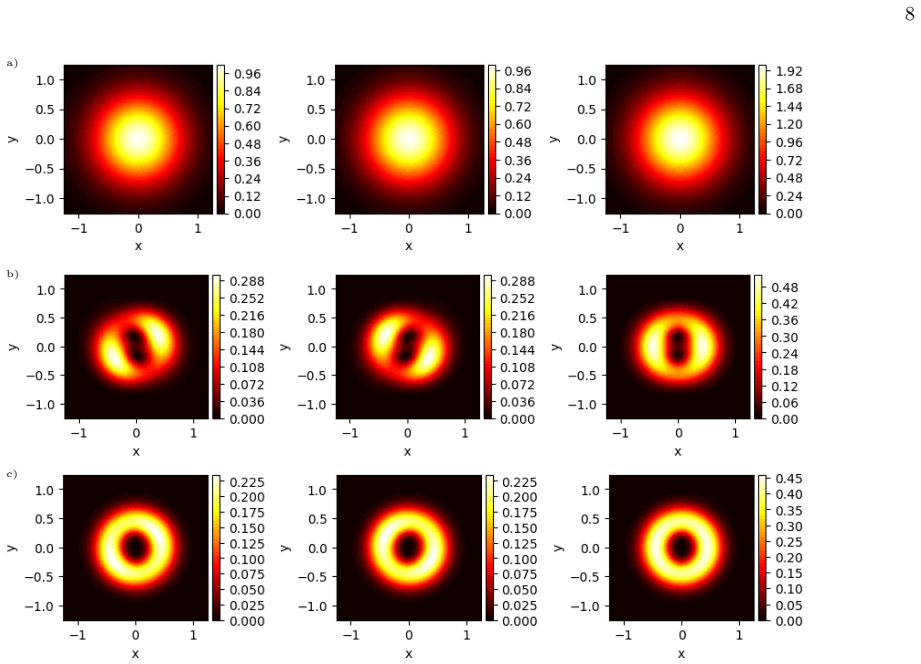
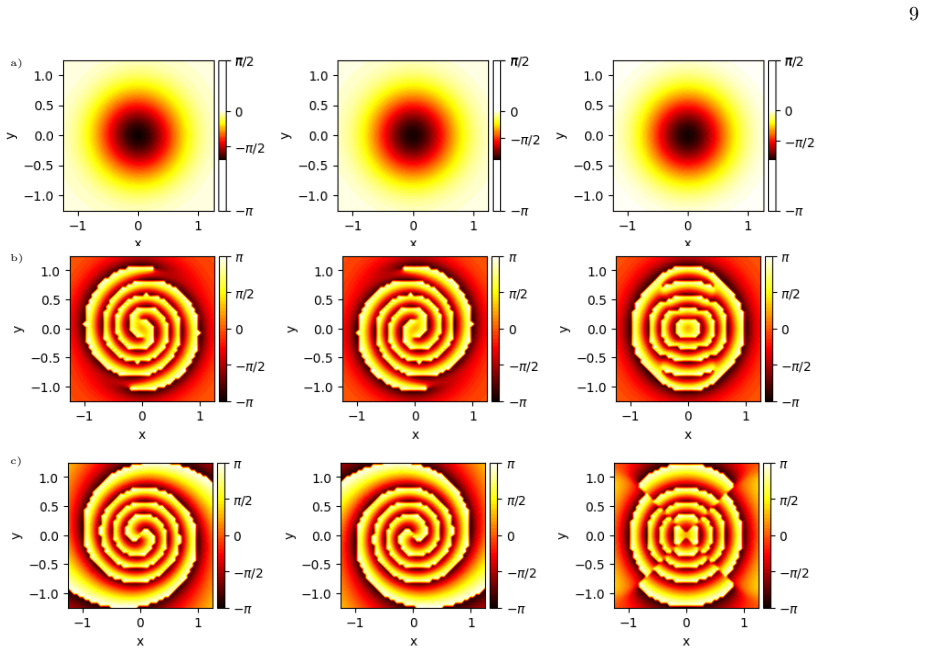
The central claim is that the competition among photonic spin-orbit coupling, mean-field interactions, and Lee-Huang-Yang quantum fluctuations decides which phase a binary polariton condensate occupies: a uniform condensate, a self-bound droplet, a vortex-bearing state, or a lattice of droplets. Starting from a dissipative two-component Gross-Pitaevskii model with an excitonic reservoir, the authors impose the critical balance condition $R n_m/2 = \gamma_c$ and neglect reservoir-mediated interactions, leaving a closed conservative equation for the two spin components with the LHY term $-\sqrt{\sigma_l/\sigma_{3-l}}\, p \log p$. In real-time simulations from Gaussian initial states with no imposed phase winding, a stable droplet without phase singularities forms at low spin-orbit strength ($\sigma = 0.05$); increasing $\sigma$ to 2 and then 11 splits the droplet, develops spiral phase windings, and produces vortex rings, which the authors interpret as the spin-orbit term injecting quantized angular momentum. Increasing the inter-component interaction $\delta g$ at fixed $\sigma$ first nucleates vortices and then deforms them until the spiral fringes dissolve, while at high spin strength and fixed $\delta g$, raising the intra-component interaction $g$ from 20000 to 50000 yields progressively more ordered droplet lattices with fewer phase singularities.
Load-bearing premise
The load-bearing premise is that pumping, decay, and reservoir interactions can be discarded completely: the reduction requires the gain to cancel the loss exactly, $R n_m/2 = \gamma_c$, and the polariton interactions to dominate the reservoir interactions, $g(|\psi_1|^2 + |\psi_2|^2) \gg g_R n_l, \bar{g}_R n_{3-l}$, conditions the paper states and then relies on, even though in real polariton microcavities gain and loss usually dominate.
Editorial extensions
If this is right
- The spin-orbit strength $\sigma$ acts as a genuine control parameter: the same interaction parameters that give a vortex-free self-bound droplet at $\sigma = 0.05$ produce vortex rings at $\sigma = 11$, so the condensate topology can be switched without retuning the atomic interactions.
- The reported structures are transient, self-organized configurations that emerge dynamically from Gaussian inputs carrying no initial phase winding, not stationary solutions; the paper explicitly leaves stationary-state dynamics to a companion study.
- Raising the inter-component interaction $\delta g$ at fixed $\sigma$ first nucleates vortices and then dissolves their spiral fringes, so $\delta g$ controls the deformation as well as the creation of topological defects.
- Increasing the intra-component interaction $g$ at high $\sigma$ makes droplet lattices more ordered and suppresses phase singularities, which the authors read as stronger interactions stabilizing coherence in the self-trapped regime.
- If the claims hold, the tunable droplet-vortex-droplet-lattice sequence offers a route to vortex-based precision sensing and to studying superfluid-to-self-trapped transitions in low-dimensional quantum fluids.
Reading between the lines
- A natural consequence the paper does not spell out: because the TE-TM splitting in a microcavity is set largely by the cavity structure, the effective spin-orbit strength could be engineered to dial between droplet and vortex phases in a single device without retuning interactions.
- Since the simulations start from phase-winding-free Gaussians, the vortices must be nucleated by the spin-orbit term itself; a direct test would be to track the total winding number as $\sigma$ grows and see whether it increases continuously or in integer jumps.
- The paper's own closing remarks concede that reservoir dynamics and gain-loss imbalance are beyond its scope; the sharpest extension would be to re-add pump and decay and check whether the droplet and vortex structures survive, since real polariton condensates are open, driven-dissipative systems.
Editorial analysis
A structured set of objections, weighed in public.
Referee Report
Summary. The manuscript studies a two-component (spin-1/2) polariton condensate in 2D, modeled by a Gross-Pitaevskii equation with photonic spin-orbit coupling and Lee-Huang-Yang-type quantum fluctuations. Starting from a driven-dissipative reservoir model, the authors impose a critical-balance condition and a strong-interaction inequality to reduce the system to a closed conservative GPE, Eq. (7). They then perform real-time split-step Fourier simulations from real Gaussian initial states and report density and phase profiles for varying intra- and inter-component interaction strengths g and δg and spin-orbit strength σ. The central claimed result is a droplet-to-vortex transition driven by increasing σ, with high interaction strengths producing ordered droplet lattices.
Significance. If substantiated, the claimed control of droplet versus vortex phases via the photonic spin-orbit strength σ would be a useful extension of quantum-droplet physics to spin-orbit-coupled polariton systems, and the numerical exploration of large parameter ranges is a step toward that goal. The paper is honest in one important respect: it explicitly labels the displayed structures as early-time, non-stationary configurations, and it does not fit parameters to pre-selected output patterns. However, the manuscript's central physical claim is currently supported only by transient snapshots, and it is weakened by internal sign inconsistencies and an unvalidated reduction from the open reservoir model. The significance will only be established after the stability and consistency issues are addressed.
major comments (4)
- [Section II, Figs. 5-7 and Conclusion] The central claim that increasing σ drives a transition from a self-bound droplet to stable vortex states is not established by the evidence shown. The text after Eq. (11) states that the presented results are 'early-time dynamical states' and 'not stationary solutions, but transient, self-organized configurations,' yet the Conclusion repeatedly calls the σ = 11 configurations 'stable vortex states' and describes a 'topological transition.' No long-time evolution traces, norm-versus-time plots, angular-momentum diagnostics, winding-number measurements, or convergence tests in time step and grid resolution are provided. The vortex rings in Fig. 5(c) could be transient structures that later relax into the droplet state. Please provide long-time simulations (e.g., peak density and norm versus time, phase singularities tracked over time) and resolution/convergence checks for at least the representative parameters of Figs. 5 and 7, and either use 'stable' only where the dynamics justify it or reformulate the claim as applying to transient self-organized structures.
- [Section I, Eq. (7) vs. Eq. (10)] There is a sign inconsistency between the working GPE and the chemical-potential expression used for Fig. 1. Substituting the plane-wave ansatz ψ_l = A_l e^{-iμt} into Eq. (7) gives μ = (δg/2)(A_1^2 + A_2^2) + (-1)^l g(A_l^2 - A_{3-l}^2) - sqrt(σ_l/σ_{3-l}) p log p, whereas Eq. (10) has a minus sign on the g-term and a plus sign on the LHY term. In addition, the SOC derivative operator changes from -σ(∂/∂x - i(-1)^l ∂/∂y)^2 in Eq. (1) to +σ(∂/∂x + i(-1)^l ∂/∂y)^2 in Eq. (7). These signs cannot all be correct. Please reconcile the model equations, the chemical-potential formula, and the code; specify which sign convention was actually implemented in the simulations, since Fig. 1 and the phase/density dynamics depend on it.
- [Section I, Eqs. (1)-(7)] The reduction from the open reservoir model to the conservative GPE is a load-bearing step but is not validated. The critical-balance condition (4) and the inequality (6) are stated, but no parameter values are given to show that the simulated regime satisfies g(|ψ_1|^2 + |ψ_2|^2) >> g_R n_l, g_R n_{3-l}, nor is any comparison made with the full Eqs. (1)-(2). In actual polariton condensates, pumping and decay typically dominate, so the observed droplet and vortex structures may be properties of a different closed system rather than of photonic polariton condensates. Please either perform simulations of the full driven-dissipative model (or of a controlled approximation with small gain/loss) and show that the reported patterns are robust, or explicitly restrict the conclusions to the conservative GPE without claiming direct polariton experimental relevance.
- [Section II, numerical methods and Fig. 7] The manuscript does not report the numerical setup needed to assess the reliability of the results: domain size, grid points, time step, integration time, boundary conditions, or any convergence study. The only statement is that parameters were 'adjusted based on the interaction parameters.' Given that the central results are complex self-organized patterns, it is essential to demonstrate that the observed droplet lattices and vortex rings are not numerical artifacts. Please provide a table of representative numerical parameters and at least one convergence test (e.g., doubling spatial resolution and halving time step for the parameters of Figs. 5 and 7).
minor comments (5)
- [Section I and II, cross-references] The text repeatedly refers to Eq. (3) when discussing the conservative GPE, but Eq. (3) is the reservoir steady-state condition; the reduced GPE is Eq. (7). Similarly, the Gaussian initial state is called 'Eq. (7)' in Section II, but it is Eq. (11). Please correct all equation cross-references.
- [Fig. 8 caption] The caption contains typos: 'for gδg = 500 and g = 100' should read 'for δg = 500 and g = 100', and 'σ − 1.5' should read 'σ = 1.5'.
- [Section II, after Fig. 2] The sentence 'The density distributions (|ψ1|2, |ψ2|2) remain uniform, suggesting a near-ground-state configuration with minimal influence from spin-orbit coupling' is repeated verbatim twice; please delete the duplicate.
- [References] References [60] and [61] are identical (Madimabe, Tabi, Tiofack, Kofané, Phys. Rev. B 107, 184502 (2023)); please merge or renumber and ensure each cited item is distinct.
- [Figs. 3 and 6] The phase profiles are described qualitatively as 'spiral phase windings,' but no color bar, phase range, or winding-number label is provided, making it difficult to verify the sign and magnitude of the topological charge from the figures.
Circularity Check
No significant circularity: the droplet and vortex patterns are emergent outputs of the stated GPE simulations, not imported or fitted predictions.
full rationale
The paper's derivation chain is Eq. (1) -> conservative reduction -> Eq. (7) -> Eq. (10) for the plane-wave chemical potential, followed by direct real-time numerical evolution of Eq. (7). No parameter in the reduced model is fitted to the reported droplet or vortex states: the interaction strengths g and delta-g, the spin-orbit strength sigma, and the LHY coefficients sigma1 and sigma2 are chosen inputs, and p is a local density expression defined before the simulations, not an adjustable constant. The reported structures are generated by split-step Fourier evolution from real-valued Gaussian initial conditions with no imposed phase winding, so the vortices and droplet lattices are outputs rather than imported results. The conservative reduction (Eqs. (3)-(6)) is a stated model assumption that removes pumping and reservoir terms; it does not encode any particular final pattern and therefore is not circular. Self-citations do appear: the starting coupled model is attributed to the authors' earlier Madimabe/Tabi/Kofane work (Ref. [61]), and Ref. [65] is cited for stationary-state dynamics. Neither citation is load-bearing for the central claim that increasing sigma drives a droplet-to-vortex transition; that claim rests on the paper's own transient simulations. The paper itself explicitly states that the displayed states 'are not stationary solutions, but transient, self-organized configurations,' which undermines the stability language in the conclusions but is a correctness and evidence issue, not a circularity issue. No step in the derivation reduces by construction to its own input, so the circularity burden is low.
Assumptions & free parameters
free parameters (6)
- g (intracomponent interaction strength) =
100 to 50000 across figures
- delta-g (intercomponent interaction strength) =
500 to 57500 across figures
- sigma (photonic spin-orbit coupling strength) =
0.05 to 200 across figures
- alpha (Gaussian width of initial condition) =
not specified
- sigma_1, sigma_2 (LHY relative strengths) =
set to 1 in the simulations
- p (plane-wave amplitude parameter) =
varied in Fig. 1 without stated values
assumptions (4)
- domain assumption The two-component polariton condensate is described by the mean-field coupled Gross-Pitaevskii equation with a local LHY term.
- domain assumption Gain and loss cancel exactly and reservoir interaction terms are negligible (Eq. (6)).
- ad hoc to paper The LHY quantum-fluctuation term has the form -sqrt(sigma_l/sigma_{3-l}) p log p.
- domain assumption The numerical split-step Fourier solutions are converged at the adjusted resolutions used.
Cite this review
Pith. "Pith review of Synergistic Effects of Spin-Orbit Coupling and Intercomponent Interactions in Two-Component (2+1)D Photonic Fields." pith.science (2026). https://pith.science/paper/TJUMOF5X
@misc{pith2026250702505,
  author       = {Pith},
  title        = {Pith review of: Synergistic Effects of Spin-Orbit Coupling and Intercomponent Interactions in Two-Component (2+1)D Photonic Fields},
  year         = {2026},
  howpublished = {\url{https://pith.science/paper/TJUMOF5X}},
  note         = {Machine review of arXiv:2507.02505}
}
read the original abstract
The study investigates the formation, stability and dynamic advancement of two-dimensional vortex quantum droplets within binary Bose-Einstein condensates (BECs), shaped by the interplay of photonic spin-orbit coupling (SOC) and quantum fluctuation effects. SOC leads to significant droplet stretching, resulting in vortex clusters forming in each component. The competition between photonic SOC and Lee-Huang-Yang (LHY) interactions introduces vortices into the condensate, described by the numerically solved Gross-Pitaevskii equation (GPE). The results show that droplets like structures arise at low SOC strengths and interaction parameters. The transition to vortex takes place as the SOC increases. Enhanced interactions give rise to the emergence of quantum droplets as the vortices dissipate, demonstrating fascinating dynamics. These findings enhance understanding of the physical properties of photonic SOC coupled binary BECs in 2D with LHY correction, impacting cold-atom physics and condensed matter research. The study can also be expanded to explore quantum droplets with a small atom count, which is advantageous for experimental applications.
Figures


Figures from the paper (6 more)




Reference graph
Works this paper leans on
- [65]
- [1]
- [2]
-
[3]
P. Massignan, M. Zaccanti, and G. M. Bruun, Rep. Prog. Phys.. 77, 034401 (2014)
work page 2014
-
[4]
Z.-H. Luo, W. Pang, B. Liu, Y.-Y. Li, and B. A. Mal- omed, Front. Phys. 16, 1 (2021)
2021
-
[5]
C. B. Tabi, S. Veni, E. Wamba, and T. C. Kofan´ e, Phys. Lett. A 485, 129087 (2023)
work page 2023
-
[6]
Y. Li, Z. Chen, Z. Luo, C. Huang, H. Tan, W. Pang, and B. A. Malomed, Phys. Rev. A 98, 063602 (2018)
2018
-
[7]
L. Dong, D. Liu, Z. Du, K. Shi, and W. Qi, Phys. Rev. A. 105 (2022)
work page 2022
Show all 67 references
-
[8]
L. Dong, K. Shi, and C. Huang, Phys. Rev. A106, 053303 (2022)
2022
-
[9]
Y. V. Kartashov, B. A. Malomed, L. Tarruell, and L. Torner, Phys. Rev. A 98, 013612 (2018)
2018
-
[10]
Dong and M
L. Dong and M. Fan, Chaos, Solitons & Fractals 173, 113728 (2023)
2023
-
[11]
S. R. Otajonov, E. N. Tsoy, and F. K. Abdullaev, Phys. Rev. A 106, 033309 (2022)
2022
-
[12]
Schmitt, M
M. Schmitt, M. Wenzel, F. B¨ ottcher, I. Ferrier-Barbut, and T. Pfau, Nature 539, 259 (2016)
2016
-
[13]
B¨ ottcher, J.-N
F. B¨ ottcher, J.-N. Schmidt, J. Hertkorn, K. S. Ng, S. D. Graham, M. Guo, T. Langen, and T. Pfau, Rep. Prog. Phys.. 84, 012403 (2020)
2020
-
[14]
X. Su, W. Dai, T. Li, J. Wang, and L. Wen, Chaos, Solitons & Fractals 184, 114979 (2024)
2024
-
[15]
S. S. Veni, M. M. Rajan, C. B. Tabi, and T. C. Kofan´ e, Phys. Scr. 99, 025202 (2024)
2024
-
[16]
S. S. Veni, M. M. Rajan, A. Biswas, and A. S. Alshom- rani, Phys. Scr. 99, 085261 (2024)
2024
-
[17]
C. Tabi, H. Tagwo, C. L. Tiofack, S. Veni, and T. Kofan´ e, Phys. Lett. A 529, 130066 (2025)
2025
-
[18]
Xi and H
K.-T. Xi and H. Saito, Phys. Rev. A. 93, 011604 (2016)
2016
-
[19]
W¨ achtler and L
F. W¨ achtler and L. Santos, Phys. Rev. A. 94, 043618 (2016)
2016
-
[20]
M. Heyl, K. Adachi, Y. M. Itahashi, Y. Nakagawa, Y. Kasahara, E. J. List-Kratochvil, Y. Kato, and 10 a) b) c) FIG. 7. Quantum droplets arranged in a lattice state for fixed spin interaction σ = 200 and intra-component interaction δg = 6500. The effect of increasing inter-compo...
2022
-
[21]
Klaus, T
L. Klaus, T. Bland, E. Poli, C. Politi, G. Lamporesi, E. Casotti, R. N. Bisset, M. J. Mark, and F. Ferlaino, Nat. Phys.. 18, 1453 (2022)
2022
-
[22]
Cidrim, F
A. Cidrim, F. E. dos Santos, E. A. Henn, and T. Macr ` ı, Phys. Rev. A. 98, 023618 (2018)
2018
-
[23]
Z. Meng, L. Huang, P. Peng, D. Li, L. Chen, Y. Xu, C. Zhang, P. Wang, and J. Zhang, Phys. Rev. Lett..117, 235304 (2016)
2016
-
[24]
Zhang, M
Y. Zhang, M. E. Mossman, T. Busch, P. Engels, and C. Zhang, Front. Phys. 11, 1 (2016)
2016
-
[25]
Zhong, Z.-P
R.-X. Zhong, Z.-P. Chen, C.-Q. Huang, Z.-H. Luo, H.-S. Tan, B. A. Malomed, and Y.-Y. Li, Front. Phys. 13, 1 (2018)
2018
-
[26]
C. B. Tabi, S. Veni, and T. C. Kofan´ e, Phys. Rev. A. 104, 033325 (2021)
2021
-
[27]
Sakaguchi, B
H. Sakaguchi, B. Li, and B. A. Malomed, Phys. Rev. E 89, 032920 (2014)
2014
-
[28]
Y. V. Kartashov, B. A. Malomed, V. V. Konotop, V. E. Lobanov, and L. Torner, Opt. Lett. 40, 1045 (2015)
2015
-
[29]
Y. Li, Z. Luo, Y. Liu, Z. Chen, C. Huang, S. Fu, H. Tan, and B. A. Malomed, New Journal of Physics 19, 113043 (2017)
2017
-
[30]
Cui, Phys
X. Cui, Phys. Rev. A. 98, 023630 (2018)
2018
-
[31]
Sakaguchi, B
H. Sakaguchi, B. A. Malomed, and D. V. Skryabin, New J. Phys. 19, 085003 (2017)
2017
-
[32]
Aristov, H
D. Aristov, H. Sigurdsson, and P. G. Lagoudakis, Phys. Rev. B. 105, 155306 (2022)
2022
-
[33]
Y. Li, X. Ma, X. Zhai, M. Gao, H. Dai, S. Schumacher, and T. Gao, Nat. Commun. 13, 3785 (2022)
2022
-
[34]
Whittaker, E
C. Whittaker, E. Cancellieri, P. Walker, D. Gulevich, H. Schomerus, D. Vaitiekus, B. Royall, D. Whittaker, E. Clarke, I. Iorsh, et al., Phys. Rev. Lett.. 120, 097401 (2018)
2018
-
[35]
Klaas, O
M. Klaas, O. A. Egorov, T. Liew, A. Nalitov, V. Markovi´ c, H. Suchomel, T. Harder, S. Betzold, E. Os- trovskaya, A. Kavokin, et al., Phys. Rev. B. 99, 115303 (2019)
2019
-
[36]
Jheng, T.-W
S.-D. Jheng, T.-W. Chen, and S.-C. Cheng, Opt. Express 30, 35325 (2022)
2022
-
[37]
Jiang, A
Z. Jiang, A. Ren, Y. Yan, J. Yao, and Y. S. Zhao, Adv. Mater. 34, 2106095 (2022)
2022
-
[38]
G. Li, O. Bleu, J. Levinsen, and M. M. Parish, Phys. Rev. B. 103, 195307 (2021)
2021
-
[39]
Carusotto and C
I. Carusotto and C. Ciuti, Rev. Mod. Phys.. 85, 299 (2013)
2013
-
[40]
L¨ uders, M
C. L¨ uders, M. Pukrop, E. Rozas, C. Schneider, S. H¨ ofling, J. Sperling, S. Schumacher, and M. Aßmann, PRX Quan- 11 tum 2, 030320 (2021)
2021
-
[41]
Pieczarka, E
M. Pieczarka, E. Estrecho, M. Boozarjmehr, O. Bleu, M. Steger, K. West, L. N. Pfeiffer, D. W. Snoke, J. Levin- sen, M. M. Parish, et al., Nat. Commun. 11, 429 (2020)
2020
-
[42]
K. Peng, R. Tao, L. Haeberl´ e, Q. Li, D. Jin, G. R. Flem- ing, S. K´ ena-Cohen, X. Zhang, and W. Bao, Nat. Com- mun. 13, 7388 (2022)
2022
-
[43]
S. Wen, A. Ren, H. Liu, Z. Jiang, X. Dong, H. Dong, J. Yao, Y. Yan, and Y. S. Zhao, Laser Photonics Rev. 19, 2401308 (2025)
2025
-
[44]
J. Feng, J. Wang, A. Fieramosca, R. Bao, J. Zhao, R. Su, Y. Peng, T. C. Liew, D. Sanvitto, and Q. Xiong, Sci. Adv. 7, eabj6627 (2021)
2021
-
[45]
Marsault, H
F. Marsault, H. S. Nguyen, D. Tanese, A. Lema ˆ ıtre, E. Galopin, I. Sagnes, A. Amo, and J. Bloch, Appl. Phys. Lett.. 107 (2015)
2015
-
[46]
Mirek, A
R. Mirek, A. Opala, P. Comaron, M. Furman, M. Kr´ ol, K. Tyszka, B. Seredyn¨ oski, D. Ballarini, D. Sanvitto, T. C. Liew, et al., Nano Lett. 21, 3715 (2021)
2021
-
[47]
D. A. Sannikov, A. V. Baranikov, A. D. Putintsev, M. Misko, A. V. Zasedatelev, U. Scherf, and P. G. Lagoudakis, Nat. Commun. 15, 5362 (2024)
2024
-
[48]
H. Li, F. Chen, H. Jia, Z. Ye, H. Zhou, S. Luo, J. Shi, Z. Sun, H. Xu, H. Xu, et al., Nat. Photonics 18, 864 (2024)
2024
-
[49]
M. D. Fraser, S. H¨ ofling, and Y. Yamamoto, Nat. Mater. 15, 1049 (2016)
2016
-
[50]
J. Hu, K. Zhang, M. Idrees, H.-j. Li, J. Lin, and A. Ka- vokin, Phys. Rev. B. 110, 155112 (2024)
2024
-
[51]
Kn¨ orzer, R
J. Kn¨ orzer, R. O ldziejewski, P. A. Murthy, and I. Amelio, Phys. Rev. A. 110, 063516 (2024)
2024
-
[52]
X. Ma, B. Berger, M. Aßmann, R. Driben, T. Meier, C. Schneider, S. H¨ ofling, and S. Schumacher, Nat. Com- mun. 11, 897 (2020)
2020
-
[53]
K. G. Lagoudakis, M. Wouters, M. Richard, A. Baas, I. Carusotto, R. Andr´ e, L. S. Dang, and B. Deveaud- Pl´ edran, Nat. Phys..4, 706 (2008)
2008
-
[54]
M.-S. Kwon, B. Y. Oh, S.-H. Gong, J.-H. Kim, H. K. Kang, S. Kang, J. D. Song, H. Choi, and Y.-H. Cho, Phys. Rev. Lett.. 122, 045302 (2019)
2019
-
[55]
R. Dall, M. D. Fraser, A. S. Desyatnikov, G. Li, S. Brod- beck, M. Kamp, C. Schneider, S. H¨ ofling, and E. A. Os- trovskaya, Phys. Rev. Lett.. 113, 200404 (2014)
2014
-
[56]
Mu˜ noz Mateo, Y
A. Mu˜ noz Mateo, Y. Rubo, and L. Toikka, Phys. Rev. B. 101, 184509 (2020)
2020
-
[57]
L. S. Ricco, I. A. Shelykh, and A. Kavokin, Sci. Rep. 14, 4211 (2024)
2024
-
[58]
Kavokin, T
A. Kavokin, T. C. Liew, C. Schneider, P. G. Lagoudakis, S. Klembt, and S. Hoefling, Nat. Rev. Phys. 4, 435 (2022)
2022
-
[59]
B. Wang, K. Wu, Z. Li, G. Wang, and Y. Xue, JJ. Phys. B: At. Mol. Opt. Phys 57, 245402 (2024)
2024
-
[60]
E. B. Madimabe, C. B. Tabi, C. G. L. Tiofack, and T. C. Kofan´ e, Phys. Rev. B107, 184502 (2023)
2023
-
[61]
E. B. Madimabe, C. B. Tabi, C. G. L. Tiofack, and T. C. Kofan´ e, Phys. Rev. B.107, 184502 (2023)
2023
-
[62]
S. R. Otajonov, E. N. Tsoy, and F. K. Abdullaev, Phys. Rev. A. 106, 033309 (2022)
2022
-
[63]
L. Zeng, M. R. Beli´ c, D. Mihalache, J. Shi, J. Li, S. Li, X. Lu, Y. Cai, and J. Li, Nonlinear Dyn. 108, 1671–1680 (2022)
2022
-
[64]
Abdolabadi, A
F. Abdolabadi, A. Zakeri, and A. Amiraslani, Commun. Nonlinear Sci. Numer. 120, 107150 (2023)
2023
-
[66]
Petrov, Phys
D. Petrov, Phys. Rev. Lett. 115, 155302 (2015)
2015
-
[67]
Chomaz, S
L. Chomaz, S. Baier, D. Petter, M. Mark, F. W¨ achtler, L. Santos, and F. Ferlaino, Phys. Rev. X. 6, 041039 (2016)
2016
Reviewed August 6, 2026 · model on record in the stance chip above.
Discussion (0). Continue with ORCID to comment.