REVIEW 3 major objections 5 minor 36 references
GENPLUGIN: A Plug-and-Play Framework for Long-Tail Generative Recommendation with Exposure Bias Mitigation
T0 review · 3 major / 5 minor · reviewed 2026-08-06 · deepseek-v4-flash
Pith's one-line read A plug-in module lifts generative recommenders on long-tail items
desk verdict A solid plug-in that improves GenRec overall, but the long-tail claim is undercut by the paper's own Appendix Table 8 and the exposure-bias claim is never directly tested. read the letter →
The pith
A machine-rendered reading of the paper's core claim, the machinery that carries it, and where it could break.
The reading
What carries the argument
The load-bearing object is the dual-encoder, shared-decoder plugin with semantic-substitution guidance. The language-semantics encoder maps item text to embeddings that are fed to a shared decoder to obtain a probability distribution over the next ID token; with probability controlled by hyperparameters p1 and p2, the decoder in the ID view is trained on a weighted average of the top-q predicted token embeddings from the language view instead of the ground-truth token. A KL loss between temperature-sharpened distributions from the two views pushes them to agree, and the retrieval-augmented stage caches user preference representations so that similar users can be concatenated into the decoder input at fine-tuning and inference without re-encoding their full histories.
What would settle it
Measure the language-semantics encoder's top-k token accuracy (or the KL divergence between language-view and ID-view distributions) on held-out item IDs after pre-training; if language predictions are near chance or the two distributions remain far apart, semantic-substitution guidance is training against noisy targets and the exposure-bias gains should shrink or vanish in an ablation that varies the replacement probability.
Extended reading notes
Core claim
The paper's central claim is that generation exposure bias and poor long-tail generalization in generative recommendation are not fixed properties of the GenRec paradigm but can be mitigated by an external module. GENPLUGIN aligns item representations from a language view (LLM embeddings of item text) and an ID view (the GenRec model's item ID tokens) with contrastive item-level and user-preference losses. To reduce exposure bias it probabilistically replaces ground-truth ID token inputs with the language-semantics encoder's predicted token distributions during training, using a temperature-sharpened KL divergence to make the two views agree. To improve long-tail coverage it retrieves similar users by BM25 over pseudo-documents and by a trained SASRec collaborative encoder, re-ranks them in the ID-semantic space, and concatenates their cached preference representations with the target user's representation for decoder fine-tuning. The reported experiments plug GENPLUGIN into TIGER, LETTER, and MQL4Rec and show higher H@k and N@k on all five Amazon datasets, with larger relative gains on tail items.
Load-bearing premise
The method assumes the language-semantics encoder's predicted distributions over item-ID tokens are accurate enough to serve as training targets when substituted for ground truth, even though the paper never directly measures that accuracy or the quality of the language-ID alignment.
Editorial extensions
If this is right
- Adding GENPLUGIN to an existing GenRec model should reduce the train/inference token mismatch, since the decoder is trained on its own noisy predictions rather than only on ground-truth tokens.
- GenRec models can be improved without redesigning item tokenization: the plugin wraps the base model and can be removed if not needed.
- Long-tail recommendation quality improves beyond what shared semantic ID tokens alone provide, because retrieval augmentation supplies interaction evidence for rare items.
- The gains are not limited to one backbone: the paper reports improvements with TIGER, LETTER, and MQL4Rec across multiple datasets.
- Head-item performance also improves, so exposure-bias mitigation is not bought at the cost of popular-item quality.
Reading between the lines
- The paper uses language-view predictions only as training targets; an unstated extension is to use the same distributions at inference time for self-correction or confidence-based early stopping during ID generation.
- Because the whole method hinges on the language view being a faithful proxy for ID semantics, a direct diagnostic of language-view token prediction accuracy could predict how much any given GenRec model will benefit from the plugin.
- The same dual-view substitution idea transfers to other structured-output tasks where one view is a learned discrete code and the other is a natural-language description, such as code generation or image captioning with quantized tokens.
Editorial analysis
A structured set of objections, weighed in public.
Referee Report
Summary. The paper proposes GENPLUGIN, a plug-and-play framework for generative recommendation (GenRec) that wraps existing GenRec backbones with a dual-encoder, shared-decoder architecture. During pre-training, contrastive losses align item and user representations across a language view and an ID view. To mitigate so-called generation exposure bias, the decoder is trained with a semantic-substitution strategy that probabilistically replaces ground-truth ID tokens with language-view predictions (Sec. 3.1.2, Eqs. 3-4). To improve long-tail recommendation, a retrieval-based augmentation mechanism retrieves similar users via BM25 and collaborative filtering, re-ranks them by ID-semantics similarity, and concatenates their cached preference representations with the target user's representation for fine-tuning (Sec. 3.2). The method is plugged into TIGER, LETTER, and MQL4Rec and evaluated on five Amazon datasets with H@5/10 and N@5/10, including head/tail splits. The authors report consistent overall improvements and claim significant mitigation of generation exposure bias and improved long-tail recommendation.
Significance. If the results hold, GENPLUGIN would be a useful backbone-agnostic enhancement for generative recommenders, with the appealing property of requiring only text and ID views rather than architectural changes to the base model. The paper's strengths are its breadth of experiments: three backbones, five datasets, ablations for every component, hyperparameter sensitivity analyses, and varying pretrained encoders. The overall H@10/N@10 gains are directionally consistent across almost all configurations. However, two load-bearing claims are not yet established: the universal long-tail improvement is contradicted by the Instruments results in Appendix B.1, and the 'exposure bias mitigation' claim is never measured directly. These issues make the current unqualified headline claims premature, but the overall approach remains plausible and the empirical gaps appear addressable within the scope of a revision.
major comments (3)
- [Appendix B.1, Table 8] The claimed universal long-tail improvement is contradicted by Table 8: for MQL4Grec on Instruments, tail H@5 drops from 0.0046 to 0.0013, tail H@10 from 0.0076 to 0.0037, and N@5/N@10 also decrease, whereas Sec. 4.3 states that GENPLUGIN consistently improves tail-item performance. In addition, the head/tail entries in Table 8 do not reconcile with the overall rows in Table 2 when weighted by the #Head and #Tail sequence counts in Table 5: for MQL4Grec, the weighted H@5 is approximately 0.093 versus 0.1085 in Table 2, and for MQL4Grec++ approximately 0.110 versus 0.1132. This suggests a reporting error or a different evaluation setup, and it prevents readers from verifying the head/tail decomposition. Please correct the tables, add significance tests or variance estimates, and either restrict the long-tail claim to the configurations where it holds or analyze why Instruments behaves differently.
- [Abstract and Sec. 4] The abstract and Sec. 4.3 claim that GENPLUGIN 'notably mitigates generation exposure bias,' but no experiment directly measures exposure bias. The reported H@k and N@k are end-task metrics that can improve for many reasons, including the retrieval augmentation and the contrastive alignment, so the attribution to exposure-bias mitigation is underdetermined. Please add a direct measurement, such as token-level generation accuracy under teacher forcing versus free-running decoding, the divergence between ground-truth and generated token sequences, or a diagnostic that isolates the effect of semantic substitution. Absent such evidence, the exposure-bias claim should be softened to an indirect inference.
- [Sec. 3.1.2, Eqs. (3)-(4)] The semantic-substitution mechanism assumes that the language-semantics encoder's top-q predictions over ID tokens are reliable enough to serve as training targets. The paper never reports the language-view predictor's accuracy, top-q recall, or the quality of the contrastive alignment in Eq. (1). If the language-view distributions are far from the true conditional distribution over the ID codebook, the substitution injects noise rather than mitigating exposure bias, and the observed gains could come from regularization or data augmentation effects. Please report a held-out evaluation of the language-view token prediction (e.g., top-q accuracy per token position) and an ablation that replaces the language-view predictions with random or ground-truth tokens to confirm that the mechanism works as described.
minor comments (5)
- [Throughout] The method name is written inconsistently as MQL4Rec (Table 2 and Appendix A.2) and MQL4Grec (Fig. 3 and Tables 6-8); please unify the notation.
- [Eq. (2)] Equation (2) contains a typo: the denominator of the first term uses sim(pi, qj), but the indices should be pu and qv, consistent with the second term and with Eq. (1).
- [Reference [15]] Reference [15] is listed as ICLR 2015, but the MQL4Rec paper was published at ICLR 2025; please correct the year.
- [Table 5] Table 5 uses a lowercase 'sports' in the second column while the rest of the paper uses 'Sports'; the table header also says '#Item' in the caption but '#Items' in the table body.
- [Sec. 4.3 and Appendix B.1] The word 'significant' is used for improvements without any statistical significance tests or error bars; for the key head/tail comparisons, please report multiple-seed means with standard deviations or a paired test.
Circularity Check
No significant circularity: the paper's claims are empirically evaluated on external benchmarks; the self-distillation objective is a training mechanism, not a derivation that equates its predictions with its inputs.
full rationale
GENPLUGIN is an empirical systems paper with no formal derivation that reduces to its own inputs. The semantic-substitution guidance (Sec. 3.1.2, Eqs. 3-4) uses the shared decoder's language-view predictions as soft targets for the ID-view decoding path; this is self-training/distillation by design, but the paper does not claim that the method's success is derived from those targets. Success is measured by H@N and N@N on held-out Amazon data for TIGER, LETTER, and MQL4Rec, all external to the plugin. The retrieval-augmented long-tail mechanism is an engineering augmentation, not a fitted predictor masquerading as a first-principles result. Citations to prior work, including MQL4Rec, are used as baselines and building blocks, not as a uniqueness theorem or as evidence that the plugin's outputs equal its inputs. The only notable issue is Appendix Table 8: on Instruments, MQL4Grec++ tail metrics drop relative to MQL4Grec, which undermines the unqualified long-tail claim; that is an evidence-consistency/correctness problem, not a circularity. No self-citation chain or definitional equality forces the paper's predictions, and no load-bearing argument reduces to a fitted parameter renamed as a prediction. Score 0.
Assumptions & free parameters
free parameters (8)
- loss weight lambda_1 =
not reported
- loss weight lambda_2 =
0.85
- loss weight lambda_3 =
0.5
- replacement probability prob=(1-p1)*(1-p2) =
0.2
- fusion token count q =
5
- retrieval counts z and v =
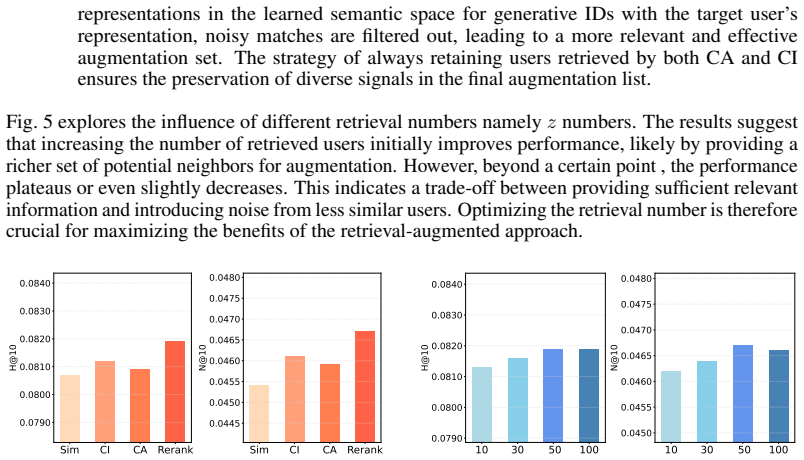
selected from {10,30,50,100}
- temperature coefficient phi (Eq. 3) =
not reported
- contrastive temperature tau (Eqs. 1-2) =
not reported
assumptions (5)
- domain assumption The language view (LLM embeddings of item text) and the ID view (generative item ID tokens from the underlying GenRec) can be aligned in a shared semantic space by contrastive losses.
- domain assumption Language-view predictions are close enough to the true ID token distribution that using them as training targets teaches the decoder to tolerate its own errors without destabilizing learning.
- domain assumption Retrieved similar users, found by BM25 on pseudo-documents and by SASRec collaborative profiles, provide useful augmentation signals for generating a target user's next item, especially for long-tail items.
- domain assumption Concatenating cached preference representations of retrieved users with the target user's representation is sufficient for the decoder to exploit augmentation; freezing the encoder preserves alignment.
- standard math Standard components (Transformer, RQ-VAE, BM25, SASRec, AdamW, contrastive learning, KL divergence) work as described in their source papers.
Cite this review
Pith. "Pith review of GENPLUGIN: A Plug-and-Play Framework for Long-Tail Generative Recommendation with Exposure Bias Mitigation." pith.science (2026). https://pith.science/paper/E44WPARH
@misc{pith2026250703568,
  author       = {Pith},
  title        = {Pith review of: GENPLUGIN: A Plug-and-Play Framework for Long-Tail Generative Recommendation with Exposure Bias Mitigation},
  year         = {2026},
  howpublished = {\url{https://pith.science/paper/E44WPARH}},
  note         = {Machine review of arXiv:2507.03568}
}
read the original abstract
Generative recommendation (GenRec) offers LLM integration, reduced embedding costs, and eliminates per-candidate scoring, attracting great attention. Despite its promising performance, this study reveals that it suffers from generation exposure bias and poor long-tail item generalization, two critical limitations overlooked by prior works on GenRec. To address these, we propose GENPLUGIN, a plug-and-play framework featuring a dual-encoder, shared-decoder architecture. During pre-training, it aligns language and ID views via contrastive learning, harmonizing item representations across two complementary views. Besides, GENPLUGIN uses a novel training strategy that probabilistically substitutes ground-truth item ID tokens with predictions from the language-semantics encoder, alleviating exposure bias. To improve long-tail generative recommendation, we propose a retrieval-based data augmentation mechanism. It fine-tunes the decoder of GENPLUGIN to endow GENPLUGIN with the ability to use relevant users w.r.t. contexts or collaborative information to augment the generation of item ID tokens in long-tail recommendation scenarios. We have plugged GENPLUGIN into several representative GenRec models and the extensive experiments demonstrate that GENPLUGIN can notably mitigate generation exposure bias during item ID generation while significantly improving the quality of long-tail item recommendation.
Figures


Figures from the paper (3 more)


Reference graph
Works this paper leans on
-
[1]
Recommender Systems Handbook
Francesco Ricci, Lior Rokach, and Bracha Shapira, editors. Recommender Systems Handbook. Springer US, 2022
2022
-
[2]
Two decades of recommender systems at amazon.com
Brent Smith and Greg Linden. Two decades of recommender systems at amazon.com. IEEE Internet Comput., 21(3):12–18, 2017
work page 2017
-
[3]
Large language models for generative recommendation: A survey and visionary discussions
Lei Li, Yongfeng Zhang, Dugang Liu, and Li Chen. Large language models for generative recommendation: A survey and visionary discussions. In LREC/COLING, pages 10146–10159, 2024
work page 2024
-
[4]
Neural collaborative filtering
Xiangnan He, Lizi Liao, Hanwang Zhang, Liqiang Nie, Xia Hu, and Tat-Seng Chua. Neural collaborative filtering. In WWW, pages 173–182, 2017
work page 2017
-
[5]
Adapting large language models by integrating collaborative semantics for recommenda- tion
Bowen Zheng, Yupeng Hou, Hongyu Lu, Yu Chen, Wayne Xin Zhao, Ming Chen, and Ji-Rong Wen. Adapting large language models by integrating collaborative semantics for recommenda- tion. In ICDE, pages 1435–1448, 2024
work page 2024
-
[6]
Tran, Jonah Samost, Maciej Kula, Ed H
Shashank Rajput, Nikhil Mehta, Anima Singh, Raghunandan Hulikal Keshavan, Trung Vu, Lukasz Heldt, Lichan Hong, Yi Tay, Vinh Q. Tran, Jonah Samost, Maciej Kula, Ed H. Chi, and Mahesh Sathiamoorthy. Recommender systems with generative retrieval. In NeurIPS, 2023
work page 2023
-
[7]
Vector quantization for recommender systems: A review and outlook
Qijiong Liu, Xiaoyu Dong, Jiaren Xiao, Nuo Chen, Hengchang Hu, Jieming Zhu, Chenxu Zhu, Tetsuya Sakai, and Xiao-Ming Wu. Vector quantization for recommender systems: A review and outlook. arXiv Preprint, 2024. URL https://arxiv.org/abs/2405.03110
arXiv 2024
-
[8]
On exposure bias, hallucination and domain shift in neural machine translation
Chaojun Wang and Rico Sennrich. On exposure bias, hallucination and domain shift in neural machine translation. In ACL, pages 3544–3552, 2020
work page 2020
Show all 36 references
-
[9]
LLM-ESR: large language models enhancement for long-tailed sequential recommendation
Qidong Liu, Xian Wu, Yejing Wang, Zijian Zhang, Feng Tian, Yefeng Zheng, and Xiangyu Zhao. LLM-ESR: large language models enhancement for long-tailed sequential recommendation. In NeurIPS, 2024
2024
-
[10]
Gomez, Lukasz Kaiser, and Illia Polosukhin
Ashish Vaswani, Noam Shazeer, Niki Parmar, Jakob Uszkoreit, Llion Jones, Aidan N. Gomez, Lukasz Kaiser, and Illia Polosukhin. Attention is all you need. In NIPS, pages 5998–6008, 2017
2017
-
[11]
Robertson and Hugo Zaragoza
Stephen E. Robertson and Hugo Zaragoza. The probabilistic relevance framework: BM25 and beyond. F ound. Trends Inf. Retr ., 3(4):333–389, 2009
2009
-
[12]
Wang-Cheng Kang and Julian J. McAuley. Self-attentive sequential recommendation. In ICDM, pages 197–206, 2018
2018
-
[13]
Jianmo Ni, Jiacheng Li, and Julian J. McAuley. Justifying recommendations using distantly- labeled reviews and fine-grained aspects. In EMNLP-IJCNLP, pages 188–197, 2019
2019
-
[14]
Learnable item tokenization for generative recommendation
Wenjie Wang, Honghui Bao, Xinyu Lin, Jizhi Zhang, Yongqi Li, Fuli Feng, See-Kiong Ng, and Tat-Seng Chua. Learnable item tokenization for generative recommendation. In CIKM, pages 2400–2409, 2024
2024
-
[15]
Multimodal quantitative language for generative recommendation
Jianyang Zhai, Zi-Feng Mai, Chang-Dong Wang, Feidiao Yang, Xiawu Zheng, Hui Li, and Yonghong Tian. Multimodal quantitative language for generative recommendation. In ICLR,
-
[16]
Session-based recommendations with recurrent neural networks
Balázs Hidasi, Alexandros Karatzoglou, Linas Baltrunas, and Domonkos Tikk. Session-based recommendations with recurrent neural networks. In ICLR, 2016. URL http://arxiv.org/ abs/1511.06939. 10
2016 arXiv
-
[17]
Bert4rec: Sequential recommendation with bidirectional encoder representations from transformer
Fei Sun, Jun Liu, Jian Wu, Changhua Pei, Xiao Lin, Wenwu Ou, and Peng Jiang. Bert4rec: Sequential recommendation with bidirectional encoder representations from transformer. In CIKM, pages 1441–1450, 2019. URL https://doi.org/10.1145/3357384.3357895
2019
-
[18]
S3-rec: Self-supervised learning for sequential recommendation with mutual information maximization
Kun Zhou, Hui Wang, Wayne Xin Zhao, Yutao Zhu, Sirui Wang, Fuzheng Zhang, Zhongyuan Wang, and Ji-Rong Wen. S3-rec: Self-supervised learning for sequential recommendation with mutual information maximization. In CIKM, pages 1893–1902, 2020. URL https: //doi.org/10.1145/3340531.3411954
1902
-
[19]
Soundstream: An end-to-end neural audio codec
Neil Zeghidour, Alejandro Luebs, Ahmed Omran, Jan Skoglund, and Marco Tagliasacchi. Soundstream: An end-to-end neural audio codec. IEEE ACM Trans. Audio Speech Lang. Process., 30:495–507, 2022
2022
-
[20]
Sc-rec: Enhancing generative retrieval with self-consistent reranking for sequential recommendation
Tongyoung Kim, Soojin Yoon, Seongku Kang, Jinyoung Yeo, and Dongha Lee. Sc-rec: Enhancing generative retrieval with self-consistent reranking for sequential recommendation. arXiv Preprint, 2024. URL https://arxiv.org/abs/2408.08686
2024 arXiv
-
[21]
Ulmrec: User-centric large language model for sequential recommendation
Minglai Shao, Hua Huang, Qiyao Peng, and Hongtao Liu. Ulmrec: User-centric large language model for sequential recommendation. arXiv Preprint, 2024. URL https://arxiv.org/ abs/2412.05543
2024 arXiv
-
[22]
Content-based collaborative generation for recommender systems
Yidan Wang, Zhaochun Ren, Weiwei Sun, Jiyuan Yang, Zhixiang Liang, Xin Chen, Ruobing Xie, Su Yan, Xu Zhang, Pengjie Ren, Zhumin Chen, and Xin Xin. Content-based collaborative generation for recommender systems. In CIKM, pages 2420–2430, 2024
2024
-
[23]
EAGER: two-stream generative recommender with behavior-semantic collaboration
Ye Wang, Jiahao Xun, Minjie Hong, Jieming Zhu, Tao Jin, Wang Lin, Haoyuan Li, Linjun Li, Yan Xia, Zhou Zhao, and Zhenhua Dong. EAGER: two-stream generative recommender with behavior-semantic collaboration. In KDD, pages 3245–3254, 2024
2024
-
[24]
EAGER-LLM: enhancing large language models as recommenders through exogenous behavior-semantic integration
Minjie Hong, Yan Xia, Zehan Wang, Jieming Zhu, Ye Wang, Sihang Cai, Xiaoda Yang, Quanyu Dai, Zhenhua Dong, Zhimeng Zhang, and Zhou Zhao. EAGER-LLM: enhancing large language models as recommenders through exogenous behavior-semantic integration. In WWW, pages 2754–2762, 2025
2025
-
[25]
STORE: streamlining semantic tokenization and generative recommendation with A single LLM
Qijiong Liu, Jieming Zhu, Lu Fan, Zhou Zhao, and Xiao-Ming Wu. STORE: streamlining semantic tokenization and generative recommendation with A single LLM. arXiv Preprint,
-
[26]
Unleash llms potential for recommendation by coordinating twin-tower dynamic semantic token generator
Jun Yin, Zhengxin Zeng, Mingzheng Li, Hao Yan, Chaozhuo Li, Weihao Han, Jianjin Zhang, Ruochen Liu, Allen Sun, Denvy Deng, Feng Sun, Qi Zhang, Shirui Pan, and Senzhang Wang. Unleash llms potential for recommendation by coordinating twin-tower dynamic semantic token generator. ...
2024 arXiv
-
[27]
End-to- end learnable item tokenization for generative recommendation
Enze Liu, Bowen Zheng, Cheng Ling, Lantao Hu, Han Li, and Wayne Xin Zhao. End-to- end learnable item tokenization for generative recommendation. arXiv Preprint, 2024. URL https://arxiv.org/abs/2409.05546
2024 arXiv
-
[28]
Bbqrec: Behavior-bind quantization for multi-modal sequential recommendation
Kaiyuan Li, Rui Xiang, Yong Bai, Yongxiang Tang, Yanhua Cheng, Xialong Liu, Peng Jiang, and Kun Gai. Bbqrec: Behavior-bind quantization for multi-modal sequential recommendation. arXiv Preprint, 2025. URL https://arxiv.org/abs/2504.06636
2025 arXiv
-
[29]
Mmgrec: Multimodal generative recommendation with transformer model
Han Liu, Yinwei Wei, Xuemeng Song, Weili Guan, Yuan-Fang Li, and Liqiang Nie. Mmgrec: Multimodal generative recommendation with transformer model. arXiv Preprint, 2024. URL https://arxiv.org/abs/2404.16555
2024 arXiv
-
[30]
RUEL: retrieval-augmented user representation with edge browser logs for sequential recommendation
Ning Wu, Ming Gong, Linjun Shou, Jian Pei, and Daxin Jiang. RUEL: retrieval-augmented user representation with edge browser logs for sequential recommendation. In CIKM, pages 4871–4878, 2023. URL https://doi.org/10.1145/3583780.3615498
2023
-
[31]
Ada-retrieval: An adaptive multi-round retrieval paradigm for sequential recommendations
Lei Li, Jianxun Lian, Xiao Zhou, and Xing Xie. Ada-retrieval: An adaptive multi-round retrieval paradigm for sequential recommendations. In AAAI, pages 8670–8678, 2024. 11
2024
-
[32]
Raserec: Retrieval-augmented sequential recommendation
Xinping Zhao, Baotian Hu, Yan Zhong, Shouzheng Huang, Zihao Zheng, Meng Wang, Haofen Wang, and Min Zhang. Raserec: Retrieval-augmented sequential recommendation. arXiv Preprint, 2024. URL https://arxiv.org/abs/2412.18378
2024 arXiv
-
[33]
Learning transferable visual models from natural language supervision
Alec Radford, Jong Wook Kim, Chris Hallacy, Aditya Ramesh, Gabriel Goh, Sandhini Agar- wal, Girish Sastry, Amanda Askell, Pamela Mishkin, Jack Clark, Gretchen Krueger, and Ilya Sutskever. Learning transferable visual models from natural language supervision. arXiv Preprint, 20...
2021 arXiv
-
[34]
quantita- tive language
Ilya Loshchilov and Frank Hutter. Decoupled weight decay regularization. In ICLR, 2019. URL https://openreview.net/forum?id=Bkg6RiCqY7. A Experimental Settings A.1 Dataset and Preprocessing For all datasets, we remove users and items with fewer than 5 related interactions. The...
2019
-
[2015]
URL https://openreview.net/forum?id=v7YrIjpkTF
-
[2024]
URL https://arxiv.org/abs/2409.07276
Reviewed August 6, 2026 · model on record in the stance chip above.
Discussion (0). Sign in to comment.