REVIEW 2 major objections 5 minor 52 references
Spatially localised doubly diffusive convection in an axisymmetric spherical shell
T0 review · 2 major / 5 minor · reviewed 2026-08-06 · deepseek-v4-flash
Pith's one-line read In an axisymmetric spherical shell, curved convection rolls force localised convection states to arise through imperfect bifurcations.
desk verdict First numerical evidence for localised double-diffusive convection in a spherical shell, with a clear mechanism and deposited code; the main gap is missing resolution/convergence data for the continuation. read the letter →
The pith
A machine-rendered reading of the paper's core claim, the machinery that carries it, and where it could break.
The reading
What carries the argument
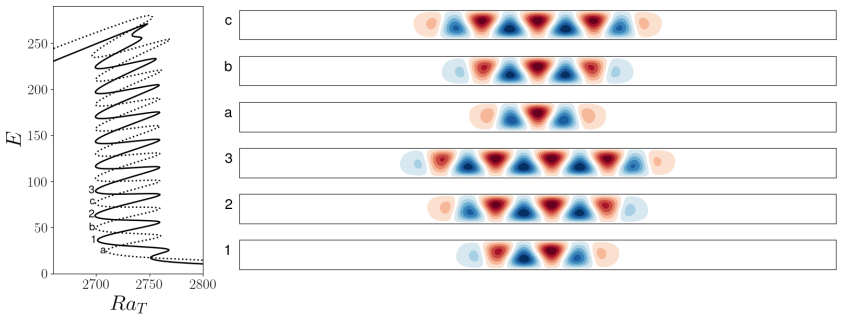
The mechanism that carries the argument is the latitudinal modulation of the eigenmodes of the conduction state: the Legendre modes that destabilise the shell have their largest amplitude at the poles because convection rolls there cover a smaller surface area, so they must be stronger to transport the same heat or solute. This modulation breaks the translational invariance of the planar problem and, together with a hidden symmetry that makes the even-parity primary bifurcation a codimension-two transcritical–saddle-node (TSN) event, causes localised states rather than periodic states to emerge from the primary bifurcation. The bifurcation diagrams are obtained by spectral numerical continuation in a streamfunction formulation, using the solutal Rayleigh number as a homotopy parameter to expose the imperfect bifurcations and the slanted snaking.
What would settle it
Run a direct three-dimensional simulation, or a linear stability analysis against azimuthal modes of order $m\neq 0$, of the axisymmetric convectons computed at $Ra_S=400$, $\Gamma=8.9224$ and at $Ra_S=150$, $\Gamma=10.029$; if $m\neq 0$ perturbations grow and destroy these states before they can be sustained, the reported bifurcation diagrams describe solutions that are not realisable in the full spherical shell.
Extended reading notes
Core claim
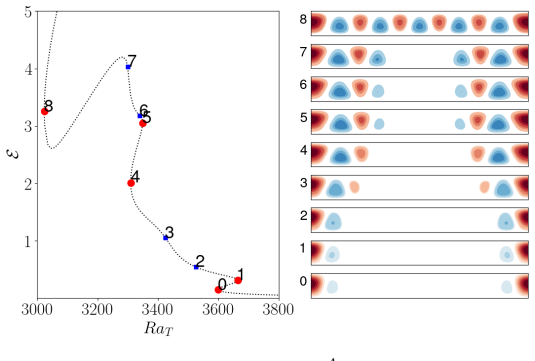
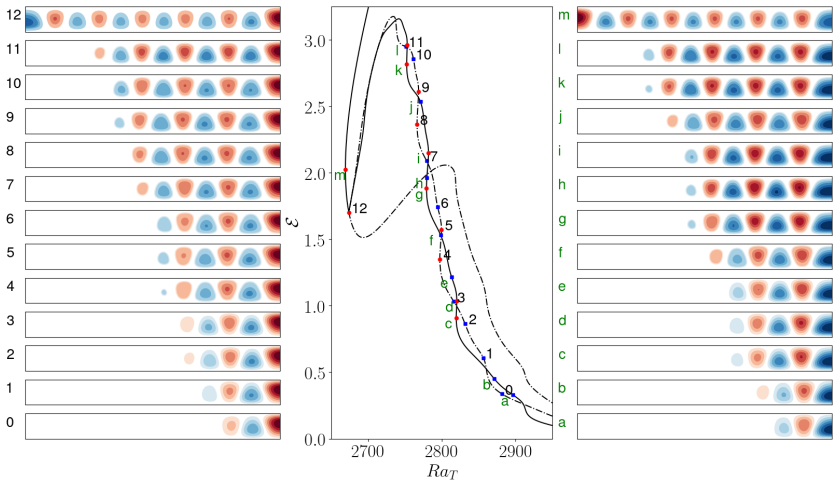
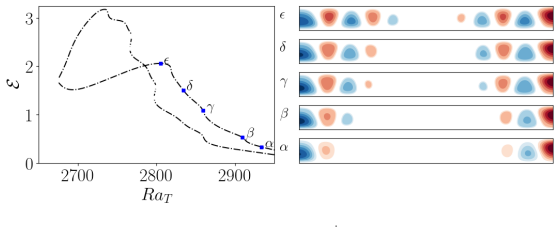
The central claim is that spatially localised doubly diffusive convection states exist in an axisymmetric spherical shell and that their origin is geometrical: convection rolls wrapping around the inner sphere are stronger near the poles, where the contact surface is smaller, so the linear eigenmodes are latitudinally modulated rather than periodic. Consequently the primary bifurcation does not create a spatially periodic pattern, and polar localised states bifurcate directly from the conduction state, while equatorial-convectons form branches disconnected from it. Continuing these branches numerically reveals slanted snaking — repeated saddle-node bifurcations with a leftward drift in the thermal Rayleigh number — organised by imperfect bifurcations that connect or disconnect the families as the solutal Rayleigh number is varied. The paper reports six branch types grouped in three families: C± equatorial-convectons, A± anticonvectons, and L± pole-convectons.
Load-bearing premise
The computed families all assume the flow is independent of longitude and has no zonal component ($\partial/\partial\phi=0$ and $u_\phi=0$), so the axisymmetric bifurcation diagrams may not survive three-dimensional perturbations.
Editorial extensions
If this is right
- In an axisymmetric spherical shell, localised convection states are the natural primary products of the instability rather than secondary structures that require a separate amplitude-modulating bifurcation.
- The solutal-to-thermal buoyancy balance selects the pattern: polar localisation is favoured at low solutal Rayleigh numbers and equatorial localisation at higher ones.
- Spherical curvature and the absence of top-down symmetry make the snaking slanted and sometimes destroy saddle-nodes, so the spherical bifurcation diagrams differ quantitatively from the aligned snaking of planar doubly diffusive convection.
- The same curvature-induced localisation mechanism is expected to operate in other axisymmetric pattern-forming systems, by analogy with the disk pattern-forming equation.
- The computed axisymmetric families provide the starting bifurcation structure for fully three-dimensional spherical-shell studies, where additional localised states breaking longitudinal invariance are anticipated.
Reading between the lines
- The axisymmetric restriction is an idealisation: a linear stability check of the computed convectons against azimuthal modes of order $m\neq 0$ would show which of the reported families survive in a truly three-dimensional spherical shell.
- Tracking the slanted snaking as the shell aspect ratio increases should recover the planar aligned-snaking limit, giving a quantitative test of how much of the spherical scenario is due to curvature.
- If the curvature mechanism is generic, similar localised states should appear in spherical-shell magnetoconvection or rapid rotation problems, where subcritical transitions have been suggested; that connection is not explored in this paper.
- The paper's inability to compute symmetry-breaking equatorial-convectons leaves an explicit gap; the predicted states could be searched for by starting from the symmetry-breaking pole-convecton branches and continuing through the parameter space the paper did not cover.
Signed reviews
Editorial analysis
A structured set of objections, weighed in public.
Referee Report
Summary. The paper studies doubly diffusive convection in an axisymmetric spherical shell, imposing longitudinal invariance and no zonal flow (Section 2). Using a pseudo-spectral method with Chebyshev radial collocation and sine/cosine latitudinal bases, the authors perform numerical continuation of steady axisymmetric states and compute bifurcation diagrams. They report three families of spatially localised solutions: equatorial-convectons (C±), anticonvectons (A±), and pole-convectons (L±_11). The primary even-mode bifurcation is interpreted as a transcritical-saddle-node (TSN) bifurcation, the equatorial-convecton branches are disconnected from the conduction state, and the localised branches exhibit slanted snaking attributed to imperfect bifurcations induced by the spatial modulation of curved convection rolls. The results are discussed through an analogy with the Swift–Hohenberg equation on a disk.
Significance. If the reported branches are numerically converged, this is the first demonstration of spatially localised doubly diffusive convection in a spherical shell, and it offers a concrete scenario in which curvature replaces translational invariance with spatial modulation, forcing localised states via imperfect bifurcations. The paper is commendable for depositing code and data, validating its time-stepper against Dedalus, and using direct numerical continuation rather than fitting to target states, so the circularity burden is low. The axisymmetric restriction is a genuine scope limitation but not a correctness flaw, since axisymmetric solutions are genuine invariant-subspace solutions of the full equations. The central existence claim remains conditional on (i) a missing resolution/convergence study and (ii) unverified support for the TSN classification.
major comments (2)
- [§5 (pseudo-spectral method), Figures 7–15] The manuscript does not report the spectral truncation (N_r, N_theta) used for the continuation runs, nor any spatial-resolution or convergence test for the computed branches. Saddle-node locations, the extent of slanted snaking, and the inferred imperfect bifurcation points (RaS ≈ 404, RaS ≈ 198, RaT ≈ 2674) are all quantities that can shift with insufficient truncation, and the existence of near-degenerate saddle-nodes on the ℓ = 10 and ℓ = 11 branches is exactly the kind of result that requires a convergence check. The deposited code and the Dedalus validation establish the time-stepper, but not the convergence of the arc-length continuation of unstable steady branches. Please add N_r, N_theta for representative states and a resolution study (e.g., comparing E or saddle-node RaT at two or more resolutions) for at least one branch per family.
- [§4 (Eq. 33) and §5.1] The conclusion that the even-parity primary bifurcation is a codimension-two transcritical-saddle-node (TSN) bifurcation is invoked from [BC15] and is load-bearing for the claim that anticonvectons bifurcate directly from the conduction state and that the equatorial-convecton branches are disconnected by imperfect bifurcations. However, the problem solved here has no-slip boundary conditions (Eq. 25), a different streamfunction formulation (Eq. 20), and finite aspect ratio Γ = 8.9224; none of these are checked against the hypotheses of the cited hidden-symmetry result. Since the unfolding is explicitly left out of scope, the manuscript should at least verify the TSN structure numerically for this system, for example by checking the quadratic tangency of the two LA± branches at the bifurcation point or by comparing with a direct normal-form computation.
minor comments (5)
- [§1] The phrase "Other work investing the role of temporal symmetry" should read "investigating the role".
- [§5] The word "dealiase" should be "dealias" in the description of the nonlinear term treatment.
- [Figures 7–15] The paper would be strengthened by reporting a stability analysis in the axisymmetric subspace: currently only one stable large-amplitude equatorial-convecton is identified by time-stepping, which leaves unclear whether the other computed localised branches are realisable or transient.
- [§5.2] The admission that symmetry-breaking equatorial-convectons could not be computed is an honest statement of limitation, but the statement "We are convinced that these states exist" is not supported by any numerical or analytical evidence and should be phrased as a conjecture.
- [References] There are minor typographical issues in the references, e.g., "Swift––Hohenberge quation" in [LS09] should read "Swift–Hohenberg equation".
Circularity Check
No significant circularity: the results are produced by direct numerical continuation and are not fitted to their own conclusions.
full rationale
The paper's central claims—the existence of equatorial-convectons, anticonvectons and pole-convectons, and the slanted snaking of their branches—are obtained by solving the governing PDEs with a pseudo-spectral method and arc-length continuation, not by fitting parameters to a target outcome. The parameter choices are inherited from the planar benchmark [BBK11] or chosen from the linear stability calculation (e.g., Gamma = 8.9224 and Gamma = 10.029 to separate nearby bifurcations), but the resulting branches are computed, not prescribed. The Swift–Hohenberg comparisons are invoked as an interpretive framework after the fact, and the statement that localised states arise 'via imperfect bifurcations' is supported by the computed branch structure via homotopy continuation in RaS rather than by definition. The use of [BBK11], which shares an author, is for parameter values and for the planar reference bifurcation diagram, and this is not load-bearing for the spherical-shell existence claim. The reliance on [BC15] for the hidden-symmetry/TSN interpretation concerns the linear operator and is independent of the nonlinear results. No equation in the paper is shown to be equivalent to its own input by construction, and no fitted quantity is renamed as a prediction. The absence of explicit convergence data for the continuation is a numerical robustness concern, not a circularity concern, and it does not change the score.
Assumptions & free parameters
free parameters (1)
- Aspect ratio Gamma =
8.9224 and 10.029
assumptions (5)
- domain assumption Boussinesq approximation with density varying linearly in temperature and salinity.
- domain assumption Gravity is spherically symmetric, g(r) ~ r^{-2}, assuming the inner core is much denser than the shell fluid.
- domain assumption Solutions are longitudinally invariant with no zonal flow: d/dphi = 0 and u_phi = 0.
- standard math The linear operator in Eq. (28) is self-adjoint, so even-parity bifurcations are transcritical-saddle-node (TSN) collisions.
- standard math Legendre polynomials are the correct separable latitudinal eigenfunctions for the linear problem.
Cite this review
Pith. "Pith review of Spatially localised doubly diffusive convection in an axisymmetric spherical shell." pith.science (2026). https://pith.science/paper/NVJZDBVG
@misc{pith2026250703830,
  author       = {Pith},
  title        = {Pith review of: Spatially localised doubly diffusive convection in an axisymmetric spherical shell},
  year         = {2026},
  howpublished = {\url{https://pith.science/paper/NVJZDBVG}},
  note         = {Machine review of arXiv:2507.03830}
}
read the original abstract
Doubly diffusive convection describes the fluid motion driven by the competition of temperature and salinity gradients diffusing at different rates. While the convective motions driven by these gradients usually occupy the entire domain, parameter regions exist where the convection is spatially localised. Although well-studied in planar geometries, spatially localised doubly diffusive convection has never been investigated in a spherical shell, a geometry of relevance to astrophysics. In this paper, numerical simulation is used to compute spatially localised solutions of doubly diffusive convection in an axisymmetric spherical shell. Several families of spatially localised solutions, named using variants of the word convecton, are found and their bifurcation diagram computed. The various convectons are distinguished by their symmetry and by whether they are localised at the poles or at the equator. We find that because the convection rolls that develop in the spherical shell are not straight but curve around the inner sphere, their strength varies with latitude, and the system is spatially modulated. As a result spatially periodic states can no longer form and, much like in a planar system with non-standard boundary conditions, localised states are forced to arise via imperfect bifurcations. While the direct relevance is to doubly diffusive convection, parallels drawn with the Swift Hohenberg equation suggest a wide applicability to other pattern forming systems in similar geometries.
Figures


Figures from the paper (12 more)




Reference graph
Works this paper leans on
-
[1]
, " * write output.state after.block = add.period write newline
ENTRY address author booktitle chapter edition editor howpublished institution journal key month note number organization pages publisher school series title type volume year eprint label extra.label sort.label short.list INTEGERS output.state before.all mid.sentence after.sentence after.block FUNCTION init.state.consts #0 'before.all := #1 'mid.sentence ...
-
[2]
write newline
" write newline "" before.all 'output.state := FUNCTION n.dashify 't := "" t empty not t #1 #1 substring "-" = t #1 #2 substring "--" = not "--" * t #2 global.max substring 't := t #1 #1 substring "-" = "-" * t #2 global.max substring 't := while if t #1 #1 substring * t #2 global.max substring 't := if while FUNCTION word.in bbl.in capitalize " " * FUNCT...
- [3]
- [4]
- [5]
-
[6]
P. Beltrame and P. Chossat. Onset of intermittent octahedral patterns in spherical B \'e nard convection. European J. Mech. B-Fluids , 50:156--174, 2015
work page 2015
-
[7]
C. Beaume. Adaptive S tokes preconditioning for steady incompressible flows. Commun. Comput. Phys. , 22(2):494--516, 2017
work page 2017
- [8]
Show all 52 references
-
[9]
J. J. Bramburger, D. J. Hill, and D. J. B. Lloyd. Localized patterns. 2025
2025
-
[10]
Burke and E
J. Burke and E. Knobloch. Localized states in the generalized S wift-- H ohenberg equation. Phys. Rev. E , 73:056211, 2006
2006
-
[11]
Bergeon and E
A. Bergeon and E. Knobloch. Periodic and localized states in natural doubly diffusive convection. Physica D , 237(8):1139--1150, 2008
2008
-
[12]
Beaume, E
C. Beaume, E. Knobloch, and A. Bergeon. Nonsnaking doubly diffusive convectons and the twist instability. Phys. Fluids , 25(114102), 2013
2013
-
[13]
Blanchflower
S. Blanchflower. Magnetohydrodynamic convectons. Phys. Lett. A , 261:74--81, 1999
1999
-
[14]
K. J. Burns, G. M. Vasil, J. S. Oishi, D. Lecoanet, and B. P. Brown. Dedalus: A flexible framework for numerical simulations with spectral methods. Phys. Rev. Res. , 2(2):023068, 2020
2020
-
[15]
J. D. Crawford and E. Knobloch. Symmetry and symmetry-breaking bifurcations in fluid dynamics. Annu. Rev. Fluid Mech. , 23(Volume 23, 1991):341--387, 1991
1991
-
[16]
S. J. Chapman and G. Kozyreff. Exponential asymptotics of localised patterns and snaking bifurcation diagrams. Physica D , 238(319--354), 2009
2009
-
[17]
Duguet, P
Y. Duguet, P. Schlatter, and D. S. Henningson. Localized edge states in plane C ouette flow. Phys. Fluids , 21:111701, 2009
2009
-
[18]
W. S. Edwards, L. S. Tuckerman, Friesner R. A., and D. C. Sorensen. Krylov methods for the incompressible N avier-- S tokes equations. J. Comput. Phys. , 110:82--102, 1994
1994
-
[19]
Foster and Knobloch
B. Foster and Knobloch. Elastic fingering in a rotating hele-shaw cell. Phys. Rev. E , 107:065104, 2023
2023
-
[20]
Foster, N
B. Foster, N. Verschueren, E. Knobloch, and L. Gordillo. Universal wrinkling of supported elastic rings. Phys. Rev. Lett. , 129:164301, 2022
2022
-
[21]
P. Garaud. Double-diffusive convection at low prandtl number. Annu. Rev. Fluid Mech. , 50(1):275--298, 2018
2018
-
[22]
Ghorayeb and A
K. Ghorayeb and A. Mojtabi. Double diffusive convection in a vertical rectangular cavity. Phys. Fluids , 9:2339--2348, 1997
1997
-
[23]
J. F. Gibson and T. M. Schneider. Homoclinic snaking in plane C ouette flow: Bending, skewing and finite-size effects. J. Fluid Mech. , 794:530--551, 5 2016
2016
-
[24]
S. M. Houghton and E. Knobloch. Homoclinic snaking in bounded domains. Phys. Rev. E , 80, 8 2009
2009
-
[25]
Knobloch
E. Knobloch. Spatial localization in dissipative systems. Annu. Rev. Condens. Mat. Phys. , 6:325--359, 3 2015
2015
-
[26]
Lo Jacono , A
D. Lo Jacono , A. Bergeon, and E. Knobloch. Spatially localized binary fluid convection in a porous medium. Physics of Fluids , 22(7), 2010
2010
-
[27]
Lo Jacono , A
D. Lo Jacono , A. Bergeon, and E. Knobloch. Localized traveling pulses in natural doubly diffusive convection. Phys. Rev. Fluids , 2:093501, 2017
2017
-
[28]
D. J. B. Lloyd, C. Gollwitzer, I. Rehberg, and R. Richter. Homoclinic snaking near the surface instability of a polarisable fluid. J. Fluid Mech. , 783:283--305, 2015
2015
-
[29]
D. J. B. Lloyd and B. Sandstede. Localized radial solutions of the S wift-– H ohenberge quation. Nonlinearity , 22(485--524), 2009
2009
-
[30]
Mercader, O
I. Mercader, O. Batiste, A. Alonso, and E. Knobloch. Localized pinning states in closed containers: homoclinic snaking without bistability. Phys. Rev. E , 80(2):025201, 2009
2009
-
[31]
Mercader, O
I. Mercader, O. Batiste, A. Alonso, and E. Knobloch. Convectons, anticonvectons and multiconvectons in binary fluid convection. J. Fluid Mech. , 667:586--606, 2011
2011
-
[32]
Mercader, O
I. Mercader, O. Batiste, A. Alonso, and E. Knobloch. Effect of small inclination on binary convection in elongated rectangular cells. Phys. Rev. E , 99:023113, 2019
2019
-
[33]
McCalla and B
S. McCalla and B. Sandstede. Snaking of radial solutions of the multi-dimensional Swift -- Hohenberg equation: A numerical study. Physica D , 239(16):1581--1592, August 2010. Publisher: Elsevier
2010
-
[34]
S. G. McCalla and B. Sandstede. Spots in the s wift-- h ohenberg equation. SIAM J. Appl. Dyn. Sys. , 12(2):831--877, 2013
2013
-
[35]
P. S. Marcus and L. S. Tuckerman. Simulation of flow between concentric rotating spheres. P art 1. S teady states. J. Fluid Mech. , 185:1--30, 1987
1987
-
[36]
Monville, J
R. Monville, J. Vidal, D. C \'e bron, and N. Schaeffer. Rotating double-diffusive convection in stably stratified planetary cores. Geophys. J. Int. , 219(Supplement\_1):S195--S218, 2019
2019
-
[37]
Pershin, C
A. Pershin, C. Beaume, and S. M. Tobias. Dynamics of spatially localized states in transitional plane C ouette flow. J. Fluid Mech. , 867:414--437, 2019
2019
-
[38]
T. Radko. Double-diffusive convection . Cambridge University Press, 2013
2013
-
[39]
F. Rincon. Dynamo theories. J. Plasma Phys. , 85(4), August 2019. arXiv: 1903.07829 Publisher: Cambridge University Press (CUP)
2019 arXiv
-
[40]
R. W. Schmitt. Double diffusion in oceanography. Annu. Rev. Fluid Mech. , 26:255--285, 1994
1994
-
[41]
T. M. Schneider, J. F. Gibson, and J. Burke. Snakes and ladders: localized solutions of plane C ouette flow. Phys. Rev. Lett. , 104(10):104501, 2010
2010
-
[42]
Stoop, R
N. Stoop, R. Lagrange, D. Terwagne, P. M. Reis, and J. Dunkel. Curvature-induced symmetry breaking determines elastic surface patterns. Nature Materials , 14(3):337--342, 2015
2015
-
[43]
C. S. Skene, F. Marcotte, and S. M. Tobias. On nonlinear transitions, minimal seeds and exact solutions for the geodynamo. arXiv preprint arXiv:2411.05499 , 2024
2024
-
[44]
Tr \"u mper, M
T. Tr \"u mper, M. Breuer, and U. Hansen. Numerical study on double-diffusive convection in the E arth’s core. Phys. Earth Plan. In. , 194:55--63, 2012
2012
-
[45]
Tumelty, C
J. Tumelty, C. Beaume, and A. Rucklidge. Towards convectons in the supercritical regime: Homoclinic snaking in natural doubly diffusive convection. SIAM J. Appl. Dyn. Sys. , 22:1710--1742, 2023
2023
-
[46]
Tumelty, C
J. Tumelty, C. Beaume, and A. M. Rucklidge. Convectons in unbalanced natural doubly diffusive convection. Phys. Rev. Fluids , 10:044401, 2025
2025
-
[47]
L. S. Tuckerman, J. Langham, and A. Willis. Order-of-Magnitude Speedup for Steady States and Traveling Waves via S tokes Preconditioning in C hannelflow and O penpipeflow , pages 3--31. Springer Berlin Heidelberg, 2019
2019
-
[48]
L. S. Tuckerman. Steady-state solving via S tokes preconditioning; recursion relations for elliptic operators. In D. L. Dwoyer, M. Y. Hussaini, and R. G. Voigt, editors, 11th International Conference on Numerical Methods in Fluid Dynamics , pages 573--577. Springer Berlin Heid...
1989
-
[49]
Verschueren, E
N. Verschueren, E. Knobloch, and H. Uecker. Localized and extended patterns in the cubic-quintic Swift -- Hohenberg equation on a disk. Phys. Rev. E , 104(1):014208, July 2021. Publisher: American Physical Society
2021
-
[50]
T. Wong, U. Hansen, T. Wieseh \"o fer, and W. B. McKinnon. Layering by double-diffusive convection in the subsurface oceans of E uropa and E nceladus. J. Geophys. Res.: Planets , 127(12):e2022JE007316, 2022
2022
-
[51]
Watanabe, M
T. Watanabe, M. Iima, and Y. Nishiura. Spontaneous formation of travelling localized structures and their asymptotic behaviour in binary fluid convection. J. Fluid Mech. , 712:219--243, 2012
2012
-
[52]
Watanabe, M
T. Watanabe, M. Iima, and Y. Nishiura. A skeleton of collision dynamics: Hierarchical network structure among even-symmetric steady pulses in binary fluid convection. SIAM J. Appl. Dyn. Sys. , 15:789--806, 2016
2016
Reviewed August 6, 2026 · model on record in the stance chip above.
Discussion (0). Continue with ORCID to comment.