REVIEW 3 major objections 5 minor 42 references
Discoveries of fine structures and secondary pulses in coherent radio emission from a magnetic massive star
T0 review · 3 major / 5 minor · reviewed 2026-08-06 · deepseek-v4-flash
Pith's one-line read A magnetic hot star's coherent radio pulses appear at unexpected rotational phases and break into 8-second spikes.
desk verdict Solid observational discoveries (off-null secondary pulses and 8-s fine structure in ECME) but the propagation-effect interpretation is a self-admittedly idealized simulation; send to review. read the letter →
The pith
A machine-rendered reading of the paper's core claim, the machinery that carries it, and where it could break.
The reading
What carries the argument
The argument leans on two instruments: (1) a 3D simulation framework (Das et al. 2020) that computes ECME lightcurves by beaming emission according to the tangent-plane model and then propagating rays through a rigidly rotating magnetosphere (RRM) density grid, letting refraction split and shift pulses; and (2) dynamic spectra of the primary pulses extracted at 8-second and 418 kHz resolution, the highest yet reported for ECME from a magnetic hot star. The simulation is used qualitatively: with parameters chosen by trial and error ($n_{p0}=10^9\,\mathrm{cm}^{-3}$, $E=10^4$, inclination $36^\circ$), it reproduces the number and relative phase locations of the observed primary and secondary pulses, which the paper takes as evidence that propagation effects can produce off-null pulses in highly oblique rotators.
What would settle it
A decisive test would be to repeat the full-cycle observation at higher time resolution (e.g., 1 second) around the LCP pulse near null 2: if the 8-second spikes dissolve into smooth emission or vary randomly between consecutive rotations, the claim of intrinsic fine structure fails. Alternatively, running the same propagation code with the star's actual non-dipolar field geometry and the measured inclination: if the secondary enhancements then disappear or shift by more than the observed phase window, the propagation-effect explanation for the off-null pulses is falsified.
Extended reading notes
Core claim
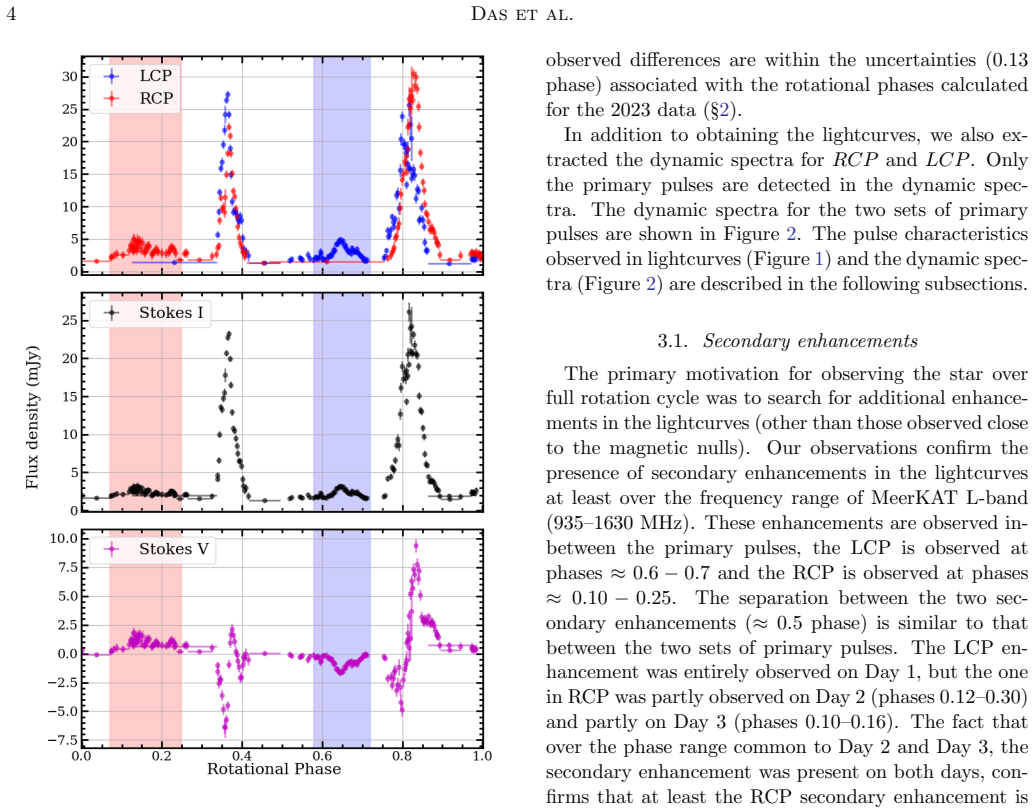
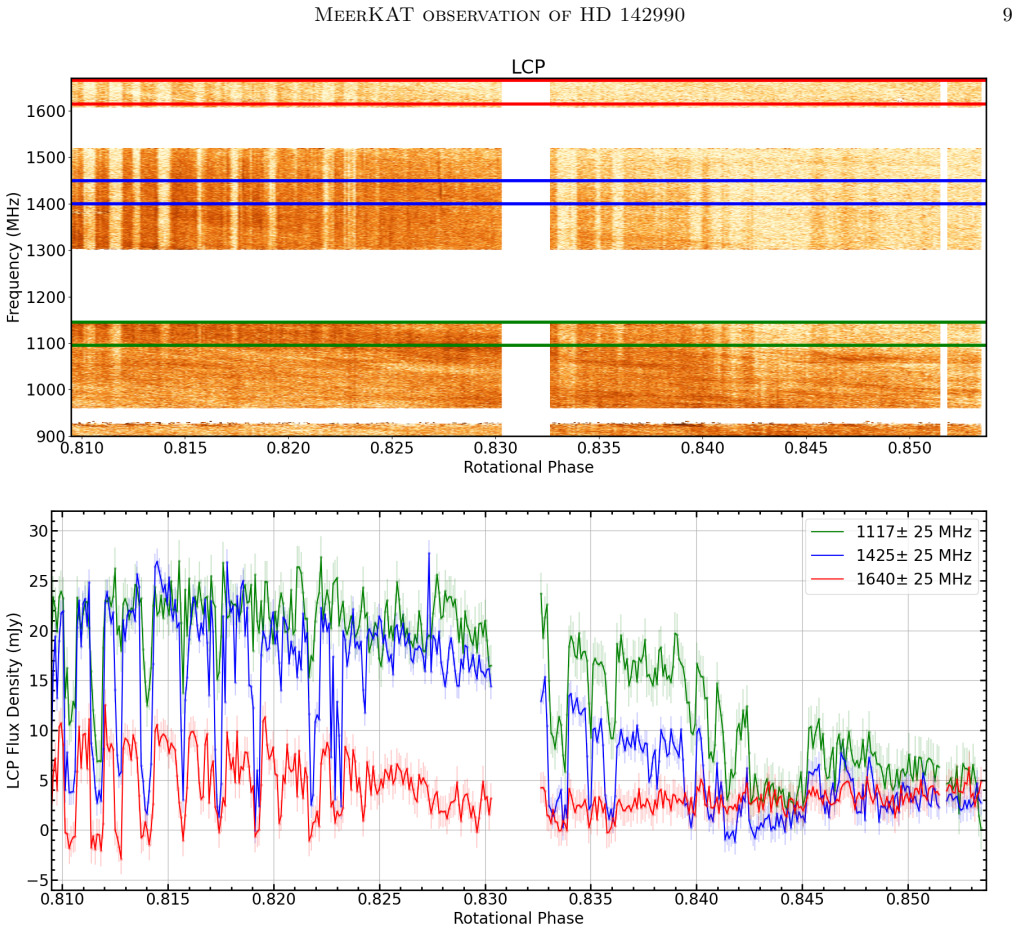
The paper reports that HD 142990, a magnetic B star with an obliquity greater than 80 degrees, emits coherent electron cyclotron maser radiation at rotational phases where the standard tangent-plane beaming model predicts no pulses: a persistent right-circularly polarized enhancement at phases roughly 0.10-0.25 and a left-circularly polarized enhancement at phases roughly 0.60-0.70. It also reports that the LCP primary pulse near magnetic null 2 is not smooth but consists of fine spikes with durations down to the 8-second time resolution, and that this spiky structure was seen on two independent days. The paper argues that the secondary enhancements arise from refraction and reflection of ECME beams as they pass through a highly azimuthally asymmetric magnetospheric plasma that forms when the magnetic and rotation axes are strongly misaligned, and that the fine structures betray the presence of discrete elementary emission sites whose number density decreases toward the emission's cutoff frequency.
Load-bearing premise
The load-bearing premise is that the idealized axisymmetric dipolar simulation, with its trial-and-error parameter choices, is a faithful enough model of this star's real (non-dipolar) magnetosphere to attribute the secondary pulses to propagation effects; if the star's known quadrupolar field or the measured inclination of 55 degrees removes the secondary pulses in the model, that interpretation loses its support while the detections themselves remain.
Editorial extensions
If this is right
- HD 142990 becomes the third main-sequence radio pulse emitter with confirmed secondary pulses, so full-rotation monitoring rather than null-phase-only scans is required to catalogue the true pulse duty cycle of magnetic hot stars.
- The persistent RCP secondary enhancement is locked to the rotation phase and seen on two days over the common phase range, making it a stable observable for probing the large-scale magnetospheric plasma distribution.
- The 8-second spikes imply that past observations at minute-level time resolution averaged over the elementary emission; future wideband observations must go to sub-minute resolution to characterise the elementary sources.
- The fine structures appear only near the upper cut-off of the LCP pulse, suggesting that the smooth envelope and the spiky component have different cut-off frequencies, so high-frequency edges of ECME pulses are the best places to search for fine structures in other MRPs.
- The confirmed reversal of pulse-drift direction with frequency around both magnetic nulls rules out the ideal constant-drift scenario and supports propagation-based explanations of the pulse timing.
Reading between the lines
- If secondary pulses are caused by propagation through a warped plasma distribution, then pulse arrival phases are not a clean geometric tracer of the magnetic field at the emission site; this complicates using ECME pulse timing to infer field geometry or to study star-planet interactions in other systems.
- The connection between fine structures and the spectral cut-off suggests a testable scaling: in any MRP pulse, the fraction of time spent in spikes should increase as the observing frequency approaches the pulse's upper cut-off, a trend the paper's data already hint at for the LCP pulse near null 2.
- The day-to-day anti-correlation of spike intensities over the same rotational phase range is unusual for rotation-locked emission; if confirmed in future cycles, it would point to a non-stationary or stochastic component in the driving of the elementary emission sites, such as episodic reconnection events.
Editorial analysis
A structured set of objections, weighed in public.
Referee Report
Summary. This paper presents MeerKAT L-band (900–1670 MHz) observations of the magnetic B star HD 142990 covering a full rotation cycle in three epochs, with 8 s time resolution and 418 kHz spectral resolution. The authors report two off-null secondary enhancements—one RCP at rotational phases ≈0.10–0.25 and one LCP at ≈0.60–0.70—with the RCP enhancement detected in overlapping phase ranges on two days. They also resolve, for the first time for a magnetic hot star, fine structures in the LCP primary pulse near magnetic null 2, with spike durations reaching the 8 s integration time, along with frequency-dependent pulse drift and polarization changes. A 3D propagation model built on Das et al. (2020) is used to argue that the secondary enhancements arise from refraction of ECME in a complex, highly oblique magnetosphere. The observations are presented with calibrated lightcurves, dynamic spectra, and explicit caveats about the model's assumptions.
Significance. If the detections hold, the paper establishes two new observational results for main-sequence radio pulse emitters: coherent ECME is not confined to the magnetic-null phases predicted by the tangent-plane beaming model, and the emission can be structured on timescales of seconds. These are meaningful advances for the study of coherent radio emission from magnetic hot stars and for comparisons with AKR and planetary ECME. The raw detection of off-null enhancements and the 8 s spikes is independent of the simulation and is the strongest part of the paper. The propagation-effect interpretation, however, is not established at the same level, because the supporting simulation uses a known-invalid dipolar geometry and parameters tuned by trial and error. With a suitably revised interpretation, the observational content is appropriate for ApJ.
major comments (3)
- [§4.1 and Abstract] The Abstract states that 'Using simulation, we infer that such pulses are likely related to the large misalignment...', but this inference is not supported by the simulation as presented. The model's first assumption is an axisymmetric dipole, which §4.1 immediately notes is known to be invalid for HD 142990 because of its significant quadrupolar component (Shultz et al. 2018). The 'best agreement' is obtained with i=36°, whereas the measured inclination is i=55° (Shultz et al. 2019b), and Figure 10 shows that i=55° does not reproduce the observations. Because the simulation also assumes the tangent-plane beaming model, it tests propagation modifications to that model and cannot exclude intrinsic beaming from non-dipolar auroral locations. The off-null detections are independent of the model, but the propagation-effect interpretation should be presented as one possibility, or demonstrated with a non-dipolar simulation.
- [§4.1, Figures 10–11] The agreement between simulation and observation is not quantified. The text says that np0=10^9 cm^-3, E=10^4, i=36°, and a 0.1-phase shift were chosen by trial and error, but no sensitivity study, grid, or fit statistic is given, so it is unclear whether the agreement is meaningful or degenerate. In addition, the simulated dynamic spectra do not reproduce the observed LCP drift reversal in Figure 8; the suggested explanation that the intrinsic LCP spectrum is not flat is an additional free assumption that is not tested. At minimum, the paper should state that the model is illustrative rather than a validated inference, or provide a parameter search and a test of the drift reversal.
- [§3.2.1, Figures 4–6] The fine-structure discovery needs a quantitative significance statement. No per-channel rms or single-time flux-density errors are reported for the dynamic spectra and extracted lightcurves, so the reader cannot confirm that the 8 s spikes are significant rather than noise or calibration artifacts. The claimed anti-correlation between Day 1 and Day 3 over phases 0.809–0.822 is based on visual inspection; please add a correlation coefficient or at least error bars. Finally, since the spikes are unresolved at the 8 s integration time, state unambiguously that 8 s is an instrumental upper limit on the spike duration and avoid wording that implies a measured intrinsic timescale.
minor comments (5)
- [§3.1] The word 'persistent' for the RCP secondary enhancement rests on two epochs separated by about one month with only partial phase overlap (Day 2 and Day 3); please replace it with 'reproduced in two observations' or explicitly discuss what 'persistent' means given the sparse sampling.
- [§4.1] The values RA=22 R* and L=30 R* are introduced without justification; a sentence on how they were chosen or on their effect on the results would help the reader assess the model's sensitivity.
- [§3.2.1] The statement that no drift of individual spikes is detected would be more informative if accompanied by the upper limit on drift rate implied by the 8 s and 418 kHz resolutions (about 52 kHz/s).
- [§4.2] The connection to centrifugal breakout is explicitly marked as a consistency argument, which is fine, but it should be labeled as speculative in the text rather than appearing as a conclusion.
- [§2] The rotational-phase uncertainty of 0.13 should be recalled when discussing the 0.1-phase shift applied in §4.1; the current text notes the uncertainty earlier but does not connect it to the shift explicitly.
Circularity Check
Secondary-pulse interpretation is partly circular: the simulation's free parameters are fitted to match the observed number and relative location of the secondary pulses, and the same simulation is then used to infer that those pulses arise from propagation effects; the raw detections and fine-structure discovery remain independent.
-
fitted input called prediction
[Abstract; §4.1, Figure 10 caption]
"Using simulation, we infer that such pulses are likely related to the large misalignment between the stellar rotation and magnetic dipole axes (>80°), leading to the formation of highly complex magnetospheric plasma distribution. ... By trial and error, the best agreement between simulated and observed lightcurves (in terms of the number of pulses observed at a given polarization and the relative location of the secondary pulses with respect to the primary pulses) are obtained for np0 = 10^9 cm−3, E = 10^4 and by using an inclination angle of i = 36°."
The inference that secondary pulses are propagation effects is supported by a simulation whose 'best agreement' is defined by the number and relative phase location of the secondary pulses—the very features the simulation is then used to explain. The parameters (np0, E, i) are chosen by trial and error against the same observed lightcurves, and the observed phases are additionally shifted by 0.1 to align the primary pulses, so the simulated reproduction of the secondary-pulse pattern is partly built into the comparison rather than independently tested. The use of i = 36° instead of the reported 55° further shows that the agreement is obtained by tuning rather than by the star's measured geometry.
full rationale
The paper's two headline discoveries are observational: (1) secondary radio enhancements at phases away from the magnetic nulls, with the RCP enhancement persistent across two days, and (2) fine structures in the LCP primary pulse with spike durations down to the 8 s integration time, seen on two days. Both are derived directly from MeerKAT lightcurves and dynamic spectra and are independent of any model, so those claims are not circular. The circularity concern is confined to the interpretive claim that the secondary enhancements are caused by magnetospheric propagation effects in a highly oblique rotator. That interpretation rests on a 3D simulation framework (Das et al. 2020) whose parameters are explicitly fitted by trial and error to reproduce the observed number and relative location of the secondary pulses. The paper honestly lists the assumptions, including that the axisymmetric dipole field is known to be invalid for HD 142990, and it shows that using the measured inclination of 55° gives poor agreement, requiring i = 36° instead. This means the simulation's ability to produce secondary pulses at the right phases is, in part, a consequence of fitting rather than an independent confirmation. However, this is not a case where the entire derivation reduces to its inputs by definition: the existence of off-null pulses was predicted by the same authors' earlier framework before these observations, and the observational phenomena stand on their own. The fine-structure discovery involves no model fitting at all. Weighing the partial circularity of the secondary-pulse interpretation against the independent observational content, a score of 4 is appropriate rather than a higher score.
Assumptions & free parameters
free parameters (5)
- np0 (base magnetospheric density) =
10^9 cm^-3
- E (density enhancement factor) =
10^4
- i (inclination angle) =
36 degrees
- Phase offset between observed and simulated lightcurves =
0.1 in rotational phase
- L (equatorial radius of auroral field lines) =
30 R*
assumptions (7)
- ad hoc to paper The stellar magnetic field is an axisymmetric dipole in the simulation.
- ad hoc to paper The intrinsic ECME spectrum is flat.
- domain assumption There is no frequency dependence of the intrinsic beaming angles, and emission follows the tangent plane beaming model.
- ad hoc to paper Radiation travels in straight lines until it hits the closed stellar magnetosphere bounded by the Alfven radius.
- domain assumption ECME is produced in the extraordinary mode at the second harmonic.
- domain assumption The magnetospheric density follows the Rigidly Rotating Magnetosphere (RRM) model.
- domain assumption The ephemeris of Shultz et al. 2019a correctly phases the data, with a phase uncertainty of about 0.13.
Cite this review
Pith. "Pith review of Discoveries of fine structures and secondary pulses in coherent radio emission from a magnetic massive star." pith.science (2026). https://pith.science/paper/AVD3G3LZ
@misc{pith2026250703882,
  author       = {Pith},
  title        = {Pith review of: Discoveries of fine structures and secondary pulses in coherent radio emission from a magnetic massive star},
  year         = {2026},
  howpublished = {\url{https://pith.science/paper/AVD3G3LZ}},
  note         = {Machine review of arXiv:2507.03882}
}
abstract
In this paper, we report auroral radio emission from a magnetic B star HD 142990 using the MeerKAT radio telescope at $900-1670$ MHz. The star is known to produce such emission (observed as periodic radio pulses) via electron cyclotron maser emission (ECME). However, past studies on ECME from this star were confined to observations at specific rotational phase ranges where one expects to see such pulses. We, for the first time, observed the star for its one complete rotation cycle and discovered that the star also produces 'off-pulse' emission, which we term as secondary enhancements. Two such enhancements were observed, one of which is left circularly polarized (LCP) and the other is right circularly polarized (RCP), the latter is confirmed to be persistent. Using simulation, we infer that such pulses are likely related to the large misalignment between the stellar rotation and magnetic dipole axes ($>80^\circ$), leading to the formation of highly complex magnetospheric plasma distribution. In addition, by extracting dynamic spectra for the primary pulses, we discovered prominent fine structures in one of the LCP pulses, with timescales as small as the instrumental time resolution (8 seconds). This is the first time that such structures are seen from a magnetic hot star, and has the potential to reveal detailed information about how the emission is driven, and the nature of the elementary sources of radiation. To pinpoint the origin of these fine structures and their significance, higher time and spectral resolution observations should be conducted in the future.
Figures


Figures from the paper (8 more)



Reference graph
Works this paper leans on
-
[1]
, " * write output.state after.block = add.period write newline
ENTRY address archivePrefix author booktitle chapter doi edition editor eprint howpublished institution journal key month number organization pages publisher school series title misctitle type volume year version url label extra.label sort.label short.list INTEGERS output.state before.all mid.sentence after.sentence after.block FUNCTION init.state.consts ...
-
[2]
write newline
" write newline "" before.all 'output.state := FUNCTION format.url url empty "" new.block "" url * "" * if FUNCTION format.eprint eprint empty "" archivePrefix empty "" archivePrefix "arXiv" = new.block " " eprint * " " * new.block " " eprint * " " * if if if FUNCTION format.doi doi empty "" " " doi * " " * if FUNCTION format.pid doi empty eprint empty ur...
-
[3]
QF = 3sÆ N &rJzŌ 3\ʯ oF8 , ; !
thebibliography [1] 20pt to REFERENCES 6pt =0pt -12pt 10pt plus 3pt =0pt =0pt =1pt plus 1pt =0pt =0pt -12pt =13pt plus 1pt =20pt =13pt plus 1pt \@M =10000 =-1.0em =0pt =0pt 0pt =0pt =1.0em @enumiv\@empty 10000 10000 `\.\@m \@noitemerr \@latex@warning Empty `thebibliography' environment \@ifnextchar \@reference \@latexerr Missing key on reference command E...
2021
-
[4]
Bastian , T. S., Cotton , W. D., & Hallinan , G. 2022, , 935, 99, 10.3847/1538-4357/ac7d57
-
[5]
Bloot , S., Callingham , J. R., Vedantham , H. K., et al. 2024, , 682, A170, 10.1051/0004-6361/202348065
-
[6]
Callingham , J. R., Pope , B. J. S., Feinstein , A. D., et al. 2021, , 648, A13, 10.1051/0004-6361/202039144
-
[7]
Cotton , W. D. 2008, PASP, 120, 439, 10.1086/586754
doi:10.1086/586754 2008
-
[8]
Cotton, W. D., Thorat, K., Condon, J. J., et al. 2020, MNRAS, 495, 1271, 10.1093/mnras/staa1240
Show all 42 references
-
[9]
2021, , 921, 9, 10.3847/1538-4357/ac1075
Das , B., & Chandra , P. 2021, , 921, 9, 10.3847/1538-4357/ac1075
2021 doi
- [10]
-
[11]
2024, , 974, 267, 10.3847/1538-4357/ad71c5
Das , B., Chandra , P., & Petit , V. 2024, , 974, 267, 10.3847/1538-4357/ad71c5
2024 doi
-
[12]
E., & Wade , G
Das , B., Chandra , P., Shultz , M. E., & Wade , G. A. 2019, , 877, 123, 10.3847/1538-4357/ab1b12
2019 doi
-
[13]
Das , B., Chandra , P., & Wade , G. A. 2018, , 474, L61, 10.1093/mnrasl/slx193
2018 doi
-
[14]
2020, , 900, 156, 10.3847/1538-4357/aba8fd
Das , B., Mondal , S., & Chandra , P. 2020, , 900, 156, 10.3847/1538-4357/aba8fd
2020 doi
-
[15]
E., et al
Das , B., Chandra , P., Shultz , M. E., et al. 2022, , 925, 125, 10.3847/1538-4357/ac2576
2022 doi
-
[16]
A., & Anderson , R
Gurnett , D. A., & Anderson , R. R. 1981, Geophysical Monograph Series, 25, 341, 10.1029/GM025p0341
1981 doi
-
[17]
A., Anderson , R
Gurnett , D. A., Anderson , R. R., Scarf , F. L., Fredricks , R. W., & Smith , E. J. 1979, , 23, 103, 10.1007/BF00174114
1979 doi
-
[18]
2016, in MeerKAT Science: On the Pathway to the SKA, 1, 10.22323/1.277.0001
Jonas , J., & MeerKAT Team . 2016, in MeerKAT Science: On the Pathway to the SKA, 1, 10.22323/1.277.0001
2016 doi
-
[19]
S., et al
Leto , P., Trigilio , C., Buemi , C. S., et al. 2016, , 459, 1159, 10.1093/mnras/stw639
2016 doi
-
[20]
2017, , 467, 2820, 10.1093/mnras/stx267
Leto , P., Trigilio , C., Oskinova , L., et al. 2017, , 467, 2820, 10.1093/mnras/stx267
2017 doi
-
[21]
M., et al
Leto , P., Trigilio , C., Oskinova , L. M., et al. 2018, , 476, 562, 10.1093/mnras/sty244
2018 doi
- [22]
-
[23]
2020 a , , 493, 4657, 10.1093/mnras/staa587
Leto , P., Trigilio , C., Leone , F., et al. 2020 a , , 493, 4657, 10.1093/mnras/staa587
2020 doi
-
[24]
S., et al
Leto , P., Trigilio , C., Buemi , C. S., et al. 2020 b , , 499, L72, 10.1093/mnrasl/slaa157
2020 doi
-
[25]
A., & Linsky , J
Lim , J., Drake , S. A., & Linsky , J. L. 1996, Astronomical Society of the Pacific Conference Series, Vol. 93, Rotational Modulation of Radio Emission from the Magnetic BP Star HR 5624 , ed. A. R. Taylor & J. M. Paredes , 324
1996
-
[26]
D., Condon , J
Mauch , T., Cotton , W. D., Condon , J. J., et al. 2020, ApJ, 888, 61, 10.3847/1538-4357/ab5d2d
2020 doi
-
[27]
P., Waters , B., Schiebel , D., Young , W., & Golap , K
McMullin , J. P., Waters , B., Schiebel , D., Young , W., & Golap , K. 2007, in Astronomical Society of the Pacific Conference Series, Vol. 376, Astronomical Data Analysis Software and Systems XVI, ed. R. A. Shaw , F. Hill , & D. J. Bell , 127
2007
- [28]
-
[29]
P., Shultz , M
Owocki , S. P., Shultz , M. E., ud-Doula , A., et al. 2020, , 499, 5366, 10.1093/mnras/staa2325
2020 doi
-
[30]
E., Treumann , R
Pottelette , R., Ergun , R. E., Treumann , R. A., et al. 1999, , 26, 2629, 10.1029/1999GL900462
1999 doi
-
[31]
Reynolds , J. E. 1994, ATNF Memo , AT/39.3/040
1994
-
[32]
A., & Chand ra , P
Shultz , M., Rivinius , T., Das , B., Wade , G. A., & Chand ra , P. 2019 a , , 486, 5558, 10.1093/mnras/stz1129
2019 doi
-
[33]
E., Wade , G
Shultz , M. E., Wade , G. A., Rivinius , T., et al. 2018, , 475, 5144, 10.1093/mnras/sty103
2018 doi
- [34]
-
[35]
E., Owocki , S., Rivinius , T., et al
Shultz , M. E., Owocki , S., Rivinius , T., et al. 2020, , 499, 5379, 10.1093/mnras/staa3102
2020 doi
-
[36]
Townsend , R. H. D., & Owocki , S. P. 2005, , 357, 251, 10.1111/j.1365-2966.2005.08642.x
2005
-
[37]
Treumann , R. A. 2006, , 13, 229, 10.1007/s00159-006-0001-y
2006 doi
-
[38]
2000, , 362, 281
Trigilio , C., Leto , P., Leone , F., Umana , G., & Buemi , C. 2000, , 362, 281. astro-ph/0007097
2000 arXiv
-
[39]
S., & Leone , F
Trigilio , C., Leto , P., Umana , G., Buemi , C. S., & Leone , F. 2011, , 739, L10, 10.1088/2041-8205/739/1/L10
2011 doi
-
[40]
2019, , 871, 214, 10.3847/1538-4357/aaf88e
Villadsen , J., & Hallinan , G. 2019, , 871, 214, 10.3847/1538-4357/aaf88e
2019 doi
-
[41]
P., Abada-Simon , M., & Denis , L
Zarka , P., Farges , T., Ryabov , B. P., Abada-Simon , M., & Denis , L. 1996, , 23, 125, 10.1029/95GL03780
1996 doi
-
[42]
2023, , 953, 65, 10.3847/1538-4357/acdb77
Zhang , J., Tian , H., Zarka , P., et al. 2023, , 953, 65, 10.3847/1538-4357/acdb77
2023 doi
Reviewed August 6, 2026 · model on record in the stance chip above.
Discussion (0). Continue with ORCID to comment.