REVIEW 3 major objections 6 minor 58 references
Search for spatial coincidences between galaxy mergers and Fermi-LAT 4FGL-DR4 sources
T0 review · 3 major / 6 minor · reviewed 2026-08-06 · deepseek-v4-flash
Pith's one-line read Twenty-one of 3,166 galaxy mergers coincide with Fermi-LAT gamma-ray sources at less than 5 percent chance of random alignment.
desk verdict A useful first cross-match and candidate list, but the per-object p-values don't establish a global excess, and the 'secure' label is stronger than the statistics support. read the letter →
The pith
A machine-rendered reading of the paper's core claim, the machinery that carries it, and where it could break.
The reading
What carries the argument
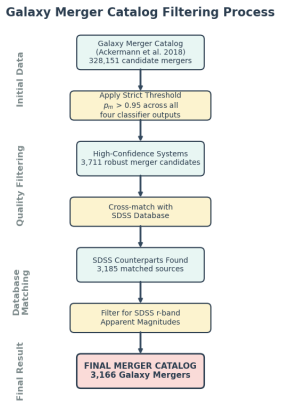
The load-bearing statistical object is the Poisson chance-coincidence probability p = 1 − $e^{{−μ}}$ with μ = πab n_s(>S). Here a and b are the semi-major and semi-minor axes of each 4FGL-DR4 source's positional uncertainty ellipse, matched at a conservative 4σ threshold, and n_s(>S) is the surface density of merger candidates with SDSS r-band flux greater than the candidate's flux, computed by counting brighter mergers in the full catalog and dividing by the estimated 6190 deg² sky footprint. This converts each spatial overlap into a probability that it arose by chance, and the p < 0.05 threshold defines the secure list. The machinery also includes the merger selection pipeline: a strict probability threshold on the CNN merger scores and a 0.1-arcsecond cross-match to SDSS DR16.
What would settle it
Recompute the 21 p-values using a local merger surface density measured in an annulus around each Fermi source rather than the global 6190 deg² footprint; if fewer than 21 associations survive at p < 0.05, the claimed secure matches are artifacts of the uniform-background assumption.
Extended reading notes
Core claim
Cross-matching 3,166 high-confidence galaxy mergers (selected from 328,151 CNN candidates by requiring merger probability > 0.95 in every fold, then matched to SDSS DR16) against 4FGL-DR4 yields 38 spatial coincidences within the 4σ positional uncertainty ellipses of Fermi sources. Using the Poisson chance-coincidence probability p = 1 − $e^{{−πab n_s(>S)}}$, where a and b are the ellipse semi-axes and n_s(>S) is the flux-dependent surface density of mergers brighter than the SDSS counterpart, 21 of these matches have p < 0.05 and are classified as statistically secure. Their 4FGL-DR4 classifications are four FSRQs, six BL Lacs, three BCUs, three radio galaxies, and five unassociated sources; none is a pulsar. A control sample with the merger coordinates randomly shifted by up to 2 degrees yields zero matches, while the 70 galaxy pairs from the CNOC2 catalog also produce no associations. The paper concludes that mergers can host gamma-ray-emitting AGN activity and that the five unassociated counterparts may point to a previously unrecognized population of gamma-ray sources.
Load-bearing premise
The chance-coincidence background is one global number—the count of mergers brighter than the candidate divided by a single uniform sky area of about 6190 square degrees—so if that footprint or the merger catalog's clustering is wrong, every p-value scales and the 21-match list could shrink or grow.
Editorial extensions
If this is right
- 21 of 38 positional coincidences are secure at p < 0.05; 62% are blazar-type (FSRQ, BLL, BCU), three are radio galaxies, and none is a pulsar.
- Five secure counterparts are unassociated Fermi sources; three show no AGN signatures in SDSS, RASS, or FIRST and are plausible merger-driven emitters.
- A control sample with merger positions randomly shifted by up to 2 degrees produces zero matches, supporting the interpretation that the 21 associations are not chance coincidences.
- The 70 CNOC2 close galaxy pairs show no Fermi associations within the same threshold, so the positive result is specific to the large morphologically selected merger sample.
- Merger catalogs can serve as physically motivated priors for identifying unassociated Fermi-LAT sources, a use the paper explicitly proposes.
Reading between the lines
- If the association is real, a stacking analysis of all 3,166 mergers, not only those inside error ellipses, should reveal a collective gamma-ray excess; that test would be independent of the 4σ threshold and is not performed in the paper.
- The three unassociated counterparts without AGN signatures are the cleanest targets for follow-up: deep X-ray and radio observations would decide whether merger-driven emission is actually present, a step the paper itself calls for.
- Replacing the uniform 6190 deg² footprint with a locally measured merger surface density, or with a full angular cross-correlation between the merger catalog and 4FGL-DR4, would convert the 21 matches into a population-level excess measurement.
- The same Poisson machinery could be applied to future merger catalogs from deeper surveys, turning a sparse list of 21 matches into a measurement of the merger-triggered gamma-ray source fraction and its evolution with redshift.
Editorial analysis
A structured set of objections, weighed in public.
Referee Report
Summary. The paper cross-matches a high-confidence sample of 3,166 CNN-selected galaxy mergers (derived from Ackermann et al. 2018) with the Fermi-LAT 4FGL-DR4 catalog. Using a 4σ positional matching radius and a Poisson chance-coincidence framework (Eqs. 1–2), the authors report 38 spatial coincidences, of which 21 have p<0.05 and are classified as “statistically secure” matches; five of these are unassociated Fermi sources. The paper also searches 70 galaxy pairs from the CNOC2/Patton et al. (2005) catalog and finds no p<0.05 counterparts. The central claim is that the 21 matches are unlikely to be random associations.
Significance. If correct, this would be the first systematic indication that a morphologically selected galaxy-merger population contains gamma-ray-emitting members, and it would motivate using merger catalogs as priors for classifying unassociated Fermi sources. The paper has genuine strengths: it uses a standard Poisson cross-match formalism, public catalogs, a transparent data-provenance statement in Section 2.1, a full table of matches, and an explicit control-sample attempt. However, the statistical support for the headline result is incomplete: the paper does not provide a global chance-coincidence budget, and the single shifted control is not a calibrated null. The result is currently suggestive rather than secure.
major comments (3)
- [Section 3, Eq. (2)] The claim that 21 of 38 coincidences are “statistically secure” is based on per-object p-values, but the paper never computes the global expected number of chance coincidences, Λ = Σ_i μ_i, summed over all 4FGL-DR4 sources. Under the null, the expected number of spatial coincidences is Λ, and for the small μ_i typical in this analysis the expected number of coincidences with p<0.05 is also approximately Λ; it is not 0.05×38. Without Λ, the observed 38 coincidences and 21 “secure” matches cannot be interpreted as an excess. Please report Λ, its Poisson uncertainty, and a Monte Carlo distribution of the number of matches and of the p-values under the null, and adjust the significance claims accordingly.
- [Section 3, control-sample paragraph] The shifted control sample is a single realization and is not a calibrated null. A shift of ±2° should approximately preserve the local merger surface density, so under the Poisson model the shifted sample should produce an expected number of chance coincidences close to the unshifted expectation; zero matches in one realization is therefore either an unlikely fluctuation or a sign that the shift does not preserve the survey mask/selection function. Please replace this with a Monte Carlo control using many independent shifts that preserve the 4FGL and SDSS footprints and the merger clustering, and report the distribution of the number of coincidences and of the p-values. A non-merger baseline (e.g., random SDSS galaxies with similar magnitude and redshift distributions) should also be included to test whether the excess is specific to mergers.
- [Section 2, Eq. (1)] The surface density n_s(>S) is estimated by dividing counts from the merger catalog by a single footprint area of 6190 deg^2, obtained from an RA/Dec binning whose bin size is not specified. Because every p-value in Eq. (2) scales linearly with n_s, uncertainty in the footprint and in the binning choice propagates directly into the list of 21 “secure” matches. Moreover, the merger catalog is strongly clustered (Figure 3), so a uniform global density may not represent the local chance-coincidence rate. Please specify the binning, quote an uncertainty on the footprint, and compare with a local-density estimate of n_s (e.g., from shuffled or nearest-neighbor catalogs).
minor comments (6)
- [Abstract] The phrase “galaxy mergers (Ackermann et al., 2018) catalog” is ungrammatical and should be rephrased.
- [Section 3 and Table 1] The text uses “4σ positional uncertainty ellipse” and “95% positional uncertainty (σ)” interchangeably; please define σ precisely and state whether the quoted separations are in units of the 1σ, 95%, or 4σ ellipse.
- [Author line] The surname appears as “Mannaa” in the author line and as “Manna” in the email address; please make this consistent.
- [Section 1] The statement that a 1 arcminute search around UGC 12914/5, UGC 813/6, VV 114, NGC 660, and NGC 3256 found no 4FGL-DR4 matches is made without listing the exact search parameters or the resulting upper limits; adding a short table or explicit thresholds would make the statement reproducible.
- [Section 3] The observation that none of the 21 secure matches is a pulsar would be more informative if compared with the expected pulsar fraction among randomly selected 4FGL-DR4 sources of similar flux.
- [References] Several reference entries contain LaTeX artifacts (e.g., “V orontsov-Velyaminov”, “V oges”, “C.E., Czarapata, P.C.”); these should be cleaned up before final submission.
Circularity Check
No significant circularity: the merger-Fermi association probabilities use standard external thresholds and an independent chance-coincidence background; no load-bearing fitted input or self-citation.
full rationale
The derivation chain is self-contained against external benchmarks. The merger sample is from Ackermann et al. (2018), and the gamma-ray positions and error ellipses are from the external 4FGL-DR4 catalog. Equations 1 and 2 use the standard Poisson chance-coincidence framework (Browne and Cohen 1978; Downes et al. 1986; Biggs et al. 2011; Zhang et al. 2022), with 4-sigma and p<0.05 thresholds imported from Zhang et al. (2022) rather than tuned to this dataset. Estimating n_s(>S) from the public merger catalog itself is the conventional way to define a null density for positional matching; it is not fitted to reproduce the 21 claimed associations and each candidate is treated individually. The shifted control is an additional null check, not an input to the p-values. The only self-citation (Ramakrishnan and Desai 2025) appears in a list of prior Fermi cross-matching studies and does not support any central premise. Statistical concerns about not reporting the total expected number of chance coincidences across the full 4FGL search and about the uncalibrated single shifted control affect the evidential strength of the claim, but they are not circularity because the claimed associations are not obtained by fitting a parameter to the gamma-ray data or by equating a prediction to its defining input.
Assumptions & free parameters
free parameters (3)
- merger probability threshold (pm) =
>0.95
- positional uncertainty threshold =
4 sigma
- sky area estimation binning =
not specified
assumptions (4)
- standard math Poisson chance coincidence model: mu = pi*a*b*n_s(>S), p = 1 - exp(-mu)
- domain assumption Uniform surface density of mergers over the estimated footprint
- domain assumption 4FGL-DR4 positional error ellipses correctly represent the localization uncertainty
- domain assumption Position-shifted control sample is a valid null
Cite this review
Pith. "Pith review of Search for spatial coincidences between galaxy mergers and Fermi-LAT 4FGL-DR4 sources." pith.science (2026). https://pith.science/paper/GYR5WJTB
@misc{pith2026250703970,
  author       = {Pith},
  title        = {Pith review of: Search for spatial coincidences between galaxy mergers and Fermi-LAT 4FGL-DR4 sources},
  year         = {2026},
  howpublished = {\url{https://pith.science/paper/GYR5WJTB}},
  note         = {Machine review of arXiv:2507.03970}
}
abstract
We present a systematic search for spatial association between a high confidence sample of 3,166 morphologically selected galaxy mergers drawn from the initial convolutional neural network (CNN) catalog of 328,151 candidate mergers and refined through SDSS cross-matching and the Fermi Large Area Telescope Fourth Source Catalog Data Release 4 (4FGL-DR4) catalog of gamma-ray sources detected by the Fermi Large Area Telescope (LAT). Using a conservative 4$\sigma$ positional uncertainty threshold and a Poisson based statistical framework, we identify 21 statistically significant associations with match probabilities $p < 0.05$. Among these are known classes of gamma-ray emitters such as Flat-Spectrum Radio Quasars (FSRQs), BL Lacertae objects (BLL), and radio galaxies bolstering the hypothesis that merger driven processes can fuel high energy activity. Intriguingly, five of the associated sources remain unclassified in 4FGL-DR4, hinting at a possible link between galaxy mergers and a hitherto unrecognized population of gamma-ray sources. The dominance of AGN like matches supports the scenario in which mergers trigger accretion onto central supermassive black holes, initiating AGN activity observable at gamma-ray energies. Moreover, the recurrent presence of unassociated sources among secure matches underscores the potential of merger catalogs as physically motivated priors in gamma-ray source identification efforts. This work constitutes the first dedicated effort to explore associations between gamma-ray sources and a large, morphologically selected sample of galaxy mergers catalog, opening new avenues for understanding the role of galaxy interactions in high-energy astrophysics.
Figures


Figures from the paper (4 more)


Reference graph
Works this paper leans on
-
[1]
The table is sorted in decreasing order of p-value
13 Table 1: Complete list of 21 secure matches between Fermi 4FGL-DR4 sources and galaxy mergers, defined by p-value < 0.05. The table is sorted in decreasing order of p-value. Uncertainties in r-band magnitudes are from SDSS DR16 photometry; redshift uncertainties are from SIMBAD; flux errors are calculated from r-band magnitudes. Fermi Source Merger RA ...
work page 1937
-
[3]
doi: 10.3847/1538-4365/ab929e, arXiv:1912.02905. Atwood, W.B., Abdo, A.A., Ackermann, M., Althouse, W., Anderson, B., Axelsson, M., Baldini, L., Ballet, J., Band, D.L., Barbiellini, G., Bartelt, J., Bastieri, D., Baughman, B.M., Bechtol, K., Bédérède, D., Bellardi, F., Bellazzini, R., Berenji, B., Bignami, G.F., Bisello, D., Bissaldi, E., Blandford, R.D.,...
arXiv 1912
-
[4]
doi: 10.3847/1538-4365/ab16f4, arXiv:1903.11124. Darg, D.W., Kaviraj, S., Lintott, C.J., Schawinski, K., Sarzi, M., Bamford, S., Silk, J., Proctor, R., Andreescu, D., Murray, P., Nichol, R.C., Raddick, M.J., Slosar, A., Szalay, A.S., Thomas, D., Vandenberg, J.,
arXiv 1903
- [7]
-
[10]
3847/1538-4357/acd172, arXiv:2304.10934. Paliya, V .S., Pérez, E., García-Benito, R., Ajello, M., Prada, F., Alberdi, A., Suh, H., Chandra, C.H.I., Domínguez, A., Marchesi, S., Di Matteo, T., Hartmann, D., Chiaberge, M.,
-
[12]
Compact Groups of Galaxies in Sloan Digital Sky Survey and LAMOST Spectral Survey: I. The Catalogs
doi: 10.3847/1538-4365/ab5c26, arXiv:1911.11478. Appendix A. SDSS Flux Conversion Methodology SDSS magnitudes are reported in the asinh magnitude system (Lupton et al., 1999), which handle low S /N and negative fluxes more robustly than traditional Pogson magnitudes. The inverse asinh formula for converting r-band apparent magnitudes (mr) to fluxes is: fr...
work page Pith review arXiv 1911
-
[18]
Imagenet: A large-scale hierarchical image database, in: 2009 IEEE Conference on Computer Vision and Pattern Recognition, pp. 248–255. doi: 10.1109/CVPR.2009. 5206848. Downes, A.J.B., Peacock, J.A., Savage, A., Carrie, D.R.,
-
[23]
Comparison of black hole growth in galaxy mergers with GASOLINE and RAMSES. Astron. & Astrophys. 592, A62. doi:10.1051/ 0004-6361/201527143, arXiv:1508.02224. Gaia Collaboration,
Show all 58 references
-
[26]
doi:10.1093/pasj/psx135, arXiv:1706.07436
Galaxy interactions trigger rapid black hole growth: An unprecedented view from the Hyper Suprime-Cam survey 70, S37. doi:10.1093/pasj/psx135, arXiv:1706.07436. Himes, M., Jagannathan, P., Frail, D.A., Schinzel, F., Gupta, N., Balashev, S.A., Combes, F., Deka, P.P., Klöckner, ...
-
[30]
Astrophys
A Catalog of Morphologically Identified Merging Galaxies. Astrophys. J. Suppl. Ser. 181, 233–237. doi: 10.1088/0067-0049/181/1/233. Kashiyama, K., Mészáros, P.,
-
[32]
arXiv e-prints , arXiv:2506.09136 arXiv:2506.09136
Mergers of galaxies. arXiv e-prints , arXiv:2506.09136 arXiv:2506.09136. Kozieł-Wierzbowska, D., Goyal, A., ˙Zywucka, N.,
-
[33]
Krizhevsky, A., Sutskever, I., Hinton, G.E.,
doi:10.3847/1538-4365/ab63d3, arXiv:1912.09959. Krizhevsky, A., Sutskever, I., Hinton, G.E.,
1912 arXiv
-
[34]
Imagenet classification with deep convolutional neural networks. Commun. ACM 60, 84–90. doi:10.1145/3065386. Lintott, C., Schawinski, K., Bamford, S., Slosar, A., Land, K., Thomas, D., Edmondson, E., Masters, K., Nichol, R.C., Raddick, M.J., Szalay, A., Andreescu, D., Murray, ...
-
[35]
MNRAS 410, 166–178
Galaxy Zoo 1: data release of morphological classifications for nearly 900 000 galaxies. MNRAS 410, 166–178. doi: 10.1111/j.1365-2966. 2010.17432.x, arXiv:1007.3265. Lintott, C.J., Schawinski, K., Slosar, A., Land, K., Bamford, S., Thomas, D., Raddick, M.J., Nichol, R.C., Szal...
2010
-
[36]
MNRAS 389, 1179–1189
Galaxy Zoo: morphologies derived from visual inspection of galaxies from the Sloan Digital Sky Survey. MNRAS 389, 1179–1189. doi:10.1111/j.1365-2966.2008.13689. x, arXiv:0804.4483. Lisenfeld, U., Völk, H.J.,
2008
-
[37]
Shock acceleration of relativistic particles in galaxy-galaxy collisions. Astron. & Astrophys. 524, A27. doi: 10.1051/0004-6361/201015083, arXiv:1009.1659. Liu, X., Shen, Y ., Strauss, M.A., Hao, L.,
-
[40]
Roma- BZCAT: a multifrequency catalogue of blazars. Astron. & Astrophys. 495, 691–696. doi: 10.1051/0004-6361: 200810161, arXiv:0810.2206. Mayer, M.G.F., Becker, W.,
-
[45]
JCAP 2025,
Search for transient gamma-ray emission from magnetar flares using Fermi-LAT. JCAP 2025,
2025
-
[47]
MNRAS 436, 997–1016
The environments of luminous radio galaxies and type-2 quasars. MNRAS 436, 997–1016. doi: 10.1093/ mnras/stt1595, arXiv:1308.4725. Satyapal, S., Ellison, S.L., McAlpine, W., Hickox, R.C., Patton, D.R., Mendel, J.T.,
-
[48]
Merger-induced AGN activity as traced by the Wide-field Infrared Survey Explorer
Galaxy pairs in the Sloan Digital Sky Survey - IX. Merger-induced AGN activity as traced by the Wide-field Infrared Survey Explorer. MNRAS 441, 1297–1304. doi: 10.1093/mnras/stu650, arXiv:1403.7531. Scudder, J.M., Ellison, S.L., Torrey, P., Patton, D.R., Mendel, J.T.,
-
[49]
Tracing changes in star formation rate and metallicity out to separations of 80 kpc
Galaxy pairs in the Sloan Digital Sky Survey - V . Tracing changes in star formation rate and metallicity out to separations of 80 kpc. MNRAS 426, 549–565. doi:10.1111/j.1365-2966.2012.21749.x, arXiv:1207.4791. Stoughton, C., Lupton, R.H., Bernardi, M., Blanton, M.R., Burles, ...
2012
-
[50]
Ramos Almeida, C., Bessiere, P.S., Tadhunter, C.N., Inskip, K.J., Morganti, R., Dicken, D., González-Serrano, J.I., Holt, J.,
doi: 10.1088/1475-7516/2025/07/050, arXiv:2412.03900. Ramos Almeida, C., Bessiere, P.S., Tadhunter, C.N., Inskip, K.J., Morganti, R., Dicken, D., González-Serrano, J.I., Holt, J.,
2025 arXiv
-
[51]
Chiaberge, M., Gilli, R., Lotz, J.M., Norman, C.,
doi: 10.3847/1538-4357/acaa33, arXiv:2212.05115. Chiaberge, M., Gilli, R., Lotz, J.M., Norman, C.,
- [52]
-
[53]
doi:10.3847/1538-4365/ac6751, arXiv:2201.11184. Ackermann, M., Ajello, M., Allafort, A., Baldini, L., Ballet, J., Bastieri, D., Bechtol, K., Bellazzini, R., Berenji, B., Bloom, E.D., Bonamente, E., Borgland, A.W., Bouvier, A., Bregeon, J., Brigida, M., Bruel, P., Buehler, R., ...
-
[54]
Search for the multi-wavelength counterparts to extragalactic unassociated Fermi γ-ray sources. Astron. & Astrophys. 694, A176. doi: 10.1051/0004-6361/202452366, arXiv:2412.19314. V oges, W., Aschenbach, B., Boller, T., Bräuninger, H., Briel, U., Burkert, W., Dennerl, K., Engl...
- [55]
-
[57]
Zhang, L., Vieira, J.D., Ajello, M., Malkan, M.A., Archipley, M.A., Capota, J., Foster, A., Madejski, G.,
doi: 10.3847/1538-4357/aab774, arXiv:1712.09754. Zhang, L., Vieira, J.D., Ajello, M., Malkan, M.A., Archipley, M.A., Capota, J., Foster, A., Madejski, G.,
-
[81]
Hopkins, P.F., Hernquist, L., Cox, T.J., Di Matteo, T., Robertson, B., Springel, V .,
doi: 10.3847/1538-4357/ada1cf, arXiv:2412.12470. Hopkins, P.F., Hernquist, L., Cox, T.J., Di Matteo, T., Robertson, B., Springel, V .,
-
[101]
Lupton, R.H., Gunn, J.E., Szalay, A.S.,
doi: 10.1088/0004-637X/737/2/101, arXiv:1104.0950. Lupton, R.H., Gunn, J.E., Szalay, A.S.,
-
[117]
Zheng, Y .L., Shen, S.Y .,
doi: 10.3847/1538-4357/ac966f, arXiv:2206.06228. Zheng, Y .L., Shen, S.Y .,
-
[133]
Patton, D.R., Grant, J.K., Simard, L., Pritchet, C.J., Carlberg, R.G., Borne, K.D.,
doi: 10.3847/1538-4357/ab754f, arXiv:2004.02703. Patton, D.R., Grant, J.K., Simard, L., Pritchet, C.J., Carlberg, R.G., Borne, K.D.,
2004 arXiv
- [147]
-
[164]
Ackermann, S., Schawinski, K., Zhang, C., Weigel, A.K., Turp, M.D.,
doi: 10.1088/0004-637X/755/2/164, arXiv:1206.1346. Ackermann, S., Schawinski, K., Zhang, C., Weigel, A.K., Turp, M.D.,
-
[220]
Astrophys. J. 617, 966–986. doi:10.1086/425415, arXiv:astro-ph/0407240. Ulgiati, A., Paiano, S., Pintore, F., Russell, T.D., Sbarufatti, B., Pinto, C., Ambrosi, E., D’Aì, A., Cusumano, G., Del Santo, M.,
-
[717]
Wenger, M., Ochsenbein, F., Egret, D., Dubois, P., Bonnarel, F., Borde, S., Genova, F., Jasniewicz, G., Laloë, S., Lesteven, S., Monier, R.,
doi:10.1080/10556790108208213. Wenger, M., Ochsenbein, F., Egret, D., Dubois, P., Bonnarel, F., Borde, S., Genova, F., Jasniewicz, G., Laloë, S., Lesteven, S., Monier, R.,
-
[1978]
MNRAS 182, 181–187
Quasars near bright galaxies - results from the Jodrell Bank 966-MHz survey. MNRAS 182, 181–187. doi: 10.1093/mnras/182.2.181. Bruzewski, S., Schinzel, F.K., Taylor, G.B.,
-
[1986]
MNRAS 218, 31–62
The Parkes selected regions : powerful radio galaxies and quasars at high redshifts. MNRAS 218, 31–62. doi: 10.1093/mnras/218.1.31. Duarte Puertas, S., Vilchez, J.M., Iglesias-Páramo, J., Kehrig, C., Pérez-Montero, E., Rosales-Ortega, F.F.,
-
[1999]
A Modified Magnitude System that Produces Well-Behaved Magnitudes, Colors, and Errors Even for Low Signal-to-Noise Ratio Measurements. Astron. J. 118, 1406–1410. doi: 10.1086/ 301004, arXiv:astro-ph/9903081. Massaro, E., Giommi, P., Leto, C., Marchegiani, P., Maselli, A., Perr...
-
[2000]
The CDS reference database for as- tronomical objects
The SIMBAD astronomical database. The CDS reference database for as- tronomical objects. Astronomy and Astrophysics Supplement Series 143, 9–22. doi: 10.1051/aas:2000332, arXiv:astro-ph/0002110. Yuan, C., Mészáros, P., Murase, K., Jeong, D.,
-
[2002]
Sloan Digital Sky Survey: Early Data Release. Astron. J. 123, 485–548. doi: 10.1086/324741. Taylor, M.B.,
-
[2004]
Catalog of Double Nucleus Disk Galaxies. Astron. J. 128, 62–67. doi:10.1086/421371. Goulding, A.D., Greene, J.E., Bezanson, R., Greco, J., Johnson, S., Leauthaud, A., Matsuoka, Y ., Medezinski, E., Price- Whelan, A.M.,
-
[2005]
A Hubble Space Telescope 17 Snapshot Survey of Dynamically Close Galaxy Pairs in the CNOC2 Redshift Survey. Astron. J. 130, 2043–2057. doi:10.1086/491672, arXiv:astro-ph/0507417. Ramakrishnan, V ., Desai, S.,
-
[2006]
Astrophys
A Unified, Merger-driven Model of the Origin of Starbursts, Quasars, the Cosmic X-Ray Background, Supermassive Black Holes, and Galaxy Spheroids. Astrophys. J. Suppl. Ser. 163, 1–49. doi: 10.1086/499298, arXiv:astro-ph/0506398. Hoyos, C., Aragón-Salamanca, A., Gray, M.E., Malt...
-
[2008]
Galaxy Pairs in the Sloan Digital Sky Survey. I. Star Formation, Active Galactic Nucleus Fraction, and the Mass-Metallicity Relation. Astron. J. 135, 1877–1899. doi:10.1088/0004-6256/135/5/1877, arXiv:0803.0161. 16 Gabor, J.M., Capelo, P.R., V olonteri, M., Bournaud, F., Bello...
-
[2009]
Astrophys
The Seventh Data Release of the Sloan Digital Sky Survey. Astrophys. J. Suppl. Ser. 182, 543–558. doi: 10.1088/0067-0049/182/2/543, arXiv:0812.0649. Abdollahi, S., Acero, F., Baldini, L., Ballet, J., Bastieri, D., Bellazzini, R., Berenji, B., Berretta, A., Bissaldi, E., Bland-...
-
[2010]
MNRAS 401, 1043–1056
Galaxy Zoo: the fraction of merging galaxies in the SDSS and their morphologies. MNRAS 401, 1043–1056. doi: 10.1111/j. 1365-2966.2009.15686.x, arXiv:0903.4937. Deng, J., Dong, W., Socher, R., Li, L.J., Li, K., Fei-Fei, L.,
2009
-
[2011]
MNRAS 413, 2314–2338
The LABOCA survey of the Extended Chandra Deep Field-South - radio and mid-infrared counterparts to submillimetre galaxies. MNRAS 413, 2314–2338. doi: 10.1111/j.1365-2966.2010.18132.x, arXiv:1012.0305. Bouri, S., Parashari, P., Das, M., Laha, R.,
2010
-
[2012]
Description and application to the Space Telescope A901 /902 Galaxy Evolution Survey
A new automatic method to identify galaxy mergers - I. Description and application to the Space Telescope A901 /902 Galaxy Evolution Survey. MNRAS 419, 2703–2724. doi:10.1111/j.1365-2966.2011.19918.x, arXiv:1109.6828. Hwang, C.Y ., Chang, M.Y .,
2011
-
[2013]
MNRAS 431, 2661–2672
The merger fraction of active and inactive galaxies in the local Universe through an improved non-parametric classifica- tion. MNRAS 431, 2661–2672. doi: 10.1093/mnras/stt358, arXiv:1303.0036. D’Abrusco, R., Álvarez Crespo, N., Massaro, F., Campana, R., Chavushyan, V ., Landon...
-
[2014]
Astro- phys
Galaxy Mergers as a Source of Cosmic Rays, Neutrinos, and Gamma Rays. Astro- phys. J. Lett. 790, L14. doi: 10.1088/2041-8205/790/1/L14, arXiv:1405.3262. Kaviraj, S.,
-
[2016]
arXiv e-prints , arXiv:1610.02357doi:10.48550/arXiv.1610.02357, arXiv:1610.02357
Xception: Deep Learning with Depthwise Separable Convolutions. arXiv e-prints , arXiv:1610.02357doi:10.48550/arXiv.1610.02357, arXiv:1610.02357. Cotini, S., Ripamonti, E., Caccianiga, A., Colpi, M., Della Ceca, R., Mapelli, M., Severgnini, P., Segreto, A.,
-
[2017]
Aperture-free star formation rate of SDSS star-forming galaxies. Astron. & Astrophys. 599, A71. doi: 10.1051/ 0004-6361/201629044, arXiv:1611.07935. Ellison, S.L., Patton, D.R., Mendel, J.T., Scudder, J.M.,
-
[2018]
MNRAS 479, 415–425
Using transfer learning to detect galaxy mergers. MNRAS 479, 415–425. doi: 10.1093/mnras/sty1398, arXiv:1805.10289. Ahumada, R., Allende Prieto, C., Almeida, A., Anders, F., Anderson, S.F., Andrews, B.H., Anguiano, B., Arcodia, R., Armengaud, E., Aubert, M., Avila, S., Avila-R...
-
[2020]
VizieR On-line Data Catalog: I/350
VizieR Online Data Catalog: Gaia EDR3 (Gaia Collaboration, 2020). VizieR On-line Data Catalog: I/350. Originally published in: 2021A&A...649A...1G. doi: 10.26093/cds/vizier.1350. Gimeno, G.N., Díaz, R.J., Carranza, G.J.,
2020 doi
- [2023]
-
[2024]
Searching for X-ray counterparts of unassociated Fermi-LAT sources and rotation- powered pulsars with SRG /eROSITA. Astron. & Astrophys. 684, A208. doi: 10.1051/0004-6361/202348620, arXiv:2401.17295. Negro, M., Crnogor ˇcevi´c, M., Burns, E., Charles, E., Marcotulli, L., Caputo, R.,
-
[2025]
Physical Review D 111, 063059
First search for high-energy neutrino emission from galaxy mergers. Physical Review D 111, 063059. doi:10.1103/PhysRevD.111.063059, arXiv:2404.06539. Browne, I.W.A., Cohen, A.M.,
Reviewed August 6, 2026 · model on record in the stance chip above.
Discussion (0). Sign in to comment.