REVIEW 4 major objections 5 minor 1 cited by
TTS-CtrlNet: Time varying emotion aligned text-to-speech generation with ControlNet
T0 review · 4 major / 5 minor · reviewed 2026-08-06 · deepseek-v4-flash
Pith's one-line read TTS-CtrlNet shows that a frozen flow-matching text-to-speech model can be given time-varying emotion control by training only a ControlNet-style side branch, using about 400 hours of public emotional speech.
desk verdict A genuinely useful ControlNet adaptation for time-varying emotion TTS, but the headline Aro-Val metric is partly self-confirming and the time-varying claim isn't directly evaluated. read the letter →
The pith
A machine-rendered reading of the paper's core claim, the machinery that carries it, and where it could break.
The reading
What carries the argument
The central object is a ControlNet-style side branch: a trainable copy of selected DiT transformer blocks from the frozen F5-TTS model, connected to the original blocks through zero-initialized convolutions so that the added conditioning (the smoothed arousal–valence sequence) starts at zero effect and grows during training. Around it sit three design choices that carry the argument: a block-selection rule that avoids connecting blocks whose removal hurts word error rate and speaker similarity; an emotion-specific flow-step interval (t in [0, temo], with temo ≈ 0.1) where emotion is established and where the control branch is active; and a control scale λ that trades emotion expressiveness against intelligibility at inference.
What would settle it
Compute Aro-Val SIM on the same generated samples using a different, independently trained time-varying emotion recognizer (or frame-level human annotations) and check whether the reported gains over baselines persist; if the gains come mostly from sharing the same SER model, the emotion-transfer claim would be weakened.
Extended reading notes
Core claim
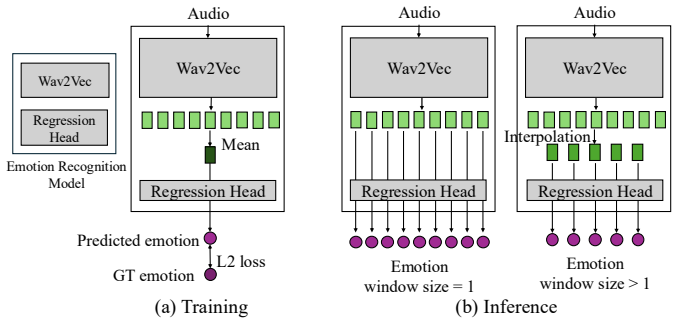
TTS-CtrlNet is built by freezing the pre-trained flow-matching TTS model and adding a trainable copy of its DiT blocks, connected to the original via zero-convolution so that training starts from the identity behavior. The additional input is a time-varying emotion signal — per-token arousal and valence values predicted by a wav2vec-based speech emotion recognition model, smoothed by a temporal window — which is injected after a 1×1 convolution to match the model's channel dimension. During training only the control branch is updated with the flow-matching loss, using a restricted flow-step interval [0, temo] that the authors identify as the range where emotion is determined. At inference a control scale λ lets the user interpolate between the original model's behavior and full emotion control. The paper reports that this setup yields the best Emo-SIM and Aro-Val SIM on the JVNV S2ST and EMO-Change benchmarks while preserving zero-shot voice cloning and naturalness, with word-error rates competitive on the English EMO-Change task.
Load-bearing premise
The wav2vec-based emotion recognizer, trained only on utterance-level arousal–valence labels, is assumed to give a faithful time-varying emotion signal once its token outputs are smoothed over a window; if that signal is wrong, both the conditioning that drives ControlNet and the headline Aro-Val SIM metric degrade together.
Editorial extensions
If this is right
- Emotion control can be added to a large flow-matching TTS model without fine-tuning its weights, using roughly 400 hours of public emotional speech, so the cost of adding a new condition drops sharply.
- Because the backbone is frozen, zero-shot voice cloning and naturalness of the original model are inherited, which means the same technique could be layered onto other large TTS models.
- Restricting the control branch to the emotion-specific flow-step interval makes the added computation small at inference and improves emotion transfer.
- The control scale λ gives a practical knob to balance intelligibility and emotional expressiveness, letting deployers tune per use case.
- On the JVNV S2ST and EMO-Change benchmarks, the method reaches higher Emo-SIM and Aro-Val SIM scores than utterance-level emotion-conditioning baselines and full-fine-tuning approaches.
Reading between the lines
- The same ControlNet recipe may transfer to other flow-matching generative models (image, video, or speech-translation systems) where a time-varying condition must be aligned with the content; the paper only tests TTS, but the mechanism is not TTS-specific.
- Because the emotion representation comes from an utterance-level SER model, its windowed interpolation may smear or miss fast emotional changes (the authors note laughter and crying are not captured); a purpose-built time-varying emotion encoder would likely improve both control fidelity and the Aro-Val SIM numbers.
- The emotion-specific flow-step finding suggests a general principle for flow-matching controllers: identify the flow interval where the target attribute is determined and apply conditioning only there, which could be investigated for prosody, speaking rate, or style.
- A strict test of the approach would be to compute Aro-Val SIM with a different, independently trained emotion recognizer, since the paper's reported gains use the same family of SER model that provides the conditioning signal.
Editorial analysis
A structured set of objections, weighed in public.
Referee Report
Summary. TTS-CtrlNet proposes to add fine-grained, time-varying emotion control to a frozen flow-matching TTS model (F5-TTS) using a ControlNet-style trainable branch. The conditioning signal is a per-frame arousal/valence embedding extracted by a wav2vec-based speech emotion recognition model, and training uses roughly 400 hours of public emotional speech while the base model remains frozen. The paper contributes practical recipes: selective connection of DiT blocks, an emotion-specific flow-step interval [0, t_emo], and an inference-time control scale. Experiments on JVNV S2ST and EMO-Change report improved Emo-SIM and Aro-Val SIM over several baselines, with subjective MOS supporting preserved naturalness and speaker similarity.
Significance. If the central claims hold, the method offers a low-cost, general recipe for adding emotion control to large pre-trained TTS systems without full fine-tuning, and the block-level and flow-step analyses are useful design guidance for future controllability work. The paper is honest about computing the free parameters from ablations and about the limitations of the SER model. The main scientific value is conditional on the evaluation being trustworthy: Emo-SIM is an independent signal, but the headline Aro-Val SIM result is potentially circular, and the time-varying claim is not directly tested. These issues do not invalidate the architecture, but they do mean the state-of-the-art claim is not yet secure.
major comments (4)
- [§3.2, §4.2, Table 5] The Aro-Val SIM metric is not independent of the conditioning signal: both the emotion embedding fed into ControlNet (§3.2, using the wav2vec-based SER model [36]) and the Aro-Val SIM evaluation (§4.2, using a sliding-window approach following [36]) rely on the same wav2vec SER model. Since the controller is trained to reproduce that model's arousal/valence outputs, reporting Aro-Val SIM from the same model can overstate perceived emotion transfer. The authors' own limitation statement concedes that the SER misses non-verbal cues such as laughter and crying, and the supplementary instructs listeners not to account for non-verbal transfer. Please add an independent check of emotional similarity (e.g., a different SER model, discrete emotion classification of the output, or listener-based emotion ratings) and report the gains on that metric separately.
- [Table 5, Table 6] The main quantitative comparison lacks error bars, confidence intervals, and significance tests, and most baseline rows (B1–B6) are adopted from [21] rather than reproduced under the authors' protocol. The reported differences are often small (e.g., EMO-Change Emo-SIM 0.724 vs 0.692 for F5-TTS), and the MOS results in Table 6 are given without significance testing. In addition, the comparison to EmoCtrl-TTS is asymmetric because that system uses both an emotion encoder and a nonverbal encoder, while TTS-CtrlNet uses only the emotion encoder; this asymmetry is disclosed only in the supplementary material. Please provide variance estimates for objective metrics, state clearly which rows were measured in-house, and justify the use of external numbers.
- [§4.1.2, §4.2, EMO-Change] The central 'time-varying' claim is not directly evaluated. EMO-Change is constructed by concatenating two utterances with different emotions, but the paper reports only whole-utterance Emo-SIM and Aro-Val SIM over sliding windows; there is no segment-level alignment or transition analysis. This makes it difficult to distinguish true time-varying emotional transfer from a single averaged emotion over the utterance. Please report per-segment similarities (e.g., first half vs second half of the generated speech) or an explicit boundary/transition metric to substantiate the time-varying control claim.
- [§3.2, Limitations] The time-varying emotion features are produced by interpolating utterance-level SER outputs over a window (W_emo=30), but the paper does not validate that these interpolated features are causally faithful time-varying emotion annotations. The feature extraction recipe is a heuristic: the SER is trained with mean pooling on utterance-level labels, and at inference token-level outputs are windowed and interpolated. The regime where this representation is acknowledged to fail (non-verbal cues such as laughter and crying) is exactly the regime excluded from the supplementary evaluation. Please add a validation of the temporal alignment of the conditioning features, or at least a quantitative analysis of how the interpolation affects the fidelity of the emotion trajectory.
minor comments (5)
- [Global] There are several typos and inconsistencies: 'valance' should be 'valence' (e.g., Figure 3), 'pre-traineded' in §2.2, 'enligsh' and 'datset' in §4.4.
- [§1] The list of practical recipes in the Introduction contains the numeral '3)' twice; remove the duplicate or renumber the items.
- [§3.1.1, Eq. (3)] Equation (3) uses the binary mask m in the block-output combination without a clear definition at that point; clarify whether this is the same temporal mask used for the infilling task and how it is applied during inference.
- [References] References [6] and [22] are the same F5-TTS paper; consolidate them to avoid duplicate citations.
- [Supplementary Table 7] The baseline IDs in Supplementary Table 7 do not match the row ordering of Table 5 (e.g., B4/B5 definitions shift between tables); align them for clarity.
Circularity Check
Aro-Val SIM is partially circular: the same wav2vec SER model both conditions TTS-CtrlNet and defines the headline metric.
-
fitted input called prediction
[Sec. 3.2 (emotion conditioning) and Sec. 4.2 (Aro-Val SIM metric); reported in Tables 1, 4, 5]
"We use a wav2vec-based emotion recognition model [36], which predicts arousal-valence-dominance. ... The token is interpolated with the emotion window size Wemo and returns e ∈ R^{D_emo × T}. ... Aro-Val SIM evaluates alignment in continuous emotion space—arousal and valence—estimated using a sliding window approach following [36]."
The ControlNet conditioning signal e is computed by the wav2vec-based SER model [36] with sliding-window interpolation, and the Aro-Val SIM evaluation metric is computed by the same [36] model with a sliding-window arousal/valence estimate. The controller is trained to make generated speech follow e (Eq. 4, with e extracted from the reference audio), so the evaluation function used for Aro-Val SIM is the same function that produced the conditioning target. A model that reproduces the conditioning SER trajectory in its output will score high on Aro-Val SIM even if human listeners perceive the emotion transfer differently; the large Aro-Val SIM gaps in Table 5 are therefore not an independent confirmation of the headline SOTA claim.
full rationale
The paper's core method—freezing F5-TTS and training a ControlNet copy on public emotion speech—is otherwise self-contained and is compared against external baselines, and no load-bearing self-citation chain is present. The main circular dependency is that the same wav2vec SER model [36] generates the emotion conditioning features (Sec. 3.2) and defines the Aro-Val SIM evaluation metric (Sec. 4.2). Since the flow-matching training objective conditions on e = SER(s_ref) and Aro-Val SIM measures SER-based similarity between reference and generated audio, the headline Aro-Val SIM improvements are confounded by the shared feature extractor. However, the paper also reports Emotion2Vec-based Emo-SIM and human EMOS, which are independent and still show improvements (e.g., Emo-SIM 0.692 to 0.724 on EMO-Change; EMOS 2.69 to 4.02 on EMO-Change in the supplementary), so the central claim retains independent content. The authors' own limitation that the SER cannot reliably capture non-verbal cues such as laughter and crying further weakens Aro-Val SIM as a standalone measure but does not invalidate the method. The score is set to 5 to reflect one significant partial circularity in the evaluation, not a fully self-referential derivation.
Assumptions & free parameters
free parameters (4)
- t_emo (emotion-specific flow step upper bound) =
0.1
- W_emo (emotion window size) =
30
- Selected DiT block subset =
not enumerated in paper
- lambda (control scale) =
not reported for final results; ablated 0.0 to 1.0
assumptions (5)
- standard math Conditional flow matching / OT-CFM provides a valid training objective for speech synthesis (Lipman et al., Eq 2).
- domain assumption Freezing the original F5-TTS parameters while training the ControlNet copy preserves zero-shot voice cloning and naturalness.
- domain assumption The wav2vec-based SER model [36] provides a causally adequate time-varying emotion representation via sliding-window interpolation.
- ad hoc to paper The emotion-specific flow-step interval [0, 0.1] identified on RAVDESS transfers to other speakers, languages, and datasets.
- domain assumption A subset of DiT blocks can be excluded from ControlNet without hurting emotion control.
Cite this review
Pith. "Pith review of TTS-CtrlNet: Time varying emotion aligned text-to-speech generation with ControlNet." pith.science (2026). https://pith.science/paper/3S3OT74L
@misc{pith2026250704349,
  author       = {Pith},
  title        = {Pith review of: TTS-CtrlNet: Time varying emotion aligned text-to-speech generation with ControlNet},
  year         = {2026},
  howpublished = {\url{https://pith.science/paper/3S3OT74L}},
  note         = {Machine review of arXiv:2507.04349}
}
read the original abstract
Recent advances in text-to-speech (TTS) have enabled natural speech synthesis, but fine-grained, time-varying emotion control remains challenging. Existing methods often allow only utterance-level control and require full model fine-tuning with a large emotion speech dataset, which can degrade performance. Inspired by adding conditional control to the existing model in ControlNet (Zhang et al, 2023), we propose the first ControlNet-based approach for controllable flow-matching TTS (TTS-CtrlNet), which freezes the original model and introduces a trainable copy of it to process additional conditions. We show that TTS-CtrlNet can boost the pretrained large TTS model by adding intuitive, scalable, and time-varying emotion control while inheriting the ability of the original model (e.g., zero-shot voice cloning & naturalness). Furthermore, we provide practical recipes for adding emotion control: 1) optimal architecture design choice with block analysis, 2) emotion-specific flow step, and 3) flexible control scale. Experiments show that ours can effectively add an emotion controller to existing TTS, and achieves state-of-the-art performance with emotion similarity scores: Emo-SIM and Aro-Val SIM. The project page is available at: https://curryjung.github.io/ttsctrlnet_project_page
Figures


Figures from the paper (3 more)


Forward citations
Cited by 1 Pith paper
-
The False Resonance: A Critical Examination of Emotion Embedding Similarity for Speech Generation Evaluation
Emotion embedding similarities are unsuitable for zero-shot evaluation of emotional expressiveness in speech generation due to confounding by non-emotional acoustic features.
Reference graph
Works this paper leans on
-
[36]
Dawn of the transformer era in speech emotion recognition: Closing the valence gap
Johannes Wagner, Andreas Triantafyllopoulos, Hagen Wierstorf, Maximilian Schmitt, Felix Burkhardt, Florian Eyben, and Björn W Schuller. Dawn of the transformer era in speech emotion recognition: Closing the valence gap. IEEE Transactions on Pattern Analysis and Machine Intelligence, pages 1–13, 2023
work page 2023
-
[21]
Haibin Wu, Xiaofei Wang, Sefik Emre Eskimez, Manthan Thakker, Daniel Tompkins, Chung-Hsien Tsai, Canrun Li, Zhen Xiao, Sheng Zhao, Jinyu Li, et al. Laugh now cry later: Controlling time-varying emotional states of flow-matching-based zero-shot text-to-speech. arXiv preprint arXiv:2407.12229, 2024
work page Pith review arXiv 2024
-
[1]
Adding conditional control to text-to-image diffusion models, 2023
Lvmin Zhang, Anyi Rao, and Maneesh Agrawala. Adding conditional control to text-to-image diffusion models, 2023. URL https://arxiv.org/abs/2302.05543
arXiv 2023
-
[2]
An emotion speech synthesis method based on VITS
Wei Zhao and Zheng Yang. An emotion speech synthesis method based on VITS. Applied Sciences, 13(4): 2225, 2023
work page 2023
-
[3]
V oiceBox: Text-guided multilingual universal speech generation at scale
Matthew Le, Apoorv Vyas, Bowen Shi, Brian Karrer, Leda Sari, Rashel Moritz, Mary Williamson, Vimal Manohar, Yossi Adi, Jay Mahadeokar, et al. V oiceBox: Text-guided multilingual universal speech generation at scale. Advances in neural information processing systems, 36, 2024
work page 2024
-
[4]
Making flow-matching-based zero-shot text-to-speech laugh as you like
Naoyuki Kanda, Xiaofei Wang, Sefik Emre Eskimez, Manthan Thakker, Hemin Yang, Zirun Zhu, Min Tang, Canrun Li, Steven Tsai, Zhen Xiao, et al. Making flow-matching-based zero-shot text-to-speech laugh as you like. arXiv preprint arXiv:2402.07383, 2024
arXiv 2024
-
[5]
E2 tts: Embarrass- ingly easy fully non-autoregressive zero-shot tts
Sefik Emre Eskimez, Xiaofei Wang, Manthan Thakker, Canrun Li, Chung-Hsien Tsai, Zhen Xiao, Hemin Yang, Zirun Zhu, Min Tang, Xu Tan, Yanqing Liu, Sheng Zhao, and Naoyuki Kanda. E2 tts: Embarrass- ingly easy fully non-autoregressive zero-shot tts. 2024. URL https://api.semanticscholar.org/ CorpusID:270738197
work page 2024
-
[7]
Zhihao Du, Qian Chen, Shiliang Zhang, Kai Hu, Heng Lu, Yexin Yang, Hangrui Hu, Siqi Zheng, Yue Gu, Ziyang Ma, et al. Cosyvoice: A scalable multilingual zero-shot text-to-speech synthesizer based on supervised semantic tokens. arXiv preprint arXiv:2407.05407, 2024
arXiv 2024
Show all 46 references
-
[8]
Tacotron: Towards end-to-end speech synthesis
Yuxuan Wang, RJ Skerry-Ryan, Daisy Stanton, Yonghui Wu, Ron J Weiss, Navdeep Jaitly, Zongheng Yang, Ying Xiao, Zhifeng Chen, Samy Bengio, et al. Tacotron: Towards end-to-end speech synthesis. arXiv preprint arXiv:1703.10135, 2017
2017 arXiv
-
[9]
Fastspeech: Fast, robust and controllable text to speech
Yi Ren, Yangjun Ruan, Xu Tan, Tao Qin, Sheng Zhao, Zhou Zhao, and Tie-Yan Liu. Fastspeech: Fast, robust and controllable text to speech. Advances in neural information processing systems, 32, 2019
2019
-
[10]
ED-TTS: Multi-scale emo- tion modeling using cross-domain emotion diarization for emotional speech synthesis
Haobin Tang, Xulong Zhang, Ning Cheng, Jing Xiao, and Jianzong Wang. ED-TTS: Multi-scale emo- tion modeling using cross-domain emotion diarization for emotional speech synthesis. arXiv preprint arXiv:2401.08166, 2024. 10
2024 arXiv
-
[11]
EmoDiff: Intensity controllable emotional text-to-speech with soft-label guidance
Yiwei Guo, Chenpeng Du, Xie Chen, and Kai Yu. EmoDiff: Intensity controllable emotional text-to-speech with soft-label guidance. In ICASSP 2023, pages 1–5. IEEE, 2023
2023
-
[12]
EmoMix: Emotion mixing via diffusion models for emotional speech synthesis
Haobin Tang, Xulong Zhang, Jianzong Wang, Ning Cheng, and Jing Xiao. EmoMix: Emotion mixing via diffusion models for emotional speech synthesis. arXiv preprint arXiv:2306.00648, 2023
2023 arXiv
-
[13]
Speech synthesis with mixed emotions
Kun Zhou, Berrak Sisman, Rajib Rana, Björn W Schuller, and Haizhou Li. Speech synthesis with mixed emotions. IEEE Transactions on Affective Computing, 2022
2022
-
[14]
QI-TTS: Questioning intonation control for emotional speech synthesis
Haobin Tang, Xulong Zhang, Jianzong Wang, Ning Cheng, and Jing Xiao. QI-TTS: Questioning intonation control for emotional speech synthesis. In ICASSP 2023, pages 1–5. IEEE, 2023
2023
-
[15]
MsEmoTTS: Multi-scale emotion transfer, prediction, and control for emotional speech synthesis
Yi Lei, Shan Yang, Xinsheng Wang, and Lei Xie. MsEmoTTS: Multi-scale emotion transfer, prediction, and control for emotional speech synthesis. IEEE/ACM Transactions on Audio, Speech, and Language Processing, 30:853–864, 2022
2022
-
[16]
Text-driven emotional style control and cross-speaker style transfer in neural tts
Yookyung Shin, Younggun Lee, Suhee Jo, Yeongtae Hwang, and Taesu Kim. Text-driven emotional style control and cross-speaker style transfer in neural tts. arXiv preprint arXiv:2207.06000, 2022
2022 arXiv
-
[17]
Emotional end-to-end neural speech synthesizer
Younggun Lee, Azam Rabiee, and Soo-Young Lee. Emotional end-to-end neural speech synthesizer. arXiv preprint arXiv:1711.05447, 2017
2017 arXiv
-
[18]
Controllable emotion transfer for end-to-end speech synthesis
Tao Li, Shan Yang, Liumeng Xue, and Lei Xie. Controllable emotion transfer for end-to-end speech synthesis. In ISCSLP 2021, pages 1–5. IEEE, 2021
2021
-
[19]
Emotion controllable speech synthesis using emotion-unlabeled dataset with the assistance of cross-domain speech emotion recognition
Xiong Cai, Dongyang Dai, Zhiyong Wu, Xiang Li, Jingbei Li, and Helen Meng. Emotion controllable speech synthesis using emotion-unlabeled dataset with the assistance of cross-domain speech emotion recognition. In ICASSP 2021, pages 5734–5738. IEEE, 2021
2021
-
[20]
Emosphere- tts: Emotional style and intensity modeling via spherical emotion vector for controllable emotional text-to-speech
Deok-Hyeon Cho, Hyung-Seok Oh, Seung-Bin Kim, Sang-Hoon Lee, and Seong-Whan Lee. Emosphere- tts: Emotional style and intensity modeling via spherical emotion vector for controllable emotional text-to-speech. In Interspeech 2024, pages 1810–1814, 2024. doi: 10.21437/Interspeech...
2024 doi
-
[22]
F5- tts: A fairytaler that fakes fluent and faithful speech with flow matching
Yushen Chen, Zhikang Niu, Ziyang Ma, Keqi Deng, Chunhui Wang, Jian Zhao, Kai Yu, and Xie Chen. F5- tts: A fairytaler that fakes fluent and faithful speech with flow matching. arXiv preprint arXiv:2410.06885, 2024
2024 arXiv
-
[23]
High-resolution image synthesis with latent diffusion models, 2021
Robin Rombach, Andreas Blattmann, Dominik Lorenz, Patrick Esser, and Björn Ommer. High-resolution image synthesis with latent diffusion models, 2021
2021
-
[24]
wav2vec 2.0: A framework for self-supervised learning of speech representations, 2020
Alexei Baevski, Henry Zhou, Abdelrahman Mohamed, and Michael Auli. wav2vec 2.0: A framework for self-supervised learning of speech representations, 2020. URL https://arxiv.org/abs/2006.11477
2020 arXiv
-
[26]
High-resolution image synthesis with latent diffusion models
Robin Rombach, Andreas Blattmann, Dominik Lorenz, Patrick Esser, and Björn Ommer. High-resolution image synthesis with latent diffusion models. In Proceedings of the IEEE/CVF Conference on Computer Vision and Pattern Recognition (CVPR), pages 10684–10695, June 2022
2022
-
[27]
Scalable diffusion models with transformers
William Peebles and Saining Xie. Scalable diffusion models with transformers. arXiv preprint arXiv:2212.09748, 2022
2022 arXiv
-
[28]
Black Forest Labs. Flux. https://github.com/black-forest-labs/flux , 2024
2024
-
[29]
Scaling rectified flow transformers for high-resolution image synthesis, 2024
Patrick Esser, Sumith Kulal, Andreas Blattmann, Rahim Entezari, Jonas Müller, Harry Saini, Yam Levi, Dominik Lorenz, Axel Sauer, Frederic Boesel, et al. Scaling rectified flow transformers for high-resolution image synthesis, 2024. URL https://arxiv. org/abs/2403.03206, 2
2024 arXiv
-
[30]
Ip-adapter: Text compatible image prompt adapter for text-to-image diffusion models
Hu Ye, Jun Zhang, Sibo Liu, Xiao Han, and Wei Yang. Ip-adapter: Text compatible image prompt adapter for text-to-image diffusion models. 2023
2023
-
[31]
Stable flow: Vital layers for training-free image editing
Omri Avrahami, Or Patashnik, Ohad Fried, Egor Nemchinov, Kfir Aberman, Dani Lischinski, and Daniel Cohen-Or. Stable flow: Vital layers for training-free image editing. arXiv preprint arXiv:2411.14430, 2024. 11
2024 arXiv
-
[32]
Yaron Lipman, Ricky T. Q. Chen, Heli Ben-Hamu, Maximilian Nickel, and Matthew Le. Flow matching for generative modeling. In ICLR 2023, 2023. URL https://openreview.net/forum?id=PqvMRDCJT9t
2023
-
[33]
Jointly predicting arousal, valence and dominance with multi-task learning
Srinivas Parthasarathy and Carlos Busso. Jointly predicting arousal, valence and dominance with multi-task learning. In Interspeech 2017, pages 1103–1107, 2017. doi: 10.21437/Interspeech.2017-1494
2017 doi
-
[34]
Automatic speech emotion recognition using recurrent neural networks with local attention
Seyedmahdad Mirsamadi, Emad Barsoum, and Cha Zhang. Automatic speech emotion recognition using recurrent neural networks with local attention. 03 2017. doi: 10.1109/ICASSP.2017.7952552
2017
-
[35]
Dia- loguegcn: A graph convolutional neural network for emotion recognition in conversation, 2019
Deepanway Ghosal, Navonil Majumder, Soujanya Poria, Niyati Chhaya, and Alexander Gelbukh. Dia- loguegcn: A graph convolutional neural network for emotion recognition in conversation, 2019. URL https://arxiv.org/abs/1908.11540
2019 arXiv
-
[37]
Emilia: An extensive, multilingual, and diverse speech dataset for large-scale speech generation
Haorui He, Zengqiang Shang, Chaoren Wang, Xuyuan Li, Yicheng Gu, Hua Hua, Liwei Liu, Chen Yang, Jiaqi Li, Peiyang Shi, et al. Emilia: An extensive, multilingual, and diverse speech dataset for large-scale speech generation. In 2024 IEEE Spoken Language Technology Workshop (SLT...
2024
-
[38]
Libritts: A corpus derived from librispeech for text-to-speech
Heiga Zen, Viet Dang, Rob Clark, Yu Zhang, Ron J Weiss, Ye Jia, Zhifeng Chen, and Yonghui Wu. Libritts: A corpus derived from librispeech for text-to-speech. arXiv preprint arXiv:1904.02882, 2019
1904 arXiv
-
[39]
Building naturalistic emotionally balanced speech corpus by retrieving emotional speech from existing podcast recordings
Reza Lotfian and Carlos Busso. Building naturalistic emotionally balanced speech corpus by retrieving emotional speech from existing podcast recordings. IEEE Transactions on Affective Computing, 10(4): 471–483, 2017
2017
-
[40]
EARS: An anechoic fullband speech dataset benchmarked for speech enhancement and dereverberation
Julius Richter, Yi-Chiao Wu, Steven Krenn, Simon Welker, Bunlong Lay, Shinjii Watanabe, Alexander Richard, and Timo Gerkmann. EARS: An anechoic fullband speech dataset benchmarked for speech enhancement and dereverberation. In ISCA Interspeech, pages 4873–4877, 2024
2024
-
[41]
Iemocap: Interactive emotional dyadic motion capture database
Carlos Busso, Murtaza Bulut, Chi-Chun Lee, Abe Kazemzadeh, Emily Mower, Samuel Kim, Jeannette N Chang, Sungbok Lee, and Shrikanth S Narayanan. Iemocap: Interactive emotional dyadic motion capture database. Language resources and evaluation, 42:335–359, 2008
2008
-
[42]
Seen and unseen emotional style transfer for voice conversion with a new emotional speech dataset
Kun Zhou, Berrak Sisman, Rui Liu, and Haizhou Li. Seen and unseen emotional style transfer for voice conversion with a new emotional speech dataset. In ICASSP 2021-2021 IEEE International Conference on Acoustics, Speech and Signal Processing (ICASSP), pages 920–924. IEEE, 2021
2021
-
[43]
Expresso: A benchmark and analysis of discrete expressive speech resynthesis
Tu Anh Nguyen, Wei-Ning Hsu, Antony D’Avirro, Bowen Shi, Itai Gat, Maryam Fazel-Zarani, Tal Remez, Jade Copet, Gabriel Synnaeve, Michael Hassid, Felix Kreuk, Yossi Adi, and Emmanuel Dupoux. Expresso: A benchmark and analysis of discrete expressive speech resynthesis. InIntersp...
2023
-
[44]
The ryerson audio-visual database of emotional speech and song (RA VDESS): A dynamic, multimodal set of facial and vocal expressions in north american english
Steven R Livingstone and Frank A Russo. The ryerson audio-visual database of emotional speech and song (RA VDESS): A dynamic, multimodal set of facial and vocal expressions in north american english. PloS one, 13(5):e0196391, 2018
2018
-
[45]
Robust speech recognition via large-scale weak supervision
Alec Radford, Jong Wook Kim, Tao Xu, Greg Brockman, Christine McLeavey, and Ilya Sutskever. Robust speech recognition via large-scale weak supervision. In Proceedings of the 40th International Conference on Machine Learning, ICML’23. JMLR.org, 2023
2023
-
[46]
Seamless: Multilingual expressive and streaming speech translation
Loïc Barrault, Yu-An Chung, Mariano Coria Meglioli, David Dale, Ning Dong, Mark Duppenthaler, Paul- Ambroise Duquenne, Brian Ellis, Hady Elsahar, Justin Haaheim, et al. Seamless: Multilingual expressive and streaming speech translation. arXiv preprint arXiv:2312.05187, 2023
2023 arXiv
-
[47]
supple_demo/index.html
Ziyang Ma, Zhisheng Zheng, Jiaxin Ye, Jinchao Li, Zhifu Gao, ShiLiang Zhang, and Xie Chen. emo- tion2vec: Self-supervised pre-training for speech emotion representation. In Lun-Wei Ku, Andre Martins, and Vivek Srikumar, editors, Findings of the Association for Computational Li...
2024 doi
-
[2023]
doi: 10.21437/Interspeech.2023-1905
2023 doi
Reviewed August 6, 2026 · model on record in the stance chip above.
Discussion (0). Continue with ORCID to comment.