REVIEW 3 major objections 5 minor 75 references
Interband Lag Variability in Active Galactic Nuclei across ZTF Data from Multiple Years
T0 review · 3 major / 5 minor · reviewed 2026-08-06 · deepseek-v4-flash
Pith's one-line read Using six years of Zwicky Transient Facility photometry for 94 active galactic nuclei, this paper reports that optical interband lags vary seasonally in more than half of the sample and that lags grow with the light-curve baseline…
desk verdict A genuinely new sample-level multi-season lag analysis with useful data, but the headline 'more than half vary' and the baseline-growth claim both need a null-hypothesis test and a quantified treatment of broad-CCF outliers before they are established. read the letter →
The pith
A machine-rendered reading of the paper's core claim, the machinery that carries it, and where it could break.
The reading
What carries the argument
The central machinery is the interpolated cross-correlation function (ICCF) centroid lag, defined as the rcc-weighted average lag over points with correlation coefficient at least 80% of the peak (rcc >= 0.8 rmax), with uncertainties estimated by flux randomization and FR/RSS. Light curves are split into six one-year seasons based on visibility windows; seasonal lags are searched within ±50 days and full-baseline lags within ±300 days. Lag significance is calibrated by damped-random-walk simulations that reproduce each band's variability, and lag variation across seasons is quantified with three estimators (weighted excess variance, fractional variability, and weighted standard deviation). The comparison between averaged seasonal lags and full-baseline lags is what carries the baseline-dependence argument.
What would settle it
Re-measure all seasonal and full-baseline lags using a shape-insensitive estimator, such as the CCF peak or a model-based lag, on the same ZTF DR22 light curves; if the fraction of AGN with seasonal variation drops below a majority and the averaged seasonal lags no longer lie systematically below the full-baseline lags, the claim that short-term lags are smaller and that stochastic baseline dependence is present would be refuted. A synthetic test injecting known constant lags into damped-random-walk light curves with the same cadence and noise would also show whether the pipeline itself produces the reported baseline growth.
Extended reading notes
Core claim
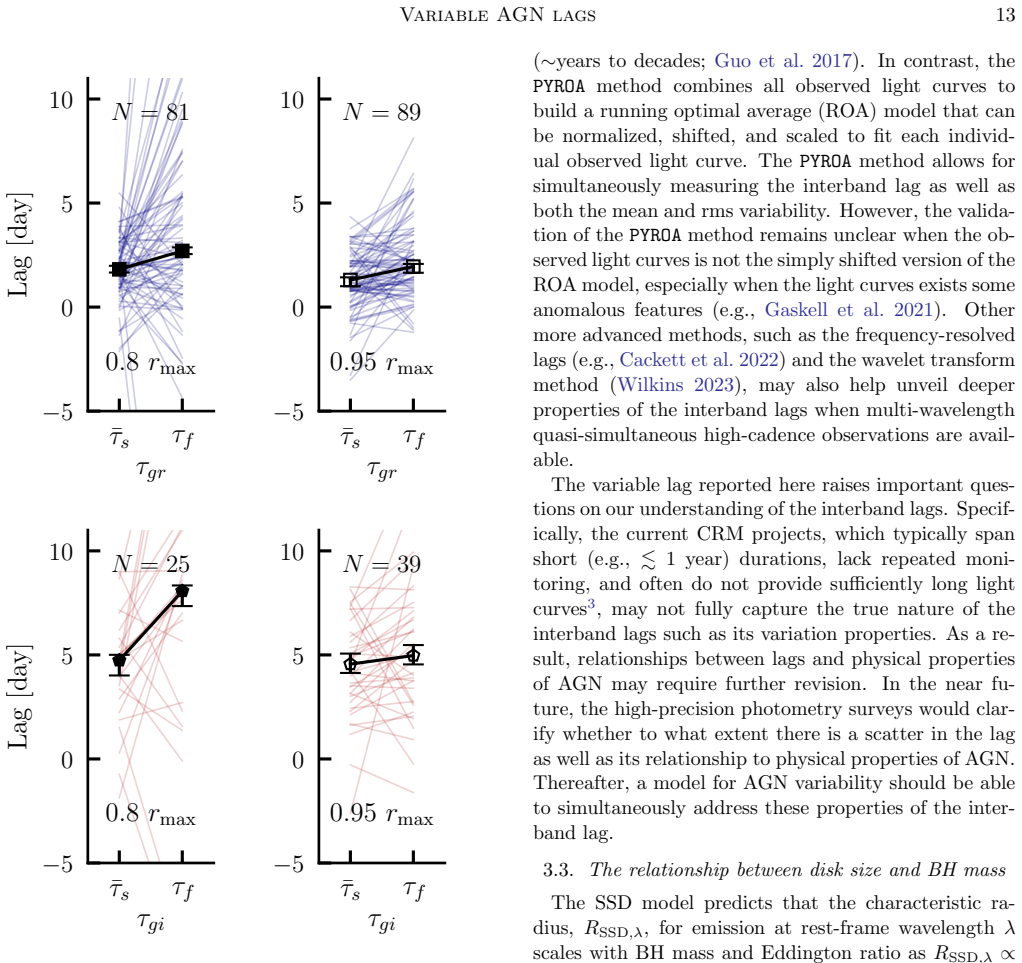
On the paper's own terms, the central discovery is that interband lags in the optical continua of AGN are variable rather than fixed. In a 94-object sample from ZTF Data Release 22, over half of the AGN show statistically significant seasonal variations in the g-r and g-i lags, and the short-term lags (the average of season-by-season measurements) are consistently smaller than the long-term lags from the full six-year light curves. The paper claims this baseline dependence is expected from the inherent randomness of AGN variability, citing simulations in which finite light-curve baselines produce randomly varying lag estimates that increase and saturate as the baseline grows. The paper also claims that inferred disk sizes depend on the choice of centroid threshold: with a correlation threshold of rcc >= 0.8 rmax, the disk-size versus black-hole-mass correlation is weak, while with rcc >= 0.95 rmax it is strong, which the authors say reconciles previously contradictory results.
Load-bearing premise
The analysis assumes that a centroid lag computed from the CCF above 80% of its peak, within a fixed search window, is a faithful estimator of the true interband lag; if real AGN light curves produce broad or asymmetric CCFs, this estimator's value and uncertainty depend on the chosen threshold and window, as the paper itself demonstrates for one object whose long-term lag drops from about 49 to about 6 days when the threshold is raised.
Editorial extensions
If this is right
- Single-season interband lags are not reliable proxies for a stable disk size; they can underestimate the lag that a longer baseline would produce.
- Lag measurements from campaigns of different lengths are not directly comparable, so part of the scatter between reported disk sizes may be baseline-induced rather than astrophysical.
- The strength of the disk-size versus black-hole-mass correlation depends on the CCF centroid threshold, which explains why previous studies using different thresholds disagreed.
- Long, high-cadence, multi-band surveys can test this picture by measuring how lag scatter and baseline growth depend on black-hole mass, luminosity, and Eddington ratio.
Reading between the lines
- A re-analysis of the same ZTF sample with a lag estimator that is insensitive to CCF shape and window, rather than the rcc >= 0.8 rmax centroid, would show whether the seasonal-variation fraction and the short-versus-long lag difference survive; the paper's Appendix A shows the threshold can change one object's long-term lag from about 49 to about 6 days.
- The same pipeline applied to simulated light curves with a known constant lag and identical cadence and noise would quantify how much of the reported variation is produced by the method itself, giving a cleaner null hypothesis for the stochastic-variability interpretation.
- If baseline-dependent lag growth is real, published black-hole mass estimates that use a fixed lag-disk-size scaling carry a systematic uncertainty that grows with monitoring duration, not just random scatter.
- The absence of a within-object lag-magnitude correlation does not rule out slow structural changes in the disk that operate on timescales longer than the seasonal windows; testing that would require comparing lags across decades rather than years.
Editorial analysis
A structured set of objections, weighed in public.
Referee Report
Summary. The paper analyzes interband lags for 94 AGN at z<0.8 using ZTF DR22 gri-band light curves split into six one-year seasons and a full six-year baseline. Lags are measured with the interpolated CCF method, using centroid lags with rcc thresholds of 0.8 rmax or 0.95 rmax, search windows of ±50 days for seasonal light curves and ±300 days for the full light curves, and success criteria rmax>0.6 and p(rmax)<0.2. The authors quantify seasonal lag variability with three estimators (σK24, σF16, σS17) using both FR and FR/RSS uncertainties, and compare mean seasonal lags with full-baseline lags. They claim that more than half of the AGN show significant seasonal lag variations, that short-term lags are systematically smaller than long-term lags, and that this baseline dependence supports stochastic-variability models. They also revisit the disk size--BH mass correlation using the two lag thresholds.
Significance. If established, the claims would be important for continuum reverberation mapping: variable and baseline-dependent interband lags would imply that single-epoch lag measurements may not trace a stable disk size, and would favor stochastic variability models. The paper benefits from a relatively large sample, a six-year baseline, and an honest presentation of the sensitivity of the results to the lag threshold and uncertainty estimator, including explicit examples of broad asymmetric CCFs in Appendix A. The main weaknesses are that the headline variability fraction depends strongly on the choice of uncertainty estimator and that no null-hypothesis simulation is performed to show whether a constant intrinsic lag, passed through the same CCF pipeline, could produce the reported seasonal scatter and baseline growth. These issues currently prevent the paper from supporting its central claims.
major comments (3)
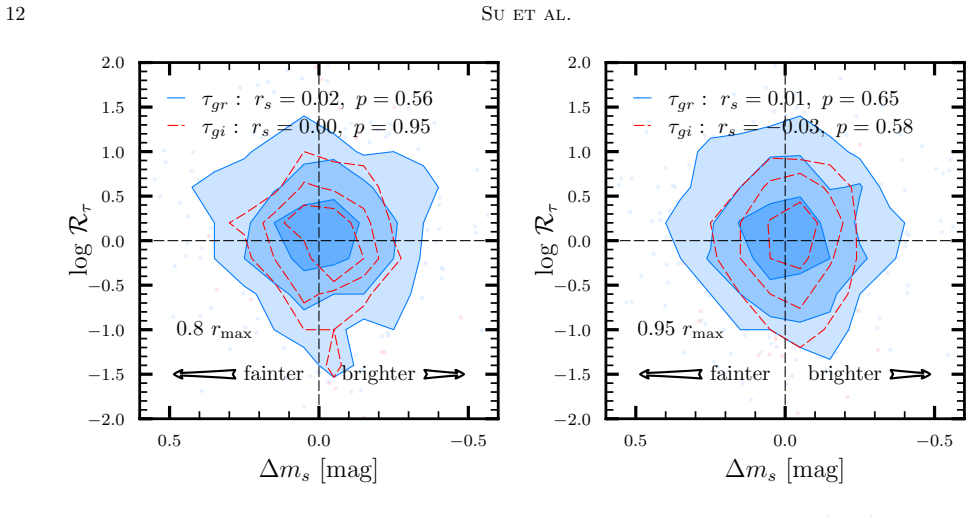
- [§3.1, Figure 9] The claim that more than half of the AGN show variable lags is not robust to the choice of uncertainty estimator. With FR/RSS uncertainties, σK24 gives roughly 30--40% variable AGN and σF16 gives 25--35%; with FR uncertainties those fractions rise to roughly 75--80% and 50--70%, while σS17 yields essentially 100% because it does not subtract the noise contribution. The paper itself states that 'none of the above estimators are robust enough,' yet the conservative conclusion of ≳50% does not follow from the most conservative estimator that subtracts measurement uncertainties (FR/RSS), which yields below 50%. A quantitative statement of the variability fraction requires either a calibrated null-hypothesis test or a model comparison that treats the uncertainty estimator as part of the measurement model.
- [§3.2.2, Figure 11, Appendix A] The baseline-growth claim (short-term lags τ̄s smaller than full-baseline lags τf) may be an artifact of the CCF-centroid estimator rather than evidence for stochastic variability. The seasonal and full light curves are analyzed with different search windows (±50 days versus ±300 days), and the same centroid threshold rcc ≥ 0.8 rmax is applied to CCFs of very different widths. Appendix A shows that one AGN's τgr decreases from 49.25 days at 0.8 rmax to 6.16 days at 0.95 rmax, and another's τgi decreases from 21.11 to 5.54 days, directly demonstrating threshold sensitivity. The text states that such anomalies are rare, but it does not count them, does not show that the median τf − τ̄s offset survives their exclusion, and does not provide a null-hypothesis simulation with a constant underlying lag through the same pipeline. Without such a simulation, the systematic offset in Figure 11 is not yet established as a physical baseline dependence.
- [§3.3, Figure 12] The claim that the use of distinct centroid thresholds is the major reason for the discrepant disk size--BH mass correlations rests on an arbitrary and data-dependent threshold choice. At rcc ≥ 0.8 rmax, the full-baseline disk size Rf shows essentially no correlation with BH mass (rs = −0.093, p = 0.376), while at rcc ≥ 0.95 rmax it shows rs = 0.284, p = 0.009. Because the threshold is selected after inspecting the data and because the same CCF-shape sensitivity that affects Figure 11 also affects Rf, the analysis demonstrates sensitivity of the result to the threshold rather than resolving the astrophysical discrepancy. The authors should either motivate the threshold from first principles or test both thresholds against a common null model.
minor comments (5)
- [§3.2.1] There is a typographical error: 'Acutally' should be 'Actually'.
- [§2.3, Figure 6] The success criteria rmax > 0.6 and p(rmax) < 0.2 are applied uniformly, but the paper acknowledges that the proper thresholds may differ from AGN to AGN. It would be helpful to state how the resulting uncertainty in the success-rate denominators propagates into the sub-sample numbers quoted in Figures 9 and 11.
- [§3.1, Equation (2)] The σK24 estimator sets the variability amplitude to zero when the square root argument is negative. This means that 'στ > 0' used in Figure 9 is not equivalent to a statistically significant detection of variability, and the numerator/denominator counts should be interpreted with this limitation in mind.
- [Figure 9] The violin plots combine the 0.8 rmax and 0.95 rmax distributions into left and right halves, but the caption is not explicit about which half corresponds to which threshold; adding direct labels or annotation inside each panel would help the reader.
- [§2.4] The definition of the lag-luminosity relation in the text as 'τ ∝ L^{1/2}' is inconsistent with the immediately following statement that a 0.7 mag change gives a 0.14 dex lag change; the latter assumes a different normalization or slope convention, and the two statements should be reconciled.
Circularity Check
No significant circularity: the lag comparisons are measured quantities, and the self-cited simulations are independent predictions rather than fitted inputs.
full rationale
The central claims—seasonal lag variability and tau_f > tau_s—are direct measurements from seasonal and full-baseline CCFs (Section 2.3, Figures 5, 9, 11), not quantities defined in terms of one another. The full-baseline lag is not computed from the seasonal lag estimates; both are estimated from the same photometry with the same centroid rule on different data subsets, so the baseline trend is not forced by construction. The interpretation cites Su et al. (2024b), Cai et al. (2018, 2020), and Guo et al. (2022a), which include overlapping authors, but these citations supply physical models or sample selection, not fitted parameters; the simulations are parameterized independently and are not fitted to the 94-object lag distribution. The threshold dependence of the centroid (Appendix A) and the sensitivity of the "variable" fraction to the uncertainty estimator are explicitly conceded (Section 3.1: "none of the above estimators are robust enough"), making them statistical robustness concerns rather than circular reductions. The absence of a constant-lag null simulation is a statistical concern, but it is not a circularity under the defined patterns. No equation was found in which a predicted quantity equals an input by definition, and no fitted parameter is relabeled as a prediction.
Assumptions & free parameters
free parameters (4)
- CCF centroid threshold rcc >= 0.8 rmax or >= 0.95 rmax =
0.80 or 0.95 times rmax
- Seasonal lag search window =
-50 to +50 days
- Minimum epochs per season per band =
20
- Success lag criteria rmax > 0.6 and p(rmax) < 0.2 =
0.6 and 0.2
assumptions (3)
- domain assumption The CCF centroid lag with rcc >= 0.8 rmax corresponds to the luminosity-weighted radius of the emission region in the reprocessing scenario.
- domain assumption The lag-wavelength relation tau = tau_g[(lambda/lambda_g)^(4/3) - 1] holds for each season with fixed beta = 4/3.
- domain assumption The DRW process adequately models the full six-year light curves for simulating lag significance.
Cite this review
Pith. "Pith review of Interband Lag Variability in Active Galactic Nuclei across ZTF Data from Multiple Years." pith.science (2026). https://pith.science/paper/W3Q46E4B
@misc{pith2026250704359,
  author       = {Pith},
  title        = {Pith review of: Interband Lag Variability in Active Galactic Nuclei across ZTF Data from Multiple Years},
  year         = {2026},
  howpublished = {\url{https://pith.science/paper/W3Q46E4B}},
  note         = {Machine review of arXiv:2507.04359}
}
abstract
Interband lags in the optical continua of active galactic nuclei (AGN) have been observed over years of monitoring, yet their physical origins remain unclear. While variable interband lags have been found in a few individual AGN potentially, the temporal behavior of interband lags of an AGN sample has not been explored systematically. Here, we analyze the interband lags of 94 bright AGN at $z<0.8$, using both seasonal one-year and full six-year $gri$-band light curves from Zwicky Transient Facility Data Release 22. We find that more than half of 94 AGN show significant seasonal variations in the interband lags. Besides, the short-term lags, derived by averaging lags inferred from multiple seasonal light curves, are consistently smaller than the long-term lags, which are inferred from the full six-year light curves. This supports recent theoretical simulations where the lag measurement is sensitive to the baseline of light curve and the lag variation could be simply attributed to the inherent randomness of AGN variability. Our findings suggest that the interband lags of AGN are more complex and stochastic than commonly thought, and highlight the importance of high-precision time-domain surveys in uncovering the properties of AGN variability as well as the associated accretion physics.
Figures


Figures from the paper (11 more)




Reference graph
Works this paper leans on
-
[1]
, " * write output.state after.block = add.period write newline
ENTRY address archivePrefix author booktitle chapter doi edition editor eprint howpublished institution journal key month number organization pages publisher school series title misctitle type volume year version url label extra.label sort.label short.list INTEGERS output.state before.all mid.sentence after.sentence after.block FUNCTION init.state.consts ...
-
[2]
write newline
" write newline "" before.all 'output.state := FUNCTION format.url url empty "" new.block "" url * "" * if FUNCTION format.eprint eprint empty "" archivePrefix empty "" archivePrefix "arXiv" = new.block " " eprint * " " * new.block " " eprint * " " * if if if FUNCTION format.doi doi empty "" " " doi * " " * if FUNCTION format.pid doi empty eprint empty ur...
-
[3]
thebibliography [1] 20pt to REFERENCES 6pt =0pt -12pt 10pt plus 3pt =0pt =0pt =1pt plus 1pt =0pt =0pt -12pt =13pt plus 1pt =20pt =13pt plus 1pt \@M =10000 =-1.0em =0pt =0pt 0pt =0pt =1.0em @enumiv\@empty 10000 10000 `\.\@m \@noitemerr \@latex@warning Empty `thebibliography' environment \@ifnextchar \@reference \@latexerr Missing key on reference command E...
work page Pith review arXiv 2021
-
[4]
F., Vernardos , G., O'Dowd , M
Bate , N. F., Vernardos , G., O'Dowd , M. J., et al. 2018, , 479, 4796, 10.1093/mnras/sty1793
-
[5]
Cackett , E. M., Bentz , M. C., & Kara , E. 2021, iScience, 24, 102557, 10.1016/j.isci.2021.102557
arXiv 2021
-
[6]
M., Chiang , C.-Y., McHardy , I., et al
Cackett , E. M., Chiang , C.-Y., McHardy , I., et al. 2018, , 857, 53, 10.3847/1538-4357/aab4f7
-
[7]
Cackett , E. M., Zoghbi , A., & Ulrich , O. 2022, , 925, 29, 10.3847/1538-4357/ac3913
-
[8]
2024, Universe, 10, 431, 10.3390/universe10110431
Cai , Z. 2024, Universe, 10, 431, 10.3390/universe10110431
Show all 75 references
-
[9]
2023, Nature Astronomy, 7, 1506, 10.1038/s41550-023-02088-5
Cai , Z.-Y., & Wang , J.-X. 2023, Nature Astronomy, 7, 1506, 10.1038/s41550-023-02088-5
2023 doi
-
[10]
2016, , 826, 7, 10.3847/0004-637X/826/1/7
Cai , Z.-Y., Wang , J.-X., Gu , W.-M., et al. 2016, , 826, 7, 10.3847/0004-637X/826/1/7
2016 doi
-
[11]
2020, , 892, 63, 10.3847/1538-4357/ab7991
Cai , Z.-Y., Wang , J.-X., & Sun , M. 2020, , 892, 63, 10.3847/1538-4357/ab7991
2020 doi
-
[12]
2018, , 855, 117, 10.3847/1538-4357/aab091
Cai , Z.-Y., Wang , J.-X., Zhu , F.-F., et al. 2018, , 855, 117, 10.3847/1538-4357/aab091
2018 doi
-
[13]
2019, Nature Astronomy, 3, 251, 10.1038/s41550-018-0659-x
Chelouche , D., Pozo Nu \ n ez , F., & Kaspi , S. 2019, Nature Astronomy, 3, 251, 10.1038/s41550-018-0659-x
2019 doi
-
[14]
2024, , 962, 134, 10.3847/1538-4357/ad16ea
Chen , J., Sun , M., & Zhang , Z.-X. 2024, , 962, 134, 10.3847/1538-4357/ad16ea
2024 doi
-
[15]
M., Ely , J., et al
De Rosa , G., Peterson , B. M., Ely , J., et al. 2015, , 806, 128, 10.1088/0004-637X/806/1/128
2015 doi
-
[16]
2011, , 727, L24, 10.1088/2041-8205/727/1/L24
Dexter , J., & Agol , E. 2011, , 727, L24, 10.1088/2041-8205/727/1/L24
2011 doi
-
[17]
R., Horne , K., & Hern \'a ndez Santisteban , J
Donnan , F. R., Horne , K., & Hern \'a ndez Santisteban , J. V. 2021, , 508, 5449, 10.1093/mnras/stab2832
2021 doi
-
[18]
M., Gelbord , J., et al
Edelson , R., Peterson , B. M., Gelbord , J., et al. 2024, , 973, 152, 10.3847/1538-4357/ad64d4
2024 doi
-
[19]
2019, , 870, 123, 10.3847/1538-4357/aaf3b4
Edelson , R., Gelbord , J., Cackett , E., et al. 2019, , 870, 123, 10.3847/1538-4357/aaf3b4
2019 doi
-
[20]
M., Denney , K
Fausnaugh , M. M., Denney , K. D., Barth , A. J., et al. 2016, , 821, 56, 10.3847/0004-637X/821/1/56
2016 doi
-
[21]
M., Starkey , D
Fausnaugh , M. M., Starkey , D. A., Horne , K., et al. 2018, , 854, 107, 10.3847/1538-4357/aaaa2b
2018 doi
-
[22]
2017, AJ, 154, 220, 10.3847/1538-3881/aa9332
Foreman-Mackey , D., Agol , E., Angus , R., & Ambikasaran , S. 2017, AJ, 154, 220, 10.3847/1538-3881/aa9332
2017 doi
-
[23]
Gaskell , C. M. 2017, , 467, 226, 10.1093/mnras/stx094
2017 doi
-
[24]
M., Bartel , K., Deffner , J
Gaskell , C. M., Bartel , K., Deffner , J. N., & Xia , I. 2021, , 508, 6077, 10.1093/mnras/stab2443
2021 doi
- [25]
-
[26]
Guo , H., & Barth , A. J. 2021, in American Astronomical Society Meeting Abstracts, Vol. 237, American Astronomical Society Meeting Abstracts, 226.08
2021
-
[27]
J., & Wang , S
Guo , H., Barth , A. J., & Wang , S. 2022 a , , 940, 20, 10.3847/1538-4357/ac96ec
2022 doi
-
[28]
2017, , 847, 132, 10.3847/1538-4357/aa8d71
Guo , H., Wang , J., Cai , Z., & Sun , M. 2017, , 847, 132, 10.3847/1538-4357/aa8d71
2017 doi
-
[29]
C., & Wang , J.-M
Guo , W.-J., Li , Y.-R., Zhang , Z.-X., Ho , L. C., & Wang , J.-M. 2022 b , , 929, 19, 10.3847/1538-4357/ac4e84
2022 doi
-
[30]
B., Sarrouh , G
Hall , P. B., Sarrouh , G. T., & Horne , K. 2018, , 854, 93, 10.3847/1538-4357/aaa768
2018 doi
-
[31]
V., Edelson , R., Horne , K., et al
Hern \'a ndez Santisteban , J. V., Edelson , R., Horne , K., et al. 2020, , 498, 5399, 10.1093/mnras/staa2365
2020 doi
-
[32]
R., Grier , C
Homayouni , Y., Trump , J. R., Grier , C. J., et al. 2019, , 880, 126, 10.3847/1538-4357/ab2638
2019 doi
-
[33]
2022, Zwicky Transient Facility Image Service, https://irsa.ipac.caltech.edu/applications/ztf, 10.26131/IRSA539
IRSA . 2022, Zwicky Transient Facility Image Service, https://irsa.ipac.caltech.edu/applications/ztf, 10.26131/IRSA539
2022 doi
-
[34]
K., Prince , R., Panda , S., & Czerny , B
Jaiswal , V. K., Prince , R., Panda , S., & Czerny , B. 2023, , 670, A147, 10.1051/0004-6361/202244352
2023 doi
-
[35]
K., Joshi , R., Chand , H., et al
Jha , V. K., Joshi , R., Chand , H., et al. 2022, , 511, 3005, 10.1093/mnras/stac109
2022 doi
-
[36]
J., Greene , J
Jiang , Y.-F., Green , P. J., Greene , J. E., et al. 2017, , 836, 186, 10.3847/1538-4357/aa5b91
2017 doi
-
[37]
S., Papadakis , I
Kammoun , E. S., Papadakis , I. E., & Dov c iak , M. 2021, , 503, 4163, 10.1093/mnras/stab725
2021 doi
-
[38]
2024, , 971, 60, 10.3847/1538-4357/ad5a0c
Kang , W.-Y., Wang , J.-X., Cai , Z.-Y., et al. 2024, , 971, 60, 10.3847/1538-4357/ad5a0c
2024 doi
-
[39]
J., Cackett , E
Kara , E., Barth , A. J., Cackett , E. M., et al. 2023, , 947, 62, 10.3847/1538-4357/acbcd3
2023 doi
- [40]
-
[41]
W., Higley , A
Lyke , B. W., Higley , A. N., McLane , J. N., et al. 2020, , 250, 8, 10.3847/1538-4365/aba623
2020 doi
-
[42]
L., Ivezi \'c , Z ., Kochanek , C
MacLeod , C. L., Ivezi \'c , Z ., Kochanek , C. S., et al. 2010, , 721, 1014, 10.1088/0004-637X/721/2/1014
2010 doi
-
[43]
J., Laher , R
Masci , F. J., Laher , R. R., Rusholme , B., et al. 2019, , 131, 018003, 10.1088/1538-3873/aae8ac
2019 doi
-
[44]
M., Beard , M., Breedt , E., et al
McHardy , I. M., Beard , M., Breedt , E., et al. 2023, , 519, 3366, 10.1093/mnras/stac3651
2023 doi
-
[45]
W., Guo , H., Barth , A
Montano , J. W., Guo , H., Barth , A. J., et al. 2022, , 934, L37, 10.3847/2041-8213/ac7e54
2022 doi
-
[46]
W., Hyer , G
Morgan , C. W., Hyer , G. E., Bonvin , V., et al. 2018, , 869, 106, 10.3847/1538-4357/aaed3e
2018 doi
-
[47]
M., Tollerud , E., Sip o cz , B., et al
Morris , B. M., Tollerud , E., Sip o cz , B., et al. 2018, , 155, 128, 10.3847/1538-3881/aaa47e
2018 doi
-
[48]
2018, , 862, 123, 10.3847/1538-4357/aac9bb
Mudd , D., Martini , P., Zu , Y., et al. 2018, , 862, 123, 10.3847/1538-4357/aac9bb
2018 doi
-
[49]
F., Edelson , R., Baumgartner , W., & Gandhi , P
Mushotzky , R. F., Edelson , R., Baumgartner , W., & Gandhi , P. 2011, , 743, L12, 10.1088/2041-8205/743/1/L12
2011 doi
-
[50]
2022, , 509, 2637, 10.1093/mnras/stab3133
Netzer , H. 2022, , 509, 2637, 10.1093/mnras/stab3133
2022 doi
-
[51]
C., Connolly , S
Pal , M., Dewangan , G. C., Connolly , S. D., & Misra , R. 2017, , 466, 1777, 10.1093/mnras/stw3173
2017 doi
-
[52]
M., Bentz , M
Peterson , B. M., Bentz , M. C., Desroches , L.-B., et al. 2005, , 632, 799, 10.1086/444494
2005 doi
-
[53]
G., Doroshenko , V
Sergeev , S. G., Doroshenko , V. T., Golubinskiy , Y. V., Merkulova , N. I., & Sergeeva , E. A. 2005, , 622, 129, 10.1086/427820
2005 doi
-
[54]
I., & Sunyaev , R
Shakura , N. I., & Sunyaev , R. A. 1973, , 500, 33
1973
-
[55]
W., Homayouni , Y., Trump , J
Sharp , H. W., Homayouni , Y., Trump , J. R., et al. 2024, , 961, 93, 10.3847/1538-4357/ad0cea
2024 doi
-
[56]
V., Gavras , P., Karampelas , A., et al
Sokolovsky , K. V., Gavras , P., Karampelas , A., et al. 2017, , 464, 274, 10.1093/mnras/stw2262
2017 doi
-
[57]
2024 a , , 969, 78, 10.3847/1538-4357/ad47c7
Su , Z.-B., Cai , Z.-Y., Sun , M., et al. 2024 a , , 969, 78, 10.3847/1538-4357/ad47c7
2024 doi
-
[58]
2024 b , , 976, 155, 10.3847/1538-4357/ad86bc
Su , Z.-B., Cai , Z.-Y., Wang , J.-X., et al. 2024 b , , 976, 155, 10.3847/1538-4357/ad86bc
2024 doi
-
[59]
J., & Peterson , B
Sun , M., Grier , C. J., & Peterson , B. M. 2018, PyCCF: Python Cross Correlation Function for reverberation mapping studies , Astrophysics Source Code Library, record ascl:1805.032. 1805.032
2018
-
[60]
R., & Gu , W.-M
Sun , M., Xue , Y., Trump , J. R., & Gu , W.-M. 2019, , 482, 2788, 10.1093/mnras/sty2885
2019 doi
-
[61]
N., et al
Sun , M., Xue , Y., Brandt , W. N., et al. 2020, , 891, 178, 10.3847/1538-4357/ab789e
2020 doi
- [62]
-
[63]
J., Vogler , H
U , V., Barth , A. J., Vogler , H. A., et al. 2022, , 925, 52, 10.3847/1538-4357/ac3d26
2022 doi
-
[64]
Ulrich , M.-H., Maraschi , L., & Urry , C. M. 1997, , 35, 445, 10.1146/annurev.astro.35.1.445
1997 doi
-
[65]
S., & Uttley , P
Vaughan , S., Edelson , R., Warwick , R. S., & Uttley , P. 2003, , 345, 1271, 10.1046/j.1365-2966.2003.07042.x
2003
-
[66]
M., Beard , M., Hardy , I
Vincentelli , F. M., Beard , M., Hardy , I. M., et al. 2023, Astronomische Nachrichten, 344, e20230018, 10.1002/asna.20230018
2023 doi
-
[67]
M., McHardy , I., Cackett , E
Vincentelli , F. M., McHardy , I., Cackett , E. M., et al. 2021, , 504, 4337, 10.1093/mnras/stab1033
2021 doi
- [68]
-
[69]
2023 b , Science China Physics, Mechanics, and Astronomy, 66, 109512, 10.1007/s11433-023-2197-5
Wang , T., Liu , G., Cai , Z., et al. 2023 b , Science China Physics, Mechanics, and Astronomy, 66, 109512, 10.1007/s11433-023-2197-5
2023 doi
-
[70]
Wilkins , D. R. 2023, , 526, 3441, 10.1093/mnras/stad2936
2023 doi
-
[71]
Wilson, E. B. 1927, Journal of the American Statistical Association, 22, 209, 10.1080/01621459.1927.10502953
1927
-
[72]
S., Peterson , B
Yu , Z., Kochanek , C. S., Peterson , B. M., et al. 2020 a , , 491, 6045, 10.1093/mnras/stz3464
2020 doi
-
[73]
M., et al
Yu , Z., Martini , P., Davis , T. M., et al. 2020 b , Apjs, 246, 16, 10.3847/1538-4365/ab5e7a
2020 doi
- [74]
-
[75]
S., & Peterson , B
Zu , Y., Kochanek , C. S., & Peterson , B. M. 2011, , 735, 80, 10.1088/0004-637X/735/2/80
2011 doi
Reviewed August 6, 2026 · model on record in the stance chip above.
Discussion (0). Sign in to comment.