REVIEW 4 major objections 5 minor 44 references
VLM-TDP: VLM-guided Trajectory-conditioned Diffusion Policy for Robust Long-Horizon Manipulation
T0 review · 4 major / 5 minor · reviewed 2026-08-06 · deepseek-v4-flash
Pith's one-line read Trajectory hints from a vision-language model make diffusion policies robust for long-horizon manipulation.
desk verdict Trajectory conditioning on voxel plans is a real, useful effect, but the paper's headline numbers are attributed to the wrong variant and the VLM decomposition is untested. read the letter →
The pith
A machine-rendered reading of the paper's core claim, the machinery that carries it, and where it could break.
The reading
What carries the argument
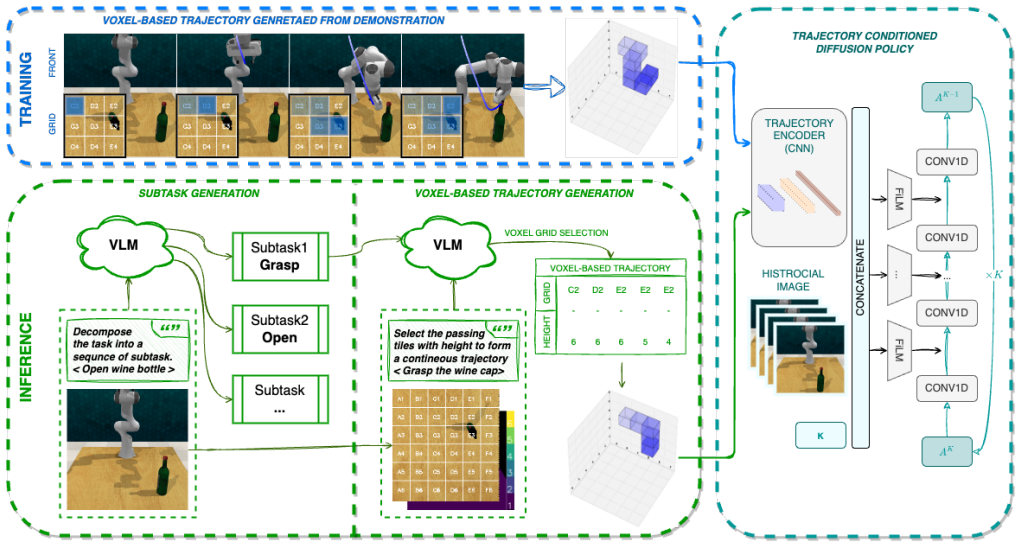
The load-bearing object is the voxel-based spatial trajectory representation: an ordered M×N×K matrix, with M=N=K=6, in which cells are labeled by their order in the end-effector path and off-path cells are 0. It encodes where the tool should go in 3D, including height, unlike a flat 2D line or a color-coded 2.5D sketch. The trajectory is produced by asking the VLM to choose cells on a grid-annotated top-down image, and it is consumed by the policy through three 3D-convolutional layers whose output is concatenated with image and state encodings before the noise predictor. A second mechanism is task decomposition into gripper-bracketed sub-tasks, which removes repeated or reversed motion segments that would make a single trajectory ambiguous. Together, they convert the VLM's coarse spatial plan into a steering signal for a trained low-level action generator.
What would settle it
Train the trajectory-conditioned policy, then evaluate it on the same stacking tasks using randomly sampled voxel trajectories drawn from the demonstration-derived distribution instead of VLM-generated ones: if success stays high, the semantic content of the VLM path is not what carries the gain, and if it collapses, the gain rests on a VLM-to-demonstration similarity that the paper never measures.
Extended reading notes
Core claim
The paper's central claim is that conditioning a denoising diffusion policy on a VLM-generated voxel trajectory makes the policy succeed where RGB-only conditioning fails, and keeps it working when images are degraded. The proposed system first asks a VLM to split a long task into sub-tasks, each starting and ending with a gripper open-close transition, then has the same VLM mark waypoints on a 6x6x6 voxel grid derived from a top-down camera view. That ordered voxel path is encoded by 3D convolutions and injected once into the denoising network alongside the RGB history and robot state. The authors argue that the spatial hint removes ambiguity about which object to target and how to approach it, so the policy degrades less under noise and visual variation and can execute long sequences by following per-sub-task trajectories. Both TDP, using ground-truth trajectories, and VLM-TDP, using VLM-generated trajectories, outperform the classical diffusion policy in all tested tasks, with the gap growing as task length increases.
Load-bearing premise
The weakest premise is that VLM-generated voxel trajectories, which are never shown to the policy during training, resemble the demonstration-derived trajectories closely enough that the same learned policy can follow both; the paper shows the fragility of this assumption when close-together blocks make VLM trajectories ambiguous.
Editorial extensions
If this is right
- In the four-block stacking task, the plain diffusion policy never completes the episode, while VLM-TDP reaches 0.04 combined success, and every increase in task length widens the gap.
- Under Gaussian image noise with σ=0.64, the trajectory-conditioned policy retains an absolute 15% success rate on the Pick sub-task, while the diffusion policy's Pick success drops to 0%.
- Across the seven simulation tasks, both TDP and VLM-TDP beat the classical diffusion policy in every task, raising flat or hard-to-see tasks like Phone on Base from 0.06–0.11 to about 0.53–0.55.
- In real-world trials the advantage grows with horizon: 85% versus 70% for one orange, 95% versus 70% for two bananas, and 70% versus 20% for three bananas.
Reading between the lines
- Because the same trajectory condition is injected once per sub-task, the policy effectively delegates sequencing and target selection to the VLM; a natural test is to freeze the learned policy and swap in cheaper or weaker planners to see how much of the gain comes from the spatial hint itself rather than from task decomposition.
- The 6x6x6 voxel grid is a visible resolution bottleneck: the paper reports Pick success falling from 0.88 to about 0.5 when two blocks are placed close together, and a coarse-to-fine or adaptive-resolution prompting scheme is the obvious next knob to turn.
- Since the method needs only a front camera plus a VLM query, the same trajectory-conditioning idea should transfer to closed-loop visuomotor backbones other than diffusion policies, such as action-chunking transformers or other imitation-learning architectures.
Editorial analysis
A structured set of objections, weighed in public.
Referee Report
Summary. The paper proposes VLM-TDP, a diffusion-policy extension that conditions action generation on voxel-based end-effector trajectories produced by a vision-language model. A trajectory-conditioned diffusion policy (TDP) is trained on trajectories extracted from demonstrations, and VLM-TDP is the same policy evaluated with trajectories generated by GPT-4o. The authors claim a 44% average success-rate improvement over classical diffusion policy, an over-100% improvement on long-horizon tasks, a 20% reduction in performance degradation under noise or environmental changes, and real-world validation on a Franka Panda robot. Experiments are conducted on seven RLBench tasks, Stack Blocks long-horizon tasks with RLBench and Colosseum robustness variations, and three real-world pick-and-place tasks.
Significance. If the central claim were fully supported, the voxel-trajectory conditioning idea would be a practical, sensor-light way to improve diffusion-policy robustness and long-horizon performance. The paper includes useful comparisons against 2D and 3D diffusion baselines, several simulation benchmarks, real-robot experiments, and a video. The main scientific contribution, VLM-generated voxel trajectories as a conditioning modality, is clear and worth pursuing. However, the numerical headline claims are associated with TDP using oracle ground-truth trajectories rather than with the full VLM-TDP system, the long-horizon evaluation uses manually chosen sub-task splits, and the real-world experiments appear to evaluate TDP rather than VLM-TDP. These mismatches mean the significance is currently not fully established in the form stated.
major comments (4)
- [IV-A, Table I, Abstract] The headline '44% improvement in average task success' is supported by TDP (0.71 vs. diffusion policy 0.49 in Table I), not by VLM-TDP, whose Table I average is 0.69 (about 41% relative improvement). Similarly, the robustness claim of a '20% reduction in performance degradation' is evaluated for TDP in Section IV-C, not for VLM-TDP. Please attribute all headline numbers to the correct system, or restate them for VLM-TDP and clearly label TDP as an oracle-trajectory upper bound.
- [IV-B] The long-horizon experiment does not exercise the proposed VLM task decomposition: the paper states 'We manually split the task into several sub-tasks and report the results.' Therefore the claimed over-100% long-horizon improvement demonstrates the benefit of trajectory conditioning combined with manual decomposition, not the VLM-based decomposition described in Section III-B. Please either rephrase the claim or add an experiment in which the VLM generates the sub-task split for Stack Blocks.
- [V, Table III] The real-world experiments are labeled 'TDP (ours)' in Table III and Section V-B, and the text does not describe any VLM-generated trajectories or VLM task decomposition in the real-world setup. The Abstract and Conclusion claim real-world validation of VLM-TDP, but the reported real-world numbers support only the trajectory-conditioned policy with demonstration-derived trajectories. Please run VLM-TDP on the physical robot or explicitly qualify the real-world claim as validating TDP alone.
- [III-C, IV] There is an unexamined distribution shift between the trajectory conditions used at training and at deployment. Section III-C says trajectory conditions are derived from demonstrations, while Section IV states VLM-TDP is validated using trajectories generated by GPT-4o. The paper provides no statistics on VLM trajectory validity, agreement with demonstration trajectories, or prompt details, and no per-condition variance. The ambiguity example in Section IV-B, where close blocks reduce Pick success from 0.88 to about 0.5, shows that VLM trajectories can mislead the policy. Please add an analysis of the trajectory distribution shift and report per-condition results and variances.
minor comments (5)
- [II-C] There is a duplicated word in 'relies on the VLM solely solely for trajectory selection'; please fix the typo.
- [VI] The sentence 'In the presene of varying input images' contains a typo; it should be 'presence'.
- [IV] The evaluation protocol 'averaging the five highest success rates' over checkpoints is unusual and can overestimate performance; please also report the mean over the last several checkpoints or justify the selection protocol.
- [IV-B] The task name 'Put Item on Drawer' in the text appears to be a typo for 'Put Item in Drawer' used elsewhere.
- [III-B] The VLM prompt templates and the exact GPT-4o model configuration are not provided; without these, the trajectory generation component is not reproducible.
Circularity Check
No significant circularity: the core evaluation uses held-out episodes and trajectories from the external GPT-4o model, so the reported successes are not equivalent to the method's inputs by construction.
full rationale
The paper's central chain is: train a trajectory-conditioned diffusion policy using trajectories extracted from demonstrations, then at deployment feed trajectories generated by GPT-4o into the policy and measure task success on held-out episodes in RLBench, Colosseum, and real-robot trials. The evaluation is therefore self-contained against external benchmarks and an external VLM, not a restatement of the training data or of a fitted parameter. The potentially suspicious elements — TDP evaluated with ground-truth demonstration trajectories, manual splitting of long-horizon tasks into sub-tasks, top-5 checkpoint averaging, and the abstract's 44% improvement matching TDP rather than VLM-TDP — are methodology or reporting concerns about what precisely is being tested, but none of them satisfies the standard of a circular reduction: no equation is equivalent to its own input by construction, no fitted parameter is renamed as a prediction, and no load-bearing claim depends on a self-citation chain or on a uniqueness theorem imported from the authors' prior work. The reported numbers come from held-out simulations and robot trials, so the central quantitative claims are not forced by the method's definitions. Accordingly, the appropriate circularity finding is no significant circularity, and the score is 0.
Assumptions & free parameters
free parameters (3)
- Voxel grid resolution (M, N, K) =
6 x 6 x 6
- Action chunk horizon T and execution count N =
T=12, N=8
- Number of training epochs and checkpoint selection =
500 epochs, best-5 average
assumptions (5)
- standard math DDPM noise-prediction objective and iterative denoising formula (Eq. 1-2) correctly model the action distribution.
- domain assumption Robot base and front camera remain fixed throughout task execution.
- domain assumption Gripper open/close delimited sub-tasks remove trajectory ambiguity.
- ad hoc to paper Manually chosen sub-task splits for Stack Blocks are representative of VLM decomposition.
- ad hoc to paper Best-of-training checkpoint averaging (top 5 of 20 evaluations) estimates deployment performance.
Cite this review
Pith. "Pith review of VLM-TDP: VLM-guided Trajectory-conditioned Diffusion Policy for Robust Long-Horizon Manipulation." pith.science (2026). https://pith.science/paper/S6F5KAB3
@misc{pith2026250704524,
  author       = {Pith},
  title        = {Pith review of: VLM-TDP: VLM-guided Trajectory-conditioned Diffusion Policy for Robust Long-Horizon Manipulation},
  year         = {2026},
  howpublished = {\url{https://pith.science/paper/S6F5KAB3}},
  note         = {Machine review of arXiv:2507.04524}
}
read the original abstract
Diffusion policy has demonstrated promising performance in the field of robotic manipulation. However, its effectiveness has been primarily limited in short-horizon tasks, and its performance significantly degrades in the presence of image noise. To address these limitations, we propose a VLM-guided trajectory-conditioned diffusion policy (VLM-TDP) for robust and long-horizon manipulation. Specifically, the proposed method leverages state-of-the-art vision-language models (VLMs) to decompose long-horizon tasks into concise, manageable sub-tasks, while also innovatively generating voxel-based trajectories for each sub-task. The generated trajectories serve as a crucial conditioning factor, effectively steering the diffusion policy and substantially enhancing its performance. The proposed Trajectory-conditioned Diffusion Policy (TDP) is trained on trajectories derived from demonstration data and validated using the trajectories generated by the VLM. Simulation experimental results indicate that our method significantly outperforms classical diffusion policies, achieving an average 44% increase in success rate, over 100% improvement in long-horizon tasks, and a 20% reduction in performance degradation in challenging conditions, such as noisy images or altered environments. These findings are further reinforced by our real-world experiments, where the performance gap becomes even more pronounced in long-horizon tasks. Videos are available on https://youtu.be/g0T6h32OSC8
Figures


Figures from the paper (2 more)


Reference graph
Works this paper leans on
-
[1]
What matters in learning from offline human demonstrations for robot manipula- tion,
A. Mandlekar, D. Xu, J. Wong, S. Nasiriany, C. Wang, R. Kulkarni, L. Fei-Fei, S. Savarese, Y . Zhu, and R. Mart´ın-Mart´ın, “What matters in learning from offline human demonstrations for robot manipula- tion,” arXiv preprint arXiv:2108.03298 , 2021
arXiv 2021
-
[2]
From play to policy: Conditional behavior generation from uncurated robot data,
Z. J. Cui, Y . Wang, N. M. M. Shafiullah, and L. Pinto, “From play to policy: Conditional behavior generation from uncurated robot data,” arXiv preprint arXiv:2210.10047 , 2022
arXiv 2022
-
[3]
Self-supervised correspon- dence in visuomotor policy learning,
P. Florence, L. Manuelli, and R. Tedrake, “Self-supervised correspon- dence in visuomotor policy learning,” IEEE Robotics and Automation Letters, vol. 5, no. 2, pp. 492–499, 2019
work page 2019
-
[4]
Diffusion policy: Visuomotor policy learning via action diffusion,
C. Chi, S. Feng, Y . Du, Z. Xu, E. Cousineau, B. Burchfiel, and S. Song, “Diffusion policy: Visuomotor policy learning via action diffusion,” arXiv preprint arXiv:2303.04137 , 2023
arXiv 2023
-
[5]
3d diffusion policy: Generalizable visuomotor policy learning via simple 3d rep- resentations,
Y . Ze, G. Zhang, K. Zhang, C. Hu, M. Wang, and H. Xu, “3d diffusion policy: Generalizable visuomotor policy learning via simple 3d rep- resentations,” in ICRA 2024 Workshop on 3D Visual Representations for Robot Manipulation , 2024
work page 2024
-
[6]
Denoising diffusion probabilistic models,
J. Ho, A. Jain, and P. Abbeel, “Denoising diffusion probabilistic models,” Advances in neural information processing systems , vol. 33, pp. 6840–6851, 2020
2020
-
[7]
3d diffuser ac- tor: Policy diffusion with 3d scene representations,
T.-W. Ke, N. Gkanatsios, and K. Fragkiadaki, “3d diffuser ac- tor: Policy diffusion with 3d scene representations,” arXiv preprint arXiv:2402.10885, 2024
arXiv 2024
-
[8]
Language-guided object-centric diffusion policy for collision-aware robotic manipula- tion,
H. Li, Q. Feng, Z. Zheng, J. Feng, and A. Knoll, “Language-guided object-centric diffusion policy for collision-aware robotic manipula- tion,” arXiv preprint arXiv:2407.00451 , 2024
arXiv 2024
Show all 44 references
-
[9]
Gpt-4 technical report,
J. Achiam, S. Adler, S. Agarwal, L. Ahmad, I. Akkaya, F. L. Aleman, D. Almeida, J. Altenschmidt, S. Altman, S. Anadkat et al. , “Gpt-4 technical report,” arXiv preprint arXiv:2303.08774 , 2023
2023 arXiv
-
[10]
Learning transferable visual models from natural language supervision,
A. Radford, J. W. Kim, C. Hallacy, A. Ramesh, G. Goh, S. Agarwal, G. Sastry, A. Askell, P. Mishkin, J. Clark et al., “Learning transferable visual models from natural language supervision,” in International conference on machine learning . PMLR, 2021, pp. 8748–8763
2021
-
[11]
Palm: Scaling language modeling with pathways,
A. Chowdhery, S. Narang, J. Devlin, M. Bosma, G. Mishra, A. Roberts, P. Barham, H. W. Chung, C. Sutton, S. Gehrmann et al. , “Palm: Scaling language modeling with pathways,” Journal of Machine Learning Research , vol. 24, no. 240, pp. 1–113, 2023
2023
-
[12]
Do as i can, not as i say: Grounding language in robotic affordances,
M. Ahn, A. Brohan, N. Brown, Y . Chebotar, O. Cortes, B. David, C. Finn, C. Fu, K. Gopalakrishnan, K. Hausman et al. , “Do as i can, not as i say: Grounding language in robotic affordances,” arXiv preprint arXiv:2204.01691, 2022
2022 arXiv
-
[13]
Open-vocabulary queryable scene representations for real world planning,
B. Chen, F. Xia, B. Ichter, K. Rao, K. Gopalakrishnan, M. S. Ryoo, A. Stone, and D. Kappler, “Open-vocabulary queryable scene representations for real world planning,” in 2023 IEEE International Conference on Robotics and Automation (ICRA) . IEEE, 2023, pp. 11 509–11 522
2023
-
[14]
Language models as zero-shot planners: Extracting actionable knowledge for embodied agents,
W. Huang, P. Abbeel, D. Pathak, and I. Mordatch, “Language models as zero-shot planners: Extracting actionable knowledge for embodied agents,” in International conference on machine learning . PMLR, 2022, pp. 9118–9147
2022
-
[15]
Spatialvlm: Endowing vision-language models with spatial reasoning capabilities,
B. Chen, Z. Xu, S. Kirmani, B. Ichter, D. Sadigh, L. Guibas, and F. Xia, “Spatialvlm: Endowing vision-language models with spatial reasoning capabilities,” in Proceedings of the IEEE/CVF Conference on Computer Vision and Pattern Recognition, 2024, pp. 14 455–14 465
2024
-
[16]
Set-of-mark prompting unleashes extraordinary visual grounding in gpt-4v,
J. Yang, H. Zhang, F. Li, X. Zou, C. Li, and J. Gao, “Set-of-mark prompting unleashes extraordinary visual grounding in gpt-4v,” arXiv preprint arXiv:2310.11441, 2023
2023 arXiv
-
[17]
Code as policies: Language model programs for em- bodied control,
J. Liang, W. Huang, F. Xia, P. Xu, K. Hausman, B. Ichter, P. Florence, and A. Zeng, “Code as policies: Language model programs for em- bodied control,” in 2023 IEEE International Conference on Robotics and Automation (ICRA) . IEEE, 2023, pp. 9493–9500
2023
-
[18]
V oxposer: Composable 3d value maps for robotic manipulation with language models,
W. Huang, C. Wang, R. Zhang, Y . Li, J. Wu, and L. Fei-Fei, “V oxposer: Composable 3d value maps for robotic manipulation with language models,” arXiv preprint arXiv:2307.05973 , 2023
2023 arXiv
-
[19]
Moka: Open-vocabulary robotic manipulation through mark-based visual prompting,
F. Liu, K. Fang, P. Abbeel, and S. Levine, “Moka: Open-vocabulary robotic manipulation through mark-based visual prompting,” arXiv preprint arXiv:2403.03174, 2024
2024 arXiv
-
[20]
Rlbench: The robot learning benchmark & learning environment,
S. James, Z. Ma, D. R. Arrojo, and A. J. Davison, “Rlbench: The robot learning benchmark & learning environment,” IEEE Robotics and Automation Letters , vol. 5, no. 2, pp. 3019–3026, 2020
2020
-
[21]
The colosseum: A benchmark for evaluating generalization for robotic manipulation,
W. Pumacay, I. Singh, J. Duan, R. Krishna, J. Thomason, and D. Fox, “The colosseum: A benchmark for evaluating generalization for robotic manipulation,” arXiv preprint arXiv:2402.08191 , 2024
2024 arXiv
-
[22]
Deep unsupervised learning using nonequilibrium thermodynamics,
J. Sohl-Dickstein, E. Weiss, N. Maheswaranathan, and S. Ganguli, “Deep unsupervised learning using nonequilibrium thermodynamics,” in International conference on machine learning . PMLR, 2015, pp. 2256–2265
2015
-
[23]
Denoising diffusion implicit models,
J. Song, C. Meng, and S. Ermon, “Denoising diffusion implicit models,” arXiv preprint arXiv:2010.02502 , 2020
2010 arXiv
-
[24]
Score-based generative modeling through stochastic differential equations,
Y . Song, J. Sohl-Dickstein, D. P. Kingma, A. Kumar, S. Ermon, and B. Poole, “Score-based generative modeling through stochastic differential equations,” arXiv preprint arXiv:2011.13456 , 2020
2011 arXiv
-
[25]
High-resolution image synthesis with latent diffusion models,
R. Rombach, A. Blattmann, D. Lorenz, P. Esser, and B. Ommer, “High-resolution image synthesis with latent diffusion models,” in Proceedings of the IEEE/CVF conference on computer vision and pattern recognition, 2022, pp. 10 684–10 695
2022
-
[26]
Scaling robot learning with semantically imagined experience,
T. Yu, T. Xiao, A. Stone, J. Tompson, A. Brohan, S. Wang, J. Singh, C. Tan, J. Peralta, B. Ichter et al. , “Scaling robot learning with semantically imagined experience,” arXiv preprint arXiv:2302.11550 , 2023
2023 arXiv
-
[27]
Cacti: A framework for scalable multi-task multi-scene visual imitation learning,
Z. Mandi, H. Bharadhwaj, V . Moens, S. Song, A. Rajeswaran, and V . Kumar, “Cacti: A framework for scalable multi-task multi-scene visual imitation learning,” arXiv preprint arXiv:2212.05711 , 2022
2022 arXiv
-
[28]
Genaug: Retargeting behaviors to unseen situations via generative augmentation,
Z. Chen, S. Kiami, A. Gupta, and V . Kumar, “Genaug: Retargeting behaviors to unseen situations via generative augmentation,” arXiv preprint arXiv:2302.06671, 2023
2023 arXiv
-
[29]
Dreamar- rangement: Learning language-conditioned robotic rearrangement of objects via denoising diffusion and vlm planner,
W. Chen, C. Xiao, G. Gao, F. Sun, C. Zhang, and J. Zhang, “Dreamar- rangement: Learning language-conditioned robotic rearrangement of objects via denoising diffusion and vlm planner,” Authorea Preprints, 2024
2024
-
[30]
Sculptdiff: Learning robotic clay sculpting from humans with goal conditioned diffusion policy,
A. Bartsch, A. Car, C. Avra, and A. B. Farimani, “Sculptdiff: Learning robotic clay sculpting from humans with goal conditioned diffusion policy,” arXiv preprint arXiv:2403.10401 , 2024
2024 arXiv
-
[31]
Hierarchical diffu- sion policy for kinematics-aware multi-task robotic manipulation,
X. Ma, S. Patidar, I. Haughton, and S. James, “Hierarchical diffu- sion policy for kinematics-aware multi-task robotic manipulation,” in Proceedings of the IEEE/CVF Conference on Computer Vision and Pattern Recognition, 2024, pp. 18 081–18 090
2024
-
[32]
Robocat: A self- improving foundation agent for robotic manipulation,
K. Bousmalis, G. Vezzani, D. Rao, C. Devin, A. X. Lee, M. Bauza, T. Davchev, Y . Zhou, A. Gupta, A. Raju et al. , “Robocat: A self- improving foundation agent for robotic manipulation,” arXiv preprint arXiv:2306.11706, 2023
2023 arXiv
-
[33]
Learning latent plans from play,
C. Lynch, M. Khansari, T. Xiao, V . Kumar, J. Tompson, S. Levine, and P. Sermanet, “Learning latent plans from play,” in Conference on robot learning. PMLR, 2020, pp. 1113–1132
2020
-
[34]
Bc-z: Zero-shot task generalization with robotic imitation learning,
E. Jang, A. Irpan, M. Khansari, D. Kappler, F. Ebert, C. Lynch, S. Levine, and C. Finn, “Bc-z: Zero-shot task generalization with robotic imitation learning,” in Conference on Robot Learning. PMLR, 2022, pp. 991–1002
2022
-
[35]
Rt-2: Vision- language-action models transfer web knowledge to robotic control,
A. Brohan, N. Brown, J. Carbajal, Y . Chebotar, X. Chen, K. Choro- manski, T. Ding, D. Driess, A. Dubey, C. Finn et al. , “Rt-2: Vision- language-action models transfer web knowledge to robotic control,” arXiv preprint arXiv:2307.15818 , 2023
2023 arXiv
-
[36]
Learning language-conditioned robot behavior from offline data and crowd- sourced annotation,
S. Nair, E. Mitchell, K. Chen, S. Savarese, C. Finn et al. , “Learning language-conditioned robot behavior from offline data and crowd- sourced annotation,” in Conference on Robot Learning . PMLR, 2022, pp. 1303–1315
2022
-
[37]
Open-world object manipulation using pre-trained vision-language models,
A. Stone, T. Xiao, Y . Lu, K. Gopalakrishnan, K.-H. Lee, Q. Vuong, P. Wohlhart, S. Kirmani, B. Zitkovich, F. Xia et al. , “Open-world object manipulation using pre-trained vision-language models,” arXiv preprint arXiv:2303.00905, 2023
2023 arXiv
-
[38]
Learning generalizable manipulation policies with object-centric 3d representations,
Y . Zhu, Z. Jiang, P. Stone, and Y . Zhu, “Learning generalizable manipulation policies with object-centric 3d representations,” arXiv preprint arXiv:2310.14386, 2023
2023 arXiv
-
[39]
Rt-trajectory: Robotic task generalization via hindsight trajectory sketches,
J. Gu, S. Kirmani, P. Wohlhart, Y . Lu, M. G. Arenas, K. Rao, W. Yu, C. Fu, K. Gopalakrishnan, Z. Xu et al., “Rt-trajectory: Robotic task generalization via hindsight trajectory sketches,” arXiv preprint arXiv:2311.01977, 2023
2023 arXiv
-
[40]
Rt-1: Robotics transformer for real-world control at scale,
A. Brohan, N. Brown, J. Carbajal, Y . Chebotar, J. Dabis, C. Finn, K. Gopalakrishnan, K. Hausman, A. Herzog, J. Hsu et al. , “Rt-1: Robotics transformer for real-world control at scale,” arXiv preprint arXiv:2212.06817, 2022
2022 arXiv
-
[41]
A robotic skill learning system built upon diffusion policies and foundation models,
N. Ingelhag, J. Munkeby, J. van Haastregt, A. Varava, M. C. Welle, and D. Kragic, “A robotic skill learning system built upon diffusion policies and foundation models,” arXiv preprint arXiv:2403.16730 , 2024
2024 arXiv
-
[42]
Affordance- guided reinforcement learning via visual prompting,
O. Y . Lee, A. Xie, K. Fang, K. Pertsch, and C. Finn, “Affordance- guided reinforcement learning via visual prompting,” arXiv preprint arXiv:2407.10341, 2024
2024 arXiv
-
[43]
V-rep: A versatile and scalable robot simulation framework,
E. Rohmer, S. P. Singh, and M. Freese, “V-rep: A versatile and scalable robot simulation framework,” in 2013 IEEE/RSJ international conference on intelligent robots and systems . IEEE, 2013, pp. 1321– 1326
2013
-
[44]
Segment anything,
A. Kirillov, E. Mintun, N. Ravi, H. Mao, C. Rolland, L. Gustafson, T. Xiao, S. Whitehead, A. C. Berg, W.-Y . Lo et al. , “Segment anything,” in Proceedings of the IEEE/CVF International Conference on Computer Vision , 2023, pp. 4015–4026
2023
Reviewed August 6, 2026 · model on record in the stance chip above.
Discussion (0). Continue with ORCID to comment.