REVIEW 4 major objections 4 minor 33 references
Cosmological Simulations with Massive Neutrinos: Efficiency and Accuracy
T0 review · 4 major / 4 minor · reviewed 2026-08-06 · deepseek-v4-flash
Pith's one-line read Massive neutrinos can be added to cosmological N-body simulations through a semi-linear response correction that preserves percent-level accuracy in power spectra and halo statistics while adding little cost.
desk verdict A solid, honest methods paper whose power-spectrum claims hold up; the halo-statistics accuracy claims rest on comparisons that lack error bars and an independent reference, so the halo side needs more work. read the letter →
The pith
A machine-rendered reading of the paper's core claim, the machinery that carries it, and where it could break.
The reading
What carries the argument
The load-bearing object is the semi-linear neutrino response function $F_\nu(k,a) = [(1-f_\nu)\,P_{cb}^{1/2}(k,a) + f_\nu f_{nr}(a)\,P_{\nu}^{1/2}(k,a)]/P_{cb}^{1/2}(k,a)$, where $f_{nr}(a)$ tracks the relativistic-to-nonrelativistic transition and $P_\nu(k)$ comes from integrating the total matter power spectrum evolution as in Eq. (63) of Ref. [17]. CDM particles evolve under the potential of the corrected total matter field, and the particle-particle force is reduced by $(1-f_\nu)^2$ on scales where neutrinos are treated as homogeneous. Supporting machinery: a precomputed Friedmann expansion history replaces the code's on-the-fly integration, and a three-level PM grid combined power spectrum estimator reuses PM density fields to avoid full-resolution global FFTs.
What would settle it
Run the same initial conditions with neutrinos represented by explicit particles or a grid fluid and compare the z=0 total matter power spectrum, $F_\nu(k)$, and the ratio of halo mass functions to the semi-linear runs; disagreement exceeding about 0.2% in the power spectrum or about 1% in the halo mass function ratio would break the central claim. A cheaper check is to measure $P_\nu$ directly from a particle-neutrino simulation and compare it with the semi-linear estimate from Eq. (6) at $k \sim 0.1$--$1\,h\,\mathrm{Mpc}^{-1}$, where the response is largest.
Extended reading notes
Core claim
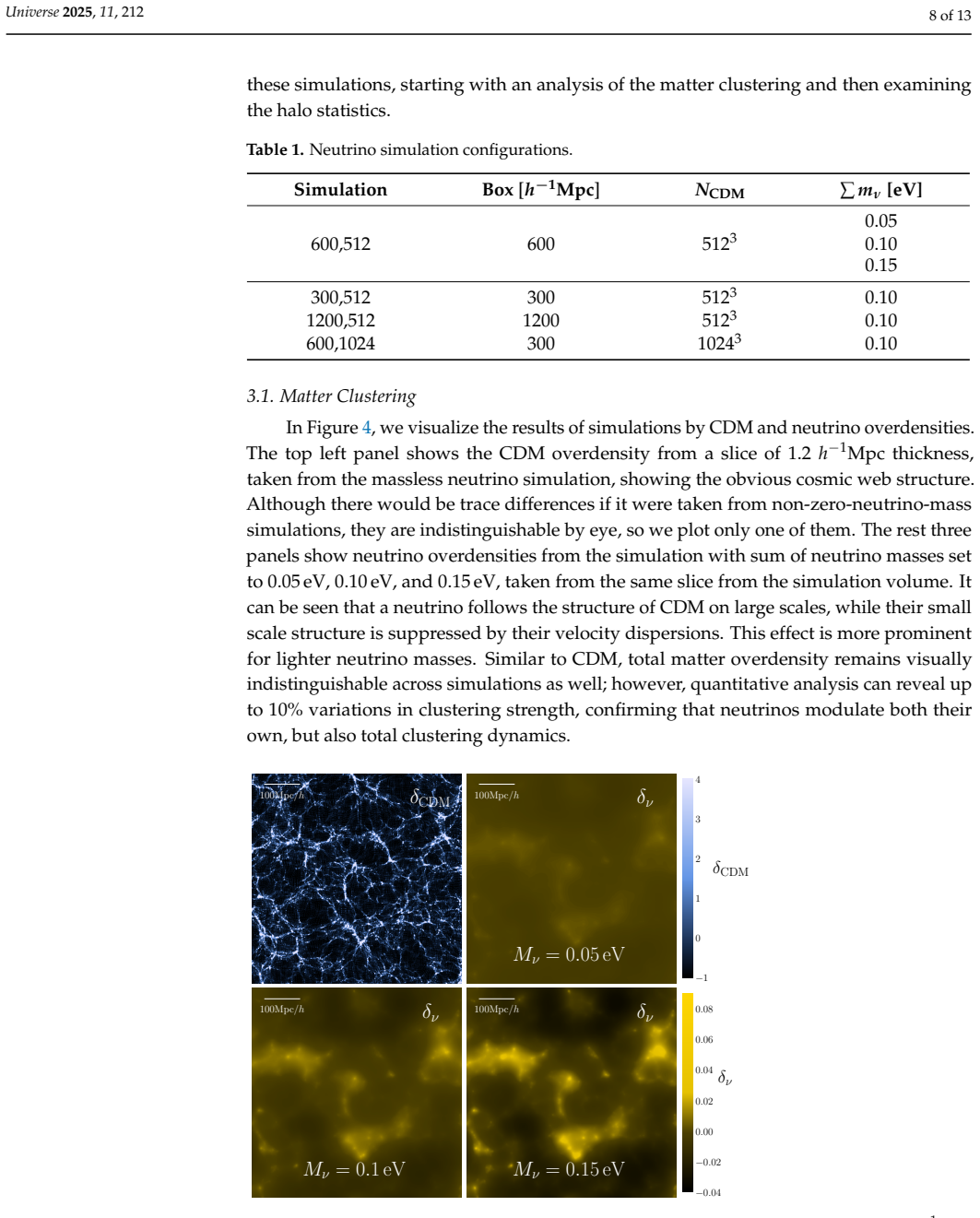
The central claim is that the correction function $F_\nu(k) = \sqrt{P_M/P_{cb}}$, estimated with a neutrino power spectrum computed semi-linearly from the evolving total matter spectrum, recovers the nonlinear matter power spectrum suppression to the level of the Halofit fitting formula, with relative errors below $10^{-4}$ in $F_\nu$ and within 0.2% for the combined power spectrum estimator. The same simulation set shows a neutrino-mass-dependent suppression of the halo mass function and a few-percent enhancement of halo bias at fixed number density, both attributed to the reduced amplitude of high-density peaks. CUBE 2.0 stores particles at 20 bytes each and recycles its PM density fields for power spectra, so neutrino runs add negligible memory overhead.
Load-bearing premise
The semi-linear approximation assumes neutrino density perturbations follow from the evolving total matter power spectrum while ignoring out-of-phase correlations between neutrino and CDM perturbations; if this missing phase information matters for halo statistics, the percent-level calibrations would lose accuracy.
Editorial extensions
If this is right
- The method makes percent-accurate massive neutrino simulations cheap enough to run large grids of neutrino masses and hierarchies, which is needed to disentangle neutrino mass from other cosmological parameters.
- Neutrino-induced power suppression can be calibrated against the nonlinear fitting formula at the 0.1% level, so survey analyses can use these simulations as templates for cosmological parameter constraints.
- Halo mass function suppression is stronger at higher mass and higher redshift, meaning multi-redshift cluster counts can serve as a neutrino-mass probe.
- Fixed-number-density halo samples show enhanced clustering in massive neutrino cosmologies, so analyses of galaxy clustering must account for bias changes, not just power suppression.
- The code's 20-bytes-per-particle memory economy enables larger particle loads, suggesting the method can scale to high-resolution, large-volume neutrino simulations.
Reading between the lines
- A direct extension would be to apply the same semi-linear response idea to other weakly clustered components, such as warm dark matter or ultralight axions, by replacing the neutrino response kernel with the appropriate free-streaming kernel.
- The interpolation and extrapolation of the matter power spectrum between a small number of snapshots is a fragile part of the error budget; running the same simulation with more frequent power-spectrum evaluations would reveal whether the 0.2% combined-spectrum claim is robust.
- If the halo-bias enhancement is as strong as reported, galaxy clustering measurements from upcoming surveys may need joint bias-power modeling, and the net observable effect on correlation functions could be smaller than the power-spectrum suppression alone suggests.
- A direct test of the out-of-phase assumption would be to compare the semi-linear neutrino density field against one evolved with particles at the same seed; the phase agreement on large scales would determine whether percent-level halo statistics are safe.
Editorial analysis
A structured set of objections, weighed in public.
Referee Report
Summary. The paper presents an implementation of the semi-linear neutrino response method in the CUBE 2.0 N-body code. The authors add a neutrino correction function F_nu applied to the CDM density field, a precomputed expansion history that accounts for the neutrino equation of state, a homogeneous-neutrino correction to the short-range PP force, and an interpolation-based multiscale power spectrum estimator. They run a suite of simulations with M_nu = 0, 0.05, 0.1, and 0.15 eV and compare the neutrino-induced suppression of the nonlinear matter power spectrum with Halofit, and the halo mass function and halo correlation function between massless and massive-neutrino runs. The central claims are that the power spectra and halo statistics are accurate and that the neutrino module has minimal additional computational cost.
Significance. The power-spectrum side of the paper contains concrete, quantitative validation: the interpolation-based correction function is tested against CAMB-based nonlinear predictions with relative residuals below 10^-4 (Figure 1), the combining power spectrum matches the full-resolution estimate to within 0.2% (Figure 3), and the measured suppression ratios are consistent with Halofit over a range of box sizes and resolutions (Figure 5). These are genuinely useful checks and support the method's use for matter clustering. However, the halo-statistics claim is not validated at the same standard, and the efficiency claim is not quantified, so the paper's broader 'efficiency and accuracy' claim is only partially supported. If the requested uncertainty quantification and external comparisons are added, the work would be a useful methods paper for neutrino simulations.
major comments (4)
- [Section 3.2, Figures 6 and 7] The halo mass function ratios (bottom panel of Figure 6) and halo correlation function ratios (bottom panel of Figure 7) are presented without error bars, jackknife or bootstrap uncertainties, or a cosmic-variance envelope, and no comparison is made to an independent neutrino simulation method or to published results such as the Euclid code comparison (Ref. [6]) or MillenniumTNG (Ref. [7]). The Introduction explicitly acknowledges that the semi-linear method neglects out-of-phase CDM-neutrino correlations, yet the magnitude of this approximation on halo collapse and halo bias is never quantified. Since the abstract claims 'accurate ... halo statistics,' this part of the central claim is not established by the current evidence.
- [Section 3 and Section 4] The paper repeatedly states that including massive neutrinos incurs 'minimal additional computational cost' (abstract and conclusions), but no timing, memory, or scaling comparison is shown for identical simulations with and without the neutrino module. Table 1 lists configurations only. Given that the title advertises efficiency, a quantitative benchmark (e.g., wall-clock overhead per time step and additional memory per particle) is required to support this claim.
- [Section 2.2, Eq. (6)] The correction function uses f_nu, which is never defined in the text; the surrounding discussion suggests it is the neutrino density fraction Omega_nu/Omega_M, but this must be stated explicitly, especially for the multi-species hierarchy cases mentioned in the introduction. Without this definition, the algorithm and the subsequent PP force rescaling by (1-f_nu)^2 cannot be reproduced from the paper alone.
- [Section 2.3] The 0.2% accuracy of the combining estimator is demonstrated only at z=0 in Figure 3, and the 10^-4 correction-function residual test in Figure 1 uses CAMB-generated theoretical power spectra rather than the simulation's combined estimator. The manuscript should state whether these accuracies hold over the full redshift range and the z_p interpolation scheme used in the production runs, and should quantify the redshift dependence of the interpolation error.
minor comments (4)
- [Section 2.2, Eq. (4)] The definition of f_nr appears to be misprinted: if f_nr = 1 - 3*w_nu is intended, the denominator should be the total neutrino density Omega_nu, not the relativistic component Omega_r_nu.
- [Figure 2] The bottom panel labels a residual as 'res.' without defining what quantity is being differenced; please spell out the residual definition in the caption.
- [Figure 6 caption] The caption contains a typo: 'HMF form neutrinos mass' should read 'HMF from neutrino mass'.
- [Section 2.2, Eq. (7)] The text introducing T_nu,0 and Gamma_nu is grammatically fragmented and should be rewritten to clearly define the neutrino temperature today, the neutrino-to-photon temperature ratio, and their roles in Eq. (7).
Circularity Check
No significant circularity: the semi-linear neutrino module is validated against external references (CAMB, Halofit), and only a minor non-load-bearing self-citation appears in the code-scalability discussion.
-
other
[Section 2.1, CUBE 2.0 description]
"CUBE 2.0 has been validated for large scale simulations (over 16,000 cores in 512 nodes) [Yu et al. in prep.], demonstrating the robustness of its three-layer parallel structure."
The efficiency/scalability claim of the code is justified only by an unpublished manuscript by the same authors, so the reader cannot independently verify it from the present article. However, this citation is not used to derive the neutrino power spectrum, the correction function, or the comparisons to CAMB and Halofit. The central physics claim therefore does not reduce to this self-citation.
full rationale
The chain of derivation is self-contained with respect to the target result. The neutrino power spectrum P_nu is taken from Eq. (63) of Ref. [17], an external analytic derivation, and the total-matter correction function F_nu from Eq. (6) is an implementation of that external ansatz. Figure 1 tests the finite-integral and interpolation strategy against CAMB nonlinear power spectra; Figure 5 compares the predicted suppression to Halofit. No parameter is fitted to reproduce the benchmark, and no benchmark quantity is used as an input to produce the same benchmark. The halo-statistics results in Figures 6 and 7 are not compared to an independent neutrino method, but the absence of an external validation is a robustness limitation, not a circularity. The only same-author citation with unverified content is the scalability statement supported by 'Yu et al. in prep.'; this is not load-bearing for the derivation of the power-spectrum or halo statistics, so it is a minor self-citation rather than a circular step.
Assumptions & free parameters
assumptions (5)
- domain assumption Semi-linear response approximation: neutrino perturbations remain a linear function of the total matter power spectrum even when CDM clustering is nonlinear.
- domain assumption Neutrinos are completely homogeneous at scales beyond the PP force resolution (k much greater than 1 h/Mpc), allowing the PP force to be scaled by (1 - f_nu)^2.
- domain assumption Baryons can be absorbed into CDM as 'cold matter' without affecting the neutrino response.
- domain assumption The Halofit fitting formula (HMcode-2020, Ref. [33]) is an adequate external benchmark for the neutrino-induced matter power spectrum suppression.
- standard math The neutrino fluid can be decomposed into relativistic and non-relativistic components with equation-of-state parameter w_nu(a) from Eqs. (1)-(4).
Cite this review
Pith. "Pith review of Cosmological Simulations with Massive Neutrinos: Efficiency and Accuracy." pith.science (2026). https://pith.science/paper/WRTXUCPN
@misc{pith2026250704627,
  author       = {Pith},
  title        = {Pith review of: Cosmological Simulations with Massive Neutrinos: Efficiency and Accuracy},
  year         = {2026},
  howpublished = {\url{https://pith.science/paper/WRTXUCPN}},
  note         = {Machine review of arXiv:2507.04627}
}
read the original abstract
Constraining neutrino mass through cosmological observations relies on precise simulations to calibrate their effects on large scale structure, while these simulations must overcome computational challenges like dealing with large velocity dispersions and small intrinsic neutrino perturbations. We present an efficient N-body implementation with semi-linear neutrino mass response which gives accurate power spectra and halo statistics. We explore the necessity of correcting the expansion history caused by massive neutrinos and the transition between relativistic and non-relativistic components. The above method of including neutrino masses is built into the memory-, scalability-, and precision-optimized parallel N-body simulation code CUBE 2.0. Through a suite of neutrino simulations, we precisely quantify the neutrino mass effects on the nonlinear matter power spectra and halo statistics.
Figures


Figures from the paper (4 more)


Reference graph
Works this paper leans on
-
[6]
Euclid: Modelling Massive Neutrinos in Cosmology—A Code Comparison.J
Adamek, J.; Angulo, R.E.; Arnold, C.; Baldi, M.; Biagetti, M.; Bose, B.; Carbone, C.; Castro, T.; Dakin, J.; Dolag, K.; et al. Euclid: Modelling Massive Neutrinos in Cosmology—A Code Comparison.J. Cosmol. Astropart. Phys.2023,2023, 035
work page 2023
-
[7]
Hernández-Aguayo, C.; Springel, V .; Bose, S.; Frenk, C.; Jenkins, A.; Barrera, M.; Ferlito, F.; Pakmor, R.; White, S.D.M.; Hernquist, L.; et al. The MillenniumTNG Project: Impact of Massive Neutrinos on the Cosmic Large-Scale Structure and the Distribution of Galaxies.arXiv2024, arXiv:2407.21103. [CrossRef]
-
[1]
2020 Global Reassessment of the Neutrino Oscillation Picture.J
de Salas, P .F.; Forero, D.V .; Gariazzo, S.; Martínez-Miravé, P .; Mena, O.; Ternes, C.A.; Tórtola, M.; Valle, J.W.F. 2020 Global Reassessment of the Neutrino Oscillation Picture.J. High Energy Phys.2021,2021, 71
work page 2020
-
[2]
Direct Neutrino-Mass Measurement with Sub-Electronvolt Sensitivity.Nat
Aker, M.; Beglarian, A.; Behrens, J.; Berlev, A.; Besserer, U.; Bieringer, B.; Block, F.; Bobien, S.; Böttcher, M.; Bornschein, B.; et al. Direct Neutrino-Mass Measurement with Sub-Electronvolt Sensitivity.Nat. Phys.2022,18, 160–166. [CrossRef] Universe2025,11, 212 12 of 13
work page 2022
-
[3]
Most Constraining Cosmological Neutrino Mass Bounds.Phys
Di Valentino, E.; Gariazzo, S.; Mena, O. Most Constraining Cosmological Neutrino Mass Bounds.Phys. Rev. D2021,104, 083504. [CrossRef]
-
[4]
Massive neutrinos and cosmology.Phys
Lesgourgues, J.; Pastor, S. Massive neutrinos and cosmology.Phys. Rep.2006,429, 307–379. [CrossRef]
work page 2006
-
[5]
Signatures of Relativistic Neutrinos in CMB Anisotropy and Matter Clustering.Phys
Bashinsky, S.; Seljak, U. Signatures of Relativistic Neutrinos in CMB Anisotropy and Matter Clustering.Phys. Rev. D2004, 69, 083002
-
[8]
Measurement of Neutrino Masses from Relative Velocities.Phys
Zhu, H.M.; Pen, U.L.; Chen, X.; Inman, D.; Yu, Y. Measurement of Neutrino Masses from Relative Velocities.Phys. Rev. Lett.2014, 113, 131301. [CrossRef]
work page 2014
Show all 33 references
-
[9]
Probing Neutrino Hierarchy and Chirality via Wakes.Phys
Zhu, H.M.; Pen, U.L.; Chen, X.; Inman, D. Probing Neutrino Hierarchy and Chirality via Wakes.Phys. Rev. Lett.2016,116, 141301. [CrossRef]
2016
-
[10]
Parity-Odd Neutrino Torque Detection.Phys
Yu, H.R.; Pen, U.L.; Wang, X. Parity-Odd Neutrino Torque Detection.Phys. Rev. D2019,99, 123532. [CrossRef]
-
[11]
Differential Neutrino Condensation onto Cosmic Structure.Nat
Yu, H.R.; Emberson, J.D.; Inman, D.; Zhang, T.J.; Pen, U.L.; Harnois-Déraps, J.; Yuan, S.; Teng, H.Y.; Zhu, H.M.; Chen, X.; et al. Differential Neutrino Condensation onto Cosmic Structure.Nat. Astron.2017,1, 0143
2017
-
[12]
The Jiutian Simulations for the CSST Extra-Galactic Surveys.arXiv2025, arXiv:2503.21368
Han, J.; Li, M.; Jiang, W.; Chen, Z.; Wang, H.; Wei, C.; He, F.; He, J.; Zhang, J.; Liu, Y.; et al. The Jiutian Simulations for the CSST Extra-Galactic Surveys.arXiv2025, arXiv:2503.21368
-
[13]
Simulating the Cosmic Neutrino Background Using Collisionless Hydrodynamics.Astrophys
Inman, D.; Yu, H.R. Simulating the Cosmic Neutrino Background Using Collisionless Hydrodynamics.Astrophys. J. Suppl. Ser. 2020,250, 21. [CrossRef]
2020
-
[14]
Effects of Neutrino Mass and Asymmetry on Cosmological Structure Formation.J
Zeng, Z.; Yeung, S.; Chu, M.c. Effects of Neutrino Mass and Asymmetry on Cosmological Structure Formation.J. Cosmol. Astropart. Phys.2019,2019, 015. [CrossRef]
2019
-
[15]
Simulating the Cold Dark Matter-Neutrino Dipole with TianNu.Phys
Inman, D.; Yu, H.R.; Zhu, H.M.; Emberson, J.D.; Pen, U.L.; Zhang, T.J.; Yuan, S.; Chen, X.; Xing, Z.Z. Simulating the Cold Dark Matter-Neutrino Dipole with TianNu.Phys. Rev. D2017,95, 083518. [CrossRef]
-
[16]
Grid Based Linear Neutrino Perturbations in Cosmological N-body Simulations.J
Brandbyge, J.; Hannestad, S. Grid Based Linear Neutrino Perturbations in Cosmological N-body Simulations.J. Cosmol. Astropart. Phys.2009,2009, 002. [CrossRef]
2009
-
[17]
An Efficient Implementation of Massive Neutrinos in Non-Linear Structure Formation Simulations
Ali-Haïmoud, Y.; Bird, S. An Efficient Implementation of Massive Neutrinos in Non-Linear Structure Formation Simulations. Mon. Not. R. Astron. Soc.2013,428, 3375–3389. [CrossRef]
2013
-
[18]
MassiveNuS: Cosmological Massive Neutrino Simulations.J
Liu, J.; Bird, S.; Matilla, J.M.Z.; Hill, J.C.; Haiman, Z.; Madhavacheril, M.S.; Petri, A.; Spergel, D.N. MassiveNuS: Cosmological Massive Neutrino Simulations.J. Cosmol. Astropart. Phys.2018,2018, 049
2018
-
[19]
One Line to Run Them All: SuperEasy Massive Neutrino Linear Response in $N$-Body Simulations.J
Chen, J.Z.; Upadhye, A.; Wong, Y.Y.Y. One Line to Run Them All: SuperEasy Massive Neutrino Linear Response in $N$-Body Simulations.J. Cosmol. Astropart. Phys.2021,2021, 078
2021
-
[20]
An Efficient and Accurate Hybrid Method for Simulating Non-Linear Neutrino Structure.Mon
Bird, S.; Ali-Haïmoud, Y.; Feng, Y.; Liu, J. An Efficient and Accurate Hybrid Method for Simulating Non-Linear Neutrino Structure.Mon. Not. R. Astron. Soc.2018,481, 1486–1500. [CrossRef]
2018
-
[21]
Research on Optimal Extraction Methods of Cosmological Information from Cosmic Large-Scale Structure
Liu, Y. Research on Optimal Extraction Methods of Cosmological Information from Cosmic Large-Scale Structure. Ph.D. Thesis, Shanghai Jiao Tong University, Shanghai, China, 2022
2022
-
[22]
Hybrid Multi-Fluid-Particle Simulations of the Cosmic Neutrino Background.J
Chen, J.Z.; Mosbech, M.R.; Upadhye, A.; Wong, Y.Y.Y. Hybrid Multi-Fluid-Particle Simulations of the Cosmic Neutrino Background.J. Cosmol. Astropart. Phys.2023,2023, 012
2023
-
[23]
A New Approach to Cosmological Structure Formation with Massive Neutrinos.J
Fidler, C.; Kleinjohann, A.; Tram, T.; Rampf, C.; Koyama, K. A New Approach to Cosmological Structure Formation with Massive Neutrinos.J. Cosmol. Astropart. Phys.2019,2019, 025
2019
-
[24]
Fast simulations of cosmic large-scale structure with massive neutrinos.J
Partmann, C.; Fidler, C.; Rampf, C.; Hahn, O. Fast simulations of cosmic large-scale structure with massive neutrinos.J. Cosmol. Astropart. Phys.2020,2020, 018. [CrossRef]
2020
-
[25]
A minimal model for massive neutrinos in Newtonian N-body simulations.J
Heuschling, P .; Partmann, C.; Fidler, C. A minimal model for massive neutrinos in Newtonian N-body simulations.J. Cosmol. Astropart. Phys.2022,2022, 068. [CrossRef]
2022
-
[26]
CUBE: An Information-optimized Parallel CosmologicalN-Body Algorithm.Astrophys
Yu, H.R.; Pen, U.L.; Wang, X. CUBE: An Information-optimized Parallel CosmologicalN-Body Algorithm.Astrophys. J. Suppl. Ser.2018,237, 24. [CrossRef]
2018
-
[27]
An Accurate P 3 M Algorithm for Gravitational Lensing Studies in Simulations.Astrophys
Xu, K.; Jing, Y. An Accurate P 3 M Algorithm for Gravitational Lensing Studies in Simulations.Astrophys. J.2021,915, 75. [CrossRef]
2021
-
[28]
The Cosmological simulation code GADGET-2.Mon
Springel, V . The Cosmological simulation code GADGET-2.Mon. Not. R. Astron. Soc.2005,364, 1105–1134. [CrossRef]
2005
-
[29]
Simulating Cosmic Structure Formation with the GADGET-4 Code.Mon
Springel, V .; Pakmor, R.; Zier, O.; Reinecke, M. Simulating Cosmic Structure Formation with the GADGET-4 Code.Mon. Not. R. Astron. Soc.2021,506, 2871–2949. [CrossRef]
2021
-
[30]
Initial Conditions for Accurate N-Body Simulations of Massive Neutrino Cosmologies.Mon
Zennaro, M.; Bel, J.; Villaescusa-Navarro, F.; Carbone, C.; Sefusatti, E.; Guzzo, L. Initial Conditions for Accurate N-Body Simulations of Massive Neutrino Cosmologies.Mon. Not. R. Astron. Soc.2017,466, 3244–3258. Universe2025,11, 212 13 of 13
2017
-
[31]
The Use of Fast Fourier Transform for the Estimation of Power Spectra: A Method Based on Time Averaging over Short, Modified Periodograms.IEEE T rans
Welch, P . The Use of Fast Fourier Transform for the Estimation of Power Spectra: A Method Based on Time Averaging over Short, Modified Periodograms.IEEE T rans. Audio Electroacoust.1967,15, 70–73. [CrossRef]
1967
-
[32]
Correcting for the Alias Effect When Measuring the Power Spectrum Using a Fast Fourier Transform.Astrophys
Jing, Y.P . Correcting for the Alias Effect When Measuring the Power Spectrum Using a Fast Fourier Transform.Astrophys. J.2005, 620, 559–563. [CrossRef]
2005
-
[33]
HMcode-2020: Improved Modelling of Non-Linear Cosmological Power Spectra with Baryonic Feedback.Mon
Mead, A.; Brieden, S.; Tröster, T.; Heymans, C. HMcode-2020: Improved Modelling of Non-Linear Cosmological Power Spectra with Baryonic Feedback.Mon. Not. R. Astron. Soc.2021,502, 1401–1422. Disclaimer/Publisher’s Note:The statements, opinions and data contained in all publicat...
2020
Reviewed August 6, 2026 · model on record in the stance chip above.
Discussion (0). Sign in to comment.