REVIEW 3 major objections 5 minor 30 references
Enhancing Data Processing Efficiency in Blockchain Enabled Metaverse over Wireless Communications
T0 review · 3 major / 5 minor · reviewed 2026-08-06 · deepseek-v4-flash
Pith's one-line read The paper claims that the DAUR algorithm turns the nonconvex problem of maximizing data processing efficiency in blockchain-enabled Metaverse wireless systems into a solvable convex optimization, and that in simulation it reaches 87.87…
desk verdict A useful rounding-comparison study and a plausible simulation story are currently attached to a central equivalence proof that does not hold as written; worth a referee, but only with a clear demand to fix Lemma 2. read the letter →
The pith
A machine-rendered reading of the paper's core claim, the machinery that carries it, and where it could break.
The reading
What carries the argument
The central objects are the DPE ratio itself, DPE := processed bits/(delay + energy), and the DAUR algorithm that alternates two optimization blocks. The first block fixes user association $x$, offloading ratio $\phi$, and server split $\gamma$, and uses the auxiliary variable $\upsilon^{(s)}_{n,m} = 1/(2 x_{n,m}\rho_n p_n \phi_n d_n r_{n,m})$ to turn the nonconvex transmission-cost ratio into a convex surrogate. The second block fixes bandwidth, power, and computing allocations and relaxes the remaining mixed-integer QCQP into an SDR problem, whose rank-one constraint is handled by the DC penalty $\mathrm{Tr}(S)-\|S\|_2$ and linearized as Problem P12; rank-1 approximation then recovers the discrete association. Lemma 4 does key work: it sets the data size changing ratio $\omega_b = 1$ and declares the validation delay $T^{sv}$ negligible, so the optimal server resource split is $\gamma^* = 1/2$.
What would settle it
Take the same DPE maximization with $\omega_b = 2$ and with non-negligible validation delay, allow $\gamma$ to vary over $(0,1)$ while recomputing the optimal association and resources, and compare the resulting DPE with the value obtained at the fixed split $\gamma = 1/2$; if the variable-$\gamma$ solution is materially higher, Lemma 4's premise fails and DAUR's reported optimum holds only for the special case.
Extended reading notes
Core claim
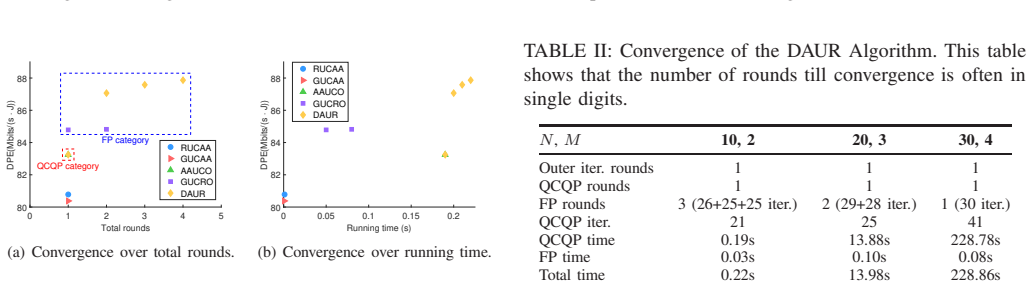
The central claim is that the nonconvex problem P1, maximizing the sum of DPE ratios over discrete user association and continuous offloading and resource variables, can be relaxed into convex subproblems without losing solution quality. The argument proceeds by a fractional-programming transformation that rewrites each ratio with auxiliary variables $\alpha$ and $\vartheta$, then splits optimization into two blocks: with user association, offloading ratio, and server split fixed, the communication and computing block becomes concave through the auxiliary variable $\upsilon^{(s)}_{n,m}$; with the communication block fixed, the residual QCQP over $x$ and $\phi$ is relaxed by semidefinite relaxation, and the rank-one constraint is retained through a difference-of-convex penalty $\mathrm{Tr}(S)-\|S\|_2$ that is linearized into a convex problem. The discrete association is recovered by rank-1 approximation, which the paper's numerical comparison selects over Hungarian, randomized, secondary-discrete, and greedy rounding. The headline numeric result is DPE 87.87 Mbit/(s·J) at default settings, versus 80.78, 80.38, 83.25, and 84.82 for the four baselines.
Load-bearing premise
The paper's argument assumes that the data size changing ratio $\omega_b = 1$ and that the blockchain validation delay $T^{sv}$ is negligible; if either assumption fails, fixing the server resource split at $\gamma = 1/2$ is not optimal and the claimed joint optimization is not actually being carried out.
Editorial extensions
If this is right
- Under the paper's simulation settings, DAUR achieves DPE 87.87 Mbit/(s·J), exceeding RUCAA, GUCAA, AAUCO, and GUCRO by about 7.09, 7.49, 4.62, and 3.05 Mbit/(s·J), respectively.
- Retaining the rank-one constraint in the SDR step yields a slightly higher objective than dropping it, improving the conference-version values from 81.87 and 86.48 to 83.25 and 87.87.
- The DAUR algorithm converges within one outer iteration for the tested (10,2), (20,3), and (30,4) setups, with total runtimes from 0.22 s to 228.86 s.
- The paper states DAUR extends beyond DPE to energy-efficiency and utility-cost problems, with successive convex approximation available for nonconcave utility functions.
- The method requires a centralized optimizer, which the paper identifies as a privacy risk and a target for future decentralized implementation.
Reading between the lines
- If $\omega_b \neq 1$ or the validation delay is not negligible, the fixed split $\gamma = 1/2$ is no longer provably optimal, so the claimed joint optimization would need $\gamma$ as a decision variable; rerunning the simulations with $\omega_b = 2$ and optimizing over $\gamma$ is a direct test.
- The reported DPE values scale with the preference weights $c_n$ and $c_{n,m}$; at low preference settings the paper reports DPE dropping to 17.29, so the absolute numbers are preference-dependent even if the ordering over baselines persists.
- The validation delay $T^{sv}$ is modeled but then declared negligible; real systems with many validator servers may see block-generation and validation costs dominate, a regime the default simulation does not stress.
- Because Algorithm 1 initializes $\gamma_{n,m} = 0.5$ and never updates it, the 'joint' optimization in the code is effectively over the other variables only; a version that treats $\gamma$ as an optimized variable would separate the paper's algorithmic contribution from its strongest simplifying assumption.
Editorial analysis
A structured set of objections, weighed in public.
Referee Report
Summary. The paper introduces a data processing efficiency (DPE) metric for blockchain-enabled Metaverse wireless systems and proposes the DAUR algorithm to jointly optimize user association, work offloading, task-specific computing resource distribution, bandwidth, transmit power, and computing allocations. The optimization problem P1 is a nonconvex sum-of-ratios problem. The authors claim to transform P1 into a solvable convex problem through a sequence of auxiliary variables and relaxations (P2, P3, ..., P12), solved by an alternating fractional-programming and QCQP/SDR-with-DC-penalty approach. Simulations over several user/server configurations show that DAUR achieves a higher DPE (87.87 M bits/(s·J)) than four baseline schemes (80.38–84.82).
Significance. If the transformations and convergence claims are sound, the paper offers a practical joint user-association and resource-allocation algorithm for a timely application domain, and it proposes a meaningful efficiency metric (processed bits per delay-plus-energy) that generalizes earlier utility-cost metrics. The manuscript is unusually transparent: it clearly lists differences from the authors' conference version [1], provides an extensive appendix with proofs, reports running times and iteration counts, and compares several rounding techniques. The numerical study is self-contained and shows consistent improvements across bandwidth, server capacity, user capacity, transmit power, and weight-ratio sweeps. The central weakness is that the main theoretical transformation (Lemma 2) is not a valid equivalence as written; this undermines the paper's stated central claim, though the algorithmic framework and simulations may remain useful if the theoretical gap can be repaired.
major comments (3)
- [Section V, Lemma 2, Eq. (16)–(20), Appendix B] The claimed equivalence of P2 and P3 is not correct as stated. In Problem P3, the variables α and ϑ appear only in the objective and have no constraints or bounds. For any feasible (x, ϕ, γ, φ, ρ, ζ, ψ, T), pick a term with x_{n,m} ϕ_n d_n > 0, set ϑ^s_{n,m} = 0, and let α^s_{n,m} → +∞; the objective tends to +∞. Hence P3 is unbounded above and cannot be equivalent to P2 or P1. Moreover, substituting the KKT values (17)–(20) into the P3 objective makes each bracketed term α(·)(num − ϑ·cost) equal to zero, so the P3 objective value at those points is zero, not the sum of DPE ratios of P2. The proof in Appendix B derives stationarity and complementary slackness of P2, not a transformation of P2 into P3. The intended statement appears to be that P3 is a fixed-parameter subproblem when α and ϑ are held constant and updated externally, as done in Algorithm 1; that formulation can be a valid algorithmic device, but Lemma 2 and the surrounding text must be rewritten to state and prove convergence of that fixed-point iteration rather than an equivalence.
- [Section V-B, Lemma 4, Appendix D, Algorithm 1] Lemma 4 sets ω_b = 1 and treats the validation delay T^sv as negligible to conclude γ*? = 1/2. For general ω_b, the expression γ^2 + ω_b(1−γ)^2 is minimized at γ = ω_b/(1+ω_b), and the sum T^sp + T^sg is minimized at γ = 1/(1+ω_b), neither of which equals 1/2 unless ω_b = 1. The validation delay T^sv is not negligible in general, and it depends on the γ values of other servers, so the optimal γ would couple across servers. Algorithm 1 initializes γ_{n,m} = 0.5 and never updates it, so the claimed joint optimization of the task-specific computing resource split (variable γ) is not actually performed. This issue affects the validity of Theorem 3 and the interpretation of the simulation results, which set ω_b = 1 by default.
- [Section V, paragraphs after Lemma 2 and Algorithm 1] The paper claims that the alternating block-coordinate update converges to a stationary point of Problem P3, but no convergence proof is provided for the outer loop of Algorithm 1 or for the overall DAUR procedure. Given that P3 as currently stated is unbounded, the stationarity claim is not meaningful without a corrected formulation. If the authors adopt the fixed-point interpretation of P3, they should prove that the sequence produced by the α/ϑ updates and the inner FP and QCQP loops converges to a stationary point of the original P1 (or of a properly defined surrogate), with explicit assumptions on the penalty parameter and rounding step.
minor comments (5)
- [Abstract and Section V] The phrase 'transforms the nonconvex problem of maximizing the sum of DPE ratios into a solvable convex optimization problem' is repeated in the abstract, introduction, and Section V; given the issues in Lemma 2, this claim should be softened or made conditional on the fixed-point interpretation until the theory is repaired.
- [Table I and Eq. (1)] The notation σ^2 φ_{n,m} b_m in the Shannon formula is introduced without defining σ^2 as a noise power spectral density; consider clarifying whether the bandwidth scaling is intentional.
- [Appendix C, Lemma 3] The proof of Lemma 3 shows equality of partial derivatives between F and G at the specific value υ^s = 1/(2 x ρ p φ d r), which is a local first-order argument; the text should explain more precisely that this is a standard fractional-programming surrogate rather than an exact problem transformation, since the equality of functions is only shown at the stationary update value.
- [Section VII and Fig. 5(c)] In Fig. 5(c), the vertical axis labels 'delay(s)', 'energy(J)', and 'DPE(Mbits/(s·J))' are combined in one plot, but the delay and energy values appear to be on different scales; clarifying the scaling or using separate subplots would improve readability.
- [Overall] There are several typographical and formatting issues, including 'Karush-–Kuhn—Tucker' in the statement of Lemma 2, and inconsistent use of 'different-of-convex' versus 'difference-of-convex' in Section I; a careful pass for language and notation is needed.
Circularity Check
No significant circularity: the DPE definition, the DAUR derivation, and the simulation comparisons are self-contained, with self-citations used only as context or incremental comparison.
full rationale
The paper's central claim is that DAUR transforms the nonconvex sum-of-ratios problem P1 into a tractable sequence of convex subproblems. The derivation is carried out in the paper itself: Lemma 1 introduces auxiliary variables ϑ and T; Lemma 2 introduces α and states KKT relationships; Lemma 3 introduces υ(s); and Lemmas 4-6, together with the DC penalty reformulation, produce the final SDP/DC problems. The proofs are given in Appendices A-F, so the transformation chain does not rely on importing an external result as a black box. The numerical section compares DAUR against four self-implemented baselines (RUCAA, GUCAA, AAUCO, GUCRO) under the same simulation model; no parameter is fitted to an external target, and the reported DPE values are computed from the paper's own definition of DPE. Self-citations appear in two places: the conference version [1] is used only to state differences and improved DPE values, and prior work [22] by the same research group is mentioned in related work as having studied a utility-cost ratio. Neither citation is load-bearing for the paper's main theorem or algorithmic construction. The assumption in Lemma 4 that ωb=1 and that T^sv is negligible is a modeling/optimality assumption, not a circular reduction: the P1 objective and Algorithm 1 are not defined in terms of each other, and the correctness of the γ=1/2 claim is a separate mathematical issue rather than a circularity issue. The paper even acknowledges a limitation in the conclusion (centralized implementation risk), which further indicates that the claimed contribution is not merely restating its inputs. Overall, the derivation chain is self-contained enough that no specific circular step can be exhibited with quotes.
Assumptions & free parameters
free parameters (3)
- Penalty weight ̟ =
175
- Delay/energy weights ωt, ωe =
0.5 each
- DPE preference weights cn, cn,m =
1/(5×10^5)
assumptions (4)
- standard math Shannon capacity formula for FDMA uplink (Eq. (1)) with no interference
- domain assumption Blockchain block propagation and validation costs follow the model of Feng et al. [7] (Eqs. (10)-(11))
- ad hoc to paper Data size changing ratio ωb is set to 1 and validation delay is negligible (Lemma 4)
- ad hoc to paper The alternating block-coordinate update and the DC penalty converge to a stationary point of the relaxed problem
Cite this review
Pith. "Pith review of Enhancing Data Processing Efficiency in Blockchain Enabled Metaverse over Wireless Communications." pith.science (2026). https://pith.science/paper/3RVXD5RP
@misc{pith2026250704657,
  author       = {Pith},
  title        = {Pith review of: Enhancing Data Processing Efficiency in Blockchain Enabled Metaverse over Wireless Communications},
  year         = {2026},
  howpublished = {\url{https://pith.science/paper/3RVXD5RP}},
  note         = {Machine review of arXiv:2507.04657}
}
read the original abstract
In the rapidly evolving landscape of the Metaverse, enhanced by blockchain technology, the efficient processing of data has emerged as a critical challenge, especially in wireless communication systems. Addressing this challenge, our paper introduces the innovative concept of data processing efficiency (DPE), aiming to maximize processed bits per unit of resource consumption in blockchain-empowered Metaverse environments. To achieve this, we propose the DPE-Aware User Association and Resource Allocation (DAUR) algorithm, a tailored optimization framework for blockchain-enabled Metaverse wireless communication systems characterized by joint computing and communication resource constraints. The DAUR algorithm transforms the nonconvex problem of maximizing the sum of DPE ratios into a solvable convex optimization problem. It alternates the optimization of key variables, including user association, work offloading ratios, task-specific computing resource distribution, bandwidth allocation, user power usage ratios, and server computing resource allocation ratios. Our extensive numerical results demonstrate the DAUR algorithm's effectiveness in DPE.
Figures


Figures from the paper (4 more)



Reference graph
Works this paper leans on
-
[1]
L. Qian and J. Zhao, “Data processing efficiency aware use r association and resource allocation in blockchain enabled Metaverse ov er wireless communications,” in ACM MobiHoc, 2024, pp. 201–210
work page 2024
-
[2]
Non-fungible token ( NFT): Overview, evaluation, opportunities and challenges,
Q. Wang, R. Li, Q. Wang, and S. Chen, “Non-fungible token ( NFT): Overview, evaluation, opportunities and challenges,” arXiv preprint arXiv:2105.07447, 2021
arXiv 2021
-
[3]
Mapping the NFT revolution: Market tre nds, trade networks, and visual features,
M. Nadini, L. Alessandretti, F. Di Giacinto, M. Martino, L. M. Aiello, and A. Baronchelli, “Mapping the NFT revolution: Market tre nds, trade networks, and visual features,” Scientific Reports , vol. 11, no. 1, p. 20902, 2021
work page 2021
-
[4]
NFTs and the Metaverse revolution: Research p erspectives and open challenges,
K. Christodoulou, L. Katelaris, M. Themistocleous, P . C hristodoulou, and E. Iosif, “NFTs and the Metaverse revolution: Research p erspectives and open challenges,” Blockchains and the Token Economy: Theory and Practice, pp. 139–178, 2022
work page 2022
-
[5]
D. V an Huynh, S. R. Khosravirad, A. Masaracchia, O. A. Dob re, and T. Q. Duong, “Edge intelligence-based ultra-reliable and l ow-latency communications for digital twin-enabled metaverse,” IEEE Wireless Communications Letters , vol. 11, no. 8, pp. 1733–1737, 2022
work page 2022
-
[6]
The en ergy consumption of blockchain technology: Beyond myth,
J. Sedlmeir, H. U. Buhl, G. Fridgen, and R. Keller, “The en ergy consumption of blockchain technology: Beyond myth,” Business & Information Systems Engineering , vol. 62, no. 6, pp. 599–608, 2020. 15
work page 2020
-
[7]
J. Feng, F. R. Y u, Q. Pei, J. Du, and L. Zhu, “Joint optimiza tion of radio and computational resources allocation in blockchain-ena bled mobile edge computing systems,” IEEE Transactions on Wireless Communica- tions, vol. 19, no. 6, pp. 4321–4334, 2020
work page 2020
-
[8]
Joint computati on offloading and user association in multi-task mobile edge computing,
Y . Dai, D. Xu, S. Maharjan, and Y . Zhang, “Joint computati on offloading and user association in multi-task mobile edge computing,” IEEE Transactions on V ehicular Technology , vol. 67, no. 12, pp. 12 313– 12 325, 2018
work page 2018
Show all 30 references
-
[9]
An energy efficient and spectrum effic ient wireless heterogeneous network framework for 5G systems,
R. Q. Hu and Y . Qian, “An energy efficient and spectrum effic ient wireless heterogeneous network framework for 5G systems,” IEEE Communications Magazine , vol. 52, no. 5, pp. 94–101, 2014
2014
-
[10]
Lifesaving wi th RescueChain: Energy-efficient and partition-tolerant blo ckchain based secure information sharing for UA V-aided disaster rescue,
Y . Wang, Z. Su, Q. Xu, R. Li, and T. H. Luan, “Lifesaving wi th RescueChain: Energy-efficient and partition-tolerant blo ckchain based secure information sharing for UA V-aided disaster rescue, ” in IEEE IN- FOCOM 2021-IEEE Conference on Computer Communications . V an- couver,...
2021
-
[11]
Near-optimal and practical jamming-resistant energy-efficient cognitive r adio communi- cations,
P . Zhou, Q. Wang, W. Wang, Y . Hu, and D. Wu, “Near-optimal and practical jamming-resistant energy-efficient cognitive r adio communi- cations,” IEEE Transactions on Information F orensics and Security , vol. 12, no. 11, pp. 2807–2822, 2017
2017
-
[12]
Towards efficient and energy-aware query processing for industrial Internet of Things,
L. Liu, Y . Wang, W. Meng, Z. Xu, W. Gao, and Z. Ma, “Towards efficient and energy-aware query processing for industrial Internet of Things,” Peer-to-Peer Networking and Applications , vol. 14, no. 6, pp. 3895– 3914, 2021
2021
-
[13]
Safe and pr actical energy-efficient detour routing in IP networks,
Q. Li, M. Xu, Y . Y ang, L. Gao, Y . Cui, and J. Wu, “Safe and pr actical energy-efficient detour routing in IP networks,” IEEE/ACM Transactions on Networking , vol. 22, no. 6, pp. 1925–1937, 2014
1925
-
[14]
Cloudshare: Towards a cost-efficient and privacy-p reserving alliance cloud using permissioned blockchains,
Y . Li, L. Zhu, M. Shen, F. Gao, B. Zheng, X. Du, S. Liu, and S. Yin, “Cloudshare: Towards a cost-efficient and privacy-p reserving alliance cloud using permissioned blockchains,” in Mobile Networks and Management: 9th International Conference . Melbourne, Australia: Springer, ...
2018
-
[15]
Throughput maximization in wireles s powered communication networks,
H. Ju and R. Zhang, “Throughput maximization in wireles s powered communication networks,” IEEE Transactions on Wireless Communica- tions, vol. 13, no. 1, pp. 418–428, 2013
2013
-
[16]
Proof of learn ing (PoLe): Empowering neural network training with consensus building on blockchains,
Y . Liu, Y . Lan, B. Li, C. Miao, and Z. Tian, “Proof of learn ing (PoLe): Empowering neural network training with consensus building on blockchains,” Computer Networks , vol. 201, p. 108594, 2021
2021
-
[17]
A daptive resource allocation in future wireless networks with block chain and mo- bile edge computing,
F. Guo, F. R. Y u, H. Zhang, H. Ji, M. Liu, and V . C. Leung, “A daptive resource allocation in future wireless networks with block chain and mo- bile edge computing,” IEEE Transactions on Wireless Communications , vol. 19, no. 3, pp. 1689–1703, 2019
2019
-
[18]
Blockchain assisted federated learning over wirele ss channels: Dynamic resource allocation and client scheduling,
X. Deng, J. Li, C. Ma, K. Wei, L. Shi, M. Ding, W. Chen, and H . V . Poor, “Blockchain assisted federated learning over wirele ss channels: Dynamic resource allocation and client scheduling,” IEEE Transactions on Wireless Communications , vol. 22, no. 5, pp. 3537–3553, 2022
2022
-
[19]
Decentralized IoT resource monitoring and scheduling fra mework based on blockchain,
D. Li, R. Chen, Q. Wan, Z. Guan, Y . Sun, Q. Wu, J. Hu, and J. L iu, “Decentralized IoT resource monitoring and scheduling fra mework based on blockchain,” IEEE Internet of Things Journal , vol. 10, no. 24, pp. 21 135–21 142, 2023
2023
-
[20]
H ealthchain: A blockchain-based privacy preserving scheme for large-sc ale health data,
J. Xu, K. Xue, S. Li, H. Tian, J. Hong, P . Hong, and N. Y u, “H ealthchain: A blockchain-based privacy preserving scheme for large-sc ale health data,” IEEE Internet of Things Journal , vol. 6, no. 5, pp. 8770–8781, 2019
2019
-
[21]
Efficie nt QoS support for robust resource allocation in blockchain-base d femtocell networks,
Z. Liu, L. Gao, Y . Liu, X. Guan, K. Ma, and Y . Wang, “Efficie nt QoS support for robust resource allocation in blockchain-base d femtocell networks,” IEEE Transactions on Industrial Informatics , vol. 16, no. 11, pp. 7070–7080, 2019
2019
-
[22]
Human-centric resource all ocation in the Metaverse over wireless communications,
J. Zhao, L. Qian, and W. Y u, “Human-centric resource all ocation in the Metaverse over wireless communications,” IEEE Journal on Selected Areas in Communications , vol. 42, no. 3, pp. 514–537, 2024
2024
-
[23]
MetaSlicing: A novel resource alloca tion framework for Metaverse,
N. H. Chu, D. T. Hoang, D. N. Nguyen, K. T. Phan, E. Dutkiew icz, D. Niyato, and T. Shu, “MetaSlicing: A novel resource alloca tion framework for Metaverse,” IEEE Transactions on Mobile Computing , vol. 1, pp. 1–18, 2023
2023
-
[24]
Unified resource allocation framework for the edge intelli gence-enabled Metaverse,
W. C. Ng, W. Y . B. Lim, J. S. Ng, Z. Xiong, D. Niyato, and C. M iao, “Unified resource allocation framework for the edge intelli gence-enabled Metaverse,” in ICC 2022-IEEE International Conference on Communi- cations. Seoul, Korea: IEEE, 2022, pp. 5214–5219
2022
-
[25]
A mathematical theory of communication ,
C. E. Shannon, “A mathematical theory of communication ,” The Bell System Technical Journal , vol. 27, no. 3, pp. 379–423, 1948
1948
-
[26]
Over-the-air computation via inte lligent reflecting surfaces,
T. Jiang and Y . Shi, “Over-the-air computation via inte lligent reflecting surfaces,” in 2019 IEEE Global Communications Conference (GLOBE- COM). IEEE, 2019, pp. 1–6
2019
-
[27]
The Hungarian method for the assignment pro blem,
H. W. Kuhn, “The Hungarian method for the assignment pro blem,” Naval Research Logistics Quarterly , vol. 2, no. 1-2, pp. 83–97, 1955
1955
-
[28]
Sem idefinite relaxation of quadratic optimization problems,
Z.-Q. Luo, W.-K. Ma, A. M.-C. So, Y . Y e, and S. Zhang, “Sem idefinite relaxation of quadratic optimization problems,” IEEE Signal Processing Magazine, vol. 27, no. 3, pp. 20–34, 2010
2010
-
[29]
Tutorial: Complexity analys is of singular value decomposition and its variants,
X. Li, S. Wang, and Y . Cai, “Tutorial: Complexity analys is of singular value decomposition and its variants,” arXiv preprint arXiv:1906.12085 , 2019
1906 arXiv
-
[30]
Performa nce analysis and location optimization for massive MIMO systems with cir cularly distributed antennas,
A. Y ang, Y . Jing, C. Xing, Z. Fei, and J. Kuang, “Performa nce analysis and location optimization for massive MIMO systems with cir cularly distributed antennas,” IEEE Transactions on Wireless Communications , vol. 14, no. 10, pp. 5659–5671, 2015. APPENDIX A PROOF OF LEMMA 1...
2015
Reviewed August 6, 2026 · model on record in the stance chip above.
Discussion (0). Continue with ORCID to comment.