REVIEW 2 major objections 4 minor 12 references
Majority dynamics on finite trees
T0 review · 2 major / 4 minor · reviewed 2026-08-06 · deepseek-v4-flash
Pith's one-line read For any finite tree with odd degrees, the worst-case majority-dynamics stabilisation time equals the length of the longest active path, with one extra step when that path ends at a leaf.
desk verdict The exact worst-case result is clean and solid; the average-case upper bound has a genuine gap in Claim 4.14 that needs repair before Theorem 1.2 is fully proven. read the letter →
The pith
A machine-rendered reading of the paper's core claim, the machinery that carries it, and where it could break.
The reading
What carries the argument
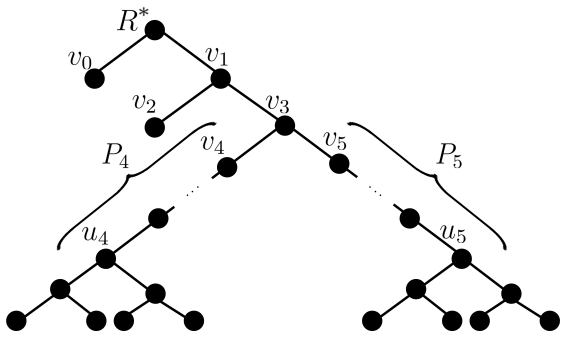
The carrying object is a classification of vertices by the number of leaf-neighbours. A vertex is active when fewer than $(\deg_T(v)-1)/2$ of its neighbours are leaves, balky when equality holds, and passive otherwise. Active vertices are the only ones that can transmit an opinion along a non-leaf path, and the maximum length of a directed path of active vertices, plus one for an end touching a leaf, gives $\tau(T)$ exactly. For random initial opinions, the proof uses two stability notions defined by the initial opinions inside a vertex's descendant subtree: strong $t$-stability, in which the vertex keeps its opinion for every outside configuration, and weak $t$-stability, in which some outside configuration locks it. The random upper bound is finished by a union bound over paths whose count is controlled by an external estimate on long paths in a perfect binary tree.
What would settle it
Count all paths of length $d=\lfloor 2h/3\rfloor$ in a perfect binary tree of height $h$; if for some sequence of $h$ this count exceeds $C\cdot 2^{h+d/2}$ for every constant $C$, the union bound in Lemma 4.8 collapses and the whp upper bound of Theorem 1.2 would need a different proof.
Extended reading notes
Core claim
Theorem 1.1 states that for every finite tree $T$ with all degrees odd and $|V(T)|\ge 5$, $\tau(T)=\max_{Q\in\mathcal{Q}} t(Q)$, where $\mathcal{Q}$ collects paths whose non-final vertices have fewer than $(\deg_T(v)-1)/2$ leaf-neighbours and whose final vertex has at most that many. The value $t(Q)$ is $|V(Q)|$, plus $1$ if the final vertex is adjacent to a leaf. For perfect trees of diameter $D$, this gives $\tau(T)=D-3$. The paper also proves that with uniformly random initial opinions on a perfect binary tree of diameter $D$, the stabilisation time lies between $c_-D$ and $c_+D$ with high probability for some $c_->1/4$ and $c_+<1/3$, and that for perfect $k$-ary trees with even $k\ge 4$ the time is whp at least a constant times $D^{1/2}(\log k/k)^{1/2}$ and at most $D-3$.
Load-bearing premise
The random-tree upper bound leans on the quoted estimate that a perfect binary tree of height $h$ contains at most about $C\cdot 2^{h+d/2}$ paths of length $d$; if that estimate is too small by an exponential factor, the union bound over long paths fails.
Editorial extensions
If this is right
- For any odd-degree tree, $\tau(T)$ can be read off from the vertex classification, so finding the worst-case stabilisation time becomes a longest-path computation rather than a search over all $2^n$ initial opinion vectors.
- Perfect trees of diameter $D$ always have worst-case stabilisation time $D-3$, so the earlier general bound $|E(T)|-|V(T)|/2$ is not tight for trees.
- On a perfect binary tree with random opinions, stabilisation time is whp linear in the diameter, between $D/4$ and $D/3$; randomness does not push the time below linear.
- On perfect $k$-ary trees with even $k\ge 4$, random stabilisation time is whp at least a constant multiple of $\sqrt{(\ln k)/k}\sqrt{D}$, and the true order is left open.
- For the infinite 3-regular tree with iid uniform opinions, Claim 1.4 follows: with probability exceeding $1/2$, a fixed root's opinion at even times equals its initial opinion forever.
Reading between the lines
- Not pursued in the paper: Theorem 1.1 reduces worst-case time to a longest-path problem on the active subgraph, so $\tau(T)$ can be computed in near-linear time by pruning leaf counts.
- If the external path-count bound used for the random upper bound is close to sharp, lowering the constant $c_+$ below $1/3$ would require a new concentration argument rather than merely a sharper count.
- The active/balky dichotomy may extend to odd-degree graphs with a bounded number of cycles, replacing 'leaf-neighbour' by 'neighbour in a dead-end branch'; this extension is not established in the paper.
- Simulating exact stabilisation times on perfect binary trees up to moderate heights could bracket the constant $c$ that the authors suspect $\tau/D$ converges to inside $(1/4,1/3)$.
Editorial analysis
A structured set of objections, weighed in public.
Referee Report
Summary. The paper studies majority dynamics on finite trees with all vertex degrees odd. Theorem 1.1 gives an exact formula for the worst-case stabilization time in terms of the longest admissible path of 'active' vertices. Thematic results for average-case dynamics are then proved for perfect binary trees (Theorems 1.2, linear stabilization with high probability) and for perfect k-ary trees (Theorem 1.3, a square-root lower bound). The proof of the worst-case theorem is constructive and self-contained. The average-case lower bound for binary trees uses a new notion of strong stability, and the upper bound uses weak stability together with a union bound over travel paths. The main concern in this report is the proof of Claim 4.14, which is load-bearing for the upper bound in Theorem 1.2.
Significance. If the results are correct, Theorem 1.1 is a clean and nontrivial exact characterization of worst-case majority dynamics on trees, and Theorem 1.2 provides the first average-case linear bounds for perfect binary trees with explicit constants. The paper introduces useful stability notions and contains detailed, non-circular probability estimates; constants are chosen to satisfy inequalities rather than fitted to the conclusions. However, the upper-bound proof for Theorem 1.2 has a genuine gap in Claim 4.14, and the result therefore cannot currently be regarded as established.
major comments (2)
- [Claim 4.14] The lower bound P(Q2 | {τ = s} ∧ Q1) ≥ 0.5(1 − (1 − pw(0))^2)^2 is not justified. The proof derives weak (s−2)-stability of the grandchildren of v via Claim 4.10, but weak stability only asserts the existence of one extension of ξ0|V(Tv) that makes a vertex 0-stable; it does not quantify over all extensions. Claims 4.3 and 4.11 act inside a fixed process and do not upgrade weak stability to stability for every extension, which is exactly what Q2 requires. The sentence 'if at least two non-sibling grandchildren of v are (s−2)-stable, then v is strongly s-stable, by Claim 4.3 and Claim 4.11' is therefore unsupported. This estimate feeds through inequality (9) and the union bound into the choice of c_+ < 2/3 in Lemma 4.8, so the upper bound of Theorem 1.2 is not proven.
- [Lemma 4.8] The union bound in Lemma 4.8 relies on the external path-count estimate 2^{h+d/2}·C1 from [4, Lemma 5.7]. Because the margin in inequality (8) is narrow, the manuscript should state the exact form of this bound or give a self-contained derivation for perfect binary trees. As written, the validity of (8) is imported without supporting detail.
minor comments (4)
- [Abstract] The abstract contains a typo: 'wort-case' should be 'worst-case'.
- [Claim 4.14] In the final sentence of Claim 4.14, 'the probability ... is at least' should read 'is at most': the proof bounds an upper tail and the displayed expression is an upper bound, not a lower bound.
- [Proof of (9)] In the paragraph bounding q2, the text says 'a fixed vertex u ∈ Ui is weakly 0-stable'; the context and the application of Claim 4.14 require 'is not weakly 0-stable'.
- [Throughout] Minor grammatical issues include 'less then' for 'less than' and a few sentence fragments; these do not affect the mathematics.
Circularity Check
No circularity: the paper's derivations are self-contained; the flagged Claim 4.14 issue is a proof gap, not a circular reduction.
full rationale
The paper's worst-case result (Theorem 1.1) is derived from explicit path-switching arguments: Claim 3.2 gives the upper bound by showing that a change at an active vertex forces a long path of active vertices, and Claim 3.3 constructs initial opinions realizing the lower bound. The quantity t(Q) is not fitted to tau(T) but is shown by independent upper and lower bound constructions. The average-case lower bound (Lemma 4.7) uses freshly defined strong-stability events whose probabilities are computed directly in Claim 4.6; no parameter is calibrated to the target stabilization time. The average-case upper bound (Lemma 4.8) uses a union bound over paths, with per-path probability estimates obtained from the authors' Claims 4.13 and 4.14 and independent subsets of vertices; the only external input is a path-counting bound from [4], which is not authored by the present authors and does not encode the stabilization-time conclusion. The citation to [2], which includes a co-author of the present paper, is used only as background and refinement context, not as justification of any central claim. The possible gap flagged in Claim 4.14, concerning the upgrade from weak stability of descendants to strong s-stability of v via Claim 4.3 and Claim 4.11, is a mathematical correctness concern rather than circularity: it does not reduce the claim to its own assumptions, to a fitted parameter, or to a self-citation chain. Thus no circular step is present, and the derivation is self-contained apart from the genuinely external counting bound.
Assumptions & free parameters
free parameters (4)
- c_- =
>1/4 (exists)
- c_+ =
<1/3 relative to D (exists)
- p_+ =
0.01
- p_- =
0.0513
assumptions (3)
- standard math Goles-Olivos period-two theorem
- domain assumption All vertices of considered trees have odd degree
- standard math Path-count bound from [4, Lemma 5.7]
Cite this review
Pith. "Pith review of Majority dynamics on finite trees." pith.science (2026). https://pith.science/paper/K3AOUNUU
@misc{pith2026250704714,
  author       = {Pith},
  title        = {Pith review of: Majority dynamics on finite trees},
  year         = {2026},
  howpublished = {\url{https://pith.science/paper/K3AOUNUU}},
  note         = {Machine review of arXiv:2507.04714}
}
abstract
For an arbitrary finite tree $T$, we find the exact value of the wort-case stabilisation time of majority dynamics on $T$. We also prove that for a perfect rooted cubic tree $T$ with diameter $D$ and uniformly random initial opinions, the dynamics stabilises in time $\tau\in(D/4,D/3)$ with high probability.
Figures


Reference graph
Works this paper leans on
-
[4]
J. V. de Jong, J. C. McLeod, and M. Steel. Neighborhoods of phylogenetic trees: exact and asymptotic counts. SIAM J. Discrete Math. , 30(4):2265–2287, 2016
work page 2016
-
[1]
D. Alistarh, J. Aspnes, D. Eisenstat, R. Gelashvili, and R. L. Rivest. Time-space trade-offs in population protocols. In Proceedings of the Twenty-Eighth Annual ACM-SIAM Symposium on Discrete Algorithms, SODA 2017, Barcelona, Spain, Hotel Porta Fira, January 16-19 , pages 2560–2579. SIAM, 2017
work page 2017
-
[2]
I. Benjamini, S.-O. Chan, R. O’Donnell, O. Tamuz, and L.-Y. Tan. Convergence, unanimity and disagreement in majority dynamics on unimodular graphs and random graphs. Stochastic Processes and their Applications , 126(9):2719–2733, 2016
work page 2016
-
[3]
D. Chakraborti, J. H. Kim, L. Joonkyung, and T. Tran. Majority dynamics on sparse random graphs. Random Structures & Algorithms , 63:171–191, 2023
work page 2023
-
[5]
N. Fountoulakis, M. Kang, and T. Makai. Resolution of a conjecture on majority dynamics: Rapid stabilization in dense random graphs. Random Structures & Algorithms, 57:1134–1156, 2020
work page 2020
-
[6]
E. Goles and J. Olivos. Periodic behaviour of generalised threshold functions. Discrete Math- ematics, 30:187–189, 1980
work page 1980
-
[7]
W. S. McCulloch and W. Pitts. A logical calculus of the ideas immanent in nervous activity. Bulletin of Mathematical Biology , 52(1–2):99–115, 1990
work page 1990
-
[8]
E. Mossel and O. Tamuz. Opinion exchange dynamics. Probability Surveys, 14:155–204, 2017
work page 2017
Show all 12 references
-
[9]
Poljak and D
S. Poljak and D. Turz ´ ık. On pre-periods of discrete influence systems. Discrete Applied Mathematics, 13(1):33–39, 1986
1986
-
[10]
Tamuz and R
O. Tamuz and R. J. Tessler. Majority dynamics and the retention of information. Israel Journal of Mathematics , 206:483–507, 2015
2015
-
[11]
X. Yin, H. Wang, P. Yin, and H. Zhu. Agent-based opinion formation modeling in social network: A perspective of social psychology. Physica A: Statistical Mechanics and its Appli- cations, 532:121786, 2019
2019
-
[12]
A. N. Zehmakan. Random majority opinion diffusion: Stabilization time, absorbing states, and influential nodes. Proc. of the 22nd International Conference on Autonomous Agents and Multiagent Systems (AAMAS 2023) , pages 2179–2187, 2023. 41
2023
Reviewed August 6, 2026 · model on record in the stance chip above.
Discussion (0). Continue with ORCID to comment.