REVIEW 4 major objections 5 minor 29 references
Multi-Objective Nonlinear Power Split Control For BESS With Real-Time Simulation Feedback
T0 review · 4 major / 5 minor · reviewed 2026-08-06 · deepseek-v4-flash
Pith's one-line read A mixed-integer nonlinear MPC controller that splits power between parallel battery strings, with feedback from an electro-thermal simulation, can raise battery, inverter, and derating efficiency by 1–2 percentage points while shaving 5…
desk verdict Useful MINLP-MPC formulation for BESS power split, but the headline efficiency and temperature numbers have no defined baseline and cannot be audited from the manuscript. read the letter →
The pith
A machine-rendered reading of the paper's core claim, the machinery that carries it, and where it could break.
The reading
What carries the argument
The carrying object is the MINLP-MPC optimizer with lexicographic priorities (availability first, then derating, then inverter loss, then battery loss) and blended weights for the lower-priority objectives. Loss models enter as piecewise-linear lookup tables and Big-M binary constraints: resistance as a function of SOC and temperature, inverter loss as a function of power, and derating as a piecewise-linear approximation of a PI-controlled derating factor. Current is derived from the quadratic root of the equivalent-circuit relation between open-circuit voltage, resistance, and power, and heat is the I²R product. Each optimization horizon is re-initialized with temperatures from a finite-difference spatial thermal simulation, giving the controller feedback it would not otherwise have.
What would settle it
Run the same controller on a physical two-string BESS with measured inverter loss and battery resistance data, and compare predicted versus measured temperature and efficiency traces; if the 5 °C peak-temperature reduction and the 1–2% efficiency gains do not appear, the reported improvements are artifacts of the model.
Extended reading notes
Core claim
The central claim is that a MINLP-based MPC can simultaneously improve efficiency and thermal behavior in a multi-string BESS by treating availability as a hard priority and then exploring Pareto trade-offs between inverter and battery losses. The optimizer uses a piecewise-linear lookup-table approximation of the inverter loss curve, an SOC- and temperature-dependent internal resistance model with an equivalent circuit for current, and a temperature-based derating factor, all updated with states from a 1D spatial electro-thermal simulation. Applied to a two-string homogeneous BESS, the balanced scenario yields the highest system efficiency, with gains of 1% battery efficiency, 1.5% inverter efficiency, and 2% derating efficiency, a 5 °C lower peak temperature, and no loss of availability.
Load-bearing premise
The loss models and thermal coefficients inside both the optimizer and the co-simulation are assumed to represent a real BESS; the inverter lookup table comes from a commercial inverter and the battery data from one manufacturer, and the thermal coefficients and LUT slopes are not shown or validated against measurements in the paper.
Editorial extensions
If this is right
- BESS operators could improve round-trip efficiency and reduce thermal stress without sacrificing availability by choosing balanced weights between inverter and battery losses.
- The Pareto sweep provides a principled way to choose operating points that favor either inverter efficiency or battery longevity, depending on market or degradation priorities.
- Real-time feedback from a high-fidelity thermal simulation makes the MPC state-aware, enabling predictive derating rather than reactive temperature limits.
- The framework can be extended to include aging and economic objectives, turning the power split decision into a lifetime-cost optimization.
- The PI-controlled derating curve can be tuned to shift the trade-off between thermal degradation and system uptime.
Reading between the lines
- The value of the method depends heavily on how well the lookup tables and thermal coefficients represent a real system; validating the unshown k1 and k2 coefficients and the inverter LUT against measurements is the natural next step.
- The same architecture should transfer to heterogeneous strings with different SOC, temperature, or aging states, where the Pareto trade-offs are likely to be larger.
- A finer Pareto sweep could generate a dynamic weight lookup table for online decisions, an extension the authors list as future work.
- Because only a two-string homogeneous case is shown, scaling to many strings may hit MINLP computational limits, so cheaper surrogate models may be needed for larger installations.
Editorial analysis
A structured set of objections, weighed in public.
Referee Report
Summary. The paper proposes an MINLP-based model predictive control strategy for power split among parallel battery strings in a BESS, co-simulated with a high-fidelity electro-thermal model that returns SOC and temperature feedback. The objective is formulated as a lexicographic plus blended multi-objective optimization over availability, thermal derating losses, inverter losses, and battery losses, with a Pareto weight sweep between inverter and battery efficiency in the second case study. The central claims are that the balanced operating point improves battery efficiency by 1%, inverter efficiency by 1.5%, derating efficiency by 2%, and reduces peak temperature by 5 °C while maintaining availability. The manuscript also presents the modeling equations, two case studies, a radar plot, and temperature trajectories.
Significance. If the quantitative claims were properly supported, the paper would address a practically important problem in multi-string BESS dispatch: explicitly trading off inverter efficiency, battery losses, thermal derating, and availability while using electro-thermal feedback. The architecture — MINLP-MPC with co-simulation feedback and a lexicographic objective hierarchy — is a sensible and nontrivial contribution, and the attempt to model temperature-dependent internal resistance and derating inside the optimizer is commendable. However, the current evidence is insufficient: the claimed improvements have no defined baseline, the KPI values are not tabulated, several load-bearing model parameters are undisclosed, and the KPIs are computed from the same variables being minimized. These issues must be resolved before the central claims can be accepted.
major comments (4)
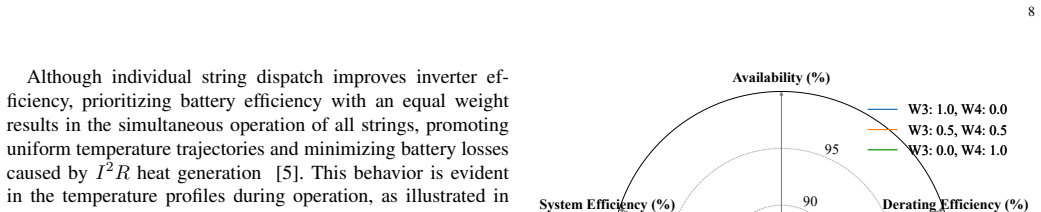
- [Abstract; §IV-A] The quantitative claims in the abstract and conclusion (1% battery efficiency, 1.5% inverter efficiency, 2% derating efficiency, and a 5 °C peak-temperature reduction) are not supported by a defined baseline or by reported numerical values. Section IV-A presents only a radar plot (Fig. 6) and a mean-temperature plot (Fig. 7); no table gives the KPI values from Eqs. (31)–(35) for scenarios S1–S3, and no comparator controller (e.g., equal-power split, rule-based dispatch, or one of S1/S3) is specified or simulated. Because S2 is a compromise between S1 and S3, it cannot improve over both on both inverter and battery efficiency simultaneously; the claimed deltas must be relative to an unspecified baseline. Please define the baseline explicitly, tabulate the KPI values for all scenarios, and report solver tolerances or other numerical uncertainties.
- [§II-D, Eqs. (8)–(14)] The availability-loss model is under-constrained. Equations (12)–(13) are one-sided upper bounds of the form p_avail,high ≤ M_avail·b_high + ε; when b_high = 1 the loss variable can still be zero without violating any constraint. The text states that the loss 'will be non-zero' when the binary is active, but no lower-bound constraint of the form p_avail ≥ m·b is present. As a result, the availability KPI in Eq. (31) may be identically 100% regardless of SOC saturation, and the lexicographic priority on availability is vacuous as written. Please add the missing lower bounds or revise the formulation and the KPI definition accordingly.
- [§II-E, §II-F, §II-G; Eqs. (15), (20), (21), (25), (30)] The parameterization that determines the claimed efficiencies is not disclosed. The lumped-thermal coefficients k1 and k2 in Eq. (15), the SOC- and temperature-dependent resistance LUT breakpoints and slopes in Eqs. (20)–(21), the derating LUT slopes and intercepts in Eq. (25), and the coefficients of the commercial-inverter loss LUT in Eq. (30) are all absent from the manuscript; the PI derating gains are selected by trial and error (Fig. 2). Because the claimed improvements are 1–2% efficiency and 5 °C in temperature, they are the same order as plausible parameter uncertainty, so the results cannot be reproduced or falsified from the manuscript. Please provide the parameter values and breakpoints (or a repository with the full data) and include a sensitivity analysis over them.
- [§II-B vs. §II-H; Eqs. (24), (26), (30), (31)–(35)] The KPIs are computed from the same loss variables that appear in the objective function: p_heat from Eq. (24) is minimized as battery loss and then used in Eq. (34), p_inv from Eq. (30) is minimized and used in Eq. (33), and p_derate,loss from Eq. (26) is minimized and used in Eq. (32). The Pareto rankings therefore partly encode the model's own loss definitions rather than an external measure of performance. To support the central claim, compute the KPIs from the independent high-fidelity electro-thermal simulator (or from measured power flows) and report the discrepancy, if any, with the optimizer-internal values.
minor comments (5)
- [Fig. 2] The figure shows three gain settings for the PI derating controller, but the text only states that the highlighted gains of Kp = 0.035 and Ki = 0.0035 were sufficient; please explain why the other settings were rejected and how the trial-and-error selection was evaluated.
- [Eq. (30)] The zero-power branch is written as '0, p^B,ch(/dch) = 0', which is unclear; furthermore, the charge and discharge branches appear to use the same index i with different segment bounds. Please rewrite the LUT definition cleanly with separate indices or explicit breakpoints.
- [References] References [12] and [14] have identical titles ('Evaluating the impact of model accuracy for optimizing battery energy storage systems'); please verify the citations and clarify whether they are companion papers or one is mis-cited.
- [§IV] The term 'Pareto analysis' is used for a sweep with only three weight combinations (S1–S3); a three-point sweep is not a Pareto frontier. Please either add more points along the weight sweep or temper the wording to 'weight-sweep analysis'.
- [Abstract; §VII] The abstract and title claim real-time operation and real-time simulation feedback, but no computation times, solver settings, hardware, or horizon length are reported, and Section VII lists computational benchmarking as future work. Please add runtime measurements or temper the real-time claim.
Circularity Check
Efficiency and temperature gains are read from the same loss terms the controller minimizes, and the thermal claim rests on the authors' own unvalidated simulation.
-
self definitional
[Section II-B Table II; Section II-H Eqs. (31)-(35)]
"The objective function accounts for losses arising from limited available capacity for charge/discharge, inverter switching, battery heat generation, and power derating required for safe operation. ... Inverter Efficiency (%) = 1 − Σ_t Σ_m pinv[m]_t / Σ_t Σ_m pB[m]_t ... Battery Efficiency (%) = 1 − Σ_t Σ_m pheat[m]_t / Σ_t Σ_m pB[m]_t ... Derating Efficiency (%) = 1 − Σ_t Σ_m pderate,loss[m]_t / Σ_t Σ_m pB[m]_t"
The KPIs are normalized sums of the very terms the MINLP minimizes (inverter loss pinv, heat pheat, derating loss pderate,loss). Scenario S1 with W3=1 minimizes inverter loss, so its highest inverter efficiency is a restatement of the objective weights, not an empirical prediction; S3 likewise maximizes battery efficiency by construction. The 1% battery / 1.5% inverter / 2% derating 'improvements' cited for balanced operation are differences of these objective-defined KPIs, so the qualitative ranking is forced by the weight sweep even though the magnitudes depend on the model.
-
fitted input called prediction
[Section II-F, Eqs. (25)-(26), Fig. 2]
"The controller gains Kp and Ki, as shown in Fig. 2, were tuned using a trial-and-error approach to ensure that the battery temperature remained within the safe operational limits under various load conditions. ... In the optimizer, this nonlinear derating factor (kderate_t) as shown in Fig. 2 is approximated as a piecewise linear LUT as defined in (25) and the derating loss is computed as per (26)."
The derating-efficiency KPI is computed from pderate_loss (Eq. 32), and pderate_loss = kderate_t · pB. The kderate_t LUT is itself an approximation of a PI-derating curve whose gains were hand-tuned by the authors. Thus the reported 2% derating-efficiency improvement is an outcome of the chosen tuning and the same optimization variable, not a measured or externally calibrated derating behavior.
1 more flagged steps
-
self citation load bearing
[Section II-A; Section II-E, Eq. (15), Fig. 1]
"To support thermal-aware control, a high-fidelity Electro-Thermal Simulation is integrated, comprising an Equivalent Circuit Model (ECM) and a Finite Difference Method (FDM) based 1D spatial thermal simulation that evaluates internal temperature distributions based on battery power and ambient air cooling [5]. ... After each horizon of optimization, the temperature estimations of the string are corrected using a high fidelity spatial thermal simulation as shown in Fig. 1 [5]."
The 5°C peak-temperature reduction is generated by this simulation, which is cited to the authors' own prior work [5]. The optimizer's lumped model (Eq. 15) uses coefficients k1 and k2 that are never reported, and the paper shows no measured validation of the spatial thermal model. The temperature claim therefore rests on an unverified self-citation chain rather than on an independent, machine-checked, or externally falsifiable benchmark.
full rationale
The paper's own KPI definitions use the exact loss variables that appear in the optimization objective (inverter loss, pheat, pderate_loss), so the scenario comparisons S1-S3 restate which weights were chosen rather than providing an external benchmark. The derating-efficiency improvement additionally depends on Kp/Ki gains that were hand-tuned. The temperature reduction is generated by an electro-thermal simulation cited only to the authors' prior work [5], with coefficients k1/k2 in Eq. (15) undisclosed and no measured validation in this manuscript. These are genuine circularity concerns: the claimed 1%/1.5%/2% and 5°C numbers are read from the same model that the controller optimizes. However, the MINLP-MPC architecture, the Pareto trade-off exploration, and the numerical magnitudes of the KPI differences are not literally equal to the objective by construction; S2's 'highest system efficiency' is a nontrivial model outcome. Hence partial circularity (score 6), not complete reduction.
Assumptions & free parameters
free parameters (8)
- PI derating gains Kp, Ki =
Kp=0.035, Ki=0.0035
- Lumped thermal model coefficients k1, k2 =
not reported
- Internal resistance LUT coefficients and breakpoints =
40 mOhm at SOC=0, 2.5 mOhm at SOC=0.1 and below 25C, 0.75 mOhm at 80C; slopes not reported
- Inverter loss LUT coefficients =
0.0193*pN charge, 0.0177*pN discharge at nominal power; slopes not reported
- Derating LUT slopes and intercepts x_i, y_i =
not reported
- SOC-OCV LUT for charge and discharge =
not reported, cited to [25], [26]
- Thermal sensitivity of BESS to power input =
0.012 degrees C per kW over 15 minutes
- Big-M constants and tolerances =
M_avail, M_inv, epsilon, epsilon_soc, epsilon_inv not reported
assumptions (8)
- standard math Lexicographic optimization with tolerance epsilon preserves the exact priority ordering
- domain assumption Lumped thermal model (15) adequately represents string mean temperature for control
- domain assumption Equivalent circuit model with LUT-based internal resistance and OCV accurately represents battery electrical behavior
- domain assumption Empirical inverter LUT from a commercial inverter system generalizes to both strings
- ad hoc to paper PI-based derating curve with trial-and-error gains represents true derating behavior
- domain assumption Static demand forecast is perfect over the horizon
- domain assumption 1D FDM electro-thermal simulation gives accurate real-time battery states for MPC feedback
- domain assumption Two homogeneous strings are representative of multi-string BESS behavior
Cite this review
Pith. "Pith review of Multi-Objective Nonlinear Power Split Control For BESS With Real-Time Simulation Feedback." pith.science (2026). https://pith.science/paper/3OJZ54KA
@misc{pith2026250704800,
  author       = {Pith},
  title        = {Pith review of: Multi-Objective Nonlinear Power Split Control For BESS With Real-Time Simulation Feedback},
  year         = {2026},
  howpublished = {\url{https://pith.science/paper/3OJZ54KA}},
  note         = {Machine review of arXiv:2507.04800}
}
read the original abstract
This paper presents a mixed-integer, nonlinear, multi-objective optimization strategy for optimal power allocation among parallel strings in Battery Energy Storage Systems (BESS). High-fidelity control is achieved by co-simulating the optimizer with a BESS electro-thermal simulation that models spatial thermal dynamics of the battery, providing real-time State of Charge (SOC) and temperature feedback. The optimizer prioritizes reliability by enforcing power availability as a hard constraint and penalizing battery thermal derating. Within these bounds, the controller performs a Pareto sweep on the relative weights of inverter and battery losses to balance the trade-off between inverter efficiency and battery efficiency. The inverter loss model is based on an empirical lookup table (LUT) derived from a commercial inverter system, while the battery thermal loss model uses SOC and temperature-dependent internal resistance, with electric current computed from the battery Equivalent Circuit Model (ECM). When the optimization was applied to a two-string BESS, the competing effects of inverter and battery losses on system availability and thermal derating were observed. The balanced operation yielded improvements of 1% in battery efficiency, 1.5% in inverter efficiency, and 2% in derating efficiency, while maintaining higher availability. Additionally, a 5 degrees C reduction in BESS peak temperature also suggests reduced thermal stress without compromising availability.
Figures


Figures from the paper (5 more)




Reference graph
Works this paper leans on
- [1]
-
[2]
Lithium-ion battery lifetime extension: A review of derating methods
Haijun Ruan, Jorge Varela Barreras, Timothy Engstrom, Yu Merla, Robert Millar, and Billy Wu. Lithium-ion battery lifetime extension: A review of derating methods. Journal of Power Sources , 563:232805, 2023
work page 2023
-
[3]
Marco Stecca, Thiago Batista Soeiro, Laura Ramirez Elizondo, Pavol Bauer, and Peter Palensky. Lifetime estimation of grid-connected battery storage and power electronics inverter providing primary frequency regulation. IEEE Open Journal of the Industrial Electronics Society , 2:240–251, 2021
work page 2021
-
[4]
Barreras, Billy Wu, and Gregory J
Michael Schimpe, Jorge V . Barreras, Billy Wu, and Gregory J. Of- fer. Battery degradation-aware current derating: An effective method to prolong lifetime and ease thermal management. Journal of The Electrochemical Society, 168(6):060506, jun 2021
work page 2021
-
[5]
Vivek Teja Tanjavooru, Melina Graner, Prashant Pant, Thomas Hamacher, and Holger Hesse. Optimal power split control for state of charge balancing in battery systems with integrated spatial thermal analysis and aging estimation. Energy Storage, 7(4), 2025
work page 2025
-
[6]
Critical review of optimal control methods for li–ion batteries in electric vehicles
Yeonsoo Kim. Critical review of optimal control methods for li–ion batteries in electric vehicles. ChemElectroChem, 11(3), 2024
work page 2024
-
[7]
Model predictive control for lithium-ion battery optimal charging
Changfu Zou, Chris Manzie, and Dragan Nesic. Model predictive control for lithium-ion battery optimal charging. IEEE/ASME Transactions on Mechatronics, 23(2):947–957, 2018
work page 2018
-
[8]
Aimin Du, Yaoyi Chen, Dongxu Zhang, and Yeyang Han. Multi- objective energy management strategy based on pso optimization for power-split hybrid electric vehicles. Energies, 14(9):2438, 2021
work page 2021
Show all 29 references
-
[9]
Multi- objective predictive balancing control of battery packs based on predic- tive current
Wenbiao Li, Longyun Kang, Xiangwei Guo, and Yuan Yao. Multi- objective predictive balancing control of battery packs based on predic- tive current. Energies, 9(4):298, 2016
2016
-
[10]
Assessing battery degradation as a key performance indicator for multi-objective optimization of multi-carrier energy systems
Lingkang Jin, Milad Kazemi, Gabriele Comodi, and Christina Papadim- itriou. Assessing battery degradation as a key performance indicator for multi-objective optimization of multi-carrier energy systems. Applied Energy, 361:122925, 2024
2024
-
[11]
Temperature effect and thermal impact in lithium-ion batteries: A review
Shuai Ma, Modi Jiang, Peng Tao, Chengyi Song, Jianbo Wu, Jun Wang, Tao Deng, and Wen Shang. Temperature effect and thermal impact in lithium-ion batteries: A review. Progress in Natural Science: Materials International, 28(6):653–666, 2018
2018
-
[12]
Evaluating the impact of model accuracy for optimiz- ing battery energy storage systems
Sheng Yin, Vivek Teja Tanjavooru, Thomas Hamacher, Christoph G¨obel, and Holger Hesse. Evaluating the impact of model accuracy for optimiz- ing battery energy storage systems. arXiv preprint arXiv:2507.00628 , 2025
2025 arXiv
-
[13]
Design and analysis of an aging–aware energy management system for islanded grids using mixed–integer quadratic programming
V olkan Kumtepeli, Yulong Zhao, Maik Naumann, Anshuman Tripathi, Youyi Wang, Andreas Jossen, and Holger Hesse. Design and analysis of an aging–aware energy management system for islanded grids using mixed–integer quadratic programming. International Journal of Energy Research,...
2019
-
[14]
Evaluating the impact of model accuracy for optimizing battery energy storage systems
Martin Cornejo, Melina Graner, Holger Hesse, and Andreas Jossen. Evaluating the impact of model accuracy for optimizing battery energy storage systems. arXiv preprint arXiv:2506.17059 , 2025
2025 arXiv
-
[15]
Hierarchical distributed coordinated control for battery energy storage systems participating in frequency regulation
Bingqing Yu, Qingquan Lv, Zhenzhen Zhang, and Haiying Dong. Hierarchical distributed coordinated control for battery energy storage systems participating in frequency regulation. Energies, 15(19):7283, 2022
2022
-
[16]
Mahamudul Hasan, Boris Berseneff, Tim Meulenbroeks, Igor Cantero, Sajib Chakraborty, Thomas Geury, and Omar Hegazy
Md. Mahamudul Hasan, Boris Berseneff, Tim Meulenbroeks, Igor Cantero, Sajib Chakraborty, Thomas Geury, and Omar Hegazy. A multi-objective co-design optimization framework for grid-connected hybrid battery energy storage systems: Optimal sizing and selection of technology. Ener...
2022
-
[17]
Optimal allocation of bess in distribution network based on improved equilibrium optimizer
Yang Li, Chengshan Wang, Hongzhan Li, and Zhipeng Wu. Optimal allocation of bess in distribution network based on improved equilibrium optimizer. Frontiers in Energy Research, 10:936592, 2022
2022
-
[18]
Multi- objective battery energy storage optimization for virtual power plant applications
Hui Song, Mingchen Gu, Chen Liu, Ali Moradi Amani, Mahdi Jalili, Lasantha Meegahapola, Xinghuo Yu, and George Dickeson. Multi- objective battery energy storage optimization for virtual power plant applications. Applied Energy, 352:121860, 2023
2023
-
[19]
Prashant Pant, Holger Hesse, Vivek Teja Tanjavooru, Martin Cornejo, Thomas Hamacher, and Vedran S. Peri ´c. Soc-temperature based power sharing algorithm for battery racks in grid ancillary services. In 2023 4th International Conference on High Voltage Engineering and Power Sy...
2023
-
[20]
A hierarchical and self-evolving digital twin (hse-dt) method for multi- faceted battery situation awareness realisation
Kai Zhao, Ying Liu, Yue Zhou, Wenlong Ming, and Jianzhong Wu. A hierarchical and self-evolving digital twin (hse-dt) method for multi- faceted battery situation awareness realisation. Machines, 13(3):175, 2025
2025
-
[21]
L. L.C. Gurobi Optimization. Gurobi optimizer reference manual: Multi- objective optimization, 2024,
2024
-
[22]
Lithium-ion battery state-of-charge estimation based on an improved coulomb-counting algorithm and uncertainty evaluation
Fazel Mohammadi. Lithium-ion battery state-of-charge estimation based on an improved coulomb-counting algorithm and uncertainty evaluation. Journal of Energy Storage , 48:104061, 2022
2022
-
[23]
Entropy measurement of a large format lithium ion battery and its application to calculate heat generation
Chil-Hoon Doh, Yoon-Cheol Ha, and Seung-wook Eom. Entropy measurement of a large format lithium ion battery and its application to calculate heat generation. Electrochimica Acta, 309:382–391, 2019
2019
-
[24]
Evaluation of lithium-ion battery equivalent circuit models for state of charge estimation by an experimental approach
Hongwen He, Rui Xiong, and Jinxin Fan. Evaluation of lithium-ion battery equivalent circuit models for state of charge estimation by an experimental approach. Energies, 4(4):582–598, 2011
2011
-
[25]
Improved ocv model of a li-ion nmc battery for online soc estimation using the extended kalman filter
Ines Baccouche, Sabeur Jemmali, Bilal Manai, Noshin Omar, and Najoua Amara. Improved ocv model of a li-ion nmc battery for online soc estimation using the extended kalman filter. Energies, 10(6):764, 2017
2017
-
[26]
Standard battery energy storage system profiles: Analysis of various applications for stationary energy storage systems using a holistic simulation framework
Daniel Kucevic, Benedikt Tepe, Stefan Englberger, Anupam Parlikar, Markus M ¨uhlbauer, Oliver Bohlen, Andreas Jossen, and Holger Hesse. Standard battery energy storage system profiles: Analysis of various applications for stationary energy storage systems using a holistic simu...
2020
-
[27]
Temperature-driven path dependence in li-ion battery cyclic aging
Max Feinauer, Margret Wohlfahrt-Mehrens, Markus H ¨olzle, and Thomas Waldmann. Temperature-driven path dependence in li-ion battery cyclic aging. Journal of Power Sources , 594:233948, 2024
2024
-
[28]
Jorge Varela Barreras, Trishna Raj, and David A. Howey. Derating strategies for lithium-ion batteries in electric vehicles. 44th Annual Conference of the IEEE Industrial Electronics Society , 2018
2018
-
[29]
Power flow distribution strategy for im- proved power electronics energy efficiency in battery storage systems: Development and implementation in a utility-scale system
Michael Schimpe, Christian Piesch, Holger Hesse, Julian Paß, Stefan Ritter, and Andreas Jossen. Power flow distribution strategy for im- proved power electronics energy efficiency in battery storage systems: Development and implementation in a utility-scale system. Energies, 1...
2018
Reviewed August 6, 2026 · model on record in the stance chip above.
Discussion (0). Continue with ORCID to comment.