Nodal Domains on Surfaces under Perturbation: Upper Semicontinuity, Courant-Sharpness, and Boundary Intersections
Pith reviewed 2026-05-19 06:44 UTC · model grok-4.3
The pith
The number of nodal domains of eigenfunctions on surfaces is upper semicontinuous under smooth perturbations of the metric and potential.
A machine-rendered reading of the paper's core claim, the machinery that carries it, and where it could break.
Core claim
Along any convergent eigenbranch of the perturbed operators, the number of nodal domains of the eigenfunctions is upper semicontinuous. In the noncritical case the count is stable. Near each nodal critical point of the limit eigenfunction, the local sector or graph count prevents both an increase in vanishing order and the creation of new local nodal domains. At the wavelength scale no new closed nodal loops can form. The result holds branch-free on spectral clusters and extends to localised perturbations that change topology outside a fixed core.
What carries the argument
Local sector and graph counts near nodal critical points, which bound the change in vanishing order and block creation of new domains under perturbation.
If this is right
- Metrics exist on any closed surface that are Courant-sharp up to any prescribed finite eigenvalue level.
- Boundary intersections can be prescribed as exactly 2n_i points on each boundary component.
- The inner radius of nodal domains admits a uniform positive lower bound along the branch at the wavelength scale.
- The nodal-domain count inside any fixed unperturbed core cannot increase under localised topology-changing perturbations.
Where Pith is reading between the lines
- The stability result suggests that numerical approximations of eigenfunctions on surfaces remain reliable when the geometry is slightly deformed.
- The wavelength-scale prohibition on new loops may extend to control the length of nodal sets in the high-frequency limit.
- The construction of Courant-sharp metrics to arbitrary order indicates that the Courant bound is achievable for finite initial segments of the spectrum on any surface.
Load-bearing premise
Perturbations of the metric and potential are smooth and the eigenbranches converge so that local sector counts can control vanishing orders.
What would settle it
An explicit smooth family of metrics and potentials together with a convergent eigenbranch on which the nodal-domain count strictly increases would falsify the upper-semicontinuity claim.
Figures


read the original abstract
We study how the number of nodal domains of eigenfunctions of Schr\"odinger operators $-\Delta_{g_t}+V_t$ on closed surfaces changes under smooth perturbations of $(g_t,V_t)$ along convergent eigenbranches. Locally, near each nodal critical point of the limit eigenfunction, we give a sector/graph count showing that no new local domains can be created and that vanishing orders cannot increase. Globally, we prove upper semicontinuity of the nodal domain count; in the noncritical case the count is stable. The result is branch-free on spectral clusters. At the wavelength scale, new closed nodal loops cannot be created. We also treat localised (topology-changing) perturbations: the count inside the unperturbed core cannot increase. As applications, we construct metrics on any closed surface that are Courant-sharp up to an arbitrary finite level and prescribe $2n_i$ boundary intersections on each boundary component. An appendix records a uniform (wavelength-scale) lower bound on the inner radius of nodal domains along the branch.
Editorial analysis
A structured set of objections, weighed in public.
Referee Report
Summary. The manuscript studies the variation of the number of nodal domains for eigenfunctions of Schrödinger operators on closed surfaces under smooth perturbations of the metric and potential. It provides local counts near nodal critical points using sector and graph arguments to show that no new local domains are created and vanishing orders do not increase. Globally, it establishes upper semicontinuity of the nodal domain count, with stability in the non-critical case. The results hold branch-free on spectral clusters, and new closed nodal loops cannot form at the wavelength scale. The paper also addresses localized perturbations where the count in the unperturbed core cannot increase. Applications include constructing Courant-sharp metrics on any closed surface up to arbitrary finite levels and prescribing an even number of boundary intersections on each component. An appendix provides a uniform lower bound on the inner radius of nodal domains along the eigenbranch.
Significance. If the central claims hold, this work advances the understanding of nodal domain stability under perturbations in spectral geometry. The upper semicontinuity result, combined with the local analysis preventing new domains and the wavelength-scale arguments ruling out new loops, provides a solid foundation for applications in constructing special metrics and boundary conditions. The branch-free approach on spectral clusters and the treatment of topology-changing localized perturbations are notable strengths. The uniform inner-radius bound is a useful technical contribution that supports the global arguments.
major comments (2)
- The local sector/graph count near each nodal critical point (used to control vanishing orders and prevent new local domains) is load-bearing for both the upper semicontinuity and the stability claims in the noncritical case; the argument should explicitly verify that the perturbation does not increase the vanishing order beyond what the sector decomposition allows.
- Appendix: the uniform (wavelength-scale) lower bound on the inner radius is invoked to rule out creation of new closed nodal loops; the proof must confirm that this bound remains positive and uniform along the convergent eigenbranch for the family of perturbed operators.
minor comments (2)
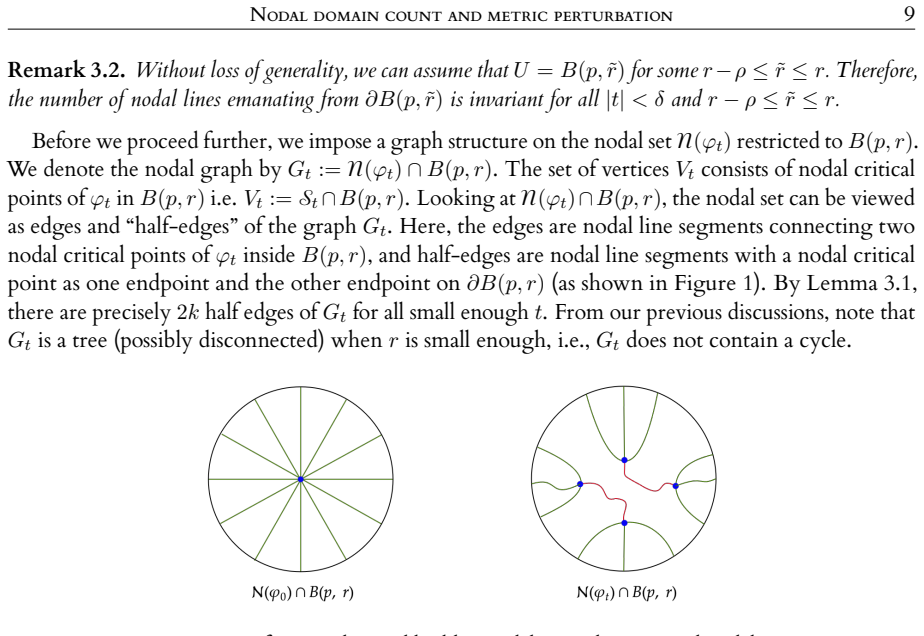
- The introduction would benefit from a brief diagram or schematic illustrating the sector decomposition near a nodal critical point to clarify the local counting argument.
- Notation for eigenbranches and the distinction between critical and noncritical cases should be made fully consistent between the abstract, introduction, and main theorems.
Simulated Author's Rebuttal
We thank the referee for the careful reading and positive assessment of the manuscript. We address the two major comments below and have made the suggested clarifications in the revised version.
read point-by-point responses
-
Referee: The local sector/graph count near each nodal critical point (used to control vanishing orders and prevent new local domains) is load-bearing for both the upper semicontinuity and the stability claims in the noncritical case; the argument should explicitly verify that the perturbation does not increase the vanishing order beyond what the sector decomposition allows.
Authors: We agree that an explicit verification improves clarity. The local analysis in Section 3 already establishes that vanishing orders cannot increase by comparing the sector decompositions of the limit eigenfunction and its perturbations via local graph representations. In the revision we have added a short paragraph immediately after the sector-count argument that invokes the C^2 convergence of eigenfunctions along the branch to show directly that the multiplicity of any zero cannot rise; consequently the number of sectors (and thus local domains) is preserved or reduced. This makes the load-bearing step fully explicit without altering the existing proofs. revision: yes
-
Referee: Appendix: the uniform (wavelength-scale) lower bound on the inner radius is invoked to rule out creation of new closed nodal loops; the proof must confirm that this bound remains positive and uniform along the convergent eigenbranch for the family of perturbed operators.
Authors: The appendix proof derives the lower bound from wavelength-scale estimates that depend only on the C^infty convergence of the metric and potential along the eigenbranch. To address the referee's request explicitly, we have inserted a concluding remark in the appendix stating that the constants appearing in the inner-radius estimate are controlled uniformly by the branch convergence, ensuring the bound stays positive and independent of the particular perturbation within any sufficiently small neighborhood of the limit operator. revision: yes
Circularity Check
No significant circularity; derivation self-contained via perturbation analysis
full rationale
The paper derives upper semicontinuity of nodal domain counts from local sector/graph counts near critical points (controlling vanishing orders and preventing new domains), wavelength-scale arguments ruling out new closed loops, branch-free treatment on spectral clusters, and a uniform inner-radius lower bound in the appendix. These rely on standard analytic and topological properties of eigenfunctions under smooth perturbations of (g_t, V_t), without reducing any central claim to a fitted input, self-definition, or load-bearing self-citation chain. The argument structure is internally consistent and externally grounded in classical nodal set theory, qualifying as self-contained.
Axiom & Free-Parameter Ledger
axioms (1)
- standard math The Schrödinger operator on a closed Riemannian surface has discrete spectrum with eigenfunctions that are smooth away from nodal sets.
Forward citations
Cited by 1 Pith paper
-
Urschel Nodal Domains via Perturbation Theory
The authors establish new bounds on the Urschel number for graph Laplacian eigenvectors, including controls for multiple eigenvalues and classifications of zero vertices as shallow or deep.
Reference graph
Works this paper leans on
-
[1]
Ahlfors, Lectures on quasiconformal mappings, Van Nostrand Mathematical Studies, vol
Lars V. Ahlfors, Lectures on quasiconformal mappings, Van Nostrand Mathematical Studies, vol. No. 10, D. Van Nostrand Co., Inc., Toronto, Ont.-New York-London, 1966, Manuscript prepared with the assistance of Clifford J. Earle, Jr. 200442
work page 1966
-
[2]
, Conformal invariants, AMS Chelsea Publishing, Providence, RI, 2010, Topics in geometric function theory, Reprint of the 1973 original, With a foreword by Peter Duren, F. W. Gehring and Brad Osgood. 2730573
work page 2010
-
[3]
Albert, Generic properties of eigenfunctions of elliptic partial differential operators, Trans
Jeffrey H. Albert, Generic properties of eigenfunctions of elliptic partial differential operators, Trans. Amer. Math. Soc. 238 (1978), 341--354. 471000
work page 1978
-
[4]
Christian B\"ar, On nodal sets for D irac and L aplace operators , Comm. Math. Phys. 188 (1997), no. 3, 709--721. 1473317
work page 1997
- [5]
-
[6]
Henri Poincar\'e 25 (2024), no
Thomas Beck, Marichi Gupta, and Jeremy Marzuola, Nodal set openings on perturbed rectangular domains, Ann. Henri Poincar\'e 25 (2024), no. 11, 4889--4929. 4809363
work page 2024
-
[7]
Pierre B\'erard and Bernard Helffer , Nodal sets of eigenfunctions, Antonie Stern's results revisited , Actes de S\'eminaire de Th\'eorie Spectrale et G\'eom\'etrie. Ann\'ee 2014--2015, St. Martin d'H\`eres: Universit\'e de Grenoble I, Institut Fourier, 2015, pp. 1--37
work page 2014
-
[8]
Pierre B\'erard and Bernard Helffer, Courant-sharp eigenvalues for the equilateral torus, and for the equilateral triangle, Lett. Math. Phys. 106 (2016), no. 12, 1729--1789. 3569644
work page 2016
-
[9]
Pierre B\'erard, Bernard Helffer, and Rola Kiwan, Courant-sharp property for D irichlet eigenfunctions on the M \"obius strip , Port. Math. 78 (2021), no. 1, 1--41. 4269391
work page 2021
-
[10]
, Courant-sharp eigenvalues of compact flat surfaces: K lein bottles and cylinders , Proc. Amer. Math. Soc. 150 (2022), no. 1, 439--453. 4335889
work page 2022
-
[11]
Pierre B\'erard and Daniel Meyer, In\'egalit\'es isop\'erim\'etriques et applications, Ann. Sci. \'Ecole Norm. Sup. (4) 15 (1982), no. 3, 513--541. 690651
work page 1982
- [12]
-
[13]
1987, Springer-Verlag, Berlin, 2009
Jean-Paul Brasselet, Jos\'e Seade, and Tatsuo Suwa, Vector fields on singular varieties, Lecture Notes in Mathematics, vol. 1987, Springer-Verlag, Berlin, 2009
work page 1987
-
[14]
Shiu Yuen Cheng, Eigenfunctions and nodal sets, Comment. Math. Helv. 51 (1976), no. 1, 43--55. 397805
work page 1976
-
[15]
Philippe Charron and Dan Mangoubi, The inner radius of nodal domains in high dimensions, Adv. Math. 452 (2024), Paper No. 109787, 17. 4766721
work page 2024
-
[16]
R. Courant, Ein allgemeiner satzt zur theorie der eigenfunktionen selbsadjungierter differentialausdrücke, Nachrichten von der Gesellschaft der Wissenschaften zu Göttingen, Mathematisch-Physikalische Klasse 1923 (1923), 81--84
work page 1923
-
[17]
Alberto Enciso and Daniel Peralta-Salas, Eigenfunctions with prescribed nodal sets, J. Differential Geom. 101 (2015), no. 2, 197--211. 3399096
work page 2015
-
[18]
Pedro Freitas, Closed nodal lines and interior hot spots of the second eigenfunction of the L aplacian on surfaces , Indiana Univ. Math. J. 51 (2002), no. 2, 305--316. 1909291
work page 2002
-
[19]
Bogdan Georgiev and Mayukh Mukherjee, Nodal geometry, heat diffusion and B rownian motion , Anal. PDE 11 (2018), no. 1, 133--148. 3707293
work page 2018
-
[20]
Amit Ghosh, Andre Reznikov, and Peter Sarnak, Nodal domains of M aass forms I , Geom. Funct. Anal. 23 (2013), no. 5, 1515--1568. 3102912
work page 2013
-
[21]
T. Hoffmann-Ostenhof, P. W. Michor, and N. Nadirashvili, Bounds on the multiplicity of eigenvalues for fixed membranes, Geom. Funct. Anal. 9 (1999), no. 6, 1169--1188. 1736932
work page 1999
-
[22]
Antoine Henrot and Michel Pierre, Shape variation and optimization, EMS Tracts in Mathematics, vol. 28, European Mathematical Society (EMS), Z\"urich, 2018, A geometrical analysis, English version of the French publication [MR2512810] with additions and updates
work page 2018
-
[23]
Robert Hardt and Leon Simon, Nodal sets for solutions of elliptic equations, J. Differential Geom. 30 (1989), no. 2, 505--522. 1010169
work page 1989
- [24]
-
[25]
Norbert Hungerb\"uhler and Micha Wasem, An integral that counts the zeros of a function, Open Math. 16 (2018), no. 1, 1621--1633. 3909796
work page 2018
-
[26]
Seung uk Jang and Junehyuk Jung, Quantum unique ergodicity and the number of nodal domains of eigenfunctions, J. Amer. Math. Soc. 31 (2018), no. 2, 303--318. 3758146
work page 2018
-
[27]
J\"urgen Jost, Compact R iemann surfaces , second ed., Springer-Verlag, Berlin, 2002, An introduction to contemporary mathematics. 1909701
work page 2002
-
[28]
Junehyuk Jung and Steve Zelditch, Number of nodal domains and singular points of eigenfunctions of negatively curved surfaces with an isometric involution, J. Differential Geom. 102 (2016), no. 1, 37--66. 3447086
work page 2016
-
[29]
Andreas Kriegl, Peter W. Michor, and Armin Rainer, Denjoy- C arleman differentiable perturbation of polynomials and unbounded operators , Integral Equations Operator Theory 71 (2011), no. 3, 407--416. 2852194
work page 2011
-
[30]
Komendarczyk, On the contact geometry of nodal sets, Trans
R. Komendarczyk, On the contact geometry of nodal sets, Trans. Amer. Math. Soc. 358 (2006), no. 6, 2399--2413. 2204037
work page 2006
-
[31]
Bakri Laurent, Critical sets of eigenfunctions of the L aplacian , J. Geom. Phys. 62 (2012), no. 10, 2024--2037. 2944790
work page 2012
-
[32]
Partial Differential Equations 2 (1977), no
Hans Lewy, On the minimum number of domains in which the nodal lines of spherical harmonics divide the sphere, Comm. Partial Differential Equations 2 (1977), no. 12, 1233--1244. 477199
work page 1977
-
[33]
Andrew Lyons, Nodal sets of L aplacian eigenfunctions with an eigenvalue of multiplicity 2 , Ann. Math. Qu\'e. 49 (2025), no. 1, 105--153. 4894860
work page 2025
-
[34]
Dan Mangoubi, On the inner radius of a nodal domain, Canad. Math. Bull. 51 (2008), no. 2, 249--260. 2414212
work page 2008
-
[35]
Akira Mori, On quasi-conformality and pseudo-analyticity, Trans. Amer. Math. Soc. 84 (1957), 56--77. 83024
work page 1957
- [36]
- [37]
-
[38]
Mayukh Mukherjee and Soumyajit Saha, Nodal sets of L aplace eigenfunctions under small perturbations , Math. Ann. 383 (2022), no. 1-2, 475--491. 4444128
work page 2022
-
[39]
Nadirashvili, Metric properties of eigenfunctions of the L aplace operator on manifolds , Ann
Nikolai S. Nadirashvili, Metric properties of eigenfunctions of the L aplace operator on manifolds , Ann. Inst. Fourier (Grenoble) 41 (1991), no. 1, 259--265. 1112199
work page 1991
-
[40]
F\"edor Nazarov, Leonid Polterovich, and Mikhail Sodin, Sign and area in nodal geometry of L aplace eigenfunctions , Amer. J. Math. 127 (2005), no. 4, 879--910. 2154374
work page 2005
-
[41]
Jaak Peetre, A generalization of C ourant's nodal domain theorem , Math. Scand. 5 (1957), 15--20. 92917
work page 1957
- [42]
-
[43]
Iosif Polterovich, Pleijel's nodal domain theorem for free membranes, Proc. Amer. Math. Soc. 137 (2009), no. 3, 1021--1024. 2457442
work page 2009
-
[44]
uber asymptotisches Verhalten von Eigenwerten und Eigenfunktionen. Math.- naturwiss. Diss. , G\
Antonie Stern , Bemerkungen \"uber asymptotisches Verhalten von Eigenwerten und Eigenfunktionen. Math.- naturwiss. Diss. , G\"ottingen, 30 S. , 1925
work page 1925
-
[45]
Junya Takahashi, Collapsing of connected sums and the eigenvalues of the L aplacian , J. Geom. Phys. 40 (2002), no. 3-4, 201--208. 1866987
work page 2002
-
[46]
Uhlenbeck, Generic properties of eigenfunctions, Amer
K. Uhlenbeck, Generic properties of eigenfunctions, Amer. J. Math. 98 (1976), no. 4, 1059--1078. 464332
work page 1976
discussion (0)
Sign in with ORCID, Apple, or X to comment. Anyone can read and Pith papers without signing in.