REVIEW 2 major objections 5 minor 72 references
The EoR 21-cm Bispectrum at $z=8.2$ from MWA data I: Foregrounds and preliminary upper limits
T0 review · 2 major / 5 minor · reviewed 2026-08-06 · deepseek-v4-flash
Pith's one-line read The 21-cm bispectrum from Epoch of Reionization data exhibits a foreground wedge analogous to the power-spectrum wedge, and the best 2σ upper limits are about (1.8×10³)³ mK³.
desk verdict First useful wedge characterisation for the 21-cm bispectrum, but the quoted upper limits are not actually justified because the foreground bispectrum can change sign and cancel the signal. read the letter →
The pith
A machine-rendered reading of the paper's core claim, the machinery that carries it, and where it could break.
The reading
What carries the argument
The central object is the cylindrical bispectrum $B(k_{1\perp}, k_{2\perp}, k_{3\perp}, k_{1\parallel}, k_{2\parallel})$, obtained by a two-dimensional Fourier transform of the multi-frequency angular bispectrum $B_A(\ell_1, \ell_2, \ell_3, \Delta\nu_1, \Delta\nu_2)$ derived from the three-visibility correlation. The foreground wedge is defined by three horizon conditions $|k_{a\parallel}| \le [r/(r' \Delta\nu_c)] k_{a\perp}$ for $a = 1,2,3$, which partition the $(k_{1\parallel}, k_{2\parallel})$ plane into regions A0, A1, A2, and A3 depending on how many triangle sides avoid the wedge; A3 is the EoR window. The estimator is a binned version that counts triangles $(k_1,k_2,k_3)$ and weights by $N_{\rm tri}$, and the paper restricts analysis to the spherical bispectrum monopole expressed as $\Delta^3(k_1, \mu, t) = (2\pi^2)^{-2} k_1^6 \bar{B}(k_1, \mu, t)$.
What would settle it
Inject a synthetic EoR 21-cm bispectrum of known amplitude (e.g., ~$10^3$ mK$^3$) into the flagged visibility data alongside the real foregrounds and rerun the full pipeline; if the recovered $\Delta^3$ does not track the injected signal in the A3 region, the upper-limit interpretation is falsified. Alternatively, measure the foreground-only bispectrum from a smooth-spectrum sky model with the same flagging pattern and check its sign: a negative foreground bispectrum comparable in amplitude to the measured $\Delta^3$ would invalidate the limits.
Extended reading notes
Core claim
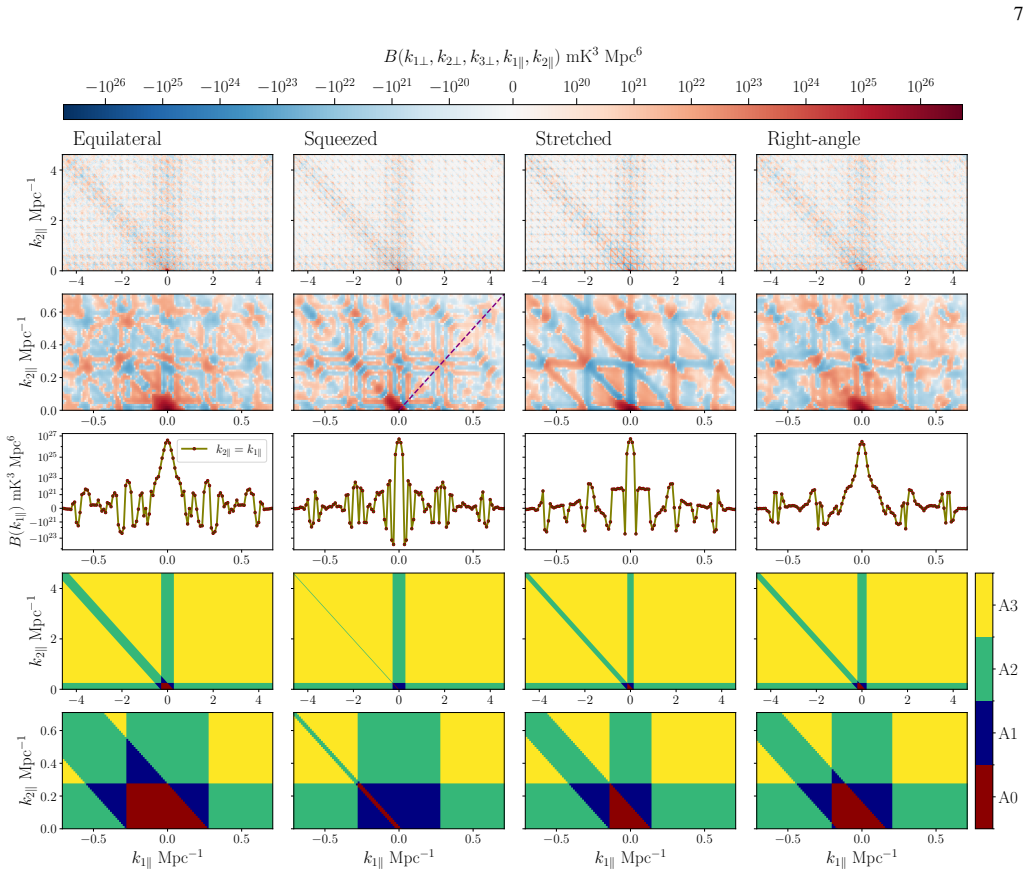
Using the three-visibility correlation, the authors estimate the multi-frequency angular bispectrum (MABS) and, after a two-dimensional Fourier transform, the cylindrical bispectrum $B(k_{1\perp}, k_{2\perp}, k_{3\perp}, k_{1\parallel}, k_{2\parallel})$ for all triangle configurations supported by the data. They find that the cylindrical bispectrum shows three bands of foreground contamination aligned with $k_{1\parallel} = 0$, $k_{2\parallel} = 0$, and $k_{3\parallel} = 0$, which they identify as the footprint of a foreground wedge: each side of the triangle satisfies $|k_{a\parallel}| \le [r/(r' \Delta\nu_c)] k_{a\perp}$, with a boundary value 3.51 for this data. Partitioning the $(k_{1\parallel}, k_{2\parallel})$ plane into regions A0–A3 by how many sides avoid the wedge, they identify A3, containing 83.6% of the $1.66\times 10^{12}$ triangles, as the EoR window. They further show that the periodic flagging of one channel per 1.28 MHz produces a periodic spike pattern at $\delta k_{\parallel} = 0.29$ Mpc$^{-1}$ that leaks into the EoR window, and that this leakage persists after foreground avoidance. The measured values of the spherical bispectrum, expressed as mean-cube brightness temperature fluctuations $\Delta^3$, are foreground-dominated in all triangle bins, and the tightest 2σ upper limits are $(1.81\times 10^3)^3$ mK$^3$ at $k_1 = 0.008$ Mpc$^{-1}$ (equilateral) and $(2.04\times 10^3)^3$ mK$^3$ at $k_1 = 0.012$ Mpc$^{-1}$ (squeezed).
Load-bearing premise
The foreground-dominated measured values of $\Delta^3$ are treated as 2σ upper limits on the EoR 21-cm bispectrum, which assumes the foreground bispectrum does not partially cancel the EoR signal; if the foregrounds and the signal had comparable amplitudes with opposite signs, the quoted limits would not bound the true signal.
Editorial extensions
If this is right
- The cylindrical 21-cm bispectrum has a foreground wedge whose boundary on each side of the triangle is set by the horizon condition $|k_{a\parallel}| = [r/(r'\Delta\nu_c)] k_{a\perp}$, and the A3 region where all three sides avoid the wedge contains 83.6% of the available triangles.
- A periodic pattern of missing frequency channels (period 1.28 MHz) produces spikes at $\delta k_{\parallel} = 0.29$ Mpc$^{-1}$ that leak into the EoR window, so flagging patterns must be modeled in any bispectrum analysis.
- The best 2σ upper limits are $\Delta^3_{\rm UL} = (1.81\times 10^3)^3$ mK$^3$ at $k_1 = 0.008$ Mpc$^{-1}$ (equilateral) and $(2.04\times 10^3)^3$ mK$^3$ at $k_1 = 0.012$ Mpc$^{-1}$ (squeezed); these are foreground-dominated and 13–15 orders of magnitude above the predicted signal.
- Restricting to the A3 region reduces foreground contamination by a factor of about 620 at $k_1 \approx 0.3$ Mpc$^{-1}$ for squeezed triangles, but does not remove the leakage at larger $k_1$.
Reading between the lines
- The half-period (0.145 Mpc$^{-1}$) spike spacing seen for one squeezed configuration suggests that different $k_{\parallel}$ combinations alias the same missing-frequency pattern differently, so flagging mitigation may need to be triangle-shape-specific.
- The same wedge-and-spike structure should appear in any EoR bispectrum analysis with periodic channel flagging, including future HERA or SKA-LOW observations, implying that flagging-aware estimators will be necessary for a detection.
- Subtracting a smooth foreground model before the bispectrum estimate, as the paper suggests for future work, could push the limits down by the two to three orders of magnitude that foreground avoidance alone achieves only at the smallest $k_1$.
- A natural next step would be to combine the multiple drift-scan pointings already available in the MWA G0031 project, increasing integration time and possibly turning the current upper limits into a measurement.
Editorial analysis
A structured set of objections, weighed in public.
Referee Report
Summary. The paper analyzes 17 minutes of MWA Phase II drift-scan data at 154.2 MHz to estimate the z=8.2 21-cm bispectrum using a visibility-based estimator developed in companion papers. It defines a cylindrical bispectrum B(k1⊥,k2⊥,k3⊥,k1∥,k2∥), shows that foregrounds produce a wedge analogous to the power-spectrum wedge, and partitions the (k1∥,k2∥) plane into regions A0-A3 according to how many triangle sides avoid the wedge. It identifies the A3 region as a candidate EoR window, but shows that periodic missing frequency channels introduce a periodic pattern of spikes that leaks into this window. The paper then computes the spherically averaged mean cube brightness temperature fluctuation Δ3(k1,μ,t) and quotes 2σ upper limits of Δ3_UL=(1.81×10^3)^3 mK^3 at k1=0.008 Mpc^-1 (equilateral) and (2.04×10^3)^3 mK^3 at k1=0.012 Mpc^-1 (squeezed), noting that these are foreground-dominated and far above predicted EoR values.
Significance. If the wedge characterization holds, the paper provides a useful methodological advance: it is one of the first attempts to map a foreground wedge in the cylindrical 21-cm bispectrum and to quantify the contamination from periodic flagging. The estimator is validated in prior companion papers on simulated data with matching baseline distribution, bandwidth, and flagging, and the thermal noise is estimated from 50 dedicated noise-only simulations. The identification of the periodic spike pattern with the 1.28 MHz flagging period is concrete and falsifiable. However, the headline upper limits are preliminary and not competitive with predicted signal levels; the main value of the paper is the foreground-wedge morphology and the demonstration that the A3 region is not clean due to flagging-induced leakage.
major comments (2)
- [Section 4, Table 2, Eq. (10)] The interpretation of the measured foreground-dominated Δ3 values as 2σ upper limits on the EoR 21-cm bispectrum is not justified. The cylindrical bispectrum is not sign-definite, as shown by the positive and negative values in the third row of Figure 4, and the spherical monopole in Eq. (10) averages over all triangle orientations. Positive and negative foreground contributions can therefore partially cancel in the spherical averaging, so the binned Δ3 values in Table 2 can be much smaller than the typical foreground bispectrum amplitude in those bins. The paper does not model the sign of the foreground bispectrum or demonstrate that cancellation is negligible for the bins used in Table 2. The problem is compounded by the statement in Section 4 that the EoR Δ3 is predicted to be negative at small k1, whereas the quoted upper limits are positive measured values. As presented, the measured Δ3 does not bound the EoR signal, and the abstract's headline upper limits rest on an unsupported assumption.
- [Section 4, Table 2] The quantity labeled '2σ upper limit Δ3_UL' is set equal to the measured Δ3 rather than to the measured value plus 2σ (or to |Δ3| plus 2σ). Since the same table lists nonzero 1σ values, this is formally incorrect; the equality is numerically reasonable only because the 1σ values are much smaller than the measured values. In addition, for negative entries in Table 3 the quoted Δ3_UL is the absolute value of the measured Δ3 without any stated recipe, and the sign information is discarded. Because the predicted EoR bispectrum at small k1 is negative, the direction of the limit matters, and the paper should define explicitly whether the limits apply to Δ3 or to |Δ3| and how the 2σ noise contribution is included.
minor comments (5)
- [Section 4, paragraph after Figure 7] The claim that the predicted EoR signal is 13–15 orders of magnitude smaller than the upper limits is inconsistent with the numbers in Table 3; for the same k1 range, the ratio is about 11–12 orders at k1=0.38 Mpc^-1 and about 6–7 orders at the smallest k1. Please recalculate the comparison.
- [Section 5, summary paragraph] There is a typo in the sentence 'the values of B(k1⊥,k2⊥,k3⊥,k1∥,k2∥), shown in Figure 4, peak around k1∥=k1∥=0'; this should read k1∥=k2∥=0.
- [Table 3 caption] The table should state explicitly that Δ3_UL is defined as |Δ3| (or as |Δ3| plus the appropriate multiple of the noise), since the table lists positive upper limits for rows where Δ3 is negative.
- [Section 3.2 and References] The estimator is referred to as 'Paper II' with the citation 'Gill & Bharadwaj 2025', but the reference list does not provide a full bibliographic entry; please supply a complete reference or indicate the manuscript status.
- [Figure 5] The top panels mix two different physical quantities (|B| in units of mK^3 Mpc^6 and |P| in units of mK^2 Mpc^3) with different color scales; a short sentence in the caption clarifying how the color scales are chosen for each panel would improve readability.
Circularity Check
No circularity: the cylindrical-BS wedge, EoR window, and upper limits are derived from the data and instrument geometry, with the estimator validated externally in the authors' prior simulation work.
full rationale
The paper's central results are not equivalent to their inputs by construction. The binned MABS estimator is taken from Paper II, but Paper II validates it against simulated visibilities whose baseline coverage, bandwidth, and flagging exactly match the present observation, so the real-data measurement is an independent application rather than a fitted quantity. The foreground wedge boundary in Eq. (3) is derived from the known baseline-migration relation using the instrument parameters r, r', and Δν_c, not fit to the measured bispectrum; the A0-A3 classification is then a descriptive partition of the measured cylindrical BS, and the periodic-spike interpretation is checked against the known 1.28 MHz flagging period. The spherical BS and Δ3 are computed directly from the measured cylindrical BS via Eqs. (10)-(12), and the Table 2 upper limits are simply the foreground-dominated measured Δ3 values because the noise-only 1σ values are several orders of magnitude smaller; no fitted parameter is renamed as a prediction. The comparison with the Gill et al. (2024) predicted EoR signal is contextual and does not enter the derivation of the measurement. The remaining self-citations are methodological and supported by external simulation validation, not load-bearing circular justifications. The skeptical concern about possible cancellation between positive and negative foreground bispectrum contributions is a scientific limitation of the upper-limit interpretation, not a circularity in the derivation chain.
Assumptions & free parameters
assumptions (6)
- domain assumption Visibility noise is uncorrelated Gaussian with σ = 20 Jy across baselines, frequencies, and times.
- domain assumption The 21-cm signal is ergodic along the line of sight, so the MABS depends only on frequency separations Δν1, Δν2.
- domain assumption The MWA primary beam is a Gaussian with FWHM 24.68°, with θ0 = 0.6 θ_FWHM.
- domain assumption Foreground contamination for each side of the triangle follows the horizon wedge boundary [k∥]_H = (r/(r'Δν_c)) k⊥.
- domain assumption Planck 2020 cosmological parameters are adopted for distance conversions.
- ad hoc to paper Foreground-dominated measured Δ³ values can be interpreted as upper limits on the EoR 21-cm bispectrum.
Cite this review
Pith. "Pith review of The EoR 21-cm Bispectrum at $z=8.2$ from MWA data I: Foregrounds and preliminary upper limits." pith.science (2026). https://pith.science/paper/3RBK67L5
@misc{pith2026250704964,
  author       = {Pith},
  title        = {Pith review of: The EoR 21-cm Bispectrum at $z=8.2$ from MWA data I: Foregrounds and preliminary upper limits},
  year         = {2026},
  howpublished = {\url{https://pith.science/paper/3RBK67L5}},
  note         = {Machine review of arXiv:2507.04964}
}
abstract
We attempt to measure the $z = 8.2$ Epoch of Reionization (EoR) 21-cm bispectrum (BS) using Murchison Widefield Array (MWA) $154.2~\mathrm{MHz}$ data. We find that $B(k_{1\perp}, k_{2\perp}, k_{3\perp}, k_{1\parallel}, k_{2\parallel})$ the 3D cylindrical BS exhibits a foreground wedge, similar to $P(k_{1\perp},k_{1\parallel})$ the 21-cm cylindrical power spectrum. However, the BS foreground wedge, which depends on $(k_{1\perp},k_{1\parallel})$, $(k_{2\perp},k_{2\parallel})$ and $(k_{3\perp},k_{3\parallel})$ the three sides of a triangle, is more complicated. Considering various foreground avoidance scenarios, we identify the region where all three sides are outside the foreground wedge as the EoR window for the 21-cm BS. However, the EoR window is contaminated by a periodic pattern of spikes that arises from the periodic pattern of missing frequency channels in the data. We evaluate the binned 3D spherical BS for triangles of all possible sizes and shapes, and present results for $\Delta^3$ the mean cube brightness temperature fluctuations. The best $2\sigma$ upper limits we obtain for the EoR 21-cm signal are $\Delta^3_{\rm UL} = (1.81\times 10^3)^3~\mathrm{mK}^3$ at $k_1 = 0.008~\mathrm{Mpc}^{-1}$ and $\Delta^3_{\rm UL} = (2.04\times 10^3)^3~\mathrm{mK}^3$ at $k_1 = 0.012~\mathrm{Mpc}^{-1}$ for equilateral and squeezed triangles, respectively. These are foreground-dominated, and are many orders of magnitude larger than the predicted EoR 21-cm signal $(\sim 10^3 ~\mathrm{mK}^3)$.
Figures


Figures from the paper (4 more)


Reference graph
Works this paper leans on
-
[1]
, " * write output.state after.block = add.period write newline
ENTRY address archivePrefix author booktitle chapter doi edition editor eprint howpublished institution journal key month number organization pages publisher school series title misctitle type volume year version url label extra.label sort.label short.list INTEGERS output.state before.all mid.sentence after.sentence after.block FUNCTION init.state.consts ...
-
[2]
write newline
" write newline "" before.all 'output.state := FUNCTION format.url url empty "" new.block "" url * "" * if FUNCTION format.eprint eprint empty "" archivePrefix empty "" archivePrefix "arXiv" = new.block " " eprint * " " * new.block " " eprint * " " * if if if FUNCTION format.doi doi empty "" " " doi * " " * if FUNCTION format.pid doi empty eprint empty ur...
-
[3]
4Pji? sGJ8usҞ a T=ӧ w Q j߱ u ][=V ĘoW ^⽅s)6؞i9 brQ 3 C v lm wW gBޤ] 6rkur 5 [߾? -D( & z
thebibliography [1] 20pt to REFERENCES 6pt =0pt -12pt 10pt plus 3pt =0pt =0pt =1pt plus 1pt =0pt =0pt -12pt =13pt plus 1pt =20pt =13pt plus 1pt \@M =10000 =-1.0em =0pt =0pt 0pt =0pt =1.0em @enumiv\@empty 10000 10000 `\.\@m \@noitemerr \@latex@warning Empty `thebibliography' environment \@ifnextchar \@reference \@latexerr Missing key on reference command E...
-
[5]
2019, , 485, 2235, 10.1093/mnras/stz532
Bag , S., Mondal , R., Sarkar , P., et al. 2019, , 485, 2235, 10.1093/mnras/stz532
-
[6]
2018, , 477, 1984, 10.1093/mnras/sty714
Bag , S., Mondal , R., Sarkar , P., Bharadwaj , S., & Sahni , V. 2018, , 477, 1984, 10.1093/mnras/sty714
-
[7]
Barnett , R., Warren , S. J., Becker , G. D., et al. 2017, , 601, A16, 10.1051/0004-6361/201630258
-
[8]
Becker , R. H., Fan , X., White , R. L., et al. 2001, , 122, 2850, 10.1086/324231
doi:10.1086/324231 2001
-
[9]
Bharadwaj, S., & Ali, S. S. 2004, Mon. Not. Roy. Astron. Soc., 352, 142, 10.1111/j.1365-2966.2004.07907.x
arXiv 2004
Show all 72 references
-
[10]
2020, , 493, 594, 10.1093/mnras/staa279
Bharadwaj , S., Mazumdar , A., & Sarkar , D. 2020, , 493, 594, 10.1093/mnras/staa279
2020 doi
-
[11]
2019, , 483, 5694, 10.1093/mnras/sty3501
Bharadwaj , S., Pal , S., Choudhuri , S., & Dutta , P. 2019, , 483, 5694, 10.1093/mnras/sty3501
2019 doi
-
[13]
Bharadwaj , S., & Pandey , S. K. 2005, , 358, 968, 10.1111/j.1365-2966.2005.08836.x
2005
-
[14]
2016, in Astrophysics and Space Science Library, Vol
Bouwens , R. 2016, in Astrophysics and Space Science Library, Vol. 423, Understanding the Epoch of Cosmic Reionization: Challenges and Progress, ed. A. Mesinger , 111, 10.1007/978-3-319-21957-8_4
2016 doi
-
[15]
Chatterjee , S., Elahi , K. M. A., Bharadwaj , S., et al. 2024, , 41, e077, 10.1017/pasa.2024.45
2024 doi
-
[16]
R., Puchwein , E., Haehnelt , M
Choudhury , T. R., Puchwein , E., Haehnelt , M. G., & Bolton , J. S. 2015, , 452, 261, 10.1093/mnras/stv1250
2015 doi
-
[17]
D., & Carilli , C
Datta , A., Bowman , J. D., & Carilli , C. L. 2010, , 724, 526, 10.1088/0004-637X/724/1/526
2010 doi
-
[18]
R., Parsons , A
DeBoer , D. R., Parsons , A. R., Aguirre , J. E., et al. 2017, , 129, 045001, 10.1088/1538-3873/129/974/045001
2017 doi
-
[19]
Elahi , K. M. A., Bharadwaj , S., Chatterjee , S., et al. 2025, , 540, 2745, 10.1093/mnras/staf896
2025 doi
-
[20]
A., Schneider , D
Fan , X., Strauss , M. A., Schneider , D. P., et al. 2003, , 125, 1649, 10.1086/368246
2003 doi
-
[21]
Furlanetto, S. R. 2006, MNRAS, 371, 867, 10.1111/j.1365-2966.2006.10725.x
2006
- [22]
-
[23]
S., & Bharadwaj, S
Gill, S. S., & Bharadwaj, S. 2025
2025
-
[24]
S., Bharadwaj, S., Ali, S
Gill, S. S., Bharadwaj, S., Ali, S. S., & Elahi, K. M. A. 2025, Astrophys. J., 979, 25, 10.3847/1538-4357/ad9b20
2025 doi
-
[25]
S., Pramanick , S., Bharadwaj , S., Shaw , A
Gill , S. S., Pramanick , S., Bharadwaj , S., Shaw , A. K., & Majumdar , S. 2024, , 527, 1135, 10.1093/mnras/stad3273
2024 doi
-
[26]
S., et al
Gupta , Y., Ajithkumar , B., Kale , H. S., et al. 2017, Current Science, 113, 707, 10.18520/cs/v113/i04/707-714
2017 doi
-
[27]
Harker , G. J. A., Zaroubi , S., Thomas , R. M., et al. 2009, , 393, 1449, 10.1111/j.1365-2966.2008.14209.x
2009
-
[28]
A., Seiler, J., et al
Hutter, A., Watkinson, C. A., Seiler, J., et al. 2020, MNRAS, 492, 653, 10.1093/mnras/stz3139
2020 doi
-
[29]
2013, , 428, 1366, 10.1093/mnras/sts116
Jensen , H., Laursen , P., Mellema , G., et al. 2013, , 428, 1366, 10.1093/mnras/sts116
2013 doi
-
[30]
2022, JCAP, 2022, 001, 10.1088/1475-7516/2022/11/001
Kamran , M., Ghara , R., Majumdar , S., et al. 2022, JCAP, 2022, 001, 10.1088/1475-7516/2022/11/001
2022 doi
-
[31]
2021 a , , 502, 3800, 10.1093/mnras/stab216
---. 2021 a , , 502, 3800, 10.1093/mnras/stab216
2021 doi
- [32]
-
[33]
M., Dunkley , J., et al
Komatsu , E., Smith , K. M., Dunkley , J., et al. 2011, , 192, 18, 10.1088/0067-0049/192/2/18
2011 doi
-
[34]
2015, in Advancing Astrophysics with the Square Kilometre Array (AASKA14), 1, 10.22323/1.215.0001
Koopmans , L., Pritchard , J., Mellema , G., et al. 2015, in Advancing Astrophysics with the Square Kilometre Array (AASKA14), 1, 10.22323/1.215.0001
2015 doi
-
[35]
2011, , 192, 16, 10.1088/0067-0049/192/2/16
Larson , D., Dunkley , J., Hinshaw , G., et al. 2011, , 192, 16, 10.1088/0067-0049/192/2/16
2011 doi
-
[36]
2004, Phys
Loeb, A., & Zaldarriaga, M. 2004, Phys. Rev. Lett., 92, 211301, 10.1103/PhysRevLett.92.211301
2004 doi
-
[37]
2023, Mon
Ma, Q.-B., & Peng, L. 2023, Mon. Not. Roy. Astron. Soc., 523, 640, 10.1093/mnras/stad1447
2023 doi
-
[38]
R., et al
Majumdar, S., Kamran, M., Pritchard, J. R., et al. 2020, MNRAS, 499, 5090, 10.1093/mnras/staa3168
2020 doi
-
[39]
R., Mondal, R., et al
Majumdar, S., Pritchard, J. R., Mondal, R., et al. 2018, MNRAS, 476, 4007, 10.1093/mnras/sty535
2018 doi
-
[40]
2020, , 498, 3975, 10.1093/mnras/staa2548
Mazumdar , A., Bharadwaj , S., & Sarkar , D. 2020, , 498, 3975, 10.1093/mnras/staa2548
2020 doi
-
[41]
R., & Ferrara , A
Mitra , S., Choudhury , T. R., & Ferrara , A. 2015, , 454, L76, 10.1093/mnrasl/slv134
2015 doi
-
[42]
2015, , 449, L41, 10.1093/mnrasl/slv015
Mondal , R., Bharadwaj , S., Majumdar , S., Bera , A., & Acharyya , A. 2015, , 449, L41, 10.1093/mnrasl/slv015
2015 doi
-
[43]
F., Hazelton , B., Sullivan , I., & Beardsley , A
Morales , M. F., Hazelton , B., Sullivan , I., & Beardsley , A. 2012, , 752, 137, 10.1088/0004-637X/752/2/137
2012 doi
- [44]
- [45]
-
[46]
Nuttall , A. H. 1981, IEEE Transactions on Acoustics Speech and Signal Processing, 29, 84
1981
-
[47]
2017, , 844, 85, 10.3847/1538-4357/aa7a0a
Ota , K., Iye , M., Kashikawa , N., et al. 2017, , 844, 85, 10.3847/1538-4357/aa7a0a
2017 doi
-
[48]
2010, , 723, 869, 10.1088/0004-637X/723/1/869
Ouchi , M., Shimasaku , K., Furusawa , H., et al. 2010, , 723, 869, 10.1088/0004-637X/723/1/869
2010 doi
-
[49]
R., Pober, J
Parsons, A. R., Pober, J. C., Aguirre, J. E., et al. 2012, The Astrophysical Journal, 756, 165, 10.1088/0004-637x/756/2/165
2012 doi
-
[50]
K., Sethi , S., & Dwarakanath , K
Patwa , A. K., Sethi , S., & Dwarakanath , K. S. 2021, , 504, 2062, 10.1093/mnras/stab989
2021 doi
-
[51]
2016, , 596, A108, 10.1051/0004-6361/201628897
Planck Collaboration , Adam , R., Aghanim , N., et al. 2016, , 596, A108, 10.1051/0004-6361/201628897
2016 doi
-
[52]
2020, , 641, A9, 10.1051/0004-6361/201935891
Planck Collaboration , Akrami , Y., Arroja , F., et al. 2020, , 641, A9, 10.1051/0004-6361/201935891
2020 doi
-
[53]
R., & Loeb, A
Pritchard, J. R., & Loeb, A. 2012, Reports on Progress in Physics, 75, 086901, 10.1088/0034-4885/75/8/086901
2012 doi
-
[54]
A., Keating , L
Raste , J., Kulkarni , G., Watkinson , C. A., Keating , L. C., & Haehnelt , M. G. 2024, , 529, 129, 10.1093/mnras/stae492
2024 doi
-
[55]
2020, Mon
Saxena, A., Majumdar, S., Kamran, M., & Viel, M. 2020, Mon. Not. Roy. Astron. Soc., 497, 2941, 10.1093/mnras/staa1768
2020 doi
-
[56]
Scoccimarro , R., Couchman , H. M. P., & Frieman , J. A. 1999, , 517, 531, 10.1086/307220
1999 doi
-
[57]
2015, , 451, 467, 10.1093/mnras/stv965
Shimabukuro , H., Yoshiura , S., Takahashi , K., Yokoyama , S., & Ichiki , K. 2015, , 451, 467, 10.1093/mnras/stv965
2015 doi
- [58]
-
[59]
K., et al
Swarup , G., Ananthakrishnan , S., Kapahi , V. K., et al. 1991, Current Science, 60, 95
1991
-
[60]
2022, The Astrophysical Journal, 925, 221, 10.3847/1538-4357/ac1c78
The HERA Collaboration, . 2022, The Astrophysical Journal, 925, 221, 10.3847/1538-4357/ac1c78
2022 doi
-
[61]
J., Goeke , R., Bowman , J
Tingay , S. J., Goeke , R., Bowman , J. D., et al. 2013, , 30, e007, 10.1017/pasa.2012.007
2013 doi
-
[62]
K., Majumdar , S., Kamran , M., & Choudhury , M
Tiwari , H., Shaw , A. K., Majumdar , S., Kamran , M., & Choudhury , M. 2022, JCAP, 2022, 045, 10.1088/1475-7516/2022/04/045
2022 doi
-
[63]
J., et al
Trenti , M., Stiavelli , M., Bouwens , R. J., et al. 2010, , 714, L202, 10.1088/2041-8205/714/2/L202
2010 doi
-
[64]
M., Wayth , R
Trott , C. M., Wayth , R. B., & Tingay , S. J. 2012, , 757, 101, 10.1088/0004-637X/757/1/101
2012 doi
-
[65]
M., et al
Trott, C. M., et al. 2019, Publ. Astron. Soc. Austral., 36, e023, 10.1017/pasa.2019.15
2019 doi
-
[66]
van Haarlem, M. P. , Wise, M. W. , Gunst, A. W. , et al. 2013, A&A, 556, A2, 10.1051/0004-6361/201220873
2013 doi
-
[67]
2012, , 745, 176, 10.1088/0004-637X/745/2/176
Vedantham , H., Udaya Shankar , N., & Subrahmanyan , R. 2012, , 745, 176, 10.1088/0004-637X/745/2/176
2012 doi
-
[68]
A., Greig , B., & Mesinger , A
Watkinson , C. A., Greig , B., & Mesinger , A. 2022, , 510, 3838, 10.1093/mnras/stab3706
2022 doi
-
[69]
A., & Pritchard , J
Watkinson , C. A., & Pritchard , J. R. 2015, , 454, 1416, 10.1093/mnras/stv2010
2015 doi
-
[70]
A., Trott , C
Watkinson , C. A., Trott , C. M., & Hothi , I. 2021, , 501, 367, 10.1093/mnras/staa3677
2021 doi
-
[71]
L., Becker , R
White , R. L., Becker , R. H., Fan , X., & Strauss , M. A. 2003, , 126, 1, 10.1086/375547
2003 doi
-
[72]
2015, , 451, 266, 10.1093/mnras/stv855
Yoshiura , S., Shimabukuro , H., Takahashi , K., et al. 2015, , 451, 266, 10.1093/mnras/stv855
2015 doi
-
[73]
2013, Astrophysics and Space Science Library, 45, 10.1007/978-3-642-32362-1_2
Zaroubi, S. 2013, Astrophysics and Space Science Library, 45, 10.1007/978-3-642-32362-1_2
2013 doi
-
[74]
A Simplified, Lossless Reanalysis of PAPER-64
Koopmans L., et al., 2015, aska.conf, 1, aska.conf @ARTICLE Kolopanis19, author = Kolopanis , Matthew and Jacobs , Daniel C. and Cheng , Carina and Parsons , Aaron R. and Kohn , Saul A. and Pober , Jonathan C. and Aguirre , James E. and Ali , Zaki S. and Bernardi , Gianni and ...
2015 arXiv
Reviewed August 6, 2026 · model on record in the stance chip above.
Discussion (0). Continue with ORCID to comment.