REVIEW 3 major objections 5 minor 12 references
Quantum cluster algebras and representations of shifted quantum affine algebras
T0 review · 3 major / 5 minor · reviewed 2026-08-06 · deepseek-v4-flash
Pith's one-line read New quantum ring holds Borel and shifted affine representations
desk verdict A promising quantization of A_w0 with a clean torus isomorphism, but the main embedding theorem is asserted by analogy and the missing t-power check is load-bearing. read the letter →
The pith
A machine-rendered reading of the paper's core claim, the machinery that carries it, and where it could break.
The reading
What carries the argument
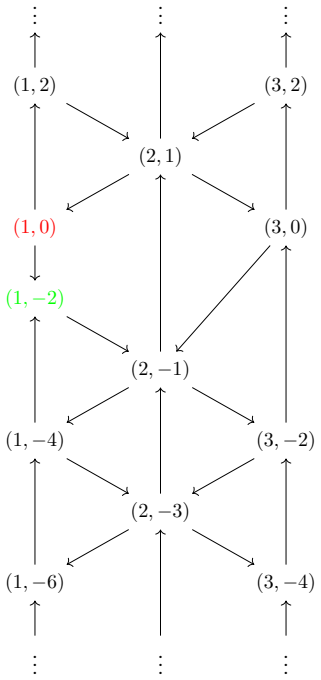
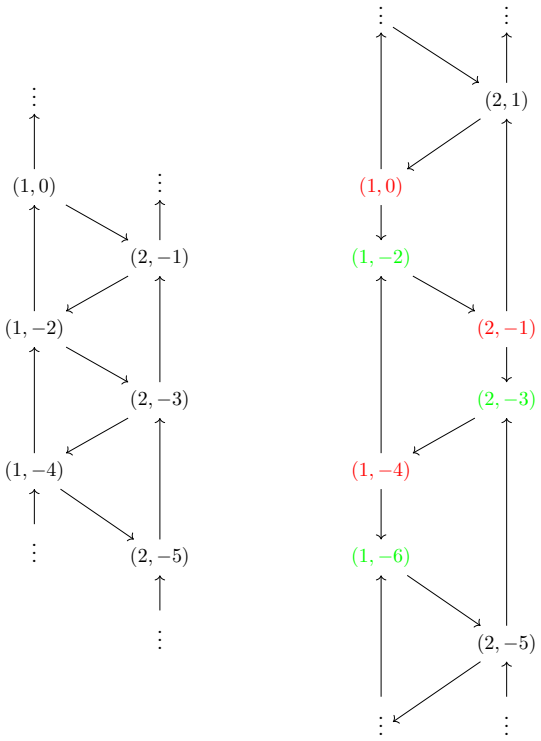
The load-bearing object is the quantization matrix $\Lambda_c$, defined as $\Lambda_c = (G^{(\infty)})^T \Lambda_e G^{(\infty)}$: here $G^{(\infty)}$ is the limit $G$-matrix whose columns are the stabilized $g$-vectors of the initial cluster variables of $A_{w_0}$, and $\Lambda_e$ is the quantization matrix of the Borel quantum torus. Together with the exchange matrix $B_c$ of the quiver $\Gamma_c$ it satisfies $B_c^T \Lambda_c = -2\,\mathrm{Id}$, so $(\Lambda_c, B_c)$ is a compatible pair in the sense of quantum cluster algebras, and this pair defines the quantum cluster algebra $A_{t,w_0}$. The torus isomorphism between $T_{t,c}$ and $T_{t,e}$, induced by mapping each quantum cluster variable to a monomial in the $\Psi$-variables with exponents given by its stabilized $g$-vector, transfers the Borel quantum torus into the shifted one and yields the embeddings $I_t^\pm$.
What would settle it
Compute, in type $A_1$, the $t$-commutation of the images under $I_t^+$ of two cluster variables of $K_t(\mathcal{O}^{\mathfrak{b},+}_{\mathbb{Z}})$ that are related by a non-initial sequence of mutations, and compare the power of $t$ with the value $F_{i,j}(s-r)$ prescribed by the Borel quantum torus; any mismatch would disprove the embedding.
Extended reading notes
Core claim
On the paper's own terms, the discovery is that the cluster algebra $A_{w_0}$, whose completion is the classical Grothendieck ring $K_0(\mathcal{O}^{\mathrm{sh}}_{\mathbb{Z}})$, admits a canonical quantization $A_{t,w_0}$ whose completion defines $K_t(\mathcal{O}^{\mathrm{sh}}_{\mathbb{Z}})$. The quantization is fixed by the matrix $\Lambda_c := (G^{(\infty)})^T \Lambda_e G^{(\infty)}$, which forms a compatible pair with the exchange matrix $B_c$ of the initial quiver $\Gamma_c$; compatibility means $B_c^T \Lambda_c = -2\,\mathrm{Id}$. Because the quantum tori of the shifted and Borel constructions are isomorphic, the paper obtains injective ring morphisms $I_t^{\pm}: K_t(\mathcal{O}^{\mathfrak{b},\pm}_{\mathbb{Z}}) \to K_t(\mathcal{O}^{\mathrm{sh}}_{\mathbb{Z}})$, so the new ring contains the quantum Grothendieck ring for the Borel affine algebra and, through it, the quantum Grothendieck ring of finite-dimensional representations of the ordinary quantum affine algebra.
Load-bearing premise
The load-bearing premise is that the classical embedding of the Borel cluster algebra into $A_{w_0}$ transfers to the quantum setting, meaning every finite sequence of quantum mutations lands inside $A_{t,w_0}$ with the same exchange relations; the paper invokes the classical argument rather than checking the quantum transfer explicitly.
Editorial extensions
If this is right
- The quantum Grothendieck ring $K_t(\mathcal{O}^{\mathrm{sh}}_{\mathbb{Z}})$ contains $K_t(\mathcal{O}^{\mathfrak{b},+}_{\mathbb{Z}})$, and through it the quantum Grothendieck ring of finite-dimensional representations of the ordinary quantum affine algebra.
- Quantum $QQ$-systems arise as quantum exchange relations with explicit powers of $t$; in type $A_1$ they read $Q_{\omega,q^{r-2}} Q_{s(\omega),q^r} - t^{-1} Q_{\omega,q^r} Q_{s(\omega),q^{r-2}} = 1$ and a companion relation with $t$ in place of $t^{-1}$.
- The localized quantum oscillator algebra $U^+_{t,\mathrm{loc}}(\mathfrak{sl}_2)$ is isomorphic to the quantum cluster algebra $A_t$ extracted from $A_{t,w_0}$, and consequently to the quantum double Bruhat cell $C_t[SL_2^{w_0,w_0}]$.
- The quantization matrix $\Lambda_c$ is given by an explicit formula in all simply-laced types, so the quantum $QQ$-systems can in principle be written down beyond type $A_1$.
- The quantum cluster structure induced on the double Bruhat cell subalgebra agrees in types $A_1$ and $A_2$ with the previously constructed quantum cluster structure on double Bruhat cells, and the paper conjectures agreement up to rescaling in general.
Reading between the lines
- If the torus isomorphism lifts to the completed rings, the same machinery should yield $(q,t)$-characters for the category $\mathcal{O}^{\mathrm{sh}}_{\mathbb{Z}}$, a direction the paper leaves for future work but for which the explicit $\Lambda_c$ provides a concrete starting point.
- The uniqueness problem raised in the paper—whether the basic infinite quiver admits a unique compatible quantization matrix—likely has a one-parameter family of solutions, mirroring the finite-rank case where compatibility forces $\Lambda$ to be proportional to the inverse of $B$.
- The recipe $\Lambda_c = (G^{(\infty)})^T \Lambda_e G^{(\infty)}$ may serve as a template for quantizing other infinite-rank cluster algebras equipped with a limit reference seed, including non-simply-laced analogues if a stabilized $G$-matrix can be defined.
- If the alternative quantization of $A_{w_0}$ described in the paper's final section coincides with $\Lambda_c$, then that quantization also contains the Borel quantum Grothendieck ring, which would close the comparison the author leaves open.
Editorial analysis
A structured set of objections, weighed in public.
Referee Report
Summary. The paper constructs a quantization of the Grothendieck ring of the category O_sh_Z of representations of shifted quantum affine algebras in simply-laced types. The construction is based on the cluster algebra A_{w0} of Geiss--Hernandez--Leclerc: the author defines a quantization matrix Λ_c := (G^{(∞)})^T Λ_e G^{(∞)}, proves that (Λ_c, B_c) is a compatible pair, and forms a quantum cluster algebra A_{t,w0} whose completion is denoted K_t(O_sh_Z). The central claim is that this quantum Grothendieck ring contains the quantum Grothendieck ring K_t(O_b^{±}_Z) of Bittmann via injective ring morphisms I_t^{±}. As applications, the paper derives a quantum QQ-system in type A_1, shows that the localized quantum oscillator algebra is a quantum cluster algebra, and relates it to the Berenstein--Zelevinsky quantum double Bruhat cell C_t[SL_2^{w0,w0}].
Significance. If the embedding theorem holds, the paper provides a natural quantization of K_0(O_sh_Z) that is compatible with the existing quantum Grothendieck ring for the Borel algebra, with concrete applications to quantum QQ-systems and to the quantum oscillator algebra. The definition of Λ_c via the limit G-matrix is elegant, and Proposition 4.6 together with Theorem 4.15 give a clean compatible pair and a quantum-torus isomorphism. The worked examples in types A_1 and A_2 are valuable. However, the main embedding theorem is asserted rather than proved, and the quantum QQ-system in type A_1 is stated without the promised derivation of the t-powers, so the central claims are not yet fully supported.
major comments (3)
- [Section 4, Theorem 4.20] The proof of the embedding K_t(O_b^{+}_Z) → K_t(O_sh_Z) is incomplete. Theorem 4.15 gives an isomorphism of the ambient quantum tori T_{t,c} and T_{t,e}, but A_{t,e} is generated from the compatible pair (Λ_e, B_e) and A_{t,w0} from (Λ_c, B_c). To conclude that the image of A_{t,e} under the toric isomorphism lies in A_{t,w0}, one must show that for every finite mutation sequence in A_{t,e}, the mutated quantum cluster variables satisfy the same quantum exchange relations in A_{t,w0}; this requires checking that the restricted quantization matrices agree after the relevant mutations and after the infinite green-mutation limit. Lemma 3.43 only matches the classical exchange matrices and variables, and the identity B_e = G^{(∞)} B_c (G^{(∞)})^T does not by itself control the t-powers after arbitrary finite sequences. The sentence 'the arguments are the same as for classical cluster algebras' is exactly the load-bearing point that needs a proof. A precise argument, or a reference to a theorem on embeddings of quantum cluster algebras, should be supplied.
- [Section 5, Proposition 5.1] The quantum QQ-system in type A_1 is stated without the promised computation. The paragraph preceding the proposition says that the t-powers can be obtained from t-commutation using Remark 4.16 and Lemma 3.32, but no actual computation is shown: the text does not identify the mutated vertex, the toric-frame monomials in equation (42), or the steps leading to the exponents -1 and t. Since this is presented as the first derivation of this deformation, the calculation should be included explicitly; as written, the reader cannot verify the signs of the t-powers or the ordering of non-commuting factors.
- [Section 4, Theorem 4.3 and Corollary 4.4] The passage to the limit in equation (34) is justified only by the sentence that the product of the limits is the limit of the products. For infinite matrices this needs a more explicit argument, since the matrix product involves infinitely many summands unless local finiteness is used carefully. The block-diagonal form of G^{(m)} from Theorem 3.21 should be used to show that each fixed matrix entry stabilizes. This is a completeness issue in a statement that is used to define Λ_c, though it is likely fixable by writing out the stabilization argument.
minor comments (5)
- [Proposition 4.6] The proof refers to 'Equation (4.1)', but the intended identity appears to be equation (35) in Corollary 4.4; the cross-reference should be corrected.
- [Example 4.18] The displayed matrix G^{(∞)} is incomplete: several blocks are missing and the ellipses do not make the block-diagonal structure fully clear. A more explicit description or a larger finite window would help the reader verify the computation of Λ_c.
- [Notation] The letter c is used both for a Coxeter element and for the index of the quantization matrix Λ_c; this can confuse the reader in Definition 3.14 and in Section 4. A separate symbol for one of the two uses would improve readability.
- [Introduction] The introduction states that the paper provides 'an explicit formula for the quantization matrix Λ_c', but for general type the formula in Definition (38) is explicit only after computing the limit G-matrix G^{(∞)}. The wording could be softened to avoid promising a more closed-form expression than is actually given.
- [Acknowledgments and references] There are several typographical errors: 'Cerullli Irelli' in the acknowledgments, 'Commununications' in the reference [FH24], and 'the quantum Grothendieck of finite-dimensional representations' in Remark 4.21 (missing 'ring'). These should be corrected.
Circularity Check
No significant circularity: the quantization matrix is chosen to make the torus isomorphism, and the embedding claim rests on external classical arguments rather than on its own conclusion.
full rationale
The paper's central construction defines Λ_c := (G^(∞))^T Λ_e G^(∞) explicitly in order to make the quantum torus T_{t,c} isomorphic to Bittmann's T_{t,e} (Theorem 4.15). This is a transparent construction with a direct verification, not a fitted parameter masquerading as a prediction; the paper states the desired compatibility as a goal before introducing the definition. The compatible-pair check (Proposition 4.6) is a short computation from Theorem 4.3 and the external fact B_e^T Λ_e = -2 Id, both prior published results. Theorem 4.20, the embedding of K_t(O^{b,+}_Z) into K_t(O^sh_Z), is asserted by analogy with the classical embedding Lemma 3.43; while the proof is terse and does not spell out the compatibility of restricted quantization matrices along every finite mutation sequence, this is a rigor gap rather than circularity. The torus isomorphism of Theorem 4.15 already transports the t-commutation relations, and the claimed embedding does not reduce to the definition of K_t(O^sh_Z) or to an assumption of the conclusion. No load-bearing step cites the present author's own prior work; citations to [GHL24], [Bit21b], and [BZ05] are independent published sources. No parameter is fitted to data, and no derived result is identical to its input by construction.
Assumptions & free parameters
assumptions (4)
- domain assumption Stabilization of G-matrices and existence of the limit G-matrix G^{(infty)} for the initial seed of A_{w0} (GHL24, Theorem 3.21).
- domain assumption The pair (Lambda_e, B_e) is compatible with B_e^T Lambda_e = -2 Id for the Borel quantum torus (Bittmann, Proposition 3.9).
- domain assumption The classical embedding A_e into A_{w0} of cluster algebras holds (Lemma 3.43, proved in the paper).
- standard math Quantum Laurent phenomenon and compatibility of infinite-rank compatible pairs (BZ05, Definition 3.8, Corollary 5.2).
Cite this review
Pith. "Pith review of Quantum cluster algebras and representations of shifted quantum affine algebras." pith.science (2026). https://pith.science/paper/S4CVLJA6
@misc{pith2026250705008,
  author       = {Pith},
  title        = {Pith review of: Quantum cluster algebras and representations of shifted quantum affine algebras},
  year         = {2026},
  howpublished = {\url{https://pith.science/paper/S4CVLJA6}},
  note         = {Machine review of arXiv:2507.05008}
}
abstract
We construct a new quantization $K_t(\mathcal{O}^{sh}_{\mathbb{Z}})$ of the Grothendieck ring of the category $\mathcal{O}^{sh}_{\mathbb{Z}}$ of representations of shifted quantum affine algebras (of simply-laced type). We establish that our quantization is compatible with the quantum Grothendieck ring $K_t(\mathcal{O}^{\mathfrak{b},+}_{\mathbb{Z}})$ for the quantum Borel affine algebra, namely that there is a natural embedding $K_t(\mathcal{O}^{\mathfrak{b},+}_{\mathbb{Z}})\hookrightarrow K_t(\mathcal{O}^{sh}_{\mathbb{Z}})$. Our construction is partially based on the cluster algebra structure on the classical Grothendieck ring discovered by Geiss-Hernandez-Leclerc. As first applications, we formulate a quantum analogue of $QQ$-systems (that we make completely explicit in type $A_1$). We also prove that the quantum oscillator algebra is isomorphic to a localization of a subalgebra of our quantum Grothendieck ring and that it is also isomorphic to the Berenstein-Zelevinsky's quantum double Bruhat cell $\mathbb{C}_t[SL_2^{w_0,w_0}]$.
Figures


Figures from the paper (11 more)




Reference graph
Works this paper leans on
-
[1]
Cluster algebras III: Upper bounds and double Bruhat cells
[BFZ05] Arkady Berenstein, Sergey Fomin, and Andrei Zelevinsky. “Cluster algebras III: Upper bounds and double Bruhat cells”. In:Duke Mathematical Journal126.1 (2005), pp. 1–52. [Bit19] L ´ea Bittmann. “Quantum Grothendieck rings, cluster algebras and quantum affine category O”. PhD thesis. Universit ´e Paris Diderot, 2019.url:https : / / theses . fr / 20...
work page 2005
-
[12]
Q eQ-Systems for Twisted Quantum Affine Algebras
arXiv:2503.06262. [Wan23] Keyu Wang. “Q eQ-Systems for Twisted Quantum Affine Algebras”. In:Communications in Mathematical Physics400.2 (2023), pp. 1137–1179. FRANCESCA PAGANELLI DEPARTMENT S.B.A.I. SAPIENZA-UNIVERSIT `A DI ROMA VIA SCARPA 10, 00164, ROMA (ITALY) & UNIVERSIT´E PARIS CIT´E, SORBONNE UNIVERSIT´E CNRS, IMJ-PRG 8 PL. AUR´ELIE NEMOURS, 75013, ...
arXiv 2023
-
[126]
Cluster algebras and categoryOfor represen- tations of Borel subalgebras of quantum affine algebras
[HL16] David Hernandez and Bernard Leclerc. “Cluster algebras and categoryOfor represen- tations of Borel subalgebras of quantum affine algebras”. In:Algebra & Number Theory 10.9 (2016), pp. 2015–2052. [HZ25] David Hernandez and Huafeng Zhang.Jordan-H ¨older property for shifted quantum affine algebras
work page 2016
-
[190]
Weyl group symmetry of q-characters
[FH25] Edward Frenkel and David Hernandez. “Weyl group symmetry of q-characters”. In: Selecta Mathematica (New Series)31.4 (2025), p
work page 2025
-
[248]
Multiplicative slices, relativistic Toda and shifted quantum affine algebras
Contemp. Math. Amer. Math. Soc., Provi- dence, RI, 1999, pp. 163–205. [FT19] Michael Finkelberg and Alexander Tsymbaliuk. “Multiplicative slices, relativistic Toda and shifted quantum affine algebras”. In:Progress in Mathematics330 (2019), pp. 133–
work page 2019
-
[304]
Cluster Algebras I: Foundations
[FZ02] Sergey Fomin and Andrei Zelevins. “Cluster Algebras I: Foundations”. In:Journal of the American Mathematical Society15.2 (2002), pp. 497–529. [FZ07] Sergey Fomin and Andrei Zelevinsky. “Cluster algebras IV: Coefficients”. In:Composi- tio Mathematica143.1 (2007), pp. 112–164. [FZ99] Sergey Fomin and Andrei Zelevinsky. “Double Bruhat Cells and Total ...
work page 2002
-
[924]
Quiver varieties andt-analogs ofq-characters of quantum affine algebras
[Nak04] Hiraku Nakajima. “Quiver varieties andt-analogs ofq-characters of quantum affine algebras”. In:Annals of Mathematics (2)160.3 (2004), pp. 1057–1097. [Nak11] Tomoki Nakanishi. “Periodicities in cluster algebras and dilogarithm identities”. In: Representations of algebras and related topics. European Mathematical Society-EMS-Publishing House GmbH, 2...
work page 2004
-
[1449]
Triangular bases in quantum cluster algebras and monoidal categorification conjectures
[Qin17] Fan Qin. “Triangular bases in quantum cluster algebras and monoidal categorification conjectures”. In:Duke Mathematical Journal166.12 (2017), pp. 2337–2442. [Qin24] Fan Qin.Based cluster algebras of infinite ranks
work page 2017
Show all 12 references
-
[1994]
Extended Baxter Relations and QQ-Systems for Quantum Affine Algebras
arXiv:9411145. [FH24] Edward Frenkel and David Hernandez. “Extended Baxter Relations and QQ-Systems for Quantum Affine Algebras”. In:Commununications in Mathematical Physics405.8 (2024), p
2024
-
[2023]
Theq-characters of representations of quan- tum affine algebras and deformations of W-algebras
arXiv:2304.02562. [FR99] Edward Frenkel and Nicolai Reshetikhin. “Theq-characters of representations of quan- tum affine algebras and deformations of W-algebras”. In:Recent developments in quan- tum affine algebras and related topics. Vol
-
[2024]
Perverse sheaves and quantum Grothendieck rings
arXiv:2409.02881 [math.QA]. [VV01] Michela Varagnolo and Eric Vasserot. “Perverse sheaves and quantum Grothendieck rings”. In:Studies in memory of Issai Schur (Chevaleret/Rehovot, 2000)210 (2001), pp. 345–
2001 arXiv
-
[2025]
Monoidal categorifi- cation and quantum affine algebras II
arXiv:2501.16859. [KKOP24] Masaki Kashiwara, Myungho Kim, Se-Jin Oh, and Euiyong Park. “Monoidal categorifi- cation and quantum affine algebras II”. In:Inventiones Mathematicae236 (2024), pp. 837–
2024 arXiv
Reviewed August 6, 2026 · model on record in the stance chip above.
Discussion (0). Continue with ORCID to comment.