REVIEW 3 major objections 6 minor 58 references
ViPSN 2.0: A Reconfigurable Battery-free IoT Platform for Vibration Energy Harvesting
T0 review · 3 major / 6 minor · reviewed 2026-08-06 · deepseek-v4-flash
Pith's one-line read ViPSN 2.0 claims that one modular platform, built on a single carrier board with standardized hot-swappable units, can power battery-free IoT workloads from 18.9 µJ BLE beacons to 23.86 mJ LoRa cycles and 27 mJ image transfers by exposing…
desk verdict A genuinely useful modular VEH platform with three real demos, but the LoRa demo's energy accounting is off by two orders of magnitude and the 'reliably' claim outruns the evidence. read the letter →
The pith
A machine-rendered reading of the paper's core claim, the machinery that carries it, and where it could break.
The reading
What carries the argument
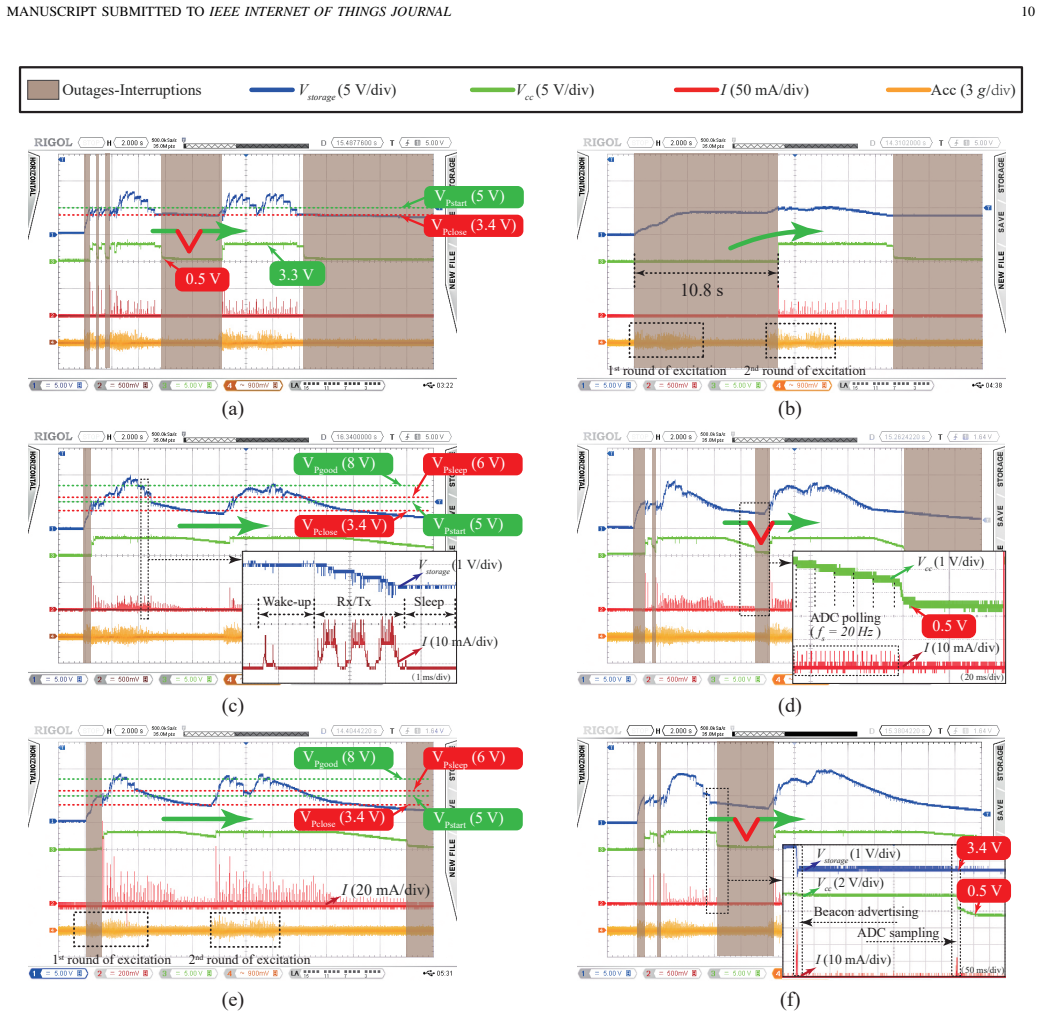
The Energy-Indication Power Solution Framework is the central mechanism: a power-management scheme in which four standardized signals — Pstart for startup, Pgood for sufficient energy to run the most energy-intensive atomic operation, Psleep for imminent shortage that triggers checkpointing, and Pclose for shutdown — are derived from storage-capacitor voltage thresholds, either through regulator undervoltage lockout, an analog comparator in the PID solution, or ADC polling in the APC solution. These signals partition operation into cold-start, energy build-up, task-operation, checkpoint, and shutdown phases, with the usable energy in each phase given by the capacitor charge difference $\tfrac{1}{2} C_{\mathrm{storage}}(V_{\mathrm{upper}}^2 - V_{\mathrm{lower}}^2)$. The framework carries the argument by mapping each power solution to a workload class: UVLO for light-duty tasks, PID for heavy-duty tasks, and APC for complex-duty streaming tasks.
What would settle it
Independently measure the average output power of the three harvesters under the same stated excitation — a fingertip press below 80 N, ocean waves of about 0.4 m height, and airflow of 3.5 to 4.5 m/s — and check whether each reaches the reported levels; if outputs fall below 125 µW, 21.63 mW, or 1.2 mW respectively, the corresponding per-cycle energy budgets of 18.9 µJ, 23.86 mJ, and 27 mJ cannot be met and the reliability claim fails for that deployment.
Extended reading notes
Core claim
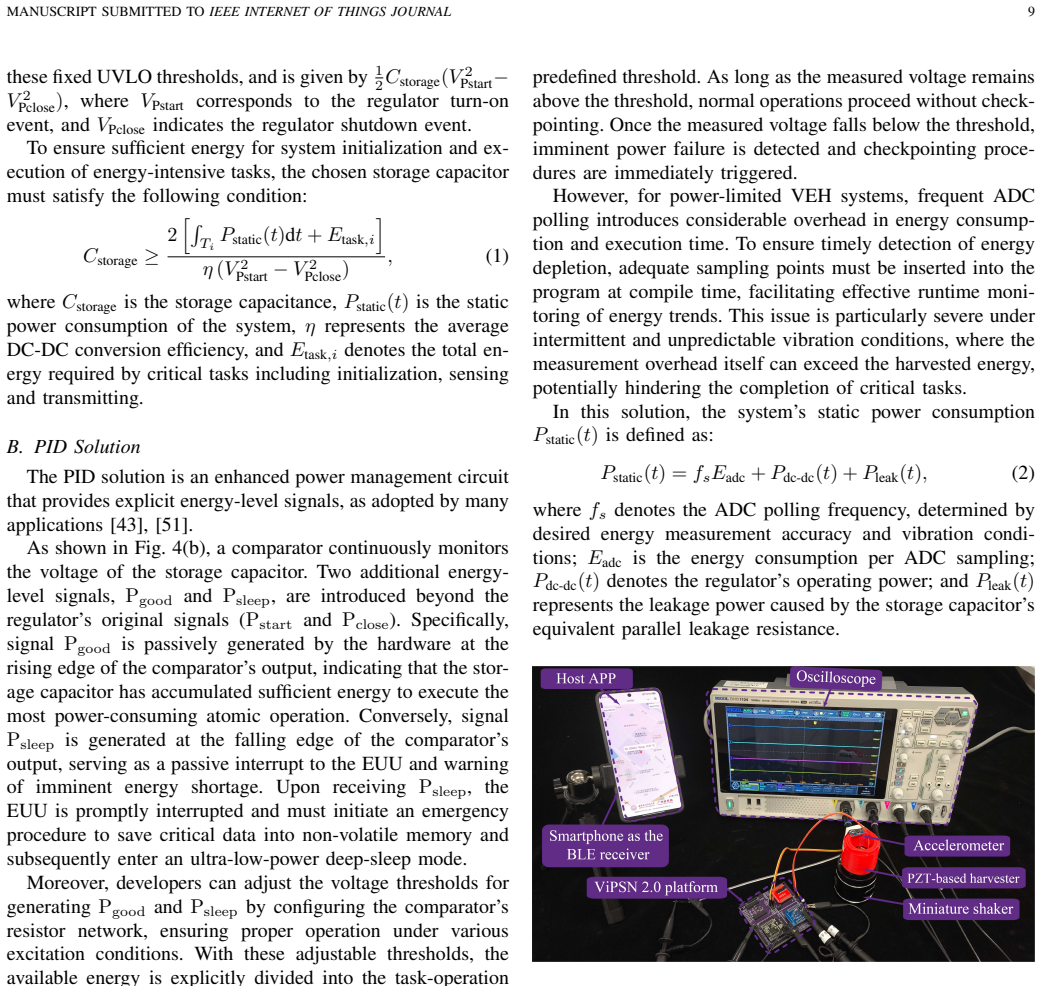
On its own terms, ViPSN 2.0 establishes that one open, modular hardware platform can span the full workload range of battery-free IoT. The platform standardizes four functional units — energy transduction with PZT, EMG, and TENG harvesters; energy management with buck, linear, and boost regulators; energy users with BLE beacon, BLE UART, and LoRa modules; and pluggable peripherals — around a single carrier board, and it makes stored energy explicit through four standardized signals: Pstart, Pgood, Psleep, and Pclose. These signals divide capacitor energy into cold-start, energy build-up, task-operation, checkpoint, and shutdown phases, allowing the system to checkpoint before power loss and resume after reboot. The claim is demonstrated by three deployments: a single fingertip press on a sub-cent PZT disc yields an 18.9 µJ BLE beacon received at 100 m; a rolling-mode TENG array in roughly 0.4 m ocean waves drives a 23.86 mJ TDS-plus-LoRa cycle over 0.8 km; and an electromagnetic wind harvester at about 4 m/s drives a 27 mJ image capture and BLE streaming cycle, with the transmitted images supporting 88.75% accurate occupancy classification.
Load-bearing premise
The central reliability claim stands or falls on the three author-measured average harvester powers — 125 µW from a fingertip press, 21.63 mW from a TENG array in roughly 0.4 m waves, and 1.2 mW from an EMG wind harvester at about 4 m/s — which are single-site values with no independent replication or error bars.
Editorial extensions
If this is right
- A BLE beacon requires only about 18.9 µJ, so ultra-low-power transient sources such as a single finger press can drive usable wireless identification.
- With a 21.63 mW TENG harvester, a 0.8 km LoRa link plus water-quality sensing can run entirely on wave energy, enabling remote marine monitoring without batteries.
- An image capture and streaming cycle is feasible at 27 mJ, so intermittent vibration energy can support vision tasks such as occupancy classification.
- Standardized hot-swappable interfaces let the same carrier board be reconfigured across PZT, EMG, and TENG harvesters and across beacon, UART, and LoRa radios without hardware redesign.
- Software-defined APC thresholds enable in-situ tuning of checkpoint timing, which the paper argues is needed for complex-duty streaming workloads.
Reading between the lines
- Because the energy budgets are stated per cycle, the same boards could likely be ported to other harvesters with comparable average output powers, provided those harvesters can refill the storage capacitor between cycles; the paper does not test such cross-harvester combinations.
- The checkpoint-phase design implies that applications with larger state, such as higher-resolution images or longer multi-packet transmissions, could be made resilient by enlarging the $\tfrac{1}{2} C_{\mathrm{storage}}(V_{\mathrm{sleep}}^2 - V_{\mathrm{close}}^2)$ reserve, at the cost of longer recharge times; this trade-off is quantified in the paper only for the three demos.
- The reported 88.75% classification accuracy on 80 test images suggests that the 121×162 grayscale camera output suffices for simple vision tasks, but the small dataset and the one-person versus multiple-people confusion hint at resolution limits.
- A testable extension would be to run the platform with two harvesters in parallel or with a hybrid PZT-plus-TENG input, measuring whether the standardized interfaces preserve the stated per-cycle energy budgets.
Editorial analysis
A structured set of objections, weighed in public.
Referee Report
Summary. The manuscript describes ViPSN 2.0, a modular battery-free IoT platform for vibration energy harvesting. It contributes a standardized carrier-board architecture supporting piezoelectric, electromagnetic, and triboelectric harvesters; three power management approaches (UVLO, PID, and APC) built around four energy-level signals; and three application case studies with field or lab deployments: a BLE beacon powered by a single fingertip press (18.9 µJ), a LoRa + TDS marine monitoring node powered by a TENG array in roughly 0.4 m waves (23.86 mJ per cycle, 0.8 km range), and a camera image capture/streaming node powered by HVAC airflow (27 mJ per image). The paper reports measured power and energy tables, oscilloscope waveforms, field transmission logs, and a classification result on received images. The central claim is that ViPSN 2.0 can reliably meet a wide range of requirements in practical battery-free IoT deployments under energy-constrained conditions.
Significance. The platform itself is a valuable contribution if the quantitative evidence holds. The modular energy transformer / power solution / application layering is a practical response to the diversity of vibration transducers and workloads, and the energy-indication framework (Pstart/Pgood/Psleep/Pclose) is clearly articulated and reusable. The three demos usefully span roughly three orders of magnitude in per-task energy and cover short-range, long-range, and streaming workloads. The paper also provides module-level energy tables, which supports reproducibility. I see no circularity in Eq. (1); the thresholds and capacitors are engineering choices rather than fitted targets. The main weakness is that the quantitative basis for the 'reliably' claim contains inconsistencies and thin sampling, so the significance claim is currently ahead of the evidence.
major comments (3)
- [§VII-A, Table VI, Fig. 12(d)] Table VI reports an average TENG array output of 21.63 mW under roughly 0.4 m waves, but the measured capacitor dynamics shown in Fig. 12(d) imply an average delivered power two orders of magnitude lower. With Cstorage = 6800 µF, charging from 0 V to VPstart = 4.7 V in ~450 s stores 0.5 × 6800 µF × (4.7 V)^2 = 75.1 mJ, i.e. about 0.167 mW average; the 200 s recharge from VPclose = 3.7 V to VPgood = 5.2 V stores about 45.4 mJ, i.e. about 0.227 mW average. Please clarify how 21.63 mW was measured and what quantity it represents. If it is a bench-top matched-load or wave-tank value, it cannot be used as the field input to the energy budget, and the deployed system actually operates on roughly 0.2 mW average. The success of the four field transmissions is not in question, but the energy-margin and transferability claims in the Abstract and Section IX need to be re-derived from the power actually delivered to storage.
- [Table III vs. Table VI] The LoRa module task energy is listed as 42.84 mJ in Table III, but the ViPSN-LoRa demo budget in Table VI uses 22.4 mJ for transmission and a 23.86 mJ total cycle. Both entries refer to the SX1276-based LoRa module with an nRF52832 MCU. The payload length, transmission power, and range differ (100 bytes / 0–2 km vs. 12 bytes / 0.8 km), but the manuscript does not state how 42.84 mJ was measured or why the demo value is lower. Because the 200–550 s sampling interval and the 'reliably complete' conclusion depend on the per-cycle energy, please reconcile these two numbers or report the exact measurement conditions for each entry.
- [Abstract, §V-D, §VI-C, §VII-C, §VIII-C] The reliability claim rests on very small samples: one 24 s bridge-vibration segment for the three-solution comparison, one fingertip actuation per indoor/outdoor beacon test (Figs. 8–9), one ocean deployment with four LoRa transmission events (Fig. 12(d)), and one 220 s camera run (Fig. 15). Energy values are reported without error bars, and recharge times are given as single numbers. Please either add repeated trials and statistics where reliability is claimed, or restrict the claim to 'demonstrated operation' for the specific conditions tested rather than 'reliably meet' in general.
minor comments (6)
- [§V-D2 and Fig. 6] The text states VPclose = 3.6 V for the UVLO configuration, but Fig. 6(a)–(b) labels VPclose as 3.4 V; please align the figure and text.
- [§V-D3] The minimum capacitance values (6.76 µF, 7.59 µF, and 7.74 µF) are reported without showing the values inserted into Eq. (1); a short calculation table would allow readers to reproduce the numbers.
- [Table I and §II] Table I lists the first application row as 'K. Ren [28]' while the text in Section II attributes [28] to Wang et al.; please correct the author/reference mismatch.
- [Index Terms] The Index Terms include 'Magnetoelectric' but the paper consistently discusses electromagnetic (EMG) harvesters; please use consistent terminology.
- [Footnotes and §VIII-B1] There are several typographical errors, e.g., 'the the School' in the corresponding-author footnote and 'base on' in Section VIII-B1; a copyedit pass is needed.
- [Table III] The LoRa and BLE UART static power entries are both 6.6 µW; please verify whether these are measured or nominal values, since static power strongly affects the energy-budget equations.
Circularity Check
No significant circularity: the platform's derivations are energy-budget sizing rules and the demo claims rest on independent measured waveforms and external receivers, not on definitions or fitted predictions.
full rationale
ViPSN 2.0's design procedure is conventional energy-budget sizing rather than a circular derivation. Eq. (1) computes a minimum storage capacitance from measured task energy and chosen UVLO thresholds; it is a sizing rule, not a prediction, and the subsequent demos validate that the sized capacitors and thresholds function under measured excitations. Each demo's energy requirements (Tables III, V, VI, and VII) are obtained from current and voltage measurements, and the claimed successful transmissions are field observations, not quantities derived from those tables. The paper cites the authors' own ViPSN 1.0 and related application papers, but those citations are contextual and historical and are not the load-bearing evidence: the three new case studies are self-contained demonstrations with external receivers and measured storage-capacitor waveforms. The ViPSN-LoRa reported average harvester output of 21.63 mW is difficult to reconcile with the roughly 200 s recharge of the 6800 µF capacitor between 3.7 V and 5.2 V, which implies only about 0.23 mW delivered on average, but that is an internal consistency or measurement-context issue, not a definitional circularity, because no equation in the paper constructs the reported output from the delivered capacitor energy. No load-bearing step reduces to its own input.
Assumptions & free parameters
free parameters (5)
- ViPSN-Beacon UVLO thresholds (VPstart, VPclose) =
6.7 V, 2.8 V
- ViPSN-LoRa PID thresholds (VPstart, VPgood, VPclose/VPsleep) =
4.7 V, 5.2 V, 3.7 V
- ViPSN-Cam APC thresholds (VPstart=VPgood, VPsleep, VPclose) =
4.7 V, ~2.4 V, 2.2 V
- Storage capacitance per demo =
2.2 µF (Beacon), 6800 µF (LoRa), 4700 µF (Cam)
- APC ADC polling frequency fs =
4 Hz
assumptions (5)
- standard math Usable stored energy equals 0.5*C*(V_high^2 - V_low^2)
- domain assumption Average DC-DC conversion efficiency eta is a single constant in Eq. (1)
- domain assumption The three excitation records are representative of the claimed application classes
- domain assumption The reported average harvester output powers are accurate and sustained
- domain assumption FRAM checkpointing saves and restores complete execution state
Cite this review
Pith. "Pith review of ViPSN 2.0: A Reconfigurable Battery-free IoT Platform for Vibration Energy Harvesting." pith.science (2026). https://pith.science/paper/2K3AJ3DI
@misc{pith2026250705081,
  author       = {Pith},
  title        = {Pith review of: ViPSN 2.0: A Reconfigurable Battery-free IoT Platform for Vibration Energy Harvesting},
  year         = {2026},
  howpublished = {\url{https://pith.science/paper/2K3AJ3DI}},
  note         = {Machine review of arXiv:2507.05081}
}
read the original abstract
Vibration energy harvesting is a promising solution for powering battery-free IoT systems; however, the instability of ambient vibrations presents significant challenges, such as limited harvested energy, intermittent power supply, and poor adaptability to various applications. To address these challenges, this paper proposes ViPSN2.0, a modular and reconfigurable IoT platform that supports multiple vibration energy harvesters (piezoelectric, electromagnetic, and triboelectric) and accommodates sensing tasks with varying application requirements through standardized hot-swappable interfaces. ViPSN~2.0 incorporates an energy-indication power management framework tailored to various application demands, including light-duty discrete sampling, heavy-duty high-power sensing, and complex-duty streaming tasks, thereby effectively managing fluctuating energy availability. The platform's versatility and robustness are validated through three representative applications: ViPSN-Beacon, enabling ultra-low-power wireless beacon transmission from a single transient fingertip press; ViPSN-LoRa, supporting high-power, long-range wireless communication powered by wave vibrations in actual marine environments; and ViPSN-Cam, enabling intermittent image capture and wireless transfer. Experimental results demonstrate that ViPSN~2.0 can reliably meet a wide range of requirements in practical battery-free IoT deployments under energy-constrained conditions.
Figures


Figures from the paper (14 more)



Reference graph
Works this paper leans on
-
[1]
Movers and shakers: Kinetic energy harvesting for the internet of things,
M. Gorlatova, J. Sarik, G. Grebla, M. Cong, I. Kymissis, and G. Zuss- man, “Movers and shakers: Kinetic energy harvesting for the internet of things,” IEEE Journal on Selected Areas in Communications , vol. 33, no. 8, pp. 1624–1639, 2015
work page 2015
-
[2]
A review of power harvesting using piezoelectric materials (2003–2006),
S. R. Anton and H. A. Sodano, “A review of power harvesting using piezoelectric materials (2003–2006),” Smart Mater. Struct. , vol. 16, no. 3, R1, May 2007
work page 2003
-
[3]
Toward broadband vibration-based energy harvesting,
L. Tang, Y . Yang, and C. K. Soh, “Toward broadband vibration-based energy harvesting,” J. Intell. Mater. Syst. Struct. , vol. 21, no. 18, pp. 1867–1897, Dec. 2010
work page 2010
-
[4]
A review of the recent research on vibration energy harvesting via bistable systems,
R. L. Harne and K. W. Wang, “A review of the recent research on vibration energy harvesting via bistable systems,” Smart Mater. Struct., vol. 22, no. 2, 023001, Jan. 2013
work page 2013
-
[5]
M. Safaei, H. A. Sodano, and S. R. Anton, “A review of energy harvesting using piezoelectric materials: state-of-the-art a decade later (2008–2018),” Smart Mater. Struct., vol. 28, no. 11, 113001, Oct. 2019
work page 2008
-
[6]
Intermittent computing: Challenges and opportunities,
B. Lucia, V . Balaji, A. Colin, K. Maeng, and E. Ruppel, “Intermittent computing: Challenges and opportunities,” in 2nd Summit on Advances in Programming Languages (SNAPL 2017). Schloss Dagstuhl-Leibniz- Zentrum fuer Informatik, 2017
work page 2017
-
[7]
G. K. Ottman, H. F. Hofmann, and G. A. Lesieutre, “Optimized piezoelectric energy harvesting circuit using step-down converter in discontinuous conduction mode,” IEEE Trans. Power Electron., vol. 18, no. 2, pp. 696–703, Mar. 2003
work page 2003
-
[8]
C. N. Loong, C.-C. Chang, and E. G. Dimitrakopoulos, “Circuit nonlin- earity effect on the performance of an electromagnetic energy harvester- structure system,” Eng. Struct., vol. 173, pp. 449–459, Oct. 2018
work page 2018
Show all 58 references
-
[9]
In- vestigation of multimodal electret-based mems energy harvester with impact-induced nonlinearity,
K. Tao, L. Tang, J. Wu, S. W. Lye, H. Chang, and J. Miao, “In- vestigation of multimodal electret-based mems energy harvester with impact-induced nonlinearity,” Journal of Microelectromechanical Sys- tems, vol. 27, no. 2, pp. 276–288, 2018
2018
-
[10]
Adaptive piezoelectric energy harvesting circuit for wireless remote power supply,
G. K. Ottman, H. F. Hofmann, A. C. Bhatt, and G. A. Lesieutre, “Adaptive piezoelectric energy harvesting circuit for wireless remote power supply,” IEEE Trans. Power Electron. , vol. 17, no. 5, pp. 669– 676, Sep. 2002
2002
-
[11]
Impedance modeling of electromagnetic energy harvesting system using full-wave bridge rectifier,
J. Liang, C. Ge, and Y .-C. Shu, “Impedance modeling of electromagnetic energy harvesting system using full-wave bridge rectifier,” in Active and Passive Smart Structures and Integrated Systems 2017 , vol. 10164. International Society for Optics and Photonics, Apr. 2017, 101642N
2017
-
[12]
Vibrations powered lora sensor: An electromechanical energy harvester working on a real bridge,
F. Orfei, C. B. Mezzetti, and F. Cottone, “Vibrations powered lora sensor: An electromechanical energy harvester working on a real bridge,” in 2016 IEEE SENSORS . IEEE, 2016, pp. 1–3
2016
-
[13]
M energy harvesters: a review of optimality condition for electrical tuning,
A. Brenes, A. Morel, J. Juillard, E. Lefeuvre, and A. Badel, “M energy harvesters: a review of optimality condition for electrical tuning,” Smart Materials and Structures , vol. 29, no. 3, 033001, 2020
2020
-
[14]
Hybrid energy harvesting technology: From materials, structural design, system inte- gration to applications,
H. Liu, H. Fu, L. Sun, C. Lee, and E. M. Yeatman, “Hybrid energy harvesting technology: From materials, structural design, system inte- gration to applications,” Renewable Sustainable Energy Rev. , vol. 137, 110473, Mar. 2021
2021
-
[15]
Macro fiber composite-based energy harvester for human knee,
F. Gao, G. Liu, B. L.-H. Chung, H. H.-T. Chan, and W.-H. Liao, “Macro fiber composite-based energy harvester for human knee,” Ap- plied Physics Letters , vol. 115, no. 3, 033901, 2019
2019
-
[16]
Review of nonlinear vibration energy harvesting: Duffing, bistability, parametric, stochastic and others,
Y . Jia, “Review of nonlinear vibration energy harvesting: Duffing, bistability, parametric, stochastic and others,” Journal of Intelligent material systems and structures , vol. 31, no. 7, pp. 921–944, 2020
2020
-
[17]
The future of sensing is batteryless, intermittent, and awesome,
J. Hester and J. Sorber, “The future of sensing is batteryless, intermittent, and awesome,” in Proceedings of the 15th ACM conference on embedded network sensor systems , 2017, pp. 1–6
2017
-
[18]
Mementos: System support for long-running computation on rfid-scale devices,
B. Ransford, J. Sorber, and K. Fu, “Mementos: System support for long-running computation on rfid-scale devices,” in Proceedings of the sixteenth international conference on Architectural support for program- ming languages and operating systems , 2011, pp. 159–170
2011
-
[19]
Chain: tasks and channels for reliable intermit- tent programs,
A. Colin and B. Lucia, “Chain: tasks and channels for reliable intermit- tent programs,” in Proceedings of the 2016 ACM SIGPLAN International Conference on Object-Oriented Programming, Systems, Languages, and Applications, 2016, pp. 514–530
2016
-
[20]
Camaroptera: A batteryless long-range remote visual sensing system,
M. Nardello, H. Desai, D. Brunelli, and B. Lucia, “Camaroptera: A batteryless long-range remote visual sensing system,” in Proceedings of the 7th International Workshop on Energy Harvesting & Energy-Neutral Sensing Systems, 2019, pp. 8–14
2019
-
[21]
Reliable timekeeping for intermittent computing,
J. De Winkel, C. Delle Donne, K. S. Yildirim, P. Pawełczak, and J. Hes- ter, “Reliable timekeeping for intermittent computing,” in Proceedings of the Twenty-Fifth International Conference on Architectural Support for Programming Languages and Operating Systems , 2020, pp. 53–67
2020
-
[22]
Task schedul- ing for energy-harvesting-based IoT: A survey and critical analysis,
M. M. Sandhu, S. Khalifa, R. Jurdak, and M. Portmann, “Task schedul- ing for energy-harvesting-based IoT: A survey and critical analysis,” IEEE Internet of Things Journal , vol. 8, no. 18, pp. 13 825–13 848, 2021
2021
-
[23]
Recent advances in human motion excited energy harvesting systems for wearables,
M. Cai, Z. Yang, J. Cao, and W.-H. Liao, “Recent advances in human motion excited energy harvesting systems for wearables,” Energy Tech- nology, vol. 8, no. 10, 2000533, 2020
2020
-
[24]
Kinetic energy har- vesting: Toward autonomous wearable sensing for internet of things,
M. Magno, L. Spadaro, J. Singh, and L. Benini, “Kinetic energy har- vesting: Toward autonomous wearable sensing for internet of things,” in 2016 International Symposium on Power Electronics, Electrical Drives, Automation and Motion (SPEEDAM) . IEEE, 2016, pp. 248–254
2016
-
[25]
Trinity: Enabling self-sustaining wsns indoors with energy-free sensing and networking,
F. Li, Y . Yang, Z. Chi, L. Zhao, Y . Yang, and J. Luo, “Trinity: Enabling self-sustaining wsns indoors with energy-free sensing and networking,” ACM Transactions on Embedded Computing Systems (TECS) , vol. 17, no. 2, pp. 1–27, 2018
2018
-
[26]
Battery-less zero-maintenance embedded sensing at the mithræum of circus maximus,
M. Afanasov, N. A. Bhatti, D. Campagna, G. Caslini, F. M. Centonze, K. Dolui, A. Maioli, E. Barone, M. H. Alizai, J. H. Siddiqui et al. , “Battery-less zero-maintenance embedded sensing at the mithræum of circus maximus,” in Proceedings of the 18th Conference on Embedded Netwo...
2020
-
[27]
Battery-free game boy,
J. De Winkel, V . Kortbeek, J. Hester, and P. Pawełczak, “Battery-free game boy,” Proceedings of the ACM on Interactive, Mobile, Wearable and Ubiquitous Technologies, vol. 4, no. 3, pp. 1–34, 2020
2020
-
[28]
A wind- driven poly (tetrafluoroethylene) electret and polylactide polymer-based hybrid nanogenerator for self-powered temperature detection system,
J. Zhang, S. Gong, X. Li, J. Liang, Z. L. Wang, and K. Ren, “A wind- driven poly (tetrafluoroethylene) electret and polylactide polymer-based hybrid nanogenerator for self-powered temperature detection system,” Advanced sustainable systems , vol. 5, no. 1, 2000192, 2021
2021
-
[29]
Triboelectric energy harvesting using an origami-inspired structure,
G. Hu, C. Zhao, Y . Yang, X. Li, and J. Liang, “Triboelectric energy harvesting using an origami-inspired structure,” Applied Energy , vol. 306, 118037, 2022
2022
-
[30]
A piezoelectric smart backing ring for high-performance power generation subject to train induced steel-spring fulcrum forces,
J. Wang, Y . Cao, H. Xiang, Z. Zhang, J. Liang, X. Li, D. Ding, T. Li, and L. Tang, “A piezoelectric smart backing ring for high-performance power generation subject to train induced steel-spring fulcrum forces,” Energy Conversion and Management , vol. 257, 115442, 2022
2022
-
[31]
Wide-bandwidth triboelectric energy harvester combining impact nonlinearity and multi- resonance method,
C. Zhao, G. Hu, X. Li, Z. Liu, W. Yuan, and Y . Yang, “Wide-bandwidth triboelectric energy harvester combining impact nonlinearity and multi- resonance method,” Applied Energy, vol. 348, 121530, 2023
2023
-
[32]
A rolling-mode triboelectric nanogenerator with multi-tunnel grating electrodes and opposite-charge-enhancement for wave energy harvesting,
Y . Wang, H. Du, H. Yang, Z. Xi, C. Zhao, Z. Qian, X. Chuai, X. Peng, H. Yu, Y . Zhang et al. , “A rolling-mode triboelectric nanogenerator with multi-tunnel grating electrodes and opposite-charge-enhancement for wave energy harvesting,” Nature Communications , vol. 15, no. 1,...
2024
-
[33]
Design and optimization of an auxetic piezoelectric energy harvester with tapered thickness for IoT applications,
K. Chen, S. Fang, T. Yan, X. Chuai, X. Li, Z. Lai, J. Liang, and W.- H. Liao, “Design and optimization of an auxetic piezoelectric energy harvester with tapered thickness for IoT applications,” IEEE Internet of Things Journal, vol. 11, no. 23, pp. 37 831–37 841, 2024. MANUSCRI...
2024
-
[34]
Advanced aerodynamics-driven energy harvesting leveraging galloping-flutter syn- ergy,
L. Dong, G. Hu, Q. Tang, C. Zhao, F. Yang, and Y . Yang, “Advanced aerodynamics-driven energy harvesting leveraging galloping-flutter syn- ergy,” Advanced Functional Materials , vol. 35, no. 4, 2414324, 2025
2025
-
[35]
An ultra- low frequency energy harvester with an asymmetric-stiffness pendulum inspired by biological grooming behavior,
Q. Lu, G. Xia, M. Cai, X. Li, J. Cao, and W.-H. Liao, “An ultra- low frequency energy harvester with an asymmetric-stiffness pendulum inspired by biological grooming behavior,” IEEE Internet of Things Journal, vol. 11, no. 13, pp. 24 222–24 233, 2024
2024
-
[36]
High output, lightweight and small-scale rotational piezoelectric energy harvester utilizing internal impact effect,
S. Fang, X. Wang, X. Zhang, K. Wu, T. Yan, X. Chuai, X. Huang, X. Li, Z. Lai, S. Dong et al., “High output, lightweight and small-scale rotational piezoelectric energy harvester utilizing internal impact effect,” Energy Conversion and Management , vol. 322, 119180, 2024
2024
-
[37]
Electromechanical modeling and experimental validation of an origami- structured triboelectric vibration energy harvester,
Z. Liu, G. Hu, Y . Wang, H. Yoon, C. Zhao, X. Li, and Y . Yang, “Electromechanical modeling and experimental validation of an origami- structured triboelectric vibration energy harvester,” Applied Energy, vol. 389, 125761, 2025
2025
-
[38]
Mutualistic symbiotic wireless node for next-era smart transportation,
Y . Wang, Y . Feng, X. Li, Z. Liu, C. Chen, D. Cao, M. Li, X. Chuai, Y . Peng, X. Meiet al., “Mutualistic symbiotic wireless node for next-era smart transportation,” Nano Energy, 110746, 2025
2025
-
[39]
Heat-powered IoT node: A synergistic fusion of thermoacoustic engine and triboelectric nanogenerator,
Y . Li, Y . Wang, Y . Li, X. Peng, D. Li, X. Xia, X. Li, Y . Zi, and G. Hu, “Heat-powered IoT node: A synergistic fusion of thermoacoustic engine and triboelectric nanogenerator,”Applied Physics Letters, vol. 126, no. 2, 023902, 2025
2025
-
[40]
A wirelessly-powered platform for sensing and computation,
J. R. Smith, A. P. Sample, P. S. Powledge, S. Roy, and A. Mamishev, “A wirelessly-powered platform for sensing and computation,” in Inter- national Conference on Ubiquitous Computing . Springer, 2006, pp. 495–506
2006
-
[41]
Neuralwisp: An energy-harvesting wireless neural interface with 1-m range,
J. Holleman, D. Yeager, R. Prasad, J. R. Smith, and B. Otis, “Neuralwisp: An energy-harvesting wireless neural interface with 1-m range,” in 2008 IEEE Biomedical Circuits and Systems Conference . IEEE, 2008, pp. 37–40
2008
-
[42]
Wispcam: An rf- powered smart camera for machine vision applications,
S. Naderiparizi, Z. Kapetanovic, and J. R. Smith, “Wispcam: An rf- powered smart camera for machine vision applications,” in Proceedings of the 4th International Workshop on Energy Harvesting and Energy- Neutral Sensing Systems , 2016, pp. 19–22
2016
-
[43]
Flicker: Rapid prototyping for the batteryless internet-of-things,
J. Hester and J. Sorber, “Flicker: Rapid prototyping for the batteryless internet-of-things,” in Proceedings of the 15th ACM Conference on Embedded Network Sensor Systems , 2017, pp. 1–13
2017
-
[44]
A reconfigurable energy stor- age architecture for energy-harvesting devices,
A. Colin, E. Ruppel, and B. Lucia, “A reconfigurable energy stor- age architecture for energy-harvesting devices,” in Proceedings of the Twenty-Third International Conference on Architectural Support for Programming Languages and Operating Systems , 2018, pp. 767–781
2018
-
[45]
Shepherd: A portable testbed for the batteryless IoT,
K. Geissdoerfer, M. Chwalisz, and M. Zimmerling, “Shepherd: A portable testbed for the batteryless IoT,” in Proceedings of the 17th conference on embedded networked sensor systems , 2019, pp. 83–95
2019
-
[46]
Astar: Sustainable battery free energy harvesting for heterogeneous platforms and dynamic en- vironments,
F. Yang, A. S. Thangarajan, G. S. Ramachandran, B. Krishnamachari, W. Joosen, C. Huygens, and D. Hughes, “Astar: Sustainable battery free energy harvesting for heterogeneous platforms and dynamic en- vironments,” in Proceedings of the 2019 International Conference on Embedded ...
2019
-
[47]
Tartan artibeus: A batteryless, computa- tional satellite research platform,
B. Denby, E. Ruppel, V . Singh, S. Che, C. Taylor, F. Zaidi, S. Kumar, Z. Manchester, and B. Lucia, “Tartan artibeus: A batteryless, computa- tional satellite research platform,” in Small Satellite Conference , 2022
2022
-
[48]
Battery-free makecode: Accessible programming for intermittent computing,
C. Kraemer, A. Guo, S. Ahmed, and J. Hester, “Battery-free makecode: Accessible programming for intermittent computing,” Proceedings of the ACM on Interactive, Mobile, Wearable and Ubiquitous Technologies , vol. 6, no. 1, pp. 1–35, 2022
2022
-
[49]
Protean: An energy-efficient and heterogeneous platform for adaptive and hardware-accelerated battery-free computing,
A. Bakar, R. Goel, J. De Winkel, J. Huang, S. Ahmed, B. Islam, P. Pawełczak, K. S. Yıldırım, and J. Hester, “Protean: An energy-efficient and heterogeneous platform for adaptive and hardware-accelerated battery-free computing,” in Proceedings of the 20th ACM Conference on Embe...
2022
-
[50]
Riotee: An open-source hardware and software platform for the battery-free internet of things,
K. Geissdoerfer and M. Zimmerling, “Riotee: An open-source hardware and software platform for the battery-free internet of things,” in Pro- ceedings of the 22nd ACM Conference on Embedded Networked Sensor Systems, 2024, pp. 198–210
2024
-
[51]
ViPSN: A vibration-powered IoT platform,
X. Li, L. Teng, H. Tang, J. Chen, H. Wang, Y . Liu, M. Fu, and J. Liang, “ViPSN: A vibration-powered IoT platform,” IEEE Internet of Things Journal, vol. 8, no. 3, pp. 1728–1739, 2021
2021
-
[52]
Batteries not included,
J. Hester and J. Sorber, “Batteries not included,” XRDS: Crossroads, The ACM Magazine for Students , vol. 26, no. 1, pp. 23–27, 2019
2019
-
[53]
Kinetic energy harvesting toward battery-free iot: Fundamentals, co-design necessity and prospects,
J. Liang, X. Li, and H. Yang, “Kinetic energy harvesting toward battery-free iot: Fundamentals, co-design necessity and prospects,” ZTE Communications, vol. 19, no. 1, pp. 48–60, 2021
2021
-
[54]
Piezoelectric energy harvesting device optimization by synchronous electric charge extraction,
E. Lefeuvre, A. Badel, C. Richard, and D. Guyomar, “Piezoelectric energy harvesting device optimization by synchronous electric charge extraction,” J. Intell. Mater. Syst. Struct. , vol. 16, no. 10, pp. 865–876, Oct. 2005
2005
-
[55]
Toward energy harvesting using active materials and conversion improvement by non- linear processing,
D. Guyomar, A. Badel, E. Lefeuvre, and C. Richard, “Toward energy harvesting using active materials and conversion improvement by non- linear processing,” IEEE Trans. Ultrason. Ferroelectr. Freq. Control , vol. 52, no. 4, pp. 584–595, Apr. 2005
2005
-
[56]
Hibernus: Sustaining computation during intermittent supply for energy-harvesting systems,
D. Balsamo, A. S. Weddell, G. V . Merrett, B. M. Al-Hashimi, D. Brunelli, and L. Benini, “Hibernus: Sustaining computation during intermittent supply for energy-harvesting systems,” IEEE Embedded Systems Letters, vol. 7, no. 1, pp. 15–18, 2014
2014
-
[57]
Quickrecall: A low overhead hw/sw approach for enabling computations across power cycles in transiently powered computers,
H. Jayakumar, A. Raha, and V . Raghunathan, “Quickrecall: A low overhead hw/sw approach for enabling computations across power cycles in transiently powered computers,” in 2014 27th International Conference on VLSI Design and 2014 13th International Conference on Embedded Syst...
2014
-
[58]
Mobilenetv2: Inverted residuals and linear bottlenecks,
M. Sandler, A. Howard, M. Zhu, A. Zhmoginov, and L.-C. Chen, “Mobilenetv2: Inverted residuals and linear bottlenecks,” in Proceedings of the IEEE conference on computer vision and pattern recognition , 2018, pp. 4510–4520
2018
Reviewed August 6, 2026 · model on record in the stance chip above.
Discussion (0). Sign in to comment.