REVIEW 3 major objections 8 minor 20 references
Differentiable structures on a union of two open sets
T0 review · 3 major / 8 minor · reviewed 2026-08-06 · deepseek-v4-flash
Pith's one-line read For every differentiability class r, the non-Hausdorff letter Y has uncountably many pairwise non-diffeomorphic C^r structures, classified by double cosets of extendable diffeomorphisms.
desk verdict Genuinely new classification of C^r structures on the non-Hausdorff letter Y, with a sound proof and only cosmetic errors in the later sections; worth refereeing. read the letter →
The pith
A machine-rendered reading of the paper's core claim, the machinery that carries it, and where it could break.
The reading
What carries the argument
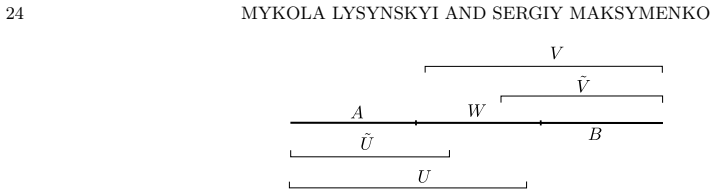
The load-bearing object is the minimal two-chart atlas on Y: a C^r structure is represented by charts φ: U→R, ψ: V→R with φ(W)=ψ(W)=R_pos, and its transition map g = ψ∘$φ^{{-1}}$ ∈ D_+(R_pos). The classification is carried by the action of the wreath product W ≀ Z_2 on D_+(R_pos), given by (a,b,δ)·g = (b∘g∘$a^{{-1}}$)^δ, whose orbits are exactly the (W,±)-double cosets; two atlases give the same structure exactly when their transition maps lie in the same orbit. Lemma 3.3.3, that every C^r structure on Y has a minimal atlas, is what reduces the whole problem to this transition-map invariant, and it rests on uniqueness of C^r structures on R.
What would settle it
Take the minimal atlases on Y with transition maps g(x)=$x^{2}$ and id, and attempt to write down a C^r diffeomorphism between the resulting manifolds; the paper's classification says this is impossible, so exhibiting one would falsify Theorem 1.2.
Extended reading notes
Core claim
Theorem 1.2 states that for each r ∈ {1,...,∞}, with D = D_+(R_pos) the orientation-preserving C^r diffeomorphism group of the positive reals and W its subgroup of diffeomorphisms extendable to C^r diffeomorphisms of R, there is a canonical bijection between isomorphism classes of C^r structures on the letter Y and (W,±)-double cosets $W \setminus D^{\pm 1} / W$. The correspondence sends each structure to the transition map of a minimal two-chart atlas, where the two charts carry U and V onto R and the overlap onto R_pos; two structures are C^r-diffeomorphic exactly when their transition maps are related by conjugation with extendable diffeomorphisms, possibly followed by inversion if the diffeomorphism swaps the two sheets. An immediate corollary is that Y has uncountably many pairwise non-diffeomorphic C^r structures, with explicit non-diffeomorphic examples given by the power maps g_s(x)=x^s for s>0. The same double-coset formalism, developed over arbitrary categories, reproduces the classification for the line with two origins and, in its categorical form, gives a unified method for classifying atlas-like structures on spans.
Load-bearing premise
The whole classification rests on the classical uniqueness of C^r structures on the real line, which is what lets every structure on Y be reduced to a minimal two-chart atlas.
Editorial extensions
If this is right
- For every r = 1,...,∞, Y carries uncountably many pairwise non-diffeomorphic C^r structures; the paper exhibits the continuum via the transition maps g_s(x) = x^s, s>0, with g_s and g_t distinct unless s=t or st=1.
- Two C^r structures on Y are diffeomorphic exactly when their transition maps lie in the same (W,±)-double coset; diffeomorphisms that preserve the two sheets correspond to ordinary double cosets, those that swap them correspond to the inversion.
- The same double-coset argument recovers the classification of C^r structures on the line with two origins L, making the two classifications special cases of one formalism.
- The categorical formulation classifies atlas-like structures on arbitrary spans; in particular, it applies whenever a space is glued from two open pieces U and V, and it specializes to a characterization of double cosets in any group.
- The paper notes the formalism can be used to classify C^k structures up to C^l diffeomorphism for l<k, and applies to infinite-dimensional manifolds.
Reading between the lines
- The same double-coset formalism should extend to manifolds glued from two open pieces along non-identical diffeomorphisms of the overlap; the classification would then be governed by the subgroup of diffeomorphisms extendable across the boundary of the overlap.
- The explicit family g_s(x)=x^s suggests a finer invariant — the leading exponent of the transition map at the branch point — that could separate the double-coset classes without invoking the full group W.
- The categorical version, applied to C^k structures up to C^l diffeomorphism or to complex structures, would likely produce double-coset classifications in settings where no triangulation theorem is available, including infinite-dimensional manifolds.
- A natural stress test is r = 0: replacing diffeomorphisms by homeomorphisms should collapse the double-coset classification to a single class, which would confirm that the counting phenomenon is genuinely smooth rather than topological.
Editorial analysis
A structured set of objections, weighed in public.
Referee Report
Summary. The paper classifies C^r differentiable structures on the non-Hausdorff one-dimensional space Y obtained by gluing two copies of R along R_{>0}. The central result, Theorem 1.2, states that for each r=1,...,∞ there is a canonical bijection between isomorphism classes of C^r structures on Y and (W,±)-double cosets W \ D^{±1} / W, where D = D_+(R_pos) is the group of orientation-preserving C^r diffeomorphisms of R_pos and W is the subgroup extendable to C^r diffeomorphisms of R; consequently Y admits uncountably many pairwise non-diffeomorphic C^r structures. The proof in Section 3 reduces every structure to a minimal two-chart atlas (Lemma 3.3.3), assigns a transition map g in D_+(R_pos), and shows via Lemma 3.3.5 that diffeomorphism classes correspond exactly to the double cosets. The power maps g_s(x)=x^s are used in Section 3.4 to exhibit the uncountable family. The paper also re-derives the analogous classification for the line with two origins L (Section 4.4) and gives a categorical generalization of the two-chart atlas formalism (Section 5).
Significance. If the main theorem is correct, it provides a complete, explicit classification of smooth structures on a simple non-Hausdorff 1-manifold, in stark contrast with the uniqueness of C^r structures on Hausdorff 1-manifolds. The proof is direct and largely self-contained: Lemma 3.3.3, Lemma 3.3.5, and the power-map separation argument in Lemma 3.4.3 are clean and convincing. The double-coset formulation gives a concrete invariant (the transition map modulo extensions) and yields explicit examples with prescribed symmetry behavior (Corollary 3.4.4). The categorical framework in Section 5, once repaired, could be a useful formalization of gluing constructions. The paper is not circular: the Y classification is proved independently of the earlier classification for L.
major comments (3)
- [Section 5.4, Theorem 5.4.1] The action defined in Theorem 5.4.1(1) is not well-typed in an arbitrary category. In the formula (a,b,δ)·g = η(bη^{-1}ga^{-1}) ... , the symbols a,b,g are automorphisms of W, while η is an isomorphism U→V; the composition bη^{-1}ga^{-1} is not a morphism in the category unless η respects the two inclusions of W into U and V, i.e., unless there is an isomorphism ε of W with η∘i = j∘ε (and similarly for η^{-1}). The manifold version in Section 4.3 explicitly assumes η(W)=W, but the categorical statement omits this hypothesis. The proof 'similarly to Theorem 4.3.3' therefore does not apply, and the independence-of-η claim in part 2 is not justified. Please add the compatibility hypothesis and define the action using the induced isomorphism of W, or restrict the theorem accordingly.
- [Section 4.4, p. 22] The sentence 'Now Theorems 4.2.1 and 4.3.3 imply show that W \ D / W classify all C^r structures on L, while W \ D^{±1} / W classifies such structures up to a C^r-diffeomorphism leaving U and V invariant' is reversed. According to Theorems 4.2.1 and 4.3.3, W \ D / W corresponds to structures up to diffeomorphisms preserving U and V, while W \ D^{±1} / W corresponds to all C^r structures (allowing diffeomorphisms that exchange U and V); the latter is exactly the statement of Theorem 1.1. As printed, the passage contradicts Theorem 1.1 and should be corrected by swapping the two clauses.
- [Section 4.4] The derivation of Theorem 1.1 from Theorems 4.2.1 and 4.3.3 is incomplete. Those theorems classify only the subclass C^r(L,U,V) of structures induced by (U,V)-atlases, and the surjectivity assertion 'µ is a bijection if and only if every g∈D(W) is a transition map' does not by itself guarantee that every C^r structure on L belongs to this subclass. An analogue of Lemma 3.3.3 for L (with W=R\{0}) is needed to pass from the classification of C^r(L,U,V) to the classification of all C^r structures on L; it is not supplied in the text.
minor comments (8)
- [Section 3.3, Theorem 3.3.4] The displayed correspondence writes g_A = ψ^{-1}∘ϕ, but the transition map is ψ∘ϕ^{-1}; the same sign error appears in Theorem 4.3.3(3) and Theorem 5.4.1(3).
- [Section 4.3, Theorem 4.3.3(2)] The statement says 'partition of E_U(W) into the orbits', but the action is on D(W); it should read 'partition of D(W)'.
- [Section 5.4, Theorem 5.4.1(2)] Similarly, 'partition of EC(W,i)' should be 'partition of AutC(W)'.
- [Section 4.4] The second displayed bijection in Section 4.4 writes E_V(W) \ D(W)^{±1} / E_V(W), but Theorem 4.3.3 uses E_U(W) on both sides; although the two subgroups coincide in the example, the notation should be made consistent.
- [Section 4.4] The formula for Φ_*(h) contains a typo: it should read Φ∘h∘Φ^{-1}.
- [Abstract] The abstract says C^k-structures but should say C^r-structures (or define k=r).
- [Section 2.5] The claim that the action is transitive for every manifold of dimension n≤3 should explicitly say 'Hausdorff' manifolds, since the paper's convention allows non-Hausdorff manifolds and the cited results are for Hausdorff ones.
- [Section 5.2, Lemma 5.2.2] The formula for ˜ψ# appears to contain a typo: it should probably be ˆb∘ψ#∘γ^{-1} rather than ˆb∘˜ϕ#∘γ^{-1}.
Circularity Check
No significant circularity: the Y classification is proved directly from the classical uniqueness theorem for R; self-citations are not load-bearing.
full rationale
The central claim, Theorem 1.2, is established in Section 3 by an explicit coordinate computation. Lemma 3.3.3 reduces an arbitrary C^r structure on Y to a minimal two-chart atlas, using Theorem 2.5.1 (uniqueness of C^r structures on R). That theorem is a classical external result, not the paper's target and not equivalent to the Y classification; the reference to [12] is for an elementary proof only. The double-coset bijections in Lemma 3.3.5 and Theorem 3.3.4 are derived directly from transition maps and diffeomorphism coordinate representations, not assumed. Section 4.4 re-derives the L classification from the new general Theorems 4.2.1 and 4.3.3 rather than importing it, so the self-citation to [12] is not load-bearing. The only anomalies are expository: Remark 1.2.1 says the proof of Theorem 1.2 is in Section 4.4 when it is in Section 3, and Section 4.4 appears to swap the roles of the two double-coset spaces for L. These are presentation and correctness issues outside the circularity analysis. No fitted parameter is relabeled as a prediction, and no ansatz is smuggled in through self-citation.
Assumptions & free parameters
assumptions (4)
- standard math Uniqueness of C^r structures on R (Theorem 2.5.1), i.e., every C^r structure on an open interval is diffeomorphic to the standard one.
- domain assumption Every homeomorphism of Y (resp. L) either preserves U,V or exchanges them, and preserves W.
- standard math Orientation-preserving C^r diffeomorphisms of Rpos extend continuously to the endpoint 0 and to infinity as homeomorphisms of [0,infinity].
- standard math Hadamard lemma: a C^r diffeomorphism of R fixing 0 can be written b(x)=x*bhat(x) with continuous bhat(0)>0.
Cite this review
Pith. "Pith review of Differentiable structures on a union of two open sets." pith.science (2026). https://pith.science/paper/QG3AIN5U
@misc{pith2026250705156,
  author       = {Pith},
  title        = {Pith review of: Differentiable structures on a union of two open sets},
  year         = {2026},
  howpublished = {\url{https://pith.science/paper/QG3AIN5U}},
  note         = {Machine review of arXiv:2507.05156}
}
abstract
In a recent paper the authors classified differentiable structures on the non-Hausdorff one-dimensional manifold $\mathbb{L}$ called the line with two origins which is obtained by gluing two copies of the real line $\mathbb{R}$ via the identity homeomorphism of $\mathbb{R}\setminus 0$. Here we give a classification of differentiable structures on another non-Hausdorff one-dimensional manifold $\mathbb{Y}$ (called letter "$Y$") obtained by gluing two copies of $\mathbb{R}$ via the identity map of positive reals. It turns out that, in contrast to the real line, for every $r=1,\ldots,\infty$, both manifolds $\mathbb{L}$ and $\mathbb{Y}$ admit uncountably many pair-wise non-diffeomorphic $\mathcal{C}^{k}$-structures. We also observe that the proofs of these classifications are very similar. This allows to formalize the arguments and extend them to a certain general statement about arrows in arbitrary categories.
Figures


Figures from the paper (1 more)
Reference graph
Works this paper leans on
-
[1]
Exotic structures on smooth four-manifolds
Selman Akbulut. Exotic structures on smooth four-manifolds. InPerspectives in analysis, geometry, and topology, volume 296 of Progr. Math., pages 1–17. Birkh¨ auser/Springer, New York, 2012.doi: 10.1007/978-0-8176-8277-4\_1
-
[2]
Stewart S. Cairns. Polyhedral approximations to regular loci.Ann. of Math. (2), 37(2):409–415, 1936. doi:10.2307/1968452
-
[3]
Cosmic censorship of smooth structures.Comm
Vladimir Chernov and Stefan Nemirovski. Cosmic censorship of smooth structures.Comm. Math. Phys., 320(2):469–473, 2013. doi:10.1007/s00220-013-1686-1
-
[4]
E. H. Connell. Approximating stable homeomorphisms by piecewise linear ones.Ann. of Math. (2), 78:326–338, 1963. doi:10.2307/1970346
-
[6]
Daniel S. Freed and Karen K. Uhlenbeck.Instantons and four-manifolds, volume 1 of Mathematical Sciences Research Institute Publications. Springer-Verlag, New York, second edition, 1991. doi:10. 1007/978-1-4613-9703-8
work page 1991
-
[7]
The topology of four-dimensional manifolds
Michael Hartley Freedman. The topology of four-dimensional manifolds. J. Differential Geometry, 17(3):357–453, 1982. URL:http://projecteuclid.org/euclid.jdg/1214437136
arXiv 1982
-
[8]
Springer, Singapore, 2014.doi:10.1007/978-981-287-257-9
David Gauld.Non-metrisable manifolds. Springer, Singapore, 2014.doi:10.1007/978-981-287-257-9
-
[9]
Robert E. Gompf. An infinite set of exotic R4’s. J. Differential Geom., 21(2):283–300, 1985. URL: http://projecteuclid.org/euclid.jdg/1214439566
arXiv 1985
Show all 20 references
-
[10]
Vari´ et´ es (non s´ epar´ ees) ` a une dimension et structures feuillet´ ees du plan
Andr´ e Haefliger and Georges Reeb. Vari´ et´ es (non s´ epar´ ees) ` a une dimension et structures feuillet´ ees du plan. Enseignement Math. (2), 3:107–125, 1957
1957
-
[11]
Foundational essays on topological manifolds, smoothings, and triangulations
RobionC.KirbyandLaurenceC.Siebenmann. Foundational essays on topological manifolds, smoothings, and triangulations. Annals of Mathematics Studies, No. 88. Princeton University Press, Princeton, NJ; University of Tokyo Press, Tokyo, 1977. With notes by John Milnor and Michael Atiyah
1977
-
[12]
Classification of differentiable structures on the non- hausdorff line with two origins, 2024.doi:10.48550/arXiv.2406.09576
Mykola Lysynskyi and Sergiy Maksymenko. Classification of differentiable structures on the non- hausdorff line with two origins, 2024.doi:10.48550/arXiv.2406.09576
-
[13]
Edwin E. Moise. Affine structures in3-manifolds. V. The triangulation theorem and Hauptvermutung. Ann. of Math. (2), 56:96–114, 1952.doi:10.2307/1969769
1952 doi
-
[14]
Obstructions to the smoothing of piecewise-differentiable homeomorphisms.Ann
James Munkres. Obstructions to the smoothing of piecewise-differentiable homeomorphisms.Ann. of Math. (2), 72:521–554, 1960.doi:10.2307/1970228
1960 doi
-
[15]
James R. Munkres. Some applications of triangulation theorems. PhD thesis, 1955. Thesis (Ph.D.)– University of Michigan. URL:https://www.proquest.com/docview/301954388
1955
-
[16]
Peter J. Nyikos. Various smoothings of the long line and their tangent bundles.Adv. Math., 93(2):129– 213, 1992. doi:10.1016/0001-8708(92)90027-I. 30 MYKOLA LYSYNSKYI AND SERGIY MAKSYMENKO
1992 doi
-
[17]
The piecewise-linear structure of Euclidean space.Proc
John Stallings. The piecewise-linear structure of Euclidean space.Proc. Cambridge Philos. Soc., 58:481– 488, 1962
1962
-
[18]
Gauge theory on asymptotically periodic 4-manifolds
Clifford Henry Taubes. Gauge theory on asymptotically periodic 4-manifolds. J. Differential Geom., 25(3):363–430, 1987. URL:http://projecteuclid.org/euclid.jdg/1214440981
1987
-
[19]
J. H. C. Whitehead. OnC 1-complexes. Ann. of Math. (2), 41:809–824, 1940.doi:10.2307/1968861
1940 doi
-
[20]
J. H. C. Whitehead. Manifolds with transverse fields in euclidean space.Ann. of Math. (2), 73:154–212,
-
[1961]
Department of Algebra and Topology, Institute of Mathematics of NAS of Ukraine, Tereshchenkivska str
doi:10.2307/1970286. Department of Algebra and Topology, Institute of Mathematics of NAS of Ukraine, Tereshchenkivska str. 3, Kyiv, 01601, Ukraine Email address: m.lysynskyi@imath.kiev.ua Department of Algebra and Topology, Institute of Mathematics of NAS of Ukraine, Tereshche...
Reviewed August 6, 2026 · model on record in the stance chip above.
Discussion (0). Continue with ORCID to comment.