pith. sign in

arxiv: 2507.05250 · v2 · submitted 2025-07-07 · 🌌 astro-ph.GA

A High Resolution Search for Dual AGN Candidates in Mergers: A Pre-Selection Strategy using Keck AO

Pith reviewed 2026-05-19 05:36 UTC · model grok-4.3

classification 🌌 astro-ph.GA
keywords dual AGNgalaxy mergersactive galactic nucleiadaptive opticspre-selectionSDSSWISEKeck observations
0
0 comments X

The pith

Offsets between SDSS optical and WISE infrared coordinates, paired with red WISE colors, pre-select advanced mergers that host unresolved nuclear substructure in 43 percent of cases when checked with Keck adaptive optics.

A machine-rendered reading of the paper's core claim, the machinery that carries it, and where it could break.

The paper develops a straightforward way to pick out nearby galaxy mergers that are far enough along to have their central black holes close together but still unresolved in ordinary images. It uses the small mismatch in position between an optical catalog and an infrared catalog, plus the infrared color that signals active accretion, to flag 46 systems for deeper study. High-resolution infrared imaging then confirms that 20 of those 46 show extra light components aligned with the original offset, a higher success rate than earlier selection tricks. If the method holds up, it gives astronomers a practical route to build larger samples of the rare sub-kiloparsec dual active nuclei needed to understand how black holes grow and eventually merge.

Core claim

By selecting 46 advanced mergers that display both red W1-W2 colors and significant sub-arcsecond SDSS-WISE coordinate offsets, the authors used Keck NIRC2 adaptive-optics Kp-band imaging to search for the unresolved nuclear substructure implied by those offsets. They report that 20 of the 46 targets (43 percent) show such substructure aligned with the offset and invisible to SDSS, a yield that exceeds rates obtained from double-peaked [O III] or hard X-ray pre-selection. Archival HST optical images often miss or misidentify the same features because of dust obscuration, reinforcing the value of infrared high-resolution follow-up for late-stage mergers.

What carries the argument

The SDSS-WISE offset pre-selection criterion, which combines sub-arcsecond coordinate differences with W1-W2 greater than 0.5 to flag candidate dual-AGN hosts before Keck AO imaging.

If this is right

  • The offset method returns a higher fraction of confirmed substructures than double-peaked emission-line or hard X-ray selection.
  • Infrared adaptive-optics imaging uncovers nuclear features that optical HST images miss or misclassify because of partial obscuration.
  • The technique supplies a systematic route to enlarge the known population of sub-kiloparsec dual AGN for spectroscopic confirmation.
  • Late-stage mergers identified this way become priority targets for measuring black-hole pairing and eventual coalescence rates.

Where Pith is reading between the lines

These are editorial extensions of the paper, not claims the author makes directly.

  • If the candidates prove to be genuine dual AGN, the method could be applied to much larger catalogs from upcoming wide-field infrared surveys to estimate the overall abundance of close black-hole pairs.
  • Repeated imaging of the same targets over years might reveal orbital motion of the nuclei and thereby test predictions for gravitational-wave sources.
  • Extending the color and offset cuts to higher-redshift samples could link the observed merger stage to the peak epoch of black-hole growth.
  • The same pre-selection logic might be tested on simulated merger populations to quantify contamination from non-AGN sources.

Load-bearing premise

Significant sub-arcsecond offsets between SDSS and WISE positions, together with red WISE colors, are produced by unresolved dual AGN rather than by dust lanes, star-forming regions, or astrometric errors.

What would settle it

High-resolution spectroscopy or X-ray imaging of the 20 systems that showed Keck-detected substructure that finds no separate accreting nuclei at the locations of the infrared components.

Figures

Figures reproduced from arXiv: 2507.05250 by A. Aravindan, B. Rothberg, Camilo Vazquez, E. K. Hicks, E. Schwartzman, F. Muller-Sanchez, G. Canalizo, J. M. Cann, J. McKaig, K. Nyland, L. Blecha, M. Malkan, M. McDonald, N. J. Secrest, P. Kurczynski, P. Nair, R. Sexton, R. W. Pfeifle, S. Doan, S. Juneau, S. Satyapal, T. Bohn, V. U.

Figure 1
Figure 1. Figure 1: Selection steps for sample of 356 galaxy merger systems with red WISE colors and significant SDSS/WISE offsets (0.15′′ < offset < 1.5 ′′). (MIR) colors indicative of AGNs and significant offsets between their infrared and optical nuclear coordinates as measured by SDSS and WISE. Although the spatial resolution of both WISE and SDSS is insufficient to re￾solve nuclei separated by less than ∼ 1.5′′ in late-s… view at source ↗
Figure 3
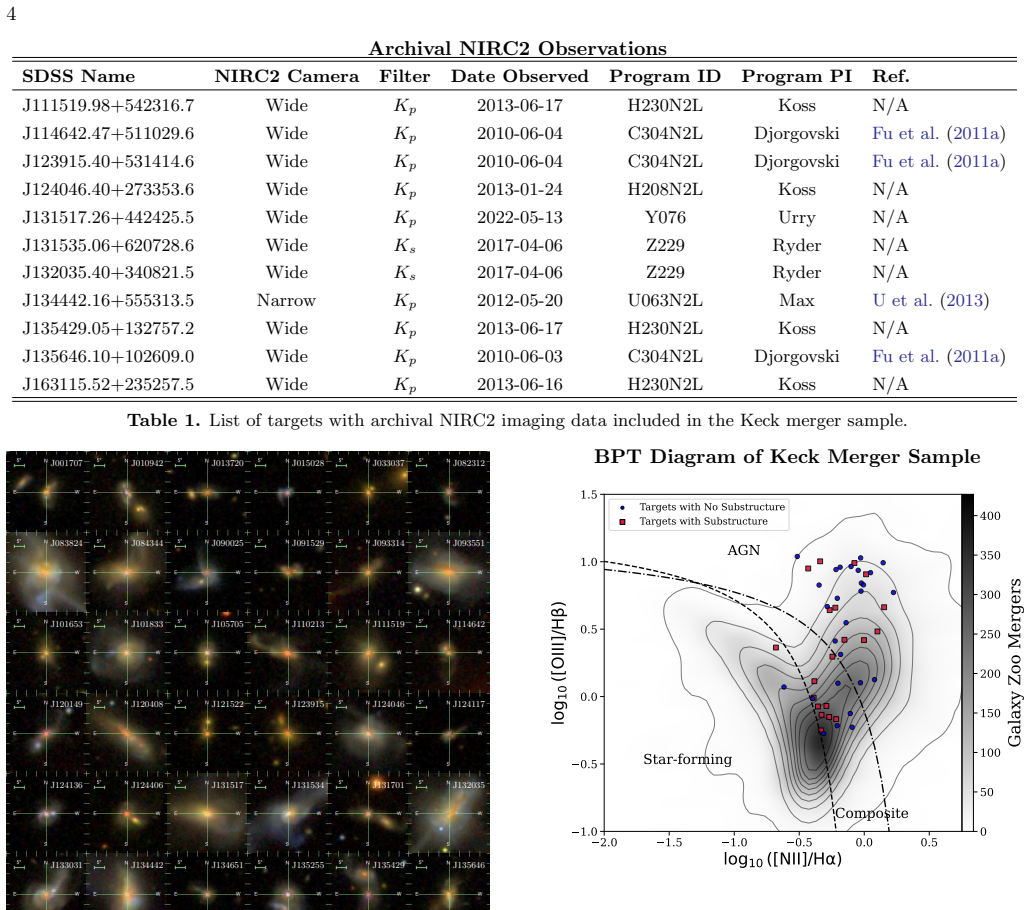
Figure 3. Figure 3: BPT diagram of the 48 target Keck merger sam￾ple (SDSS/WISE offset < 1.5 ′′) and the parent sample of mergers in Galaxy Zoo. The narrow emission line ratios were drawn from the MPA-JHU DR8 Catalog (Kauffmann et al. 2003a; Brinchmann et al. 2004; Tremonti et al. 2004). Crim￾son squares correspond to systems with substructure (see Section 4.1) and blue points correspond to all other galaxies in our sample. T… view at source ↗
Figure 2
Figure 2. Figure 2: SDSS cutout images of our sample of mergers con￾taining SDSS/WISE offsets between 0.15′′ and 1.5 ′′. Each cutout has dimensions of 40′′ × 40′′ . selected galaxies that have a high likelihood of being strongly disturbed mergers based on the Galaxy Zoo’s weighted merger-vote fraction parameter, fm, where fm > 0.4 indicates a system is a strong merger can￾didate (Darg et al. 2010). We also applied a MIR color… view at source ↗
Figure 4
Figure 4. Figure 4: A WISE color-color plot of the 48 target Keck merger sample and the parent sample of mergers in Galaxy Zoo. Crimson squares correspond to systems in our sam￾ple with substructure (see Section 4.1) and blue points cor￾respond to all other galaxies in our sample. The shaded contours correspond to all merger systems (fm > 0.4) in Galaxy Zoo. The red dotted horizontal line illustrates the W1 −W2 > 0.5 color cu… view at source ↗
Figure 6
Figure 6. Figure 6: Example UKIDSS K band cutout image of J131012.68+001809.3, one of the targets included in the ex￾panded UKIDSS sample. We overlay the offset SDSS and WISE coordinates for this system demonstrating how the SDSS/WISE offset traces a merger system unresolved by WISE. are classified with the BPT diagram. We also use the three-band AGN color cut from Jarrett et al. (2011) to identify MIR AGNs in the sample. The… view at source ↗
Figure 7
Figure 7. Figure 7: Same as [PITH_FULL_IMAGE:figures/full_fig_p008_7.png] view at source ↗
Figure 9
Figure 9. Figure 9: Same as [PITH_FULL_IMAGE:figures/full_fig_p009_9.png] view at source ↗
Figure 10
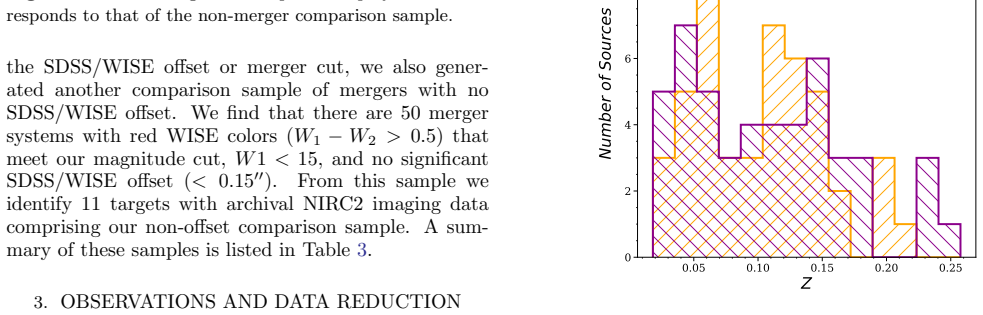
Figure 10. Figure 10: Histograms comparing the distributions of SDSS/WISE offset and redshift of the 48 target merger sam￾ple and 48 target non-merger sample. We conduct a two￾sample KS-test for each variable and include the results in the legend of each histogram. Wide-Field Camera images and 5×300s for the Narrow￾Field Camera image. A 3-point dither pattern strategy was employed for all observations across all three nights, … view at source ↗
Figure 11
Figure 11. Figure 11: Histograms comparing the distributions of W1 magnitude, W1 − W2, and W2 − W3 of the 48 target Keck merger sample and 48 target Keck non-merger sample. We conduct a two-sample KS-test for each variable and include the results in the legend of each histogram. Note that one target (J152659) from the merger sample is not included in the W2 − W3 comparison since it does not have an available W3 magnitude. erag… view at source ↗
Figure 12
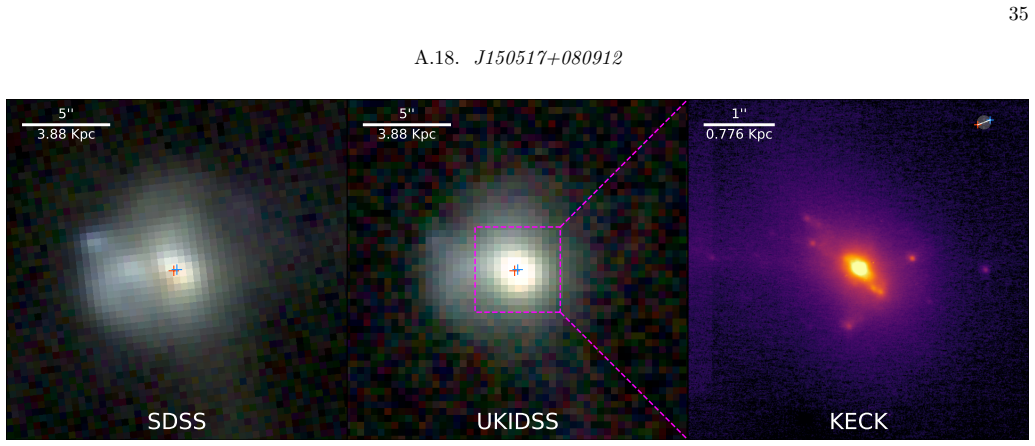
Figure 12. Figure 12: Final NIRC2 AO Kp band cutout images of the 48 target Keck merger sample. North is up and East is to the left in each image. The white scale bar in the top left of each image corresponds to 1 arcsecond. Those targets which we identify as having substructure are highlighted in green (see Appendix A for detailed descriptions) [PITH_FULL_IMAGE:figures/full_fig_p012_12.png] view at source ↗
Figure 13
Figure 13. Figure 13: A comparison of substructure detection rate to SDSS/WISE offset in our 48 target Keck merger sample (0.15′′ < offset < 1.5 ′′). We define 8 bins that vary in width and position along the X-axis such that the sample size for each bin is relatively the same. For each bin we plot the sub￾structure detection rate for targets with SDSS/WISE offsets within that range. The error bars we include are calculated wi… view at source ↗
Figure 14
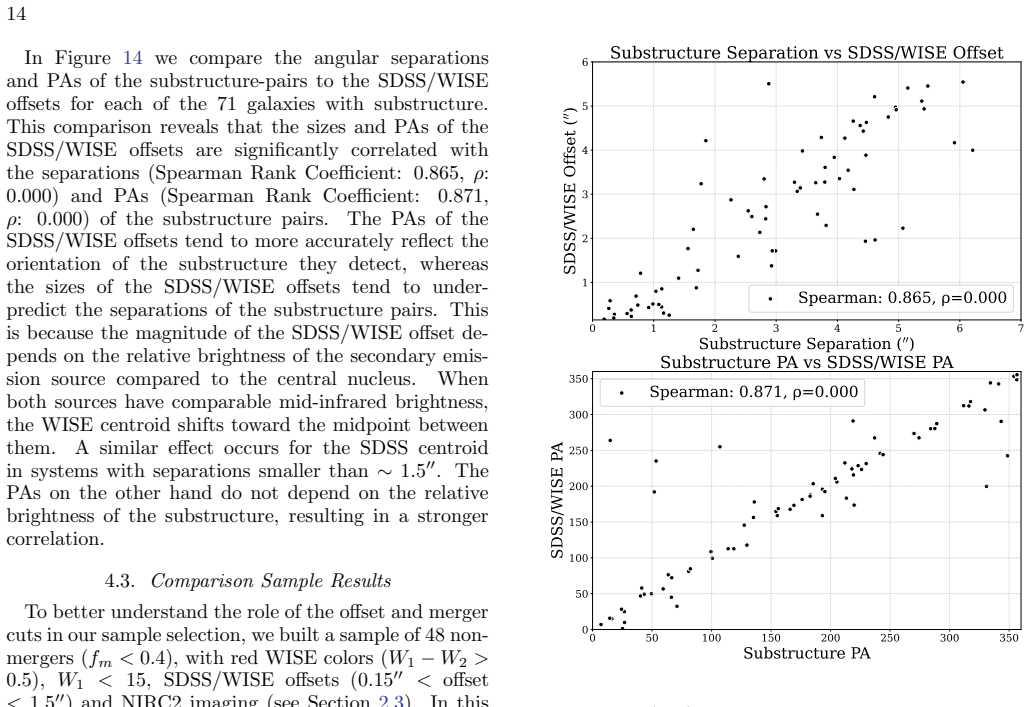
Figure 14. Figure 14: (Top) A comparison between the angular sepa￾rations of the SDSS/WISE positional offset and substructure pair in each target with substructure. (Bottom) A compar￾ison between the position angles of the SDSS/WISE posi￾tional offset and substructure pair in each target with sub￾structure. (offset< 0.15′′; see Section 2.3). Only one target of the 11 contains substructure with a flux ratio of 0.185, which is c… view at source ↗
Figure 15
Figure 15. Figure 15: Examples of targets with no substructure whose SDSS/WISE offsets are likely caused by partial obscuration of their optical emission. For each target we include the cor￾responding SDSS, HST, Keck and when available UKIDSS images. In the top right of each HST or Keck image we in￾clude a representation of the SDSS/WISE offset which shows the orientation and length of the offset for that particular system, ad… view at source ↗
Figure 16
Figure 16. Figure 16: Same as [PITH_FULL_IMAGE:figures/full_fig_p016_16.png] view at source ↗
Figure 17
Figure 17. Figure 17: Example images of targets with substructure whose SDSS/WISE offsets are likely caused by partial obscuration of the substructure. For each target we include the corresponding HST and Keck images. In the top right of each image we include a representation of the SDSS/WISE offset which shows the orientation and length of the offset for that particular system. (Top Left) J015028, (Top Middle) J110213, (Top R… view at source ↗
Figure 18
Figure 18. Figure 18: Histogram of the ratio of NIR/Optical sources as a function of merger nuclear separation for targets in our 48 target merger sample with NIRC2 and HST imaging. We include images of two targets included in this plot, J131534 and J131517, as an example of targets with a ratio above and below 1, respectively. 5'' 9.68 Kpc SDSS 5'' 9.68 Kpc UKIDSS 1'' 1.94 Kpc KECK [PITH_FULL_IMAGE:figures/full_fig_p017_18.png] view at source ↗
Figure 19
Figure 19. Figure 19: SDSS and NIRC2 image of J001707, a target from the Keck merger sample with a sub-arcsecond offset between its WISE and UKIDSS nuclear coordinates. Over￾laid on the SDSS image is the WISE coordinate (red), SDSS coordinate (blue) and UKIDSS coordinate (green). In the top right of the NIRC2 image we include representations of the SDSS/WISE and UKIDSS/WISE offsets corresponding to their sizes and orientations… view at source ↗
Figure 20
Figure 20. Figure 20: Images provided above are described at the beginning of Appendix A. NIRC2 imaging of J001707 reveals that it contains clear dual nuclei separated by 0.986′′ or 1.910 kpc with a PA of 99.51°. In both SDSS and UKIDSS these nuclei are blended into a single apparent nucleus elongated along the direction of the two nuclei. The host galaxy exhibits bipolar tidal tails extending out to ∼12.4 kpc in the North and… view at source ↗
Figure 21
Figure 21. Figure 21: Images provided above are described at the beginning of Appendix A. J010942 appears to be a highly disturbed galaxy undergoing a merger with a companion 10′′ or 16.57 kpc to the Southwest. J010942 appears to contain a single elongated nucleus in both SDSS and UKIDSS whereas the companion contains two semi-resolved nuclei. High-resolution NIRC2 imaging of this target reveals two nuclei and confirms the pre… view at source ↗
Figure 22
Figure 22. Figure 22: Images provided above are described at the beginning of Appendix A. J015028 is a merger system with a galaxy pair in the East and West of the SDSS cutout image, only the Western galaxy is visible in UKIDSS, separated by 3.742′′ or 9.60 kpc. We detect an SDSS/WISE offset in this Western galaxy with a separation of 0.275′′ and PA of 62.35° and thus consider it to be the target galaxy for this analysis. High… view at source ↗
Figure 23
Figure 23. Figure 23: Images provided above are described at the beginning of Appendix A. NIRC2 imaging of J082312 reveals three potential nuclei connected by an arc of emission. There is a clear primary nucleus and two secondary nuclei, northwest from the primary at a distance of 0.56′′ and north from the primary at a distance of 1.06′′ with PA’s of 331.030° and 2.440° respectively. The host galaxy, as seen in SDSS, exhibits … view at source ↗
Figure 24
Figure 24. Figure 24: Images provided above are described at the beginning of Appendix A. J091529 is a close galaxy pair separated by 3.344′′ and 8.392 kpc; the nuclei of both galaxies are resolved in the SDSS, UKIDSS and NIRC2 images. The high resolution NIRC2 imaging of this target reveals previously unresolved substructure near the primary central nucleus of the Eastern galaxy. Surrounding this nucleus we can see faint emis… view at source ↗
Figure 25
Figure 25. Figure 25: Images provided above are described at the beginning of Appendix A. J093314 is an advanced merger system which appears to contain a single nucleus with multiple tidal tails in its SDSS image. The tidal tails extend in opposite directions without much curvature out to distances of ∼ 30 kpc and ∼ 15 kpc. The NIRC2 imaging reveals two apparent nuclei at a separation of 0.190′′ or 0.405 kpc with a PA of 316.2… view at source ↗
Figure 26
Figure 26. Figure 26: Images provided above are described at the beginning of Appendix A. J101653 is a close galaxy pair separated by 2.26′′ or 4.76 kpc, with the nuclei of both galaxies resolved in SDSS and UKIDSS. This target has been previously identified as an elliptical galaxy within a disturbed pre-coalescence system (Pierce et al. 2023). The detected SDSS/WISE offset is in the Northwestern galaxy of this pair. The NIRC2… view at source ↗
Figure 27
Figure 27. Figure 27: Images provided above are described at the beginning of Appendix A. J110213 is a candidate dual AGN system containing clear sub-kpc dual nuclei with a separation of 0.357′′ or 0.524 kpc and PA of 70.923°. This is a late-stage merging system with one apparent nucleus detected in SDSS. One prominent tidal tail extends 17.5′′ out to the East and curves towards the North and back into the center of the galaxy… view at source ↗
Figure 28
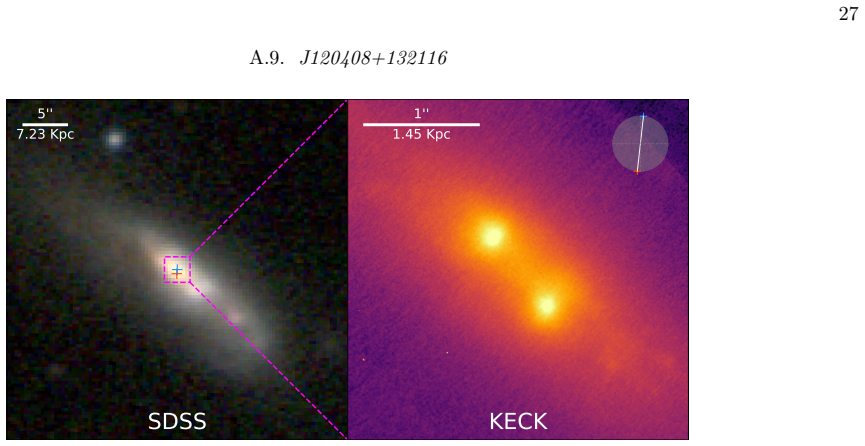
Figure 28. Figure 28: Images provided above are described at the beginning of Appendix A. J120408 is a candidate dual AGN system containing two clear nuclei at a separation of 0.740′′ or 1.070 kpc and PA of 219.846°. SDSS imaging of this target shows an elongated galaxy with one apparent optical nucleus and a highly extended (> 10′′) tidal tail extending to the Northeast. The SDSS/WISE offset for this target has a separation o… view at source ↗
Figure 29
Figure 29. Figure 29: Images provided above are described at the beginning of Appendix A. J123915 is one of the targets in the 48 target Keck merger sample which has publicly available NIRC2 imaging available in the Keck archive (see Section 2.1). Fu et al. (2011a) conducted Keck LGSAO observations of this target with the NIRC2 Wide-Field Camera (FOV: 40′′ × 40′′, pixel scale: 0.039686′′pixel−1 ) in the Kp filter as part of an… view at source ↗
Figure 30
Figure 30. Figure 30: Images provided above are described at the beginning of Appendix A. J124117 is the Northeastern galaxy in a close galaxy pair separated by 2.44′′ or 6 kpc, in which we detect a coordinate offset. Both galaxies are visible in the NIRC2 imaging, with the galaxy of interest (Northeast) containing a complex nuclear region with multiple compact sources of emission within the central arcsecond of the galaxy. Th… view at source ↗
Figure 31
Figure 31. Figure 31: Images provided above are described at the beginning of Appendix A. J131517 is one of the targets in the 48 target Keck merger sample which has publicly available NIRC2 imaging in the Keck archive (see Section 2.1). Keck LGSAO observations of this target were conducted with the NIRC2 Wide-Field Camera (FOV: 40′′ × 40′′, pixel scale: 0.039686′′pixel−1 ) in the Kp filter as part of Keck observing program Y0… view at source ↗
Figure 32
Figure 32. Figure 32: Images provided above are described at the beginning of Appendix A. J131534 is one of the targets in the 48 target Keck merger sample which has publicly available NIRC2 imaging in the Keck archive (see Section 2.1). Keck LGSAO observations of this target were conducted with the NIRC2 Wide-Field Camera (FOV: 40′′ × 40′′, pixel scale: 0.039686′′pixel−1 ) in the Ks (λc = 2.146µm) filter as part of Keck obser… view at source ↗
Figure 33
Figure 33. Figure 33: Images provided above are described at the beginning of Appendix A. Note that this target does not have a UKIDSS Y band cutout image available, thus the UKIDSS three color image is comprised of K band, H band and J band images. J132035 is one of the targets in the 48 target Keck merger sample which has publicly available NIRC2 imaging in the Keck archive (see Section 2.1). Keck LGSAO observations of this … view at source ↗
Figure 34
Figure 34. Figure 34: Images provided above are described at the beginning of Appendix A. J134442 is one of the targets in the 48 target Keck merger sample which has publicly available NIRC2 imaging in the Keck archive (see Section 2.1). This target is an ultra-luminous infrared galaxy (ULIRG) and late-stage merger system with a very extended optical tidal tail stretching 40 kpc to the South in the SDSS image. U et al. (2013) … view at source ↗
Figure 35
Figure 35. Figure 35: Images provided above are described at the beginning of Appendix A. J134651 appears to be a post-merger system with an extended tidal tail extending 5.5′′ or 19.19 kpc to the Northeast. The NIRC2 imaging reveals substructure in the form of apparent spiral arms in the Northeast and Southwest. In the Northeast arm we identify concentrated emission as the brightest secondary source of emission, forming a sub… view at source ↗
Figure 36
Figure 36. Figure 36: Images provided above are described at the beginning of Appendix A. J135646 is one of the targets in the 48 target Keck merger sample which has publicly available NIRC2 imaging available in the Keck archive (see Section 2.1). Fu et al. (2011a) conducted Keck LGSAO observations of this target with the NIRC2 Wide-Field Camera (FOV: 40′′ × 40′′, pixel scale: 0.039686′′pixel−1 ) in the Kp filter as part of an… view at source ↗
Figure 37
Figure 37. Figure 37: Images provided above are described at the beginning of Appendix A. J1505 is a late-stage merger system with significant tidal features and an elongated nucleus. In its SDSS image we see two tidal tails, one extending Southward out to 11 kpc and a Western tail curving Northward with an approximate length of 13 kpc. Additionally, there is a highly curved tail of emission coming out of the Western side of t… view at source ↗
Figure 38
Figure 38. Figure 38: Images provided above are described at the beginning of Appendix A. J151806 is an extensively studied target also known as VV 705. The SDSS image shows that this is clearly a merging system which appears to have gone through its first pass, indicated by its very prominent tidal tails and bridge of emission between the two galaxies. This is a previously identified candidate dual AGN at a separation of 5.8 … view at source ↗
Figure 39
Figure 39. Figure 39: Images provided above are described at the beginning of Appendix A. J152659 is an advanced merger system with tidal tails in the Southwest and East connected by an arc of emission with an approximate radius of 12′′ or 13 kpc. In the NIRC2 image we can see multiple sources of substructure within the nuclear region of this target which were unresolved in SDSS. There is a prominent bright primary nucleus in … view at source ↗
read the original abstract

Accreting supermassive black holes (SMBHs) in galaxy mergers with separations $<$ 1 kpc are crucial to our understanding of SMBH growth, galaxy evolution, and SMBH binary evolution. Despite their importance, few are known, and most have been discovered serendipitously. In this work, we develop and test a method to systematically pre-select candidate advanced mergers likely to contain unresolved sub-kpc nuclear substructure constituting high-priority dual-AGN candidates for follow-up spectroscopy. By exploiting the survey area and astrometric precision of the Wide-field Infrared Survey Explorer (WISE) and the Sloan Digital Sky Survey (SDSS), we identified 46 nearby advanced mergers that have red WISE colors ($W_1-W_2>0.5$) indicative of accretion activity and significant sub-arcsecond offsets between their optical and infrared coordinates as measured by SDSS and WISE. We conducted high-resolution adaptive optics (AO) observations with the Keck NIRC2 camera in the $K_p$ band ($2.124 \mu m$, $\Delta\lambda = 0.351 \mu m$) to search for unresolved substructure suggested by the optical-to-infrared offsets. We find that 20/46 (43\%) of the sample shows substructure tracing the SDSS/WISE offset and unresolved by SDSS , representing a higher yield than previous pre-selection techniques such as double-peaked [O III] or hard X-ray selection. These results demonstrate that the SDSS/WISE offset method provides an efficient pathway for identifying late-stage mergers and dual-AGN candidates for spectroscopic confirmation. Archival optical Hubble Space Telescope (HST) imaging reveals that substructure identified with Keck is often missed in the optical or erroneously identified due to partial obscuration, underscoring the importance of infrared studies of late-stage mergers.

Editorial analysis

A structured set of objections, weighed in public.

Desk editor's note, referee report, simulated authors' rebuttal, and a circularity audit. Tearing a paper down is the easy half of reading it; the pith above is the substance, this is the friction.

Referee Report

2 major / 2 minor

Summary. The paper develops a pre-selection strategy for dual-AGN candidates in advanced galaxy mergers by identifying 46 nearby systems with significant sub-arcsecond SDSS-WISE coordinate offsets and W1-W2 > 0.5 colors. Keck AO imaging in the Kp band reveals unresolved substructure tracing the offset in 20 of 46 targets (43%), a higher yield than prior methods such as double-peaked [O III] or hard X-ray selection. Archival HST imaging is used to show that Keck-detected substructure is often missed or misidentified in optical data due to obscuration.

Significance. If the substructure corresponds to dual AGN, the method offers an efficient, observationally grounded pathway to increase the known sample of sub-kpc SMBH pairs, which are critical for merger-driven SMBH growth and binary evolution studies. The direct AO confirmation of substructure in a substantial fraction of the pre-selected sample is a strength, as is the comparison to HST data highlighting the value of infrared observations.

major comments (2)
  1. [Selection criteria and Results] Selection criteria and interpretation sections: the central claim that SDSS-WISE offsets plus W1-W2 > 0.5 reliably flag unresolved nuclear substructure due to dual AGN (rather than dust lanes, off-nuclear star formation, or astrometric mismatches) is load-bearing for attributing the 43% yield to the dual-AGN channel. No quantitative position-angle alignment statistics between the reported offset vector and the detected Kp-band substructure are provided, nor is a control sample of mergers lacking the offset criterion analyzed for comparison.
  2. [Abstract and Results] Abstract and Results: the reported yield of 20/46 (43%) lacks formal binomial or Poisson error bars, and no quantitative statistical comparison (e.g., yield ratios with uncertainties) to double-peaked [O III] or X-ray pre-selection samples is given, weakening the claim of a 'higher yield'.
minor comments (2)
  1. [Results] Clarify the exact definition of 'tracing the SDSS/WISE offset' used to classify the 20 detections (e.g., centroid offset direction and magnitude thresholds).
  2. [Sample selection] Provide the typical astrometric uncertainties for SDSS and WISE at the magnitudes of the sample to allow readers to assess possible catalog mismatch contributions.

Simulated Author's Rebuttal

2 responses · 0 unresolved

We thank the referee for their constructive and detailed review, which has helped us identify areas where the manuscript can be strengthened. We address each major comment below with clarifications and revisions.

read point-by-point responses
  1. Referee: Selection criteria and interpretation sections: the central claim that SDSS-WISE offsets plus W1-W2 > 0.5 reliably flag unresolved nuclear substructure due to dual AGN (rather than dust lanes, off-nuclear star formation, or astrometric mismatches) is load-bearing for attributing the 43% yield to the dual-AGN channel. No quantitative position-angle alignment statistics between the reported offset vector and the detected Kp-band substructure are provided, nor is a control sample of mergers lacking the offset criterion analyzed for comparison.

    Authors: We agree that quantitative position-angle alignment would provide a stronger test of association between the SDSS-WISE offset and the Keck substructure. In the revised manuscript we will add a statistical summary of the position-angle differences for the 20 systems showing substructure, including the fraction aligned within 30 degrees and a simple significance estimate against random orientations. A dedicated control sample of advanced mergers lacking the offset criterion was not observed in this program, as the study was designed to measure the efficiency of the offset-plus-color pre-selection; we will explicitly note this scope limitation and compare our 43% substructure detection rate to literature yields for merger samples selected by other criteria (e.g., morphological or spectroscopic) to place the result in context. revision: partial

  2. Referee: Abstract and Results: the reported yield of 20/46 (43%) lacks formal binomial or Poisson error bars, and no quantitative statistical comparison (e.g., yield ratios with uncertainties) to double-peaked [O III] or X-ray pre-selection samples is given, weakening the claim of a 'higher yield'.

    Authors: We accept that formal uncertainties and a quantitative literature comparison would improve clarity. The revised version will report the binomial 68% confidence interval on the 20/46 yield (approximately 29–58%) in both the abstract and results. We will also tabulate or cite representative confirmation yields from double-peaked [O III] and hard X-ray studies (typically 10–25% for confirmed dual or offset AGN) and note that our substructure detection fraction is higher, while acknowledging that the comparison is not identical because our confirmation is morphological rather than spectroscopic. revision: yes

Circularity Check

0 steps flagged

Purely observational study with no derivations, equations, or self-referential predictions

full rationale

The manuscript is an empirical observational program: it applies fixed selection cuts (sub-arcsecond SDSS-WISE offsets plus W1-W2 > 0.5) to identify 46 targets, obtains Keck NIRC2 Kp-band AO images, and reports the measured fraction (20/46) that exhibit unresolved substructure. No equations, model fits, or first-principles derivations appear in the abstract or described methods. The central claim is therefore a direct count in a pre-selected sample rather than a prediction that reduces to its own inputs by construction. Any self-citations that may exist are not load-bearing for a mathematical result, and the work contains no uniqueness theorems, ansatzes, or renamings of known patterns. The analysis is self-contained against external benchmarks because the detection rate is measured directly from the new imaging data.

Axiom & Free-Parameter Ledger

2 free parameters · 1 axioms · 0 invented entities

The central claim rests on two survey-specific assumptions: that WISE and SDSS astrometry are accurate enough at the sub-arcsecond level to indicate real nuclear offsets, and that red WISE colors reliably flag accretion rather than star formation. No new physical entities are introduced.

free parameters (2)
  • W1-W2 color threshold
    The cut W1-W2 > 0.5 is adopted from prior AGN selection literature and functions as a fixed selection parameter for the sample.
  • offset significance threshold
    The precise angular offset criterion used to define 'significant' is not numerically specified in the abstract but is required to produce the 46-object sample.
axioms (1)
  • domain assumption WISE and SDSS coordinate differences at sub-arcsecond level trace physical nuclear substructure rather than catalog artifacts or dust extinction effects.
    Invoked when interpreting the offsets as evidence for unresolved dual-AGN candidates.

pith-pipeline@v0.9.0 · 5991 in / 1583 out tokens · 41912 ms · 2026-05-19T05:36:44.068936+00:00 · methodology

discussion (0)

Sign in with ORCID, Apple, or X to comment. Anyone can read and Pith papers without signing in.

Lean theorems connected to this paper

Citations machine-checked in the Pith Canon. Every link opens the source theorem in the public Lean library.

What do these tags mean?
matches
The paper's claim is directly supported by a theorem in the formal canon.
supports
The theorem supports part of the paper's argument, but the paper may add assumptions or extra steps.
extends
The paper goes beyond the formal theorem; the theorem is a base layer rather than the whole result.
uses
The paper appears to rely on the theorem as machinery.
contradicts
The paper's claim conflicts with a theorem or certificate in the canon.
unclear
Pith found a possible connection, but the passage is too broad, indirect, or ambiguous to say the theorem truly supports the claim.

Reference graph

Works this paper leans on

83 extracted references · 83 canonical work pages

  1. [1]

    M., et al

    Agazie, G., Anumarlapudi, A., Archibald, A. M., et al. 2023, ApJL, 951, L8

  2. [2]

    M., Evans, A

    Armus, L., Mazzarella, J. M., Evans, A. S., et al. 2009, PASP, 121, 559 37 Astropy Collaboration, Robitaille, T. P., Tollerud, E. J., et al. 2013, A&A, 558, A33

  3. [3]

    A., Phillips, M

    Baldwin, J. A., Phillips, M. M., & Terlevich, R. 1981, PASP, 93, 5

  4. [4]

    2008, MNRAS, 386, 105

    Matt, G. 2008, MNRAS, 386, 105

  5. [5]

    F., Satyapal, S., & Ellison, S

    Blecha, L., Snyder, G. F., Satyapal, S., & Ellison, S. L. 2018, MNRAS, 478, 3056

  6. [6]

    D., Bushouse, H., Colina, L., et al

    Borne, K. D., Bushouse, H., Colina, L., et al. 1999, in Astronomical Society of the Pacific Conference Series, Vol. 177, Astrophysics with Infrared Surveys: A Prelude to SIRTF, ed. M. D. Bicay, R. M. Cutri, & B. F. Madore, 167

  7. [7]

    Brinchmann, J., Charlot, S., White, S. D. M., et al. 2004, MNRAS, 351, 1151

  8. [8]

    R., Dotti, M., Volonteri, M., et al

    Capelo, P. R., Dotti, M., Volonteri, M., et al. 2017, MNRAS, 469, 4437

  9. [9]

    R., Volonteri, M., Dotti, M., et al

    Capelo, P. R., Volonteri, M., Dotti, M., et al. 2015, MNRAS, 447, 2123

  10. [10]

    2007, A&A, 467, 777

    Casali, M., Adamson, A., Alves de Oliveira, C., et al. 2007, A&A, 467, 777

  11. [11]

    2022, ApJ, 925, 162

    Chen, Y.-C., Hwang, H.-C., Shen, Y., et al. 2022, ApJ, 925, 162

  12. [12]

    M., Negus, J., Barrows, R

    Comerford, J. M., Negus, J., Barrows, R. S., et al. 2022, ApJ, 927, 23

  13. [13]

    M., Nevin, R., Stemo, A., et al

    Comerford, J. M., Nevin, R., Stemo, A., et al. 2018, ApJ, 867, 66

  14. [14]

    M., Pooley, D., Barrows, R

    Comerford, J. M., Pooley, D., Barrows, R. S., et al. 2015, ApJ, 806, 219

  15. [15]

    M., Pooley, D., Gerke, B

    Comerford, J. M., Pooley, D., Gerke, B. F., & Madejski, G. M. 2011, ApJL, 737, L19

  16. [16]

    M., Schluns, K., Greene, J

    Comerford, J. M., Schluns, K., Greene, J. E., & Cool, R. J. 2013, ApJ, 777, 64

  17. [17]

    W., Kaviraj, S., Lintott, C

    Darg, D. W., Kaviraj, S., Lintott, C. J., et al. 2010, MNRAS, 401, 1043 De Rosa, A., Vignali, C., Husemann, B., et al. 2018, MNRAS, 480, 1639

  18. [18]

    D., et al

    Fu, H., Yan, L., Myers, A. D., et al. 2012, ApJ, 745, 67

  19. [19]

    E., Zakamska, N

    Greene, J. E., Zakamska, N. L., & Smith, P. S. 2012, ApJ, 746, 86

  20. [20]

    C., Collins, R

    Hambly, N. C., Collins, R. S., Cross, N. J. G., et al. 2008, MNRAS, 384, 637

  21. [21]

    R., Millman, K

    Harris, C. R., Millman, K. J., van der Walt, S. J., et al. 2020, Nature, 585, 357

  22. [22]

    2023, ApJ, 949, 49

    He, L., Hou, M., Li, Z., Feng, S., & Liu, X. 2023, ApJ, 949, 49

  23. [23]

    C., Warren, S

    Hewett, P. C., Warren, S. J., Leggett, S. K., & Hodgkin, S. T. 2006, MNRAS, 367, 454

  24. [24]

    F., & Hernquist, L

    Hopkins, P. F., & Hernquist, L. 2006, ApJS, 166, 1

  25. [25]

    2019, ApJ, 882, 41

    Hou, M., Liu, X., Guo, H., et al. 2019, ApJ, 882, 41

  26. [26]

    K., & Malkan, M

    Hunt, L. K., & Malkan, M. A. 2004, ApJ, 616, 707

  27. [27]

    2020, ApJ, 888, 73

    Hwang, H.-C., Shen, Y., Zakamska, N., & Liu, X. 2020, ApJ, 888, 73

  28. [28]

    Irwin, M. J. 2008, in 2007 ESO Instrument Calibration Workshop, ed. A. Kaufer & F. Kerber, 541

  29. [29]

    M., et al

    Iwasawa, K., U, V., Mazzarella, J. M., et al. 2018, A&A, 611, A71

  30. [30]

    H., Cohen, M., Masci, F., et al

    Jarrett, T. H., Cohen, M., Masci, F., et al. 2011, ApJ, 735, 112

  31. [31]

    Z., Blecha, L., & Hernquist, L

    Kelley, L. Z., Blecha, L., & Hernquist, L. 2017, MNRAS, 464, 3131

  32. [32]

    J., Dopita, M

    Kewley, L. J., Dopita, M. A., Sutherland, R. S., Heisler, C. A., & Trevena, J. 2001, ApJ, 556, 121

  33. [33]

    C., Yoon, I., Evans, A

    Kim, D. C., Yoon, I., Evans, A. S., et al. 2020, ApJ, 904, 23

  34. [34]

    J., Ho, L

    Kim, M., Barth, A. J., Ho, L. C., & Son, S. 2021, ApJS, 256, 40

  35. [35]

    2003, ApJL, 582, L15

    Komossa, S., Burwitz, V., Hasinger, G., et al. 2003, ApJL, 582, L15

  36. [36]

    2012, ApJL, 746, L22

    Koss, M., Mushotzky, R., Treister, E., et al. 2012, ApJL, 746, L22

  37. [37]

    J., Blecha, L., Bernhard, P., et al

    Koss, M. J., Blecha, L., Bernhard, P., et al. 2018, Nature, 563, 214

  38. [38]

    J., Treister, E., Kakkad, D., et al

    Koss, M. J., Treister, E., Kakkad, D., et al. 2023, ApJL, 942, L24

  39. [39]

    J., Almaini, O., et al

    Lawrence, A., Warren, S. J., Almaini, O., et al. 2007, MNRAS, 379, 1599

  40. [40]

    2024, arXiv e-prints, arXiv:2405.14980

    Li, J., Zhuang, M.-Y., Shen, Y., et al. 2024, arXiv e-prints, arXiv:2405.14980

  41. [41]

    R., & Bogdanovi´ c, T

    Li, K., Ballantyne, D. R., & Bogdanovi´ c, T. 2021, ApJ, 916, 110

  42. [42]

    R., & Bonetti, M

    Li, K., Bogdanovi´ c, T., Ballantyne, D. R., & Bonetti, M. 2022, ApJ, 933, 104

  43. [43]

    J., Schawinski, K., Slosar, A., et al

    Lintott, C. J., Schawinski, K., Slosar, A., et al. 2008, MNRAS, 389, 1179

  44. [44]

    2013, ApJ, 762, 110

    Liu, X., Civano, F., Shen, Y., et al. 2013, ApJ, 762, 110

  45. [45]

    A., & Hao, L

    Liu, X., Shen, Y., Strauss, M. A., & Hao, L. 2011, ApJ, 737, 101

  46. [46]

    2019, ApJ, 887, 90

    Liu, X., Hou, M., Li, Z., et al. 2019, ApJ, 887, 90

  47. [47]

    2016, MNRAS, 463, 24

    Lyu, Y., & Liu, X. 2016, MNRAS, 463, 24

  48. [48]

    and Charlot, Stéphane and Chevallard, Jacopo and Eisenstein, Daniel J

    Maiolino, R., Scholtz, J., Curtis-Lake, E., et al. 2023, arXiv e-prints, arXiv:2308.01230

  49. [49]

    A., Gorjian, V., & Tam, R

    Malkan, M. A., Gorjian, V., & Tam, R. 1998, ApJS, 117, 25

  50. [50]

    Marocco, F., Eisenhardt, P. R. M., Fowler, J. W., et al. 2021, ApJS, 253, 8

  51. [51]

    V., & Katkov, I

    Chilingarian, I. V., & Katkov, I. Y. 2020, A&A, 641, A171

  52. [52]

    C., Max, C

    McGurk, R. C., Max, C. E., Medling, A. M., Shields, G. A., & Comerford, J. M. 2015, ApJ, 811, 14

  53. [53]

    2005, Living Reviews in Relativity, 8, 8 M¨ uller-S´ anchez, F., Comerford, J

    Merritt, D., & Milosavljevi´ c, M. 2005, Living Reviews in Relativity, 8, 8 M¨ uller-S´ anchez, F., Comerford, J. M., Nevin, R., et al. 2015, ApJ, 813, 103

  54. [54]

    2023, arXiv e-prints, arXiv:2310.03067

    Perna, M., Arribas, S., Lamperti, I., et al. 2023, arXiv e-prints, arXiv:2310.03067

  55. [55]

    W., Weaver, K

    Pfeifle, R. W., Weaver, K. A., Secrest, N. J., Rothberg, B., & Patton, D. R. 2024, arXiv e-prints, arXiv:2411.12799

  56. [56]

    Pierce, J. C. S., Tadhunter, C., Ramos Almeida, C., et al. 2023, MNRAS, 522, 1736

  57. [57]

    E., Treister, E., et al

    Ricci, C., Bauer, F. E., Treister, E., et al. 2017, MNRAS, 468, 1273

  58. [58]

    B., Zavala, R

    Rodriguez, C., Taylor, G. B., Zavala, R. T., et al. 2006, ApJ, 646, 49 Romero-Ca˜ nizales, C., Alberdi, A., Ricci, C., et al. 2017, MNRAS, 467, 2504

  59. [59]

    J., Shields, G

    Rosario, D. J., Shields, G. A., Taylor, G. B., Salviander, S., & Smith, K. L. 2010, ApJ, 716, 131

  60. [60]

    L., McAlpine, W., et al

    Satyapal, S., Ellison, S. L., McAlpine, W., et al. 2014, MNRAS, 441, 1297

  61. [61]

    J., Ricci, C., et al

    Satyapal, S., Secrest, N. J., Ricci, C., et al. 2017, ApJ, 848, 126

  62. [62]

    E., Nyland, K., et al

    Schwartzman, E., Clarke, T. E., Nyland, K., et al. 2024, ApJ, 961, 233

  63. [63]

    Z., Evans, A

    Scoville, N. Z., Evans, A. S., Thompson, R., et al. 2000, AJ, 119, 991

  64. [64]

    R., Campbell, R., et al

    Service, M., Lu, J. R., Campbell, R., et al. 2016, PASP, 128, 095004

  65. [65]

    2019, ApJL, 885, L4

    Shen, Y., Hwang, H.-C., Zakamska, N., & Liu, X. 2019, ApJL, 885, L4

  66. [66]

    2013, ApJ, 775, 49

    Shen, Y., Liu, X., Loeb, A., & Tremaine, S. 2013, ApJ, 775, 49

  67. [67]

    L., Shields, G

    Smith, K. L., Shields, G. A., Bonning, E. W., et al. 2010, ApJ, 716, 866

  68. [68]

    F., Hayward, C

    Snyder, G. F., Hayward, C. C., Sajina, A., et al. 2013, ApJ, 768, 168 Stasi´ nska, G., Cid Fernandes, R., Mateus, A., Sodr´ e, L., &

  69. [69]

    Asari, N. V. 2006, MNRAS, 371, 972

  70. [70]

    Taylor, M. B. 2005, in Astronomical Society of the Pacific Conference Series, Vol. 347, Astronomical Data Analysis Software and Systems XIV, ed. P. Shopbell, M. Britton, & R. Ebert, 29

  71. [71]

    A., Heckman, T

    Tremonti, C. A., Heckman, T. M., Kauffmann, G., et al. 2004, ApJ, 613, 898 U, V., Medling, A., Sanders, D., et al. 2013, ApJ, 775, 115

  72. [72]

    2024, ApJ, 975, 286 van Dam, M

    Uppal, A., Ward, C., Gezari, S., et al. 2024, ApJ, 975, 286 van Dam, M. A., Bouchez, A. H., Le Mignant, D., et al. 2006, PASP, 118, 310 Van Wassenhove, S., Volonteri, M., Mayer, L., et al. 2012, ApJL, 748, L7

  73. [73]

    E., et al

    Virtanen, P., Gommers, R., Oliphant, T. E., et al. 2020, Nature Methods, 17, 261

  74. [74]

    T., Seth, A

    Voggel, K. T., Seth, A. C., Baumgardt, H., et al. 2022, A&A, 658, A152

  75. [75]

    2022, MNRAS, 514, 640

    Volonteri, M., Pfister, H., Beckmann, R., et al. 2022, MNRAS, 514, 640

  76. [76]

    S., et al

    Volonteri, M., Pfister, H., Beckmann, R. S., et al. 2020, MNRAS, 498, 2219

  77. [77]

    2023, MNRAS, 524, L38

    Wang, H.-C., Wang, J.-X., Gu, M.-F., & Liao, M. 2023, MNRAS, 524, L38

  78. [78]

    2009, ApJL, 705, L76

    Wang, J.-M., Chen, Y.-M., Hu, C., et al. 2009, ApJL, 705, L76

  79. [79]

    2024, ApJ, 961, 172

    Ward, C., Gezari, S., Nugent, P., et al. 2024, ApJ, 961, 172

  80. [80]

    S., Shelton, C., et al

    Wizinowich, P., Acton, D. S., Shelton, C., et al. 2000, PASP, 112, 315

Showing first 80 references.