REVIEW 3 major objections 4 minor 96 references
Seismology and diffusion of ultramassive white dwarf magnetic fields
T0 review · 3 major / 4 minor · reviewed 2026-08-06 · deepseek-v4-flash
Pith's one-line read WD J0135+5722's longest g-mode pulsation caps its surface magnetic field at ~2 kG, and the field's inward diffusion turns that limit into a verdict on whether its core is carbon–oxygen or oxygen–neon.
desk verdict A solid transfer of seismic magnetometry to an ultramassive WD that yields a new CO/ONe discriminator, with the ONe exclusion resting on one MESA r0_out that the authors flag but don't stress-test. read the letter →
The pith
A machine-rendered reading of the paper's core claim, the machinery that carries it, and where it could break.
The reading
What carries the argument
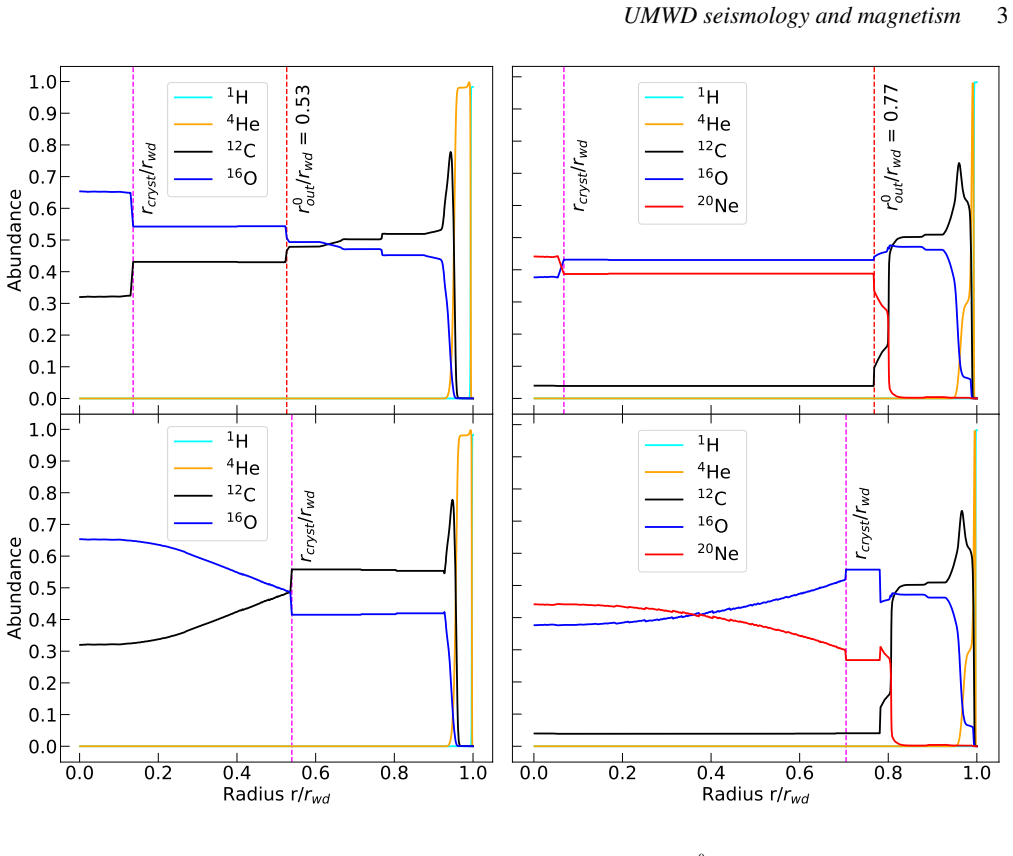
The mechanism has two coupled pieces. First, magnetic g-mode suppression: a radial field exceeding $B_{r,\mathrm{crit}} = \frac{8\pi^{5/2} a_{\mathrm{crit}} \sqrt{\rho r}}{N P^2}$ locally halts the propagation of a gravity wave, and this threshold is smallest in the strongly stratified, low-density layers just below the surface, so the longest observed period is an exquisitely sensitive upper bound on the near-surface field. Second, Ohmic diffusion of the interior field: the authors solve the induction equation (dipole geometry, Crank–Nicolson) starting from a uniform field $B_0$ confined to radii $r \le r^0_{\mathrm{out}}$, where $r^0_{\mathrm{out}}$ is the outer radius of the convection zone at the onset of crystallization, set by the drop in mean molecular weight in the initial composition profile. The CO and ONe models differ precisely there—$r^0_{\mathrm{out}}/r_{\mathrm{wd}} \approx 0.53$ versus $0.77$—and that single number decides whether only the exponential tail reaches the surface (CO) or the bulk field breaks out (ONe), turning the same observed 2 kG surface limit into a 0.6 MG versus 7 kG internal bound.
What would settle it
Rebuild the oxygen–neon model with a ternary phase diagram (adding sodium and magnesium) or with a merger-produced composition profile and recompute the convection-zone outer radius at the onset of crystallization; a value of $r^0_{\mathrm{out}}/r_{\mathrm{wd}}$ much below 0.77 would mean the field has not broken out by the observed cooling age, lifting the internal-field limit for ONe far above 7 kG and vitiating the 'not ONe' conclusion.
Extended reading notes
Core claim
The central claim is that the pulsations of a partially crystallized ultramassive white dwarf can act as a magnetometer for magnetic fields that are still buried in the interior. Because the g-mode cavity is bounded on the inside by the crystal front and the suppression threshold $B_{r,\mathrm{crit}}$ is lowest in the low-density outer layers, the mere detection of a sharply peaked long-period mode implies $B_{\mathrm{surf}} \lesssim 2\,\mathrm{kG}$ for WD J0135+5722. Diffusing that limit inward with the induction equation gives wildly different allowed internal fields depending on composition: $B_0 \lesssim 0.6\,\mathrm{MG}$ for a CO core (only the exponential tail of the field has reached the surface) versus $B_0 \lesssim 7\,\mathrm{kG}$ for an ONe core, where the field has already broken out because the convection-zone outer radius is larger ($r^0_{\mathrm{out}}/r_{\mathrm{wd}} \approx 0.77$ vs $0.53$). The authors conclude that WD J0135 is unlikely to harbor an ONe core; if it does, the crystallization dynamo or merger field must be far weaker than proposed. Either way, seismic magnetic constraints become a new probe of the composition and formation history of ultramassive white dwarfs.
Load-bearing premise
The conclusion hinges on the value of $r^0_{\mathrm{out}}$, the outer radius of the convection zone at the onset of crystallization, and specifically on the ONe model's $r^0_{\mathrm{out}}/r_{\mathrm{wd}} = 0.77$; if the true ONe value were smaller, the field would not have broken out to the surface and the derived 7 kG internal-field limit would be replaced by a far larger limit, destroying the case against an ONe core.
Editorial extensions
If this is right
- For WD J0135+5722, the detection of a sharply peaked ~1350 s pulsation bounds the near-surface magnetic field to $B_{\mathrm{surf}} \lesssim 2\,\mathrm{kG}$, an order of magnitude or more below typical white-dwarf spectropolarimetric detection limits.
- If the core is carbon–oxygen, the internal field satisfies $B_0 \lesssim 0.6\,\mathrm{MG}$, comfortably consistent with the crystallization dynamo theory and with the pattern of late-emerging fields seen in lower-mass white dwarfs.
- If the core is oxygen–neon, the internal field must satisfy $B_0 \lesssim 7\,\mathrm{kG}$, which rules out the intense early dynamo or merger-generated field that an ONe core would require; the paper therefore takes the data to disfavor an ONe core for WD J0135.
- A future non-detection of magnetic frequency shifts at the level of $1\,\mu\mathrm{Hz}$ would tighten the surface-field bound to roughly a few $\times 10^2\,\mathrm{G}$ for both compositions, sharpening the composition test.
- More generally, seismology can now probe internal magnetic fields of partially crystallized white dwarfs before those fields diffuse to the surface, turning each pulsating UMWD into a joint constraint on core composition and internal field strength.
Reading between the lines
- The same diffusion-plus-seismology pipeline can be applied to other crystallizing pulsating white dwarfs, effectively mapping out the (composition, internal-field) plane across the UMWD population; a survey would test whether the apparent CO preference of WD J0135 reflects a broader trend.
- The extreme sensitivity of the CO bound to the exponential tail means that small improvements in the $^{12}\mathrm{C}(\alpha,\gamma)^{16}\mathrm{O}$ reaction rate or in overshoot prescriptions will translate directly into sharper internal-field limits—so the result is a practical target for nuclear astrophysics as well.
- If surface convection zones generate their own kilogauss fields, as the paper notes is possible, those fields would have to be prevented from entering the radiative g-mode cavity for the seismic bound to hold; observations that correlate magnetic signatures with near-surface properties would distinguish surface-generated from internally diffused fields.
Editorial analysis
A structured set of objections, weighed in public.
Referee Report
Summary. The paper proposes a seismic method to probe magnetic fields buried inside ultramassive white dwarfs before they diffuse to the surface. For the pulsating UMWD WD J0135+5722, a non-detection of g-mode suppression yields a surface field limit B_surf <~ 2 kG. Combining this with a numerical solution of the induction equation, the authors derive an internal field limit B0 <~ 0.6 MG for a CO core and B0 <~ 7 kG for an ONe core. The small ONe limit is interpreted as ruling out an ONe composition or, alternatively, an intense dynamo during crystallization or merger.
Significance. If the ONe conclusion survives scrutiny, the paper offers a new and potentially powerful diagnostic of UMWD core composition and magnetic field origin, using seismology as a probe of fields that have not yet reached the surface. The CO-core limit is robust at the factor-of-a-few level and is consistent with crystallization dynamo predictions. The paper is careful in several respects: it uses a physically motivated initial field profile, accounts for the exponential diffusion tail, tests CO models against variations in the 12C(alpha,gamma)16O reaction rate and convective overshoot, and conservatively assumes all detected modes are ell=1. These strengths make the method credible for the CO case. The ONe exclusion, however, rests on a single model parameter whose uncertainty is acknowledged but not quantified.
major comments (3)
- [Sec. 2, Eq. (5) and Fig. 1] The ONe-core exclusion is load-bearing and rests entirely on the value r0_out/rwd = 0.77 obtained from a single MESA model. Because the diffusing field at the surface is exponentially sensitive to the distance between r0_out and the stellar surface, a modest reduction in the ONe r0_out would move the field from the bulk-breakout regime into the exponential-tail regime. In that case the limit would rise from B0 <~ 7 kG to roughly 0.1-1 MG, and the claimed exclusion of an ONe core would disappear. The paper itself flags sensitivity to the ternary ONe phase diagram (Castro-Tapia & Cumming 2025) and to formation history (Sec. 5), but it computes no ONe variants. I request either additional ONe models spanning plausible phase diagrams and formation channels, or a substantially weakened statement of the ONe exclusion.
- [Sec. 2, footnote 1] The footnote states that the make_o_ne_wd test suite 'simplifies some stages of stellar evolution for numerical convenience.' Since the initial composition profile sets r0_out, and r0_out sets the breakout behavior, the authors should specify which evolutionary stages are simplified and argue that these simplifications do not bias r0_out at the level needed for the ONe conclusion. Without this, the value r0_out/rwd = 0.77 is not established with the precision required to distinguish bulk breakout from exponential-tail diffusion.
- [Sec. 4 and Eq. (7)] The seismic upper limit B_surf <~ 2 kG is derived from the non-suppression of the longest-period mode. This is a reasonable and conservative application of the Fuller et al. (2015) criterion, but the interpretation assumes that the detected mode is a genuine g mode in the cavity and that its sharp peak implies no magnetic suppression. The paper cites literature questioning the totality of suppression (Mosser et al. 2017; Loi 2020; Mueller et al. 2025) but does not quantify how a partial-suppression scenario would affect the derived B0 limits. A brief quantitative discussion of this uncertainty would strengthen the central claim.
minor comments (4)
- [Abstract] There is a typo in the abstract: 'on the the other hand' should be 'on the other hand.'
- [Sec. 5] 'Never the less' should be 'Nevertheless.'
- [Fig. 3 caption] The caption text '10.2 0.5' appears garbled; it likely should read something like '0.2 0.5' or '0.2 0.5 mode period (ks)'. Please correct the axis label/caption.
- [Sec. 4.1] The symbol ell in Eq. (9) and surrounding text is used both as the angular degree and in the subscript of the sensitivity factor; this is understandable but could be clarified by using explicit 'l' in the text.
Circularity Check
No significant circularity: the seismic surface-field limit and the diffusion-based internal-field bound are independent forward-model steps, with acknowledged model uncertainties in r0_out rather than constructional circularity.
full rationale
The derivation chain is: (i) observed g-mode non-suppression in WD J0135 implies B_r,surf <= B_r,crit (Eq. 7); (ii) the induction equation (Eq. 3) is solved linearly with the initial uniform-field condition (Eq. 5), so B(r,t) = B0 f(r,t); (iii) the surface limit is divided by the diffusion factor f at the surface to obtain an upper limit on B0 (CO: 0.6 MG, ONe: 7 kG); (iv) this bound is compared with dynamo/merger expectations. At no point is the target quantity (B0 or core composition) used to define the observable or the fitted parameter; B0 is a free amplitude scaled by a linear diffusion solution, and the ONe exclusion is a forward-model consequence of the larger r0_out obtained from MESA structure models. The paper explicitly flags the dominant uncertainty in Sec. 5: 'The major uncertainty of our analysis is the size of the initial convection zone r0_out,' including sensitivity to the ternary ONe phase diagram (Castro-Tapia & Cumming 2025) and formation history (single vs. merger). This is a parameter-sensitivity caveat, not an equation that reduces to its own input. Self-citations (Rui et al. 2025 for the seismic method; Blatman & Ginzburg 2024a,b for dynamo expectations) are independently published, applied to other stars, or externally falsifiable, so they do not constitute load-bearing self-justification. No circular step can be exhibited as Eq. X = Eq. Y by construction or as a fitted parameter renamed as a prediction.
Assumptions & free parameters
free parameters (3)
- r0_out/rwd for CO model =
0.53
- r0_out/rwd for ONe model =
0.77
- a_crit =
0.5 sqrt(l(l+1)), about 0.7 for l=1
assumptions (6)
- domain assumption The magnetic field is an axisymmetric poloidal dipole with a uniform initial strength B0 confined to r < r0_out at time t0 (eq. 5).
- domain assumption Detection of a sharply peaked g mode implies the magnetic field is below the suppression threshold B_r,crit everywhere in the cavity.
- domain assumption Ohmic diffusion is the only magnetic transport mechanism for r > r0_out; turbulent diffusivity is neglected.
- domain assumption The crystal phase's higher electrical conductivity does not significantly affect diffusion of the field's outer tail.
- domain assumption The MESA phase-separation scheme (Bauer 2023) correctly determines r0_out for both compositions.
- domain assumption The suppression criterion of Fuller et al. (2015) with a_crit approximately 0.5 sqrt(l(l+1)) applies to white dwarf g modes.
Cite this review
Pith. "Pith review of Seismology and diffusion of ultramassive white dwarf magnetic fields." pith.science (2026). https://pith.science/paper/B5Y6H4PT
@misc{pith2026250705343,
  author       = {Pith},
  title        = {Pith review of: Seismology and diffusion of ultramassive white dwarf magnetic fields},
  year         = {2026},
  howpublished = {\url{https://pith.science/paper/B5Y6H4PT}},
  note         = {Machine review of arXiv:2507.05343}
}
abstract
Ultramassive white dwarfs (UMWDs; defined by masses $\gtrsim 1.1\,{\rm M}_\odot$) are prime targets for seismology, because they pass through the ZZ Ceti instability strip at the same time that their cores crystallize. Recent studies suggest that crystallization may magnetize white dwarf interiors with a strong magnetic field $B_0$ up to a radius $r_{\rm out}^0$, either through a magnetic dynamo or by transporting a pre-existing fossil field. We demonstrate that seismology can probe these buried fields before they break out at the surface, because even the weak exponential tail of the outwardly diffusing field can disrupt the propagation of gravity waves near the surface. Based on the observed oscillation modes of WD J0135+5722 - the richest pulsating UMWD to date - we constrain its surface field $B_{\rm surf}\lesssim 2\,\textrm{kG}$. We solve the induction equation and translate this to an upper limit on the internal field $B_0$. For a carbon-oxygen (CO) core we find $B_{\rm surf}\ll B_0\lesssim 0.6\,\textrm{MG}$, consistent with the crystallization dynamo theory. For an oxygen-neon (ONe) core, on the the other hand, $r_{\rm out}^0$ is larger, such that the magnetic field breaks out and $B_{\rm surf}\lesssim B_0\lesssim 7\,\textrm{kG}$. This low magnetic field rules out an ONe composition or, alternatively, an intense dynamo during crystallization or merger. Either way, the imprint of magnetic fields on UMWD seismology may reveal the uncertain composition and formation paths of these stars.
Figures


Reference graph
Works this paper leans on
-
[1]
Althaus L. G., et al., 2021, @doi [ ] 10.1051/0004-6361/202038930 , https://ui.adsabs.harvard.edu/abs/2021A&A...646A..30A 646, A30
-
[2]
Angel J. R. P., Landstreet J. D., 1971, @doi [ ] 10.1086/180682 , https://ui.adsabs.harvard.edu/abs/1971ApJ...164L..15A 164, L15
doi:10.1086/180682 1971
-
[3]
Bagnulo S., Landstreet J. D., 2022, @doi [ ] 10.3847/2041-8213/ac84d3 , https://ui.adsabs.harvard.edu/abs/2022ApJ...935L..12B 935, L12
-
[4]
Bauer E. B., 2023, @doi [ ] 10.3847/1538-4357/acd057 , https://ui.adsabs.harvard.edu/abs/2023ApJ...950..115B 950, 115
-
[5]
Bauer E. B., Schwab J., Bildsten L., Cheng S., 2020, @doi [ ] 10.3847/1538-4357/abb5a5 , https://ui.adsabs.harvard.edu/abs/2020ApJ...902...93B 902, 93
-
[6]
B \'e dard A., Blouin S., Cheng S., 2024, @doi [ ] 10.1038/s41586-024-07102-y , https://ui.adsabs.harvard.edu/abs/2024Natur.627..286B 627, 286
-
[7]
Blatman D., Ginzburg S., 2024a, @doi [ ] 10.1093/mnras/stae222 , https://ui.adsabs.harvard.edu/abs/2024MNRAS.528.3153B 528, 3153
-
[8]
Blatman D., Ginzburg S., 2024b, @doi [ ] 10.1093/mnrasl/slae054 , https://ui.adsabs.harvard.edu/abs/2024MNRAS.533L..13B 533, L13
Show all 96 references
-
[9]
Blouin S., Daligault J., 2021a, @doi [ ] 10.1103/PhysRevE.103.043204 , https://ui.adsabs.harvard.edu/abs/2021PhRvE.103d3204B 103, 043204
-
[10]
Blouin S., Daligault J., 2021b, @doi [ ] 10.3847/1538-4357/ac1513 , https://ui.adsabs.harvard.edu/abs/2021ApJ...919...87B 919, 87
-
[11]
Blouin S., Daligault J., Saumon D., 2021, @doi [ ] 10.3847/2041-8213/abf14b , https://ui.adsabs.harvard.edu/abs/2021ApJ...911L...5B 911, L5
2021 doi
-
[12]
J., 1992, @doi [ ] 10.1086/191668 , https://ui.adsabs.harvard.edu/abs/1992ApJS...80..369B 80, 369
Brassard P., Fontaine G., Wesemael F., Hansen C. J., 1992, @doi [ ] 10.1086/191668 , https://ui.adsabs.harvard.edu/abs/1992ApJS...80..369B 80, 369
1992 doi
- [13]
-
[14]
E., Althaus L
Camisassa M. E., Althaus L. G., Torres S., C \'o rsico A. H., Rebassa-Mansergas A., Tremblay P.-E., Cheng S., Raddi R., 2021, @doi [ ] 10.1051/0004-6361/202140720 , https://ui.adsabs.harvard.edu/abs/2021A&A...649L...7C 649, L7
2021 doi
-
[15]
E., Raddi R., Althaus L
Camisassa M. E., Raddi R., Althaus L. G., Isern J., Rebassa-Mansergas A., Torres S., C \'o rsico A. H., Korre L., 2022, @doi [ ] 10.1093/mnrasl/slac078 , https://ui.adsabs.harvard.edu/abs/2022MNRAS.516L...1C 516, L1
2022 doi
-
[16]
R., Schreiber M
Camisassa M., Fuentes J. R., Schreiber M. R., Rebassa-Mansergas A., Torres S., Raddi R., Dominguez I., 2024, @doi [ ] 10.1051/0004-6361/202452539 , https://ui.adsabs.harvard.edu/abs/2024A&A...691L..21C 691, L21
2024 doi
-
[17]
Cantiello M., Fuller J., Bildsten L., 2016, @doi [ ] 10.3847/0004-637X/824/1/14 , https://ui.adsabs.harvard.edu/abs/2016ApJ...824...14C 824, 14
2016 doi
-
[18]
arXiv:2506.16529
Castro-Tapia M., Cumming A., 2025, @doi [arXiv e-prints] 10.48550/arXiv.2506.16529 , https://ui.adsabs.harvard.edu/abs/2025arXiv250616529C p. arXiv:2506.16529
2025 doi
-
[19]
R., 2024a, @doi [ ] 10.3847/1538-4357/ad4152 , https://ui.adsabs.harvard.edu/abs/2024ApJ...969...10C 969, 10
Castro-Tapia M., Cumming A., Fuentes J. R., 2024a, @doi [ ] 10.3847/1538-4357/ad4152 , https://ui.adsabs.harvard.edu/abs/2024ApJ...969...10C 969, 10
-
[20]
Castro-Tapia M., Zhang S., Cumming A., 2024b, @doi [ ] 10.3847/1538-4357/ad7a6a , https://ui.adsabs.harvard.edu/abs/2024ApJ...975...63C 975, 63
-
[21]
D., M \'e nard B., 2019, @doi [ ] 10.3847/1538-4357/ab4989 , https://ui.adsabs.harvard.edu/abs/2019ApJ...886..100C 886, 100
Cheng S., Cummings J. D., M \'e nard B., 2019, @doi [ ] 10.3847/1538-4357/ab4989 , https://ui.adsabs.harvard.edu/abs/2019ApJ...886..100C 886, 100
2019 doi
-
[22]
T., Farag E., Timmes F
Chidester M. T., Farag E., Timmes F. X., 2022, @doi [ ] 10.3847/1538-4357/ac7ec3 , https://ui.adsabs.harvard.edu/abs/2022ApJ...935...21C 935, 21
2022 doi
-
[23]
T., Timmes F
Chidester M. T., Timmes F. X., Farag E., 2023, @doi [ ] 10.3847/1538-4357/ace620 , https://ui.adsabs.harvard.edu/abs/2023ApJ...954...51C 954, 51
2023 doi
-
[24]
H., Garc \' a-Berro E., Althaus L
C \'o rsico A. H., Garc \' a-Berro E., Althaus L. G., Isern J., 2004, @doi [ ] 10.1051/0004-6361:20040416 , https://ui.adsabs.harvard.edu/abs/2004A&A...427..923C 427, 923
2004 doi
-
[25]
H., Althaus L
C \'o rsico A. H., Althaus L. G., Montgomery M. H., Garc \' a-Berro E., Isern J., 2005, @doi [ ] 10.1051/0004-6361:20041101 , https://ui.adsabs.harvard.edu/abs/2005A&A...429..277C 429, 277
2005 doi
-
[26]
H., Althaus L
C \'o rsico A. H., Althaus L. G., Miller Bertolami M. M., Kepler S. O., 2019a, @doi [ ] 10.1007/s00159-019-0118-4 , https://ui.adsabs.harvard.edu/abs/2019A&ARv..27....7C 27, 7
-
[27]
H., De Ger \'o nimo F
C \'o rsico A. H., De Ger \'o nimo F. C., Camisassa M. E., Althaus L. G., 2019b, @doi [ ] 10.1051/0004-6361/201936698 , https://ui.adsabs.harvard.edu/abs/2019A&A...632A.119C 632, A119
-
[28]
Cumming A., 2002, @doi [ ] 10.1046/j.1365-8711.2002.05434.x , https://ui.adsabs.harvard.edu/abs/2002MNRAS.333..589C 333, 589
2002
-
[29]
J., Kilic M., Romero A
Curd B., Gianninas A., Bell K. J., Kilic M., Romero A. D., Allende Prieto C., Winget D. E., Winget K. I., 2017, @doi [ ] 10.1093/mnras/stx320 , https://ui.adsabs.harvard.edu/abs/2017MNRAS.468..239C 468, 239
2017 doi
-
[30]
C., C \'o rsico A
De Ger \'o nimo F. C., C \'o rsico A. H., Althaus L. G., Wachlin F. C., Camisassa M. E., 2019, @doi [ ] 10.1051/0004-6361/201833789 , https://ui.adsabs.harvard.edu/abs/2019A&A...621A.100D 621, A100
2019 doi
-
[31]
C., Miller Bertolami M
De Ger \'o nimo F. C., Miller Bertolami M. M., Plaza F., Catelan M., 2022, @doi [ ] 10.1051/0004-6361/202142341 , https://ui.adsabs.harvard.edu/abs/2022A&A...659A.150D 659, A150
2022 doi
-
[32]
C., Uzundag M., Rebassa-Mansergas A., Brown A., Kilic M., C \'o rsico A
De Ger \'o nimo F. C., Uzundag M., Rebassa-Mansergas A., Brown A., Kilic M., C \'o rsico A. H., Jewett G. C., Moss A. G., 2025, @doi [ ] 10.3847/2041-8213/adad73 , https://ui.adsabs.harvard.edu/abs/2025ApJ...980L...9D 980, L9
2025 doi
-
[33]
Dominguez I., Straniero O., Tornambe A., Isern J., 1996, @doi [ ] 10.1086/178106 , https://ui.adsabs.harvard.edu/abs/1996ApJ...472..783D 472, 783
1996 doi
-
[34]
T., 2015, @doi [ ] 10.1007/s11214-015-0152-0 , https://ui.adsabs.harvard.edu/abs/2015SSRv..191..111F 191, 111
Ferrario L., de Martino D., G \"a nsicke B. T., 2015, @doi [ ] 10.1007/s11214-015-0152-0 , https://ui.adsabs.harvard.edu/abs/2015SSRv..191..111F 191, 111
2015 doi
-
[35]
Ferrario L., Wickramasinghe D., Kawka A., 2020, @doi [Advances in Space Research] 10.1016/j.asr.2019.11.012 , https://ui.adsabs.harvard.edu/abs/2020AdSpR..66.1025F 66, 1025
2020 doi
-
[36]
Fontaine G., Brassard P., 2008, @doi [ ] 10.1086/592788 , https://ui.adsabs.harvard.edu/abs/2008PASP..120.1043F 120, 1043
2008 doi
-
[37]
H., van Horn H
Fontaine G., Thomas J. H., van Horn H. M., 1973, @doi [ ] 10.1086/152381 , https://ui.adsabs.harvard.edu/abs/1973ApJ...184..911F 184, 911
1973 doi
-
[38]
R., Cumming A., Castro-Tapia M., Anders E
Fuentes J. R., Cumming A., Castro-Tapia M., Anders E. H., 2023, @doi [ ] 10.3847/1538-4357/accb56 , https://ui.adsabs.harvard.edu/abs/2023ApJ...950...73F 950, 73
2023 doi
-
[39]
R., Castro-Tapia M., Cumming A., 2024, @doi [ ] 10.3847/2041-8213/ad3100 , https://ui.adsabs.harvard.edu/abs/2024ApJ...964L..15F 964, L15
Fuentes J. R., Castro-Tapia M., Cumming A., 2024, @doi [ ] 10.3847/2041-8213/ad3100 , https://ui.adsabs.harvard.edu/abs/2024ApJ...964L..15F 964, L15
2024 doi
-
[40]
A., Bildsten L., 2015, @doi [Science] 10.1126/science.aac6933 , https://ui.adsabs.harvard.edu/abs/2015Sci...350..423F 350, 423
Fuller J., Cantiello M., Stello D., Garcia R. A., Bildsten L., 2015, @doi [Science] 10.1126/science.aac6933 , https://ui.adsabs.harvard.edu/abs/2015Sci...350..423F 350, 423
2015 doi
-
[41]
Garc \' a-Berro E., et al., 2012, @doi [ ] 10.1088/0004-637X/749/1/25 , https://ui.adsabs.harvard.edu/abs/2012ApJ...749...25G 749, 25
2012 doi
-
[42]
P., et al., 2019, @doi [ ] 10.1093/mnras/sty3016 , https://ui.adsabs.harvard.edu/abs/2019MNRAS.482.4570G 482, 4570
Gentile Fusillo N. P., et al., 2019, @doi [ ] 10.1093/mnras/sty3016 , https://ui.adsabs.harvard.edu/abs/2019MNRAS.482.4570G 482, 4570
2019 doi
-
[43]
Ginzburg S., Fuller J., Kawka A., Caiazzo I., 2022, @doi [ ] 10.1093/mnras/stac1363 , https://ui.adsabs.harvard.edu/abs/2022MNRAS.514.4111G 514, 4111
2022 doi
-
[44]
J., Kepler S
Hermes J. J., Kepler S. O., Castanheira B. G., Gianninas A., Winget D. E., Montgomery M. H., Brown W. R., Harrold S. T., 2013, @doi [ ] 10.1088/2041-8205/771/1/L2 , https://ui.adsabs.harvard.edu/abs/2013ApJ...771L...2H 771, L2
2013 doi
- [45]
-
[46]
Isern J., Mochkovitch R., Garc \' a-Berro E., Hernanz M., 1997, @doi [ ] 10.1086/304425 , https://ui.adsabs.harvard.edu/abs/1997ApJ...485..308I 485, 308
1997 doi
-
[47]
Isern J., Garc \' a-Berro E., K \"u lebi B., Lor \'e n-Aguilar P., 2017, @doi [ ] 10.3847/2041-8213/aa5eae , https://ui.adsabs.harvard.edu/abs/2017ApJ...836L..28I 836, L28
2017 doi
-
[48]
S., Schwab J., Bauer E., Timmes F
Jermyn A. S., Schwab J., Bauer E., Timmes F. X., Potekhin A. Y., 2021, @doi [ ] 10.3847/1538-4357/abf48e , https://ui.adsabs.harvard.edu/abs/2021ApJ...913...72J 913, 72
2021 doi
-
[49]
S., et al., 2023, @doi [ ] 10.3847/1538-4365/acae8d , https://ui.adsabs.harvard.edu/abs/2023ApJS..265...15J 265, 15
Jermyn A. S., et al., 2023, @doi [ ] 10.3847/1538-4365/acae8d , https://ui.adsabs.harvard.edu/abs/2023ApJS..265...15J 265, 15
2023 doi
-
[50]
Jewett G., et al., 2024, @doi [ ] 10.3847/1538-4357/ad6905 , https://ui.adsabs.harvard.edu/abs/2024ApJ...974...12J 974, 12
2024 doi
-
[51]
Ji S., et al., 2013, @doi [ ] 10.1088/0004-637X/773/2/136 , https://ui.adsabs.harvard.edu/abs/2013ApJ...773..136J 773, 136
2013 doi
-
[52]
W., Pesnell W
Jones P. W., Pesnell W. D., Hansen C. J., Kawaler S. D., 1989, @doi [ ] 10.1086/167019 , https://ui.adsabs.harvard.edu/abs/1989ApJ...336..403J 336, 403
1989 doi
-
[53]
Kanaan A., et al., 2005, @doi [ ] 10.1051/0004-6361:20041125 , https://ui.adsabs.harvard.edu/abs/2005A&A...432..219K 432, 219
2005 doi
-
[54]
C., Swedlund J
Kemp J. C., Swedlund J. B., Landstreet J. D., Angel J. R. P., 1970, @doi [ ] 10.1086/180574 , https://ui.adsabs.harvard.edu/abs/1970ApJ...161L..77K 161, L77
1970 doi
-
[55]
H., Moss A
Kilic M., C \'o rsico A. H., Moss A. G., Jewett G., De Ger \'o nimo F. C., Althaus L. G., 2023, @doi [ ] 10.1093/mnras/stad1113 , https://ui.adsabs.harvard.edu/abs/2023MNRAS.522.2181K 522, 2181
2023 doi
-
[56]
D., Angel J
Landstreet J. D., Angel J. R. P., 1971, @doi [ ] 10.1086/180718 , https://ui.adsabs.harvard.edu/abs/1971ApJ...165L..67L 165, L67
1971 doi
-
[57]
D., Bagnulo S., Valyavin G
Landstreet J. D., Bagnulo S., Valyavin G. G., Gadelshin D., Martin A. J., Galazutdinov G., Semenko E., 2015, @doi [ ] 10.1051/0004-6361/201526434 , https://ui.adsabs.harvard.edu/abs/2015A&A...580A.120L 580, A120
2015 doi
-
[58]
M., Fuller J., Cantiello M., Burns K
Lecoanet D., Vasil G. M., Fuller J., Cantiello M., Burns K. J., 2017, @doi [ ] 10.1093/mnras/stw3273 , https://ui.adsabs.harvard.edu/abs/2017MNRAS.466.2181L 466, 2181
2017 doi
-
[59]
W., 1994, @doi [ ] 10.1086/174024 , https://ui.adsabs.harvard.edu/abs/1994ApJ...425..797L 425, 797
Livio M., Truran J. W., 1994, @doi [ ] 10.1086/174024 , https://ui.adsabs.harvard.edu/abs/1994ApJ...425..797L 425, 797
1994 doi
-
[60]
T., 2020, @doi [ ] 10.1093/mnras/staa581 , https://ui.adsabs.harvard.edu/abs/2020MNRAS.493.5726L 493, 5726
Loi S. T., 2020, @doi [ ] 10.1093/mnras/staa581 , https://ui.adsabs.harvard.edu/abs/2020MNRAS.493.5726L 493, 5726
2020 doi
-
[61]
A., Thomas J
Markiel J. A., Thomas J. H., van Horn H. M., 1994, @doi [ ] 10.1086/174454 , https://ui.adsabs.harvard.edu/abs/1994ApJ...430..834M 430, 834
1994 doi
-
[62]
K., Buonanno A., Gair J., Miller M
Mehta A. K., Buonanno A., Gair J., Miller M. C., Farag E., deBoer R. J., Wiescher M., Timmes F. X., 2022, @doi [ ] 10.3847/1538-4357/ac3130 , https://ui.adsabs.harvard.edu/abs/2022ApJ...924...39M 924, 39
2022 doi
-
[63]
S., Montgomery M
Metcalfe T. S., Montgomery M. H., Kanaan A., 2004, @doi [ ] 10.1086/420884 , https://ui.adsabs.harvard.edu/abs/2004ApJ...605L.133M 605, L133
2004 doi
-
[64]
Mochkovitch R., 1983, , https://ui.adsabs.harvard.edu/abs/1983A&A...122..212M 122, 212
1983
-
[65]
H., Dunlap B
Montgomery M. H., Dunlap B. H., 2024, @doi [ ] 10.3847/1538-4357/ad16dc , https://ui.adsabs.harvard.edu/abs/2024ApJ...961..197M 961, 197
2024 doi
-
[66]
H., Winget D
Montgomery M. H., Winget D. E., 1999, @doi [ ] 10.1086/308044 , https://ui.adsabs.harvard.edu/abs/1999ApJ...526..976M 526, 976
1999 doi
-
[67]
H., et al., 2010, @doi [ ] 10.1088/0004-637X/716/1/84 , https://ui.adsabs.harvard.edu/abs/2010ApJ...716...84M 716, 84
Montgomery M. H., et al., 2010, @doi [ ] 10.1088/0004-637X/716/1/84 , https://ui.adsabs.harvard.edu/abs/2010ApJ...716...84M 716, 84
2010 doi
-
[68]
Mosser B., et al., 2017, @doi [ ] 10.1051/0004-6361/201629494 , https://ui.adsabs.harvard.edu/abs/2017A&A...598A..62M 598, A62
2017 doi
-
[69]
M \"u ller J., Copp \'e e Q., Hekker S., 2025, @doi [ ] 10.1051/0004-6361/202553888 , https://ui.adsabs.harvard.edu/abs/2025A&A...696A.134M 696, A134
2025 doi
-
[70]
J., 1984, @doi [ ] 10.1093/mnras/209.3.511 , https://ui.adsabs.harvard.edu/abs/1984MNRAS.209..511N 209, 511
Nandkumar R., Pethick C. J., 1984, @doi [ ] 10.1093/mnras/209.3.511 , https://ui.adsabs.harvard.edu/abs/1984MNRAS.209..511N 209, 511
1984 doi
-
[71]
Paxton B., Bildsten L., Dotter A., Herwig F., Lesaffre P., Timmes F., 2011, @doi [ ] 10.1088/0067-0049/192/1/3 , https://ui.adsabs.harvard.edu/abs/2011ApJS..192....3P 192, 3
2011 doi
-
[72]
Paxton B., et al., 2013, @doi [ ] 10.1088/0067-0049/208/1/4 , https://ui.adsabs.harvard.edu/abs/2013ApJS..208....4P 208, 4
2013 doi
-
[73]
Paxton B., et al., 2015, @doi [ ] 10.1088/0067-0049/220/1/15 , https://ui.adsabs.harvard.edu/abs/2015ApJS..220...15P 220, 15
2015 doi
-
[74]
Paxton B., et al., 2018, @doi [ ] 10.3847/1538-4365/aaa5a8 , https://ui.adsabs.harvard.edu/abs/2018ApJS..234...34P 234, 34
2018 doi
-
[75]
Paxton B., et al., 2019, @doi [ ] 10.3847/1538-4365/ab2241 , https://ui.adsabs.harvard.edu/abs/2019ApJS..243...10P 243, 10
2019 doi
-
[76]
M., Tucker M
Rowan D. M., Tucker M. A., Shappee B. J., Hermes J. J., 2019, @doi [ ] 10.1093/mnras/stz1116 , https://ui.adsabs.harvard.edu/abs/2019MNRAS.486.4574R 486, 4574
2019 doi
-
[77]
Z., Fuller J., 2023, @doi [ ] 10.1093/mnras/stad1424 , https://ui.adsabs.harvard.edu/abs/2023MNRAS.523..582R 523, 582
Rui N. Z., Fuller J., 2023, @doi [ ] 10.1093/mnras/stad1424 , https://ui.adsabs.harvard.edu/abs/2023MNRAS.523..582R 523, 582
2023 doi
-
[78]
Z., Fuller J., Hermes J
Rui N. Z., Fuller J., Hermes J. J., 2025, @doi [ ] 10.3847/1538-4357/adaf9e , https://ui.adsabs.harvard.edu/abs/2025ApJ...981...72R 981, 72
2025 doi
-
[79]
R., Belloni D., G \"a nsicke B
Schreiber M. R., Belloni D., G \"a nsicke B. T., Parsons S. G., Zorotovic M., 2021, @doi [Nature Astronomy] 10.1038/s41550-021-01346-8 , https://ui.adsabs.harvard.edu/abs/2021NatAs...5..648S 5, 648
2021 doi
-
[80]
Schwab J., 2021, @doi [ ] 10.3847/1538-4357/abc87e , https://ui.adsabs.harvard.edu/abs/2021ApJ...906...53S 906, 53
2021 doi
-
[81]
J., Blouin S., Breivik K., 2023, @doi [ ] 10.3847/2041-8213/acf57b , https://ui.adsabs.harvard.edu/abs/2023ApJ...955L..33S 955, L33
Shen K. J., Blouin S., Breivik K., 2023, @doi [ ] 10.3847/2041-8213/acf57b , https://ui.adsabs.harvard.edu/abs/2023ApJ...955L..33S 955, L33
2023 doi
-
[82]
Interscience, New York
Spitzer L., 1962, Physics of Fully Ionized Gases . Interscience, New York
1962
-
[83]
A., Bedding T
Stello D., Cantiello M., Fuller J., Huber D., Garc \' a R. A., Bedding T. R., Bildsten L., Silva Aguirre V., 2016, @doi [ ] 10.1038/nature16171 , https://ui.adsabs.harvard.edu/abs/2016Natur.529..364S 529, 364
2016 doi
-
[84]
J., 1980, Journal de Physique, https://ui.adsabs.harvard.edu/abs/1980JPhys..41C..61S 41, C2, 61
Stevenson D. J., 1980, Journal de Physique, https://ui.adsabs.harvard.edu/abs/1980JPhys..41C..61S 41, C2, 61
1980
-
[85]
H., Markiel J
Thomas J. H., Markiel J. A., van Horn H. M., 1995, @doi [ ] 10.1086/176400 , https://ui.adsabs.harvard.edu/abs/1995ApJ...453..403T 453, 403
1995 doi
-
[86]
Townsend R. H. D., Teitler S. A., 2013, @doi [ ] 10.1093/mnras/stt1533 , https://ui.adsabs.harvard.edu/abs/2013MNRAS.435.3406T 435, 3406
2013 doi
-
[87]
E., Fontaine G., Freytag B., Steiner O., Ludwig H
Tremblay P. E., Fontaine G., Freytag B., Steiner O., Ludwig H. G., Steffen M., Wedemeyer S., Brassard P., 2015, @doi [ ] 10.1088/0004-637X/812/1/19 , https://ui.adsabs.harvard.edu/abs/2015ApJ...812...19T 812, 19
2015 doi
-
[88]
Tremblay P.-E., et al., 2019, @doi [ ] 10.1038/s41586-018-0791-x , https://ui.adsabs.harvard.edu/abs/2019Natur.565..202T 565, 202
2019 doi
-
[89]
W., Livio M., 1986, @doi [ ] 10.1086/164544 , https://ui.adsabs.harvard.edu/abs/1986ApJ...308..721T 308, 721
Truran J. W., Livio M., 1986, @doi [ ] 10.1086/164544 , https://ui.adsabs.harvard.edu/abs/1986ApJ...308..721T 308, 721
1986 doi
-
[90]
Vincent O., Bergeron P., Lafreni \`e re D., 2020, @doi [ ] 10.3847/1538-3881/abbe20 , https://ui.adsabs.harvard.edu/abs/2020AJ....160..252V 160, 252
2020 doi
-
[91]
E., van Horn H
Wendell C. E., van Horn H. M., Sargent D., 1987, @doi [ ] 10.1086/164968 , https://ui.adsabs.harvard.edu/abs/1987ApJ...313..284W 313, 284
1987 doi
-
[92]
E., Kepler S
Winget D. E., Kepler S. O., 2008, @doi [ ] 10.1146/annurev.astro.46.060407.145250 , https://ui.adsabs.harvard.edu/abs/2008ARA&A..46..157W 46, 157
2008
-
[93]
E., et al., 1994, @doi [ ] 10.1086/174455 , https://ui.adsabs.harvard.edu/abs/1994ApJ...430..839W 430, 839
Winget D. E., et al., 1994, @doi [ ] 10.1086/174455 , https://ui.adsabs.harvard.edu/abs/1994ApJ...430..839W 430, 839
1994 doi
-
[94]
Wu C., Xiong H., Wang X., 2022, @doi [ ] 10.1093/mnras/stac273 , https://ui.adsabs.harvard.edu/abs/2022MNRAS.512.2972W 512, 2972
2022 doi
-
[95]
Z., 2025, arXiv e-prints, https://ui.adsabs.harvard.edu/abs/2025arXiv250518257Y p
Yaakovyan R., Ginzburg S., Fuller J., Rui N. Z., 2025, arXiv e-prints, https://ui.adsabs.harvard.edu/abs/2025arXiv250518257Y p. arXiv:2505.18257
2025 arXiv
-
[96]
H., Chang P., 2015, @doi [ ] 10.1088/2041-8205/806/1/L1 , https://ui.adsabs.harvard.edu/abs/2015ApJ...806L...1Z 806, L1
Zhu C., Pakmor R., van Kerkwijk M. H., Chang P., 2015, @doi [ ] 10.1088/2041-8205/806/1/L1 , https://ui.adsabs.harvard.edu/abs/2015ApJ...806L...1Z 806, L1
2015 doi
Reviewed August 6, 2026 · model on record in the stance chip above.
Discussion (0). Sign in to comment.