REVIEW 2 major objections 5 minor 5 cited by
Equivalence of the field-level inference and conventional analyses on large scales
T0 review · 2 major / 5 minor · reviewed 2026-08-06 · deepseek-v4-flash
Pith's one-line read The paper claims that on large scales, a conventional joint power-spectrum, bispectrum, and trispectrum analysis recovers the same precision on the linear density amplitude as field-level inference, so field-level inference gains little…
desk verdict Solid P+B forecast and a genuinely new trispectrum covariance, but the headline equivalence to field-level inference rests on a mock-data trispectrum that is never validated against simulations. read the letter →
The pith
A machine-rendered reading of the paper's core claim, the machinery that carries it, and where it could break.
The reading
What carries the argument
Three elements carry the argument. First is the cubic Eulerian bias model: the halo density field is expanded to third order in the linear field with eight bias and counterterm parameters, which defines the one-loop power spectrum, tree-level bispectrum, and tree-level trispectrum as the complete set of predictions at this order. Second is the signal-to-noise hierarchy $(\mathrm{SNR})_n^2\sim N_{\mathrm{pix}}\,\Delta^{2(n-2)}(k_{\max})$ with $\Delta^2(k_{\max})\simeq 0.13$ at the scales used, which implies each higher $n$-point function adds only a small fraction of information and predicts the observed $k_{\max}^{-3/2}/\Delta(k_{\max})$ scaling of the errors. Third is the cross-correlation coefficient between Eulerian and Lagrangian perturbative fields, $r(k)\approx e^{-k^2\sigma_v^2/2}$, which shows the two descriptions agree at the percent level on the relevant scales, excluding large displacements as a source of extra information. For the trispectrum, the paper derives a new covariance expression, including the quadrilateral-shell volume $V_{1234}=\frac{8}{3}\pi^2 k_1k_2k_3k_4D_1D_2 V_{\mathrm{tetra}}\Delta k^6$, which makes a full-shape trispectrum likelihood computationally tractable.
What would settle it
Measure the connected trispectrum of the PT Challenge halo catalogs directly, run the joint P+B+T likelihood on the measured data rather than on mock data drawn from the same tree-level model, and check whether the inferred amplitude errors remain about 4–5% and unbiased at $k_{\max}=0.12\,h/\mathrm{Mpc}$.
Extended reading notes
Core claim
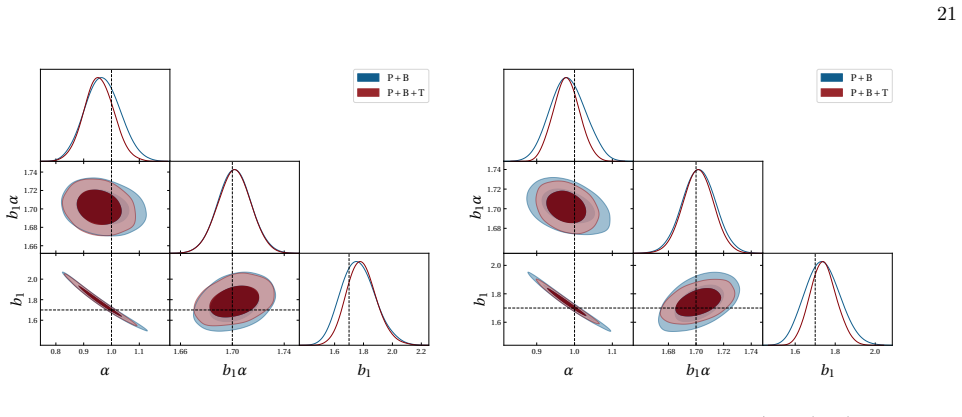
On large scales, with the amplitude $\alpha$ of the linear density field as the only free cosmological parameter, Eulerian perturbation theory with the cubic bias model is adequate: the consistent set of observables is the one-loop power spectrum, the tree-level bispectrum, and the tree-level trispectrum. The paper's main result is that a joint $P+B+T$ analysis recovers errors on $\alpha$ of about $4$–$5\%$ in a $(2\,\mathrm{Gpc}/h)^3$ volume, in good agreement with the field-level inference results of [35] and [36]. $P+B$ alone gives roughly $5$–$6\%$, so the trispectrum contributes only a $20$–$30\%$ improvement. The paper takes this agreement, together with the matching scaling of errors with $k_{\max}$, as evidence that field-level inference on these scales gains nothing significant from large displacements beyond Eulerian kernels or from $n$-point functions beyond the trispectrum. The remaining disagreement between this analysis and the simulation-based $P+B$ analysis of [35] is attributed, tentatively, to the inclusion of higher-order bias and loop contributions with wide priors in the simulation-based pipeline.
Load-bearing premise
The load-bearing assumption is that the four-point function model used for the trispectrum is accurate at the scales analyzed and that the chosen fiducial halo bias values resemble the real samples; the trispectrum prediction is never validated against simulations, and the mock data are generated with the same model being tested.
Editorial extensions
If this is right
- The $P+B$ analysis alone measures the linear amplitude to about $5$–$6\%$ in the $(2\,\mathrm{Gpc}/h)^3$ box, close to field-level inference and roughly three times better than the simulation-based $P+B$ analysis it compared against.
- Adding the tree-level trispectrum improves the amplitude error by only $20$–$30\%$, so the large-scale information is nearly saturated once the bispectrum is included.
- The error bars scale with $k_{\max}$ in the same way as field-level inference, supporting the conclusion that both approaches draw on the same information.
- In the restricted setup with cubic biases fixed, the trispectrum improves the error by more than a factor of two, but the authors argue this is an artificial configuration rather than the generic case.
- The remaining discrepancy with simulation-based $P+B$ analyses is attributed to wide priors on higher-order bias and loop terms rather than to missing physics in the low-order correlation functions.
Reading between the lines
- If the equivalence holds, the practical payoff of field-level inference on large scales would have to come from smaller scales, from baryon acoustic oscillation wiggles beyond $k_{\max}\sim0.2\,h/\mathrm{Mpc}$, or from redshift-space analyses where the degeneracies differ.
- A direct check of the paper's explanation would be to rerun the simulation-based $P+B$ pipeline of [35] with perturbativity priors or with cubic biases set to zero; the paper predicts the errors would shrink to match the conventional analysis.
- The new full-shape trispectrum covariance could serve for forecasts of parity-violating or non-Gaussian four-point signals, where the trispectrum is the leading observable rather than a correction.
- The BAO-wiggle forecast implies that large displacements do carry amplitude information, but only beyond $k\sim0.2\,h/\mathrm{Mpc}$; this sets a testable boundary for where the equivalence between field-level and correlation-function analyses should break down.
Editorial analysis
A structured set of objections, weighed in public.
Referee Report
Summary. The paper develops an Eulerian EFT model for real-space dark matter halos with the linear density amplitude A (parametrized by alpha) as the only cosmological parameter. It computes the one-loop power spectrum, tree-level bispectrum, and tree-level trispectrum, and derives a new Gaussian covariance for the full-shape trispectrum. The P+B model is validated against the PT Challenge simulation suite, giving unbiased alpha constraints. The authors then generate mock data from the same model and forecast P+B and P+B+T errors for a volume matching [35], finding P+B errors of roughly 5-6% and P+B+T errors of roughly 4-5%, in agreement with field-level inference results from [35] and [36]. They conclude that large-scale field-level inference gains no significant information beyond Eulerian kernels and the trispectrum, and they discuss a possible origin of the disagreement with simulation-based P+B analyses.
Significance. If the central claim holds, this is an important result: it demystifies the apparent advantage of field-level inference on large scales, showing that the information is largely captured by low-order n-point functions. The paper has several concrete strengths: a transparent mode-counting derivation (Sec. IV G), an explicit validation of the P+B model against a large-volume simulation suite with unbiased alpha recovery (Sec. V), a self-contained derivation of the trispectrum covariance (Appendix C), and a falsifiable forecast that the trispectrum improves alpha errors by at most about 20-30%. The main weakness is that the trispectrum part of the forecast is not validated against simulations; the agreement between the P+B+T forecast and the FBI error bars is partly a self-consistency check. The paper is candid about the 10-20% uncertainty in its results and about the choices that maximize the trispectrum's impact, which strengthens the qualitative conclusion even if the exact percentage is uncertain.
major comments (2)
- [Sec. VI B, Eqs. (31), (40)-(41)] The central quantitative support for the claim that no information lies beyond the trispectrum is a mock-data forecast in which the data vector is generated with the same tree-level trispectrum (Eq. 31) and the same Gaussian diagonal covariance (Eqs. 40-41) used in the likelihood. The PT Challenge validation in Sec. V covers only P and B; the trispectrum model and its covariance are never compared with measured halo four-point functions. Consequently, the agreement between the P+B+T forecast and the FBI error bars of [35,36] is a self-consistency check, not an empirical test, and the abstract's conclusion about 'higher-order n-point functions beyond the trispectrum' is not yet quantitatively supported. I recommend either measuring the halo trispectrum in the PT Challenge suite and validating Eq. (31) and Eqs. (40)-(41), or explicitly reframing the result as an upper-limit forecast and moving the caveat into the abstract.
- [Sec. VI, Table II] The claimed 20-30% trispectrum improvement is comparable to the paper's own estimate that all results are uncertain at the 10-20% level (Sec. VI). From Table II, the P+B to P+B+T improvement is 16% at kmax=0.10 (alpha error from 0.064 to 0.054) and 24% at kmax=0.12 (from 0.046 to 0.035). Given the stated uncertainty, the headline quantitative claim 'reduces the error by only 20-30%' should either be accompanied by a propagated uncertainty on the improvement or softened to 'at most a few tens of percent.' This matters because the smallness of the T contribution is the basis for the conclusion that field-level inference gains no significant information from higher-order n-point functions beyond the trispectrum.
minor comments (5)
- [Eq. (15)] The integrand contains 'δ1(q1)···δ1(q1)' which should presumably be 'δ1(q1)···δ1(qn)'.
- [Table I caption] The volume unit '(2 Gpc/h)^2' should be '(2 Gpc/h)^3'.
- [Sec. IV opening] The phrase 'we present the the likelihoods' contains a duplicated article.
- [Sec. VI B] The trispectrum is referred to as the 'three-level four-point function'; this should be 'tree-level four-point function'.
- [Fig. 12 caption] The phrase 'liner density field' should be 'linear density field'.
Circularity Check
No significant circularity: the central agreement with field-level inference rests on an external benchmark, and the mock-data forecast is transparently self-consistent.
full rationale
The paper's central claim is that a conventional P+B+T analysis reproduces the error bars of field-level inference (FBI) from refs. [35,36], implying that FBI gains no significant large-scale information beyond the trispectrum. That comparison is not circular: the FBI error bars are external published results, not inputs to the analysis, and the present paper's P+B model is validated against the PT Challenge simulations. The trispectrum forecast is admittedly computed on mock data generated from the same tree-level trispectrum and Gaussian covariance that are then used in the likelihood, so the P+B+T forecast is a self-consistency statement of the model; however, the paper explicitly states that it does not analyze real trispectrum data and that results carry 10-20% uncertainty. This is a limitation and a correctness risk, not a circular derivation, because no fitted parameter is renamed as a prediction and the target error bars are not defined in terms of the model's own output. The theoretical identification of FBI with n-point functions is supported by published derivations in refs. [38,39]; although ref. [38] has overlapping authorship with one author of this paper, it is a parameter-free analytic equivalence result whose stated assumptions do not include the numerical agreement claimed here, so it qualifies as independent support rather than a load-bearing self-citation. No summary statistic is defined in terms of the target amplitude alpha, no uniqueness theorem is imported from the authors' own work to forbid alternatives, and no ansatz is smuggled in via citation. The disagreement discussion with SBI P+B analyses is framed as an open puzzle, not as a result forced by a self-citation chain. Therefore the derivation chain is self-contained with respect to circularity.
Assumptions & free parameters
free parameters (12)
- alpha (amplitude ratio) =
1 (fiducial)
- b1 =
1.7 or 2.5 (fiducial)
- b2 =
0.1 or 0.2
- bG2 =
0.1 or -0.6
- b3 =
0.1 or -2
- bG3 =
0.1 or -1
- bG2delta =
0.1 or 0.5
- bGamma3 =
0.1 or 1.5
- cs^2 =
1 (fiducial)
- cw^2 =
0 (fiducial)
- c1, c2, c3 =
1 (fiducial)
- Theoretical error parameters (Delta_k, exponents) =
Delta_k = 0.1 h/Mpc; exponents 3.3 and 1.8
assumptions (5)
- domain assumption Eulerian perturbation theory with the cubic bias expansion describes the halo density field on large scales.
- domain assumption Perturbativity prior: all nuisance and counterterm parameters are of order one and cannot conspire to produce large loop corrections.
- domain assumption Gaussian likelihood with diagonal covariance (neglecting cross-covariance) is sufficient at kmax <= 0.12 h/Mpc.
- domain assumption EPT and LPT are practically indistinguishable on the scales used.
- standard math Standard PT kernels and bias expansion from prior literature.
Cite this review
Pith. "Pith review of Equivalence of the field-level inference and conventional analyses on large scales." pith.science (2026). https://pith.science/paper/WN2GG4IH
@misc{pith2026250705378,
  author       = {Pith},
  title        = {Pith review of: Equivalence of the field-level inference and conventional analyses on large scales},
  year         = {2026},
  howpublished = {\url{https://pith.science/paper/WN2GG4IH}},
  note         = {Machine review of arXiv:2507.05378}
}
abstract
We study a simple setup with dark matter halos in real space, with the amplitude of the linear density field $A$ as the only free cosmological parameter. We show that Eulerian perturbation theory is adequate for describing this system on large scales, compute the leading $n$-point functions and perform a joint power spectrum, bispectrum and trispectrum analysis. Beyond the bispectrum which is crucial for breaking the degeneracy between $A$ and the linear bias, we find that addition of the trispectrum reduces the error on $A$ by only $20-30\%$. Our results for the joint analysis are in good agreement with recent field-level analyses in the same setup. This implies that the field-level inference on large scales does not get significant information from large displacements beyond those in Eulerian kernels or higher-order $n$-point functions beyond the trispectrum. We provide further evidence for this showing that the dependence of the error bars on the maximum wavenumbers used in the analysis is the same in the two approaches. Our results are in disagreement with some of the recent joint power spectrum and bispectrum analyses using likelihood-free inference based on perturbative forward modeling. We discuss a possible origin of this discrepancy and highlight the importance of resolving it in order to have the optimal results in cosmological analyses based on perturbation theory.
Figures


Figures from the paper (9 more)




Forward citations
Cited by 5 Pith papers
-
Galaxy bias renormalization: Two-loop Power Spectrum, One-loop Trispectrum and Bispectrum
Complete fifth-order galaxy bias renormalization in real space enables consistent two-loop power spectrum and one-loop bispectrum/trispectrum calculations for biased tracers with operator-level counterterms.
-
Probing nonlinear structure formation beyond $\Lambda$CDM with the LSS bootstrap: a joint power spectrum and bispectrum analysis
First MCMC constraints on LSS bootstrap parameters yield ~7% precision on linear growth modifications and ~57% on quadratic kernel modifications from BOSS data, improving to 1% and 25% with larger simulations.
-
Lyman-Alpha Forest and its Cross-Correlation with High-Redshift Galaxies in Effective Field Theory at the Field Level
An EFT-based field-level forward model for the Lyman-alpha forest matches simulations at the percent level on quasi-linear scales and generates mocks for DESI and DESI-II analyses.
-
Field-level likelihood for projected fields: Evolved projected fields from initial projected fields
The mean evolved projected density field is a 2D Zel'dovich-evolved field times a Gaussian damping factor that quantifies information loss from unconstrained line-of-sight modes.
-
Debiasing inference in large-scale structure with non-flat volume measures
A curvature-weighted, non-flat volume measure removes the leading-order marginalization bias in posterior means, recovering cosmological parameters in mocks to below 0.1 sigma.
Reference graph
Works this paper leans on
- [36]
- [35]
-
[1]
PT cross terms In the Gaussian approximation some PT cross-terms survive. We have: ⟨T (k1,k 2,k 3,k 4,D 1,D 2)P (k)⟩−⟨ T (k1,k 2,k 3,k 4,D 1,D 2)⟩⟨P (k)⟩ = 1 V 2V1234VP 4∏ i=1 ∏ j=1,2 ∏ n=a,b ∫ qi∈ki d3qi ∫ pi∈Dj d3pj ∫ qn∈kn d3qnδD(q1234)δD(qab)δD(q12 + p1)δD(q23 + p2)× ⟨(δ(q1)δ(q2)δ(q3)δ(q4)δ(qa)δ(qb)⟩c = 2 (2π)9 V 2V1234VP 4∏ i=1 ∏ j=1,2 ∏ n=a,b ∫ qi∈k...
-
[2]
D. Baumann, A. Nicolis, L. Senatore, and M. Zaldarriaga, Cosmological Non-Linearities as an Effective Fluid, JCAP07, 051, arXiv:1004.2488 [astro-ph.CO]
-
[3]
J. J. M. Carrasco, M. P. Hertzberg, and L. Senatore, The Effective Field Theory of Cosmological Large Scale Structures, JHEP 09, 082, arXiv:1206.2926 [astro-ph.CO]
-
[4]
V. Assassi, D. Baumann, D. Green, and M. Zaldarriaga, Renormalized Halo Bias, JCAP08, 056, arXiv:1402.5916 [astro-ph.CO]
-
[5]
L. Senatore, Bias in the Effective Field Theory of Large Scale Structures, JCAP11, 007, arXiv:1406.7843 [astro-ph.CO]
-
[6]
M. Mirbabayi, F. Schmidt, and M. Zaldarriaga, Biased Tracers and Time Evolution, JCAP07, 030, arXiv:1412.5169 [astro-ph.CO]
Show all 110 references
-
[7]
Senatore and M
L. Senatore and M. Zaldarriaga, Redshift Space Distortions in the Effective Field Theory of Large Scale Structures, (2014), arXiv:1409.1225 [astro-ph.CO]
2014 arXiv
-
[8]
Manzotti, M
A. Manzotti, M. Peloso, M. Pietroni, M. Viel, and F. Villaescusa-Navarro, A coarse grained perturbation theory for the Large Scale Structure, with cosmology and time independence in the UV, JCAP09, 047, arXiv:1407.1342 [astro-ph.CO]
-
[9]
M. M. Ivanov, Effective Field Theory for Large-Scale Structure (2023) arXiv:2212.08488 [astro-ph.CO]
2023 arXiv
-
[10]
Cabass, M
G. Cabass, M. M. Ivanov, M. Lewandowski, M. Mirbabayi, and M. Simonović, Snowmass white paper: Effective field theories in cosmology, Phys. Dark Univ.40, 101193 (2023), arXiv:2203.08232 [astro-ph.CO]
2023 arXiv
-
[11]
Baldauf, E
T. Baldauf, E. Schaan, and M. Zaldarriaga, On the reach of perturbative descriptions for dark matter displacement fields, JCAP 03, 017, arXiv:1505.07098 [astro-ph.CO]
-
[12]
Baldauf, E
T. Baldauf, E. Schaan, and M. Zaldarriaga, On the reach of perturbative methods for dark matter density fields, JCAP 03, 007, arXiv:1507.02255 [astro-ph.CO]
-
[13]
Schmittfull, M
M. Schmittfull, M. Simonović, V. Assassi, and M. Zaldarriaga, Modeling Biased Tracers at the Field Level, Phys. Rev. D 100, 043514 (2019), arXiv:1811.10640 [astro-ph.CO]
2019 arXiv
-
[14]
Schmidt, F
F. Schmidt, F. Elsner, J. Jasche, N. M. Nguyen, and G. Lavaux, A rigorous EFT-based forward model for large-scale structure, JCAP01, 042, arXiv:1808.02002 [astro-ph.CO]
-
[15]
C. Modi, M. White, A. Slosar, and E. Castorina, Reconstructing large-scale structure with neutral hydrogen surveys, JCAP 11, 023, arXiv:1907.02330 [astro-ph.CO]. 33
1907 arXiv
-
[16]
Schmittfull, M
M. Schmittfull, M. Simonović, M. M. Ivanov, O. H. E. Philcox, and M. Zaldarriaga, Modeling Galaxies in Redshift Space at the Field Level, JCAP05, 059, arXiv:2012.03334 [astro-ph.CO]
2012 arXiv
-
[17]
Schmidt, Ann-th order Lagrangian Forward Model for Large-Scale Structure, JCAP04, 033, arXiv:2012.09837 [astro-ph.CO]
F. Schmidt, Ann-th order Lagrangian Forward Model for Large-Scale Structure, JCAP04, 033, arXiv:2012.09837 [astro-ph.CO]
2012 arXiv
-
[18]
Obuljen, M
A. Obuljen, M. Simonović, A. Schneider, and R. Feldmann, Modeling HI at the field level, Phys. Rev. D108, 083528 (2023), arXiv:2207.12398 [astro-ph.CO]
2023 arXiv
-
[19]
Stadler, F
J. Stadler, F. Schmidt, and M. Reinecke, Fast, accurate and perturbative forward modeling of galaxy clustering. Part I. Galaxies in the restframe, JCAP04, 089, arXiv:2409.10937 [astro-ph.CO]
-
[20]
Stadler, F
J. Stadler, F. Schmidt, M. Reinecke, and M. Esposito, Fast, Accurate and Perturbative Forward Modeling of Galaxy Clustering Part II: Redshift Space, (2024), arXiv:2411.04513 [astro-ph.CO]
2024
-
[21]
Cabass and F
G. Cabass and F. Schmidt, The EFT Likelihood for Large-Scale Structure, JCAP04, 042, arXiv:1909.04022 [astro-ph.CO]
1909 arXiv
-
[22]
Elsner, F
F. Elsner, F. Schmidt, J. Jasche, G. Lavaux, and N.-M. Nguyen, Cosmology inference from a biased density field using the EFT-based likelihood, JCAP01, 029, arXiv:1906.07143 [astro-ph.CO]
1906 arXiv
-
[23]
Schmidt, G
F. Schmidt, G. Cabass, J. Jasche, and G. Lavaux, Unbiased Cosmology Inference from Biased Tracers using the EFT Likelihood, JCAP11, 008, arXiv:2004.06707 [astro-ph.CO]
2004 arXiv
-
[24]
Cabass and F
G. Cabass and F. Schmidt, The Likelihood for LSS: Stochasticity of Bias Coefficients at All Orders, JCAP07, 051, arXiv:2004.00617 [astro-ph.CO]
2004 arXiv
-
[25]
Schmidt, Sigma-Eight at the Percent Level: The EFT Likelihood in Real Space, JCAP04, 032, arXiv:2009.14176 [astro-ph.CO]
F. Schmidt, Sigma-Eight at the Percent Level: The EFT Likelihood in Real Space, JCAP04, 032, arXiv:2009.14176 [astro-ph.CO]
2009 arXiv
-
[26]
Kostić, N.-M
A. Kostić, N.-M. Nguyen, F. Schmidt, and M. Reinecke, Consistency tests of field level inference with the EFT likelihood, JCAP 07, 063, arXiv:2212.07875 [astro-ph.CO]
-
[27]
Babić, F
I. Babić, F. Schmidt, and B. Tucci, BAO scale inference from biased tracers using the EFT likelihood, JCAP08 (08), 007, arXiv:2203.06177 [astro-ph.CO]
-
[28]
Stadler, F
J. Stadler, F. Schmidt, and M. Reinecke, Cosmology inference at the field level from biased tracers in redshift-space, JCAP 10, 069, arXiv:2303.09876 [astro-ph.CO]
-
[29]
Tucci and F
B. Tucci and F. Schmidt, EFTofLSS meets simulation-based inference: σ 8 from biased tracers, JCAP 05, 063, arXiv:2310.03741 [astro-ph.CO]
-
[30]
Babić, F
I. Babić, F. Schmidt, and B. Tucci, Straightening the Ruler: Field-Level Inference of the BAO Scale with LEFTfield, (2024), arXiv:2407.01524 [astro-ph.CO]
2024
-
[31]
Peron, T
M. Peron, T. Nishimichi, M. Pietroni, and A. Taruya, Renormalized Perturbation Theory at Field-level: the LSS bootstrap in GridSPT, (2025), arXiv:2506.07105 [astro-ph.CO]
2025 arXiv
-
[32]
D’Amico, M
G. D’Amico, M. Marinucci, M. Pietroni, and F. Vernizzi, The large scale structure bootstrap: perturbation theory and bias expansion from symmetries, JCAP10, 069, arXiv:2109.09573 [astro-ph.CO]
-
[33]
Amendola, M
L. Amendola, M. Marinucci, M. Pietroni, and M. Quartin, Improving precision and accuracy in cosmology with model- independent spectrum and bispectrum, JCAP01, 001, arXiv:2307.02117 [astro-ph.CO]
-
[34]
Marinucci, K
M. Marinucci, K. Pardede, and M. Pietroni, Bootstrapping Lagrangian perturbation theory for the large scale structure, JCAP 10, 051, arXiv:2405.08413 [astro-ph.CO]
-
[37]
Krause et al
E. Krause et al. (Beyond-2pt), A Parameter-Masked Mock Data Challenge for Beyond-Two-Point Galaxy Clustering Statistics, (2024), arXiv:2405.02252 [astro-ph.CO]
2024 arXiv
-
[38]
Braganca, Y
D. Braganca, Y. Donath, L. Senatore, and H. Zheng, Peeking into the next decade in Large-Scale Structure Cosmology with its Effective Field Theory, (2023), arXiv:2307.04992 [astro-ph.CO]
2023
-
[39]
Cabass, M
G. Cabass, M. Simonović, and M. Zaldarriaga, Cosmological information in perturbative forward modeling, Phys. Rev. D 109, 043526 (2024), arXiv:2307.04706 [astro-ph.CO]
2024 arXiv
-
[40]
Schmidt, On the Connection between Field-Level Inference andn-point Correlation Functions, (2025), arXiv:2504.15351 [astro-ph.CO]
F. Schmidt, On the Connection between Field-Level Inference andn-point Correlation Functions, (2025), arXiv:2504.15351 [astro-ph.CO]
2025
-
[41]
Nishimichi, G
T. Nishimichi, G. D’Amico, M. M. Ivanov, L. Senatore, M. Simonović, M. Takada, M. Zaldarriaga, and P. Zhang, Blinded challenge for precision cosmology with large-scale structure: results from effective field theory for the redshift-space galaxy power spectrum, Phys. Rev. D102,...
2020 arXiv
-
[42]
Taruya, T
A. Taruya, T. Nishimichi, and D. Jeong, Grid-based calculation for perturbation theory of large-scale structure, Phys. Rev. D 98, 103532 (2018), arXiv:1807.04215 [astro-ph.CO]
2018 arXiv
-
[43]
Peloso and M
M. Peloso and M. Pietroni, Galilean invariance and the consistency relation for the nonlinear squeezed bispectrum of large scale structure, JCAP05, 031, arXiv:1302.0223 [astro-ph.CO]
-
[44]
Kehagias and A
A. Kehagias and A. Riotto, Symmetries and Consistency Relations in the Large Scale Structure of the Universe, Nucl. Phys. B873, 514 (2013), arXiv:1302.0130 [astro-ph.CO]
2013 arXiv
-
[45]
Creminelli, J
P. Creminelli, J. Gleyzes, M. Simonović, and F. Vernizzi, Single-Field Consistency Relations of Large Scale Structure. Part II: Resummation and Redshift Space, JCAP02, 051, arXiv:1311.0290 [astro-ph.CO]
-
[46]
Creminelli, J
P. Creminelli, J. Noreña, M. Simonović, and F. Vernizzi, Single-Field Consistency Relations of Large Scale Structure, JCAP 12, 025, arXiv:1309.3557 [astro-ph.CO]
-
[47]
Senatore and M
L. Senatore and M. Zaldarriaga, The IR-resummed Effective Field Theory of Large Scale Structures, JCAP02, 013, arXiv:1404.5954 [astro-ph.CO]. 34
-
[48]
Mirbabayi, M
M. Mirbabayi, M. Simonović, and M. Zaldarriaga, Baryon Acoustic Peak and the Squeezed Limit Bispectrum, (2014), arXiv:1412.3796 [astro-ph.CO]
2014 arXiv
-
[49]
Baldauf, M
T. Baldauf, M. Mirbabayi, M. Simonović, and M. Zaldarriaga, Equivalence Principle and the Baryon Acoustic Peak, Phys. Rev. D92, 043514 (2015), arXiv:1504.04366 [astro-ph.CO]
2015 arXiv
-
[50]
Tegmark and P
M. Tegmark and P. J. E. Peebles, The Time evolution of bias, Astrophys. J. Lett.500, L79 (1998), arXiv:astro-ph/9804067
1998 arXiv
-
[51]
K. C. Chan, R. Scoccimarro, and R. K. Sheth, Gravity and Large-Scale Non-local Bias, Phys. Rev. D85, 083509 (2012), arXiv:1201.3614 [astro-ph.CO]
2012 arXiv
-
[52]
Donath, M
Y. Donath, M. Lewandowski, and L. Senatore, Direct signatures of the formation time of galaxies, Phys. Rev. D109, 123510 (2024), arXiv:2307.11409 [astro-ph.CO]
2024 arXiv
-
[53]
Desjacques, D
V. Desjacques, D. Jeong, and F. Schmidt, Large-Scale Galaxy Bias, Phys. Rept.733, 1 (2018), arXiv:1611.09787 [astro-ph.CO]
2018 arXiv
-
[54]
Angulo, M
R. Angulo, M. Fasiello, L. Senatore, and Z. Vlah, On the Statistics of Biased Tracers in the Effective Field Theory of Large Scale Structures, JCAP09, 029, arXiv:1503.08826 [astro-ph.CO]
-
[55]
Bernardeau, S
F. Bernardeau, S. Colombi, E. Gaztanaga, and R. Scoccimarro, Large scale structure of the universe and cosmological perturbation theory, Phys. Rept.367, 1 (2002), arXiv:astro-ph/0112551
2002 arXiv
-
[56]
Chudaykin, M
A. Chudaykin, M. M. Ivanov, O. H. E. Philcox, and M. Simonović, Nonlinear perturbation theory extension of the Boltzmann code CLASS, Phys. Rev. D102, 063533 (2020), arXiv:2004.10607 [astro-ph.CO]
2020 arXiv
-
[57]
Senatore and G
L. Senatore and G. Trevisan, On the IR-Resummation in the EFTofLSS, JCAP05, 019, arXiv:1710.02178 [astro-ph.CO]
-
[58]
Baumann, D
D. Baumann, D. Green, and B. Wallisch, Searching for light relics with large-scale structure, JCAP08, 029, arXiv:1712.08067 [astro-ph.CO]
-
[59]
Hamann, S
J. Hamann, S. Hannestad, J. Lesgourgues, C. Rampf, and Y. Y. Y. Wong, Cosmological parameters from large scale structure - geometric versus shape information, JCAP07, 022, arXiv:1003.3999 [astro-ph.CO]
-
[60]
Z. Vlah, U. Seljak, M. Y. Chu, and Y. Feng, Perturbation theory, effective field theory, and oscillations in the power spectrum, JCAP03, 057, arXiv:1509.02120 [astro-ph.CO]
-
[61]
D. Blas, M. Garny, M. M. Ivanov, and S. Sibiryakov, Time-Sliced Perturbation Theory II: Baryon Acoustic Oscillations and Infrared Resummation, JCAP07, 028, arXiv:1605.02149 [astro-ph.CO]
-
[62]
O. H. E. Philcox, M. M. Ivanov, M. Simonović, and M. Zaldarriaga, Combining Full-Shape and BAO Analyses of Galaxy Power Spectra: A 1.6\% CMB-independent constraint on H0, JCAP05, 032, arXiv:2002.04035 [astro-ph.CO]
2002 arXiv
-
[63]
Zhang, G
P. Zhang, G. D’Amico, L. Senatore, C. Zhao, and Y. Cai, BOSS Correlation Function analysis from the Effective Field Theory of Large-Scale Structure, JCAP02 (02), 036, arXiv:2110.07539 [astro-ph.CO]
-
[64]
S.-F. Chen, Z. Vlah, and M. White, A new analysis of galaxy 2-point functions in the BOSS survey, including full-shape information and post-reconstruction BAO, JCAP02 (02), 008, arXiv:2110.05530 [astro-ph.CO]
-
[65]
Gil-Marín, How to optimally combine pre-reconstruction full shape and post-reconstruction BAO signals, JCAP05 (05), 040, arXiv:2203.05581 [astro-ph.CO]
H. Gil-Marín, How to optimally combine pre-reconstruction full shape and post-reconstruction BAO signals, JCAP05 (05), 040, arXiv:2203.05581 [astro-ph.CO]
-
[66]
Chudaykin, M
A. Chudaykin, M. M. Ivanov, and M. Simonović, Optimizing large-scale structure data analysis with the theoretical error likelihood, Phys. Rev. D103, 043525 (2021), arXiv:2009.10724 [astro-ph.CO]
2021 arXiv
-
[67]
Wadekar, M
D. Wadekar, M. M. Ivanov, and R. Scoccimarro, Cosmological constraints from BOSS with analytic covariance matrices, Phys. Rev. D102, 123521 (2020), arXiv:2009.00622 [astro-ph.CO]
2020 arXiv
-
[68]
Gualdi, S
D. Gualdi, S. Novell-Masot, H. Gil-Marín, and L. Verde, Matter trispectrum: theoretical modelling and comparison to N-body simulations, JCAP01, 015, arXiv:2009.02290 [astro-ph.CO]
2009 arXiv
-
[69]
Gualdi and L
D. Gualdi and L. Verde, Integrated trispectrum detection from BOSS DR12 NGC CMASS, JCAP09, 050, arXiv:2201.06932 [astro-ph.CO]
-
[70]
Baldauf, M
T. Baldauf, M. Mirbabayi, M. Simonović, and M. Zaldarriaga, LSS constraints with controlled theoretical uncertainties, (2016), arXiv:1602.00674 [astro-ph.CO]
2016 arXiv
-
[71]
M. G. Moreira, F. Andrade-Oliveira, X. Fang, H.-J. Huang, E. Krause, V. Miranda, R. Rosenfeld, and M. Simonović, Miti- gating baryonic effects with a theoretical error covariance, Mon. Not. Roy. Astron. Soc.507, 5592 (2021), arXiv:2104.01397 [astro-ph.CO]
2021 arXiv
-
[72]
Aires, N
A. Aires, N. Kokron, R. Rosenfeld, F. Andrade-Oliveira, and V. Miranda, Mitigation of nonlinear galaxy bias with a theoretical-error likelihood, JCAP04, 070, arXiv:2410.08930 [astro-ph.CO]
-
[73]
Maraio, A
A. Maraio, A. Hall, and A. Taylor, Mitigating baryon feedback bias in cosmic shear through a theoretical error covariance in the matter power spectrum, Mon. Not. Roy. Astron. Soc.537, 1749 (2025), arXiv:2410.12500 [astro-ph.CO]
2025 arXiv
-
[74]
Takahashi, N
R. Takahashi, N. Yoshida, M. Takada, T. Matsubara, N. Sugiyama, I. Kayo, T. Nishimichi, S. Saito, and A. Taruya, Non-Gaussian Error Contribution to Likelihood Analysis of the Matter Power Spectrum, Astrophys. J.726, 7 (2011), arXiv:0912.1381 [astro-ph.CO]
2011 arXiv
-
[75]
Wadekar and R
D. Wadekar and R. Scoccimarro, Galaxy power spectrum multipoles covariance in perturbation theory, Phys. Rev. D102, 123517 (2020), arXiv:1910.02914 [astro-ph.CO]
2020 arXiv
-
[76]
A. Oddo, E. Sefusatti, C. Porciani, P. Monaco, and A. G. Sánchez, Toward a robust inference method for the galaxy bispectrum: likelihood function and model selection, JCAP03, 056, arXiv:1908.01774 [astro-ph.CO]
1908 arXiv
-
[77]
Martin, P
S. Martin, P. Schneider, and P. Simon, The bispectrum covariance beyond Gaussianity: A log-normal approach, Astron. Astrophys. 540, A9 (2012), arXiv:1109.0944 [astro-ph.CO]
2012 arXiv
-
[78]
Takahashi, N
R. Takahashi, N. Yoshida, M. Takada, T. Matsubara, N. Sugiyama, I. Kayo, A. J. Nishizawa, T. Nishimichi, S. Saito, and A. Taruya, Simulations of Baryon Acoustic Oscillations II: Covariance matrix of the matter power spectrum, Astrophys. J. 700, 479 (2009), arXiv:0902.0371 [ast...
2009 arXiv
-
[79]
Sefusatti, M
E. Sefusatti, M. Crocce, S. Pueblas, and R. Scoccimarro, Cosmology and the Bispectrum, Phys. Rev. D74, 023522 (2006), 35 arXiv:astro-ph/0604505
2006 arXiv
-
[80]
M. M. Ivanov, O. H. E. Philcox, T. Nishimichi, M. Simonović, M. Takada, and M. Zaldarriaga, Precision analysis of the redshift-space galaxy bispectrum, Phys. Rev. D105, 063512 (2022), arXiv:2110.10161 [astro-ph.CO]
2022 arXiv
-
[81]
K. C. Chan and L. Blot, Assessment of the Information Content of the Power Spectrum and Bispectrum, Phys. Rev. D96, 023528 (2017), arXiv:1610.06585 [astro-ph.CO]
2017 arXiv
-
[82]
Novell-Masot, H
S. Novell-Masot, H. Gil-Marín, and L. Verde, On approximations of the redshift-space bispectrum and power spectrum multipoles covariance matrix, JCAP06, 048, arXiv:2306.03137 [astro-ph.CO]
-
[83]
Sefusatti, M
E. Sefusatti, M. Crocce, and V. Desjacques, The Matter Bispectrum in N-body Simulations with non-Gaussian Initial Conditions, Mon. Not. Roy. Astron. Soc.406, 1014 (2010), arXiv:1003.0007 [astro-ph.CO]
2010 arXiv
-
[84]
Moradinezhad Dizgah, M
A. Moradinezhad Dizgah, M. Biagetti, E. Sefusatti, V. Desjacques, and J. Noreña, Primordial Non-Gaussianity from Biased Tracers: Likelihood Analysis of Real-Space Power Spectrum and Bispectrum, JCAP05, 015, arXiv:2010.14523 [astro-ph.CO]
2010 arXiv
-
[85]
Alkhanishvili, C
D. Alkhanishvili, C. Porciani, E. Sefusatti, M. Biagetti, A. Lazanu, A. Oddo, and V. Yankelevich, The reach of next-to-leading-order perturbation theory for the matter bispectrum, Mon. Not. Roy. Astron. Soc.512, 4961 (2022), arXiv:2107.08054 [astro-ph.CO]
2022 arXiv
-
[86]
Eggemeier, R
A. Eggemeier, R. Scoccimarro, R. E. Smith, M. Crocce, A. Pezzotta, and A. G. Sánchez, Testing one-loop galaxy bias: Joint analysis of power spectrum and bispectrum, Phys. Rev. D103, 123550 (2021), arXiv:2102.06902 [astro-ph.CO]
2021 arXiv
-
[87]
A. Oddo, F. Rizzo, E. Sefusatti, C. Porciani, and P. Monaco, Cosmological parameters from the likelihood analysis of the galaxy power spectrum and bispectrum in real space, JCAP11, 038, arXiv:2108.03204 [astro-ph.CO]
-
[88]
D’Amico, L
G. D’Amico, L. Senatore, and P. Zhang, Limits onwCDM from the EFTofLSS with the PyBird code, JCAP01, 006, arXiv:2003.07956 [astro-ph.CO]
2003 arXiv
-
[89]
S.-F. Chen, Z. Vlah, E. Castorina, and M. White, Redshift-Space Distortions in Lagrangian Perturbation Theory, JCAP 03, 100, arXiv:2012.04636 [astro-ph.CO]
2012 arXiv
-
[90]
Linde, A
D. Linde, A. Moradinezhad Dizgah, C. Radermacher, S. Casas, and J. Lesgourgues, CLASS-OneLoop: accurate and unbiased inference from spectroscopic galaxy surveys, JCAP07, 068, arXiv:2402.09778 [astro-ph.CO]
-
[91]
Lazeyras, C
T. Lazeyras, C. Wagner, T. Baldauf, and F. Schmidt, Precision measurement of the local bias of dark matter halos, JCAP 02, 018, arXiv:1511.01096 [astro-ph.CO]
-
[92]
Lazeyras and F
T. Lazeyras and F. Schmidt, Beyond LIMD bias: a measurement of the complete set of third-order halo bias parameters, JCAP 09, 008, arXiv:1712.07531 [astro-ph.CO]
-
[93]
O. H. E. Philcox, M. M. Ivanov, G. Cabass, M. Simonović, M. Zaldarriaga, and T. Nishimichi, Cosmology with the redshift-space galaxy bispectrum monopole at one-loop order, Phys. Rev. D106, 043530 (2022), arXiv:2206.02800 [astro-ph.CO]
2022 arXiv
-
[94]
D’Amico, Y
G. D’Amico, Y. Donath, M. Lewandowski, L. Senatore, and P. Zhang, The BOSS bispectrum analysis at one loop from the Effective Field Theory of Large-Scale Structure, JCAP05, 059, arXiv:2206.08327 [astro-ph.CO]
-
[95]
Akitsu, Mapping the galaxy-halo connection to the galaxy bias: implication to the HOD-informed prior, (2024), arXiv:2410.08998 [astro-ph.CO]
K. Akitsu, Mapping the galaxy-halo connection to the galaxy bias: implication to the HOD-informed prior, (2024), arXiv:2410.08998 [astro-ph.CO]
2024 arXiv
-
[96]
M. M. Ivanov, C. Cuesta-Lazaro, S. Mishra-Sharma, A. Obuljen, and M. W. Toomey, Full-shape analysis with simulation- based priors: Constraints on single field inflation from BOSS, Phys. Rev. D110, 063538 (2024), arXiv:2402.13310 [astro-ph.CO]
2024 arXiv
-
[97]
M. M. Ivanov, A. Obuljen, C. Cuesta-Lazaro, and M. W. Toomey, Full-shape analysis with simulation-based priors: Cosmological parameters and the structure growth anomaly, Phys. Rev. D111, 063548 (2025), arXiv:2409.10609 [astro- ph.CO]
2025 arXiv
-
[98]
Zhang, M
H. Zhang, M. Bonici, G. D’Amico, S. Paradiso, and W. J. Percival, HOD-informed prior for EFT-based full-shape analyses of LSS, JCAP04, 041, arXiv:2409.12937 [astro-ph.CO]
-
[99]
M. M. Ivanov, Simulation-Based Priors without Simulations: an Analytic Perspective on EFT Parameters of Galaxies, (2025), arXiv:2503.07270 [astro-ph.CO]
2025 arXiv
-
[100]
Babić, F
I. Babić, F. Schmidt, and B. Tucci, Forward vs Backward: Improving BAO Constraints with Field-Level Inference, (2025), arXiv:2505.13588 [astro-ph.CO]
2025
-
[101]
Foreman, A
S. Foreman, A. Obuljen, and M. Simonović, Improving cosmological analyses of HI clustering by reducing stochastic noise, Phys. Rev. D110, 063555 (2024), arXiv:2405.18559 [astro-ph.CO]
2024 arXiv
-
[102]
Kokron, Local primordial non-Gaussianity from ’zero-bias’ 21cm radiation during reionization, (2025), arXiv:2504.20025 [astro-ph.CO]
N. Kokron, Local primordial non-Gaussianity from ’zero-bias’ 21cm radiation during reionization, (2025), arXiv:2504.20025 [astro-ph.CO]
2025 arXiv
-
[103]
Cabass, M
G. Cabass, M. M. Ivanov, and O. H. E. Philcox, Colliders and ghosts: Constraining inflation with the parity-odd galaxy four-point function, Phys. Rev. D107, 023523 (2023), arXiv:2210.16320 [astro-ph.CO]
2023 arXiv
-
[104]
Creminelli, A
P. Creminelli, A. Joyce, J. Khoury, and M. Simonovic, Consistency Relations for the Conformal Mechanism, JCAP04, 020, arXiv:1212.3329 [hep-th]
-
[105]
Heavens, R
A. Heavens, R. Jimenez, and O. Lahav, Massive lossless data compression and multiple parameter estimation from galaxy spectra, Mon. Not. Roy. Astron. Soc.317, 965 (2000), arXiv:astro-ph/9911102
2000 arXiv
-
[106]
Scoccimarro, The bispectrum: from theory to observations, Astrophys
R. Scoccimarro, The bispectrum: from theory to observations, Astrophys. J.544, 597 (2000), arXiv:astro-ph/0004086
2000 arXiv
-
[107]
Reichardt, R
C. Reichardt, R. Jimenez, and A. Heavens, Recovering physical parameters from galaxy spectra using moped, Mon. Not. Roy. Astron. Soc.327, 849 (2001), arXiv:astro-ph/0101074
2001 arXiv
-
[108]
D. J. Eisenstein, H.-j. Seo, E. Sirko, and D. Spergel, Improving Cosmological Distance Measurements by Reconstruction of the Baryon Acoustic Peak, Astrophys. J.664, 675 (2007), arXiv:astro-ph/0604362
2007 arXiv
-
[109]
O. H. E. Philcox, M. M. Ivanov, M. Zaldarriaga, M. Simonovic, and M. Schmittfull, Fewer Mocks and Less Noise: 36 Reducing the Dimensionality of Cosmological Observables with Subspace Projections, Phys. Rev. D103, 043508 (2021), arXiv:2009.03311 [astro-ph.CO]
2021 arXiv
-
[110]
Desjacques, D
V. Desjacques, D. Jeong, and F. Schmidt, The Galaxy Power Spectrum and Bispectrum in Redshift Space, JCAP12, 035, arXiv:1806.04015 [astro-ph.CO]
Reviewed August 6, 2026 · model on record in the stance chip above.
Discussion (0). Sign in to comment.