REVIEW 4 major objections 4 minor 52 references
Visualization of nonlinear optics in a microresonator
T0 review · 4 major / 4 minor · reviewed 2026-08-06 · deepseek-v4-flash
Pith's one-line read Scattered-light imaging of a microrod resonator distinguishes four-wave-mixing combs, tungsten-tip Q-factor changes, and stimulated Brillouin scattering by their spatial fingerprints.
desk verdict Visually striking and worth a serious look, but the central 'fingerprint' claim is undercut by the paper's own control experiment, so it needs major revision before the distinct-per-process story can be trusted. read the letter →
The pith
A machine-rendered reading of the paper's core claim, the machinery that carries it, and where it could break.
The reading
What carries the argument
The core instrument is the scattering-pattern image: the angular distribution of light scattered out of the microrod, recorded by a short-wave infrared camera as the laser detuning is swept. The mechanism behind the fingerprints is that backscattering inside the high-Q resonator creates standing-wave components in the intracavity field; where the standing-wave maxima sit relative to physical scatterers on the rim determines the local scattered brightness, and different nonlinear processes redistribute light among cavity modes and change losses, so the overlap pattern changes in process-specific ways. The analysis compares scattering intensity along the resonator's circumference versus detuning for selected inner and outer ring regions, and correlates selected regions of interest with transmitted power.
What would settle it
Repeat the detuning scans with the tapered fiber deliberately moved to different coupling positions while keeping the same pump power and resonance: if the claimed fingerprints for four-wave mixing or stimulated Brillouin scattering shift or disappear under the new coupling geometry alone, the images are not process-specific. A supporting calculation would be to simulate the intracavity standing-wave field for each state and verify that the overlap with fixed scatterers reproduces the measured angular intensity maps.
Extended reading notes
Core claim
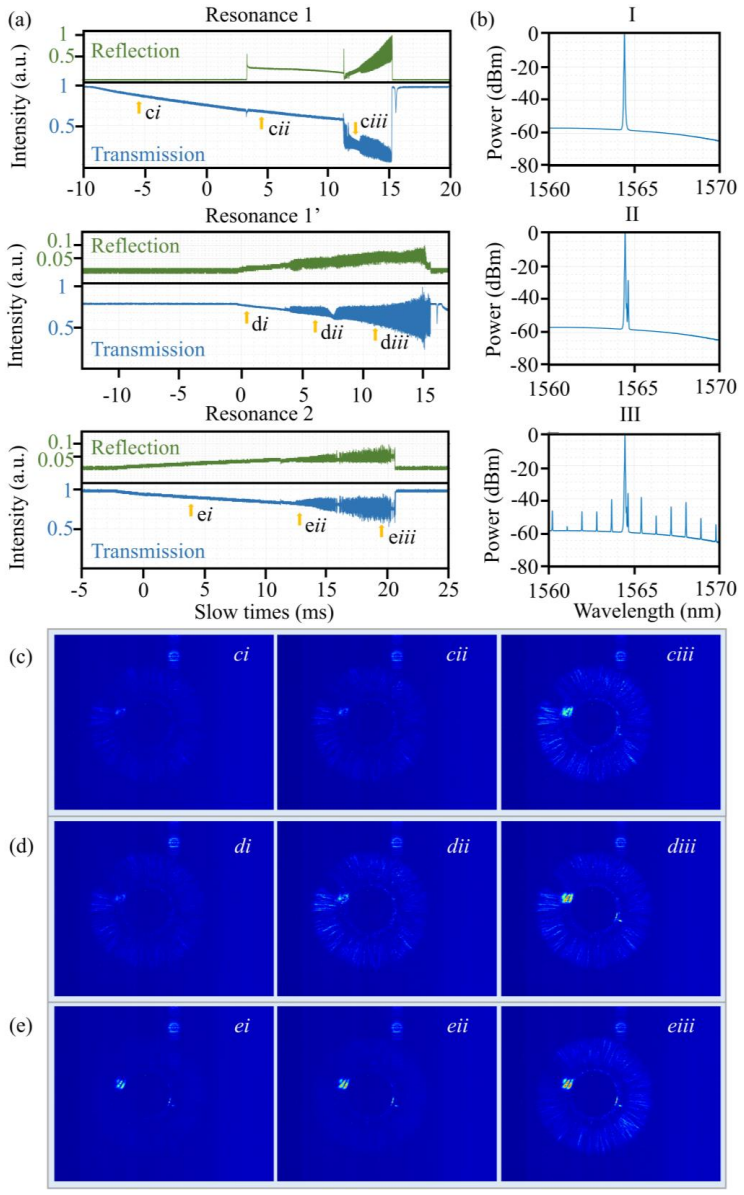
In the paper's own account, each intracavity state leaves a characteristic scattering signature on the resonator's rim. A resonance with no nonlinearity produces a fairly uniform ring of scattered light with a surrounding halo, and its total scattering intensity grows linearly with transmitted power. A comb-generating resonance instead shows localized scattering peaks whose brightness responds nonlinearly to power, reflecting light being redistributed among comb sidebands and standing-wave maxima shifting with detuning. Placing a tungsten tip near the resonator suppresses the four-wave-mixing noise and lowers the loaded Q-factor from $1.13\times10^8$ to $0.63\times10^8$, yet the spatial pattern stays closer to the comb state than to the no-comb state. For stimulated Brillouin scattering, the detuning-resolved scattering maps change abruptly at the onset of SBS, and SBS-plus-comb, SBS-only, and chaotic four-wave-mixing states can be distinguished by their spatial distribution.
Load-bearing premise
The load-bearing assumption is that the scattering patterns truly map the intracavity nonlinear dynamics and that differences between images are caused by the nonlinear process itself, not by uncontrolled changes in coupling, detuning, thermal drift, or measurement geometry.
Editorial extensions
If this is right
- Imaging can identify whether a resonance is generating a frequency comb without needing an optical spectrum analyzer.
- A tungsten-tip perturbation can suppress chaotic four-wave-mixing noise while leaving the spatial mode profile nearly unchanged, so spectral similarity and spatial fingerprints can disagree.
- The onset of stimulated Brillouin scattering shows up as an abrupt change in the detuning-resolved scattering map, and SBS-plus-comb can be told apart from SBS-only and chaotic four-wave mixing.
- Scattering intensity in the no-comb state varies linearly with transmitted power, which gives a way to estimate the circulating field intensity from images.
- Real-time scattering imaging can be used to monitor and debug photonic circuits during operation and to identify abnormal states in microresonator-based combs and memories.
Reading between the lines
- The paper leaves the link between image and intracavity field qualitative; a quantitative follow-up would simulate the standing-wave field for each state and check whether overlap with fixed scatterers reproduces the measured angular maps.
- If the fingerprints survive changes in coupling position and resonator sample, the same camera approach should work for chip-scale microresonators, where surface scatterers act as built-in monitors of the comb state.
- A classifier trained on detuning-resolved scattering maps, an outlook the paper mentions, could automate state identification and catch mode transitions faster than manual inspection.
- Because the authors attribute peak motion to standing-wave maxima shifting with power, tracking peak positions versus detuning could yield a separate measurement of mode dispersion and backscattering phase.
Signed reviews
Editorial analysis
A structured set of objections, weighed in public.
Referee Report
Summary. The paper reports a method for visualizing nonlinear optical processes in a fused-silica microrod WGM resonator by imaging near-infrared scattered light with a SWIR camera. The authors compare scattering patterns for a no-comb state, a frequency-comb (FWM) state, a comb-suppressed state obtained with a tungsten near-field tip, and several Brillouin-scattering states. They quantify the scattered intensity in selected regions of interest versus transmitted power, present detuning-resolved angular scattering maps, and claim that each nonlinear process leaves a unique spatial mode fingerprint that can be used to identify and localize nonlinear dynamics without modifying the device. Optical spectra recorded with an OSA serve as independent ground truth for which process is present.
Significance. If the central claim is established, the technique would provide a valuable spatially resolved diagnostic for WGM microresonators, complementing the spatially averaged information obtained from bus-waveguide transmission measurements. The paper has several strengths: the experiments are performed on a high-quality platform, the optical spectra provide independent confirmation of the nonlinear states, the detuning-scanned scattering maps offer a rich data set, and the SBS measurements include a clear spectral onset that correlates with an abrupt scattering change. However, as presented, the 'unique spatial mode fingerprints' are not yet convincingly established: the key FWM comparison is confounded with the choice of resonance, and the tungsten-tip control contradicts the process-specificity claim. With additional controlled experiments and a more rigorous classification framework, this could become a useful technique, but the current evidence is insufficient for the paper's headline claim.
major comments (4)
- [Main text, 'Visualization and characterization of comb states', Fig. 2] The central no-comb versus comb comparison is confounded: the manuscript states that the no-comb state and the stable comb state are achieved by pumping two different resonances (Resonance A at 1564.28 nm and Resonance B at 1564.27 nm). The observed differences in scattering patterns could therefore be caused by differences in the pumped mode family, coupling conditions, or intrinsic Q-factor (0.68e8 versus 1.13e8) rather than by the presence of the frequency comb. To support a process-specific fingerprint, the authors should compare comb and no-comb conditions on the same resonance, for example by varying the pump power or detuning, or they should demonstrate that the fingerprint is reproducible across multiple resonances that support the same process.
- [Main text, Fig. 2(c,f) and Fig. 2 caption] The tungsten-tip control undermines the process-specificity claim rather than supporting it. When the comb is suppressed by the tip on the same Resonance B, the optical spectrum shows no comb sidebands, yet the scattering patterns 'still resemble those in Fig. 2(e) rather than those in Fig. 2(d)' and localized scattering persists at the same locations. This indicates that the localized-scatterer pattern tracks the pumped cavity mode and its structural defects, not the nonlinear process. The sentence 'the FWM suppression does not change the spatial profile of the cavity mode' is an interpretation, but it directly contradicts the stated aim of using scattering patterns to distinguish nonlinear processes. The authors should either provide a separate observable that changes with the onset of FWM while holding the mode fixed, or revise the claim to 'spatial patterns encode the pumped mode family, with nonlinear processes modulating the overall intensity and detuning dependence.'
- [Main text, Fig. 3 and 'Visualization and characterization of comb states'] The quantitative analysis in Fig. 3(b,d-f) is based on manually selected regions of interest, and no error bars, repeated measurements, or fits with uncertainties are provided. The statements that the no-comb state shows 'a clear linear relation' and the comb state shows 'a distinct nonlinear trend' are supported only by visual inspection of individual curves. To substantiate the claim of process-specific quantitative fingerprints, the authors should report the number of independent measurements, the standard deviation or confidence intervals, and a quantitative fit (e.g., a linear model for the no-comb state and a power-law or threshold model for the comb state) with goodness-of-fit metrics.
- [Main text, Discussion and outlook; Fig. 5] The SBS section (Fig. 5) provides the strongest evidence for an abrupt, process-related scattering change at the onset of SBS, and the spectral confirmation is convincing. However, the claim that 'the presence of these characteristic scattering patterns allows us to distinguish different nonlinear processes' is not backed by a classification procedure. No blind analysis, held-out validation, or quantitative similarity metric is applied to the images; the fingerprints are defined and judged on the same data set from which they were extracted. A simple test, such as training a classifier on one set of detuning scans and testing on another, or computing a cross-correlation metric between states, would greatly increase the confidence in this claim.
minor comments (4)
- [Main text, after Fig. 2] The text refers to 'similar to the data in Fig. 2(j)' when describing detuning-scattering maps; the maps are actually in Fig. 3(j)-(l). Please correct this cross-reference.
- [Author contributions] The contributions list 'H.C.Z.' but the author list contains 'Haochen Yan' (H.Y.); this abbreviation should be corrected for consistency.
- [Fig. 2 and Fig. 3] The camera images would benefit from scale bars and a clear indication of the taper and tip positions in all panels; currently the reader must infer the geometry from the schematic in Fig. 1.
- [References] References [50] and [52] are unpublished arXiv preprints; if possible, update or clearly mark them as such, and ensure that all claims that rely on these works are explicitly flagged in the text as preliminary.
Circularity Check
No load-bearing circularity; one minor calibration overclaim about estimating circulating field intensity.
-
fitted input called prediction
[Results, 'Visualization and characterization of comb states', paragraph after Fig. 2]
"The comparison between different scattering patterns enables us to estimate the circulating field intensity without measuring transmission spectra."
The paper establishes the relation between scattering intensity and circulating power by measuring transmitted power: Fig. 3(b) reports 'a clear linear relation between the scattering intensity and transmitted power (and thus intracavity power)', explicitly noting that transmitted power decreases when intracavity power increases. Therefore the claimed estimation is a calibration derived from transmission measurements, and asserting that it works 'without measuring transmission spectra' overstates the independence of the estimate. This is a side remark rather than evidence for the main fingerprint classification, so it is a minor calibration overclaim rather than a load-bearing circular step.
full rationale
The central claim—that scattering-pattern 'fingerprints' can distinguish nonlinear processes in a WGM microresonator—is supported by independent ground truth: optical spectra recorded on an OSA are used to identify which nonlinear process is present (e.g., Fig. 2(g)-(h), Fig. 4(b), Fig. 5(d)-(i)). The scattering images are then visually and quantitatively compared against those spectral states; the fingerprints are not fitted to the spectral labels and no parameter is fitted to a subset and then used to predict that same subset. Self-citations (refs. 48-50) are method/phenomenon references, not load-bearing uniqueness arguments. The main weaknesses are experimental confounds—the no-comb and comb states are pumped at different resonances, and the comb-suppressed control still shows the comb-like scattering pattern—but these are validity/correctness issues rather than circular derivations. The only identifiable circularity-adjacent statement is the intensity-estimation claim, which is a calibration overstatement and does not support the core fingerprint result. Overall the paper is self-contained against external spectral benchmarks, so circularity is minor.
Assumptions & free parameters
free parameters (1)
- Spatial regions of interest for scattering analysis =
Not quantified; positions chosen by visual inspection of images
assumptions (4)
- domain assumption Scattered light intensity measured by the camera is proportional to the local intracavity optical intensity.
- domain assumption The tungsten tip only changes the resonator's Q-factor and backscattering, leaving the mode structure otherwise unchanged.
- domain assumption The absence of comb sidebands in the optical spectrum implies that nonlinear conversion is suppressed.
- domain assumption Backscattering-induced standing waves and their detuning-dependent shifts explain the scatterer intensity changes.
Cite this review
Pith. "Pith review of Visualization of nonlinear optics in a microresonator." pith.science (2026). https://pith.science/paper/EFYSUOCO
@misc{pith2026250705450,
  author       = {Pith},
  title        = {Pith review of: Visualization of nonlinear optics in a microresonator},
  year         = {2026},
  howpublished = {\url{https://pith.science/paper/EFYSUOCO}},
  note         = {Machine review of arXiv:2507.05450}
}
read the original abstract
A precise understanding of nonlinear optical phenomena in whispering gallery mode (WGM) microresonators is crucial for developing next-generation integrated photonic devices. Applications include on-chip sensors for biomedical use, optical memories for all-optical networks and frequency combs for optical clocks. However, our ability to spatially localize nonlinear optical processes within microresonators has been limited because optical feedback is often only collected through a bus waveguide. In this study, we present the direct visualization of nonlinear optical processes using scattering patterns captured by a short-wave infrared (SWIR) camera. Through systematic analysis of these scattering patterns, we can distinguish between different nonlinear effects occurring within the microresonator. Direct imaging of nonlinear processes in microresonators can significantly impact many applications, including the optimization of soliton frequency combs, real-time debugging of photonic circuits, microresonator-based memories, and chip-based data switching in telecom circuits.
Figures


Figures from the paper (1 more)

Reference graph
Works this paper leans on
-
[1]
K. J. Vahala, "Optical microcavities," Nature 424, 839-846 (2003)
work page 2003
-
[2]
Dissipative Kerr solitons in optical microresonators,
T. J. Kippenberg, A. L. Gaeta, M. Lipson, and M. L. Gorodetsky, "Dissipative Kerr solitons in optical microresonators," Science 361, eaan8083 (2018)
work page 2018
-
[3]
Quantum-dot microlasers based on whispering gallery mode resonators,
A. E. Zhukov, N. V. Kryzhanovskaya, E. I. Moiseev, and M. V. Maximov, "Quantum-dot microlasers based on whispering gallery mode resonators," Light Sci Appl 10, 80 (2021)
work page 2021
-
[4]
Self-Switching Kerr Oscillations of Counterpropagating Light in Microresonators,
M. T. M. Woodley, L. Hill, L. Del Bino, G. L. Oppo, and P. Del'Haye, "Self-Switching Kerr Oscillations of Counterpropagating Light in Microresonators," Phys Rev Lett 126, 043901 (2021)
work page 2021
-
[5]
Frequency comb assisted diode laser spectroscopy for measurement of microcavity dispersion,
P. Del'Haye, O. Arcizet, M. L. Gorodetsky, R. Holzwarth, and T. J. Kippenberg, "Frequency comb assisted diode laser spectroscopy for measurement of microcavity dispersion," Nature Photonics 3, 529-533 (2009)
work page 2009
-
[6]
Optical frequency comb generation from a monolithic microresonator,
P. Del'Haye, A. Schliesser, O. Arcizet, T. Wilken, R. Holzwarth, and T. J. Kippenberg, "Optical frequency comb generation from a monolithic microresonator," Nature 450, 1214-1217 (2007)
work page 2007
-
[7]
Photonic -chip-based frequency combs,
A. L. Gaeta, M. Lipson, and T. J. Kippenberg, "Photonic -chip-based frequency combs," Nature Photonics 13, 158-169 (2019)
work page 2019
-
[8]
Temporal solitons in optical microresonators,
T. Herr, V. Brasch, J. D. Jost, C. Y. Wang, N. M. Kondratiev, M. L. Gorodetsky, and T. J. Kippenberg, "Temporal solitons in optical microresonators," Nature Photonics 8, 145-152 (2013)
work page 2013
Show all 52 references
-
[9]
Soliton crystals in Kerr resonators,
D. C. Cole, E. S. Lamb, P. Del’Haye, S. A. Diddams, and S. B. Papp, "Soliton crystals in Kerr resonators," Nature Photonics 11, 671-676 (2017)
2017
-
[10]
Parity-time-symmetric whispering- gallery mode nanoparticle sensor [Invited],
W. Chen, J. Zhang, B. Peng, Ş. K. Özdemir, X. Fan, and L. Yang, "Parity-time-symmetric whispering- gallery mode nanoparticle sensor [Invited]," Photonics Research 6 (2018)
2018
-
[11]
Parity -time- symmetric microring lasers,
H. Hodaei, M. A. Miri, M. Heinrich, D. N. Christodoulides, and M. Khajavikhan, "Parity -time- symmetric microring lasers," Science 346, 975-978 (2014)
2014
-
[12]
Single-mode laser by parity-time symmetry breaking,
L. Feng, Z. J. Wong, R. M. Ma, Y. Wang, and X. Zhang, "Single-mode laser by parity-time symmetry breaking," Science 346, 972-975 (2014)
2014
-
[13]
Brillouin -Kerr Soliton Frequency Combs in an Optical Microresonator,
Y. Bai, M. Zhang, Q. Shi, S. Ding, Y. Qin, Z. Xie, X. Jiang, and M. Xiao, "Brillouin -Kerr Soliton Frequency Combs in an Optical Microresonator," Phys Rev Lett 126, 063901 (2021)
2021
-
[14]
Brillouin lasing with a CaF2 whispering gallery mode resonator,
I. S. Grudinin, A. B. Matsko, and L. Maleki, "Brillouin lasing with a CaF2 whispering gallery mode resonator," Phys Rev Lett 102, 043902 (2009)
2009
-
[15]
A silicon Brillouin laser,
N. T. Otterstrom, R. O. Behunin, E. A. Kittlaus, Z. Wang, and P. T. Rakich, "A silicon Brillouin laser," Science 360, 1113-1116 (2018)
2018
-
[16]
Brillouin -enhanced hyperparametric generation of an optical frequency comb in a monolithic highly nonlinear fiber cavity pumped by a cw laser,
D. Braje, L. Hollberg, and S. Diddams, "Brillouin -enhanced hyperparametric generation of an optical frequency comb in a monolithic highly nonlinear fiber cavity pumped by a cw laser," Phys Rev Lett 102, 193902 (2009)
2009
-
[17]
Sub -hertz fundamental linewidth photonic integrated Brillouin laser,
S. Gundavarapu, G. M. Brodnik, M. Puckett, T. Huffman, D. Bose, R. Behunin, J. Wu, T. Qiu, C. Pinho, N. Chauhan, J. Nohava, P. T. Rakich, K. D. Nelson, M. Salit, and D. J. Blumenthal, "Sub -hertz fundamental linewidth photonic integrated Brillouin laser," Nature Photonics 13, ...
2018
-
[18]
Visible light photonic integrated Brillouin laser,
N. Chauhan, A. Isichenko, K. Liu, J. Wang, Q. Zhao, R. O. Behunin, P. T. Rakich, A. M. Jayich, C. Fertig, C. W. Hoyt, and D. J. Blumenthal, "Visible light photonic integrated Brillouin laser," Nat Commun 12, 4685 (2021)
2021
-
[19]
Non -reciprocal Brillouin scattering induced transparency,
J. Kim, M. C. Kuzyk, K. Han, H. Wang, and G. Bahl, "Non -reciprocal Brillouin scattering induced transparency," Nature Physics 11, 275-280 (2015)
2015
-
[20]
Broadband high -Q multimode silicon concentric racetrack resonators for widely tunable Raman lasers,
Y. Zhang, K. Zhong, X. Zhou, and H. K. Tsang, "Broadband high -Q multimode silicon concentric racetrack resonators for widely tunable Raman lasers," Nat Commun 13, 3534 (2022)
2022
-
[21]
A scatterer-assisted whispering-gallery-mode microprobe,
F. Shu, X. Jiang, G. Zhao, and L. Yang, "A scatterer-assisted whispering-gallery-mode microprobe," Nanophotonics 7, 1455-1460 (2018)
2018
-
[22]
Quantum optics of soliton microcombs,
M. A. Guidry, D. M. Lukin, K. Y. Yang, R. Trivedi, and J. Vučković, "Quantum optics of soliton microcombs," Nature Photonics 16, 52-58 (2021)
2021
-
[23]
Kerr-Nonlinearity-Induced Mode-Splitting in Optical Microresonators,
G. N. Ghalanos, J. M. Silver, L. Del Bino, N. Moroney, S. Zhang, M. T. M. Woodley, A. O. Svela, and P. Del'Haye, "Kerr-Nonlinearity-Induced Mode-Splitting in Optical Microresonators," Phys Rev Lett 124, 223901 (2020). 13
2020
-
[24]
Cavity -QED treatment of scattering - induced free-space excitation and collection in high -Qwhispering-gallery microcavities,
Y.-C. Liu, Y. -F. Xiao, X. -F. Jiang, B. -B. Li, Y. Li, and Q. Gong, "Cavity -QED treatment of scattering - induced free-space excitation and collection in high -Qwhispering-gallery microcavities," Physical Review A 85 (2012)
2012
-
[25]
Tunable whispering-gallery-mode resonators for cavity quantum electrodynamics,
Y. Louyer, D. Meschede, and A. Rauschenbeutel, "Tunable whispering-gallery-mode resonators for cavity quantum electrodynamics," Physical Review A 72 (2005)
2005
-
[26]
Dark -Bright Soliton Bound States in a Microresonator,
S. Zhang, T. Bi, G. N. Ghalanos, N. P. Moroney, L. Del Bino, and P. Del'Haye, "Dark -Bright Soliton Bound States in a Microresonator," Phys Rev Lett 128, 033901 (2022)
2022
-
[27]
Cavity optomechanics: back-action at the mesoscale,
T. J. Kippenberg, and K. J. Vahala, "Cavity optomechanics: back-action at the mesoscale," Science 321, 1172-1176 (2008)
2008
-
[28]
Petermann -factor sensitivity limit near an exceptional point in a Brillouin ring laser gyroscope,
H. Wang, Y. H. Lai, Z. Yuan, M. G. Suh, and K. Vahala, "Petermann -factor sensitivity limit near an exceptional point in a Brillouin ring laser gyroscope," Nat Commun 11, 1610 (2020)
2020
-
[29]
Nonlinear enhanced microresonator gyroscope,
J. M. Silver, L. Del Bino, M. T. M. Woodley, G. N. Ghalanos, A. Ø . Svela, N. Moroney, S. Zhang, K. T. V. Grattan, and P. Del’Haye, "Nonlinear enhanced microresonator gyroscope," Optica 8 (2021)
2021
-
[30]
Coherent terabit communications with microres onator Kerr frequency combs,
J. Pfeifle, V. Brasch, M. Lauermann, Y. Yu, D. Wegner, T. Herr, K. Hartinger, P. Schindler, J. Li, D. Hillerkuss, R. Schmogrow, C. Weimann, R. Holzwarth, W. Freude, J. Leuthold, T. J. Kippenberg, and C. Koos, "Coherent terabit communications with microres onator Kerr frequency...
2014
-
[31]
Vernier spectrometer using counterpropagating soliton microcombs,
Q. F. Yang, B. Shen, H. Wang, M. Tran, Z. Zhang, K. Y. Yang, L. Wu, C. Bao, J. Bowers, A. Yariv, and K. Vahala, "Vernier spectrometer using counterpropagating soliton microcombs," Science 363, 965-968 (2019)
2019
-
[32]
Single- particle photoacoustic vibrational spectroscopy using optical microresonators,
S.-J. Tang, M. Zhang, J. Sun, J.-W. Meng, X. Xiong, Q. Gong, D. Jin, Q.-F. Yang, and Y.-F. Xiao, "Single- particle photoacoustic vibrational spectroscopy using optical microresonators," Nature Photonics 17, 951-956 (2023)
2023
-
[33]
Advances in optoplasmonic sensors – combining optical nano/microcavities and photonic crystals with plasmonic nanostructures and nanoparticles,
J. Xavier, S. Vincent, F. Meder, and F. Vollmer, "Advances in optoplasmonic sensors – combining optical nano/microcavities and photonic crystals with plasmonic nanostructures and nanoparticles," Nanophotonics 7, 1-38 (2018)
2018
-
[34]
Quantum nanophotonic and nanoplasmonic sensing: towards quantum optical bioscience laboratories on chip,
J. Xavier, D. Yu, C. Jones, E. Zossimova, and F. Vollmer, "Quantum nanophotonic and nanoplasmonic sensing: towards quantum optical bioscience laboratories on chip," Nanophotonics 10, 1387-1435 (2021)
2021
-
[35]
Brillouin light scattering anisotropy microscopy for imaging the viscoelastic anisotropy in living cells,
H. Keshmiri, D. Cikes, M. Samalova, L. Schindler, L. -M. Appel, M. Urbanek, I. Yudushkin, D. Slade, W. J. Weninger, A. Peaucelle, J. Penninger, and K. Elsayad, "Brillouin light scattering anisotropy microscopy for imaging the viscoelastic anisotropy in living cells," Nature Ph...
2024
-
[36]
Self ‐Injection Locked Frequency Conversion Laser,
J. Ling, J. Staffa, H. Wang, B. Shen, L. Chang, U. A. Javid, L. Wu, Z. Yuan, R. Lopez‐Rios, M. Li, Y. He, B. Li, J. E. Bowers, K. J. Vahala, and Q. Lin, "Self ‐Injection Locked Frequency Conversion Laser," Laser & Photonics Reviews (2023)
2023
-
[37]
Hertz -linewidth semiconductor lasers using CMOS-ready ultra-high-Q microresonators,
W. Jin, Q. F. Yang, L. Chang, B. Q. Shen, H. M. Wang, M. A. Leal, L. Wu, M. D. Gao, A. Feshali, M. Paniccia, K. J. Vahala, and J. E. Bowers, "Hertz -linewidth semiconductor lasers using CMOS-ready ultra-high-Q microresonators," Nature Photonics 15, 346-353 (2021)
2021
-
[38]
3D integration enables ultralow -noise isolator-free lasers in silicon photonics,
C. Xiang, W. Jin, O. Terra, B. Dong, H. Wang, L. Wu, J. Guo, T. J. Morin, E. Hughes, J. Peters, Q. X. Ji, A. Feshali, M. Paniccia, K. J. Vahala, and J. E. Bowers, "3D integration enables ultralow -noise isolator-free lasers in silicon photonics," Nature 620, 78-85 (2023)
2023
-
[39]
Microresonator-based solitons for massively parallel coherent optical communications,
P. Marin-Palomo, J. N. Kemal, M. Karpov, A. Kordts, J. Pfeifle, M. H. P. Pfeiffer, P. Trocha, S. Wolf, V. Brasch, M. H. Anderson, R. Rosenberger, K. Vijayan, W. Freude, T. J. Kippenberg, and C. Koos, "Microresonator-based solitons for massively parallel coherent optical commun...
2017
-
[40]
Optimally Coherent Kerr Combs Generated with Crystalline Whispering Gallery Mode Resonators for Ultrahigh Capacity Fiber Communications,
J. Pfeifle, A. Coillet, R. Henriet, K. Saleh, P. Schindler, C. Weimann, W. Freude, I. V. Balakireva, L. Larger, C. Koos, and Y. K. Chembo, "Optimally Coherent Kerr Combs Generated with Crystalline Whispering Gallery Mode Resonators for Ultrahigh Capacity Fiber Communications,"...
2015
-
[41]
Dynamics of soliton crystals in optical microresonators,
M. Karpov, M. H. P. Pfeiffer, H. Guo, W. Weng, J. Liu, and T. J. Kippenberg, "Dynamics of soliton crystals in optical microresonators," Nature Physics 15, 1071-1077 (2019). 14
2019
-
[42]
Critical dynamics of an asymmetrically bidirectionally pumped optical microresonator,
J. M. Silver, K. T. V. Grattan, and P. Del'Haye, "Critical dynamics of an asymmetrically bidirectionally pumped optical microresonator," Physical Review A 104 (2021)
2021
-
[43]
Imaging soliton dynamics in optical microcavities,
X. Yi, Q. F. Yang, K. Y. Yang, and K. Vahala, "Imaging soliton dynamics in optical microcavities," Nat Commun 9, 3565 (2018)
2018
-
[44]
Visualizing the Nanoscopic Field Distribution of Whispering-Gallery Modes in a Dielectric Sphere by Cathodoluminescence,
I. Machfuudzoh, T. Hinamoto, F. J. Garcia de Abajo, H. Sugimoto, M. Fujii, and T. Sannomiya, "Visualizing the Nanoscopic Field Distribution of Whispering-Gallery Modes in a Dielectric Sphere by Cathodoluminescence," ACS Photonics 10, 1434-1445 (2023)
2023
-
[45]
Observation of the all-optical Stern–Gerlach effect in nonlinear optics,
O. Yesharim, A. Karnieli, S. Jackel, G. Di Domenico, S. Trajtenberg-Mills, and A. Arie, "Observation of the all-optical Stern–Gerlach effect in nonlinear optics," Nature Photonics 16, 582-587 (2022)
2022
-
[46]
Virtual optofluidic time-stretch quantitative phase imaging,
H. Yan, Y. Wu, Y. Zhou, M. Xu, P. Paiè, C. Lei, S. Yan, and K. Goda, "Virtual optofluidic time-stretch quantitative phase imaging," APL Photonics 5 (2020)
2020
-
[47]
Slow -Light-Enhanced Optical Imaging of Microfiber Radius Variations with Subangstrom Precision,
M. Scheucher, K. Kassem, A. Rauschenbeutel, P. Schneeweiss, and J. Volz, "Slow -Light-Enhanced Optical Imaging of Microfiber Radius Variations with Subangstrom Precision," Physical Review Applied 14 (2020)
2020
-
[48]
Coherent suppression of backscattering in optical microresonators,
A. O. Svela, J. M. Silver, L. Del Bino, S. Zhang, M. T. M. Woodley, M. R. Vanner, and P. Del'Haye, "Coherent suppression of backscattering in optical microresonators," Light Sci Appl 9, 204 (2020)
2020
-
[49]
Real -time imaging of standing -wave patterns in microresonators,
H. Yan, A. Ghosh, A. Pal, H. Zhang, T. Bi, G. Ghalanos, S. Zhang, L. Hill, Y. Zhang, Y. Zhuang, J. Xavier, and P. Del'Haye, "Real -time imaging of standing -wave patterns in microresonators," Proc Natl Acad Sci U S A 121, e2313981121 (2024)
2024
-
[50]
Microresonator soliton frequency combs via cascaded Brillouin scattering,
H. Zhang, S. Zhang, T. Bi, G. Ghalanos, Y. Zhang, H. Yan, A. Pal, J. He, S. Pan, and P. Del Haye "Microresonator soliton frequency combs via cascaded Brillouin scattering," ArXiv preprint arXiv:2312.15506 (2023)
2023 arXiv
-
[51]
Robust optical physical unclonable function using disordered photonic integrated circuits,
F. Bin Tarik, A. Famili, Y. Lao, and J. D. Ryckman, "Robust optical physical unclonable function using disordered photonic integrated circuits," Nanophotonics 9, 2817-2828 (2020)
2020
-
[52]
Phase symmetry breaking of counterpropagating light in microresonators for switches and logic gates,
A. Ghosh, A. Pal, S. Zhang, L. Hill, T. Bi, and P. Del'Haye "Phase symmetry breaking of counterpropagating light in microresonators for switches and logic gates," ArXiv preprint arXiv:2407.16625 (2024)
2024 arXiv
Reviewed August 6, 2026 · model on record in the stance chip above.
Discussion (0). Continue with ORCID to comment.