REVIEW 3 major objections 6 minor 88 references
Gaussian Process-Based Active Exploration Strategies in Vision and Touch
T0 review · 3 major / 6 minor · reviewed 2026-08-06 · deepseek-v4-flash
Pith's one-line read The thesis argues that one Gaussian Process Distance Field can carry both visual and tactile observations, letting a robot actively refine an object's geometry by choosing camera poses and contact points that maximize information gain…
desk verdict A promising GPDF-based vision-touch exploration pipeline whose central claim is undercut by experiments that only validate the uncertainty proxies it optimizes, not reconstruction accuracy. read the letter →
The pith
A machine-rendered reading of the paper's core claim, the machinery that carries it, and where it could break.
The reading
What carries the argument
The load-bearing object is the Gaussian Process Distance Field: Gaussian Process regression over observed surface points whose y-values are fixed to one, combined with a reverting function that maps the occupancy posterior back to a distance so that the field satisfies $|\nabla d|=1$. The covariance kernel $\exp(-d/\ell)$ is singled out because its reverting function is bijective, which produces signed distance; ray marching then iteratively pulls query points to the surface. Surface uncertainty is derived either from a Mahalanobis distance between the kernel derivative and the inferred gradient, or from deviation of $\|\nabla d\|$ from one, and it is this uncertainty that drives touch contact selection through projected gradient ascent. Visual exploration is carried by differentiable volumetric rendering of the SDF, whose color and depth estimates give ensemble-based information gain for next-best-view choice; inducing points, voxel downsampling, and Nyström approximation keep the Gaussian Process cost manageable.
What would settle it
Measure the point-to-surface or Chamfer distance between the GPDF surface and a ground-truth scan of the same object after each exploration step; if information-gain-selected camera poses and uncertainty-selected contact points do not reduce that error faster than random selection, the paper's planning claim would be overturned.
Extended reading notes
Core claim
The central claim is that the Gaussian Process Distance Field is a unified, training-free representation for active visuo-tactile perception. By applying a Gaussian Process to surface points and using a reverting function that inverts the kernel, the model outputs signed distance, analytic gradient and Hessian, and surface uncertainty at any query point; with the exponential kernel $\exp(-d/\ell)$ the reverting function is bijective, giving a true signed distance field that ray marching can refine. The thesis shows this field can be rendered through differentiable volumetric ray marching, so color images with known poses can optimize the underlying point cloud even where depth is unreliable, and an ensemble of GPDFs with different interpolation lengths supplies the information-gain signal for choosing the next camera view. For touch, gradient ascent on surface uncertainty, projected onto the surface tangent plane, finds the most uncertain points to contact; real-robot experiments show maximum surface uncertainty decreasing as tactile exploration adds points. The same GP machinery is extended to RGB color, CLIP embeddings, and force-based material classification, making the claimed contribution a multi-modal active perception pipeline rather than a geometry-only method.
Load-bearing premise
The load-bearing premise is that the information-gain scores and surface-uncertainty values computed from the GPDF are faithful proxies for real reconstruction improvement; the thesis plans every next view and contact from these proxies but never checks them against ground-truth geometry.
Editorial extensions
If this is right
- A robot can start from a single RGB-D view and refine a full distance field by choosing each next camera pose from information gain and each next contact from surface uncertainty, with no network training on large shape datasets.
- New camera views and tactile contacts can be folded into the existing field via incremental block-matrix updates, so the representation supports online active perception rather than full re-optimization.
- Because color, CLIP embeddings, and material features share the same GP machinery, exploration policies designed for geometry transfer to semantic and physical property estimation.
- Differentiable rendering of the field makes it possible to recover geometry in reflective or translucent regions where the depth camera is noisy, by optimizing the point cloud against ordinary color images.
- Scalable GP approximations (inducing points, voxel sampling, Nyström) bring the pipeline from cubic to roughly linear cost, permitting thousands of sensor points in the loop.
Reading between the lines
- Editorial inference: a natural next experiment, left implicit in the thesis, is to compare information-gain-driven view selection against random view selection using Chamfer distance to a ground-truth scan; this would directly test whether the uncertainty proxies track true reconstruction improvement.
- Editorial inference: because the field is incremental and explicit, the same pipeline could be extended to deformable objects or continuous re-grasping if the point cloud were updated online; the thesis assumes static rigid objects.
- Editorial inference: the CLIP feature field opens a route to language-guided exploration, where the robot queries which surface region matches a word and plans camera or touch motions to reduce semantic uncertainty; the thesis stores and renders these features but does not run the semantic exploration loop.
Editorial analysis
A structured set of objections, weighed in public.
Referee Report
Summary. The thesis proposes a Gaussian Process Distance Field (GPDF) as a unified representation for active multimodal perception, combining dense vision (RGBD plus differentiable rendering) and sparse tactile measurements. It derives differentiable rendering and information-gain measures for camera-pose selection, surface-uncertainty-guided tactile exploration, incremental GP updates, and scalable kernel approximations. The pipeline is instantiated in simulation and on a Franka robot with a customized DIGIT sensor, and a separate rolling-based tactile material-classification study is presented. The central claim is that information-gain-driven exploration with this representation enables training-free, incrementally updatable, accurate 3D reconstruction of complex object geometries.
Significance. If substantiated, the GPDF-based framework would be a valuable contribution: it combines a training-free implicit representation with analytic gradients, uncertainty quantification, incremental updates, and multimodal fusion, and it demonstrates differentiable rendering from a GP distance field, an unusual and potentially useful capability. Strengths include the detailed treatment of kernel approximations (Section 3.5, Figs. 3-9 to 3-11), the custom tactile-sensor calibration pipeline (Sections 2.2-2.3), and real-robot integration. The main weakness is that the empirical validation of the exploration benefit is internal: the reported curves show the optimized information metrics decreasing, but no ground-truth reconstruction error, no repeated trials, and no comparison to baselines are provided. The material-classification results (Table 5.1) are also too weak to support the broader multimodal claims. The framework is plausible, but the current evidence does not yet establish the central claim.
major comments (3)
- [§4.1.2 and §4.2.1, Figs. 4-14 and 4-21] The quantitative evidence for the central claim that information-gain-guided exploration improves geometry is the decrease of the very objectives being optimized: Fig. 4-14 shows maximum information gain dropping faster under IG-guided view selection than random selection, and Fig. 4-21 shows maximum surface uncertainty falling as tactile contacts are added. Because the selection policy chooses views/contacts with high IG or high uncertainty, these decreases are expected even if the model's geometric accuracy does not improve. No ground-truth reconstruction metric (e.g., Chamfer distance to a high-fidelity scan, held-out depth error, or surface-normal error) is reported, there are no repeated trials or error bars, and no comparison to random contact selection or to existing GPIS-based tactile exploration methods such as those in Refs. [48,49,51]. Section 6.2 lists scalability and exploration-strategy limitations but does not acknowledge this absence of external geometric validation. This is the load-bearing gap: without such validation, the experiments cannot distinguish effective active exploration from a closed active-learning loop that simply reduces its own surrogate.
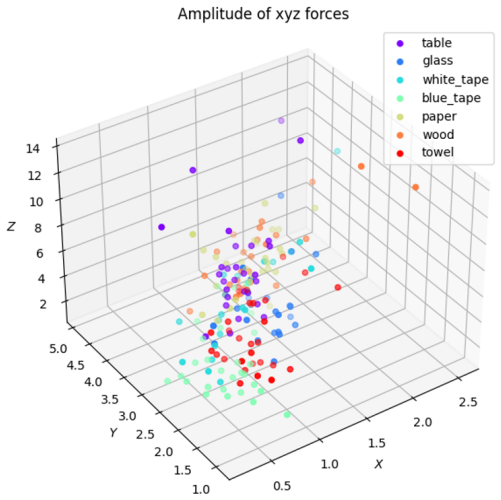
- [§5.2.1, Table 5.1] The material-classification experiments, which are the main support for the 'beyond geometry' claim, achieve cross-validation accuracies of 36.37% (SVM), 33.11% (MLP), and 29.87% (Random Forest) on seven materials (chance 14.29%), with training accuracies of 36.05%, 82.99%, and 79.59%, respectively. The large train-CV gap indicates severe overfitting, and the paper's own hypothesis that force amplitude alone is insufficient is stated but not followed by any experiments with the higher-dimensional features (raw images, deformation vectors) it suggests. Section 5.2.2 then proposes GP-based incorporation of classification into the multimodal field, but no experimental validation of that integration is provided. As presented, this chapter does not establish that tactile exploration can reliably identify materials, and the claim in Section 1.4 that the framework demonstrates potential for modeling surface properties beyond geometry is therefore premature.
- [§3.2.2 and §4.2.1, Eq. (3.4) vs Eq. (4.11)] The relationship between the two uncertainty quantities is never made explicit. Equation (3.4) defines a 'surrogate for distance uncertainty' using a Mahalanobis-like expression with a covariance Σ_ô(x) that is not defined in the text, and the notation ∂|k(d)|/∂d|_dhat is ambiguous (evaluated at what value, and which kernel derivative?). Later, Section 4.2.1 and Eq. (4.11) define tactile surface uncertainty in terms of the gradient of the GP predictive variance var(o(x)), which is a different quantity. Since Fig. 4-21 reports 'maximum surface uncertainty decreasing' without stating which of these measures is plotted, the reader cannot verify what the tactile exploration actually optimized or whether the reported decrease is the one promised by the surrogate. This needs to be clarified and, ideally, both quantities should be reported.
minor comments (6)
- [§1.4] The phrase 'Surface Uncertianty Quatification' contains two typos; it should read 'Surface Uncertainty Quantification.'
- [§3.2.3, Eq. (3.6)] The terms ∂f̄ and Δf̄ are not defined; the text says 'a gradient of one mean function value' and 'a gradient of n mean function values' but does not specify the differentiation variable or the exact construction of these quantities.
- [Appendix A] The table caption uses 'Generalized Probability Density Function (GPDF)'; this should be 'Gaussian Process Distance Field (GPDF).'
- [Fig. 4-14] The y-axis label gives no units for information gain, and no error bars are shown; please state in the caption how information gain is computed (number of ensemble members, interpolation values, etc.).
- [§5.2.1] The description of cross-validation ('dividing the dataset into three subsets') should state whether the splits are per-trial or per-sample; with 187 data points from 3 trials per material, the standard error is large and should be reported.
- [§4.1.2] The proposed ensemble of GPDFs with varying interpolation values is not compared against the alternative single-GPDF method mentioned in the same paragraph; a brief quantitative comparison would increase confidence in the choice.
Circularity Check
Exploration is validated by its own objectives: the tactile 'success' curve (max surface uncertainty decreasing) is mathematically forced by the GP posterior variance update, and the visual 'convergence' curve is the information-gain metric the planner maximizes, with no ground-truth geometry comparison.
-
fitted input called prediction
[Section 4.1.5 (Implementation); Figure 4-14]
"In contrast to random view selection in simulation, employing information gain to guide the exploration accelerates the convergence of the GPDFs, as illustrated in Figure 4-14. Choose the next-best-view from a set of predefined pose candidates based on the information gain."
The only quantitative evidence for 'convergence' is the drop in maximum information gain, yet that same IG is the objective the next-view rule maximizes ('choose the next-best-view ... based on the information gain'). IG (Eq. 4.4, adopted from He et al.) is evaluated with an ensemble of GPDFs fitted to the already-collected images; after a pose chosen because it maximizes IG is observed and the model is re-fit on that view, the candidate-pose IG falls simply because the model has absorbed that view, even if the underlying geometry is no more accurate. Figure 4-14's random-selection baseline is scored with the same self-referential metric, and no ground-truth reconstruction error is reported in Chapter 4.
-
self definitional
[Section 4.2.2 (Implementation); Figure 4-21]
"Identify the most uncertain surface point based on the GP model. Move the robot to the identified point and add it as an observation point. ... From Figure 4-21, it is evident that as more points are explored using tactile sensing, the maximum surface uncertainty decreases."
The claimed success measure, maximum surface uncertainty decreasing (Fig. 4-21), is exactly the function whose argmax defines the contact choice: Section 4.2.1 ascends the variance gradient (Eq. 4.11) and targets the most uncertain surface point (Eq. 4.14), which is then added as an observation point. For fixed hyperparameters, the GP posterior variance (Eqs. 3.2/3.6) never increases at any query location when a training point is added (positive-definite kernel with PSD noise augmentation), so the maximum surface uncertainty is forced to fall each iteration by the conditioning equations.
full rationale
The central empirical claims, that information-gain-guided views 'accelerate the convergence of the GPDFs' and that touching uncertain regions yields 'successful' exploration, rest only on plots of the very objectives the planner optimizes. The tactile result is the stronger case: contact points are chosen at the argmax of the GP's surface variance, and adding an observation there makes the posterior variance non-increasing at every point (Eqs. 3.2/3.6), so the monotone decrease in Figure 4-21 is a consequence of the conditioning equations rather than evidence of geometric improvement. The visual result is partly self-referential: maximum IG is both the selection objective and the convergence metric, and no ground-truth reconstruction error is measured anywhere in Chapter 4, nor is any comparison made against GPIS-based tactile exploration methods (Driess et al., Khadivar et al.). Notably, Section 6.2 flags scalability and discrete-sampling limitations but never acknowledges the absence of geometric validation of the exploration benefit, which is the load-bearing gap that leaves these self-referential metrics as the only quantitative support. The self-citation [10] (the authors' own prior work) for the signed-distance property of the Matern 1/2 kernel is not load-bearing: Table A.1 (sourced to [1,2]) gives the reverting function r(o) = -l*log(o), whose inversion of k(d) = exp(-d/l) is directly checkable in the appendix, independent of [10]. The remainder of the thesis, including the GPDF formulation from [1,22], kernel approximations, incremental updates, QP control, and the honestly reported low material-classification accuracies (Table 5.1, cross-validation 29-36%), is self-contained against external work and shows no equation-level circularity. The circularity is partial but attaches to the thesis's central claim, so the score is 6 rather than lower.
Assumptions & free parameters
free parameters (8)
- GP lengthscale l =
Not reported; heuristic l >= 2x nominal point spacing
- Sigmoid smoothness parameter s in volumetric rendering =
Not reported; described as a high positive constant
- Number of inducing points m =
1000 and 2000 in Figure 4-4
- Input or observation noise covariance =
Not reported
- Tactile stiffness matrix K =
Not reported; fit with gradient descent
- Inverse reflectance function matrix R^-1 =
2x11 matrix fit by incremental solver
- Classifier hyperparameters =
SVM C=10^3, gamma=10^-4; MLP 64x64x64
- Voxel downsampling size =
e.g. 2 cm unit voxel
assumptions (6)
- standard math The Matérn 1/2 kernel reverting function r(o) = -l log(o) is bijective and yields a signed distance field.
- domain assumption Objects are static, rigid, and within the robot workspace, and the robot and sensor kinematics are known.
- domain assumption Each tactile contact can be modeled as a point on a rigid object surface, with all deformation confined to the sensor.
- ad hoc to paper GPDF predictive variance and the eikonal deviation |1 - ||grad d||| are valid measures of geometric surface uncertainty.
- domain assumption Ensemble information gain computed from rendered color and depth approximates the true value of a camera pose.
- ad hoc to paper CLIP features can be spatially interpolated with GP kernels and retain semantic meaning.
Cite this review
Pith. "Pith review of Gaussian Process-Based Active Exploration Strategies in Vision and Touch." pith.science (2026). https://pith.science/paper/YUFUP32W
@misc{pith2026250705522,
  author       = {Pith},
  title        = {Pith review of: Gaussian Process-Based Active Exploration Strategies in Vision and Touch},
  year         = {2026},
  howpublished = {\url{https://pith.science/paper/YUFUP32W}},
  note         = {Machine review of arXiv:2507.05522}
}
read the original abstract
Robots struggle to understand object properties like shape, material, and semantics due to limited prior knowledge, hindering manipulation in unstructured environments. In contrast, humans learn these properties through interactive multi-sensor exploration. This work proposes fusing visual and tactile observations into a unified Gaussian Process Distance Field (GPDF) representation for active perception of object properties. While primarily focusing on geometry, this approach also demonstrates potential for modeling surface properties beyond geometry. The GPDF encodes signed distance using point cloud, analytic gradient and Hessian, and surface uncertainty estimates, which are attributes that common neural network shape representation lack. By utilizing a point cloud to construct a distance function, GPDF does not need extensive pretraining on large datasets and can incorporate observations by aggregation. Starting with an initial visual shape estimate, the framework iteratively refines the geometry by integrating dense vision measurements using differentiable rendering and tactile measurements at uncertain surface regions. By quantifying multi-sensor uncertainties, it plans exploratory motions to maximize information gain for recovering precise 3D structures. For the real-world robot experiment, we utilize the Franka Research 3 robot manipulator, which is fixed on a table and has a customized DIGIT tactile sensor and an Intel Realsense D435 RGBD camera mounted on the end-effector. In these experiments, the robot explores the shape and properties of objects assumed to be static and placed on the table. To improve scalability, we investigate approximation methods like inducing point method for Gaussian Processes. This probabilistic multi-modal fusion enables active exploration and mapping of complex object geometries, extending potentially beyond geometry.
Figures


Figures from the paper (43 more)






Reference graph
Works this paper leans on
-
[1]
Accurate Gaussian-Process-based Distance Fields with applications to Echolocation and Mapping
C. L. Gentil, O.-L. Ouabi, L. Wu, C. Pradalier, and T. Vidal-Calleja, “Accurate gaussian process distance fields with applications to echolocation and mapping,” ArXiv, vol. abs/2302.13005, 2023
work page Pith review arXiv 2023
-
[2]
Gaussian processes for machine learning,
S. T. Ounpraseuth, “Gaussian processes for machine learning,” Journal of the American Statistical Association, vol. 103, pp. 429 – 429, 2008
2008
-
[3]
The development of embodied cognition: Six lessons from babies,
L. B. Smith and M. Gasser, “The development of embodied cognition: Six lessons from babies,” Artificial Life, vol. 11, pp. 13–29, 2005
2005
-
[4]
Nerf: Representing scenes as neural radiance fields for view synthesis,
B. Mildenhall, P. P. Srinivasan, M. Tancik, J. T. Barron, R. Ramamoorthi, and R. Ng, “Nerf: Representing scenes as neural radiance fields for view synthesis,” Commun. ACM, vol. 65, pp. 99–106, 2020
2020
-
[5]
Digit: A novel design for a low-cost compact high-resolution tactile sensor with appli- cation to in-hand manipulation,
M. Lambeta, P. wei Chou, S. Tian, B. Yang, B. Maloon, V. R. Most, D. Stroud, R. Santos, A. Byagowi, G. Kammerer, D. Jayaraman, and R. Calandra, “Digit: A novel design for a low-cost compact high-resolution tactile sensor with appli- cation to in-hand manipulation,” IEEE Robotics and Automation Letters, vol. 5, pp. 3838–3845, 2020
2020
-
[6]
Point set registration: Coherent point drift,
A. Myronenko and X. B. Song, “Point set registration: Coherent point drift,” IEEE Transactions on Pattern Analysis and Machine Intelligence , vol. 32, pp. 2262–2275, 2009
2009
-
[7]
Advances in neural rendering,
A. Tewari, O. Fried, J. Thies, V. Sitzmann, S. Lombardi, Z. Xu, T. Simon, M. Nießner, E. Tretschk, L. Liu, B. Mildenhall, P. Srinivasan, R. Pandey, S. Orts-Escolano, S. Fanello, M. G. Guo, G. Wetzstein, J. y Zhu, C. Theobalt, M. Agrawala, D. B. Goldman, and M. Zollh¨ ofer, “Advances in neural rendering,” Computer Graphics Forum, vol. 41, 2021
2021
-
[8]
Superquadrics and their geometric prop- erties,
A. Jakliˇ c, A. Leonardis, and F. Solina, “Superquadrics and their geometric prop- erties,” 2000
2000
Show all 88 references
-
[9]
Capsule - closest 3d
iq, “Capsule - closest 3d.” https://www.shadertoy.com/view/stXXzl, Jul
-
[10]
Towards feasible dynamic grasping: Leveraging gaussian process distance field, se(3) equivariance and riemannian mixture mod- els,
H. J. Choi and N. Figueroa, “Towards feasible dynamic grasping: Leveraging gaussian process distance field, se(3) equivariance and riemannian mixture mod- els,” ArXiv, vol. abs/2311.02576, 2023
2023 arXiv
-
[11]
Curobo: Parallelized collision-free minimum-jerk robot motion genera- tion,
B. Sundaralingam, S. K. S. Hari, A. Fishman, C. R. Garrett, K. V. Wyk, V. Blukis, A. Millane, H. Oleynikova, A. Handa, F. Ramos, N. Ratliff, and D. Fox, “Curobo: Parallelized collision-free minimum-jerk robot motion genera- tion,” ArXiv, vol. abs/2310.17274, 2023
-
[12]
Hand movements: A window into haptic object recognition,
S. J. Lederman and R. L. Klatzky, “Hand movements: A window into haptic object recognition,” Cognitive Psychology, vol. 19, pp. 342–368, 1987
1987
-
[13]
Revisiting active perception,
R. Bajcsy, Y. Aloimonos, and J. K. Tsotsos, “Revisiting active perception,” CoRR, vol. abs/1603.02729, 2016
2016 arXiv
-
[14]
Active perception,
R. Bajcsy, “Active perception,” Proc. IEEE, vol. 76, pp. 966–1005, 1988
1988
-
[15]
Object recognition using vision and touch,
P. K. Allen and R. Bajcsy, “Object recognition using vision and touch,” in In- ternational Joint Conference on Artificial Intelligence , 1985
1985
-
[16]
Morphing and sampling network for dense point cloud completion,
M. Liu, L. Sheng, S. Yang, J. Shao, and S. Hu, “Morphing and sampling network for dense point cloud completion,” CoRR, vol. abs/1912.00280, 2019
1912 arXiv
-
[17]
Foldingnet: Interpretable unsupervised learning on 3d point clouds,
Y. Yang, C. Feng, Y. Shen, and D. Tian, “Foldingnet: Interpretable unsupervised learning on 3d point clouds,” CoRR, vol. abs/1712.07262, 2017
2017 arXiv
-
[18]
PCN: point completion network,
W. Yuan, T. Khot, D. Held, C. Mertz, and M. Hebert, “PCN: point completion network,” CoRR, vol. abs/1808.00671, 2018
2018 arXiv
-
[19]
isdf: Real-time neural signed distance fields for robot percep- tion,
J. Ortiz, A. Clegg, J. Dong, E. Sucar, D. Novotn´ y, M. Zollhoefer, and M. Mukadam, “isdf: Real-time neural signed distance fields for robot percep- tion,” ArXiv, vol. abs/2204.02296, 2022
2022 arXiv
-
[20]
3d gaussian splatting for real-time radiance field rendering,
B. Kerbl, G. Kopanas, T. Leimkuehler, and G. Drettakis, “3d gaussian splatting for real-time radiance field rendering,” ACM Transactions on Graphics (TOG) , vol. 42, pp. 1 – 14, 2023
2023
-
[21]
Hand-eye calibration using dual quaternions,
K. Daniilidis, “Hand-eye calibration using dual quaternions,” The International Journal of Robotics Research, vol. 18, pp. 286 – 298, 1999
1999
-
[22]
Faithful euclidean distance field from log-gaussian process implicit surfaces,
L. Wu, K. M. B. Lee, L. Liu, and T. A. Vidal-Calleja, “Faithful euclidean distance field from log-gaussian process implicit surfaces,” CoRR, vol. abs/2010.11487, 2020
2010 arXiv
-
[23]
Uncertainty guided policy for active robotic 3d reconstruction using neural radiance fields,
S. Lee, C. Le, W. Jiahao, A. Liniger, S. Kumar, and F. Yu, “Uncertainty guided policy for active robotic 3d reconstruction using neural radiance fields,” IEEE Robotics and Automation Letters , 2022. 85
2022
-
[24]
Activenerf: Learning where to see with uncertainty estimation,
X. Pan, Z. Lai, S. Song, and G. Huang, “Activenerf: Learning where to see with uncertainty estimation,” in European Conference on Computer Vision , 2022
2022
-
[25]
Neu-nbv: Next best view planning using uncertainty estimation in image-based neural rendering,
L. Jin, X. Chen, J. Ruckin, and M. Popovi’c, “Neu-nbv: Next best view planning using uncertainty estimation in image-based neural rendering,” 2023 IEEE/RSJ International Conference on Intelligent Robots and Systems (IROS) , pp. 11305– 11312, 2023
2023
-
[26]
Activermap: Radiance field for active mapping and planning,
H. Zhan, J. Zheng, Y. Xu, I. D. Reid, and H. Rezatofighi, “Activermap: Radiance field for active mapping and planning,” ArXiv, vol. abs/2211.12656, 2022
2022 arXiv
-
[27]
Fisherrf: Active view selection and un- certainty quantification for radiance fields using fisher information,
W. Jiang, B. Lei, and K. Daniilidis, “Fisherrf: Active view selection and un- certainty quantification for radiance fields using fisher information,” ArXiv, vol. abs/2311.17874, 2023
2023 arXiv
-
[28]
Active perception using neural radiance fields,
S. He, C. D. Hsu, D. Ong, Y. Shao, and P. Chaudhari, “Active perception using neural radiance fields,” ArXiv, vol. abs/2310.09892, 2023
2023 arXiv
-
[29]
Active perception for ambiguous objects classification,
E. Safronov, N. A. Piga, M. Colledanchise, and L. Natale, “Active perception for ambiguous objects classification,” CoRR, vol. abs/2108.00737, 2021
2021 arXiv
-
[30]
Segmentation of cluttered scenes through interactive perception,
K. Hausman, C. Bersch, D. Pangercic, S. Osentoski, Z.-C. M´ arton, and M. Beetz, “Segmentation of cluttered scenes through interactive perception,” 2012
2012
-
[31]
Learning transferable visual models from natural language supervision,
A. Radford, J. W. Kim, C. Hallacy, A. Ramesh, G. Goh, S. Agarwal, G. Sas- try, A. Askell, P. Mishkin, J. Clark, G. Krueger, and I. Sutskever, “Learning transferable visual models from natural language supervision,” in International Conference on Machine Learning , 2021
2021
-
[32]
Tactile tool manip- ulation /author=shirai, yuki; jha, devesh k.; raghunathan, arvind; hong, dennis /creationdate=may 2, 2023 /subject=robotics,
Y. Shirai, D. K. Jha, A. U. Raghunathan, and D. W. Hong, “Tactile tool manip- ulation /author=shirai, yuki; jha, devesh k.; raghunathan, arvind; hong, dennis /creationdate=may 2, 2023 /subject=robotics,” 2023
2023
-
[33]
Tactile dexterity: Manip- ulation primitives with tactile feedback,
F. R. Hogan, J. Ballester, S. Dong, and A. Rodriguez, “Tactile dexterity: Manip- ulation primitives with tactile feedback,” 2020 IEEE International Conference on Robotics and Automation (ICRA) , pp. 8863–8869, 2020
2020
-
[34]
Ca- ble manipulation with a tactile-reactive gripper,
Y. She, S. Wang, S. Dong, N. Sunil, A. Rodriguez, and E. H. Adelson, “Ca- ble manipulation with a tactile-reactive gripper,” The International Journal of Robotics Research, vol. 40, pp. 1385 – 1401, 2019
2019
-
[35]
Tactile perception of roughness and hardness to discriminate materials by friction-induced vibration,
S. Ding, Y. Pan, M. Tong, and X. Zhao, “Tactile perception of roughness and hardness to discriminate materials by friction-induced vibration,” Sensors (Basel, Switzerland) , vol. 17, 2017. 86
2017
-
[36]
Estimating object hardness with a gelsight touch sensor,
W. Yuan, M. A. Srinivasan, and E. H. Adelson, “Estimating object hardness with a gelsight touch sensor,” 2016 IEEE/RSJ International Conference on Intelligent Robots and Systems (IROS) , pp. 208–215, 2016
2016
-
[37]
Multimodal zero-shot learning for tactile texture recognition,
G. Cao, J. Jiang, D. Bollegala, M. Li, and S. Luo, “Multimodal zero-shot learning for tactile texture recognition,” ArXiv, vol. abs/2306.12705, 2023
2023 arXiv
-
[38]
Few-shot learning of force-based motions from demonstration through pre-training of haptic represen- tation,
M. Y. Aoyama, J. Moura, N. Saito, and S. Vijayakumar, “Few-shot learning of force-based motions from demonstration through pre-training of haptic represen- tation,” ArXiv, vol. abs/2309.04640, 2023
2023 arXiv
-
[39]
Tactile sensing in dexterous robot hands - review,
Z. Kappasov, J. A. Corrales, and V. Perdereau, “Tactile sensing in dexterous robot hands - review,” Robotics Auton. Syst., vol. 74, pp. 195–220, 2015
2015
-
[40]
Soft tactile sensing skins for robotics,
P. Roberts, M. Zadan, and C. Majidi, “Soft tactile sensing skins for robotics,” Current Robotics Reports, vol. 2, pp. 343 – 354, 2021
2021
-
[41]
Gelsight: High-resolution robot tactile sensors for estimating geometry and force,
W. Yuan, S. Dong, and E. H. Adelson, “Gelsight: High-resolution robot tactile sensors for estimating geometry and force,” Sensors (Basel, Switzerland), vol. 17, 2017
2017
-
[42]
Gelslim 3.0: High-resolution mea- surement of shape, force and slip in a compact tactile-sensing finger,
I. H. Taylor, S. Dong, and A. Rodriguez, “Gelslim 3.0: High-resolution mea- surement of shape, force and slip in a compact tactile-sensing finger,” 2022 In- ternational Conference on Robotics and Automation (ICRA) , pp. 10781–10787, 2021
2022
-
[43]
Soft biomimetic optical tactile sensing with the tactip: A review,
N. F. Lepora, “Soft biomimetic optical tactile sensing with the tactip: A review,” IEEE Sensors Journal , vol. 21, pp. 21131–21143, 2021
2021
-
[44]
Multimodal proximity and visuotactile sensing with a selectively transmissive soft membrane,
J. Yin, G. M. Campbell, J. H. Pikul, and M. H. Yim, “Multimodal proximity and visuotactile sensing with a selectively transmissive soft membrane,” 2022 IEEE 5th International Conference on Soft Robotics (RoboSoft) , pp. 802–808, 2022
2022
-
[45]
Tactile sensors
XELA Robotics, “Tactile sensors.” https://www.xelarobotics.com/tactile- sensors, 2018. [Online; accessed 9-April-2024]
2018
-
[46]
Tactile sensors
Contactile, “Tactile sensors.” https://contactile.com/products/#tactile_ sensors, 2019. [Online; accessed 9-April-2024]
2019
-
[47]
Velocity level approximation of pressure field contact patches,
J. G. Masterjohn, D. Guoy, J. Shepherd, and A. M. Castro, “Velocity level approximation of pressure field contact patches,”IEEE Robotics and Automation Letters, vol. 7, pp. 11593–11600, 2021
2021
-
[48]
Active multi-contact continuous tactile exploration with gaussian process differential entropy,
D. Driess, D. Hennes, and M. Toussaint, “Active multi-contact continuous tactile exploration with gaussian process differential entropy,” in 2019 International Conference on Robotics and Automation (ICRA) , pp. 7844–7850, May 2019. 87
2019
-
[49]
Online active and dynamic object shape exploration with a multi-fingered robotic hand,
F. Khadivar, K. Yao, X. Gao, and A. Billard, “Online active and dynamic object shape exploration with a multi-fingered robotic hand,”Robotics and Autonomous Systems, vol. 166, p. 104461, 2023
2023
-
[50]
Simultane- ous tactile exploration and grasp refinement for unknown objects,
C. de Farias, N. Marturi, R. Stolkin, and Y. Bekiroglu, “Simultane- ous tactile exploration and grasp refinement for unknown objects,” CoRR, vol. abs/2103.00655, 2021
2021 arXiv
-
[51]
Efficient shape mapping through dense touch and vision,
S. Suresh, Z. Si, J. G. Mangelson, W. Yuan, and M. Kaess, “Efficient shape mapping through dense touch and vision,” CoRR, vol. abs/2109.09884, 2021
2021 arXiv
-
[52]
Tactile SLAM: real-time inference of shape and pose from planar pushing,
S. Suresh, M. Bauz´ a, K. Yu, J. G. Mangelson, A. Rodriguez, and M. Kaess, “Tactile SLAM: real-time inference of shape and pose from planar pushing,” CoRR, vol. abs/2011.07044, 2020
2011 arXiv
-
[53]
Neural feels with neural fields: Visuo-tactile perception for in-hand manipulation,
S. Suresh, H. Qi, T. Wu, T. Fan, L. Pineda, M. Lambeta, J. Malik, M. Kalakr- ishnan, R. Calandra, M. Kaess, J. Ortiz, and M. Mukadam, “Neural feels with neural fields: Visuo-tactile perception for in-hand manipulation,” 2023
2023
-
[54]
Touch-gs: Visual-tactile supervised 3d gaussian splatting,
A. Swann, M. Strong, W. K. Do, G. S. Camps, M. Schwager, and M. Kennedy, “Touch-gs: Visual-tactile supervised 3d gaussian splatting,” 2024
2024
-
[55]
Active perception and modeling of deformable surfaces using gaussian processes and position-based dy- namics,
S. Caccamo, P. G¨ uler, H. Kjellstr¨ om, and D. Kragic, “Active perception and modeling of deformable surfaces using gaussian processes and position-based dy- namics,” 2016 IEEE-RAS 16th International Conference on Humanoid Robots (Humanoids), pp. 530–537, 2016
2016
-
[56]
Neus: Learn- ing neural implicit surfaces by volume rendering for multi-view reconstruction,
P. Wang, L. Liu, Y. Liu, C. Theobalt, T. Komura, and W. Wang, “Neus: Learn- ing neural implicit surfaces by volume rendering for multi-view reconstruction,” ArXiv, vol. abs/2106.10689, 2021
2021 arXiv
-
[57]
Analysis and noise mod- eling of the intel realsense d435 for mobile robots,
M. S. Ahn, H. Chae, D. Noh, H. Nam, and D. Hong, “Analysis and noise mod- eling of the intel realsense d435 for mobile robots,” in 2019 16th International Conference on Ubiquitous Robots (UR) , pp. 707–711, 2019
2019
-
[58]
A new technique for fully autonomous and efficient 3d robotics hand/eye calibration,
R. Y. Tsai and R. K. Lenz, “A new technique for fully autonomous and efficient 3d robotics hand/eye calibration,” IEEE Trans. Robotics Autom., vol. 5, pp. 345– 358, 1988
1988
-
[59]
Products
Smooth-On, “Products.” https://www.smooth-on.com/products/. [Online; accessed 9-April-2024]
2024
-
[60]
Allsight: A low-cost and high-resolution round tactile sensor with zero-shot learning capability,
O. Azulay, N. Curtis, R. Sokolovsky, G. Levitski, D. Slomovik, G. Lilling, and A. Sintov, “Allsight: A low-cost and high-resolution round tactile sensor with zero-shot learning capability,” IEEE Robotics and Automation Letters , vol. 9, pp. 483–490, 2023. 88
2023
-
[61]
The hungarian method for the assignment problem,
H. W. Kuhn, “The hungarian method for the assignment problem,” Naval Re- search Logistics (NRL), vol. 52, 1955
1955
-
[62]
A mathematical analysis of the motion co- herence theory,
A. L. Yuille and N. M. Grzywacz, “A mathematical analysis of the motion co- herence theory,” International Journal of Computer Vision , vol. 3, pp. 155–175, 1989
1989
-
[63]
Towards a passive adaptive planar foot with ground orientation and contact force sensing for legged robots,
R. Kaslin, H. Kolvenbach, L. Paez, K. Lika, and M. Hutter, “Towards a passive adaptive planar foot with ground orientation and contact force sensing for legged robots,” 2018 IEEE/RSJ International Conference on Intelligent Robots and Systems (IROS), pp. 2707–2714, 2018
2018
-
[64]
Differentiable collision detection for a set of convex primitives,
K. Tracy, T. A. Howell, and Z. Manchester, “Differentiable collision detection for a set of convex primitives,” 2023 IEEE International Conference on Robotics and Automation (ICRA) , pp. 3663–3670, 2022
2023
-
[65]
Factory: Fast contact for robotic assembly,
Y. S. Narang, K. Storey, I. Akinola, M. Macklin, P. Reist, L. Wawrzyniak, Y. Guo, ´A. Morav´ anszky, G. State, M. Lu, A. Handa, and D. Fox, “Factory: Fast contact for robotic assembly,” ArXiv, vol. abs/2205.03532, 2022
2022 arXiv
-
[66]
Representing robot geometry as distance fields: Applications to whole-body manipulation,
Y. Li, Y. Zhang, A. Razmjoo, and S. Calinon, “Representing robot geometry as distance fields: Applications to whole-body manipulation,” 2023
2023
-
[67]
Neural joint space implicit signed distance functions for reactive robot manipulator control,
M. Koptev, N. Figueroa, and A. Billard, “Neural joint space implicit signed distance functions for reactive robot manipulator control,” IEEE Robotics and Automation Letters, vol. 8, pp. 480–487, 2023
2023
-
[68]
Continuous implicit sdf based any-shape robot trajectory optimization,
T. Zhang, J. Wang, C. Xu, A. Gao, and F. Gao, “Continuous implicit sdf based any-shape robot trajectory optimization,” 2023 IEEE/RSJ International Con- ference on Intelligent Robots and Systems (IROS) , pp. 282–289, 2023
2023
-
[69]
Three dimensional object representation revisited,
R. Bajcsy and F. Solina, “Three dimensional object representation revisited,” 1987
1987
-
[70]
Robust and accurate su- perquadric recovery: a probabilistic approach,
W. Liu, Y. Wu, S. Ruan, and G. S. Chirikjian, “Robust and accurate su- perquadric recovery: a probabilistic approach,” 2022 IEEE/CVF Conference on Computer Vision and Pattern Recognition (CVPR) , pp. 2666–2675, 2021
2022
-
[71]
Learn- ing continuous 3d reconstructions for geometrically aware grasping,
M. V. der Merwe, Q. Lu, B. Sundaralingam, M. Matak, and T. Hermans, “Learn- ing continuous 3d reconstructions for geometrically aware grasping,” 2020 IEEE International Conference on Robotics and Automation (ICRA), pp. 11516–11522, 2019
2020
-
[72]
Gensdf: Two-stage learning of generaliz- able signed distance functions,
G. Chou, I. Chugunov, and F. Heide, “Gensdf: Two-stage learning of generaliz- able signed distance functions,” ArXiv, vol. abs/2206.02780, 2022. 89
2022 arXiv
-
[73]
Neural unsigned distance fields for im- plicit function learning,
J. Chibane, A. Mir, and G. Pons-Moll, “Neural unsigned distance fields for im- plicit function learning,” ArXiv, vol. abs/2010.13938, 2020
2010 arXiv
-
[74]
Gaussian processes for machine learning,
M. W. Seeger, “Gaussian processes for machine learning,” International journal of neural systems , vol. 14 2, pp. 69–106, 2004
2004
-
[75]
Gaussian process implicit surfaces,
O. Williams and A. Fitzgibbon, “Gaussian process implicit surfaces,” inGaussian Processes in Practice, April 2007
2007
-
[76]
Gaussian process training with input noise,
A. Mchutchon and C. Rasmussen, “Gaussian process training with input noise,” in Advances in Neural Information Processing Systems (J. Shawe-Taylor, R. Zemel, P. Bartlett, F. Pereira, and K. Weinberger, eds.), vol. 24, Curran Associates, Inc., 2011
2011
-
[77]
Kernel inter- polation for scalable online gaussian processes,
S. Stanton, W. J. Maddox, I. A. Delbridge, and A. G. Wilson, “Kernel inter- polation for scalable online gaussian processes,” in International Conference on Artificial Intelligence and Statistics , 2021
2021
-
[78]
Practical hilbert space approximate bayesian gaussian processes for probabilistic programming,
G. Riutort-Mayol, P.-C. Burkner, M. R. Andersen, A. Solin, and A. Vehtari, “Practical hilbert space approximate bayesian gaussian processes for probabilistic programming,” Statistics and Computing , vol. 33, 2020
2020
-
[79]
Uni-fusion: Universal continuous mapping,
Y. Yuan and A. Nuechter, “Uni-fusion: Universal continuous mapping,” ArXiv, vol. abs/2303.12678, 2023
2023 arXiv
-
[80]
Segment tracing using local lipschitz bounds,
E. Galin, ´E. Gu´ erin, A. Paris, and A. Peytavie, “Segment tracing using local lipschitz bounds,” Computer Graphics Forum, vol. 39, 2020
2020
-
[81]
Forward inclusion functions for ray-tracing implicit surfaces,
M. Aydinlilar and C. Zanni, “Forward inclusion functions for ray-tracing implicit surfaces,” Comput. Graph., vol. 114, pp. 190–200, 2023
2023
-
[82]
Distilled feature fields enable few-shot language-guided manipulation,
B. W. Shen, G. Yang, A. Yu, J. R. Wong, L. P. Kaelbling, and P. Isola, “Distilled feature fields enable few-shot language-guided manipulation,” ArXiv, vol. abs/2308.07931, 2023
2023 arXiv
-
[83]
Yale-cmu-berkeley dataset for robotic manipulation re- search,
B. C ¸ alli, A. Singh, J. Bruce, A. Walsman, K. Konolige, S. S. Srinivasa, P. Abbeel, and A. M. Dollar, “Yale-cmu-berkeley dataset for robotic manipulation re- search,” The International Journal of Robotics Research , vol. 36, pp. 261 – 268, 2017
2017
-
[84]
A unified framework for co- ordinated multi-arm motion planning,
S. S. M. Salehian, N. Figueroa, and A. Billard, “A unified framework for co- ordinated multi-arm motion planning,” The International Journal of Robotics Research, vol. 37, pp. 1205 – 1232, 2018
2018
-
[85]
Learning to feel textures: Predicting perceptual similarities from unconstrained finger- surface interactions,
B. A. Richardson, Y. Vardar, C. Wallraven, and K. J. Kuchenbecker, “Learning to feel textures: Predicting perceptual similarities from unconstrained finger- surface interactions,” IEEE Transactions on Haptics, vol. 15, pp. 705–717, 2022. 90
2022
-
[86]
Robust surface recogni- tion with the maximum mean discrepancy: Degrading haptic-auditory signals through bandwidth and noise,
B. Khojasteh, Y. Shao, and K. J. Kuchenbecker, “Robust surface recogni- tion with the maximum mean discrepancy: Degrading haptic-auditory signals through bandwidth and noise,” IEEE Transactions on Haptics , vol. 17, pp. 58– 65, 2024
2024
-
[87]
Matern gaus- sian processes on riemannian manifolds,
V. Borovitskiy, A. Terenin, P. Mostowsky, and M. P. Deisenroth, “Matern gaus- sian processes on riemannian manifolds,” ArXiv, vol. abs/2006.10160, 2020. 91
2006 arXiv
-
[2021]
[Online; accessed 9-April-2024]. 84
2024
Reviewed August 6, 2026 · model on record in the stance chip above.
Discussion (0). Sign in to comment.