REVIEW 3 major objections 5 minor 110 references
Constructing a Pristine View of Extended Globular Cluster Structure
T0 review · 3 major / 5 minor · reviewed 2026-08-06 · deepseek-v4-flash
Pith's one-line read Adding photometric metallicities from the Pristine-Gaia-Synthetic catalogue to Gaia astrometry reveals extended structure around 22 of 30 Milky Way globular clusters, six of them new tentative detections.
desk verdict A careful, honest extension of the KI25 method to 30 globular clusters, but the six new tentative detections rest on uncalibrated significance levels and need a null-field control before they can be fully trusted. read the letter →
The pith
A machine-rendered reading of the paper's core claim, the machinery that carries it, and where it could break.
The reading
What carries the argument
The load-bearing object is the Pristine-Gaia-Synthetic (PGS) catalogue, which supplies all-sky synthetic CaHK-band photometry and photometric $[\mathrm{Fe/H}]$ for Gaia sources, giving a metallicity-sensitive colour index $(\mathrm{CaHK}-G_0)-2.5(G_{\mathrm{BP}}-G_{\mathrm{RP}})_0$. The membership machinery is an unsupervised k-nearest-neighbour likelihood that combines three parameter spaces — Gaia proper motion, Gaia colour–magnitude, and PGS colour–colour — to assign each star a probability of belonging to the cluster rather than the Milky Way field. A conservative sample ($P_{\mathrm{mem}} > 0.99$) provides the cleanest extra-tidal candidates, and a variable smoothing radius plus first-order field subtraction turns those candidates into density maps whose position angles are then fit as a function of radius and compared with orbits and N-body models.
What would settle it
Obtain moderate-resolution spectra of the conservative-sample stars beyond the Jacobi radius for the six new tentative detections: if the measured line-of-sight velocities do not cluster around each cluster's systemic velocity, or the spectroscopic metallicities disagree with the photometric values, the claimed extra-tidal structure would be revealed as field contamination rather than stripped cluster stars.
Extended reading notes
Core claim
Within five degrees of each of 30 Milky Way globular clusters, the authors combine Gaia proper motions and photometry with synthetic CaHK-band photometric metallicities ($[\mathrm{Fe/H}]$) from the Pristine-Gaia-Synthetic catalogue. A k-nearest-neighbour likelihood assigns each star a membership probability in proper-motion, colour-magnitude, and colour-colour spaces, and adaptive smoothing of the high-probability stars produces two-dimensional density maps. After subtracting a first-order Milky Way field gradient and excluding eight clusters with incomplete coverage or too few high-probability stars, 22 clusters show extended structure; six of these are new tentative detections. Four clusters present diffuse envelope-like features and the rest show tidal tail-like structure, with position angles broadly consistent with cluster orbits and N-body disruption models. The mean photometric metallicities of conservative high-probability samples outside the Jacobi radius agree with their clusters' metallicities, indicating the stars are likely genuinely stripped.
Load-bearing premise
The analysis assumes that the Milky Way field density across each five-degree field is smooth enough to be removed by subtracting a fitted first-order polynomial, so any residual overdensity is attributed to cluster debris; if the field contains real substructure such as other streams or halo clumps, some of the detected excess could be spurious.
Editorial extensions
If this is right
- If the central claim holds, photometric metallicities from narrowband CaHK surveys become a general tool for finding stripped stars around globular clusters, not just for Omega Centauri.
- The candidate lists for the six new tentative detections (NGC 6101, NGC 6205, NGC 6218, NGC 6541, NGC 6752, NGC 6934) are concrete targets for spectroscopic follow-up that can confirm membership with line-of-sight velocities.
- Broad agreement between measured position angles and cluster orbits implies that the morphology of extended structure can be mapped from density maps alone in many clusters, enabling population-wide studies of globular cluster disruption.
- The consistency of metallicities inside and outside the Jacobi radius suggests that extra-tidal stars trace the same stellar populations as their progenitors, so chemistry can be used to link debris to parent clusters.
Reading between the lines
- Because PGS reaches only about $G = 17$, the detected tails are likely the bright tips of longer structures; deeper CaHK photometry should reveal that several new tentative detections are longer streams than the current maps show.
- If spectroscopic follow-up confirms the six tentative detections at the predicted metallicities, the same classifier could be run on future all-sky narrowband surveys to build a complete census of dissolving globular clusters in the Milky Way.
- The disagreement between observed debris orientation and N-body predictions for NGC 1261, NGC 1851, NGC 2808 and NGC 6934 suggests the comparison itself is a probe of the Milky Way potential; fitting these data with flexible potentials might constrain the bar or halo shape more sharply than the paper's fixed-potential comparison does.
- The roughly 20 percent contamination fraction at $P_{\mathrm{mem}} > 0.5$ outside the Jacobi radius implies that membership-probability thresholds alone cannot separate true members from field stars that mimic cluster properties; radial velocities are required before individual stars can be claimed as members.
Editorial analysis
A structured set of objections, weighed in public.
Referee Report
Summary. This paper presents a search for extra-tidal structure around 30 Milky Way globular clusters using the Pristine-Gaia-Synthetic catalogue, which provides photometric [Fe/H] estimates from synthetic CaHK photometry combined with Gaia astrometry and photometry. The authors define a probabilistic membership model in proper-motion, colour-magnitude, and colour-colour spaces, using cluster stars inside the tidal radius as a template and field stars outside two degrees as a contrast. They build 2D surface density maps with adaptive smoothing, subtract a first-order polynomial to remove the Milky Way field gradient, and identify 22 clusters with extended structure within 5 degrees, six of which are new tentative detections. They also measure mean [Fe/H] in three radial ranges and find broad consistency, and they compare position angles of the extended structure with eTidals N-body models, particle-spray models, and Galstreams tracks.
Significance. If the detections are secure, this would be one of the largest homogeneous censuses of extra-tidal structure in GCs and would demonstrate the power of adding CaHK-based photometric metallicities to Gaia astrometry for this purpose. The paper is careful about photometric depth and contamination, releases membership probabilities as online material, and makes a useful comparison to dynamical models. However, the two main quantitative claims—the detection statistics of the overdensities and the metallicity consistency of the outer populations—are weakened by an uncalibrated significance estimator and by a selection that uses a metallicity-sensitive dimension, respectively. The six new detections are explicitly tentative, but the paper's headline count of 22 clusters with extended structure depends on the same uncalibrated maps.
major comments (3)
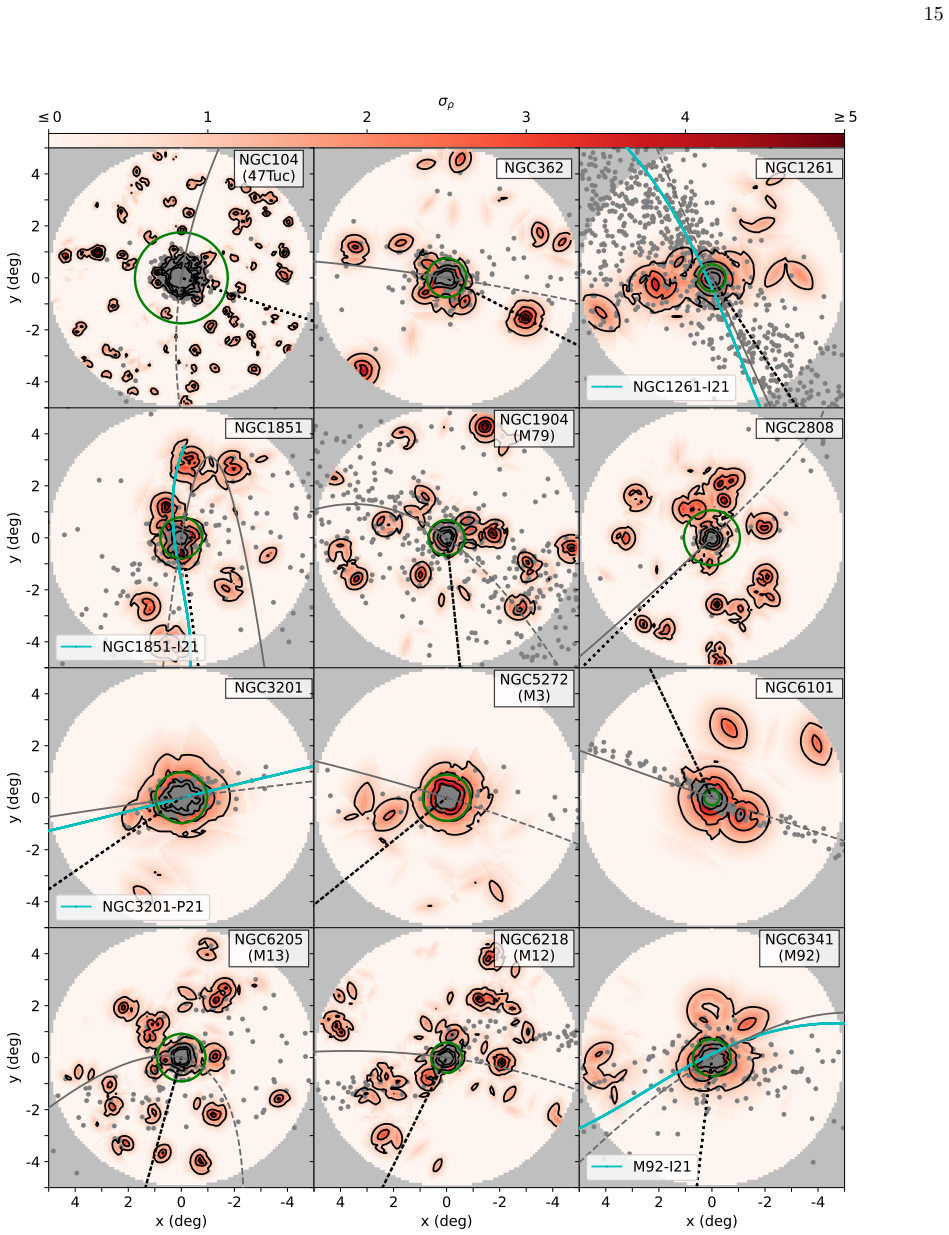
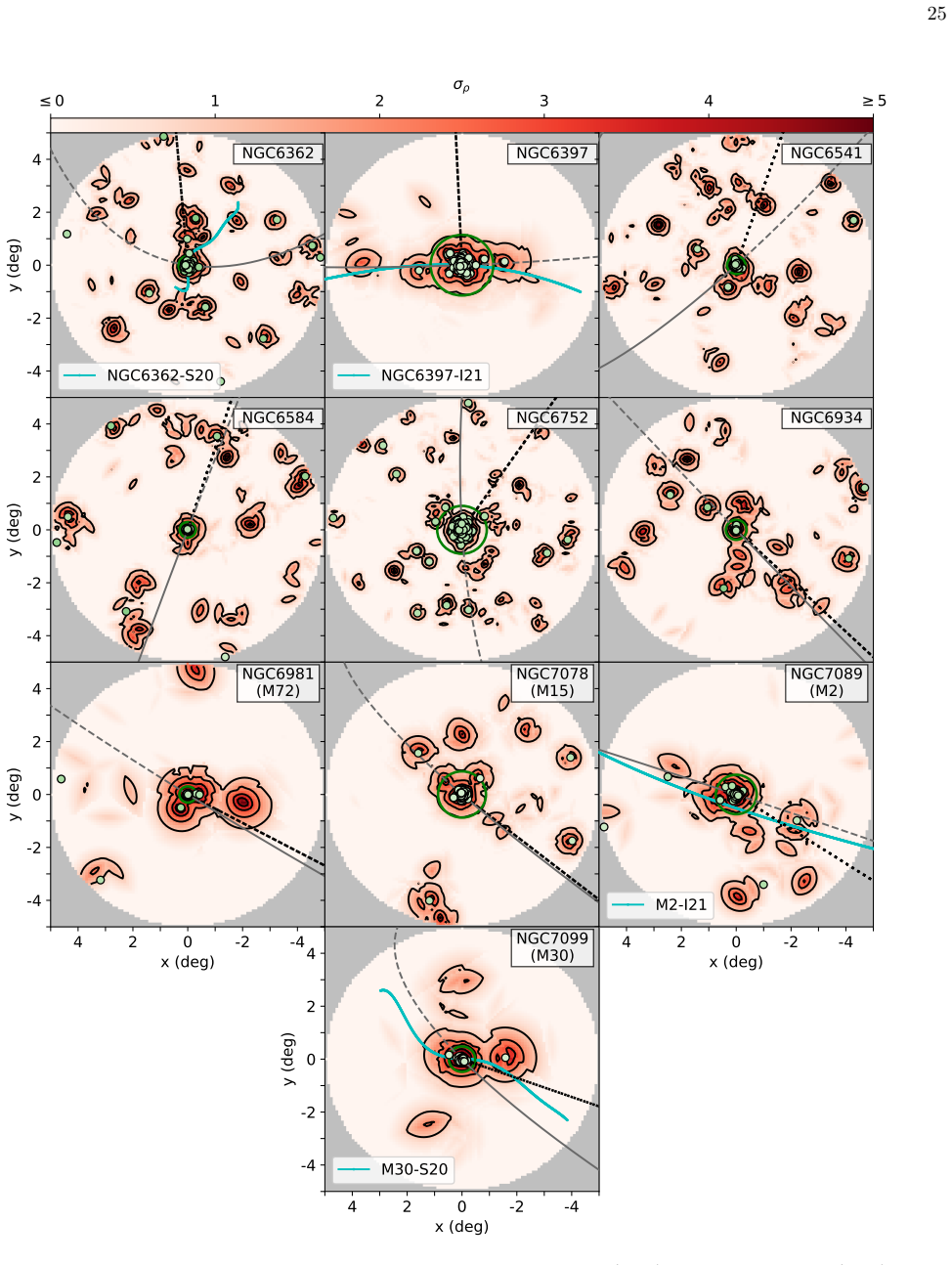
- [Section 3, Eq. (8) and Section 4.2, Fig. 4] The significance of the residual overdensities that underlie the claim of 22 GCs with extended structure (six of them new) is not calibrated against the null hypothesis. The adaptive-knot estimator in Eq. (8) sets Rloc from the distance to the nearest P_mem-weighted stars, producing spatially correlated knot densities; the first-order polynomial is fitted to and subtracted from these same knots, and the reported σ levels are computed from the RMS of the residuals of that fit. No null-field control is run, so the σ values do not measure the probability that a residual overdensity arises from a smooth Milky Way field. The authors' own statement in Section 5.3 that "regions could just as easily be residual fluctuations in the MW field around the GCs observed" applies directly to the six new tentative detections (NGC 6101, NGC 6205, NGC 6218, NGC 6541, NGC 6752, NGC 6934). I request that the authors run the full pipeline on null fields (e.g., off-cluster positions with the same footprint and quality cuts) or on randomized P_mem assignments, and report the false-positive rate as a function of the claimed σ threshold.
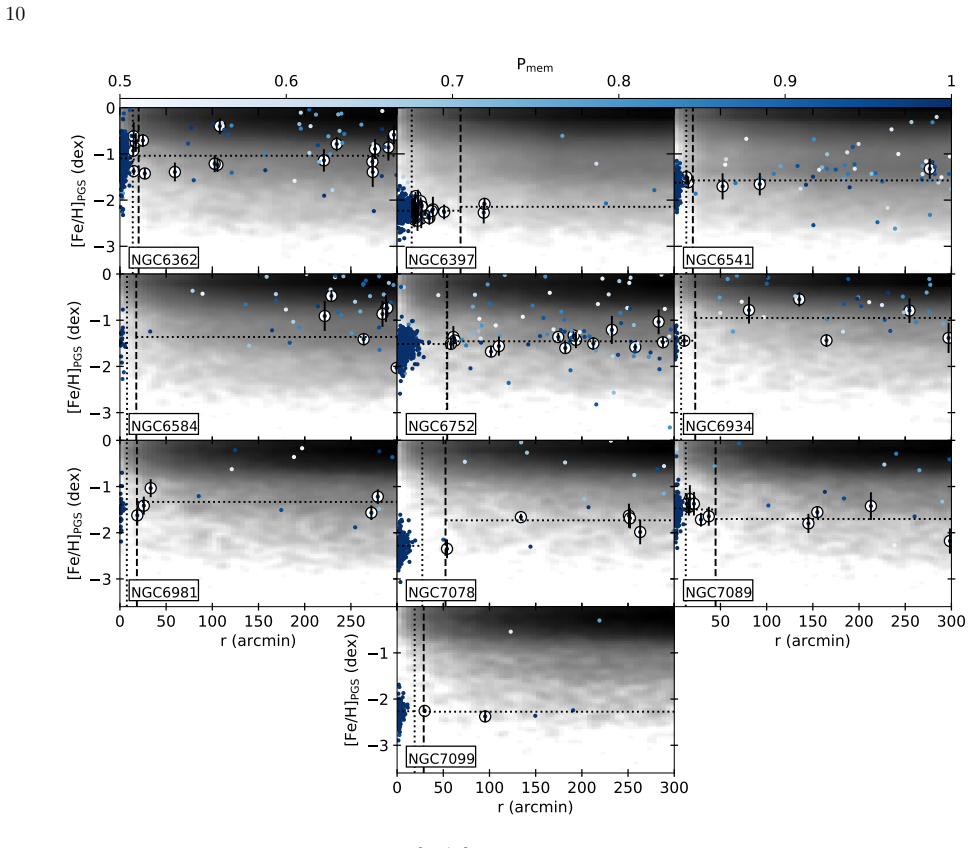
- [Section 3, Eqs. (3)-(6); Section 4.1, Table 2] The finding that high-probability stars outside the Jacobi radius have metallicities consistent with the cluster is partly circular. The membership likelihood includes a colour-colour space built on the CaHK index, which is a direct photometric metallicity proxy, and the GC reference sample defines the locus in that space. Stars with high P_mem are therefore selected because they lie near the cluster locus in a metallicity-sensitive dimension, so the agreement between [Fe/H]_PGS outside r_J and inside r_t is not an independent test that these stars are stripped cluster members. To support this claim, the authors should either demonstrate that the outer [Fe/H] distribution is narrower or more peaked than what the selection function alone would produce (e.g., by applying the same P_mem cut to a field-only control sample), or explicitly re-frame the metallicity comparison as a consistency check rather than a confirmation of membership.
- [Section 4.2.1, Fig. 5] The split between tidal-tail-like and diffuse-envelope structures is based on the threshold σθ < 8 deg, where σθ is the weighted uncertainty of position angles measured from the same uncalibrated 2D density maps. For the six new tentative detections, this classification is provisional at best; reporting fractions such as "17 GCs have tidal tail structure and 4 have envelope structure" as quantitative results gives these provisional classifications more weight than the data support. The authors should either tie the classification to a calibrated detection significance or present it as a morphological description of the candidate maps only.
minor comments (5)
- [Section 2] The word "Specifcally" is a typo; the sentence should read "Specifically."
- [Section 5, COMPARISON TO MODELS] The text "theeTidalsGCs9 project" contains a typo and should be "the eTidals GCs project" or "the eTidalsGCs project."
- [References] The reference list contains a duplicated entry for Massari, Koppelman, and Helmi (2019), with one version garbled as "r 1/4ap"; the duplicate should be removed.
- [Section 4.1] The contamination estimate at P_mem > 0.5 is described as the ratio of stars with [Fe/H] consistent with the cluster to all stars present; this does not measure contamination in the usual sense (the fraction of apparent members that are field stars) because both the numerator and denominator are already filtered by a metallicity-sensitive selection, and the wording should be adjusted accordingly.
- [Appendix A] In the criterion for whether a cluster is suitable for 2D density map analysis, "P Pmem > 5" should be written as "Σ P_mem > 5" to avoid confusion.
Circularity Check
Metallicity agreement is partly self-consistent by construction; extended-structure detections remain independent.
-
fitted input called prediction
[Section 3 (Methods, Eqs. 6-7) and Section 4.1 (Results, Fig. 3)]
"The latter space utilises the PGS CaHK-band, which is sensitive to [Fe/H]... can be used to identify [Fe/H]-similar groups. ... There is a predominantly clear one-to-one relationship between the mean measurements across the three radial regions, which supports our assumption that the stars are excited/stripped from the GC central regions."
The conservative sample used for the outside-Jacobi-radius metallicity is defined by P_mem > 0.99, and P_mem (Eq. 7) is the ratio of cluster to field likelihoods whose cluster term includes P_CC, a k-NN density in (G_BP - G_RP, CaHK ind) space around a reference built from stars inside the tidal radius. CaHK ind is the same photometric dimension that drives the Pristine [Fe/H] estimate, so high-P_mem stars are, by construction, confined to the cluster's CaHK locus and hence to the cluster's [Fe/H]_PGS. The agreement reported in Fig. 3 is therefore a self-consistency of the selection, not an independent test that stripped stars share the cluster metallicity; the paper itself notes the selection 'may directly influence our findings.'
full rationale
The main structural claim—22 GCs with 2D density overdensities, six new—is not circular: it is a spatial clustering signal in a sample selected by PM, CMD, and CaHK-ind similarity, and it is compared against external Galstreams tracks, eTidals N-body models, and particle-spray models. However, the supporting claim that high-probability stars beyond the Jacobi radius have PGS metallicities consistent with the cluster is partly constructed: the membership probability includes the CaHK-ind (metallicity-sensitive) dimension, with the cluster reference defined by stars inside the tidal radius, so the conservative extra-tidal sample must populate the same CaHK locus. The Fig. 3 one-to-one relation is thus a selection echo rather than an independent confirmation. The paper's Section 5.3 admission that field stars can match PM, CMD, and [Fe/H]_PGS simultaneously and be indistinguishable reinforces that the metallicity dimension alone does not break the degeneracy. The uncalibrated field-subtraction sigma levels are an in-sample statistic; the authors concede 'regions could just as easily be residual fluctuations in the MW field around the GCs observed,' which is a null-test limitation, not a definitional circularity. No load-bearing self-citation chain is present: KI25 is a methodological inheritance and the model comparisons are external.
Assumptions & free parameters
free parameters (7)
- f_cl (cluster-to-field ratio) =
fit per GC, values not reported
- k (nearest neighbors) =
10
- CMD weighting metric ratio =
1:10 (colour:mag)
- CC weighting metric ratio =
1:2 (CaHK ind:colour)
- P_mem selection thresholds =
0.5 and 0.99
- sigma_theta tail/envelope split =
8 deg
- minimum summed P_mem per density knot =
2
assumptions (6)
- domain assumption PGS synthetic CaHK photometry yields reliable photometric [Fe/H] for -4<[Fe/H]<0
- domain assumption Reference GC sample inside the tidal radius with PM within 1 mas/yr of the cluster is clean
- domain assumption Field sample outside 2 degrees is dominated by MW stars, not cluster debris
- domain assumption MW field density across each 5-degree field varies smoothly (first-order polynomial)
- domain assumption Cluster tidal and Jacobi radii from cited catalogues are accurate
- domain assumption Orbital integration with MWPotential2014 approximates true GC orbits
Cite this review
Pith. "Pith review of Constructing a Pristine View of Extended Globular Cluster Structure." pith.science (2026). https://pith.science/paper/A23PCJEV
@misc{pith2026250705590,
  author       = {Pith},
  title        = {Pith review of: Constructing a Pristine View of Extended Globular Cluster Structure},
  year         = {2026},
  howpublished = {\url{https://pith.science/paper/A23PCJEV}},
  note         = {Machine review of arXiv:2507.05590}
}
read the original abstract
Globular Clusters (GCs) displaying extended structures are becoming increasingly ubiquitous in the Milky Way (MW). Despite their low surface brightness, which makes disentangling the true structure from the MW overwhelmingly difficult, the increasing availability of multi-dimensional data sets has allowed for new detections of extended GC structure. This work utilises the Pristine-Gaia-Synthetic catalogue released as part of the Pristine Surveys first data release to search for tidally stripped stars in the peripheries of MW GCs. Pristine provides photometric [Fe/H] measurements based on CaHK-band photometry. Using unsupervised machine learning techniques, we provided lists of extra-tidal stars for 30 GCs, one of the largest surveys of its kind. We find that (1) 22 GCs that passed our quality cut have extended structure within 5 deg from the cluster centers of which six are new tentative detections, (2) four of those GCs exhibit diffuse envelope-like extra-tidal features, while the remaining GCs exhibit tidal tail-like structures. We measure the position angles of the extended structures, find broad consistency between the position angles and the GC orbits, and discuss our results concerning N-body models. This work demonstrates the effectiveness of adding photometric metallicities to the multi-dimensional search of extended tidal structure and how the upcoming multi-object spectrographs will be crucial for exploring GC peripheries in the coming years.
Figures


Figures from the paper (18 more)






Reference graph
Works this paper leans on
-
[1]
, " * write output.state after.block = add.period write newline
ENTRY address archivePrefix author booktitle chapter doi edition editor eprint howpublished institution journal key month number organization pages publisher school series title misctitle type volume year version url label extra.label sort.label short.list INTEGERS output.state before.all mid.sentence after.sentence after.block FUNCTION init.state.consts ...
-
[2]
write newline
" write newline "" before.all 'output.state := FUNCTION format.url url empty "" new.block "" url * "" * if FUNCTION format.eprint eprint empty "" archivePrefix empty "" archivePrefix "arXiv" = new.block " " eprint * " " * new.block " " eprint * " " * if if if FUNCTION format.doi doi empty "" " " doi * " " * if FUNCTION format.pid doi empty eprint empty ur...
-
[3]
?;^nk*6 Oۄ ][wv P;|dq Sn u<urS =j O?rlo&Q= :ƚ9<[)7/I cU[K& 縏9,1 >Dt 1듣 :o y
thebibliography [1] 20pt to REFERENCES 6pt =0pt \@twocolumntrue 12pt -12pt 10pt plus 3pt =0pt =0pt =1pt plus 1pt =0pt =0pt -12pt =13pt plus 1pt =20pt =13pt plus 1pt \@M =10000 =-1.0em =0pt =0pt 0pt =0pt =1.0em @enumiv\@empty 10000 10000 `\.\@m \@noitemerr \@latex@warning Empty `thebibliography' environment \@ifnextchar \@reference \@latexerr Missing key o...
arXiv 2017
-
[4]
Arnold, A. D., & Baumgardt, H. 2025, title Direct N-body simulations of NGC 6397 and its tidal tails, Monthly Notices of the Royal Astronomical Society, 537, 1807–1817, 10.1093/mnras/staf121
-
[5]
Awad , P., Li , T. S., Erkal , D., et al. 2025, title S ^ 5 : New insights from deep spectroscopic observations of the tidal tails of the globular clusters NGC 1261 and NGC 1904 , , 693, A69, 10.1051/0004-6361/202451930
-
[6]
Balbinot , E., Cabrera-Ziri , I., & Lardo , C. 2022, title Evidence for C and Mg variations in the GD-1 stellar stream , , 515, 5802, 10.1093/mnras/stac1953
-
[7]
Balbinot , E., & Gieles , M. 2018, title The devil is in the tails: the role of globular cluster mass evolution on stream properties , , 474, 2479, 10.1093/mnras/stx2708
-
[8]
Bastian , N., & Lardo , C. 2018, title Multiple Stellar Populations in Globular Clusters , , 56, 83, 10.1146/annurev-astro-081817-051839
Show all 110 references
-
[9]
2018, title A catalogue of masses, structural parameters, and velocity dispersion profiles of 112 Milky Way globular clusters , , 478, 1520, 10.1093/mnras/sty1057
Baumgardt , H., & Hilker , M. 2018, title A catalogue of masses, structural parameters, and velocity dispersion profiles of 112 Milky Way globular clusters , , 478, 1520, 10.1093/mnras/sty1057
2018 doi
-
[10]
2021, title Accurate distances to Galactic globular clusters through a combination of Gaia EDR3 , HST , and literature data, , 505, 5957, 10.1093/mnras/stab1474
Baumgardt, H., & Vasiliev, E. 2021, title Accurate distances to Galactic globular clusters through a combination of Gaia EDR3 , HST , and literature data, , 505, 5957, 10.1093/mnras/stab1474
2021 doi
-
[11]
Bonaca, A., Geha, M., K\" u pper, A. H. W., et al. 2014, title MILKY WAY MASS AND POTENTIAL RECOVERY USING TIDAL STREAMS IN A REALISTIC HALO, The Astrophysical Journal, 795, 94, 10.1088/0004-637x/795/1/94
2014 doi
-
[12]
Bonaca , A., & Price-Whelan , A. M. 2025, title Stellar streams in the Gaia era , , 100, 101713, 10.1016/j.newar.2024.101713
2025
-
[13]
2014, title DYNAMICAL MODELING OF TIDAL STREAMS, The Astrophysical Journal, 795, 95, 10.1088/0004-637x/795/1/95
Bovy, J. 2014, title DYNAMICAL MODELING OF TIDAL STREAMS, The Astrophysical Journal, 795, 95, 10.1088/0004-637x/795/1/95
2014 doi
-
[14]
2015, title galpy: A python LIBRARY FOR GALACTIC DYNAMICS, The Astrophysical Journal Supplement Series, 216, 29, 10.1088/0067-0049/216/2/29
Bovy, J. 2015, title galpy: A python LIBRARY FOR GALACTIC DYNAMICS, The Astrophysical Journal Supplement Series, 216, 29, 10.1088/0067-0049/216/2/29
2015 doi
-
[15]
K., & Kallivayalil, N
Bovy, J., Bahmanyar, A., Fritz, T. K., & Kallivayalil, N. 2016, title THE SHAPE OF THE INNER MILKY WAY HALO FROM OBSERVATIONS OF THE PAL 5 AND GD–1 STELLAR STREAMS, The Astrophysical Journal, 833, 31, 10.3847/1538-4357/833/1/31
2016 doi
-
[16]
2019, title Collaborative Nested Sampling: Big Data versus Complex Physical Models , , 131, 108005, 10.1088/1538-3873/aae7fc
Buchner , J. 2019, title Collaborative Nested Sampling: Big Data versus Complex Physical Models , , 131, 108005, 10.1088/1538-3873/aae7fc
2019 doi
-
[17]
2021, title UltraNest - a robust, general purpose Bayesian inference engine , The Journal of Open Source Software, 6, 3001, 10.21105/joss.03001
Buchner , J. 2021, title UltraNest - a robust, general purpose Bayesian inference engine , The Journal of Open Source Software, 6, 3001, 10.21105/joss.03001
2021 doi
-
[18]
2014, title X-ray spectral modelling of the AGN obscuring region in the CDFS: Bayesian model selection and catalogue, A & A, 564, A125, 10.1051/0004-6361/201322971
Buchner, J., Georgakakis, A., Nandra, K., et al. 2014, title X-ray spectral modelling of the AGN obscuring region in the CDFS: Bayesian model selection and catalogue, A & A, 564, A125, 10.1051/0004-6361/201322971
2014 doi
-
[19]
M., Cautun , M., Deason , A
Callingham , T. M., Cautun , M., Deason , A. J., et al. 2022, title The chemo-dynamical groups of Galactic globular clusters , , 513, 4107, 10.1093/mnras/stac1145
2022 doi
-
[20]
Carballo-Bello, J. A. 2019, title Using Gaia DR2 to detect extratidal structures around the Galactic globular cluster NGC 362, Monthly Notices of the Royal Astronomical Society, 486, 1667–1671, 10.1093/mnras/stz962
2019 doi
-
[21]
A., Martínez-Delgado, D., Navarrete, C., et al
Carballo-Bello, J. A., Martínez-Delgado, D., Navarrete, C., et al. 2017, title Tails and streams around the Galactic globular clusters NGC 1851, NGC 1904, NGC 2298 and NGC 2808, Monthly Notices of the Royal Astronomical Society, 474, 683–695, 10.1093/mnras/stx2767
2017 doi
-
[22]
A., Salinas, R., & Piatti, A
Carballo-Bello, J. A., Salinas, R., & Piatti, A. E. 2020, title The disruption of the low-mass globular cluster E 3, Monthly Notices of the Royal Astronomical Society, 499, 2157–2161, 10.1093/mnras/staa2864
2020 doi
-
[23]
G., & Grillmair , C
Carlberg , R. G., & Grillmair , C. J. 2021, title Testing for Dark Matter in the Outskirts of Globular Clusters , , 922, 104, 10.3847/1538-4357/ac289f
2021 doi
-
[24]
G., & Grillmair , C
Carlberg , R. G., & Grillmair , C. J. 2022, title The Dark Matter Halo of M54 , , 935, 14, 10.3847/1538-4357/ac7d54
2022 doi
-
[25]
2009, title Intrinsic iron spread and a new metallicity scale for globular clusters, A & A, 508, 695–706, 10.1051/0004-6361/200913003
Carretta, E., Bragaglia, A., Gratton, R., D’Orazi, V., & Lucatello, S. 2009, title Intrinsic iron spread and a new metallicity scale for globular clusters, A & A, 508, 695–706, 10.1051/0004-6361/200913003
2009 doi
-
[26]
J., et al
Cautun , M., Ben \' tez-Llambay , A., Deason , A. J., et al. 2020, title The milky way total mass profile as inferred from Gaia DR2 , , 494, 4291, 10.1093/mnras/staa1017
2020 doi
-
[27]
Y., & Ash , N
Chen , Y., Valluri , M., Gnedin , O. Y., & Ash , N. 2025, title Improved Particle Spray Algorithm for Modeling Globular Cluster Streams , , 276, 32, 10.3847/1538-4365/ad9904
2025 doi
-
[28]
C., Abrams, D
Dalton, G., Trager, S. C., Abrams, D. C., et al. 2012, in Society of Photo-Optical Instrumentation Engineers (SPIE) Conference Series, Vol. 8446, Ground-based and Airborne Instrumentation for Astronomy IV, ed. I. S. McLean, S. K. Ramsay, & H. Takami, 84460P, 10.1117/12.925950
2012 doi
-
[29]
de Boer, T. J. L., Gieles, M., Balbinot, E., et al. 2019, title Globular cluster number density profiles using Gaia DR2 , , 485, 4906, 10.1093/mnras/stz651
2019 doi
-
[30]
1999, title The Pattern Speed of the Galactic Bar , , 524, L35, 10.1086/312299
Dehnen , W. 1999, title The Pattern Speed of the Galactic Bar , , 524, L35, 10.1086/312299
1999 doi
-
[31]
K., & Rix, H.-W
Dehnen, W., Odenkirchen, M., Grebel, E. K., & Rix, H.-W. 2004, title Modeling the Disruption of the Globular Cluster Palomar 5 by Galactic Tides, The Astronomical Journal, 127, 2753–2770, 10.1086/383214
2004 doi
-
[32]
2018, title On the Solar Velocity , Research Notes of the American Astronomical Society, 2, 210, 10.3847/2515-5172/aaef8b
Drimmel , R., & Poggio , E. 2018, title On the Solar Velocity , Research Notes of the American Astronomical Society, 2, 210, 10.3847/2515-5172/aaef8b
2018 doi
-
[33]
F., Ibata , R., et al
Errani , R., Navarro , J. F., Ibata , R., et al. 2022, title The Pristine survey - XVIII. C-19: tidal debris of a dark matter-dominated globular cluster? , , 514, 3532, 10.1093/mnras/stac1516
2022 doi
-
[34]
2023, title The e-TidalGCs project
Ferrone , S., Di Matteo , P., Mastrobuono-Battisti , A., et al. 2023, title The e-TidalGCs project. Modeling the extra-tidal features generated by Galactic globular clusters , , 673, A44, 10.1051/0004-6361/202244141
2023 doi
-
[35]
Gaia Collaboration , Prusti, T., de Bruijne, J. H. J., et al. 2016, title The Gaia mission , A & A, 595, A1, 10.1051/0004-6361/201629272
2016 doi
-
[36]
2018, title Gaia Data Release 2
Gaia Collaboration , Helmi, A., van Leeuwen, F., et al. 2018, title Gaia Data Release 2. Kinematics of globular clusters and dwarf galaxies around the Milky Way , A & A, 616, A12, 10.1051/0004-6361/201832698
2018 doi
-
[37]
Gaia Collaboration , Vallenari , A., Brown , A. G. A., et al. 2023, title Gaia Data Release 3. Summary of the content and survey properties , , 674, A1, 10.1051/0004-6361/202243940
2023 doi
-
[38]
2021, title A supra-massive population of stellar-mass black holes in the globular cluster Palomar 5 , Nature Astronomy, 5, 957, 10.1038/s41550-021-01392-2
Gieles , M., Erkal , D., Antonini , F., Balbinot , E., & Pe \ n arrubia , J. 2021, title A supra-massive population of stellar-mass black holes in the globular cluster Palomar 5 , Nature Astronomy, 5, 957, 10.1038/s41550-021-01392-2
2021 doi
-
[39]
M., Brasseur, C
Ginsburg, A., Sip o cz, B. M., Brasseur, C. E., et al. 2019, title astroquery: An Astronomical Web-querying Package in Python , AJ, 157, 98, 10.3847/1538-3881/aafc33
2019 doi
-
[40]
2019, title What is a globular cluster? An observational perspective , , 27, 8, 10.1007/s00159-019-0119-3
Gratton , R., Bragaglia , A., Carretta , E., et al. 2019, title What is a globular cluster? An observational perspective , , 27, 8, 10.1007/s00159-019-0119-3
2019 doi
-
[41]
2004, title Abundance Variations within Globular Clusters, Annual Review of Astronomy and Astrophysics, 42, 385–440, 10.1146/annurev.astro.42.053102.133945
Gratton, R., Sneden, C., & Carretta, E. 2004, title Abundance Variations within Globular Clusters, Annual Review of Astronomy and Astrophysics, 42, 385–440, 10.1146/annurev.astro.42.053102.133945
2004
-
[42]
G., Carretta, E., & Bragaglia, A
Gratton, R. G., Carretta, E., & Bragaglia, A. 2012, title Multiple populations in globular clusters: Lessons learned from the Milky Way globular clusters, The Astronomy and Astrophysics Review, 20, 10.1007/s00159-012-0050-3
2012 doi
-
[43]
Grillmair , C. J. 2019, title Detection of a 50 long Trailing Tidal Tail for the Globular Cluster M5 , , 884, 174, 10.3847/1538-4357/ab441d
2019 doi
-
[44]
M., Webb , J
Grondin , S. M., Webb , J. J., Lane , J. M. M., Speagle , J. S., & Leigh , N. W. C. 2024, title A catalogue of Galactic GEMS: Globular cluster Extra-tidal Mock Stars , , 528, 5189, 10.1093/mnras/stae203
2024 doi
-
[45]
2015, title Development of multiple tidal tails around globular clusters and dwarf satellite galaxies , , 446, 3100
Hozumi, S., & Burkert, A. 2015, title Development of multiple tidal tails around globular clusters and dwarf satellite galaxies , , 446, 3100
2015
-
[46]
Hunter, J. D. 2007, title Matplotlib: A 2D Graphics Environment, Computing in Science & Engineering, 9, 90–95, 10.1109/mcse.2007.55
2007 doi
-
[47]
2021, title Charting the Galactic Acceleration Field
Ibata , R., Malhan , K., Martin , N., et al. 2021, title Charting the Galactic Acceleration Field. I. A Search for Stellar Streams with Gaia DR2 and EDR3 with Follow-up from ESPaDOnS and UVES , , 914, 123, 10.3847/1538-4357/abfcc2
2021 doi
-
[48]
2024, title Charting the Galactic Acceleration Field
Ibata , R., Malhan , K., Tenachi , W., et al. 2024, title Charting the Galactic Acceleration Field. II. A Global Mass Model of the Milky Way from the STREAMFINDER Atlas of Stellar Streams Detected in Gaia DR3 , , 967, 89, 10.3847/1538-4357/ad382d
2024 doi
-
[49]
A., Lewis , G
Ibata , R. A., Lewis , G. F., Irwin , M. J., & Quinn , T. 2002, title Uncovering cold dark matter halo substructure with tidal streams , , 332, 915, 10.1046/j.1365-8711.2002.05358.x
2002
-
[50]
2017, title On the kinematic detection of accreted streams in the Gaia era: a cautionary tale , , 604, A106, 10.1051/0004-6361/201629691
Jean-Baptiste , I., Di Matteo , P., Haywood , M., et al. 2017, title On the kinematic detection of accreted streams in the Gaia era: a cautionary tale , , 604, A106, 10.1051/0004-6361/201629691
2017 doi
-
[51]
W., et al
Jensen, J., Thomas, G., McConnachie, A. W., et al. 2021, title Uncovering fossils of the distant Milky Way with UNIONS: NGC 5466 and its stellar stream, Monthly Notices of the Royal Astronomical Society, 507, 1923, 10.1093/mnras/stab2325
2021 doi
-
[52]
C., Dalton , G
Jin , S., Trager , S. C., Dalton , G. B., et al. 2024, title The wide-field, multiplexed, spectroscopic facility WEAVE: Survey design, overview, and simulated implementation , , 530, 2688, 10.1093/mnras/stad557
2024 doi
-
[53]
S., Agertz, O., Berbel, A
Jong De de Jong, R. S., Agertz, O., Berbel, A. A., et al. 2019, title 4MOST: Project overview and information for the First Call for Proposals , The Messenger, 175, 3, 10.18727/0722-6691/5117
2019 doi
-
[54]
Jordi, K., & Grebel, E. K. 2010, title Search for extratidal features around 17 globular clusters in the Sloan Digital Sky Survey , A & A, 522, A71, 10.1051/0004-6361/201014392
2010 doi
-
[55]
Kraft , R. P. 1994, title Abundance Differences among Globular Cluster Giants: Primordial vs. Evolutionary Scenarios , , 106, 553, 10.1086/133416
1994 doi
-
[56]
B., Da Costa, G
Kuzma, P. B., Da Costa, G. S., & Mackey, A. D. 2018, title The outer envelopes of globular clusters. II. NGC 1851, NGC 5824 and NGC 1261* , , 473, 2881, 10.1093/mnras/stx2353
2018 doi
-
[57]
B., Ferguson , A
Kuzma , P. B., Ferguson , A. M. N., & Pe \ n arrubia , J. 2021, title Detecting globular cluster tidal extensions with Bayesian inference - I. Analysis of Centauri with Gaia EDR3 , , 507, 1127, 10.1093/mnras/stab2280
2021 doi
-
[58]
B., Ferguson , A
Kuzma , P. B., Ferguson , A. M. N., Varri , A. L., et al. 2022, title Forward and back: kinematics of the Palomar 5 tidal tails , , 512, 315, 10.1093/mnras/stac381
2022 doi
-
[59]
B., & Ishigaki , M
Kuzma , P. B., & Ishigaki , M. N. 2025, title A pristine view of galactic globular clusters and their peripheries: Omega Centauri , , 537, 2752, 10.1093/mnras/staf212
2025 doi
-
[60]
Küpper, A. H. W., Kroupa, P., Baumgardt, H., & Heggie, D. C. 2010, title Tidal tails of star clusters, , 401, 105, 10.1111/j.1365-2966.2009.15690.x
2010
-
[61]
Küpper, A. H. W., Lane, R. R., & Heggie, D. C. 2012, title More on the structure of tidal tails, , 420, 2700, 10.1111/j.1365-2966.2011.20242.x
2012
-
[62]
2000, title Tidal tails around 20 Galactic globular clusters
Leon, S., Meylan, G., & Combes, F. 2000, title Tidal tails around 20 Galactic globular clusters. Observational evidence for gravitational disk/bulge shocking , A & A, 359, 907, 10.48550/ARXIV.ASTRO-PH/0006100
2000 doi
-
[63]
2018, title Gaia Data Release 2
Lindegren, L., Hern \'a ndez, J., Bombrun, A., et al. 2018, title Gaia Data Release 2. The astrometric solution , A & A, 616, A2, 10.1051/0004-6361/201832727
2018 doi
-
[64]
A., Hern \'a ndez , J., et al
Lindegren , L., Klioner , S. A., Hern \'a ndez , J., et al. 2021, title Gaia Early Data Release 3. The astrometric solution , , 649, A2, 10.1051/0004-6361/202039709
2021 doi
-
[65]
A., Sharma, S., et al
Malhan, K., Ibata, R. A., Sharma, S., et al. 2022, title The Global Dynamical Atlas of the Milky Way Mergers : Constraints from Gaia EDR3 -based Orbits of Globular Clusters , Stellar Streams , and Satellite Galaxies , apj, 926, 107, 10.3847/1538-4357/ac4d2a
2022 doi
-
[66]
F., Starkenburg , E., Yuan , Z., et al
Martin , N. F., Starkenburg , E., Yuan , Z., et al. 2024, title The Pristine survey: XXIII. Data Release 1 and an all-sky metallicity catalogue based on Gaia DR3 BP/RP spectro-photometry , , 692, A115, 10.1051/0004-6361/202347633
2024 doi
-
[67]
2025, title Origin of the system of globular clusters in the Milky Way -- Gaia eDR3 edition , arXiv e-prints, arXiv:2503.14657, 10.48550/arXiv.2503.14657
Massari , D. 2025, title Origin of the system of globular clusters in the Milky Way -- Gaia eDR3 edition , arXiv e-prints, arXiv:2503.14657, 10.48550/arXiv.2503.14657
-
[69]
H., & Helmi, A
Massari, D., Koppelman, H. H., & Helmi, A. 2019, title Origin of the system of globular clusters in the Milky Way , åp, 630, L4, 10.1051/0004-6361/201936135
2019 doi
-
[70]
Massari, D., Dalessandro, E., Erkal, D., et al. 2025, title Euclid: Early Release Observations – Unveiling the morphology of two Milky Way globular clusters out to their periphery, Astronomy & Astrophysics, 697, A8, 10.1051/0004-6361/202449696
2025 doi
-
[71]
2023, title galstreams: A library of Milky Way stellar stream footprints and tracks, Monthly Notices of the Royal Astronomical Society, 520, 5225, 10.1093/mnras/stad321
Mateu, C. 2023, title galstreams: A library of Milky Way stellar stream footprints and tracks, Monthly Notices of the Royal Astronomical Society, 520, 5225, 10.1093/mnras/stad321
2023 doi
-
[72]
McMillan, P. J. 2017, title The mass distribution and gravitational potential of the Milky Way , , 465, 76, 10.1093/mnras/stw2759
2017 doi
-
[73]
P., & Marino , A
Milone , A. P., & Marino , A. F. 2022, title Multiple Populations in Star Clusters , Universe, 8, 359, 10.3390/universe8070359
2022 doi
-
[74]
2024, title Metallicity distributions of halo stars: do they trace the Galactic accretion history? , , 690, A136, 10.1051/0004-6361/202449291
Mori , A., Di Matteo , P., Salvadori , S., et al. 2024, title Metallicity distributions of halo stars: do they trace the Galactic accretion history? , , 690, A136, 10.1051/0004-6361/202449291
2024 doi
-
[75]
K., Rockosi, C
Odenkirchen, M., Grebel, E. K., Rockosi, C. M., et al. 2001, title Detection of Massive Tidal Tails around the Globular Cluster Palomar 5 with Sloan Digital Sky Survey Commissioning Data , apjl, 548, L165, 10.1086/319095
2001 doi
-
[76]
W., Saha, A., Knezek, P., et al
Olszewski, E. W., Saha, A., Knezek, P., et al. 2009, title A 500 Parsec Halo Surrounding the Galactic Globular NGC 1851 , AJ, 138, 1570
2009
-
[77]
2023, title The distribution of globular clusters in kinematic spaces does not trace the accretion history of the host galaxy , , 673, A86, 10.1051/0004-6361/202245128
Pagnini , G., Di Matteo , P., Khoperskov , S., et al. 2023, title The distribution of globular clusters in kinematic spaces does not trace the accretion history of the host galaxy , , 673, A86, 10.1051/0004-6361/202245128
2023 doi
-
[78]
2025, title Abundance ties: Nephele and the globular cluster population accreted with Cen: Based on APOGEE DR17 and Gaia EDR3 , , 693, A155, 10.1051/0004-6361/202450264
Pagnini , G., Di Matteo , P., Haywood , M., et al. 2025, title Abundance ties: Nephele and the globular cluster population accreted with Cen: Based on APOGEE DR17 and Gaia EDR3 , , 693, A155, 10.1051/0004-6361/202450264
2025 doi
-
[79]
G., & Miralda-Escud \'e , J
Palau , C. G., & Miralda-Escud \'e , J. 2019, title Statistical detection of a tidal stream associated with the globular cluster M68 using Gaia data , , 488, 1535, 10.1093/mnras/stz1790
2019 doi
-
[80]
G., & Miralda-Escud \'e , J
Palau , C. G., & Miralda-Escud \'e , J. 2021, title The tidal stream generated by the globular cluster NGC 3201 , , 504, 2727, 10.1093/mnras/stab1024
2021 doi
-
[81]
2011, title Scikit-learn: Machine Learning in P ython, Journal of Machine Learning Research, 12, 2825, 10.48550/ARXIV.1201.0490
Pedregosa, F., Varoquaux, G., Gramfort, A., et al. 2011, title Scikit-learn: Machine Learning in P ython, Journal of Machine Learning Research, 12, 2825, 10.48550/ARXIV.1201.0490
-
[82]
L., Breen, P
Peñarrubia, J., Varri, A. L., Breen, P. G., Ferguson, A. M. N., & Sánchez-Janssen, R. 2017, title Stellar envelopes of globular clusters embedded in dark mini-haloes, , 471, L31, 10.1093/mnrasl/slx094
2017 doi
-
[83]
Piatti , A. E. 2019, title Formation Imprints in the Kinematics of the Milky Way Globular Cluster System , , 882, 98, 10.3847/1538-4357/ab3574
2019 doi
-
[84]
Piatti , A. E. 2024 a , title Surviving Tidal Tails Around the Milky Way Bulge Globular Cluster NGC 6355 , , 167, 279, 10.3847/1538-3881/ad4704
2024 doi
-
[85]
Piatti , A. E. 2024 b , title First deep search of tidal tails in the Milky Way globular cluster NGC 6362 , , 683, A151, 10.1051/0004-6361/202348534
2024 doi
-
[86]
E., & Carballo-Bello, J
Piatti, A. E., & Carballo-Bello, J. A. 2019, title Extra-tidal structures around the Gaia Sausage candidate globular cluster NGC 6779 (M56) , , 485, 1029, 10.1093/mnras/stz500
2019 doi
-
[87]
E., & Carballo-Bello , J
Piatti , A. E., & Carballo-Bello , J. A. 2020, title The tidal tails of Milky Way globular clusters , , 637, L2, 10.1051/0004-6361/202037994
2020 doi
-
[88]
E., Mestre , M
Piatti , A. E., Mestre , M. F., Carballo-Bello , J. A., et al. 2021, title Signatures of tidal disruption in the Milky Way globular cluster NGC 6981 (M72) , , 646, A176, 10.1051/0004-6361/202040038
2021 doi
-
[89]
2020, title adrn/gala: v1.3, , v1.3 Zenodo, 10.5281/zenodo.4159870
Price-Whelan, A., Sipőcz, B., Lenz, D., et al. 2020, title adrn/gala: v1.3, , v1.3 Zenodo, 10.5281/zenodo.4159870
2020 doi
-
[90]
Price-Whelan, A. M. 2017, title Gala: A Python package for galactic dynamics, The Journal of Open Source Software, 2, 10.21105/joss.00388
2017 doi
-
[91]
M., Johnston , K
Price-Whelan , A. M., Johnston , K. V., Valluri , M., et al. 2016, title Chaotic dispersal of tidal debris , , 455, 1079, 10.1093/mnras/stv2383
2016 doi
-
[92]
W., et al
Riello , M., De Angeli , F., Evans , D. W., et al. 2021, title Gaia Early Data Release 3. Photometric content and validation , , 649, A3, 10.1051/0004-6361/202039587
2021 doi
-
[93]
Roberts , D., Gieles , M., Erkal , D., & Sanders , J. L. 2025, title Stellar streams from black hole-rich star clusters , , 538, 454, 10.1093/mnras/staf321
2025 doi
-
[94]
2020, title The eye of Gaia on globular clusters structure: tidal tails , , 495, 2222
Sollima, A. 2020, title The eye of Gaia on globular clusters structure: tidal tails , , 495, 2222
2020
-
[95]
2019, title The eye of Gaia on globular clusters kinematics: internal rotation , , 485, 1460, 10.1093/mnras/stz505
Sollima, A., Baumgardt, H., & Hilker, M. 2019, title The eye of Gaia on globular clusters kinematics: internal rotation , , 485, 1460, 10.1093/mnras/stz505
2019 doi
-
[96]
2017, title The Pristine survey - I
Starkenburg , E., Martin , N., Youakim , K., et al. 2017, title The Pristine survey - I. Mining the Galaxy for the most metal-poor stars , , 471, 2587, 10.1093/mnras/stx1068
2017 doi
-
[97]
2023, title Classifying Globular Clusters and Applying them to Estimate the mass of the Milky Way , Research in Astronomy and Astrophysics, 23, 015013, 10.1088/1674-4527/ac9e91
Sun , G., Wang , Y., Liu , C., et al. 2023, title Classifying Globular Clusters and Applying them to Estimate the mass of the Milky Way , Research in Astronomy and Astrophysics, 23, 015013, 10.1088/1674-4527/ac9e91
2023 doi
-
[98]
S., Chiba , M., et al
Takada , M., Ellis , R. S., Chiba , M., et al. 2014, title Extragalactic science, cosmology, and Galactic archaeology with the Subaru Prime Focus Spectrograph , , 66, R1, 10.1093/pasj/pst019
2014 doi
-
[99]
2016, in Society of Photo-Optical Instrumentation Engineers (SPIE) Conference Series, Vol
Tamura , N., Takato , N., Shimono , A., et al. 2016, in Society of Photo-Optical Instrumentation Engineers (SPIE) Conference Series, Vol. 9908, Ground-based and Airborne Instrumentation for Astronomy VI, ed. C. J. Evans , L. Simard , & H. Takami , 99081M, 10.1117/12.2232103
2016 doi
-
[100]
Tavangar , K., & Price-Whelan , A. M. 2025, title Inferring the density and membership of stellar streams with flexible models: The GD-1 stream in Gaia Data Release 3 , arXiv e-prints, arXiv:2502.13236, 10.48550/arXiv.2502.13236
2025 doi
-
[101]
P., Tollerud, E
The Astropy Collaboration , Robitaille, T. P., Tollerud, E. J., et al. 2013, title Astropy: A community Python package for astronomy , A & A, 558, A33
2013
-
[102]
M., Sip o cz, B
The Astropy Collaboration , Price-Whelan, A. M., Sip o cz, B. M., et al. 2018, title The Astropy Project: Building an Open-science Project and Status of the v2.0 Core Package , AJ, 156, 123
2018
-
[103]
2021, title Gaia EDR3 view on galactic globular clusters , , 505, 5978, 10.1093/mnras/stab1475
Vasiliev , E., & Baumgardt , H. 2021, title Gaia EDR3 view on galactic globular clusters , , 505, 5978, 10.1093/mnras/stab1475
2021 doi
-
[104]
E., et al
Virtanen, P., Gommers, R., Oliphant, T. E., et al. 2020, title SciPy 1.0: Fundamental Algorithms for Scientific Computing in Python , Nature Methods, 17, 261
2020
-
[105]
C., & Varoquaux, G
Walt van van der Walt, S., Colbert, S. C., & Varoquaux, G. 2011, title The NumPy Array: A Structure for Efficient Numerical Computation , arXiv, 13, 22
2011
-
[106]
H., Baumgardt, H., et al
Wan, Z., Oliver, W. H., Baumgardt, H., et al. 2021, title The dynamics of the globular cluster NGC 3201 out to the Jacobi radius, , 502, 4513, 10.1093/mnras/stab306
2021 doi
-
[107]
D., Oliver, W
Wan, Z., Arnold, A. D., Oliver, W. H., et al. 2022, title Dynamics in the outskirts of four Milky Way globular clusters: it's the tides that dominate, Monthly Notices of the Royal Astronomical Society, 519, 192, 10.1093/mnras/stac3566
2022 doi
-
[108]
C., K ro g lu , F., Fragione , G., et al
Weatherford , N. C., K ro g lu , F., Fragione , G., et al. 2023, title Stellar Escape from Globular Clusters. I. Escape Mechanisms and Properties at Ejection , , 946, 104, 10.3847/1538-4357/acbcc1
2023 doi
-
[109]
2023, title The Spectacular Tidal Tails of Globular Cluster M3 (NGC 5272) , , 953, 130, 10.3847/1538-4357/acdee2
Yang , Y., Zhao , J.-K., Tang , X.-Z., Ye , X.-H., & Zhao , G. 2023, title The Spectacular Tidal Tails of Globular Cluster M3 (NGC 5272) , , 953, 130, 10.3847/1538-4357/acdee2
2023 doi
-
[110]
D., Johnston , K
Yavetz , T. D., Johnston , K. V., Pearson , S., Price-Whelan , A. M., & Hamilton , C. 2023, title Stream Fanning and Bifurcations: Observable Signatures of Resonances in Stellar Stream Morphology , , 954, 215, 10.3847/1538-4357/ace7b9
2023 doi
-
[111]
2012, title LAMOST spectral survey An overview , Research in Astronomy and Astrophysics, 12, 723, 10.1088/1674-4527/12/7/002
Zhao , G., Zhao , Y.-H., Chu , Y.-Q., Jing , Y.-P., & Deng , L.-C. 2012, title LAMOST spectral survey An overview , Research in Astronomy and Astrophysics, 12, 723, 10.1088/1674-4527/12/7/002
2012 doi
Reviewed August 6, 2026 · model on record in the stance chip above.
Discussion (0). Continue with ORCID to comment.