REVIEW 4 major objections 6 minor 57 references
Baton: Compensate for Missing Wi-Fi Features for Practical Device-free Tracking
T0 review · 4 major / 6 minor · reviewed 2026-08-06 · deepseek-v4-flash
Pith's one-line read This paper claims that Wi-Fi device-free tracking can keep working when 80% of signal features are missing, with a median tracking error of 0.46 m at a 20% communication duty cycle.
desk verdict Genuinely new compensation idea, but the headline 20% duty-cycle result is measured under random feature dropout, not bursty traffic; the paper's own continuous-loss tests show the practical claim is not yet nailed down. read the letter →
The pith
A machine-rendered reading of the paper's core claim, the machinery that carries it, and where it could break.
The reading
What carries the argument
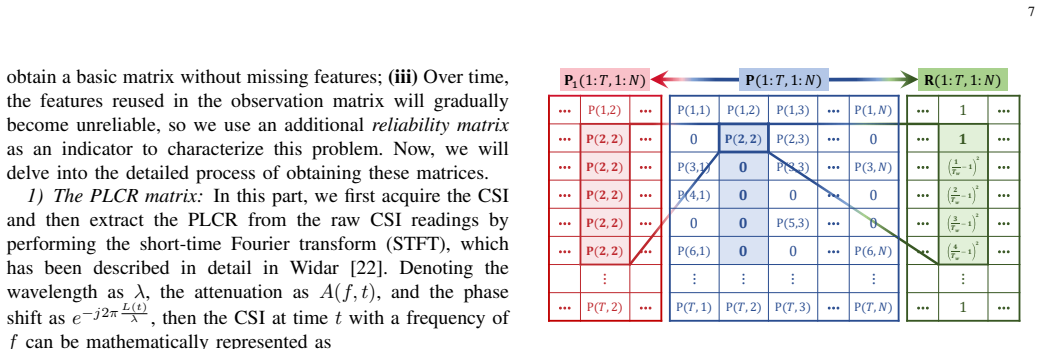
The load-bearing object is the PLCR (path length change rate), the derivative of the reflected-path length, equal up to a sign to the Wi-Fi Doppler frequency shift. Two observations carry the argument: within a half-second window a link's PLCR stays nearly constant, and across two links the PLCR ratio remains stable because both scale with the normal component of the human velocity. STAP converts these into three predictors and fuses them: Pred.1 repeats the most recent observed PLCR, Pred.2 multiplies a known link's value by the stable cross-link ratio, and Pred.3 computes the PLCR from the Fresnel-zone geometry of the current position and velocity. A reliability matrix assigns a quadratically decaying weight to Pred.1 over time, and a BiLSTM neural network, trained on simulated walking traces, maps the first rows of PLCRs into the initial trajectory that seeds the tracking loop.
What would settle it
Retrain the tracking network on simulated traces with a very different motion model (e.g., constant speed, no turns) and evaluate on turn-heavy walks at CDC=20%; if median error rises much above 0.46 m, the simulated-training statistics are load-bearing. Alternatively, measure PLCR ratios between two links during rapid back-and-forth pivots and check whether the half-second-ratio stability assumption breaks.
Extended reading notes
Core claim
On its own terms, the paper claims that missing Wi-Fi features do not have to be recovered from raw packets; they can be re-created from the structure of the features that are present. The central discovery is that the PLCR matrix has two usable dimensions of correlation—temporal continuity within each link and a stable proportional relationship across links—and that these can be exploited simultaneously. The paper packages this into the STAP algorithm, which alternates between predicting missing PLCRs and updating the trajectory, weighting the three prediction sources by a reliability matrix that decays trust in stale observations. The empirical payoff is a median tracking error of 0.46 m at CDC=20%, a 79.19% error reduction over the strongest prior work it compares against.
Load-bearing premise
Everything downstream depends on the simulated-walking training set: if the simulator's step lengths, speeds, and turning statistics do not match real locomotion, the initial trajectory is biased and the self-correction loop cannot fully recover, and the paper's own robustness test already shows instability at CDC 20% when people suddenly accelerate or brake.
Editorial extensions
If this is right
- A smart home can deploy Wi-Fi sensing without dedicating continuous packet streams to it: Baton's reported performance at 20% duty cycle means sensing traffic can share airtime with normal IoT communication.
- Because the STAP loop corrects its own earlier errors, the final trajectory is more accurate than the initial network output, so the system does not need a perfect first guess.
- The compensation method is modular: Baton can be placed on top of existing trackers such as NNE-Tracking and HyperTracking, extending them to low-duty-cycle and NLoS conditions.
- Tracking degrades gracefully rather than collapsing as data disappears: median errors stay under 0.65 m down to a 10% duty cycle, and using two receivers instead of four only raises the error to 0.59 m.
Reading between the lines
- If the cross-link PLCR ratio stability holds beyond the tested layouts, the same temporal-and-proportional compensation could be applied to other CSI-derived quantities or other RF bands, since the derivation only assumes path geometry and human inertia.
- A sharper test of the simulated-training assumption would be to retrain the network on measured walking traces from one environment and deploy in another; the paper's reported error is likely sensitive to the step-and-turn distribution.
- The paper's own robustness result—unstable tracking at CDC 20% under sudden speed changes—suggests the compensation works best for walkers whose motion obeys smooth inertia; extending STAP to erratic motion would require a stronger model for velocity changes.
Editorial analysis
A structured set of objections, weighed in public.
Referee Report
Summary. The paper proposes Baton, a device-free Wi-Fi tracking system designed to maintain tracking accuracy when many Wi-Fi features are missing, motivated by low communication duty cycles (CDCs) in IoT-style traffic. The system extracts path length change rates (PLCRs) from CSI and fills missing PLCR values by combining three prediction mechanisms: observation-based prediction (Pred.1) using the most recent observed value on the same link, proportionate prediction (Pred.2) using cross-link PLCR ratios, and model-based prediction (Pred.3) using a Fresnel-zone model fed by the current trajectory estimate. The predictions are integrated using a reliability-weighted scheme, and the tracking and prediction steps are iterated in an incremental loop (STAP). A neural network trained on simulated walking traces provides initial trajectory estimates. The authors implement Baton on commercial Intel 5300 Wi-Fi devices and evaluate it in four environments, reporting a median tracking error of 0.46 m at a 20% communication duty cycle and large improvements over NNE-Tracking and WiTraj under random PLCR removal.
Significance. If the central claims are correct, Baton would be an important step toward practical ISAC: it would show that device-free tracking can tolerate losing most Wi-Fi measurements through a combination of temporal and cross-link compensation, and it offers a plug-and-play mechanism that could be layered on existing data-driven trackers. The work has clear strengths: it is implemented on real COTS hardware, evaluated in multiple physical environments including an NLoS scenario, compared against two relevant baselines, and the main evaluation is anchored to external ground truth, so the headline result is not circular. The self-correction observation in Fig. 19 and the careful treatment of the all-links-missing case are also valuable. However, the practical CDC claim is weakened by the evaluation protocol, which removes PLCR values randomly after feature extraction rather than emulating bursty acquisition-level duty cycling, and the evaluation statistics are thin for the strength of the claims. The simulated-training dependence also adds a sim-to-real risk.
major comments (4)
- [§VI-D] The headline 0.46 m median error at 20% CDC is obtained by randomly removing 80% of the entries of an already-computed PLCR matrix, not by running the system under a bursty acquisition-level 20% duty cycle. In §VI-D the paper states that 'the probability of any element in the PLCR matrix being missing is the same,' which is a Bernoulli mask over clean, densely sampled PLCR estimates. Real intermittent IoT traffic produces idle intervals during which no CSI exists; in such intervals STFT-based PLCR extraction itself becomes unreliable, Pred.2 is undefined when all links are idle, and the system must rely on stale Pred.1 and model-based Pred.3. The paper's own continuous-loss robustness test in §VI-D shows that adding 1 s, 2 s, or 3 s of continuous loss to the random-missing baseline raises mean error from 0.1764 m to 0.3024 m, 0.6702 m, and 0.7125 m, respectively. Thus the central claim that Baton accurately tracks under practical severe Wi-Fi feature deficiencies is not yet established; the 0.46 m result needs to be reproduced under a bursty, acquisition-level duty-cycle protocol.
- [§V-C, Fig. 9] The tracking-stage neural network is trained exclusively on simulated walking traces generated with randomized step lengths, speeds, and turning ranges. The paper asserts that these traces are 'remarkably comparable' to real trajectories, but it provides no quantitative validation of the simulated trace distribution against the real walking data used in evaluation. This is load-bearing because the entire STAP loop depends on the network producing a reliable initial trajectory from the first Nf observation-based PLCR rows; any systematic difference between simulated and real human locomotion will bias the initial trajectory, the derived velocity, and every model-based Pred.3 value, and it is not clear that the self-correction in Fig. 19 can recover from such a bias. The authors should provide a sim-to-real analysis, for example by comparing trajectory statistics or by evaluating with a network trained on a held-out portion of real traces.
- [§VI-B, Table I, Fig. 16] The quantitative evaluation is based on only five repetitions per trace shape, and the paper reports median or mean errors without confidence intervals or statistical significance tests. For example, the improvement percentages in Table I and the overall medians in Fig. 16a are point estimates; the non-monotonic ordering in Fig. 16a (0.47 m at 40%, 0.50 m at 30%, 0.46 m at 20%, 0.65 m at 10%) further suggests that the differences between conditions may be within the noise. Additionally, the key parameters Nf, Tw, and the quadratic reliability weight in Eq. (9) are chosen empirically, and no sensitivity analysis with error bars is reported for these choices. Given the strength of the 'first system' and 'reduces error by 79.19%' claims, the evaluation needs more repetitions or confidence intervals to support them.
- [§V-B, Algorithm 1] The STAP loop is a feedback cycle: the trajectory is produced by a neural network fed with predicted PLCRs, and the model-based PLCR predictions (Pred.3) are computed from that same trajectory. In the all-links-missing case, the final PLCR prediction is w·Pred.1 + (1-w)·Pred.3, so errors in the trajectory estimate are fed back into the PLCR predictions and then back into the next trajectory estimate. The paper's empirical self-correction result in Fig. 19 is encouraging, but it is not accompanied by any analysis of when this feedback loop converges versus diverges; the non-uniform motion experiment in §VI-E shows instability at 20% CDC. A stability or error-propagation analysis, or at least a diagnostic of per-iteration error for failure cases, would materially strengthen the claim that the algorithm is robust rather than merely tuned to the tested traces.
minor comments (6)
- [Abstract/§VI-B] The abstract reports a median tracking error of 0.46 m at 20% CDC, while Fig. 16a reports median errors of 0.47 m, 0.50 m, and 0.46 m at 40%, 30%, and 20% CDC respectively; the non-monotonic relationship should be explained or reconciled.
- [§III-B, Eq. (5)] In Eq. (5) the coefficient is written as kBC in both the second and third expressions; the third should presumably be kAC or another distinct symbol to match the text.
- [§V-A.3, Eq. (9)] The reliability weight w is defined for '0 < t < Tw' and 't ≥ Tw', but the units of t (time slots versus seconds) and the discrete-time nature of the weight are not specified; clarifying this would help reproducibility.
- [§V-A.1] The set of raw PLCR values in the PLCR matrix is said to be set to 0 when missing, but PLCR is a signed quantity and 0 is also a valid measured value; the use of 0 as a missing-value sentinel should be stated explicitly or replaced with a NaN/flag mechanism.
- [§VI-B] The paper states that ten PLCR values are extracted per second and that the tracking result is updated ten times per second, but the transmitter sends at 1000 Hz; the relationship between these rates and the STFT window/hop length is not described, making it hard to reproduce the feature extraction.
- [General] No data or code release is mentioned, and the experimental protocol does not include a statement about randomized ordering or blinding; a reproducibility appendix or a link to the implementation would improve the manuscript.
Circularity Check
No significant circularity: the central 0.46 m tracking result is anchored to external ground-truth trajectories, and the STAP feedback loop is a fixed-point estimator rather than a definitional equivalence.
full rationale
The paper's central claim (median tracking error 0.46 m at 20% communication duty cycle) is evaluated against externally measured ground-truth trajectories obtained from COTS Wi-Fi devices, so the main result is not circular. The STAP loop is a feedback estimator: the trajectory T is produced by a neural network from the (partially filled) PLCR matrix P, and the model-based prediction Pred.3 is computed from T via the Fresnel geometry model (Eq. 12). This is an iterative fixed-point process, not a definitional identity: the input PLCR matrix also contains real observed values (Pred.1) that are not derived from T, and the final trajectory is scored against independent ground truth. The paper's own robustness experiments show that the loop degrades under continuous-link loss (mean error rises from 0.1764 m to 0.7125 m with 3 s fully-missing intervals), demonstrating that the loop is not tautologically self-consistent. The self-citations (NNE-Tracking [43] as a baseline; HyperTracking [47] for the NLoS extension) are to externally published, independently evaluated prior work and are not load-bearing for the LoS 20% CDC result. The main validity concern is operational: the 20% CDC is implemented as random post-hoc masking of already-computed PLCR values rather than acquisition-level bursty duty cycling, and the paper's own continuous-loss tests show that the missingness pattern matters. This is an external-validity and correctness concern, not a circularity of the derivation chain. No prediction in the paper reduces to its inputs by construction.
Assumptions & free parameters
free parameters (5)
- Nf (initial observation window) =
10 (time slots in one second)
- Tw (reliability decay horizon) =
not reported
- Quadratic reliability weight function =
w = (t/Tw - 1)^2
- Simulated trace generation parameters =
not specified
- Neural network hyperparameters =
not fully reported
assumptions (5)
- domain assumption Human motion is continuous: PLCR in a single link is nearly constant over very short intervals (Observation 1, Section III-A).
- domain assumption The ratio of PLCRs across two links is constant within a short time interval (Observation 2, Eq. 5, Section III-B).
- domain assumption A single human reflector dominates the dynamic signal; the Fresnel/ellipse model Eq. 1 describes the PLCR.
- domain assumption The simulated walking traces are representative of real trajectories.
- domain assumption PLCR extraction via STFT is accurate and the initial phase offset can be removed.
Cite this review
Pith. "Pith review of Baton: Compensate for Missing Wi-Fi Features for Practical Device-free Tracking." pith.science (2026). https://pith.science/paper/KFN4NDC6
@misc{pith2026250705597,
  author       = {Pith},
  title        = {Pith review of: Baton: Compensate for Missing Wi-Fi Features for Practical Device-free Tracking},
  year         = {2026},
  howpublished = {\url{https://pith.science/paper/KFN4NDC6}},
  note         = {Machine review of arXiv:2507.05597}
}
read the original abstract
Wi-Fi contact-free sensing systems have attracted widespread attention due to their ubiquity and convenience. The integrated sensing and communication (ISAC) technology utilizes off-the-shelf Wi-Fi communication signals for sensing, which further promotes the deployment of intelligent sensing applications. However, current Wi-Fi sensing systems often require prolonged and unnecessary communication between transceivers, and brief communication interruptions will lead to significant performance degradation. This paper proposes Baton, the first system capable of accurately tracking targets even under severe Wi-Fi feature deficiencies. To be specific, we explore the relevance of the Wi-Fi feature matrix from both horizontal and vertical dimensions. The horizontal dimension reveals feature correlation across different Wi-Fi links, while the vertical dimension reveals feature correlation among different time slots. Based on the above principle, we propose the Simultaneous Tracking And Predicting (STAP) algorithm, which enables the seamless transfer of Wi-Fi features over time and across different links, akin to passing a baton. We implement the system on commercial devices, and the experimental results show that our system outperforms existing solutions with a median tracking error of 0.46m, even when the communication duty cycle is as low as 20.00%. Compared with the state-of-the-art, our system reduces the tracking error by 79.19% in scenarios with severe Wi-Fi feature deficiencies.
Figures


Figures from the paper (13 more)



Reference graph
Works this paper leans on
-
[1]
Towards a dynamic fresnel zone model to wifi-based human activity recognition,
J. Liu, W. Li, T. Gu, R. Gao, B. Chen, F. Zhang, D. Wu, and D. Zhang, “Towards a dynamic fresnel zone model to wifi-based human activity recognition,” Proceedings of the ACM on Interactive, Mobile, Wearable and Ubiquitous Technologies, vol. 7, no. 2, pp. 1–24, 2023
work page 2023
-
[2]
Secur-fi: A secure wireless sensing system based on commercial wi-fi devices,
X. Meng, J. Zhou, X. Liu, X. Tong, W. Qu, and J. Wang, “Secur-fi: A secure wireless sensing system based on commercial wi-fi devices,” in Proc. of IEEE INFOCOM . IEEE, 2023
work page 2023
-
[3]
Placement matters: Understanding the effects of device placement for wifi sensing,
X. Wang, K. Niu, J. Xiong, B. Qian, Z. Yao, T. Lou, and D. Zhang, “Placement matters: Understanding the effects of device placement for wifi sensing,” Proceedings of the ACM on Interactive, Mobile, Wearable and Ubiquitous Technologies, vol. 6, no. 1, pp. 1–25, 2022
work page 2022
-
[4]
Integrating sensing and communi- cations for ubiquitous iot: Applications, trends, and challenges,
Y . Cui, F. Liu, X. Jing, and J. Mu, “Integrating sensing and communi- cations for ubiquitous iot: Applications, trends, and challenges,” IEEE Network, vol. 35, no. 5, pp. 158–167, 2021
work page 2021
-
[5]
Integrated sensing and communications: Toward dual-functional wire- less networks for 6g and beyond,
F. Liu, Y . Cui, C. Masouros, J. Xu, T. X. Han, Y . C. Eldar, and S. Buzzi, “Integrated sensing and communications: Toward dual-functional wire- less networks for 6g and beyond,” IEEE journal on selected areas in communications, vol. 40, no. 6, pp. 1728–1767, 2022
work page 2022
-
[6]
Wifi csi-based device-free sensing: from fresnel zone model to csi-ratio model,
D. Wu, Y . Zeng, F. Zhang, and D. Zhang, “Wifi csi-based device-free sensing: from fresnel zone model to csi-ratio model,” CCF Transactions on Pervasive Computing and Interaction , pp. 1–15, 2022
work page 2022
-
[7]
Farsense: Pushing the range limit of wifi-based respiration sensing with csi ratio of two antennas,
Y . Zeng, D. Wu, J. Xiong, E. Yi, R. Gao, and D. Zhang, “Farsense: Pushing the range limit of wifi-based respiration sensing with csi ratio of two antennas,” Proceedings of the ACM on Interactive, Mobile, Wearable and Ubiquitous Technologies, vol. 3, no. 3, pp. 1–26, 2019
work page 2019
-
[8]
Zero-effort cross-domain gesture recognition with wi-fi,
Y . Zheng, Y . Zhang, K. Qian, G. Zhang, Y . Liu, C. Wu, and Z. Yang, “Zero-effort cross-domain gesture recognition with wi-fi,” in Proc. of ACM MobiSys, 2019, pp. 313–325
work page 2019
Show all 57 references
-
[9]
Device-free human tracking and gait recognition based on the smart speaker,
Y . Tian, Y . Wang, Y . Wang, X. Tong, X. Liu, W. Qu, and J. Chen, “Device-free human tracking and gait recognition based on the smart speaker,” IEEE Transactions on Mobile Computing , 2024
2024
-
[10]
Classifying iot devices in smart environments using network traffic characteristics,
A. Sivanathan, H. H. Gharakheili, F. Loi, A. Radford, C. Wijenayake, A. Vishwanath, and V . Sivaraman, “Classifying iot devices in smart environments using network traffic characteristics,” IEEE Transactions on Mobile Computing , vol. 18, no. 8, pp. 1745–1759, 2018
2018
-
[11]
The rise of traffic classification in iot networks: A survey,
H. Tahaei, F. Afifi, A. Asemi, F. Zaki, and N. B. Anuar, “The rise of traffic classification in iot networks: A survey,” Journal of Network and Computer Applications, vol. 154, p. 102538, 2020
2020
-
[12]
Network traffic characteristics of iot devices in smart homes,
M. Mainuddin, Z. Duan, and Y . Dong, “Network traffic characteristics of iot devices in smart homes,” in 2021 International Conference on Computer Communications and Networks (ICCCN) . IEEE, 2021, pp. 1–11
2021
-
[13]
Widir: walking direction estimation using wireless signals,
D. Wu, D. Zhang, C. Xu, Y . Wang, and H. Wang, “Widir: walking direction estimation using wireless signals,” in Proc. of ACM UbiComp, 2016, pp. 351–362
2016
-
[14]
Wstrack: A wi-fi and sound fusion system for device-free human tracking,
Y . Tian, Y . Wang, R. Zheng, X. Liu, X. Tong, and K. Li, “Wstrack: A wi-fi and sound fusion system for device-free human tracking,” in Proc. of IEEE INFOCOM . IEEE, 2023
2023
-
[15]
Understanding the mechanism of through-wall wireless sensing: A model-based perspective,
H. Zhang, Z. Wang, Z. Sun, W. Song, Z. Ren, Z. Yu, and B. Guo, “Understanding the mechanism of through-wall wireless sensing: A model-based perspective,” Proceedings of the ACM on Interactive, Mobile, Wearable and Ubiquitous Technologies , vol. 6, no. 4, pp. 1– 28, 2023
2023
-
[16]
From rssi to csi: Indoor localization via channel response,
Z. Yang, Z. Zhou, and Y . Liu, “From rssi to csi: Indoor localization via channel response,” ACM Computing Surveys , vol. 46, no. 2, pp. 1–32, 2013
2013
-
[17]
X. Tian, X. Tong, and X. Wang, Wireless Localization Techniques . Springer Nature, 2023. 16
2023
-
[18]
Spotfi: Decimeter level localization using wifi,
M. Kotaru, K. Joshi, D. Bharadia, and S. Katti, “Spotfi: Decimeter level localization using wifi,” in Proc. of ACM SIGCOMM , 2015, pp. 269– 282
2015
-
[19]
Fineloc: A fine-grained self-calibrating wireless indoor localization system,
X. Tong, K. Liu, X. Tian, L. Fu, and X. Wang, “Fineloc: A fine-grained self-calibrating wireless indoor localization system,” IEEE Transactions on Mobile Computing , vol. 18, no. 9, pp. 2077–2090, 2018
2018
-
[20]
Mapfi: Autonomous mapping of wi-fi infrastructure for indoor localization,
X. Tong, H. Wang, X. Liu, and W. Qu, “Mapfi: Autonomous mapping of wi-fi infrastructure for indoor localization,” IEEE Transactions on Mobile Computing, 2021
2021
-
[21]
Bls- location: A wireless fingerprint localization algorithm based on broad learning,
X. Zhu, T. Qiu, W. Qu, X. Zhou, M. Atiquzzaman, and D. O. Wu, “Bls- location: A wireless fingerprint localization algorithm based on broad learning,” IEEE Transactions on Mobile Computing , vol. 22, no. 1, pp. 115–128, 2021
2021
-
[22]
Widar: Decimeter- level passive tracking via velocity monitoring with commodity wi-fi,
K. Qian, C. Wu, Z. Yang, Y . Liu, and K. Jamieson, “Widar: Decimeter- level passive tracking via velocity monitoring with commodity wi-fi,” in Proc. of ACM/IEEE MobiHoc , 2017, pp. 1–10
2017
-
[23]
md-track: Leveraging multi- dimensionality for passive indoor wi-fi tracking,
Y . Xie, J. Xiong, M. Li, and K. Jamieson, “md-track: Leveraging multi- dimensionality for passive indoor wi-fi tracking,” in Proc. of ACM MobiCom, 2019, pp. 1–16
2019
-
[24]
Crosstrack: Device-free cross-link tracking with commodity wi-fi,
W. Ge, Y . Tian, X. Liu, X. Tong, W. Qu, Z. Zhong, and H. Chen, “Crosstrack: Device-free cross-link tracking with commodity wi-fi,” IEEE Internet of Things Journal , 2023
2023
-
[25]
A smartphone localization algorithm using rssi and inertial sensor measurement fusion,
W. W.-L. Li, R. A. Iltis, and M. Z. Win, “A smartphone localization algorithm using rssi and inertial sensor measurement fusion,” in Proc. of GLOBECOM. IEEE, 2013, pp. 3335–3340
2013
-
[26]
Bluetooth positioning using rssi and triangulation methods,
Y . Wang, X. Yang, Y . Zhao, Y . Liu, and L. Cuthbert, “Bluetooth positioning using rssi and triangulation methods,” in Proc. of CCNC . IEEE, 2013, pp. 837–842
2013
-
[27]
Recurrent neural networks for accurate rssi indoor localization,
M. T. Hoang, B. Yuen, X. Dong, T. Lu, R. Westendorp, and K. Reddy, “Recurrent neural networks for accurate rssi indoor localization,” IEEE Internet of Things Journal , vol. 6, no. 6, pp. 10 639–10 651, 2019
2019
-
[28]
Travi-navi: Self-deployable indoor navigation system,
Y . Zheng, G. Shen, L. Li, C. Zhao, M. Li, and F. Zhao, “Travi-navi: Self-deployable indoor navigation system,” in Proceedings of the 20th annual international conference on Mobile computing and networking , 2014, pp. 471–482
2014
-
[29]
Pallas: Self-bootstrapping fine-grained passive indoor localization using wifi monitors,
C. Luo, L. Cheng, M. C. Chan, Y . Gu, J. Li, and Z. Ming, “Pallas: Self-bootstrapping fine-grained passive indoor localization using wifi monitors,” IEEE Transactions on Mobile Computing , vol. 16, no. 2, pp. 466–481, 2016
2016
-
[30]
Sound of motion: Real-time wrist tracking with a smart watch-phone pair,
T. Zheng, C. Cai, Z. Chen, and J. Luo, “Sound of motion: Real-time wrist tracking with a smart watch-phone pair,” inIEEE INFOCOM 2022-IEEE Conference on Computer Communications . IEEE, 2022, pp. 110–119
2022
-
[31]
{ArrayTrack}: A {Fine-Grained} indoor location system,
J. Xiong and K. Jamieson, “ {ArrayTrack}: A {Fine-Grained} indoor location system,” in Proc. of NSDI , 2013, pp. 71–84
2013
-
[32]
Csi-based fingerprinting for indoor localization: A deep learning approach,
X. Wang, L. Gao, S. Mao, and S. Pandey, “Csi-based fingerprinting for indoor localization: A deep learning approach,” IEEE Transactions on Vehicular Technology, vol. 66, no. 1, pp. 763–776, 2016
2016
-
[33]
Crisloc: Reconstructable csi fingerprinting for indoor smartphone localization,
Z. Gao, Y . Gao, S. Wang, D. Li, and Y . Xu, “Crisloc: Reconstructable csi fingerprinting for indoor smartphone localization,” IEEE Internet of Things Journal, vol. 8, no. 5, pp. 3422–3437, 2020
2020
-
[34]
Phasefi: Phase fingerprinting for indoor localization with a deep learning approach,
X. Wang, L. Gao, and S. Mao, “Phasefi: Phase fingerprinting for indoor localization with a deep learning approach,” in Proc. of GLOBECOM . IEEE, 2015, pp. 1–6
2015
-
[35]
Csi fingerprinting localization with low human efforts,
X. Tong, Y . Wan, Q. Li, X. Tian, and X. Wang, “Csi fingerprinting localization with low human efforts,” IEEE/ACM Transactions on Net- working, vol. 29, no. 1, pp. 372–385, 2020
2020
-
[36]
Roarray: Towards more robust indoor localization using sparse recovery with commodity wifi,
W. Gong and J. Liu, “Roarray: Towards more robust indoor localization using sparse recovery with commodity wifi,” IEEE Transactions on Mobile Computing, vol. 18, no. 6, pp. 1380–1392, 2018
2018
-
[37]
Deep learning based wireless localization for indoor navigation,
R. Ayyalasomayajula, A. Arun, C. Wu, S. Sharma, A. R. Sethi, D. Va- sisht, and D. Bharadia, “Deep learning based wireless localization for indoor navigation,” in Proc. of ACM MobiCom , 2020, pp. 1–14
2020
-
[38]
Indoor fingerprinting with bimodal csi tensors: A deep residual sharing learning approach,
X. Wang, X. Wang, and S. Mao, “Indoor fingerprinting with bimodal csi tensors: A deep residual sharing learning approach,” IEEE Internet of Things Journal , vol. 8, no. 6, pp. 4498–4513, 2020
2020
-
[39]
Indotrack: Device-free indoor human tracking with commodity wi- fi,
X. Li, D. Zhang, Q. Lv, J. Xiong, S. Li, Y . Zhang, and H. Mei, “Indotrack: Device-free indoor human tracking with commodity wi- fi,” Proceedings of the ACM on Interactive, Mobile, Wearable and Ubiquitous Technologies, vol. 1, no. 3, pp. 1–22, 2017
2017
-
[40]
Widar2. 0: Passive human tracking with a single wi-fi link,
K. Qian, C. Wu, Y . Zhang, G. Zhang, Z. Yang, and Y . Liu, “Widar2. 0: Passive human tracking with a single wi-fi link,” in Proc. of ACM MobiSys, 2018, pp. 350–361
2018
-
[41]
Single-target real-time passive wifi tracking,
Z. Wang, J. A. Zhang, M. Xu, and Y . J. Guo, “Single-target real-time passive wifi tracking,” IEEE Transactions on Mobile Computing, vol. 22, no. 6, pp. 3724–3742, 2022
2022
-
[42]
Construct 3d hand skeleton with commercial wifi,
S. Ji, X. Zhang, Y . Zheng, and M. Li, “Construct 3d hand skeleton with commercial wifi,” in Proceedings of the 21st ACM Conference on Embedded Networked Sensor Systems , 2023, pp. 322–334
2023
-
[43]
Nne-tracking: A neural network enhanced framework for device-free wi-fi tracking,
X. Tong, W. Ge, Y . Tian, Z. Liu, X. Liu, and W. Qu, “Nne-tracking: A neural network enhanced framework for device-free wi-fi tracking,” IEEE Transactions on Mobile Computing , 2024
2024
-
[44]
Multiauth: Enable multi-user authentication with single commodity wifi device,
H. Kong, L. Lu, J. Yu, Y . Chen, X. Xu, F. Tang, and Y .-C. Chen, “Multiauth: Enable multi-user authentication with single commodity wifi device,” in Proceedings of the Twenty-second International Symposium on Theory, Algorithmic Foundations, and Protocol Design for Mobile Net...
2021
-
[45]
Leveraging polarization of wifi signals to simultaneously track multiple people,
R. H. Venkatnarayan, M. Shahzad, S. Yun, C. Vlachou, and K.-H. Kim, “Leveraging polarization of wifi signals to simultaneously track multiple people,” Proceedings of the ACM on Interactive, Mobile, Wearable and Ubiquitous Technologies, vol. 4, no. 2, pp. 1–24, 2020
2020
-
[46]
Toward reliable non-line-of- sight localization using multipath reflections,
X. Zhang, L. Chen, M. Feng, and T. Jiang, “Toward reliable non-line-of- sight localization using multipath reflections,” Proceedings of the ACM on Interactive, Mobile, Wearable and Ubiquitous Technologies , vol. 6, no. 1, pp. 1–25, 2022
2022
-
[47]
Hypertracking: Exploring the hyperbolic model for non-line-of-sight device-free wi-fi tracking,
X. Xu, X. Meng, X. Tong, X. Liu, X. Xie, and W. Qu, “Hypertracking: Exploring the hyperbolic model for non-line-of-sight device-free wi-fi tracking,” Proceedings of the ACM on Interactive, Mobile, Wearable and Ubiquitous Technologies, vol. 7, no. 4, pp. 1–26, 2024
2024
-
[48]
Indoor localization system using dual-frequency bands and interpolation algorithm,
J. Yang, “Indoor localization system using dual-frequency bands and interpolation algorithm,” IEEE Internet of Things Journal, vol. 7, no. 11, pp. 11 183–11 194, 2020
2020
-
[49]
Fingerprinting-based indoor localiza- tion using interpolated preprocessed csi phases and bayesian tracking,
W. Wang, D. Marelli, and M. Fu, “Fingerprinting-based indoor localiza- tion using interpolated preprocessed csi phases and bayesian tracking,” Sensors, vol. 20, no. 10, p. 2854, 2020
2020
-
[50]
Applying kriging interpolation for wifi fingerprinting based indoor positioning systems,
H. Zhao, B. Huang, and B. Jia, “Applying kriging interpolation for wifi fingerprinting based indoor positioning systems,” in 2016 IEEE Wireless Communications and Networking Conference . IEEE, 2016, pp. 1–6
2016
-
[51]
Residual carrier frequency offset estimation and compensation for commodity wifi,
Y . Chen, X. Su, Y . Hu, and B. Zeng, “Residual carrier frequency offset estimation and compensation for commodity wifi,” IEEE Transactions on Mobile Computing , vol. 19, no. 12, pp. 2891–2902, 2019
2019
-
[52]
Simultaneous wifi ranging compensation and localization for indoor nlos environments,
M. Sun, Y . Wang, L. Huang, S. Xu, H. Cao, W. Joseph, and D. Plets, “Simultaneous wifi ranging compensation and localization for indoor nlos environments,” IEEE Communications Letters , vol. 26, no. 9, pp. 2052–2056, 2022
2022
-
[53]
Los compensation and trusted nlos recognition assisted wifi rtt indoor positioning algorithm,
H. Cao, Y . Wang, J. Bi, Y . Zhang, G. Yao, Y . Feng, and M. Si, “Los compensation and trusted nlos recognition assisted wifi rtt indoor positioning algorithm,” Expert Systems with Applications , vol. 243, p. 122867, 2024
2024
-
[54]
Wifi-csi difference paradigm: Achieving efficient doppler speed estimation for passive tracking,
W. Li, R. Gao, J. Xiong, J. Zhou, L. Wang, X. Mao, E. Yi, and D. Zhang, “Wifi-csi difference paradigm: Achieving efficient doppler speed estimation for passive tracking,” Proceedings of the ACM on Interactive, Mobile, Wearable and Ubiquitous Technologies, vol. 8, no. 2, pp. 1–29, 2024
2024
-
[55]
Gait recognition using wifi signals,
W. Wang, A. X. Liu, and M. Shahzad, “Gait recognition using wifi signals,” in Proc. of ACM UbiComp , 2016, pp. 363–373
2016
-
[56]
Wiborder: Precise wi-fi based boundary sensing via through-wall dis- crimination,
S. Li, Z. Liu, Y . Zhang, Q. Lv, X. Niu, L. Wang, and D. Zhang, “Wiborder: Precise wi-fi based boundary sensing via through-wall dis- crimination,” Proceedings of the ACM on Interactive, Mobile, Wearable and Ubiquitous Technologies, vol. 4, no. 3, pp. 1–30, 2020
2020
-
[57]
Witraj: Robust indoor motion tracking with wifi signals,
D. Wu, Y . Zeng, R. Gao, S. Li, Y . Li, R. C. Shah, H. Lu, and D. Zhang, “Witraj: Robust indoor motion tracking with wifi signals,” IEEE Transactions on Mobile Computing , 2021. 17 Yiming Zhao is a senior undergraduate student at the College of Intelligence and Computing, Tian...
2021
Reviewed August 6, 2026 · model on record in the stance chip above.
Discussion (0). Continue with ORCID to comment.