REVIEW 3 major objections 5 minor 97 references
A Comprehensive Look at PUDG-R21: Stellar Population and Kinematics of a Globular Cluster-Rich Ultra-Diffuse Galaxy in the Perseus Cluster
T0 review · 3 major / 5 minor · reviewed 2026-08-06 · deepseek-v4-flash
Pith's one-line read KCWI spectroscopy of ultra-diffuse galaxy PUDG-R21 shows a 19.4 km/s velocity dispersion fitting a cored dark matter halo, while its old stellar population brands it a classical dwarf, not a failed galaxy.
desk verdict Careful single-object study with honest caveats, but the cored-halo claim is more dependent on the GC–halo scaling relation than the abstract suggests. read the letter →
The pith
A machine-rendered reading of the paper's core claim, the machinery that carries it, and where it could break.
The reading
What carries the argument
The argument runs through three connected tools. The Wolf et al. (2010) mass estimator, $M_{\mathrm{dyn}} = 930\,(\sigma_e^2/\mathrm{km^2\,s^{-2}})\,(R_{e,\mathrm{circ}}/\mathrm{pc})$ M$_\odot$, converts the measured velocity dispersion into a dynamical mass at the three-dimensional half-light radius $r_{1/2} = 2.66$ kpc. The Burkert & Forbes (2020) globular-cluster-count to halo-mass relation, calibrated as one globular cluster per $5 \times 10^9$ M$_\odot$ of dark matter, turns the $36 \pm 8$ cluster candidates into a virial halo mass of $1.8 \times 10^{11}$ M$_\odot$. The decisive comparison plots the measured dynamical-mass point against a cuspy NFW profile and a cored coreNFW profile from Read et al. (2016), with the core radius set to $2.75$ times the observed half-light radius; the measurement sits on the cored profile, and the same conclusion holds under the lower $7.5 \times 10^{10}$ M$_\odot$ stellar-mass-halo-mass expectation. Stellar population parameters come from pPXF full-spectral fitting with E-MILES templates, and $\alpha$ enhancement from three line-index approaches.
What would settle it
Measure radial velocities of a dozen or more of R21's globular clusters, or obtain a stellar velocity dispersion profile at several radii inside and outside the effective radius. If the enclosed mass rises steeply toward the center, the cored profile is ruled out; a flat inner mass profile confirms it. An independent total-halo-mass estimate for R21 that lands near the $7.5\times10^{10}$ M$_\odot$ stellar-mass-halo-mass expectation rather than the $1.8\times10^{11}$ M$_\odot$ GC-based value would likewise undo the paper's cored-versus-cuspy comparison.
Extended reading notes
Core claim
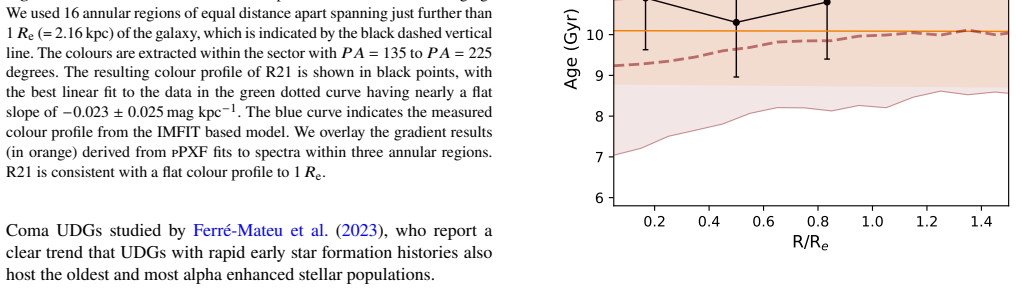
On the paper's own terms, R21 is an old, early-quenched, mildly rotating dwarf galaxy that nonetheless carries an unusually massive dark matter halo for its stellar mass. The central quantitative result is the stellar velocity dispersion of $19.4 \pm 3.5$ km s$^{-1}$ measured within $1\,R_e$, which yields $M_{\mathrm{dyn}} = 9.3 \pm 3.3 \times 10^8$ M$_\odot$ within $r_{1/2}$ via the Wolf et al. (2010) mass estimator. When that point is overlaid on cuspy NFW and cored (Read et al. 2016) halo profiles normalized to the virial mass of $1.8 \times 10^{11}$ M$_\odot$ inferred from the galaxy's $36 \pm 8$ globular clusters, it falls on the cored track; the authors note a countervailing hint, namely the galaxy's nucleus, which they say offers some support for a cuspy profile because globular clusters spiral in and merge more quickly there. The stellar population reinforces the picture: a $10.4$ Gyr, $[M/H] = -0.64$ dex body with $[Mg/Fe] = 0.38 \pm 0.25$ dex, flat age and metallicity gradients, and fast-rotator kinematics with $V/\sigma \approx 0.95$. Because the diffuse stars are more metal-rich than the galaxy's globular clusters, the authors argue that at least two star formation events occurred, the first building the metal-poor cluster population and the second the more enriched stellar body, and that R21 is therefore more like an extension of the classical dwarf population than a failed galaxy.
Load-bearing premise
The cored-halo conclusion requires that the globular-cluster-count to halo-mass scaling relation gives the correct virial halo mass for R21 and that the mass estimator's assumptions of dynamical equilibrium and spherical symmetry hold; because the dynamical measurement is a single point at the half-light radius, an error in either premise leaves the data unable to robustly tell a cored from a cuspy dark matter profile.
Editorial extensions
If this is right
- GC richness alone does not identify a failed galaxy: R21's intermediate metallicity, rotation, flat gradients, and cored-halo-consistent dynamical mass place it among classical dwarfs, so the failed-galaxy label should be reserved for GC-rich UDGs with much lower stellar metallicities such as PUDG-R84.
- R21 adds a sixth dynamical-mass measurement to the spectroscopically studied Perseus UDG sample and strengthens the observed trend that GC-rich UDGs have higher dynamical masses for their stellar mass than GC-poor ones.
- The flat age and metallicity gradients out to one effective radius extend the set of observed UDGs whose flat-to-positive metallicity profiles contrast with the steeply declining metallicity gradients that the TNG50 simulation predicts for quenched cluster UDGs.
- R21's star formation history, with 90% of its stellar mass in place by about 8.9 Gyr ago, resembles the cumulative star formation histories of UDGs in high-density environments and supports an early infall into the Perseus cluster, with later star formation truncated by ram-pressure stripping.
Reading between the lines
- If the cored-halo preference is taken as a prediction, it can be tested directly: radial velocities for a dozen or more of R21's globular clusters would map the enclosed mass profile at several radii and bypass the globular-cluster-count to halo-mass calibration entirely.
- Because R21 classifies as a fast rotator, its disk may be seen at a favorable inclination; if the galaxy is rotationally supported, the spherical-equilibrium mass estimator could be biased, and the rotation component should be subtracted before comparing the residual dispersion with halo models.
- The two-episode star formation scenario predicts a unimodally metal-poor globular cluster system (roughly -1.2 dex) set against a field population near -0.7 dex; deep spectroscopy of the clusters could test whether a metal-rich cluster subpopulation is genuinely absent.
- The hinted 30-degree offset between the rotation axis and the photometric major axis, if real, would point to a triaxial halo or a past minor merger, a kinematic claim that higher signal-to-noise integral-field data could confirm or refute.
Editorial analysis
A structured set of objections, weighed in public.
Referee Report
Summary. The paper presents Keck/KCWI spectroscopy of the globular-cluster-rich ultra-diffuse galaxy PUDG-R21 in the Perseus cluster. The authors measure a recessional velocity of 5536±10 km/s, a stellar velocity dispersion of 19.4±3.5 km/s within one effective radius, and a dynamical mass of 9.3±3.3×10^8 Msun within r1/2. Combining this with a halo mass of 1.8×10^11 Msun derived from the GC count through the Burkert & Forbes (2020) relation, they argue that the dynamical mass is more consistent with a cored than a cuspy dark matter profile. The stellar population analysis yields an old (10.4±1.2 Gyr), intermediate-metallicity ([M/H]=-0.64±0.12 dex), alpha-enhanced ([Mg/Fe]=0.38±0.25 dex) population with flat age and metallicity gradients out to 1 Re. The authors propose that R21 is an extension of the classical dwarf population rather than a failed galaxy, with at least two star formation episodes.
Significance. If the results hold, this is a valuable addition to the small sample of spectroscopically studied, GC-rich UDGs: the independent measurements of stellar population properties, gradients, and kinematics are made with standard and carefully checked methods (pPXF, bootstrap uncertainties, parameter sweeps), and the data are publicly available through the Keck Observatory Archive. The flat gradients and the GC-versus-stellar-body colour offset are interesting and will inform formation scenarios. However, the headline cored-halo conclusion is heavily dependent on the assumed total halo mass and on the adopted dark-matter profile normalization, and the reported rotation is only marginally significant, so the broad interpretive claims currently outrun the data.
major comments (3)
- [§3.4 and Figure 4] The cored-versus-cuspy preference is driven mainly by the assumed total halo mass, not by the shape of the enclosed-mass profile at r1/2. The yellow uncertainty bands in Figure 4 propagate only the Poisson error in the GC count (±8) and do not include the intrinsic scatter of the Burkert & Forbes (2020) GC-count–halo-mass calibration, which is typically ≥0.2–0.3 dex. Since the NFW enclosed mass at fixed radius scales roughly as Mhalo^(1/3), lowering Mhalo from 1.8×10^11 to ~5×10^10 Msun reduces the predicted NFW enclosed mass from ~2.4×10^9 to ~1.4×10^9 Msun, bringing the cuspy prediction within ~1.5σ of the measured 9.3±3.3×10^8 Msun. The manuscript acknowledges this assumption in Section 3.4, but the abstract and conclusions present the cored result without this caveat. Please marginalize over the scatter in the GC–halo relation and the concentration–mass relation, and report a quantitative model comparison (e.g., relative likelihoods or ΔBIC) between cored and cuspy profiles.
- [§3.1 and §5.2.3] The rotation is detected at only about 1.5–2σ: the measured value is 10.1±6.7 km/s (15.6 km/s only after the π/2 aperture-dilution correction). Despite this, Section 5.2.3 uses the rotation to classify R21 as a fast rotator with V/σ~0.95 and uses this classification as support for the classical-dwarf interpretation and for the flat metallicity gradient. The V/σ calculation is also fragile because it subtracts V^2 from the global dispersion measured within the same aperture where rotation is included. Please present the rotation as a tentative detection, propagate the full uncertainty into V/σ, and avoid building the central formation-origin argument on a sub-2σ signal.
- [§3.3 and Eq. (1)] The dynamical mass relies on the Wolf et al. (2010) estimator, which assumes dynamical equilibrium and a dispersion-supported, spherical system. The paper quotes Courteau et al. (2014) for the validity of this estimator in the presence of rotation, but if the claimed rotation is real, the systematic uncertainty in Mdyn from this mismatch is not quantified. Since Mdyn is the only direct dynamical constraint used in the cored/cuspy comparison, please add a quantitative discussion of how much the inferred mass would change under a rotating, flattened model, or explicitly state why the correction is negligible at the current precision.
minor comments (5)
- [Table 1 and §2.1] The observing program for the second night is listed as W283 in Table 1 but as W285 in the text; please reconcile.
- [§4.1 and Table 2] The text reports t50 = 10.6±1.32 Gyr, while Table 2 lists t50 = 11.6±1.32 Gyr; these values should be consistent.
- [Abstract and §6] The abstract quotes a rotation of 15.6±10 km/s, while the conclusions quote 15.8±6.7 km/s; please harmonize the values and state which aperture correction and uncertainty are being quoted.
- [§3.4] The notation '1011.8 M⊙' for the Sifón et al. upper limit should be written as 10^11.8 M⊙ to avoid ambiguity.
- [§5.2.2] The GC-versus-stellar-body colour difference of 0.14±0.08 mag is less than 2σ; the text appropriately calls this a hint, but the subsequent SSP-to-metallicity conversion should be framed as illustrative rather than as a firm measurement of a two-population metallicity difference.
Circularity Check
No significant circularity: the dynamical mass and stellar-population parameters are measured independently; the core-versus-cusp preference is a conditional comparison based on an external GC-halo mass calibration and a transparently stated core-radius assumption.
full rationale
The paper's primary measurements are independent of its interpretive claims. The velocity dispersion (19.4 ± 3.5 km/s), dynamical mass (9.3 ± 3.3 × 10^8 Msun), stellar age, metallicity, and alpha-enhancement are all derived directly from KCWI spectra and HST photometry via standard tools (pPXF, Wolf et al. 2010, E-MILES templates). No fitted parameter is fed back into a 'prediction' that is then claimed as an independent result. The core-versus-cusp comparison in Section 3.4 is explicitly conditional: the total halo mass of 1.8 × 10^11 Msun is taken from the Burkert & Forbes (2020) GC-count relation, and the cored profile is generated using an adopted maximum core radius of 2.75 times the half-light radius, following Forbes & Gannon (2024). These are input assumptions, not outputs of the present data. The authors state the limitation: 'As our dynamical measurement is limited to a measure at a fixed radius, direct comparison with total halo mass models requires an assumption of a dark matter profile.' The self-citations (Burkert & Forbes 2020; Forbes & Gannon 2024) are load-bearing for the interpretation, but they are external, published calibrations and explicitly acknowledged modeling choices rather than unverified premises unique to this paper. The central quantitative results therefore stand independently; the cored/cuspy preference is an interpretation whose robustness depends on the halo-mass calibration and core-radius ansatz, which is a correctness/statistical concern rather than circular reasoning.
Assumptions & free parameters
free parameters (3)
- Core radius of dark matter profile =
2.75 x Re = ~5.94 kpc
- Rotation PA-averaging correction =
pi/2 = 1.57
- Globular cluster count =
36 +/- 8
assumptions (6)
- domain assumption Wolf et al. (2010) mass estimator is applicable.
- domain assumption Burkert & Forbes (2020) GC-halo mass relation holds for this galaxy.
- domain assumption Behroozi et al. (2013) stellar mass-halo mass relation is valid at this mass.
- domain assumption NFW concentration from Dutton & Macciò (2014) applies.
- domain assumption Read et al. (2016) core transformation is a reasonable model.
- domain assumption Distance to Perseus cluster is 75 Mpc.
Cite this review
Pith. "Pith review of A Comprehensive Look at PUDG-R21: Stellar Population and Kinematics of a Globular Cluster-Rich Ultra-Diffuse Galaxy in the Perseus Cluster." pith.science (2026). https://pith.science/paper/OSJTG2AK
@misc{pith2026250705679,
  author       = {Pith},
  title        = {Pith review of: A Comprehensive Look at PUDG-R21: Stellar Population and Kinematics of a Globular Cluster-Rich Ultra-Diffuse Galaxy in the Perseus Cluster},
  year         = {2026},
  howpublished = {\url{https://pith.science/paper/OSJTG2AK}},
  note         = {Machine review of arXiv:2507.05679}
}
abstract
We present the analysis of the stellar populations and kinematics of the globular cluster (GC) rich ultra-diffuse galaxy, PUDG-R21, using spectroscopic observations obtained with the Keck Cosmic Web Imager (KCWI). The recessional velocity is measured to be 5536$\pm$10 km s$^{\mathrm{-1}}$, confirming its association with the Perseus cluster. The galaxy exhibits mild rotation of 15.6$\pm$10 km s$^{\mathrm{-1}}$ and a stellar velocity dispersion of 19.4$\pm$3.5 km s$^{\mathrm{-1}}$ within the galaxy effective radius. From this, we infer a dynamical mass of M$_{\mathrm{dyn}}=9.3\pm3.3\times10^{8}$ M$_{\odot}$. Based on a halo mass derived from PUDG-R21 GC counts, we find our dynamical mass is consistent with a cored dark matter profile. The integrated stellar population analysis reveals a predominantly old stellar population of 10.4$\pm$1.2 Gyr, with intermediate-low metallicity ([M/H]=-0.64$\pm$0.12 dex) and elevated alpha abundances ([Mg/Fe]=0.38$\pm$0.25 dex). The inferred star formation history suggests rapid stellar assembly, likely truncating prior to or during the galaxy's infall into the cluster at an early epoch ($\sim$10 Gyr ago). The analysis of stellar population gradients (age and metallicity) indicates a flat profile out to one effective radius. Here, we consider the involvement of two star formation events, initially forming a large population of metal-poor globular clusters, and then the latter contributing to the more metal-enriched diffuse stellar body. The evidence of subsequent star formation suggests this galaxy is more like an extension of the classical dwarf population than the much discussed failed galaxy UDGs.
Figures


Figures from the paper (5 more)


Reference graph
Works this paper leans on
-
[1]
Aguerri J. A. L., Girardi M., Agulli I., Negri A., Dalla Vecchia C., Dom \' nguez Palmero L., 2020, @doi [ ] 10.1093/mnras/staa800 , https://ui.adsabs.harvard.edu/abs/2020MNRAS.494.1681A 494, 1681
-
[2]
Amorisco N. C., Loeb A., 2016, @doi [ ] 10.1093/mnrasl/slw055 , https://ui.adsabs.harvard.edu/abs/2016MNRAS.459L..51A 459, L51
-
[3]
Behroozi P. S., Wechsler R. H., Conroy C., 2013, @doi [ ] 10.1088/0004-637X/770/1/57 , https://ui.adsabs.harvard.edu/abs/2013ApJ...770...57B 770, 57
-
[4]
Benavides J. A., Sales L. V., Abadi M. G., Vogelsberger M., Marinacci F., Hernquist L., 2024, @doi [ ] 10.3847/1538-4357/ad8de8 , https://ui.adsabs.harvard.edu/abs/2024ApJ...977..169B 977, 169
-
[5]
Bradley L., et al., 2024, astropy/photutils: 2.0.2, @doi 10.5281/zenodo.13989456 , https://doi.org/10.5281/zenodo.13989456
-
[6]
Brodie J. P., Strader J., 2006, @doi [ ] 10.1146/annurev.astro.44.051905.092441 , https://ui.adsabs.harvard.edu/abs/2006ARA&A..44..193B 44, 193
arXiv 2006
-
[7]
Burkert A., Forbes D. A., 2020, @doi [ ] 10.3847/1538-3881/ab5b0e , https://ui.adsabs.harvard.edu/abs/2020AJ....159...56B 159, 56
-
[8]
Buttitta C., et al., 2025, @doi [ ] 10.1051/0004-6361/202452915 , https://ui.adsabs.harvard.edu/abs/2025A&A...694A.276B 694, A276
Show all 97 references
-
[9]
L., et al., 2022, @doi [ ] 10.1093/mnras/stac2442 , https://ui.adsabs.harvard.edu/abs/2022MNRAS.517.2231B 517, 2231
Buzzo M. L., et al., 2022, @doi [ ] 10.1093/mnras/stac2442 , https://ui.adsabs.harvard.edu/abs/2022MNRAS.517.2231B 517, 2231
2022 doi
-
[10]
L., et al., 2025a, @doi [ ] 10.1093/mnras/stae2700 , https://ui.adsabs.harvard.edu/abs/2025MNRAS.536.2536B 536, 2536
Buzzo M. L., et al., 2025a, @doi [ ] 10.1093/mnras/stae2700 , https://ui.adsabs.harvard.edu/abs/2025MNRAS.536.2536B 536, 2536
-
[11]
L., et al., 2025b, @doi [ ] 10.1051/0004-6361/202453522 , https://ui.adsabs.harvard.edu/abs/2025A&A...695A.124B 695, A124
Buzzo M. L., et al., 2025b, @doi [ ] 10.1051/0004-6361/202453522 , https://ui.adsabs.harvard.edu/abs/2025A&A...695A.124B 695, A124
-
[12]
Cappellari M., 2017, @doi [ ] 10.1093/mnras/stw3020 , https://ui.adsabs.harvard.edu/abs/2017MNRAS.466..798C 466, 798
2017 doi
-
[13]
V., Taibi S., 2023, @doi [ ] 10.1093/mnras/stac3243 , https://ui.adsabs.harvard.edu/abs/2023MNRAS.519.1545C 519, 1545
Cardona-Barrero S., Di Cintio A., Battaglia G., Macci \`o A. V., Taibi S., 2023, @doi [ ] 10.1093/mnras/stac3243 , https://ui.adsabs.harvard.edu/abs/2023MNRAS.519.1545C 519, 1545
2023 doi
-
[14]
Carleton T., Errani R., Cooper M., Kaplinghat M., Pe \ n arrubia J., Guo Y., 2019, @doi [ ] 10.1093/mnras/stz383 , https://ui.adsabs.harvard.edu/abs/2019MNRAS.485..382C 485, 382
2019 doi
-
[15]
Carleton T., Guo Y., Munshi F., Tremmel M., Wright A., 2021, @doi [ ] 10.1093/mnras/stab031 , https://ui.adsabs.harvard.edu/abs/2021MNRAS.502..398C 502, 398
2021 doi
-
[16]
L., Vazdekis A., 2009, @doi [ ] 10.1111/j.1365-2966.2008.14079.x , https://ui.adsabs.harvard.edu/abs/2009MNRAS.392..691C 392, 691
Cervantes J. L., Vazdekis A., 2009, @doi [ ] 10.1111/j.1365-2966.2008.14079.x , https://ui.adsabs.harvard.edu/abs/2009MNRAS.392..691C 392, 691
2009
-
[17]
Y., 2023, @doi [ ] 10.1093/mnras/stad1328 , https://ui.adsabs.harvard.edu/abs/2023MNRAS.522.5638C 522, 5638
Chen Y., Gnedin O. Y., 2023, @doi [ ] 10.1093/mnras/stad1328 , https://ui.adsabs.harvard.edu/abs/2023MNRAS.522.5638C 522, 5638
2023 doi
-
[18]
V., 2009, @doi [ ] 10.1111/j.1365-2966.2009.14450.x , https://ui.adsabs.harvard.edu/abs/2009MNRAS.394.1229C 394, 1229
Chilingarian I. V., 2009, @doi [ ] 10.1111/j.1365-2966.2009.14450.x , https://ui.adsabs.harvard.edu/abs/2009MNRAS.394.1229C 394, 1229
2009
-
[19]
V., Afanasiev A
Chilingarian I. V., Afanasiev A. V., Grishin K. A., Fabricant D., Moran S., 2019, @doi [ ] 10.3847/1538-4357/ab4205 , https://ui.adsabs.harvard.edu/abs/2019ApJ...884...79C 884, 79
2019 doi
-
[20]
Coelho P. R. T., 2014, @doi [ ] 10.1093/mnras/stu365 , https://ui.adsabs.harvard.edu/abs/2014MNRAS.440.1027C 440, 1027
2014 doi
-
[21]
Courteau S., et al., 2014, @doi [Reviews of Modern Physics] 10.1103/RevModPhys.86.47 , https://ui.adsabs.harvard.edu/abs/2014RvMP...86...47C 86, 47
2014 doi
-
[22]
Danieli S., et al., 2022, @doi [ ] 10.3847/2041-8213/ac590a , https://ui.adsabs.harvard.edu/abs/2022ApJ...927L..28D 927, L28
2022 doi
-
[23]
B., Macci \`o A
Di Cintio A., Brook C. B., Macci \`o A. V., Stinson G. S., Knebe A., Dutton A. A., Wadsley J., 2014, @doi [ ] 10.1093/mnras/stt1891 , https://ui.adsabs.harvard.edu/abs/2014MNRAS.437..415D 437, 415
2014 doi
-
[24]
B., Dutton A
Di Cintio A., Brook C. B., Dutton A. A., Macci \`o A. V., Obreja A., Dekel A., 2017, @doi [ ] 10.1093/mnrasl/slw210 , https://ui.adsabs.harvard.edu/abs/2017MNRAS.466L...1D 466, L1
2017 doi
-
[25]
A., Macci \`o A
Dutton A. A., Macci \`o A. V., 2014, @doi [ ] 10.1093/mnras/stu742 , https://ui.adsabs.harvard.edu/abs/2014MNRAS.441.3359D 441, 3359
2014 doi
-
[26]
G., Efremov Y
Elmegreen B. G., Efremov Y. N., 1997, @doi [ ] 10.1086/303966 , https://ui.adsabs.harvard.edu/abs/1997ApJ...480..235E 480, 235
1997 doi
-
[28]
Emsellem E., et al., 2019, @doi [ ] 10.1051/0004-6361/201834909 , https://ui.adsabs.harvard.edu/abs/2019A&A...625A..76E 625, A76
2019 doi
-
[29]
Erwin P., 2015, @doi [ ] 10.1088/0004-637X/799/2/226 , https://ui.adsabs.harvard.edu/abs/2015ApJ...799..226E 799, 226
2015 doi
-
[30]
Fahrion K., Leaman R., Lyubenova M., van de Ven G., 2022, @doi [ ] 10.1051/0004-6361/202039778 , https://ui.adsabs.harvard.edu/abs/2022A&A...658A.172F 658, A172
2022 doi
-
[31]
Fensch J., et al., 2019, @doi [ ] 10.1051/0004-6361/201834911 , https://ui.adsabs.harvard.edu/abs/2019A&A...625A..77F 625, A77
2019 doi
-
[32]
G., 2014, @doi [ ] 10.1088/0004-637X/797/2/136 , https://ui.adsabs.harvard.edu/abs/2014ApJ...797..136F 797, 136
Ferr \'e -Mateu A., S \'a nchez-Bl \'a zquez P., Vazdekis A., de la Rosa I. G., 2014, @doi [ ] 10.1088/0004-637X/797/2/136 , https://ui.adsabs.harvard.edu/abs/2014ApJ...797..136F 797, 136
2014 doi
-
[33]
Ferr \'e -Mateu A., et al., 2018, @doi [ ] 10.1093/mnras/sty1597 , https://ui.adsabs.harvard.edu/abs/2018MNRAS.479.4891F 479, 4891
2018 doi
-
[34]
S., Forbes D
Ferr \'e -Mateu A., Gannon J. S., Forbes D. A., Buzzo M. L., Romanowsky A. J., Brodie J. P., 2023, @doi [ ] 10.1093/mnras/stad3102 , https://ui.adsabs.harvard.edu/abs/2023MNRAS.526.4735F 526, 4735
2023 doi
-
[35]
A., Romanowsky A
Ferr \'e -Mateu A., Gannon J., Forbes D. A., Romanowsky A. J., Buzzo M. L., Brodie J. P., 2025, @doi [ ] 10.1051/0004-6361/202453393 , https://ui.adsabs.harvard.edu/abs/2025A&A...694L...6F 694, L6
2025 doi
-
[36]
P., Cooper M
Fillingham S. P., Cooper M. C., Wheeler C., Garrison-Kimmel S., Boylan-Kolchin M., Bullock J. S., 2015, @doi [ ] 10.1093/mnras/stv2058 , https://ui.adsabs.harvard.edu/abs/2015MNRAS.454.2039F 454, 2039
2015 doi
-
[37]
A., 2005, @doi [ ] 10.1086/499563 , https://ui.adsabs.harvard.edu/abs/2005ApJ...635L.137F 635, L137
Forbes D. A., 2005, @doi [ ] 10.1086/499563 , https://ui.adsabs.harvard.edu/abs/2005ApJ...635L.137F 635, L137
2005 doi
-
[38]
A., Gannon J., 2024, @doi [ ] 10.1093/mnras/stad4004 , https://ui.adsabs.harvard.edu/abs/2024MNRAS.528..608F 528, 608
Forbes D. A., Gannon J., 2024, @doi [ ] 10.1093/mnras/stad4004 , https://ui.adsabs.harvard.edu/abs/2024MNRAS.528..608F 528, 608
2024 doi
-
[39]
A., Read J
Forbes D. A., Read J. I., Gieles M., Collins M. L. M., 2018, @doi [ ] 10.1093/mnras/sty2584 , https://ui.adsabs.harvard.edu/abs/2018MNRAS.481.5592F 481, 5592
2018 doi
-
[40]
A., Gannon J., Couch W
Forbes D. A., Gannon J., Couch W. J., Iodice E., Spavone M., Cantiello M., Napolitano N., Schipani P., 2019, @doi [ ] 10.1051/0004-6361/201935499 , https://ui.adsabs.harvard.edu/abs/2019A&A...626A..66F 626, A66
2019 doi
-
[41]
A., Buzzo M
Forbes D. A., Buzzo M. L., Ferre-Mateu A., Romanowsky A. J., Gannon J., Brodie J. P., Collins M. L. M., 2025, @doi [ ] 10.1093/mnras/stae2675 , https://ui.adsabs.harvard.edu/abs/2025MNRAS.536.1217F 536, 1217
2025 doi
-
[42]
S., Forbes D
Gannon J. S., Forbes D. A., Romanowsky A. J., Ferr \'e -Mateu A., Couch W. J., Brodie J. P., 2020, @doi [ ] 10.1093/mnras/staa1282 , https://ui.adsabs.harvard.edu/abs/2020MNRAS.495.2582G 495, 2582
2020 doi
-
[43]
S., et al., 2021, @doi [ ] 10.1093/mnras/stab277 , https://ui.adsabs.harvard.edu/abs/2021MNRAS.502.3144G 502, 3144
Gannon J. S., et al., 2021, @doi [ ] 10.1093/mnras/stab277 , https://ui.adsabs.harvard.edu/abs/2021MNRAS.502.3144G 502, 3144
2021 doi
-
[44]
S., et al., 2022, @doi [ ] 10.1093/mnras/stab3297 , https://ui.adsabs.harvard.edu/abs/2022MNRAS.510..946G 510, 946
Gannon J. S., et al., 2022, @doi [ ] 10.1093/mnras/stab3297 , https://ui.adsabs.harvard.edu/abs/2022MNRAS.510..946G 510, 946
2022 doi
-
[45]
S., Forbes D
Gannon J. S., Forbes D. A., Brodie J. P., Romanowsky A. J., Couch W. J., Ferr \'e -Mateu A., 2023, @doi [ ] 10.1093/mnras/stac3264 , https://ui.adsabs.harvard.edu/abs/2023MNRAS.518.3653G 518, 3653
2023 doi
-
[46]
Gu M., et al., 2018, @doi [ ] 10.3847/1538-4357/aabbae , https://ui.adsabs.harvard.edu/abs/2018ApJ...859...37G 859, 37
2018 doi
-
[47]
E., et al., 2020, @doi [ ] 10.3847/1538-4357/ab6992 , https://ui.adsabs.harvard.edu/abs/2020ApJ...890..105H 890, 105
Harris W. E., et al., 2020, @doi [ ] 10.3847/1538-4357/ab6992 , https://ui.adsabs.harvard.edu/abs/2020ApJ...890..105H 890, 105
2020 doi
-
[48]
Hernandez X., Gilmore G., 1998, @doi [ ] 10.1046/j.1365-8711.1998.01511.x , https://ui.adsabs.harvard.edu/abs/1998MNRAS.297..517H 297, 517
1998
-
[49]
Iodice E., et al., 2020, @doi [ ] 10.1051/0004-6361/202038523 , https://ui.adsabs.harvard.edu/abs/2020A&A...642A..48I 642, A48
2020 doi
-
[50]
C., et al., 2010, Montage: An Astronomical Image Mosaicking Toolkit , Astrophysics Source Code Library, record ascl:1010.036
Jacob J. C., et al., 2010, Montage: An Astronomical Image Mosaicking Toolkit , Astrophysics Source Code Library, record ascl:1010.036
2010
-
[51]
G., Leisman L., Webb A., 2019, @doi [ ] 10.1093/mnras/stz1868 , https://ui.adsabs.harvard.edu/abs/2019MNRAS.490..566J 490, 566
Janowiecki S., Jones M. G., Leisman L., Webb A., 2019, @doi [ ] 10.1093/mnras/stz1868 , https://ui.adsabs.harvard.edu/abs/2019MNRAS.490..566J 490, 566
2019 doi
-
[52]
J., van Dokkum P., 2017, @doi [ ] 10.3847/2041-8213/aa667d , https://ui.adsabs.harvard.edu/abs/2017ApJ...839L..17J 839, L17
Janssens S., Abraham R., Brodie J., Forbes D., Romanowsky A. J., van Dokkum P., 2017, @doi [ ] 10.3847/2041-8213/aa667d , https://ui.adsabs.harvard.edu/abs/2017ApJ...839L..17J 839, L17
2017 doi
-
[53]
R., et al., 2022, @doi [ ] 10.1093/mnras/stac2717 , https://ui.adsabs.harvard.edu/abs/2022MNRAS.517..858J 517, 858
Janssens S. R., et al., 2022, @doi [ ] 10.1093/mnras/stac2717 , https://ui.adsabs.harvard.edu/abs/2022MNRAS.517..858J 517, 858
2022 doi
- [54]
-
[55]
J., Dutton A
Jiang F., Dekel A., Freundlich J., Romanowsky A. J., Dutton A. A., Macci \`o A. V., Di Cintio A., 2019, @doi [ ] 10.1093/mnras/stz1499 , https://ui.adsabs.harvard.edu/abs/2019MNRAS.487.5272J 487, 5272
2019 doi
-
[56]
Jones M., et al., 2023, in American Astronomical Society Meeting Abstracts. p. 426.01
2023
-
[57]
N., Cohen J
Kirby E. N., Cohen J. G., Guhathakurta P., Cheng L., Bullock J. S., Gallazzi A., 2013, @doi [ ] 10.1088/0004-637X/779/2/102 , https://ui.adsabs.harvard.edu/abs/2013ApJ...779..102K 779, 102
2013 doi
-
[58]
W., 2011, @doi [ ] 10.1111/j.1365-2966.2011.19057.x , https://ui.adsabs.harvard.edu/abs/2011MNRAS.417.1643K 417, 1643
Koleva M., Prugniel P., De Rijcke S., Zeilinger W. W., 2011, @doi [ ] 10.1111/j.1365-2966.2011.19057.x , https://ui.adsabs.harvard.edu/abs/2011MNRAS.417.1643K 417, 1643
2011
-
[59]
Kroupa P., 2001, @doi [ ] 10.1046/j.1365-8711.2001.04022.x , https://ui.adsabs.harvard.edu/abs/2001MNRAS.322..231K 322, 231
2001
-
[60]
La Marca A., et al., 2022, @doi [ ] 10.1051/0004-6361/202142367 , https://ui.adsabs.harvard.edu/abs/2022A&A...665A.105L 665, A105
2022 doi
-
[61]
Leisman L., et al., 2017, @doi [ ] 10.3847/1538-4357/aa7575 , https://ui.adsabs.harvard.edu/abs/2017ApJ...842..133L 842, 133
2017 doi
- [62]
-
[63]
Lim S., et al., 2020, @doi [ ] 10.3847/1538-4357/aba433 , https://ui.adsabs.harvard.edu/abs/2020ApJ...899...69L 899, 69
2020 doi
-
[64]
Lipka M., Thomas J., Saglia R., Bender R., Fabricius M., Partmann C., 2024, @doi [ ] 10.3847/1538-4357/ad7baa , https://ui.adsabs.harvard.edu/abs/2024ApJ...976...17L 976, 17
2024 doi
-
[65]
Liu Y., et al., 2016, @doi [ ] 10.3847/0004-637X/818/2/179 , https://ui.adsabs.harvard.edu/abs/2016ApJ...818..179L 818, 179
2016 doi
-
[66]
Manolopoulou M., Plionis M., 2017, @doi [ ] 10.1093/mnras/stw2870 , https://ui.adsabs.harvard.edu/abs/2017MNRAS.465.2616M 465, 2616
2017 doi
-
[67]
R., et al., 2024, @doi [arXiv e-prints] 10.48550/arXiv.2405.13502 , https://ui.adsabs.harvard.edu/abs/2024arXiv240513502M p
Marleau F. R., et al., 2024, @doi [arXiv e-prints] 10.48550/arXiv.2405.13502 , https://ui.adsabs.harvard.edu/abs/2024arXiv240513502M p. arXiv:2405.13502
2024 doi
-
[68]
A., et al., 2016, @doi [ ] 10.1093/mnras/stv2435 , https://ui.adsabs.harvard.edu/abs/2016MNRAS.455.2323M 455, 2323
Mistani P. A., et al., 2016, @doi [ ] 10.1093/mnras/stv2435 , https://ui.adsabs.harvard.edu/abs/2016MNRAS.455.2323M 455, 2323
2016 doi
-
[69]
Morrissey P., et al., 2018, @doi [ ] 10.3847/1538-4357/aad597 , https://ui.adsabs.harvard.edu/abs/2018ApJ...864...93M 864, 93
2018 doi
-
[70]
M \"u ller O., et al., 2020, @doi [ ] 10.1051/0004-6361/202038351 , https://ui.adsabs.harvard.edu/abs/2020A&A...640A.106M 640, A106
2020 doi
-
[71]
F., Frenk C
Navarro J. F., Frenk C. S., White S. D. M., 1996, @doi [ ] 10.1086/177173 , https://ui.adsabs.harvard.edu/abs/1996ApJ...462..563N 462, 563
1996 doi
-
[72]
C., Springel V., van de Voort F., 2023, @doi [ ] 10.1093/mnras/stac3776 , https://ui.adsabs.harvard.edu/abs/2023MNRAS.520.2692P 520, 2692
Pasha I., Mandelker N., van den Bosch F. C., Springel V., van de Voort F., 2023, @doi [ ] 10.1093/mnras/stac3776 , https://ui.adsabs.harvard.edu/abs/2023MNRAS.520.2692P 520, 2692
2023 doi
-
[73]
W., Lim S., 2016, @doi [ ] 10.3847/2041-8205/822/2/L31 , https://ui.adsabs.harvard.edu/abs/2016ApJ...822L..31P 822, L31
Peng E. W., Lim S., 2016, @doi [ ] 10.3847/2041-8205/822/2/L31 , https://ui.adsabs.harvard.edu/abs/2016ApJ...822L..31P 822, L31
2016 doi
-
[74]
W., et al., 2006, @doi [ ] 10.1086/498210 , https://ui.adsabs.harvard.edu/abs/2006ApJ...639...95P 639, 95
Peng E. W., et al., 2006, @doi [ ] 10.1086/498210 , https://ui.adsabs.harvard.edu/abs/2006ApJ...639...95P 639, 95
2006 doi
-
[75]
Pfeffer J., et al., 2024, @doi [ ] 10.1093/mnras/stae850 , https://ui.adsabs.harvard.edu/abs/2024MNRAS.529.4914P 529, 4914
2024 doi
-
[76]
J., et al., 2019, @doi [ ] 10.1093/mnras/stz326 , https://ui.adsabs.harvard.edu/abs/2019MNRAS.484.4865P 484, 4865
Prole D. J., et al., 2019, @doi [ ] 10.1093/mnras/stz326 , https://ui.adsabs.harvard.edu/abs/2019MNRAS.484.4865P 484, 4865
2019 doi
-
[77]
I., Agertz O., Collins M
Read J. I., Agertz O., Collins M. L. M., 2016, @doi [ ] 10.1093/mnras/stw713 , https://ui.adsabs.harvard.edu/abs/2016MNRAS.459.2573R 459, 2573
2016 doi
-
[78]
K., Jaff \'e Y., Candlish G., S \'a nchez-J \'a nssen R., 2017, @doi [ ] 10.3847/1538-4357/aa6d6c , https://ui.adsabs.harvard.edu/abs/2017ApJ...843..128R 843, 128
Rhee J., Smith R., Choi H., Yi S. K., Jaff \'e Y., Candlish G., S \'a nchez-J \'a nssen R., 2017, @doi [ ] 10.3847/1538-4357/aa6d6c , https://ui.adsabs.harvard.edu/abs/2017ApJ...843..128R 843, 128
2017 doi
-
[79]
L., Brooks A
Riggs C. L., Brooks A. M., Munshi F., Christensen C. R., Cohen R. E., Quinn T. R., Wadsley J., 2024, @doi [ ] 10.3847/1538-4357/ad8b1e , https://ui.adsabs.harvard.edu/abs/2024ApJ...977...20R 977, 20
2024 doi
-
[80]
Romero-G \'o mez J., et al., 2023, @doi [ ] 10.1093/mnras/stad953 , https://ui.adsabs.harvard.edu/abs/2023MNRAS.522..130R 522, 130
2023 doi
-
[81]
H., Sun S., Pan J., 2017, @doi [ ] 10.1093/mnras/stx1440 , https://ui.adsabs.harvard.edu/abs/2017MNRAS.470.4231R 470, 4231
Rong Y., Guo Q., Gao L., Liao S., Xie L., Puzia T. H., Sun S., Pan J., 2017, @doi [ ] 10.1093/mnras/stx1440 , https://ui.adsabs.harvard.edu/abs/2017MNRAS.470.4231R 470, 4231
2017 doi
-
[82]
V., Navarro J
Sales L. V., Navarro J. F., Pe \ n afiel L., Peng E. W., Lim S., Hernquist L., 2020, @doi [ ] 10.1093/mnras/staa854 , https://ui.adsabs.harvard.edu/abs/2020MNRAS.494.1848S 494, 1848
2020 doi
-
[83]
F., Finkbeiner D
Schlafly E. F., Finkbeiner D. P., 2011, @doi [ ] 10.1088/0004-637X/737/2/103 , https://ui.adsabs.harvard.edu/abs/2011ApJ...737..103S 737, 103
2011 doi
-
[84]
Sif \'o n C., van der Burg R. F. J., Hoekstra H., Muzzin A., Herbonnet R., 2018, @doi [ ] 10.1093/mnras/stx2648 , https://ui.adsabs.harvard.edu/abs/2018MNRAS.473.3747S 473, 3747
2018 doi
-
[87]
R., Forbes D
Spitler L. R., Forbes D. A., 2009, @doi [ ] 10.1111/j.1745-3933.2008.00567.x , https://ui.adsabs.harvard.edu/abs/2009MNRAS.392L...1S 392, L1
2009
-
[88]
Sybilska A., et al., 2017, @doi [ ] 10.1093/mnras/stx1138 , https://ui.adsabs.harvard.edu/abs/2017MNRAS.470..815S 470, 815
2017 doi
-
[89]
Taibi S., Battaglia G., Leaman R., Brooks A., Riggs C., Munshi F., Revaz Y., Jablonka P., 2022, @doi [ ] 10.1051/0004-6361/202243508 , https://ui.adsabs.harvard.edu/abs/2022A&A...665A..92T 665, A92
2022 doi
-
[90]
Vazdekis A., et al., 2015, @doi [ ] 10.1093/mnras/stv151 , https://ui.adsabs.harvard.edu/abs/2015MNRAS.449.1177V 449, 1177
2015 doi
-
[91]
Villaume A., et al., 2022, @doi [ ] 10.3847/1538-4357/ac341e , https://ui.adsabs.harvard.edu/abs/2022ApJ...924...32V 924, 32
2022 doi
-
[92]
Wittmann C., et al., 2017, @doi [ ] 10.1093/mnras/stx1229 , https://ui.adsabs.harvard.edu/abs/2017MNRAS.470.1512W 470, 1512
2017 doi
-
[93]
D., Bullock J
Wolf J., Martinez G. D., Bullock J. S., Kaplinghat M., Geha M., Mu \ n oz R. R., Simon J. D., Avedo F. F., 2010, @doi [ ] 10.1111/j.1365-2966.2010.16753.x , https://ui.adsabs.harvard.edu/abs/2010MNRAS.406.1220W 406, 1220
2010
-
[94]
C., Tremmel M., Brooks A
Wright A. C., Tremmel M., Brooks A. M., Munshi F., Nagai D., Sharma R. S., Quinn T. R., 2021, @doi [ ] 10.1093/mnras/stab081 , https://ui.adsabs.harvard.edu/abs/2021MNRAS.502.5370W 502, 5370
2021 doi
-
[95]
Yagi M., Koda J., Komiyama Y., Yamanoi H., 2016, @doi [ ] 10.3847/0067-0049/225/1/11 , https://ui.adsabs.harvard.edu/abs/2016ApJS..225...11Y 225, 11
2016 doi
-
[96]
Yozin C., Bekki K., 2015, @doi [ ] 10.1093/mnras/stv1073 , https://ui.adsabs.harvard.edu/abs/2015MNRAS.452..937Y 452, 937
2015 doi
-
[97]
E., Dey A., Kadowaki J., Spekkens K., Zhang H., 2021, @doi [ ] 10.3847/1538-4365/ac2607 , https://ui.adsabs.harvard.edu/abs/2021ApJS..257...60Z 257, 60
Zaritsky D., Donnerstein R., Karunakaran A., Barbosa C. E., Dey A., Kadowaki J., Spekkens K., Zhang H., 2021, @doi [ ] 10.3847/1538-4365/ac2607 , https://ui.adsabs.harvard.edu/abs/2021ApJS..257...60Z 257, 60
2021 doi
-
[98]
G., Abraham R., Merritt A., Zhang J., Geha M., Conroy C., 2015, @doi [ ] 10.1088/2041-8205/798/2/L45 , https://ui.adsabs.harvard.edu/abs/2015ApJ...798L..45V 798, L45
van Dokkum P. G., Abraham R., Merritt A., Zhang J., Geha M., Conroy C., 2015, @doi [ ] 10.1088/2041-8205/798/2/L45 , https://ui.adsabs.harvard.edu/abs/2015ApJ...798L..45V 798, L45
2015 doi
-
[99]
van Dokkum P., et al., 2019, @doi [ ] 10.3847/1538-4357/ab2914 , https://ui.adsabs.harvard.edu/abs/2019ApJ...880...91V 880, 91
2019 doi
-
[100]
write newline
" write newline "" before.all 'output.state := FUNCTION fin.entry write newline FUNCTION new.block output.state before.all = 'skip after.block 'output.state := if FUNCTION new.sentence output.state after.block = 'skip output.state before.all = 'skip after.sentence 'output.stat...
Reviewed August 6, 2026 · model on record in the stance chip above.
Discussion (0). Continue with ORCID to comment.