REVIEW 4 major objections 6 minor 32 references
Hierarchical Interaction Summarization and Contrastive Prompting for Explainable Recommendations
T0 review · 4 major / 6 minor · reviewed 2026-08-06 · deepseek-v4-flash
Pith's one-line read Replacing embeddings with hierarchical text summaries and contrastively filtered ground truths pushes explainable recommendation quality to new state-of-the-art levels on three datasets.
desk verdict The framework is clever, but Table 1 is circular: all baselines are scored on CPEG-generated references that the proposed model is SFT'd to reproduce, so the reported gains don't establish better explanations. read the letter →
The pith
A machine-rendered reading of the paper's core claim, the machinery that carries it, and where it could break.
The reading
What carries the argument
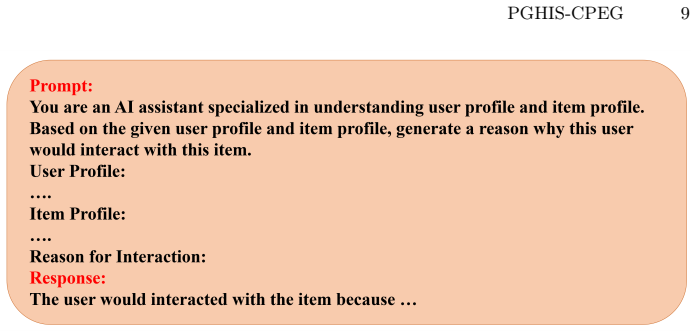
The central machinery is PGHIS, a hierarchical interaction summarization procedure that replaces the message-passing of graph collaborative filtering with LLM-based textual aggregation: starting from initial attribute profiles, an LLM prompted with a system instruction updates each user or item profile by summarizing the common features of its interacted neighbors, layer by layer. The second load-bearing piece is CPEG, contrastive prompting for explanation generation, which feeds a reasoning LLM the user profile, the positive item, and a mix of hard and random negative items, generates both a predicted item and an explanation, and accepts the explanation only if the predicted item matches the true interaction. These accepted explanations become the supervised targets for fine-tuning, so the quality of the training signal is controlled by the model's discriminative success rather than by the user's willingness to write detailed reviews.
What would settle it
Run a human panel where annotators rate the informativeness of CPEG-accepted explanations versus CPEG-rejected explanations of equal fluency; if rejected explanations are rated at least as informative, the filter is not selecting for explanation quality and the win-rate gains would be mostly stylistic.
Extended reading notes
Core claim
On the paper's own terms, the discovery is that both core barriers in explainable recommendation - information loss from embedding-based representations and poor ground truth explanations from sparse user reviews - can be removed by treating the LLM itself as the aggregation function and by using item-selection correctness as a filter for explanation quality. The paper's PGHIS method iteratively updates user and item profiles by summarizing the common features of interacted neighbors, producing explicit textual representations that preserve interaction semantics. The CPEG method prompts a reasoning language model with positive and negative item profiles, retains explanations only when the model predicts the right item, and feeds erroneous outputs back as counterexamples to sharpen later generations. Fine-tuning a lightweight LLM on these profiles and contrastively filtered explanations yields state-of-the-art scores on Amazon-Books, Yelp, and Steam, and the CPEG ground truths win against user-written reviews and baseline-generated texts in LLM-as-judge comparisons.
Load-bearing premise
The method's training-data filter assumes that whether a reasoning model can pick the correct item is a valid proxy for whether its explanation is genuinely informative, so explanations that are fluent but say nothing useful can survive the filter.
Editorial extensions
If this is right
- Textual profiles could replace embeddings as the standard input format for LLM-based recommendation modules, not just for explanation generation but for downstream tasks like ranking and user understanding.
- Contrastively filtered ground truths could be used to clean noisy user-generated text in other NLG tasks where the generated text is meant to justify a verifiable decision.
- The hierarchical summarization approach scales across domains because it does not require retraining an embedding layer; only the attributes and the prompt change.
- The method suggests that the quality of training explanations, not model size, is the limiting factor for explainable recommendation performance.
- Fine-tuning a relatively small instruction-tuned LLM on high-quality contrastive targets can outperform larger or embedding-based pipelines on both explainability and lexical-overlap metrics.
Reading between the lines
- The item-selection proxy may implicitly bias the training set toward explanations written in the stylistic register of modern reasoning LLMs, so part of the GPTScore and win-rate gains could reflect LLM-preferred prose rather than user-facing informativeness; a human study would separate these.
- PGHIS can be read as a general recipe for injecting explicit collaborative signals into any LLM-based recommender: instead of learning graph embeddings, aggregate neighbor attributes in natural language, which suggests a testable extension to sequential or session-based recommendation.
- The contrastive retry loop is a form of self-training with a discriminative filter, and the paper's ablation indicates that even without fine-tuning the profiles alone beat a prior LLM baseline, so the profile representation may be the more transferable contribution.
- One testable extension is to replace the item-selection filter with a more direct explanation-quality signal, such as a learned reward model, to see whether the gap over user reviews grows or shrinks.
Editorial analysis
A structured set of objections, weighed in public.
Referee Report
Summary. The paper proposes an explainable-recommendation framework with two main components: PGHIS, which generates textual user/item profiles by prompting an LLM to hierarchically aggregate interaction information (Eqs. 3-5), and CPEG, which uses a reasoning language model (DeepSeek-R1) with positive and negative items to generate ground-truth explanations, retaining outputs only when the RLM predicts the correct interacted item (Eqs. 6-7). The authors fine-tune Qwen2.5-7B via supervised fine-tuning on the resulting profile-explanation pairs (Eq. 8) and evaluate on Amazon-Book, Yelp, and Steam against Att2Seq, NRT, PETER, PEPLER, and XRec. The paper reports average gains of 5 points on GPTScore and large BLEU/ROUGE improvements, plus LLM-judged win rates for CPEG-generated ground truths.
Significance. If the central claims are sound, replacing learned embeddings with hierarchical textual profiles and producing contrastively filtered LLM-generated training targets could be a useful recipe for explainable recommendation, and the comparison with five baselines across three datasets would be a valuable benchmark contribution. The paper gives concrete prompts, hyperparameters (k=2, m=5), datasets, and a case study, which make the pipeline easy to reproduce. The main risk is that the headline evaluation is partially self-referential: the test-set reference is itself CPEG-generated text, and the LLM-based judges share a distribution with the LLM-generated candidates, so the reported gains may reflect distributional alignment rather than explanation quality.
major comments (4)
- [Section 4.2, Table 1 vs. Section 3.3] The test set for Table 1 uses CPEG-generated explanations as the reference: Section 3 states that CPEG outputs serve as the ground-truth output for both training and testing datasets, and no other reference is identified for Table 1. Since every metric in Table 1 (GPTScore, BERTScore, BLEURT, BLEU, ROUGE) compares generated text to this reference, and the proposed model is SFT'd on those exact CPEG targets (Eq. 8), the large improvements are at least in part a measure of how closely the model reproduces CPEG's distribution; the baselines were not trained on those targets. The authors should re-evaluate all methods against the original user reviews, or retrain all baselines on the same CPEG targets, or report both; without this, the headline claim in the abstract is not established.
- [Section 4.4, Figure 6] The win-rate study uses GPT-3.5 as judge to compare CPEG explanations (generated by DeepSeek-R1) against user reviews and XRec ground truths. Because both the candidate and judge are LLMs and the judge has no independent human-annotated quality signal, the win rates may reflect generic LLM-style agreement rather than explanation informativeness. Additionally, the k and m values used in all main experiments (k=2, m=5) are selected from this same test data using these win rates, so the hyperparameters are tuned on the evaluation set. Please provide a held-out validation split for hyperparameter selection and supplement the LLM-judge results with a human evaluation or a calibrated human-annotated subset.
- [Section 3.2, Eqs. (6)-(7)] The assumption that RLM item-selection accuracy is a valid proxy for explanation quality is load-bearing for CPEG: explanations are accepted or rejected solely based on whether the predicted item matches the interacted item. If explanation quality and item prediction are separable, the filter could retain fluent, LLM-typical prose while discarding less polished but more informative explanations, and SFT would inherit that bias. The paper should provide evidence for this proxy, for example by comparing human or LLM quality ratings of explanations from correct versus incorrect RLM predictions, or by showing that item-selection accuracy and explanation quality correlate on a labeled sample.
- [Table 1, overall] All results in Table 1 are point estimates without error bars, significance tests, or multiple runs. Given that hyperparameters are selected using the same datasets, the reported improvements need at least confidence intervals or paired significance tests to support the 'significant enhancement' wording. This is less severe than the reference confound but should be addressed in revision.
minor comments (6)
- [Eq. (8)] Equation (8) defines the loss L as a sum of probabilities pθ(xt|...), but the standard SFT objective is the negative log-likelihood; please correct the formula and the surrounding text.
- [Abstract and Section 1] The abstract and introduction report '5% on GPTScore', but Table 1's GPTScore is on a 0-100 scale; '5 points' is the accurate description.
- [Section 4.1 and Figure 5] Please proofread for typos: 'Seting' in Section 4.1, 'Ablastion' in the Figure 5 caption, 'recommendater' and 'al se' in Section 2.1, and 'perfomence' in the conclusion.
- [Section 4.4] The win-rate experiment is reported only for Amazon-Books and Steam; please justify omitting Yelp or add the Yelp results.
- [Section 4.1] The split description is unclear about whether the 2,000 test instances overlap with the profile-generation subset and about how negative items are chosen at test time; please clarify the exact protocol.
- [Section 4.1, evaluation metrics] The GPTScore implementation is described only as 'derived from GPT-3.5'; please specify the scoring prompt, the model version, and whether the same evaluator is used for all baselines.
Circularity Check
Reported gains in Table 1 are scored against CPEG-generated references that are also the SFT training targets, making the headline improvements measure imitation of CPEG style rather than independent explanation quality.
-
fitted input called prediction
[Section 3 (Method overview) and Section 3.3 (Supervised Fine-Tuning), Eq. 8; see also Section 4.1 (Datasets/Evaluation)]
"Finally, we use the generated user and item profiles as inputs to the model and produce recommendation explanations generated by CPEG as the ground truth output to construct training and testing datasets for our model. Then, we fine-tune a lightweight LLM using SFT with these datasets, resulting in our final recommendation explanation generation model."
The CPEG-generated explanation is both the SFT training target (Eq. 8 optimizes next-token probability on these targets) and the test-set reference for BLEU, ROUGE, BERTScore, BLEURT, and GPTScore. The fine-tuned Qwen2.5 model is therefore explicitly optimized to reproduce the reference distribution, while baselines (Att2Seq, NRT, PETER, PEPLER, XRec) were trained on user reviews or their own targets. The reported gains (+5 GPTScore, +20.6% BLEU, +19.6% ROUGE) thus measure distributional alignment with CPEG outputs rather than independent explanation quality. The comparison would be informative only if all methods were scored against a common external reference (e.g., original user reviews) or if all baselines were retrained on the same CPEG ground truths.
full rationale
The paper's pipeline is not internally circular in its method design: PGHIS generates textual profiles, CPEG uses RLMs with contrastive prompts, and SFT trains a model. The circularity is in the evaluation protocol. Training and testing datasets both use CPEG explanations as ground truth (Section 3). The fine-tuned model is optimized by token-level cross-entropy to reproduce these explanations (Eq. 8). Table 1 then scores all methods with reference-based metrics (GPTScore, BERTScore, BLEURT, BLEU, ROUGE) against the CPEG test references. Since the proposed model is explicitly trained to match the reference distribution, its superior scores are expected by construction. Baselines trained on user reviews or their own objectives are not aligned to the reference distribution, so the comparison is confounded. The win-rate analysis in Section 4.4 uses an LLM judge, which may share stylistic preferences with the RLM generator, but this is a bias rather than a formal reduction. No self-citations are load-bearing; the method does not depend on the authors' own prior theorems. Overall, the central performance claim partially reduces to a fit to the evaluation reference.
Assumptions & free parameters
free parameters (3)
- number of hard negatives k =
2
- number of random negatives m =
5
- neighbor count for profile aggregation =
15
assumptions (3)
- domain assumption Pretrained LLMs reliably aggregate interaction summaries and assess explanation quality as intended.
- ad hoc to paper RLM item-selection accuracy is a valid proxy for explanation quality.
- domain assumption Automated metrics (GPTScore, BERTScore, BLEURT, BLEU, ROUGE) capture explanation quality for this task.
Cite this review
Pith. "Pith review of Hierarchical Interaction Summarization and Contrastive Prompting for Explainable Recommendations." pith.science (2026). https://pith.science/paper/CU4WSGB4
@misc{pith2026250706044,
  author       = {Pith},
  title        = {Pith review of: Hierarchical Interaction Summarization and Contrastive Prompting for Explainable Recommendations},
  year         = {2026},
  howpublished = {\url{https://pith.science/paper/CU4WSGB4}},
  note         = {Machine review of arXiv:2507.06044}
}
read the original abstract
Explainable recommendations, which use the information of user and item with interaction to generate a explanation for why the user would interact with the item, are crucial for improving user trust and decision transparency to the recommender system. Existing methods primarily rely on encoding features of users and items to embeddings, which often leads to information loss due to dimensionality reduction, sparse interactions, and so on. With the advancements of large language models (LLMs) in language comprehension, some methods use embeddings as LLM inputs for explanation generation. However, since embeddings lack inherent semantics, LLMs must adjust or extend their parameters to interpret them, a process that inevitably incurs information loss. To address this issue, we propose a novel approach combining profile generation via hierarchical interaction summarization (PGHIS), which leverages a pretrained LLM to hierarchically summarize user-item interactions, generating structured textual profiles as explicit representations of user and item characteristics. Additionally, we propose contrastive prompting for explanation generation (CPEG) which employs contrastive learning to guide another reasoning language models in producing high-quality ground truth recommendation explanations. Finally, we use the textual profiles of user and item as input and high-quality explanation as output to fine-tune a LLM for generating explanations. Experimental results on multiple datasets demonstrate that our approach outperforms existing state-of-the-art methods, achieving a great improvement on metrics about explainability (e.g., 5% on GPTScore) and text quality. Furthermore, our generated ground truth explanations achieve a significantly higher win rate compared to user-written reviews and those produced by other methods, demonstrating the effectiveness of CPEG in generating high-quality ground truths.
Figures


Figures from the paper (4 more)


Reference graph
Works this paper leans on
-
[1]
arXiv preprint arXiv:2501.11223 (2025)
Besta, M., Barth, J., Schreiber, E., Kubicek, A., Catarino, A., Gerstenberger, R., Nyczyk, P., Iff, P., Li, Y., Houliston, S., et al.: Reasoning language models: A blueprint. arXiv preprint arXiv:2501.11223 (2025)
arXiv 2025
-
[2]
Chen, J., Cai, Z., Ji, K., Wang, X., Liu, W., Wang, R., Hou, J., Wang, B.: Huatuogpt-o1, towards medical complex reasoning with llms. CoRR abs/2412.18925 (2024)
arXiv 2024
- [3]
-
[4]
Chia, Y.K., Chen, G., Tuan, L.A., Poria, S., Bing, L.: Contrastive chain-of-thought prompting. CoRR abs/2311.09277 (2023)
arXiv 2023
-
[5]
CoRR abs/1412.3555 (2014), http://arxiv.org/abs/1412.3555
Chung, J., Gülçehre, Ç., Cho, K., Bengio, Y.: Empirical evaluation of gated re- current neural networks on sequence modeling. CoRR abs/1412.3555 (2014), http://arxiv.org/abs/1412.3555
arXiv 2014
-
[6]
Recommender systems based on graph embedding techniques: A comprehensive review
Deng, Y.: Recommender systems based on graph embedding techniques: A compre- hensive review. CoRRabs/2109.09587 (2021), https://arxiv.org/abs/2109.09587
work page Pith review arXiv 2021
-
[7]
Dong, L., Huang, S., Wei, F., Lapata, M., Zhou, M., Xu, K.: Learning to gener- ate product reviews from attributes. In: EACL (1). pp. 623–632. Association for Computational Linguistics (2017)
work page 2017
-
[8]
Fu,J.,Ng,S.,Jiang,Z.,Liu,P.:Gptscore:Evaluateasyoudesire.In:NAACL-HLT. pp. 6556–6576. Association for Computational Linguistics (2024)
work page 2024
Show all 32 references
-
[9]
CoRRabs/2411.15594 (2024)
Gu, J., Jiang, X., Shi, Z., Tan, H., Zhai, X., Xu, C., Li, W., Shen, Y., Ma, S., Liu, H., Wang, Y., Guo, J.: A survey on llm-as-a-judge. CoRRabs/2411.15594 (2024)
2024 arXiv
-
[10]
arXiv preprint arXiv:2501.12948 (2025)
Guo, D., Yang, D., Zhang, H., Song, J., Zhang, R., Xu, R., Zhu, Q., Ma, S., Wang, P., Bi, X., et al.: Deepseek-r1: Incentivizing reasoning capability in llms via reinforcement learning. arXiv preprint arXiv:2501.12948 (2025)
2025 arXiv
-
[11]
In: Huang, J.X., Chang, Y., Cheng, X., Kamps, J., Murdock, V., Wen, J., Liu, Y
He, X., Deng, K., Wang, X., Li, Y., Zhang, Y., Wang, M.: Lightgcn: Simpli- fying and powering graph convolution network for recommendation. In: Huang, J.X., Chang, Y., Cheng, X., Kamps, J., Murdock, V., Wen, J., Liu, Y. (eds.) Proceedings of the 43rd International ACM SIGIR co...
2020
-
[12]
In: Zhang, A., Rangwala, H
Hou, Y., Mu, S., Zhao, W.X., Li, Y., Ding, B., Wen, J.: Towards uni- versal sequence representation learning for recommender systems. In: Zhang, A., Rangwala, H. (eds.) KDD ’22: The 28th ACM SIGKDD Conference on Knowledge Discovery and Data Mining, Washington, DC, USA, August ...
2022
-
[13]
Kang,W.C.,McAuley,J.:Self-attentivesequentialrecommendation.In:2018IEEE international conference on data mining (ICDM). pp. 197–206. IEEE (2018)
2018
-
[14]
In: ACL/IJCNLP (1)
Li, L., Zhang, Y., Chen, L.: Personalized transformer for explainable recommen- dation. In: ACL/IJCNLP (1). pp. 4947–4957. Association for Computational Lin- guistics (2021)
2021
-
[15]
ACM Trans
Li, L., Zhang, Y., Chen, L.: Personalized prompt learning for explainable recom- mendation. ACM Trans. Inf. Syst.41(4), 103:1–103:26 (2023)
2023
-
[16]
arXiv preprint arXiv:2409.15199 (2024)
Li, M., Aggarwal, K., Xie, Y., Ahmad, A., Lau, S.: Learning from con- trastive prompts: Automated optimization and adaptation. arXiv preprint arXiv:2409.15199 (2024)
2024 arXiv
-
[17]
In: SIGIR
Li, P., Wang, Z., Ren, Z., Bing, L., Lam, W.: Neural rating regression with abstrac- tive tips generation for recommendation. In: SIGIR. pp. 345–354. ACM (2017)
2017
-
[18]
In: Text Summarization Branches Out
Lin, C.Y.: ROUGE: A package for automatic evaluation of summaries. In: Text Summarization Branches Out. pp. 74–81. Association for Computational Linguis- tics, Barcelona, Spain (Jul 2004), https://aclanthology.org/W04-1013/
2004
-
[19]
In: EMNLP (Findings)
Ma, Q., Ren, X., Huang, C.: Xrec: Large language models for explainable recom- mendation. In: EMNLP (Findings). pp. 391–402. Association for Computational Linguistics (2024)
2024
-
[20]
Papineni, K., Roukos, S., Ward, T., Zhu, W.: Bleu: a method for automatic eval- uation of machine translation. In: ACL. pp. 311–318. ACL (2002)
2002
-
[21]
Ren, X., Wei, W., Xia, L., Su, L., Cheng, S., Wang, J., Yin, D., Huang, C.: Rep- resentation learning with large language models for recommendation. In: WWW. pp. 3464–3475. ACM (2024)
2024
-
[22]
In: ICLR
Robinson, J.D., Chuang, C., Sra, S., Jegelka, S.: Contrastive learning with hard negative samples. In: ICLR. OpenReview.net (2021)
2021
-
[23]
Roy, D., Dutta, M.: A systematic review and research perspective on recommender systems. J. Big Data9(1), 59 (2022). https://doi.org/10.1186/S40537-022-00592- 5, https://doi.org/10.1186/s40537-022-00592-5
2022 doi
-
[24]
Sellam, T., Das, D., Parikh, A.P.: BLEURT: learning robust metrics for text gen- eration. In: ACL. pp. 7881–7892. Association for Computational Linguistics (2020)
2020
-
[25]
In: Cortes, C., Lawrence, N.D., Lee, D.D., Sugiyama, M., Garnett, R
Shi, X., Chen, Z., Wang, H., Yeung, D., Wong, W., Woo, W.: Convo- lutional LSTM network: A machine learning approach for precipitation nowcasting. In: Cortes, C., Lawrence, N.D., Lee, D.D., Sugiyama, M., Garnett, R. (eds.) Advances in Neural Information Processing Systems 28: ...
2015
-
[26]
In: Guyon, I., von Luxburg, U., Bengio, S., Wallach, H.M., Fergus, R., Vishwanathan, S.V.N., Garnett, R
Vaswani, A., Shazeer, N., Parmar, N., Uszkoreit, J., Jones, L., Gomez, A.N., Kaiser, L., Polosukhin, I.: Attention is all you need. In: Guyon, I., von Luxburg, U., Bengio, S., Wallach, H.M., Fergus, R., Vishwanathan, S.V.N., Garnett, R. (eds.) Advances in Neural Information Pr...
2017
-
[27]
In: Findings of the Association for Computational Linguistics: PGHIS-CPEG 17 ACL-IJCNLP 2021
Wang, W., Bao, H., Huang, S., Dong, L., Wei, F.: MiniLMv2: Multi- head self-attention relation distillation for compressing pretrained trans- formers. In: Findings of the Association for Computational Linguistics: PGHIS-CPEG 17 ACL-IJCNLP 2021. pp. 2140–2151. Association for C...
2021 doi
-
[28]
In: Proceedings of the 42nd International ACM SIGIR Conference on Research and Development in Information Retrieval, SIGIR 2019, Paris, France, July 21-25,
Wang, X., He, X., Wang, M., Feng, F., Chua, T.: Neural graph collaborative filter- ing. In: Proceedings of the 42nd International ACM SIGIR Conference on Research and Development in Information Retrieval, SIGIR 2019, Paris, France, July 21-25,
2019
-
[29]
In: The Web Conference (WWW) (2023)
Xia, L., Huang, C., Huang, C., Lin, K., Yu, T., Kao, B.: Automated self-supervised learning for recommendation. In: The Web Conference (WWW) (2023)
2023
-
[30]
arXiv preprint arXiv:2412.15115 (2024)
Yang, A., Yang, B., Zhang, B., Hui, B., Zheng, B., Yu, B., Li, C., Liu, D., Huang, F., Wei, H., Lin, H., Yang, J., Tu, J., Zhang, J., Yang, J., Yang, J., Zhou, J., Lin, J., Dang, K., Lu, K., Bao, K., Yang, K., Yu, L., Li, M., Xue, M., Zhang, P., Zhu, Q., Men, R., Lin, R., Li, ...
2024 arXiv
-
[31]
In: ICLR
Zhang, T., Kishore, V., Wu, F., Weinberger, K.Q., Artzi, Y.: Bertscore: Evaluating text generation with BERT. In: ICLR. OpenReview.net (2020)
2020
-
[32]
In: Proceedings of the 62nd Annual Meeting of the Association for Computational Linguistics (Volume 3: System Demonstrations)
Zheng, Y., Zhang, R., Zhang, J., Ye, Y., Luo, Z., Feng, Z., Ma, Y.: Llamafac- tory: Unified efficient fine-tuning of 100+ language models. In: Proceedings of the 62nd Annual Meeting of the Association for Computational Linguistics (Volume 3: System Demonstrations). Association...
2024 arXiv
Reviewed August 6, 2026 · model on record in the stance chip above.
Discussion (0). Continue with ORCID to comment.