REVIEW 2 major objections 5 minor 13 references
A Unified Ontology for Scalable Knowledge Graph-Driven Operational Data Analytics in High-Performance Computing Systems
T0 review · 2 major / 5 minor · reviewed 2026-08-06 · deepseek-v4-flash
Pith's one-line read The paper claims that two major HPC telemetry sources can be modeled by one ontology, cutting knowledge-graph storage by 38.84% (and 26.82% more with blank nodes).
desk verdict Useful storage optimizations on top of the authors' own prior ontology, but the central claim of unifying M100 and F-DATA is not demonstrated—no F-DATA graph is built, no competency query is executed, and the proposed JobMetric class cannot represent the per-job time-series telemetry that the paper itself says F-DATA contains. read the letter →
The pith
A machine-rendered reading of the paper's core claim, the machinery that carries it, and where it could break.
The reading
What carries the argument
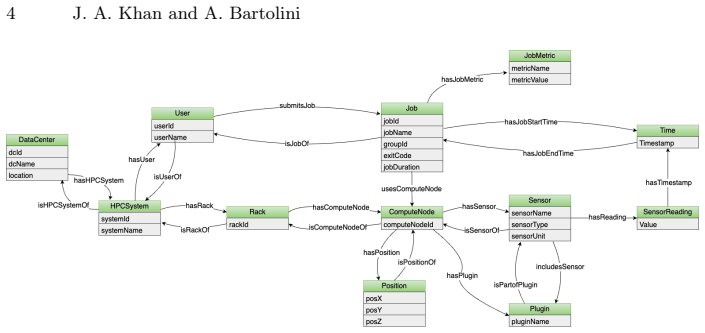
The load-bearing artifact is the ontology schema itself: 12 classes, 23 object properties, 25 data properties, 104 logical axioms, and 60 declarations. Its operative ideas are (1) DataCenter and HPCSystem as top-level separators that let one schema host multiple sites, (2) JobMetric as the bridge to job-centric datasets where telemetry is not produced by physical sensors, (3) a Time class that stores each Unix timestamp once and lets many readings point to it, and (4) moving sensorUnit up to the Sensor class so units are not repeated per reading. These changes encode each reading in fewer triples, and using blank nodes for SensorReading individuals removes long URI strings entirely.
What would settle it
Instantiate an F-DATA knowledge graph from the raw dataset using the proposed ontology and execute all 36 SPARQL queries, or at minimum the cross-system and job-metric ones; if any query cannot be encoded, returns an error, or produces results that do not match the raw data, the unification claim is refuted. The storage claims can be checked independently by rebuilding the one-day M100 'total_power' knowledge graph from February 1, 2022 and verifying 16,917,120 triples and sizes 657.36 MiB (URI version) and 481.00 MiB (blank-node version).
Extended reading notes
Core claim
The paper's central claim is that a single ontology, built by extending a prior M100-specific telemetry ontology, can represent both the sensor-centric M100 telemetry and the job-centric F-DATA telemetry in one knowledge graph. To do this it introduces top-level classes DataCenter and HPCSystem to tell sites apart, a User class for user-centric queries, and a JobMetric class so job-level performance counters that are not tied to any physical sensor can be recorded directly. It also claims that three schema changes—dropping the redundant DataRecord class, moving the unit of measurement from each reading to its Sensor, and centralizing timestamps in a reused Time class with Unix encoding—cut the number of RDF triples per sensor reading enough to reduce knowledge-graph storage by 38.84% against the previous ontology, with a further 26.82% reduction when sensor readings are modeled as blank nodes. The adequacy of the model is argued by mapping 36 competency questions to classes and properties, with a single SPARQL query given as an illustration.
Load-bearing premise
The unification claim depends on the assumption that F-DATA's job-centric telemetry can be faithfully represented and queried using the new JobMetric and Time classes, yet the paper never actually builds an F-DATA knowledge graph or runs the 36 queries against one.
Editorial extensions
If this is right
- A data center that adopts the unified ontology can issue one SPARQL query pattern across telemetry from different HPC systems instead of writing per-site queries.
- Knowledge-graph storage for a month of one metric drops from roughly 29.39 GiB with the previous ontology to 17.97 GiB, or 13.15 GiB with blank nodes.
- Storage size scales linearly with sampling frequency and duration, so operators can project disk needs from a per-day per-metric rate.
- The 36 competency questions provide a reusable requirement checklist covering topology, monitoring, job metrics, users, scheduling, and cross-system comparison.
- Keeping units on sensors rather than on every reading makes the graph more compact and also removes a source of inconsistent unit annotations.
Reading between the lines
- Editorial extension: a direct, decisive test of the unification claim is to build an end-to-end F-DATA knowledge graph and run all 36 competency queries; the paper's class mapping is a schema-level proof, not an execution proof.
- Editorial extension: the storage reductions are demonstrated on a single metric for one day; the paper argues linear scaling, so reproducing the measurement on additional sensors, sampling rates, and datasets would reveal whether the 38.84% and 26.82% figures generalize.
- Editorial extension: blank-node savings imply a deployment trade-off—anonymous reading nodes are not dereferenceable externally—so cross-center federation over URIs may require skolemizing blank nodes, partially offsetting the gain.
- Editorial extension: the cited 92%-versus-25% accuracy advantage for LLM-generated SPARQL over NoSQL queries suggests the practical value of the ontology will be measured mainly by query authoring and execution performance, neither of which this paper evaluates.
Editorial analysis
A structured set of objections, weighed in public.
Referee Report
Summary. The paper presents the Unified ODA Ontology, an RDF/OWL ontology intended to model operational telemetry from the M100 (Marconi100) and F-DATA (Fugaku) HPC datasets within a single schema. The ontology extends the authors' earlier ExaQuery ontology with new classes DataCenter, HPCSystem, User, JobMetric, and Time, and introduces storage optimizations: removing the DataRecord class, moving sensor unit information to the Sensor class, and centralizing timestamps in a reusable Time class. Validation is claimed through 36 self-authored competency questions, and storage is benchmarked on one day of M100 'total_power' data, reporting a 38.84% reduction in storage size and an additional 26.82% reduction when sensor readings are blank nodes. The paper argues this is the first unified ODA ontology for HPC systems.
Significance. If the cross-system unification were convincingly demonstrated, this would be a useful contribution to semantic ODA: a single SPARQL model over heterogeneous telemetry with measurable storage savings. The storage arithmetic in Table 5 is verifiable and correct, and the proposed optimizations are concrete and well motivated. The ontology artifacts are made available in a public repository, which is good for reproducibility. However, the central unification claim currently rests on a class-to-question mapping exercise rather than any instantiated F-DATA knowledge graph or executed competency query. The empirical support is therefore partial, and the paper's strongest verified result is the storage-size reduction for M100 data.
major comments (2)
- [Section 4.2, Listing 1.1] The only concrete SPARQL example in the paper is not executable as written: subtracting two xsd:dateTime values yields a duration, and multiplying that duration by 86400 is not a defined operation in standard SPARQL 1.1. More importantly, none of the 36 competency queries is actually executed against an instantiated graph; Section 4.2 validates the ontology by manually mapping classes and properties to the questions, which is circular because the questions were authored by the same team. The paper should construct a knowledge graph from the F-DATA dataset and execute the competency-query suite, or the central claim of unifying M100 and F-DATA is not supported by the evidence presented.
- [Section 3.1, Tables 1-3] The paper describes F-DATA as job-centric with time-series telemetry recorded per job, but the JobMetric class carries only metricName and metricValue data properties, and the only temporal property hasTimestamp has domain SensorReading. No object property links JobMetric to Time. Consequently, per-job time-indexed metrics cannot be faithfully represented or queried, which blocks the competency questions requiring temporal aggregation over job metrics (e.g., C2.3 and C6.5). Either the ontology needs an explicit temporal link for JobMetric, or the paper must clarify that JobMetric stores only scalar aggregates; as written, the model is inconsistent with the characterization of F-DATA.
minor comments (5)
- [Section 5] The statement that the 'total_power' metric 'requires approximately 2.8 MiB per day' conflicts with Table 5, where the same day's data requires 1074.89 MiB under the previous ontology and 657.36 MiB under the proposed one. The 2.8 MiB figure appears to refer to NoSQL storage, not RDF; the subsequent GiB projections are based on the RDF sizes, so the text conflates two different storage figures and should be reworded for clarity.
- [Listing 1.1] The PREFIX declaration for xsd contains a space before the closing URI: <http://www.w3.org/2001/XMLSchema #>, which makes the prefix invalid in standard SPARQL syntax.
- [Table 5] The node count stays essentially unchanged (4,234,662 vs. 4,234,658) even though the triple count drops by roughly 8.5 million; the authors should briefly explain why the number of RDF nodes is nearly identical when DataRecord nodes are removed, as this is counterintuitive without further context.
- [Section 4.1] The namespace URI http://ontology.hpc.org/ is acknowledged as a placeholder and is not resolvable; while the authors note this limitation, the lack of a persistent IRI is a practical obstacle to reuse of the ontology by third parties.
- [Section 4.2] The paper states that the complete set of SPARQL queries for all competency questions is available in the Git repository, but it neither includes the queries nor reports their execution results; adding a supplementary file with the queries and their output for a sample KG would strengthen reproducibility.
Circularity Check
Ontology validation reduces to the same competency questions used as design inputs; F-DATA unification is therefore self-definitional, while the storage benchmark remains independent.
-
self definitional
[Section 4.1 'Experimental setting' and Section 4.2 'Validation of the proposed Unified ODA Ontology'; also Section 3.1 'Ontology design process']
"The ontology was designed to address a defined set of competency questions, which are subsequently used to evaluate its adequacy."
Section 3.1 states the ontology was extended specifically to answer the CQs: 'To support cross-system competency questions, we introduced two new top-level classes,' 'we identified the need to explicitly represent users... we introduced the User class,' and 'we introduced a dedicated JobMetric class' for F-DATA's job-centric metrics. Section 4.1 then says those same CQs are 'subsequently used to evaluate its adequacy,' and Section 4.2 validates the ontology by 'mapping its relevant classes and object properties to the competency questions.' Hence every CQ maps to a class/property inserted because of that CQ; the test is guaranteed to pass by construction.
full rationale
The paper's storage-efficiency claim is self-contained and not circular: it compares measured triple counts and MiB for one day of M100 'total_power' telemetry under the prior ODA ontology and the proposed ontology, with and without blank nodes. Those are empirical measurements against a real dataset and a stated baseline, with no fitted parameters. However, the paper's central unification and validation claim is circular in a narrower sense. The 36 competency questions are explicitly the design drivers for the new classes (DataCenter, HPCSystem, User, JobMetric), and the same questions are then used as the evaluation instrument. Section 4.2 validates by mapping classes and properties to the questions, so the mapping is guaranteed by the design process. Since no F-DATA knowledge graph is instantiated and none of the 36 SPARQL queries is executed in the paper, the F-DATA side of the unification claim is supported only by this self-definitional mapping. No other circularity patterns apply: there are no fitted inputs called predictions, no imported uniqueness theorems, and no ansatz smuggled via self-citation. The self-citation to [8] is a legitimate baseline for the measured storage comparison.
Assumptions & free parameters
assumptions (3)
- domain assumption The 36 self-authored competency questions are a valid measure of ontology adequacy for ODA stakeholders.
- domain assumption F-DATA job-centric metrics can be represented by the JobMetric and Time classes.
- domain assumption Storage scales linearly with sampling duration and number of metrics.
invented entities (1)
-
Unified ODA Ontology class hierarchy (DataCenter, HPCSystem, User, JobMetric, Time)
Cite this review
Pith. "Pith review of A Unified Ontology for Scalable Knowledge Graph-Driven Operational Data Analytics in High-Performance Computing Systems." pith.science (2026). https://pith.science/paper/4EFL2A35
@misc{pith2026250706107,
  author       = {Pith},
  title        = {Pith review of: A Unified Ontology for Scalable Knowledge Graph-Driven Operational Data Analytics in High-Performance Computing Systems},
  year         = {2026},
  howpublished = {\url{https://pith.science/paper/4EFL2A35}},
  note         = {Machine review of arXiv:2507.06107}
}
read the original abstract
Modern high-performance computing (HPC) systems generate massive volumes of heterogeneous telemetry data from millions of sensors monitoring compute, memory, power, cooling, and storage subsystems. As HPC infrastructures scale to support increasingly complex workloads-including generative AI-the need for efficient, reliable, and interoperable telemetry analysis becomes critical. Operational Data Analytics (ODA) has emerged to address these demands; however, the reliance on schema-less storage solutions limits data accessibility and semantic integration. Ontologies and knowledge graphs (KG) provide an effective way to enable efficient and expressive data querying by capturing domain semantics, but they face challenges such as significant storage overhead and the limited applicability of existing ontologies, which are often tailored to specific HPC systems only. In this paper, we present the first unified ontology for ODA in HPC systems, designed to enable semantic interoperability across heterogeneous data centers. Our ontology models telemetry data from the two largest publicly available ODA datasets-M100 (Cineca, Italy) and F-DATA (Fugaku, Japan)-within a single data model. The ontology is validated through 36 competency questions reflecting real-world stakeholder requirements, and we introduce modeling optimizations that reduce knowledge graph (KG) storage overhead by up to 38.84% compared to a previous approach, with an additional 26.82% reduction depending on the desired deployment configuration. This work paves the way for scalable ODA KGs and supports not only analysis within individual systems, but also cross-system analysis across heterogeneous HPC systems.
Figures
Reference graph
Works this paper leans on
-
[1]
https://doi.org/10.5281/zenodo.11467483, https://doi.org/10
Antici, F., Bartolini, A., Domke, J., Kiziltan, Z., Yamamoto, K.: F-DATA: A Fugaku Workload Dataset for Job-centric Predictive Modelling in HPC Systems (1.0)(2024). https://doi.org/10.5281/zenodo.11467483, https://doi.org/10. 5281/zenodo.11467483, data set
-
[2]
Scientific Data 10, 288 (2023)
Borghesi, A., Di Santi, C., Molan, M., et al.: M100 exadata: a data collection campaign on the cineca’s marconi100 tier-0 supercomputer. Scientific Data 10, 288 (2023). https://doi.org/10.1038/s41597-023-02174-3, https://doi.org/ 10.1038/s41597-023-02174-3
-
[3]
Brewer, W., Maiterth, M., Kumar, V., Wojda, R., Bouknight, S., Hines, J., Shin, W., Greenwood, S., Grant, D., Williams, W., Wang, F.: A digital twin frame- work for liquid-cooled supercomputers as demonstrated at exascale. In: Proceed- ings of the International Conference for High Performance Computing, Network- ing,Storage,andAnalysis.SC’24,IEEEPress(202...
arXiv 2024
-
[4]
Future Generation Computer Systems 88, 373–384 (2018)
Castañé, G.G., Xiong, H., Dong, D., Morrison, J.P.: An ontology for hetero- geneous resources management interoperability and hpc in the cloud. Future Generation Computer Systems 88, 373–384 (2018). https://doi.org/https: //doi.org/10.1016/j.future.2018.05.086, https://www.sciencedirect.com/ science/article/pii/S0167739X17330467
-
[5]
Corcho, O., Chaves-Fraga, D., Toledo, J., Arenas-Guerrero, J., Badenes-Olmedo, C., Wang, M., Peng, H., Burrett, N., Mora, J., Zhang, P.: A high-level ontology network for ict infrastructures. In: Hotho, A., Blomqvist, E., Dietze, S., Fokoue, A., Ding, Y., Barnaghi, P., Haller, A., Dragoni, M., Alani, H. (eds.) The Semantic Web – ISWC 2021. pp. 446–462. Sp...
work page 2021
-
[6]
Imam, F.T.: Application of ontologies in cloud computing: The state-of-the-art (2016), https://arxiv.org/abs/1610.02333
work page Pith review arXiv 2016
-
[7]
Khan, J.A., Cavagna, H.P., Proia, A., Bartolini, A.: Towards operational data analytics chatbots – virtual knowledge graph is all you need (2025), https:// arxiv.org/abs/2506.22267
work page Pith review arXiv 2025
-
[9]
Khan, J.A., Molan, M., Bartolini, A.: EXASAGE: The First Data Center Oper- ational Data Co-pilot. TechRxiv (February 2025). https://doi.org/10.36227/ techrxiv.173202812.28217996/v2
Show all 13 references
-
[10]
Future Generation Computer Systems 160, 644–653 (2024)
Molan, M., Ardebili, M.S., Khan, J.A., Beneventi, F., Cesarini, D., Borgh- esi, A., Bartolini, A.: Graafe: Graph anomaly anticipation framework for exas- cale hpc systems. Future Generation Computer Systems 160, 644–653 (2024). https://doi.org/https://doi.org/10.1016/j.future....
2024 doi
-
[11]
In: 2021 IEEE International Conference on Cluster Computing (CLUSTER)
Netti, A., Shin, W., Ott, M., Wilde, T., Bates, N.: A conceptual framework for hpc operational data analytics. In: 2021 IEEE International Conference on Cluster Computing (CLUSTER). pp. 596–603 (2021).https://doi.org/10.1109/ Cluster48925.2021.00086
2021
-
[12]
In: 2020 IEEE International Conference on Cluster Computing (2020)
Ott, M., Shin, W., et al.: Global experiences with hpc operational data measure- ment, collection and analysis. In: 2020 IEEE International Conference on Cluster Computing (2020)
2020
-
[13]
In: Companion of the 15th ACM/SPEC Interna- tional Conference on Performance Engineering
Suman, S., Chu, X., Niewenhuis, D., Talluri, S., De Matteis, T., Iosup, A.: En- abling operational data analytics for datacenters through ontologies, monitoring, and simulation-based prediction. In: Companion of the 15th ACM/SPEC Interna- tional Conference on Performance Engin...
2024
-
[14]
In: The Semantic Web: 21st International Conference, ESWC 2024, Hersonissos, Crete, Greece, May 26–30, 2024, Proceedings, Part II
Tailhardat, L., Chabot, Y., Troncy, R.: Noria-o: An ontology for anomaly detection and incident management in ict systems. In: The Semantic Web: 21st International Conference, ESWC 2024, Hersonissos, Crete, Greece, May 26–30, 2024, Proceedings, Part II. p. 21–39. Springer-Verl...
2024 doi
Reviewed August 6, 2026 · model on record in the stance chip above.
Discussion (0). Sign in to comment.