Strange metal and Fermi arcs from disordering spin stripes
Pith reviewed 2026-05-19 05:41 UTC · model grok-4.3
The pith
Potential disorder in fluctuating spin stripe models produces a strange metal quantum critical point and Fermi arcs.
A machine-rendered reading of the paper's core claim, the machinery that carries it, and where it could break.
Core claim
Adding potential disorder to the effective theory for fluctuating spin stripes coupled to a Fermi surface gives rise to a phase diagram containing a quantum critical point described by the universal theory of strange metals with spatial disorder in both the magnitude and sign of the electron-boson coupling term. One difference from the original formulation is that at non-zero temperatures the disordered spin-stripe model automatically self-averages over the sign of the coupling. Monte Carlo simulations of a phenomenological model for the disordered spin density wave state find that a short anti-ferromagnetic correlation length of order 4-5 lattice constants already leads to pronounced Fermi
What carries the argument
The effective theory of fluctuating spin stripes coupled to a Fermi surface, with potential disorder acting as unconventional random-field disorder that couples to the magnitude and sign of the electron-boson interaction term.
If this is right
- The phase diagram includes a quantum critical point governed by the strange-metal fixed point with disordered couplings.
- The model self-averages over the sign of the electron-boson coupling at non-zero temperatures.
- Short anti-ferromagnetic correlation lengths of 4-5 lattice constants produce pronounced Fermi arcs in the electronic spectral weight.
Where Pith is reading between the lines
- This construction supplies a microscopic route from stripe fluctuations to the strange-metal phenomenology observed in cuprates.
- The same disorder mechanism may be testable in other quantum materials that host competing stripe and nematic orders.
Load-bearing premise
Potential disorder couples to the sign and magnitude of the electron-boson interaction in the spin-stripe model as an unconventional random-field disorder.
What would settle it
Observation in a material with spin stripe fluctuations of a quantum critical point where the sign of the electron-boson coupling self-averages at finite temperature, or direct measurement showing Fermi arcs emerging once anti-ferromagnetic correlations shorten to approximately 4-5 lattice constants.
Figures


read the original abstract
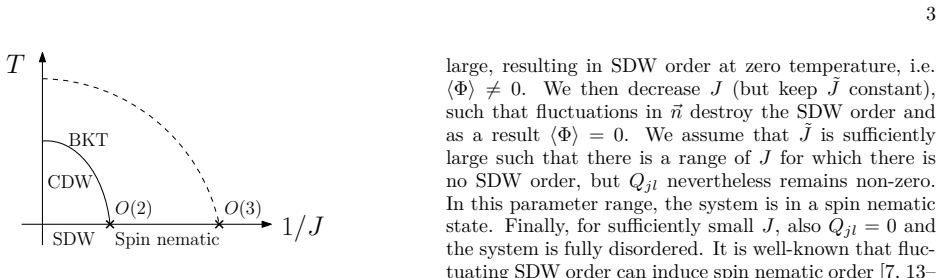
We revisit the effective theory for fluctuating spin stripes coupled to a Fermi surface, and consider the parameter regime where a spin nematic phase intervenes between the spin density wave state and the symmetric state. It is shown that adding potential disorder to this theory, which acts as an unconventional type of random-field disorder, naturally gives rise to a phase diagram containing a quantum critical point that is described by the universal theory of strange metals with spatial disorder in both the magnitude and sign of the electron-boson coupling term [A.A. Patel, H. Guo, I. Esterlis and S. Sachdev, Science 381, 790 (2023)]. One difference compared to the original theory, however, is that at non-zero temperatures the disordered spin-stripe model automatically self-averages over the sign of the coupling. We also study the effects of thermal fluctuations in a phenomenological model for the disordered spin density wave state, and find from Monte Carlo simulations that a short anti-ferromagnetic correlation length (order 4-5 lattice constants) already leads to pronounced Fermi arcs in the electronic spectral weight.
Editorial analysis
A structured set of objections, weighed in public.
Referee Report
Summary. The manuscript revisits the effective theory for fluctuating spin stripes coupled to a Fermi surface in the regime where a spin nematic phase intervenes between the spin density wave and symmetric states. It claims that adding potential disorder, acting as an unconventional random-field disorder, produces a phase diagram containing a quantum critical point described by the universal strange-metal theory of Patel et al. with spatial disorder in both the magnitude and sign of the electron-boson coupling. The paper further reports Monte Carlo simulations of a phenomenological model for the disordered spin density wave state, finding that antiferromagnetic correlation lengths of order 4-5 lattice constants already generate pronounced Fermi arcs in the electronic spectral weight. At finite temperature the model is said to self-average over the sign of the coupling.
Significance. If the central mapping is rigorously established, the work supplies a microscopic route from stripe fluctuations plus conventional potential disorder to the spatially disordered strange-metal fixed point, offering a possible origin for strange-metal behavior in cuprates and related materials. The numerical evidence that short correlation lengths suffice for Fermi arcs strengthens the link between disordered spin-density-wave states and pseudogap phenomenology. The automatic self-averaging over coupling sign at nonzero temperature is a potentially useful distinction from the original Patel et al. construction.
major comments (2)
- [Abstract, paragraph beginning 'It is shown that adding potential disorder'] Abstract, paragraph beginning 'It is shown that adding potential disorder': The central claim requires that conventional potential disorder, when added to the effective theory of fluctuating spin stripes, generates an unconventional random-field disorder that independently randomizes both the magnitude and the sign of the electron-boson coupling, thereby reaching the Patel et al. fixed point. The manuscript states that this mapping 'is shown' but does not display the explicit rewriting of the action or the disorder-averaging procedure that demonstrates emergence of the sign disorder; without this derivation the connection remains an assumption rather than a derived result and is load-bearing for the strongest claim.
- [Monte Carlo simulations of phenomenological model] Monte Carlo section (phenomenological model for disordered SDW): The report that a correlation length of order 4-5 lattice constants produces pronounced Fermi arcs is numerically interesting, yet the manuscript provides no details on the precise form of the phenomenological Hamiltonian, lattice sizes, number of disorder realizations, error analysis, or the method used to extract the spectral weight. These omissions prevent assessment of whether the Fermi-arc feature is robust or sensitive to parameter choices.
minor comments (2)
- [Abstract] The abstract would be clearer if it indicated the section or equation where the effective-action rewriting for the disorder mapping is presented.
- Notation for the electron-boson coupling and the random-field disorder should be introduced with explicit definitions when first used, to avoid ambiguity with the Patel et al. conventions.
Simulated Author's Rebuttal
We thank the referee for the careful reading and constructive feedback. The comments correctly identify places where the presentation of the central mapping and the numerical details can be strengthened. We address each major comment below and will incorporate the suggested clarifications in the revised manuscript.
read point-by-point responses
-
Referee: Abstract, paragraph beginning 'It is shown that adding potential disorder': The central claim requires that conventional potential disorder, when added to the effective theory of fluctuating spin stripes, generates an unconventional random-field disorder that independently randomizes both the magnitude and the sign of the electron-boson coupling, thereby reaching the Patel et al. fixed point. The manuscript states that this mapping 'is shown' but does not display the explicit rewriting of the action or the disorder-averaging procedure that demonstrates emergence of the sign disorder; without this derivation the connection remains an assumption rather than a derived result and is load-bearing for the strongest claim.
Authors: We agree that an explicit step-by-step derivation of how conventional potential disorder maps onto random-field disorder with independent randomization of both magnitude and sign is essential to substantiate the central claim. While the effective theory and the disorder term are introduced in the main text, the rewriting of the action and the explicit disorder-averaging procedure that produces the sign disorder were not displayed with sufficient detail. In the revised manuscript we will add a dedicated subsection (or short appendix) that starts from the clean effective action, inserts the potential-disorder term, performs the disorder average, and shows how the resulting random couplings acquire both magnitude and sign disorder, thereby reaching the Patel et al. fixed point. revision: yes
-
Referee: [Monte Carlo simulations of phenomenological model] Monte Carlo section (phenomenological model for disordered SDW): The report that a correlation length of order 4-5 lattice constants produces pronounced Fermi arcs is numerically interesting, yet the manuscript provides no details on the precise form of the phenomenological Hamiltonian, lattice sizes, number of disorder realizations, error analysis, or the method used to extract the spectral weight. These omissions prevent assessment of whether the Fermi-arc feature is robust or sensitive to parameter choices.
Authors: We thank the referee for highlighting these omissions. The phenomenological Hamiltonian is defined in Section III, but the implementation details were not reported. In the revised version we will specify the exact form of the Hamiltonian (including the coupling constants and the disorder distribution), the lattice sizes employed (typically 24×24 and 32×32 with periodic boundaries), the number of independent disorder realizations (100–200), the error estimation procedure (bootstrap resampling of the disorder ensemble), and the method used to obtain the spectral weight (maximum-entropy analytic continuation of the imaginary-time Green’s function). These additions will allow readers to assess the robustness of the Fermi-arc feature. revision: yes
Circularity Check
No significant circularity; mapping to external strange-metal theory is independent
full rationale
The paper revisits the effective theory for fluctuating spin stripes, adds potential disorder, and identifies the resulting QCP with the universality class of the strange-metal theory from Patel et al. (Science 2023). This identification uses an external reference with no author overlap. The paper's contribution is the specific mapping from the disordered stripe model rather than a re-derivation of the fixed point itself. No load-bearing step reduces by construction to the paper's inputs, via self-citation, or by renaming a fitted result. The derivation chain is self-contained against the cited external benchmark.
Axiom & Free-Parameter Ledger
axioms (2)
- domain assumption The effective theory for fluctuating spin stripes coupled to a Fermi surface remains valid in the regime where a spin nematic phase intervenes between the spin density wave and symmetric states.
- domain assumption Potential disorder acts as an unconventional random-field disorder that couples to both magnitude and sign of the electron-boson interaction.
Forward citations
Cited by 1 Pith paper
-
SU(2) gauge theory of fluctuating stripe order in the two-dimensional Hubbard model
SU(2) gauge theory via chargon-spinon fractionalization yields charge-ordered pseudogap with reconstructed Fermi surface and spin gap in 2D Hubbard model.
Reference graph
Works this paper leans on
-
[1]
Adding potential disorder to a model of fluctuat- ing spin stripes naturally produces the theory of strange metals put forward in Refs. [8–11]
-
[2]
A simple (and numerically solvable) model for ther- mal fluctuations in a SDW glass produces clear Fermi arcs in the zero-frequency spectral weight al- ready with short-range AFM correlations. The bearing that these observations have on the actual physics of the cuprate superconductors is at present un- clear and requires further study. Nevertheless, we b...
work page 2020
-
[3]
E. Fradkin, S. A. Kivelson, and J. M. Tranquada, Rev. Mod. Phys. 87, 457 (2015), URL https://link.aps. org/doi/10.1103/RevModPhys.87.457
-
[4]
J. Zaanen and O. Gunnarsson, Phys. Rev. B 40, 7391 (1989), URL https://link.aps.org/doi/10. 1103/PhysRevB.40.7391
work page 1989
-
[5]
K. Machida, Physica C: Superconductivity 158, 192 (1989), ISSN 0921-4534, URL https: //www.sciencedirect.com/science/article/pii/ 092145348990316X
work page 1989
-
[6]
M. Kato, K. Machida, H. Nakanishi, and M. Fujita, Jour- nal of the Physical Society of Japan59, 1047 (1990), URL https://doi.org/10.1143/JPSJ.59.1047
- [8]
- [9]
-
[10]
E. E. Aldape, T. Cookmeyer, A. A. Patel, and E. Altman, Phys. Rev. B 105, 235111 (2022), URL https://link. aps.org/doi/10.1103/PhysRevB.105.235111
-
[11]
I. Esterlis, H. Guo, A. A. Patel, and S. Sachdev, Phys. Rev. B 103, 235129 (2021), URL https://link.aps. org/doi/10.1103/PhysRevB.103.235129
-
[12]
H. Guo, A. A. Patel, I. Esterlis, and S. Sachdev, Phys. Rev. B 106, 115151 (2022), URL https://link.aps. org/doi/10.1103/PhysRevB.106.115151
-
[13]
A. A. Patel, H. Guo, I. Esterlis, and S. Sachdev, Science 381, 790 (2023), URL https://www.science.org/doi/ abs/10.1126/science.abq6011
-
[14]
D. F. Mross and T. Senthil, Phys. Rev. X 5, 031008 (2015), URL https://link.aps.org/doi/10. 1103/PhysRevX.5.031008
work page 2015
-
[15]
S. Sachdev and T. Morinari, Phys. Rev. B 66, 235117 (2002), URL https://link.aps.org/doi/10. 1103/PhysRevB.66.235117
work page 2002
-
[16]
Z. Nussinov and J. Zaanen, J. Phys. IV France 12, 245 (2002), URL https://doi.org/10.1051/jp4:20020405
-
[17]
Y. Zhang, E. Demler, and S. Sachdev, Phys. Rev. B 66, 094501 (2002), URL https://link.aps.org/doi/ 10.1103/PhysRevB.66.094501
-
[18]
D. F. Mross and T. Senthil, Phys. Rev. Lett. 108, 267001 (2012), URL https://link.aps.org/doi/10. 1103/PhysRevLett.108.267001
work page 2012
-
[19]
D. F. Mross and T. Senthil, Phys. Rev. B 86, 115138 (2012), URL https://link.aps.org/doi/10. 1103/PhysRevB.86.115138
work page 2012
-
[20]
F. Kr¨ uger and S. Scheidl, Phys. Rev. Lett. 89, 9 095701 (2002), URL https://link.aps.org/doi/10. 1103/PhysRevLett.89.095701
work page 2002
-
[21]
D. F. Agterberg and H. Tsunetsugu, Nature Physics 4, 639 (2008), ISSN 1745-2481, URL https://doi.org/10. 1038/nphys999
work page 2008
-
[22]
E. Berg, E. Fradkin, and S. A. Kivelson, Nature Physics 5, 830 (2009), ISSN 1745-2481, URL https://doi.org/ 10.1038/nphys1389
-
[23]
L. Radzihovsky and A. Vishwanath, Phys. Rev. Lett. 103, 010404 (2009), URL https://link.aps.org/doi/ 10.1103/PhysRevLett.103.010404
-
[24]
T. Giamarchi and P. Le Doussal, Phys. Rev. Lett. 72, 1530 (1994), URL https://link.aps.org/doi/10. 1103/PhysRevLett.72.1530
work page 1994
-
[25]
T. Giamarchi and P. Le Doussal, Phys. Rev. B 52, 1242 (1995), URL https://link.aps.org/doi/10. 1103/PhysRevB.52.1242
work page 1995
-
[26]
P. Le Doussal and T. Giamarchi, Physica C: Superconductivity 331, 233 (2000), ISSN 0921- 4534, URL https://www.sciencedirect.com/science/ article/pii/S0921453400000058
work page 2000
-
[27]
M. J. P. Gingras and D. A. Huse, Phys. Rev. B 53, 15193 (1996), URL https://link.aps.org/doi/10. 1103/PhysRevB.53.15193
work page 1996
-
[28]
A. I. Larkin, Sov. Phys. JETP 31, 784 (1970)
work page 1970
-
[29]
J. A. Hertz, Phys. Rev. B 14, 1165 (1976), URL https: //link.aps.org/doi/10.1103/PhysRevB.14.1165
-
[30]
Moriya, Spin Fluctuations in Itinerant Electron Mag- netism (Springer Berlin Heidelberg, 2012)
T. Moriya, Spin Fluctuations in Itinerant Electron Mag- netism (Springer Berlin Heidelberg, 2012)
work page 2012
-
[31]
A. J. Millis, Phys. Rev. B 48, 7183 (1993), URL https: //link.aps.org/doi/10.1103/PhysRevB.48.7183
-
[32]
Sachdev, Quantum Phase Transitions (Cambridge University Press, 2011), ISBN 9781139500210
S. Sachdev, Quantum Phase Transitions (Cambridge University Press, 2011), ISBN 9781139500210
work page 2011
-
[33]
C. M. Varma, P. B. Littlewood, S. Schmitt-Rink, E. Abrahams, and A. E. Ruckenstein, Phys. Rev. Lett. 63, 1996 (1989), URL https://link.aps.org/doi/10. 1103/PhysRevLett.63.1996
work page 1996
-
[34]
A. Ruckenstein and C. Varma, Physica C: Su- perconductivity 185-189, 134 (1991), ISSN 0921- 4534, URL https://www.sciencedirect.com/science/ article/pii/0921453491919624
-
[35]
P. w. Anderson, B. I. Halperin, and c. M. Varma and, The Philosophical Magazine: A Journal of Theoretical Experimental and Applied Physics 25, 1 (1972)
work page 1972
-
[36]
W. A. Phillips, Journal of Low Temperature Physics 7, 351 (1972), ISSN 1573-7357
work page 1972
-
[37]
E. Tulipman, N. Bashan, J. Schmalian, and E. Berg, Phys. Rev. B 110, 155118 (2024), URL https://link. aps.org/doi/10.1103/PhysRevB.110.155118
-
[38]
A. A. Patel, P. Lunts, and S. Sachdev, Proceedings of the National Academy of Sciences 121, e2402052121 (2024)
work page 2024
- [39]
-
[40]
R. K. Kaul, Phys. Rev. Lett. 115, 157202 (2015), URL https://link.aps.org/doi/10.1103/PhysRevLett. 115.157202
-
[41]
S. Pujari, T. C. Lang, G. Murthy, and R. K. Kaul, Phys. Rev. Lett. 117, 086404 (2016), URL https://link.aps. org/doi/10.1103/PhysRevLett.117.086404
-
[42]
X. Zhang and N. Bultinck (2025), arXiv: 2503.07747, URL https://arxiv.org/abs/2503.07747
-
[43]
C. Bauer, Y. Schattner, S. Trebst, and E. Berg, Phys. Rev. Res. 2, 023008 (2020), URL https://link.aps. org/doi/10.1103/PhysRevResearch.2.023008
-
[44]
P. M. Chaikin and T. C. Lubensky, Principles of Con- densed Matter Physics (Cambridge University Press, 1995)
work page 1995
-
[45]
N. Trivedi and M. Randeria, Phys. Rev. Lett. 75, 312 (1995), URL https://link.aps.org/doi/10.1103/ PhysRevLett.75.312
work page 1995
-
[46]
Y. Schattner, S. Lederer, S. A. Kivelson, and E. Berg, Phys. Rev. X6, 031028 (2016), URL https://link.aps. org/doi/10.1103/PhysRevX.6.031028
-
[47]
X. Y. Xu, K. Sun, Y. Schattner, E. Berg, and Z. Y. Meng, Phys. Rev. X7, 031058 (2017), URL https://link.aps. org/doi/10.1103/PhysRevX.7.031058
-
[48]
Z. H. Liu, X. Y. Xu, Y. Qi, K. Sun, and Z. Y. Meng, Phys. Rev. B 98, 045116 (2018), URL https://link. aps.org/doi/10.1103/PhysRevB.98.045116
-
[49]
Z. H. Liu, G. Pan, X. Y. Xu, K. Sun, and Z. Y. Meng, Proceedings of the National Academy of Sciences 116, 16760 (2019), URL https://www.pnas.org/doi/ abs/10.1073/pnas.1901751116. 10 Appendix A: The O(3)×O(2) Z2 boson model In this appendix, we present a more general effective model for fluctuating spin stripes, and numerically determine the phase diagram....
-
[50]
Introduction of the model In the appendix we work with the three-component complex field ϕ, which is related to the 2 ×3 real matrix field Φ of the main text as ϕη= Φ 1,η+iΦ 2,η. The purely bosonic part of the action is given by SB = ∫ dτ[1 2 ∑ r;η J|1 c∂τϕη(r,τ)|2 +J|∇rϕη(r,τ)|2−m|ϕη(r,τ)|2 +λ ∑ r ( ∑ η |ϕη(r,τ)|2)2−v ∑ r | ∑ η (ϕη(r,τ))2|2 −Jv ∑ r ∑ dr=...
-
[51]
Wolff cluster update For the QMC simulations we use Wolff cluster updates to reduce autocorrelation time and increase the sampling efficiency. However, the Wolff updates should be combined with local updates, since the former cannot update the longitudinal mode|ϕ|. We divide the Wolff update in O(3) and O(2) parts, and discuss them separately. The O(3) Wo...
-
[52]
We obtained the phase diagram by calculating Binder ratios and correlation ratios (defined below)
Phase diagram We set ∆ τ= 0.1,m′= c = 1/∆τ,λ= 11,v = 1 and tune J to go from the symmetric phase to the CDW phase (Jv > 0,Ju = 0) or to the spin nematic phase (Ju > 0,Jv = 0). We obtained the phase diagram by calculating Binder ratios and correlation ratios (defined below). The three relevant order parameters aremstripe∼ϕη,mO(2)∼ ∑ η(ϕη)2 | ∑ η(ϕη)2| and ...
-
[53]
Introduction of the O(3)×O(2) Z2 boson-fermion model We now couple the boson model of the previous appendix with fermions by adding following term to the action: SF = ∫ dτ[ ∑ r,r′;s,l=± ¯ψs,l(r,τ)(δr,r′∂τ−H(r, r′)−δr,r′µ)ψs,l(r′,τ) + g ∑ r,η,s,s′,l (−1)rx+ry+l ¯ψs,l(r,τ)ση s,s′ψs′,l(r,τ) cos(Qsrxθη)|ϕη(r,τ)|] = ∫ dτ[ ∑ r,r′;s,l=± ¯ψs,l(r,τ)(δr,r′∂τ−H(r, r...
-
[54]
Quantum Monte Carlo update For our simulations we combine the local update together with the Wolff cluster update described in the previous appendix to sample the system efficiently. For the local update of the bosonic field, the ratio is RB = e−S′ B(τ)∆τ+SB(τ)∆τe−J ∑ (ℜ[ϕ(τ+∆τ)+ϕ(τ−∆τ)]ℜ[ϕ′(τ)−ϕ(τ)]+ℑ[ϕ(τ+∆τ)+ϕ(τ−∆τ)]ℑ[ϕ′(τ)−ϕ(τ)])/c2∆τ (B5) And the cont...
-
[55]
Introduction of the simplified O(3) boson-fermion model When simulating the above model with small Qs (we have tried Qs = 1/8), we find that with sizable coupling strengths, the feedback from the fermions on the bosons cannot be neglected, and changes the phase diagram in important ways. In particular, we find that when g is order one, the bosons tend to ...
-
[56]
Fermi surface in the spin nematic phase Next we zoom in on the parameter region from [J,Ju] = [2.27, 8.54] to [J,Ju] = [2.9, 9.8]. In Fig. 6 we plot the AFM correlation length at finite temperature for L = 12. This correlation length was obtained via the relation ξAFM = L 2π √ 1 RC −1 [41, 42]. Finally, we have also calculated the imaginary-time fermion p...
discussion (0)
Sign in with ORCID, Apple, or X to comment. Anyone can read and Pith papers without signing in.