REVIEW 3 major objections 5 minor 107 references
High-Resolution Optical IFU Spectroscopy of the Complex Galaxy Merger II Zw 096
T0 review · 3 major / 5 minor · reviewed 2026-08-06 · deepseek-v4-flash
Pith's one-line read A buried black hole powers the compact D1 knot of II Zw 096
desk verdict Useful new IFU data on a complex merger; the obscured-AGN claim is plausible but not yet secure because the non-AGN model grid under-samples D1's regime and the conclusions misquote the X-ray hardness ratio. read the letter →
The pith
A machine-rendered reading of the paper's core claim, the machinery that carries it, and where it could break.
The reading
What carries the argument
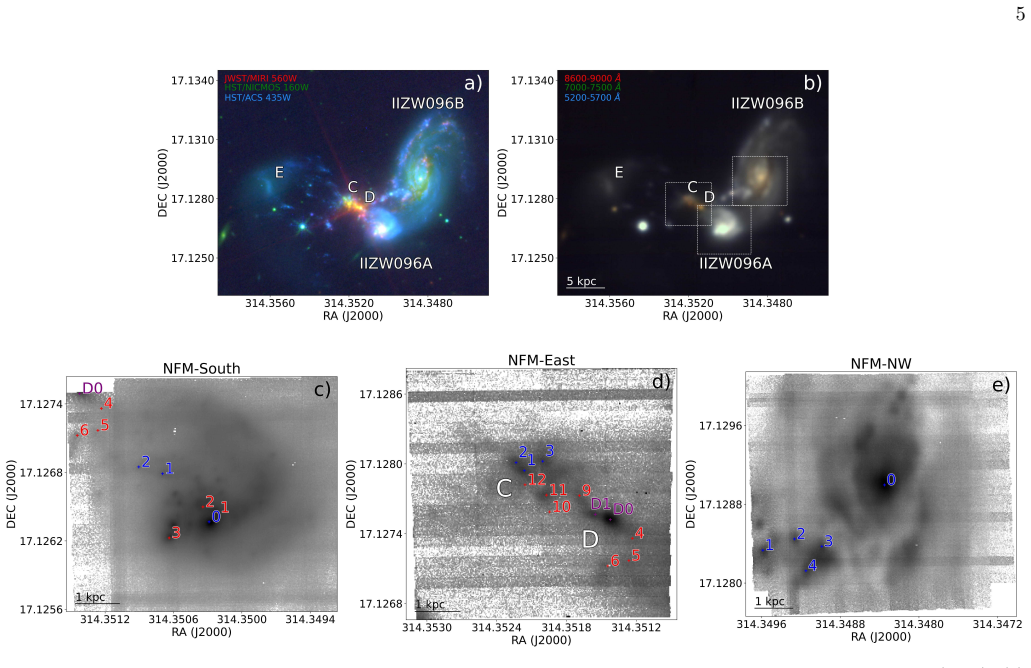
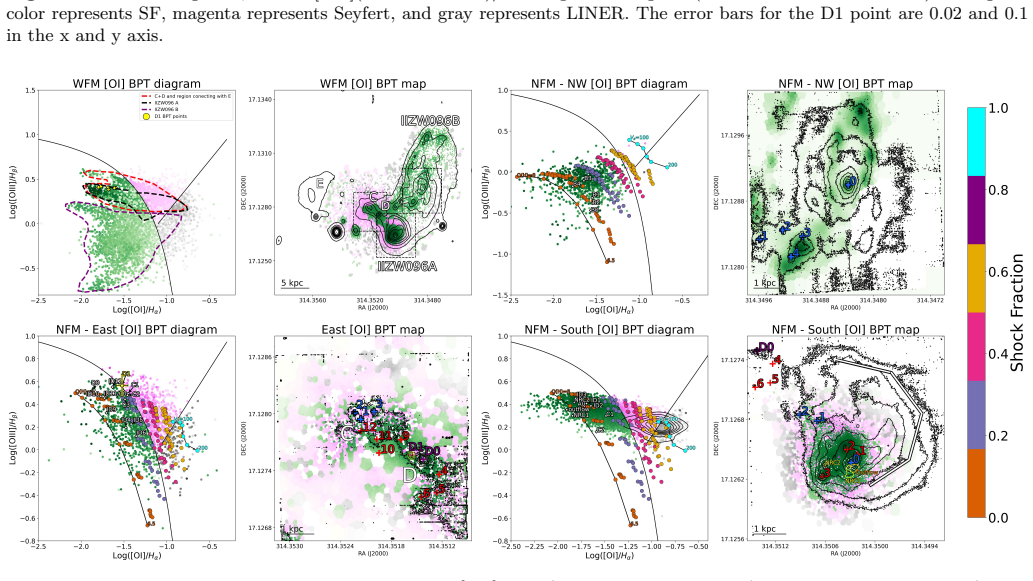
The key object is D1, a compact infrared-bright region with a measured size below 70 pc that dominates the system's luminosity. The argument is carried by the narrow-field adaptive-optics MUSE cubes that spatially isolate D1 from the nearby star-forming source D0, by the Baldwin–Phillips–Terlevich diagnostic diagrams built from those cubes, and by a parameter grid that combines a 5 Myr CLOUDY starburst with MAPPINGS III shock emission to test whether ordinary star formation plus shocks can explain the observed line ratios. A second piece of machinery is the ratio of the 2–10 keV X-ray flux to the 100 GHz ALMA continuum, which converts the lack of a detected AGN into an upper limit on its column density.
What would settle it
Run a non-AGN model grid with pre-shock densities extending to $4\times10^4$ cm$^{-3}$ and shock velocities beyond 150 km/s, and check whether any combination reproduces D1's observed [N II], [S II], and [O I] line ratios; if one does, the optical case for the AGN collapses. Alternatively, a Chandra exposure long enough to measure D1's hardness ratio with significance better than $0.1\pm0.3$, or a NuSTAR detection of hard X-rays, would decide the issue.
Extended reading notes
Core claim
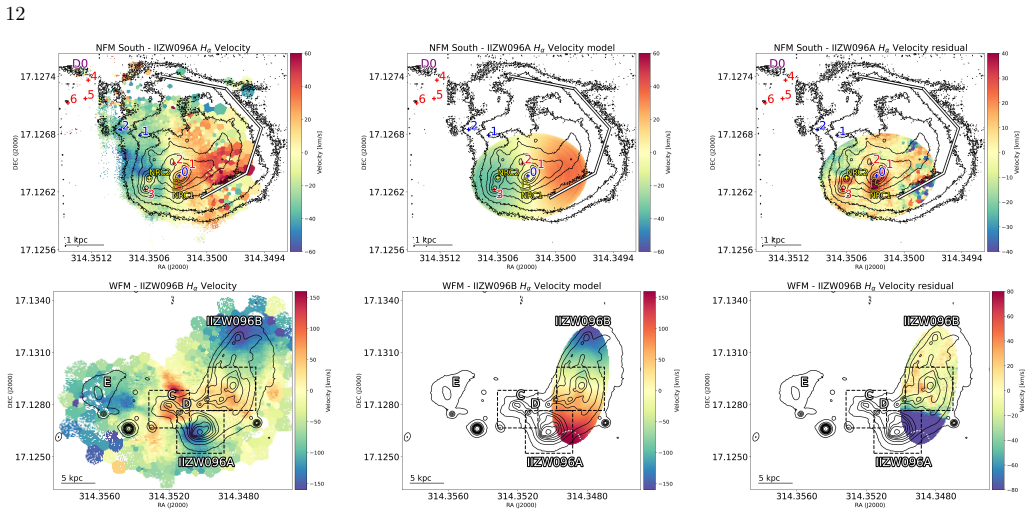
The central claim is that the D1 compact region of II Zw 096 is powered by an accreting supermassive black hole that is heavily obscured by dust, coexisting with a very compact starburst. This conclusion synthesizes several lines of evidence: adaptive-optics optical spectroscopy that resolves D1 from its bright neighbour D0 and places its [N II]/Hα versus [O III]/Hβ ratios in the Seyfert region; a combined CLOUDY starburst plus MAPPINGS III shock model grid that cannot reproduce the D1 line ratios without an additional ionizing source; a positive but statistically uncertain Chandra hardness ratio; an ALMA Band 3 to X-ray flux ratio that implies $\log N_{\rm H} > 24.5$ if the 100 GHz emission is AGN-dominated; and earlier infrared work suggesting a buried AGN. The paper also concludes that II Zw 096 is a merging system of at least three galaxies, with the western pair still showing rotation and the eastern C+D and E regions in a more advanced, highly disrupted stage.
Load-bearing premise
The load-bearing assumption is that the starburst-plus-shock model grid covers all plausible non-AGN ionization conditions in D1, especially because the grid caps pre-shock density at $1000$ cm$^{-3}$ while the paper cites an estimated density of $4\times10^4$ cm$^{-3}$ for D1; if a denser non-AGN model reproduces the line ratios, the optical evidence for the AGN weakens.
Editorial extensions
If this is right
- If the D1 AGN is real, an accreting supermassive black hole is growing inside a sub-70 pc starburst whose surface density is already at the maximum starburst limit, so radiation pressure must shape both the starburst and the nucleus.
- Because D1 emits 40–70% of the system's infrared light, any complete model of II Zw 096 must include both a buried AGN and a compact starburst, not star formation alone.
- The kinematics are consistent with a collapsing small galaxy group rather than a simple binary merger, so the same multi-component interpretation should be tested in other luminous infrared mergers.
- The potential outflow in II Zw 096A and the post-starburst tidal tail show that shock-driven ionization and feedback can appear before the galaxy nuclei coalesce.
Reading between the lines
- The paper does not test whether a non-AGN model grid with pre-shock densities near the $4\times10^4$ cm$^{-3}$ estimated by Wu et al. (2022) could reproduce the D1 line ratios; that test could either harden or weaken the AGN case.
- A longer Chandra or XMM-Newton exposure that measures the D1 hardness ratio with small errors would settle the AGN question independently of optical line modeling.
- If confirmed, D1 would be a local analogue of the compact obscured nuclei invoked at high redshift, implying that some of the most luminous infrared galaxies are powered by buried black holes even when low-resolution optical spectra look starburst-dominated.
Editorial analysis
A structured set of objections, weighed in public.
Referee Report
Summary. The paper presents VLT/MUSE Wide Field Mode and Narrow Field Mode observations of the merging LIRG II Zw 096, combining emission-line fitting, kinematic modeling, and archival multi-wavelength data. The authors identify at least three interacting structures (II Zw 096A, II Zw 096B, and the C+D/E complex), characterize their ionization through BPT diagrams and shock-model comparisons, and propose a two-stage merger scenario. The central claim is that the compact region D1, contributing 40-70% of the system's infrared luminosity, contains a heavily obscured AGN coexisting with a compact starburst. This claim rests on the optical line-ratio classification of D1, the failure of a CLOUDY + MAPPINGS III non-AGN model grid to reproduce the observed ratios, a positive but uncertain Chandra hardness ratio, and a model-dependent column-density upper limit from ALMA Band 3 data.
Significance. If the D1 AGN claim holds, the paper identifies a rare, heavily obscured accreting supermassive black hole embedded in a compact starburst, making II Zw 096 a valuable laboratory for studying AGN fueling and feedback in a complex, late-stage merger. The manuscript also provides a carefully reduced and analyzed high-resolution optical IFU dataset, with detailed multi-Gaussian emission-line fitting, pPXF continuum subtraction, Voronoi binning, and Bbarolo kinematic models. The authors are transparent about several limitations, such as the low significance of the D1 X-ray hardness ratio and the upper-limit nature of the column-density estimate, which strengthens the credibility of the observational analysis. However, the non-AGN model grid in Appendix C is not sufficiently broad to justify the strong conclusion that an additional ionizing source is required, and one of the three supporting lines of evidence is misquoted in the Conclusions.
major comments (3)
- [Appendix C, Section 6.2] The conclusion in Section 6.2 that 'an additional ionization source is required' rests on the CLOUDY + MAPPINGS III grid described in Appendix C, but that grid does not bracket the plausible non-AGN conditions for D1. The grid fixes the starburst age at 5 Myr, metallicity at 0.5–0.8 Zsun, shock velocity at 150 km/s, pre-shock density at 100–1000 cm^-3, and a 50% shock contribution to H-alpha, whereas Wu et al. (2022), cited in the Appendix, estimates a gas density of ~4×10^4 cm^-3 for D1, more than an order of magnitude above the grid maximum. The paper argues that n=1000 cm^-3 is the closest grid point, but in MAPPINGS III shock line ratios are governed largely by the magnetic parameter B/√n, so fixing B=10 μG while increasing n by more than an order of magnitude does not reproduce the high-density regime. In addition, a younger starburst (1–3 Myr) containing Wolf-Rayet stars produces a harder ionizing spectrum and can raise [O III]/H-beta into the Seyfert region without an AGN; the 5 Myr age itself rests on CO and Br-gamma equivalent-width estimates with systematic uncertainties. I therefore ask the authors either to expand the grid to cover the actual density, age, and velocity range of D1, or to rephrase the non-AGN exclusion as conditional on the assumed grid.
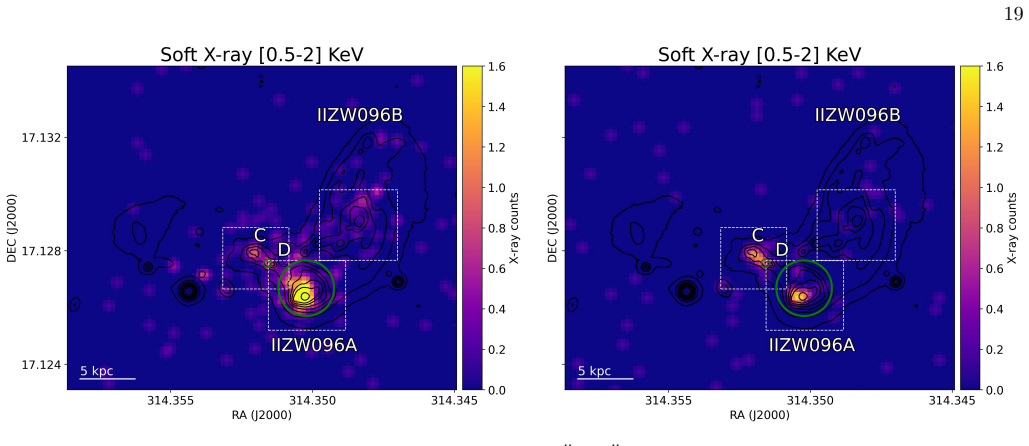
- [Section 7 (Conclusions) and Section 5.2] The Conclusions misquote the Chandra hardness ratio of D1. Section 5.2 reports D1's hardness ratio as HR = 0.1 ± 0.3, while the value '-0.56 ± 0.08' quoted in Section 7 as 'a positive value (-0.56 ± 0.08) consistent with a hard source' is in fact II ZW 096A's soft X-ray hardness ratio. This is internally inconsistent and inflates the X-ray support for the AGN claim. The D1 HR is positive but carries a large uncertainty and is statistically consistent with both hard and soft spectra; the concluding synthesis should be corrected and should state that the X-ray evidence is only weakly consistent with an obscured AGN.
- [Section 4.3, Figure 8, Section 6.2] The optical evidence for an AGN in D1 is marginal. In the [N II] diagram the D1 point is classified as Seyfert but, as the text states, lies near the classification boundary once the error bars (0.01 in log([O III]/H-beta) and 0.1 in log([N II]/H-alpha)) are considered; in the [S II] and [O I] diagrams the point is classified as star-forming, with Seyfert not ruled out only by the error bars. The claim in Section 6.2 that the [N II] diagram shows a 'characteristic hard photoionization source' therefore overstates the diagnostic power of the optical ratios alone. This is not a reason to reject the AGN hypothesis, but it means the central claim must be framed as relying on the conjunction of several individually inconclusive diagnostics, including the expanded non-AGN model grid requested above.
minor comments (5)
- [Section 2.2] The phrase 'South paintings' should read 'South pointings' in the sentence describing the astrometric calibration sources for the NFM cubes.
- [Section 4.3 and Figure 9 caption] The [S II] wavelength is written inconsistently: the text uses λ(6717 + 6731) in the bullet list, while the Figure 9 caption uses λ6716 + λ6731; please standardize to one notation.
- [Section 6.3] The values '∆MS = 9' and '∆MS = 13' are not defined; please specify that this is the offset from the main sequence in dex relative to the Elbaz et al. (2007) relation, or provide the equivalent unit or normalization.
- [Figure 7 caption] The caption contains a repeated 'Top-panels:' at the start of the second paragraph; please remove the duplicate.
- [Section 6.2] The ratio 'F2-10keV/F100GHz < 2.7' is given without units; please state the units or refer explicitly to the definition in Ricci et al. (2023), as the value is used to derive a column-density limit.
Circularity Check
No significant circularity: the D1 AGN inference combines independent MUSE, Chandra, and ALMA measurements with published external grids and calibrations.
full rationale
The paper's central claim, that D1 hosts a heavily obscured AGN combined with a compact starburst, rests on measured optical line ratios (MUSE NFM), the Chandra hardness ratio, the ALMA Band 3 flux, and independent infrared diagnostics from the literature. No model parameter is optimized to reproduce D1's line ratios and then renamed a prediction. Appendix C's CLOUDY + MAPPINGS III grid is computed from published codes with priors taken from Inami et al. (2010), Wu et al. (2022), Pereira-Santaella et al. (2024), and Rich et al. (2015); the grid's failure to reproduce D1 is a model-exclusion argument, not an identity. The column-density estimate uses the Ricci et al. (2023) F2-10keV/F100GHz relation as an external empirical calibration, applied conditionally ('If we assume that all the 100 GHz emission comes from the AGN'), so it is not a fitted-input-called-prediction even though C. Ricci is a co-author. The self-citations in the paper (Ricci et al. 2021, 2023; Barcos-Munoz et al. 2017) are archival measurements or external calibrations rather than uniqueness theorems or smuggled ansatze, and they do not carry the load of the derivation by themselves. Two concerns are flagged as non-circular: first, the Conclusions quote D1's hardness ratio as '-0.56 ± 0.08' whereas Section 5.2 reports D1 HR = 0.1 ± 0.3, an internal inconsistency that weakens the concluding X-ray support; second, Appendix C's pre-shock density range (100-1000 cm^-3) is far below the Wu et al. (2022) estimate of about 4e4 cm^-3, so the non-AGN exclusion grid is under-sampled. Both are correctness or completeness issues, not circular reductions of the conclusion to its inputs.
Assumptions & free parameters
free parameters (4)
- Shock contribution fraction to H-alpha luminosity =
0.5 (assumed)
- Starburst age =
5 Myr
- Pre-shock density range =
100-1000 cm^-3
- Shock velocity =
150 km/s
assumptions (5)
- domain assumption BPT diagnostic diagrams and the Kewley/Kauffmann boundary lines correctly separate star formation from AGN ionization in this merger.
- domain assumption Case B recombination with T=1e4 K and the Calzetti et al. (2000) attenuation law with R_V=3.12 apply to the gas in II Zw 096.
- domain assumption The F2-10keV/F100GHz correlation from Ricci et al. (2023) is valid for the compact D1 region and gives a meaningful column-density upper limit.
- domain assumption The Wen et al. (2013) 3.4 um stellar mass relation and the Curti et al. (2020) mass-metallicity relation are applicable to these galaxies and the E region.
- ad hoc to paper The CLOUDY + MAPPINGS III starburst-plus-shock grid brackets the plausible non-AGN ionization conditions in D1.
Cite this review
Pith. "Pith review of High-Resolution Optical IFU Spectroscopy of the Complex Galaxy Merger II Zw 096." pith.science (2026). https://pith.science/paper/PT7762IA
@misc{pith2026250706339,
  author       = {Pith},
  title        = {Pith review of: High-Resolution Optical IFU Spectroscopy of the Complex Galaxy Merger II Zw 096},
  year         = {2026},
  howpublished = {\url{https://pith.science/paper/PT7762IA}},
  note         = {Machine review of arXiv:2507.06339}
}
read the original abstract
Luminous and Ultra-luminous IR galaxies ((U)LIRGs) are critical for investigating feedback mechanisms due to a combination of intense star formation (SF) episodes and active galactic nuclei (AGN), particularly in the context of complex galaxy interactions. We conduct a detailed analysis of the II ZW 096 merging system using the Multi-Unit Spectroscopic Explorer (MUSE) on the Very Large Telescope (VLT), combining high-resolution Narrow Field Mode (NFM) and large-area Wide Field Mode (WFM) observations. We mapped the morphology, kinematics, and ionizing radiation of the system's gas by fitting atomic emission lines and the optical continuum. We identify three or more distinct galaxies within II ZW 096, revealing rotational patterns and complex interactions consistent with a collapsing small galaxy group. The kinematics and ionization structures suggest high star formation rates and shock-driven processes, which align with this proposed scenario. Focusing on the D1 compact region, which contributes 40-70% of the system's IR emission, and combining information from archival multi-wavelength observations, we find strong evidence of a heavily obscured AGN powering it. Our analysis of the internal structure, interactions, and merger state of II ZW 096 offers novel insights into the galaxy evolution processes in this dynamic and highly chaotic system
Figures


Figures from the paper (17 more)







Reference graph
Works this paper leans on
-
[1]
Allen, M. G., Groves, B. A., Dopita, M. A., Sutherland, R. S., & Kewley, L. J. 2008, 10.1086/589652
doi:10.1086/589652 2008
-
[2]
Altintas , I., Berkley , C., Jaeger , E., et al. 2004, in Proceedings. 16th International Conference on Scientific and Statistical Database Management, 2004., 423--424, 10.1109/SSDM.2004.1311241
arXiv 2004
-
[3]
Armus, L., Mazzarella, J. M., Evans, A. S., et al. 2009, 10.1086/600092
doi:10.1086/600092 2009
-
[4]
Baan, W. A., & Klöckner, H. R. 2006, Astronomy and Astrophysics, 449, 559, 10.1051/0004-6361:20042331
-
[5]
A., Phillips, M
Baldwin, J. A., Phillips, M. M., & Terlevich, R. 1981, CLASSIFICATION PARAMETERS FOR THE EMISSION-LINE SPECTRA OF EXTRAGALACTIC OBJECTS
1981
-
[6]
2004, in Astronomical Society of the Pacific Conference Series, Vol
Banse , K., Ballester , P., Izzo , C., et al. 2004, in Astronomical Society of the Pacific Conference Series, Vol. 314, Astronomical Data Analysis Software and Systems (ADASS) XIII, ed. F. Ochsenbein , M. G. Allen , & D. Egret , 392
2004
-
[7]
Barcos-Mu \ n oz , L., Leroy , A. K., Evans , A. S., et al. 2017, , 843, 117, 10.3847/1538-4357/aa789a
-
[8]
2016, , 461, 3111, 10.1093/mnras/stw1234
Belfiore , F., Maiolino , R., Maraston , C., et al. 2016, , 461, 3111, 10.1093/mnras/stw1234
Show all 107 references
-
[9]
2022, , 659, A26, 10.1051/0004-6361/202141859
Belfiore , F., Santoro , F., Groves , B., et al. 2022, , 659, A26, 10.1051/0004-6361/202141859
2022 doi
-
[10]
2008, , 677, 846, 10.1086/529068
Bennert , N., Canalizo , G., Jungwiert , B., et al. 2008, , 677, 846, 10.1086/529068
2008 doi
-
[11]
2019, 10.1051/0004-6361/201935829
Bittner, A., Falcón-Barroso, J., Nedelchev, B., et al. 2019, 10.1051/0004-6361/201935829
2019 doi
-
[12]
H., & Socrates, A
Blaes, O., Lee, M. H., & Socrates, A. 2002, The Kozai Mechanism and the Evolution of Binary Supermassive Black Holes
2002
-
[13]
N., & Hasinger , G
Brandt , W. N., & Hasinger , G. 2005, , 43, 827, 10.1146/annurev.astro.43.051804.102213
2005 arXiv
-
[14]
G., Vallenari, A., Prusti, T., et al
Brown, A. G., Vallenari, A., Prusti, T., et al. 2021, Gaia Early Data Release 3: Summary of the contents and survey properties, EDP Sciences, 10.1051/0004-6361/202039657
2021 doi
-
[15]
C., et al
Calzetti , D., Armus , L., Bohlin , R. C., et al. 2000, , 533, 682, 10.1086/308692
2000 doi
-
[16]
2007, , 669, 801, 10.1086/521721
Canalizo , G., Bennert , N., Jungwiert , B., et al. 2007, , 669, 801, 10.1086/521721
2007 doi
-
[17]
Cappellari, M. 2009. http://arxiv.org/abs/0912.1303
2009 arXiv
- [18]
-
[19]
2005, , 364, 407, 10.1111/j.1365-2966.2005.09608.x
Cattaneo , A., Blaizot , J., Devriendt , J., & Guiderdoni , B. 2005, , 364, 407, 10.1111/j.1365-2966.2005.09608.x
2005
-
[20]
J., Jacoby , G
Ciardullo , R., Feldmeier , J. J., Jacoby , G. H., et al. 2002, , 577, 31, 10.1086/342180
2002 doi
-
[21]
M., Nevin, R., Stemo, A., et al
Comerford, J. M., Nevin, R., Stemo, A., et al. 2018, 10.3847/1538-4357/aae2b4
2018 doi
-
[22]
S., Hughes , T
Couto , G. S., Hughes , T. M., Boquien , M., et al. 2021, , 654, A128, 10.1051/0004-6361/202141490
2021 doi
-
[23]
2020, Monthly Notices of the Royal Astronomical Society, 491, 944, 10.1093/mnras/stz2910
Curti, M., Mannucci, F., Cresci, G., & Maiolino, R. 2020, Monthly Notices of the Royal Astronomical Society, 491, 944, 10.1093/mnras/stz2910
2020 doi
-
[24]
A., Smith , J
Dale , D. A., Smith , J. D. T., Schlawin , E. A., et al. 2009, , 693, 1821, 10.1088/0004-637X/693/2/1821
2009 doi
-
[25]
2019, , 485, 3794, 10.1093/mnras/stz637
del Moral-Castro , I., Garc \' a-Lorenzo , B., Ramos Almeida , C., et al. 2019, , 485, 3794, 10.1093/mnras/stz637
2019 doi
-
[26]
R., García-Bernete, I., Rigopoulou, D., et al
Donnan, F. R., García-Bernete, I., Rigopoulou, D., et al. 2024. http://arxiv.org/abs/2402.17479
2024 arXiv
-
[27]
A., Kewley , L
Dopita , M. A., Kewley , L. J., Heisler , C. A., & Sutherland , R. S. 2000, , 542, 224, 10.1086/309538
2000 doi
-
[28]
2017, The Astrophysical Journal, 846, 32, 10.3847/1538-4357/aa81d7
Díaz-Santos, T., Armus, L., Charmandaris, V., et al. 2017, The Astrophysical Journal, 846, 32, 10.3847/1538-4357/aa81d7
2017 doi
-
[29]
2007, , 468, 33, 10.1051/0004-6361:20077525
Elbaz , D., Daddi , E., Le Borgne , D., et al. 2007, , 468, 33, 10.1051/0004-6361:20077525
2007 doi
- [30]
-
[31]
2014, CPL: Common Pipeline Library
ESO CPL Development Team . 2014, CPL: Common Pipeline Library . 1402.010
2014
-
[32]
2015, EsoRex: ESO Recipe Execution Tool
---. 2015, EsoRex: ESO Recipe Execution Tool . 1504.003
2015
-
[33]
L., McGregor , P
Farage , C. L., McGregor , P. J., Dopita , M. A., & Bicknell , G. V. 2010, , 724, 267, 10.1088/0004-637X/724/1/267
2010 doi
-
[34]
M., Mayer , L., et al
Feldmann , R., Carollo , C. M., Mayer , L., et al. 2010, , 709, 218, 10.1088/0004-637X/709/1/218
2010 doi
-
[35]
J., Porter, R
Ferland, G. J., Porter, R. L., van Hoof, P. A. M., et al. 2013. http://arxiv.org/abs/1302.4485
2013 arXiv
-
[36]
C., & Koss, M
Foord, A., Gultekin, K., Runnoe, J. C., & Koss, M. J. 2020, 10.3847/1538-4357/abce5d
2020 doi
-
[37]
M., et al
Freudling , W., Romaniello , M., Bramich , D. M., et al. 2013, , 559, A96, 10.1051/0004-6361/201322494
2013 doi
-
[38]
R., Rigopoulou , D., et al
Garc \' a-Bernete , I., Donnan , F. R., Rigopoulou , D., et al. 2025, arXiv e-prints, arXiv:2502.16301. 2502.16301
2025
-
[39]
García-Bernete, I., Pereira-Santaella, M., González-Alfonso, E., et al. 2024. http://arxiv.org/abs/2401.02763
2024
-
[40]
P., Bautz, M
Garmire, G. P., Bautz, M. W., Ford, P. G., Nousek, J. A., & Ricker, G. R. 2003, Advanced CCD imaging spectrometer (ACIS) instrument on the Chandra X-ray Observatory. http://spiedl.org/terms
2003
-
[41]
2022, 10.3847/1538-3881/ac695a
Ginsburg, A., Sokolov, V., de Val-Borro, M., et al. 2022, 10.3847/1538-3881/ac695a
2022 doi
-
[42]
Goldader, J. D. 1997, 10.1086/118374
1997 doi
-
[44]
L., De Zotti , G., Silva , L., Bressan , A., & Danese , L
Granato , G. L., De Zotti , G., Silva , L., Bressan , A., & Danese , L. 2004, , 600, 580, 10.1086/379875
2004 doi
-
[45]
L., Silva , L., Lapi , A., et al
Granato , G. L., Silva , L., Lapi , A., et al. 2006, , 368, L72, 10.1111/j.1745-3933.2006.00160.x
2006
-
[46]
Gunawardhana , M. L. P., Brinchmann , J., Weilbacher , P. M., et al. 2020, , 497, 3860, 10.1093/mnras/staa2158
2020 doi
-
[47]
Hernquist , L., & Spergel , D. N. 1992, , 399, L117, 10.1086/186621
1992 doi
-
[48]
L., Hill, R
Hinshaw, G., Weiland, J. L., Hill, R. S., et al. 2009, Astrophysical Journal, Supplement Series, 180, 225, 10.1088/0067-0049/180/2/225
2009 doi
-
[49]
F., Hernquist, L., Cox, T
Hopkins, P. F., Hernquist, L., Cox, T. J., et al. 2005, 10.1086/499298
2005 doi
-
[50]
F., Richards , G
Hopkins , P. F., Richards , G. T., & Hernquist , L. 2007, , 654, 731, 10.1086/509629
2007 doi
- [51]
-
[52]
2022, The Astrophysical Journal Letters, 940, L6, 10.3847/2041-8213/ac9389
Inami, H., Surace, J., Armus, L., et al. 2022, The Astrophysical Journal Letters, 940, L6, 10.3847/2041-8213/ac9389
2022 doi
-
[53]
B., Teng, S
Iwasawa, K., Sanders, D. B., Teng, S. H., et al. 2011, Astronomy and Astrophysics, 529, 10.1051/0004-6361/201015264
2011 doi
-
[55]
M., Tremonti , C., et al
Kauffmann , G., Heckman , T. M., Tremonti , C., et al. 2003, , 346, 1055, 10.1111/j.1365-2966.2003.07154.x
2003
-
[56]
2022, , 938, 87, 10.3847/1538-4357/ac8794
Kawamuro , T., Ricci , C., Imanishi , M., et al. 2022, , 938, 87, 10.3847/1538-4357/ac8794
2022 doi
-
[57]
Kennicutt, R. C. 1998, STAR FORMATION IN GALAXIES ALONG THE HUBBLE SEQUENCE
1998
-
[58]
J., Dopita , M
Kewley , L. J., Dopita , M. A., Leitherer , C., et al. 2013, , 774, 100, 10.1088/0004-637X/774/2/100
2013 doi
-
[59]
J., Dopita, M
Kewley, L. J., Dopita, M. A., Sutherland, R. S., et al. 2001, THEORETICAL MODELING OF STARBURST GALAXIES
2001
-
[60]
J., Groves, B., Kauffmann, G., & Heckman, T
Kewley, L. J., Groves, B., Kauffmann, G., & Heckman, T. 2008, The Host Galaxies and Classification of Active Galactic Nuclei
2008
-
[61]
D., Brightman, M., Nandra, K., et al
Kocevski, D. D., Brightman, M., Nandra, K., et al. 2015, Astrophysical Journal, 814, 10.1088/0004-637X/814/2/104
2015 doi
-
[62]
2020, , 491, 889, 10.1093/mnras/stz2594
Kopsacheili , M., Zezas , A., & Leonidaki , I. 2020, , 491, 889, 10.1093/mnras/stz2594
2020 doi
-
[63]
2006, , 650, 42, 10.1086/507122
Lapi , A., Shankar , F., Mao , J., et al. 2006, , 650, 42, 10.1086/507122
2006 doi
-
[64]
L., Díaz-Santos, T., Armus, L., et al
Larson, K. L., Díaz-Santos, T., Armus, L., et al. 2019, 10.3847/1538-4357/ab5dc3
2019 doi
-
[65]
D., et al
Leitherer , C., Schaerer , D., Goldader , J. D., et al. 1999, , 123, 3, 10.1086/313233
1999 doi
-
[66]
M., Jonsson , P., Cox , T
Lotz , J. M., Jonsson , P., Cox , T. J., & Primack , J. R. 2008, , 391, 1137, 10.1111/j.1365-2966.2008.14004.x
2008
-
[67]
A., Rosales-Ortega, F
Marino, R. A., Rosales-Ortega, F. F., Sánchez, S. F., et al. 2013, Astronomy and Astrophysics, 559, 10.1051/0004-6361/201321956
2013 doi
-
[68]
D., Springel, V., & Hernquist, L
Matteo, T. D., Springel, V., & Hernquist, L. 2005, 10.1038/nature03335
2005 doi
-
[69]
M., Kewley , L
Medling , A. M., Kewley , L. J., Calzetti , D., et al. 2021, , 923, 160, 10.3847/1538-4357/ac2ebb
2021 doi
-
[70]
2005, , 429, 581, 10.1051/0004-6361:20047106
Meynet , G., & Maeder , A. 2005, , 429, 581, 10.1051/0004-6361:20047106
2005 doi
-
[71]
C., & Hernquist, L
Mihos, J. C., & Hernquist, L. 1995, Gasdynamics and Starbursts in Major Mergers
1995
-
[72]
L., & Bressan, A
Mollá, M., García-Vargas, M. L., & Bressan, A. 2009, Monthly Notices of the Royal Astronomical Society, 398, 451, 10.1111/j.1365-2966.2009.15160.x
2009
-
[73]
2006, , 637, 138, 10.1086/498257
Monreal-Ibero , A., Arribas , S., & Colina , L. 2006, , 637, 138, 10.1086/498257
2006 doi
-
[74]
2010, , 517, A28, 10.1051/0004-6361/200913239
Monreal-Ibero , A., Arribas , S., Colina , L., et al. 2010, , 517, A28, 10.1051/0004-6361/200913239
2010 doi
-
[75]
2007, 10.1093/pasj/59.sp2.S401
Onaka, T., Matsuhara, H., Wada, T., et al. 2007, 10.1093/pasj/59.sp2.S401
2007 doi
-
[76]
Osterbrock , D. E. 1989, Astrophysics of gaseous nebulae and active galactic nuclei
1989
-
[77]
L., Siemiginowska, A., et al
Park, T., Kashyap, V. L., Siemiginowska, A., et al. 2006, Bayesian Estimation of Hardness Ratios: Modeling and Computations
2006
-
[78]
2024, 10.1051/0004-6361/202449982
Pereira-Santaella, M., García-Bernete, I., González-Alfonso, E., et al. 2024, 10.1051/0004-6361/202449982
2024 doi
-
[79]
Pierce , J. C. S., Tadhunter , C., Ramos Almeida , C., et al. 2023, , 522, 1736, 10.1093/mnras/stad455
2023 doi
-
[80]
S., & Grebel , E
Pilyugin , L. S., & Grebel , E. K. 2016, , 457, 3678, 10.1093/mnras/stw238
2016 doi
-
[81]
Quinn , P. J. 1984, , 279, 596, 10.1086/161924
1984 doi
-
[82]
N., Inskip , K
Ramos Almeida , C., Tadhunter , C. N., Inskip , K. J., et al. 2011, , 410, 1550, 10.1111/j.1365-2966.2010.17542.x
2011
-
[83]
C., Pfeifle, R
Ricci, C., Privon, G. C., Pfeifle, R. W., et al. 2021, 10.1093/mnras/stab2052
2021 doi
-
[84]
2023, , 952, L28, 10.3847/2041-8213/acda27
Ricci , C., Chang , C.-S., Kawamuro , T., et al. 2023, , 952, L28, 10.3847/2041-8213/acda27
2023 doi
-
[85]
A., Dopita , M
Rich , J. A., Dopita , M. A., Kewley , L. J., & Rupke , D. S. N. 2010, , 721, 505, 10.1088/0004-637X/721/1/505
2010 doi
-
[86]
A., Kewley , L
Rich , J. A., Kewley , L. J., & Dopita , M. A. 2011, , 734, 87, 10.1088/0004-637X/734/2/87
2011 doi
-
[87]
A., Kewley, L
Rich, J. A., Kewley, L. J., & Dopita, M. A. 2015, Astrophysical Journal, Supplement Series, 221, 10.1088/0067-0049/221/2/28
2015 doi
-
[88]
M., et al
Ruby , M., M \"u ller-S \'a nchez , F., Comerford , J. M., et al. 2024, , 535, 763, 10.1093/mnras/stae2320
2024 doi
-
[89]
P., & Stone, N
Ryu, T., Perna, R., Haiman, Z., Ostriker, J. P., & Stone, N. C. 2018, Monthly Notices of the Royal Astronomical Society, 473, 3410, 10.1093/MNRAS/STX2524
2018 doi
-
[90]
B., Mazzarella, J
Sanders, D. B., Mazzarella, J. M., Kim, D.-C., Surace, J. A., & Soifer, B. T. 2003, The IRAS Revised Bright Galaxy Sample (RBGS). http://irsa.ipac.caltech.edu/
2003
-
[91]
B., Soifer, B
Sanders, D. B., Soifer, B. T., Elias, J. H., et al. 1988, ULTRALUMINOUS INFRARED GALAXIES AND THE ORIGIN OF QUASARS
1988
-
[92]
2007, Monthly Notices of the Royal Astronomical Society, 382, 1415, 10.1111/j.1365-2966.2007.12487.x
Schawinski, K., Thomas, D., Sarzi, M., et al. 2007, Monthly Notices of the Royal Astronomical Society, 382, 1415, 10.1111/j.1365-2966.2007.12487.x
2007
-
[93]
J., Finkbeiner , D
Schlegel , D. J., Finkbeiner , D. P., & Davis , M. 1998, , 500, 525, 10.1086/305772
1998 doi
-
[94]
J., Hwang, H
Sohn, J., Geller, M. J., Hwang, H. S., Zahid, H. J., & Lee, M. G. 2016, The Astrophysical Journal Supplement Series, 225, 23, 10.3847/0067-0049/225/2/23
2016 doi
-
[95]
M., Perea, J
Solanes, J. M., Perea, J. D., Valentí-Rojas, G., et al. 2018, 10.1051/0004-6361/201833767
2018 doi
-
[96]
A., et al
Stierwalt , S., Armus , L., Surace , J. A., et al. 2013, , 206, 1, 10.1088/0067-0049/206/1/1
2013 doi
-
[97]
D., & Fraternali, F
Teodoro, E. D., & Fraternali, F. 2015. http://arxiv.org/abs/1505.07834
2015 arXiv
-
[98]
A., Quataert , E., & Murray , N
Thompson , T. A., Quataert , E., & Murray , N. 2005, , 630, 167, 10.1086/431923
2005 doi
- [99]
-
[100]
E., Gallagher, S
Tzanavaris, P., Hornschemeier, A. E., Gallagher, S. C., et al. 2010, 10.1088/0004-637X/716/1/556
2010 doi
-
[101]
J., et al
Vardoulaki, E., Charmandaris, V., Murphy, E. J., et al. 2015, Astronomy and Astrophysics, 574, 10.1051/0004-6361/201424125
2015 doi
-
[102]
2016, 10.1093/mnras/stw2231
Vazdekis, A., Koleva, M., Ricciardelli, E., Röck, B., & Falcón-Barroso, J. 2016, 10.1093/mnras/stw2231
2016 doi
-
[103]
Veilleux , S., & Osterbrock , D. E. 1987, , 63, 295, 10.1086/191166
1987 doi
-
[104]
Veilleux, S., Rupke, D. S. N., Kim, D. C., et al. 2009, 10.1088/0067-0049/182/2/628
2009 doi
-
[105]
2018, Astronomy and Astrophysics, 619, 10.1051/0004-6361/201833668
Venturi, G., Nardini, E., Marconi, A., et al. 2018, Astronomy and Astrophysics, 619, 10.1051/0004-6361/201833668
2018 doi
-
[106]
M., Monreal-Ibero , A., Verhamme , A., et al
Weilbacher , P. M., Monreal-Ibero , A., Verhamme , A., et al. 2018, , 611, A95, 10.1051/0004-6361/201731669
2018 doi
-
[107]
M., Palsa , R., Streicher , O., et al
Weilbacher , P. M., Palsa , R., Streicher , O., et al. 2020, , 641, A28, 10.1051/0004-6361/202037855
2020 doi
-
[108]
Q., Wu, H., Zhu, Y
Wen, X. Q., Wu, H., Zhu, Y. N., et al. 2013, Monthly Notices of the Royal Astronomical Society, 433, 10.1093/mnras/stt939
2013 doi
-
[109]
2022, Astronomy and Astrophysics, 661, 10.1051/0004-6361/202142854
Wu, H., Wu, Z., Sotnikova, Y., et al. 2022, Astronomy and Astrophysics, 661, 10.1051/0004-6361/202142854
2022 doi
Reviewed August 6, 2026 · model on record in the stance chip above.
Discussion (0). Continue with ORCID to comment.