REVIEW 4 major objections 4 minor 60 references
A Detailed Analysis of the Milky Way Warp Based on Classical Cepheids
T0 review · 4 major / 4 minor · reviewed 2026-08-06 · deepseek-v4-flash
Pith's one-line read Cepheids from Gaia DR3 place the Milky Way's warp in a single continuous power-law surface whose line of nodes twists with radius and precesses prograde at 4.86 km/s/kpc beyond 12.5 kpc.
desk verdict Useful warp model and a likely-real precession measurement, but a dropped chain-rule term biases omega by ~1 km/s/kpc and the 'nearly uniform' claim contradicts the paper's own radial fit. read the letter →
The pith
A machine-rendered reading of the paper's core claim, the machinery that carries it, and where it could break.
The reading
What carries the argument
The load-bearing object is the fully differentiable, time-dependent warp surface $Z_w(t) = a R(t)^b \sin(\phi(t) - (cR(t) + d + \omega t))$, fitted with $a = 0.00019$, $b = 3.08$, $c = 3.87$ deg/kpc, $d = -41.79$ deg, and $\omega = 4.86$ km/s/kpc. The carrying mechanism is direct differentiation: using $dR/dt = V_R$ and $d\phi/dt = V_\phi/R$ turns the surface equation into a formula for each star's vertical velocity, and solving that formula for $\omega$ assigns a precession rate to every Cepheid. This single construction simultaneously wins the six-way geometric model comparison and supplies the kinematic recipe, recovering earlier kinematic prescriptions as special cases.
What would settle it
Take a larger Cepheid sample beyond 15.5 kpc, bin it in radius, and fit Eq. (4) with $\omega$ left free to vary; if the recovered $\omega(R)$ does not follow the claimed monotonic rise, or if the per-star scatter does not collapse beyond 12.5 kpc, the uniform-precession model is ruled out.
Extended reading notes
Core claim
On its own terms, the paper's central discovery is that the Galactic warp traced by Cepheids is not a flat inner disk plus a bent outer annulus, but a continuous power-law surface with a line of nodes that twists linearly and rotates prograde with time. The best-fit geometric form is $Z_w = (0.00019 \pm 0.00003) R^{3.08 \pm 0.07} \sin(\phi - ((3.87 \pm 0.27) R - (41.79 \pm 3.95)))$, and its time-dependent extension $Z_w(t) = 0.00019 R^{3.08} \sin(\phi - (3.87R - 41.79 + 4.86t))$ describes a nearly uniform precession with $\omega = 4.86 \pm (0.88)_{\rm stat} \pm (2.14)_{\rm sys}$ km/s/kpc beyond 12.5 kpc. The paper also reports significant warp features in the 5–9 kpc region where the warp model outperforms a flat model, finds that the second Fourier (lopsided) term does not improve the fit beyond 15 kpc, and shows that extinction treatment affects the inner-disk warp amplitude but not the outer-disk structure or the precession rate.
Load-bearing premise
The load-bearing premise is that every Cepheid sits exactly on the warped midplane surface and moves with it, so each star's vertical velocity is the full time-derivative of that surface with a single constant precession rate.
Editorial extensions
If this is right
- The warp begins before the solar circle: the power-law model beats flat-disk models in the 5–9 kpc region, so inner-disk Cepheids should not be treated as lying in a flat plane.
- Beyond 15 kpc the twisted-line-of-nodes model matches the data better than a model with a second Fourier lopsided term, arguing that strong north-south asymmetry claims for the outer warp may be modeling artifacts.
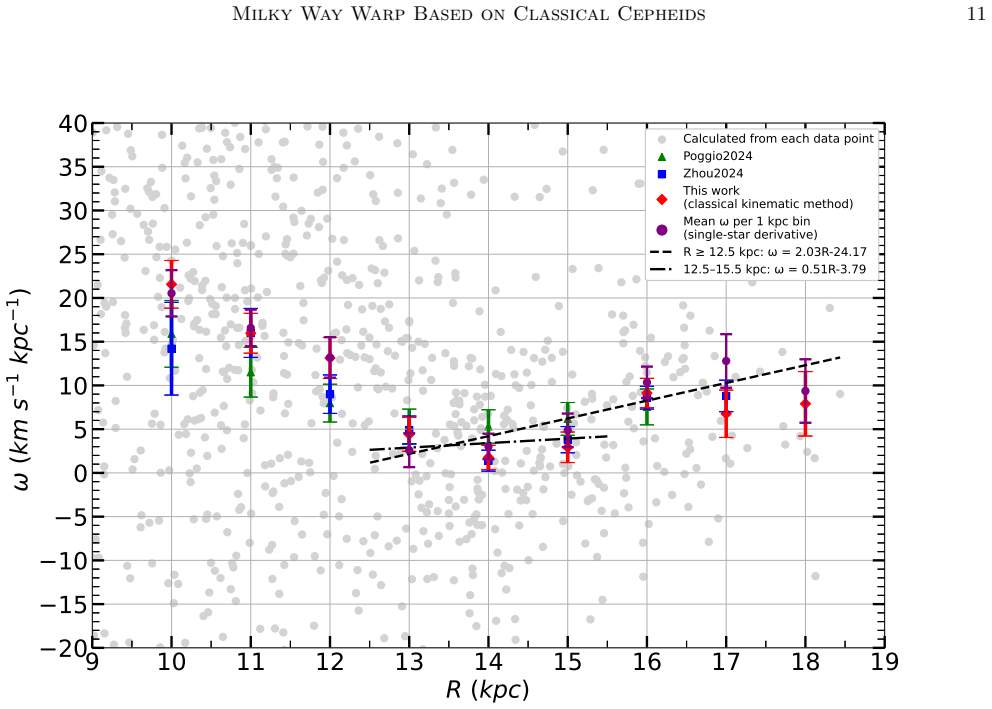
- The warp precesses prograde at a nearly uniform $4.86 \pm 0.88 \pm 2.14$ km/s/kpc beyond 12.5 kpc, connecting the measured kinematics of individual Cepheids to the warp's long-term evolution.
- The time-dependent model provides a single formula for the warp at any epoch, so applying it to tracers of different ages should recover how the line of nodes has rotated over time.
- Outer-disk warp geometry and the precession rate are insensitive to the extinction treatment, while inner-disk warp amplitude is sensitive to it, so future inner-disk work needs infrared-based distances.
Reading between the lines
- [Editorial inference] Because the warp surface is one continuous differentiable function, the same direct-differentiation recipe can be applied to any future smooth warp model, making the geometric form a reusable kinematic engine rather than a one-off fit.
- [Editorial inference] A fuller expansion of Eq. (4) would include the radial-drift term $-cV_R$ that enters when the twisted phase $cR(t)$ is differentiated; for typical Cepheid radial velocities this shifts individual $\omega$ estimates by a few km/s/kpc, so testing it directly would show how much of the claimed pattern speed is tied to the model's phase convention.
- [Editorial inference] The measured precession rate is strongly sensitive to the adopted solar vertical velocity (the paper's own scan gives roughly 8 km/s/kpc at $V_{Z,\odot}=6.9$ km/s and 3.7 km/s/kpc at 9.2 km/s), so a direct kinematic determination of the Sun's vertical motion would sharpen the pattern speed as much as adding more Cepheids.
- [Editorial inference] If the reported 5–9 kpc warp signature is confirmed with extinction-corrected infrared distances, the traditional warp onset radius should be replaced by a continuous warp description, and young tracers such as open clusters or OB stars at those radii would provide an independent check.
Editorial analysis
A structured set of objections, weighed in public.
Referee Report
Summary. The paper analyzes the Milky Way warp using Gaia DR3 classical Cepheids. It fits six geometric warp models and concludes that a continuous power-law model with a twisted line of nodes, Zw = (0.00019 ± 0.00003) R^(3.08±0.07) sin(phi - ((3.87 ± 0.27) R - (41.79 ± 3.95))), is the best description of the data. The authors then differentiate this model to derive a kinematic expression for the vertical velocity and use it to measure the warp precession rate from individual stars and from least-squares fits, obtaining omega = 4.86 ± 0.88 (stat) ± 2.14 (sys) km/s/kpc beyond 12.5 kpc. They propose a time-dependent model Zw(t) = 0.00019 R^3.08 sin(phi - (3.87R - 41.79 + 4.86t)), and they investigate the influence of solar vertical velocity and extinction on the results.
Significance. If the derivation and interpretation are corrected, this is a valuable empirical contribution: it uses a well-measured Cepheid sample, provides a continuous differentiable model of the warp, and presents a new route from the warp geometry to its precession rate. The comparison with Poggio et al. (2024), the Monte Carlo uncertainty propagation, the systematic error budget, and the robustness checks against solar vertical velocity and extinction are genuine strengths. However, the central kinematic claim currently rests on a derivative that omits the radial-drift term of the twisted line of nodes, and the paper's own fit shows a strong radial dependence of omega that is incompatible with the advertised 'nearly uniform' precession. Both issues must be resolved before the quoted numerical value and the time-dependent model can be accepted.
major comments (4)
- [Section 5, Eqs. (3)-(4)] The chain-rule derivative of Eq. (2) is missing the radial-drift term from the twisted line of nodes. Since theta = phi - cR - d - omega t, the correct derivative is dtheta/dt = V_phi/R - c V_R - omega, so Eq. (3) should contain an additional term -c V_R a R^b cos(theta). The omission propagates into Eq. (4) and into the least-squares version in Eq. (8), so both estimators return omega_est = omega_true + c V_R rather than omega_true. With c = 3.87 deg/kpc = 0.0675 rad/kpc, a sample-mean radial velocity of only 15 km/s changes the quoted 4.86 km/s/kpc by about 1.0 km/s/kpc, which is comparable to the statistical error and is not included in the systematic budget of Table 2. Please repeat the per-star and least-squares analyses with the corrected derivative and report the mean V_R of the kinematic sample.
- [Section 5, Fig. 5] The paper's own linear fit over R > 12.5 kpc, omega = 2.03R - 24.17, increases from about 1.2 km/s/kpc at 12.5 kpc to about 14.4 km/s/kpc at 19 kpc. This is not 'nearly uniform', and it is inconsistent with the time-dependent model Zw(t) = 0.00019 R^3.08 sin(phi - (3.87R - 41.79 + 4.86t)), which assumes a single constant precession rate across the entire quoted range. The restricted fit over 12.5-15.5 kpc also varies by more than 1 km/s/kpc across its own range. The authors should either restrict the constant-omega claim to the radius interval where it is actually supported or present the time-dependent model with a radially dependent precession rate.
- [Section 3 and Table 1; Section 2 outlier filtering] The selection of the 'best' model rests on RMSE differences that are small (for example, 0.190 versus 0.197 kpc in Table 1) and are presented without uncertainties, so no statistical significance is established for the model ranking. Moreover, the RMSE comparison is performed after a radius-dependent outlier cut that was guided by residuals from an initial classical warp model, so the final power-law-with-twisted model is evaluated on a sample that was cleaned using a different model. This circularity can bias the model comparison. Please provide bootstrap or Monte Carlo uncertainties for the RMSE curves and a model-selection criterion that is not conditioned on residuals from the initial model.
- [Section 5, Eqs. (2)-(4)] The identification of VZ with the full time derivative of the warp surface assumes that each star is locked to the warped midplane with no vertical oscillation or phase lag. This is a strong assumption for individual Cepheids, whose vertical velocities may include significant epicyclic motion. Since the per-star omega values are derived from this assumption, its validity should be tested, for example by comparing the residual VZ after subtracting the model or by repeating the analysis with a sample of tracers with different vertical velocity dispersions.
minor comments (4)
- [Section 3, model 5 description] In the description of the 'Power-law with twisted model', the phrase 'incorporating both an exponential warp structure' should read 'power-law warp structure'.
- [Figure 5 and captions] Several axis labels and legend entries in Figure 5 are garbled (for example, 'Calc-lated fr(m each data )(int', 'P (i(2024', 'Zh(-2024', and 'sin gle-star derivative'), apparently due to encoding problems; these should be regenerated with proper glyphs.
- [Section 2 and Section 3] The geometric sample selection initially uses 5 <= R <= 20 kpc, but the model fitting later uses only stars with R < 18.5 kpc because of the small sample beyond 19 kpc; the final sample size and radial cuts should be stated more explicitly in the text so that the reader can track which stars enter the RMSE comparison.
- [Section 6.3 and Table 2] In the systematic error budget, the entry for 'Geometric model parameter uncertainties' lists a distribution from -1.97 to 5.49 but the derived 1-sigma is 0.40; please clarify whether this is the standard deviation of the sampled omega distribution and how negative values should be interpreted.
Circularity Check
No circular steps: the precession rate is measured from independent Gaia DR3 velocities, so the time-dependent warp model is a synthesis, not a reduction to the position fit; self-citations are non-load-bearing.
full rationale
The central derivation is not circular. The geometric parameters (a,b,c,d) of the power-law twisted model are least-squares fits to Cepheid vertical positions (Sect. 3, Table 1), while the precession rate is measured from independent Gaia DR3 proper motions and radial velocities via Eq. (4) and the least-squares kinematic method (Sect. 5). The kinematic data are different quantities from the positions used to fit the geometry, so omega = 4.86 km/s/kpc is not forced by the position fit. The final time-dependent model Zw(t) synthesizes the position-fitted warp with the velocity-measured precession rate; it is a proposed descriptive model, not a prediction equivalent to its inputs. The paper explicitly states that Eq. (3) 'has the same structure as classical warp kinematic models' (Poggio et al. 2020; Cheng et al. 2020), so this is an acknowledged re-derivation, not a disguised renaming. Self-citations (Chen et al. 2019; Zhou et al. 2024; Wang & Chen 2025) are used for context, for a flare-height outlier threshold, and for an extinction robustness check; none alone establishes the central claim, and the twist and precession rate are re-derived from the present sample. A separate correctness concern, not a circularity, is that Eq. (3) omits the -c V_R term from differentiating the twisted phase cR(t), which can bias per-star omega estimates; likewise the R>12.5 kpc fit omega = 2.03R - 24.17 shows radial variation that complicates the 'nearly uniform' wording. These are systematic-error and interpretation issues, not a reduction of the result to its inputs.
Assumptions & free parameters
free parameters (5)
- a (warp amplitude scale) =
0.00019 ± 0.00003 kpc
- b (power-law index) =
3.08 ± 0.07
- c (LON twist rate) =
3.87 ± 0.27 deg/kpc
- d (LON intercept) =
-41.79 ± 3.95 deg
- omega (precession rate) =
4.86 ± 0.88 (stat) ± 2.14 (sys) km/s/kpc
assumptions (6)
- domain assumption Gaia DR3 Cepheid distances from the period-Wesenheit-metallicity relation are accurate to better than 10% and unbiased in the outer disk.
- domain assumption The adopted solar position R_sun = 8.277 kpc and solar motion [U,V,W] = [9.3, 251.5, 8.59] km/s are correct.
- domain assumption The warp is adequately represented by a single Fourier mode with power-law amplitude and linearly twisting LON over 5-18.5 kpc; the second Fourier term is negligible.
- ad hoc to paper Stars move in strict vertical equilibrium with the warp surface, so the vertical velocity equals the time derivative of Z at the star's instantaneous position.
- ad hoc to paper The LON precesses prograde at a constant rate omega independent of radius and time.
- domain assumption Excluding the 120-240 degree sector and removing 211 residual outliers leaves a representative sample of the warp.
Cite this review
Pith. "Pith review of A Detailed Analysis of the Milky Way Warp Based on Classical Cepheids." pith.science (2026). https://pith.science/paper/PJZFDWXZ
@misc{pith2026250706494,
  author       = {Pith},
  title        = {Pith review of: A Detailed Analysis of the Milky Way Warp Based on Classical Cepheids},
  year         = {2026},
  howpublished = {\url{https://pith.science/paper/PJZFDWXZ}},
  note         = {Machine review of arXiv:2507.06494}
}
abstract
Classical Cepheids (CCs) are important probes for the large-scale warp structure of the Milky Way. Using Gaia DR3 CCs, we establish an optimal time-dependent warp model, where the warp height increases with radius following a power-law, the line of nodes (LONs) exhibit linear twisting with radius, following a leading spiral pattern, and the LONs undergo prograde evolution over time. Structurally, we identify significant warp features in the $5-9$ kpc region of the Galactic disk, where the warp model performs better than the flat model. Beyond 15 kpc, the model with the second Fourier term does not fit the observations well, whereas the model with twisted LONs better matches the data. Kinematically, we derived expressions for the vertical velocities using direct differentiation and then calculated the precession rates for each CC. Our results intuitively indicate a nearly uniform and low warp precession rate of $\omega = 4.86 \pm (0.88)_{stat} \pm (2.14)_{sys}$ km s$^{-1}$ kpc$^{-1}$ beyond 12.5 kpc, in agreement with classical kinematic estimates. Based on these findings, we propose a simple yet comprehensive time-dependent warp model, $Z_{w}(t) = 0.00019R^{3.08}\sin(\phi - (3.87R-41.79 + 4.86t))$, which provides a unified framework for describing both the geometric and kinematic evolution of the Galactic warp. We analyzed the impact of the adopted solar vertical velocity on the inferred warp precession rate and confirmed the reliability of the measured precession rate. In addition, we found that extinction treatment affects the warp amplitude in the inner disk, while its influence on the outer disk warp structure and the precession rate is negligible.
Figures


Figures from the paper (4 more)



Reference graph
Works this paper leans on
-
[1]
Am \^o res , E. B., Robin , A. C., & Reyl \'e , C. 2017, , 602, A67, 10.1051/0004-6361/201628461
-
[2]
2003, , 583, L79, 10.1086/368160
Bailin , J. 2003, , 583, L79, 10.1086/368160
-
[3]
2008, Galactic Dynamics: Second Edition
Binney , J., & Tremaine , S. 2008, Galactic Dynamics: Second Edition
work page 2008
-
[4]
1991, in Warped Disks and Inclined Rings around Galaxies, 181
Bosma , A. 1991, in Warped Disks and Inclined Rings around Galaxies, 181
work page 1991
-
[5]
Briggs , F. H. 1990, , 352, 15, 10.1086/168512
doi:10.1086/168512 1990
-
[6]
Burke , B. F. 1957, , 62, 90, 10.1086/107463
doi:10.1086/107463 1957
-
[7]
2024, , 528, 4409, 10.1093/mnras/stae308
Cabrera-Gadea , M., Mateu , C., Ramos , P., et al. 2024, , 528, 4409, 10.1093/mnras/stae308
-
[8]
2019, Nature Astronomy, 3, 320, 10.1038/s41550-018-0686-7
Chen , X., Wang , S., Deng , L., et al. 2019, Nature Astronomy, 3, 320, 10.1038/s41550-018-0686-7
Show all 60 references
-
[9]
R., et al
Cheng , X., Anguiano , B., Majewski , S. R., et al. 2020, , 905, 49, 10.3847/1538-4357/abc3c2
2020 doi
-
[10]
2021, , 912, 130, 10.3847/1538-4357/abf356
Chrob \'a kov \'a , Z ., & L \'o pez-Corredoira , M. 2021, , 912, 130, 10.3847/1538-4357/abf356
2021 doi
-
[11]
2020, , 637, A96, 10.1051/0004-6361/201937289
Chrob \'a kov \'a , Z ., Nagy , R., & L \'o pez-Corredoira , M. 2020, , 637, A96, 10.1051/0004-6361/201937289
2020 doi
-
[12]
2022, , 664, A58, 10.1051/0004-6361/202243296
---. 2022, , 664, A58, 10.1051/0004-6361/202243296
2022 doi
-
[13]
2023, , 523, 1556, 10.1093/mnras/stad1502
Dehnen , W., Semczuk , M., & Sch \"o nrich , R. 2023, , 523, 1556, 10.1093/mnras/stad1502
2023 doi
-
[14]
2024, , 975, 28, 10.3847/1538-4357/ad7799
Deng , M., Du , C., Yang , Y., Liao , J., & Ye , D. 2024, , 975, 28, 10.3847/1538-4357/ad7799
2024 doi
-
[15]
Derriere , S., & Robin , A. C. 2001, in Astronomical Society of the Pacific Conference Series, Vol. 232, The New Era of Wide Field Astronomy, ed. R. Clowes , A. Adamson , & G. Bromage , 229
2001
-
[16]
Drimmel , R., & Spergel , D. N. 2001, , 556, 181, 10.1086/321556
2001 doi
-
[17]
2009, , 703, 2068, 10.1088/0004-637X/703/2/2068
Dubinski , J., & Chakrabarty , D. 2009, , 703, 2068, 10.1088/0004-637X/703/2/2068
2009 doi
-
[18]
L., Madore , B
Freedman , W. L., Madore , B. F., Scowcroft , V., et al. 2012, , 758, 24, 10.1088/0004-637X/758/1/24
2012 doi
-
[19]
2023, , 674, A37, 10.1051/0004-6361/202243797
Gaia Collaboration , Drimmel , R., Romero-G \'o mez , M., et al. 2023, , 674, A37, 10.1051/0004-6361/202243797
2023 doi
-
[20]
2022, , 657, L12, 10.1051/0004-6361/202142465
GRAVITY Collaboration , Abuter , R., Aimar , N., et al. 2022, , 657, L12, 10.1051/0004-6361/202142465
2022 doi
-
[21]
J., Conroy , C., & Hernquist , L
Han , J. J., Conroy , C., & Hernquist , L. 2023, Nature Astronomy, 7, 1481, 10.1038/s41550-023-02076-9
2023 doi
-
[22]
2023, , 954, L9, 10.3847/2041-8213/ace77d
He , Z. 2023, , 954, L9, 10.3847/2041-8213/ace77d
2023 doi
-
[23]
W., et al
Huang , Y., Sch \"o nrich , R., Liu , X. W., et al. 2018, , 864, 129, 10.3847/1538-4357/aad285
2018 doi
-
[24]
2024, Nature Astronomy, 8, 1294, 10.1038/s41550-024-02309-5
Huang , Y., Feng , Q., Khachaturyants , T., et al. 2024, Nature Astronomy, 8, 1294, 10.1038/s41550-024-02309-5
2024 doi
-
[25]
Hunt , J. A. S., & Vasiliev , E. 2025, , 100, 101721, 10.1016/j.newar.2024.101721
2025
-
[26]
Z., et al
Inno , L., Rix , H.-W., Stanek , K. Z., et al. 2021, , 914, 127, 10.3847/1538-4357/abf940
2021 doi
-
[27]
H., & McMillan , P
J \'o nsson , V. H., & McMillan , P. J. 2024, , 688, A38, 10.1051/0004-6361/202449744
2024 doi
-
[28]
Kalberla , P. M. W., & Dedes , L. 2008, , 487, 951, 10.1051/0004-6361:20079240
2008 doi
-
[29]
Kerr , F. J. 1957, , 62, 93, 10.1086/107466
1957 doi
-
[30]
J., Hindman , J
Kerr , F. J., Hindman , J. V., & Carpenter , M. S. 1957, , 180, 677, 10.1038/180677a0
1957 doi
-
[31]
S., & Pickering , E
Leavitt , H. S., & Pickering , E. C. 1912, Harvard College Observatory Circular, 173, 1
1912
-
[32]
N., Kovtyukh , V., et al
Lemasle , B., Lala , H. N., Kovtyukh , V., et al. 2022, , 668, A40, 10.1051/0004-6361/202243273
2022 doi
-
[33]
S., Blitz , L., & Heiles , C
Levine , E. S., Blitz , L., & Heiles , C. 2006, , 643, 881, 10.1086/503091
2006 doi
-
[34]
2023, , 943, 88, 10.3847/1538-4357/acab5b
Li , X., Wang , H.-F., Luo , Y.-P., et al. 2023, , 943, 88, 10.3847/1538-4357/acab5b
2023 doi
-
[35]
L \'o pez-Corredoira , M., Betancort-Rijo , J., & Beckman , J. E. 2002 a , , 386, 169, 10.1051/0004-6361:20020229
2002 doi
-
[36]
L \'o pez-Corredoira , M., Cabrera-Lavers , A., Garz \'o n , F., & Hammersley , P. L. 2002 b , , 394, 883, 10.1051/0004-6361:20021175
2002 doi
-
[37]
1965, , 129, 299, 10.1093/mnras/129.3.299
Lynden-Bell , D. 1965, , 129, 299, 10.1093/mnras/129.3.299
1965 doi
-
[38]
J., Robin , A
Marshall , D. J., Robin , A. C., Reyl \'e , C., Schultheis , M., & Picaud , S. 2006, , 453, 635, 10.1051/0004-6361:20053842
2006 doi
- [39]
-
[40]
2021, , 71, 205, 10.32023/0001-5237/71.3.2
Pietrukowicz , P., Soszy \'n ski , I., & Udalski , A. 2021, , 71, 205, 10.32023/0001-5237/71.3.2
2021 doi
-
[41]
2020, Nature Astronomy, 4, 590, 10.1038/s41550-020-1017-3
Poggio , E., Drimmel , R., Andrae , R., et al. 2020, Nature Astronomy, 4, 590, 10.1038/s41550-020-1017-3
2020 doi
-
[42]
G., et al
Poggio , E., Drimmel , R., Lattanzi , M. G., et al. 2018, , 481, L21, 10.1093/mnrasl/sly148
2018 doi
- [43]
-
[44]
J., Robin , A
Reyl \'e , C., Marshall , D. J., Robin , A. C., & Schultheis , M. 2009, , 495, 819, 10.1051/0004-6361/200811341
2009 doi
-
[45]
G., Breuval , L., Yuan , W., et al
Riess , A. G., Breuval , L., Yuan , W., et al. 2022, , 938, 36, 10.3847/1538-4357/ac8f24
2022 doi
-
[46]
2019, , 625, A14, 10.1051/0004-6361/201834506
Ripepi , V., Molinaro , R., Musella , I., et al. 2019, , 625, A14, 10.1051/0004-6361/201834506
2019 doi
-
[47]
2022, , 659, A167, 10.1051/0004-6361/202142649
Ripepi , V., Catanzaro , G., Clementini , G., et al. 2022, , 659, A167, 10.1051/0004-6361/202142649
2022 doi
-
[48]
2023, , 674, A17, 10.1051/0004-6361/202243990
Ripepi , V., Clementini , G., Molinaro , R., et al. 2023, , 674, A17, 10.1051/0004-6361/202243990
2023 doi
-
[49]
2019, , 627, A150, 10.1051/0004-6361/201834908
Romero-G \'o mez , M., Mateu , C., Aguilar , L., Figueras , F., & Castro-Ginard , A. 2019, , 627, A150, 10.1051/0004-6361/201834908
2019 doi
-
[50]
L., Battaner , E., & Florido , E
S \'a nchez-Saavedra , M. L., Battaner , E., & Florido , E. 1990, , 246, 458
1990
-
[51]
2018, , 478, 3809, 10.1093/mnras/sty1256
Sch \"o nrich , R., & Dehnen , W. 2018, , 478, 3809, 10.1093/mnras/sty1256
2018 doi
-
[52]
M., Drimmel , R., Khanna , S., et al
Skowron , D. M., Drimmel , R., Khanna , S., et al. 2025, , 278, 57, 10.3847/1538-4365/adc3f3
2025 doi
-
[53]
M., Skowron , J., Mr \'o z , P., et al
Skowron , D. M., Skowron , J., Mr \'o z , P., et al. 2019 a , Science, 365, 478, 10.1126/science.aau3181
2019 doi
-
[54]
2019 b , , 69, 305, 10.32023/0001-5237/69.4.1
---. 2019 b , , 69, 305, 10.32023/0001-5237/69.4.1
2019 doi
-
[55]
2024, , 527, 4863, 10.1093/mnras/stad3525
Uppal , N., Ganesh , S., & Schultheis , M. 2024, , 527, 4863, 10.1093/mnras/stad3525
2024 doi
-
[56]
2025, , 981, 179, 10.3847/1538-4357/adb39d
Wang , H., & Chen , X. 2025, , 981, 179, 10.3847/1538-4357/adb39d
2025 doi
-
[57]
F., L \'o pez-Corredoira , M., Huang , Y., et al
Wang , H. F., L \'o pez-Corredoira , M., Huang , Y., et al. 2020, , 897, 119, 10.3847/1538-4357/ab93ad
2020 doi
- [58]
- [59]
-
[60]
2024, , 965, 132, 10.3847/1538-4357/ad2c08
Zhou , X., Chen , X., Deng , L., & Wang , S. 2024, , 965, 132, 10.3847/1538-4357/ad2c08
2024 doi
Reviewed August 6, 2026 · model on record in the stance chip above.
Discussion (0). Sign in to comment.