REVIEW 4 major objections 6 minor 5 references
Assessing Learned Models for Phase-only Hologram Compression
T0 review · 4 major / 6 minor · reviewed 2026-08-06 · deepseek-v4-flash
Pith's one-line read The paper claims that a 4.9k-parameter SIREN compresses phase-only holograms to 40% of raw size while reconstructed 3D image quality stays at 34.54 dB PSNR, and that a pretrained image VAE fails without task-specific adaptation.
desk verdict Useful small benchmark, but the headline '40% compression' is an element-count ratio, not a bitrate, so the central claim is not yet established. read the letter →
The pith
A machine-rendered reading of the paper's core claim, the machinery that carries it, and where it could break.
The reading
What carries the argument
The central object is the patch-wise implicit neural representation: a small coordinate-to-phase network that is overfitted to one patch of a hologram and whose weights, rather than the phase values, are stored as the compressed form. SIREN is the version that works best here, using sinusoidal activation functions to fit the high-frequency phase structure. The hologram is divided into 3×64×64 patches, each patch gets its own INR initialized from previously trained weights, and the patched outputs are stitched together; the sum of parameters across patches gives the 40% compression ratio. The comparison point is TAESD, a 2.2M-parameter pretrained image autoencoder that maps a 3×512×512 hologram to a 16×64×64 latent and back, which serves as the representative VAE baseline.
What would settle it
Quantize the SIREN weights for all patches to 16-bit or 8-bit fixed point, entropy-code them, and add per-patch bookkeeping; if the resulting bitstream is larger than 40% of the raw 3×512×512 hologram, or if an actual phase-only display shows a drop from the reported 34.54 dB PSNR at the three focal planes, the compression claim would be contradicted.
Extended reading notes
Core claim
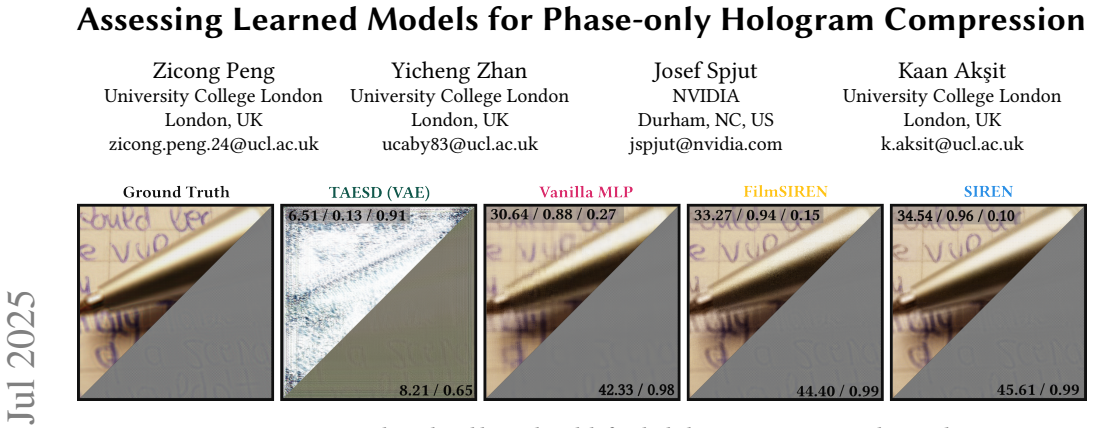
The discovery on the paper's own terms is that a small sinusoidal implicit neural representation can serve as a practical compressor for phase-only holograms, while a generic image-compression VAE cannot. For the SIREN model trained on 3×64×64 patches, the compressed representation consists of the network weights themselves, scaling to 40% of the original 3×512×512 hologram when all patches are counted, and the decompressed holograms reconstructed to 42.29 dB PSNR on the hologram plane and 34.54 dB PSNR, 0.96 SSIM, and 0.10 LPIPS in a 5-mm-deep 3D reconstruction sampled at −2.5 mm, 0, and +2.5 mm. FilmSIREN trails slightly (33.27 dB), vanilla MLP is worse, and TAESD fails despite an 8% latent size. The authors frame this as the first structured comparison of INR and VAE structures for hologram compression and as a foundation for future task-specific designs.
Load-bearing premise
The headline numbers depend on counting raw parameter counts as the true stored size and on ten simulated-hologram samples standing in for all holographic content, with fidelity judged by numerical propagation rather than optical measurement.
Editorial extensions
If this is right
- If SIREN's per-patch compression holds up on larger datasets, phase-only holograms can be stored and transmitted at 40% of raw size without a hand-designed codec.
- The failure of the pretrained VAE implies that image compression models must be re-trained or re-architected for holographic content before they can compete.
- Because the same 40% target is attainable at all tested patch sizes, users can trade quality for latency by choosing patch size, with 3×64×64 giving the best fidelity.
- The observed early stopping near 2000 epochs means the actual training cost per hologram is much lower than the nominal 10000 epochs, making the approach feasible in practice.
Reading between the lines
- A natural extension the authors do not run is to entropy-code or quantize the SIREN weights; because only raw parameter count is measured, true bitrate could be well below 40%.
- If a VAE were trained from scratch with a phase-aware loss or with frequency-domain supervision, the gap between TAESD and SIREN might shrink; that is a direct testable consequence of the paper's comparison.
- Because patches share initialization, a single global INR with patch-index conditioning might achieve a similar compression ratio with one network instead of many, an architecture the paper leaves unexplored.
- The ten-hologram evaluation suggests a larger-scale benchmark with varied content and optical reconstruction would be the next decisive test of whether the SIREN result generalizes.
Editorial analysis
A structured set of objections, weighed in public.
Referee Report
Summary. This paper evaluates four learned models—vanilla MLP, SIREN, FiLM-SIREN, and the TAESD VAE—for compression of double-phase-encoded 3x512x512 phase-only holograms. The authors report direct hologram PSNR/SSIM for INR patch-based compression at various patch sizes and 3D reconstruction metrics after numerical propagation at three focal planes. The abstract's headline claim is that SIREN with 4.9k parameters achieves ~40% compression with PSNR 34.54 dB in 3D reconstruction, while a pretrained image VAE fails to compress holograms effectively.
Significance. If the compression ratio were substantiated at the bitrate level, the result that a compact INR can represent phase-only holograms at sufficient quality for 3D reconstruction would be a valuable data point for holographic display storage and streaming. The paper's structured comparison across INR variants and a VAE, with explicit patch sizes and training settings, is a useful baseline contribution. However, the central quantitative claim currently rests on parameter-to-element ratios rather than stored bits, and the small test set limits generality. The VAE comparison covers only one untuned model, so the conclusion about VAE unsuitability is preliminary.
major comments (4)
- [Section 3, Table 1 and Abstract] The '40% compression' claim is defined as the ratio of INR parameter count to phase element count, not as a bitrate. The manuscript does not state the bit depth of the phase values (e.g., 8-bit) or the network weights (e.g., float32), nor does it account for quantization, entropy coding, or model metadata. Under a common convention of 8-bit phase and float32 weights, a SIREN with 4,899 parameters per 3x64x64 patch would require 156,768 bits to encode 98,304 bits of raw phase data, i.e., roughly 159% of the raw size—an expansion rather than a compression. Please report actual bitrates (e.g., bits per phase element) under explicit precision assumptions, or revise the headline claim.
- [Section 3] The 3D reconstruction metrics for SIREN (PSNR = 34.54 dB, SSIM = 0.96, LPIPS = 0.10) are reported without error bars or the number of test holograms over which they are averaged. Since Table 1 reports standard deviations for the direct hologram metrics, the absence of variance for the headline 3D claim makes the 1.27 dB margin between SIREN and FilmSIREN not statistically supported on the ten available holograms. Please add per-hologram 3D results or error bars.
- [Sections 2 and 3] The conclusion that pretrained image VAEs 'struggle with phase-only hologram compression' is based on a single off-the-shelf TAESD model with no task-specific training or architectural tuning. This conclusion is broader than the evidence supports, since a VAE trained on hologram data or with a different latent space could behave differently. Please either narrow the claim to the specific evaluated model or add a task-adapted VAE baseline.
- [Section 3 (overall assessment)] The paper does not compare the learned models against any conventional codec (e.g., JPEG 2000, HEVC, or a dedicated hologram codec) at matched bitrates. Without such a comparison, the '40% compression' result lacks rate-distortion context, and readers cannot judge whether the learned approach is competitive for actual storage or transmission. Adding at least one standard codec baseline would substantially strengthen the assessment.
minor comments (6)
- [Figure 1] The inset labels in Figure 1 are very small; the PSNR, SSIM, and LPIPS values are likely to be illegible in the printed poster format. Please enlarge the text or restructure the figure for readability.
- [Abstract and Section 1] The manuscript contains formatting artifacts such as 'A V AE' and 'V AE' with extra spaces; the intended term is likely 'VAE' throughout. Please fix these spelling and spacing issues.
- [Table 1] The 'Comp. Ratio' column entries are shown as plain numbers without percent signs; the column header should indicate the unit, or the values should be formatted with '%' for clarity.
- [Section 2] The text refers to 'Tbl. 1' instead of 'Table 1'; please use the standard 'Table 1' format for consistency with the rest of the manuscript.
- [Section 1] The claim that this is 'the first attempt to assess the learned models in a structured way' should be supported by a more thorough discussion of related work on learned hologram compression (including the cited Wang et al. 2022 and any other relevant studies) to clarify the novelty.
- [Section 2 (supplementary)] The manuscript states that model details are available in the supplementary materials, but no supplementary document is attached to the arXiv version. Please include the supplementary material or state where it can be accessed.
Circularity Check
No circularity: the paper is an empirical rate-distortion benchmark with no load-bearing self-citation or fitted-parameter-as-prediction step.
full rationale
The manuscript makes no derivation claim; it reports measured reconstruction quality (PSNR/SSIM/LPIPS) for INR and VAE models trained on hologram patches. The '40% compression' figure is computed as parameter count divided by patch element count (Table 1: 4,899 / 12,288 = 0.3987), which is a transparent, definitional rate metric rather than a predicted quantity, and the paper does not present this ratio as a model-derived result. The empirical content is the reconstructed-image quality at that rate, obtained by numerical propagation and standard metrics; this is not equivalent to an input fit and is independent of the authors' prior claims. The only self-citations (Kavakli et al. 2023 and Zheng et al. 2024) appear as background motivation for holographic displays and are not load-bearing. Concerns about bit depth, per-patch model overhead, and the ten-hologram sample size are validity limitations, not circularity; the paper itself acknowledges the small-sample scope. No circular step can be exhibited from the paper's text, so the appropriate finding is no significant circularity.
Assumptions & free parameters
free parameters (6)
- patch_size =
[64, 96, 128, 160]
- training_epochs =
10000
- learning_rate =
0.0001
- early_stopping_criterion =
unspecified (near 2000 epochs)
- focal_plane_distances =
[-2.5, 0, +2.5] mm
- test_hologram_count =
10
assumptions (5)
- domain assumption Compression ratio can be measured by parameter count versus raw patch size.
- domain assumption Numerical propagation at three focal planes approximates optical reconstruction quality.
- domain assumption Independent patch-wise INR training is a valid decomposition of a hologram.
- domain assumption TAESD represents the class of pretrained image compression VAEs.
- domain assumption Ten holograms capture enough diversity to reveal comparative trends.
Cite this review
Pith. "Pith review of Assessing Learned Models for Phase-only Hologram Compression." pith.science (2026). https://pith.science/paper/V2EK7P2B
@misc{pith2026250706646,
  author       = {Pith},
  title        = {Pith review of: Assessing Learned Models for Phase-only Hologram Compression},
  year         = {2026},
  howpublished = {\url{https://pith.science/paper/V2EK7P2B}},
  note         = {Machine review of arXiv:2507.06646}
}
read the original abstract
We evaluate the performance of four common learned models utilizing INR and VAE structures for compressing phase-only holograms in holographic displays. The evaluated models include a vanilla MLP, SIREN, and FilmSIREN, with TAESD as the representative VAE model. Our experiments reveal that a pretrained image VAE, TAESD, with 2.2M parameters struggles with phase-only hologram compression, revealing the need for task-specific adaptations. Among the INRs, SIREN with 4.9k parameters achieves %40 compression with high quality in the reconstructed 3D images (PSNR = 34.54 dB). These results emphasize the effectiveness of INRs and identify the limitations of pretrained image compression VAEs for hologram compression task.
Figures

Reference graph
Works this paper leans on
-
[2020]
Advances in neural information processing systems 33 (2020), 7462–7473
Implicit neural representations with periodic activation functions. Advances in neural information processing systems 33 (2020), 7462–7473. doi:10. 48550/arXiv.2006.09661 Yujie Wang, Praneeth Chakravarthula, Qi Sun, and Baoquan Chen
-
[2021]
In Proceedings of the IEEE/CVF conference on computer vision and pattern recognition
pi-gan: Periodic implicit generative adversarial networks for 3d-aware image synthesis. In Proceedings of the IEEE/CVF conference on computer vision and pattern recognition. 5799–5809. doi:10.1109/CVPR46437.2021.00574 Koray Kavaklı, Liang Shi, Hakan Urey, Wojciech Matusik, and Kaan Akşit
arXiv 2021
-
[2022]
doi:10.1145/3528223.3530070 Chuanjun Zheng, Yicheng Zhan, Liang Shi, Ozan Cakmakci, and Kaan Akşit
Joint neural phase retrieval and compression for energy-and computation-efficient holography on the edge.ACM Transactions on Graphics41, 4 (2022). doi:10.1145/3528223.3530070 Chuanjun Zheng, Yicheng Zhan, Liang Shi, Ozan Cakmakci, and Kaan Akşit
arXiv 2022
-
[2023]
In SIGGRAPH ASIA 2023 Conference Papers (Sydney, NSW, Australia) (SA ’23)
Multi- color Holograms Improve Brightness in Holographic Displays. In SIGGRAPH ASIA 2023 Conference Papers (Sydney, NSW, Australia) (SA ’23) . Article 20, 11 pages. doi:10.1145/3610548.3618135 Vincent Sitzmann, Julien Martel, Alexander Bergman, David Lindell, and Gordon Wetzstein
arXiv 2023
-
[2024]
Focal Surface Holographic Light Transport using Learned Spatially Adaptive Con- volutions. In SIGGRAPH Asia 2024 Technical Communications (SA Technical Com- munications ’24) (Tokyo, Japan) (SA ’24). doi:10.1145/3681758.3697989
Reviewed August 6, 2026 · model on record in the stance chip above.
Discussion (0). Sign in to comment.