REVIEW 3 major objections 5 minor 75 references
Robustness of the flux-free sector of the Kitaev honeycomb against environment
T0 review · 3 major / 5 minor · reviewed 2026-08-06 · deepseek-v4-flash
Pith's one-line read Environmental dephasing drives the Kitaev honeycomb's Majorana modes out of existence, closing the bulk gap in finite time.
desk verdict Useful numerical map of the flux-free Kitaev sector under Lindblad noise, but the flux-free truncation keeps it a model study rather than a direct STM prediction. read the letter →
The pith
A machine-rendered reading of the paper's core claim, the machinery that carries it, and where it could break.
The reading
What carries the argument
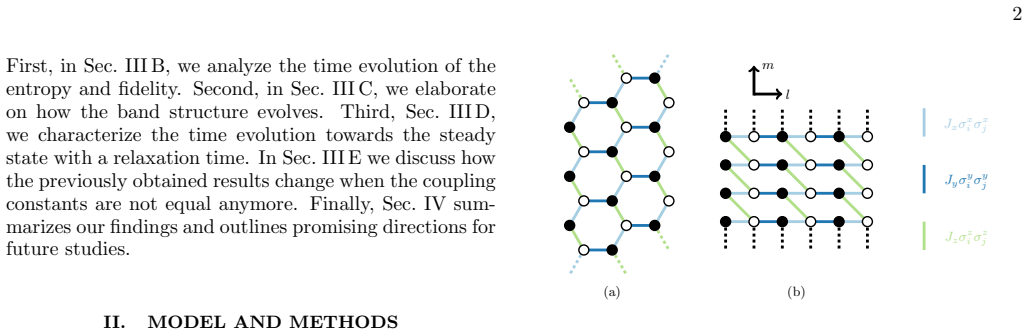
The analysis rests on the fermionized, flux-free-sector Hamiltonian of the Kitaev honeycomb model on a zigzag cylinder, in which the spins are mapped via a Jordan-Wigner transformation to complex fermions $\alpha_{(l,k)}$ and the ground state lies in the flux-free sector. On top of this quadratic Hamiltonian the authors solve a Lindblad master equation, with jump operators obtained from the local $\sigma^z$ operators (dephasing) together with related number, pair, and hopping operators. The time evolution is computed by vectorizing the Liouvillian via the Choi-Jamiolkowski isomorphism and exponentiating it, and the band structure is obtained from the Bogoliubov-de Gennes spectrum of the quadratic Hamiltonian. The quantum Zeno effect and the relaxation time are read off from the spectral gap of the Liouvillian, i.e. the slowest nonzero decay rate.
What would settle it
Exact-diagonalize the full spin Hamiltonian of a small honeycomb cluster together with the local $\sigma^z$ dephasing Lindblad terms without any flux-free truncation, and compare the steady state and the gap-closing time with the flux-free prediction; a steady state different from the maximally mixed state, or a surviving gap at the predicted relaxation time, would falsify the central claim.
Extended reading notes
Core claim
Within the flux-free sector of the Kitaev honeycomb model on a zigzag cylinder, dephasing-type Lindblad dissipation drives the system to the maximally mixed state $\rho_{\mathrm{mm}} = \mathbb{1}/2^L$ for almost all jump operators built from number operators, pair creation/annihilation, and incoherent hopping. Because this steady state has energy zero by particle-hole symmetry, every band converges to $E=0$, the gap closes, and the Majorana zero modes become indistinguishable from the other bands; in the authors' words, the topological features of the band structure vanish. The relaxation is governed by a quantum Zeno effect: the approach to the steady state is fastest when the dissipation strength $\gamma$ is of order the Kitaev coupling $J_\alpha$, and slows down for both smaller and larger $\gamma$. The exceptions are the parameter sets realizing the Kitaev chain with periodic boundary conditions, where the steady state is not maximally mixed, and certain jump operators that preserve only half the Nambu degrees of freedom and produce slower decay.
Load-bearing premise
The entire calculation assumes the environment only acts inside the flux-free sector, so that the dissipator never creates flux excitations on the plaquettes; if real spin dephasing does create fluxes at a significant rate, the steady state and the fate of the Majorana modes could be different.
Editorial extensions
If this is right
- If the central claim is correct, STM detection of Kitaev-spin-liquid Majorana zero modes requires the substrate coupling to be weak enough that the system does not relax to the maximally mixed state before the measurement.
- The bulk gap closes in finite time under environmental coupling, so any spectroscopic feature that relies on the coexistence of a bulk gap and gapless edge states disappears on the relaxation timescale.
- The quantum Zeno effect gives a concrete design rule: minimum robustness occurs when $\gamma \sim J_\alpha$, so operating far from this crossover (either much weaker or much stronger dissipation) prolongs the topological signatures.
- The Kitaev chain with periodic boundary conditions is the notable protected case, since its steady state is not maximally mixed and some distinction between bands survives.
Reading between the lines
- The authors truncate to the flux-free sector and do not quantify the rate at which the full spin dissipator creates flux excitations; if that rate is comparable to $\gamma$, the steady state and the gap-closing time could differ from their predictions.
- A natural testable extension is to compute a time-dependent topological invariant; the paper shows the gap closes but does not determine whether a dynamical topological phase transition occurs.
- The result suggests a general principle for local dephasing on Majorana-carrying systems: any environment that effectively measures the local fermion parity will destroy the spectral signature of zero modes, independent of the microscopic origin of the jump operators.
- The fidelity fitting function, previously derived for the Kitaev honeycomb with periodic boundary conditions, is shown here to also describe open-boundary (zigzag) systems with Majorana modes for $\gamma \ll J_\alpha$, extending its range of applicability.
Editorial analysis
A structured set of objections, weighed in public.
Referee Report
Summary. The paper studies the Lindblad dynamics of the Kitaev honeycomb model on a zigzag cylinder, working entirely within the flux-free sector of the Majorana-fermion representation. For a catalog of quadratic fermionic jump operators, the authors compute the steady states of the Liouvillian, the time evolution of entropy, fidelity, band-resolved energies, and the spectral gap, and they identify a quantum Zeno effect with the fastest relaxation around γ ∼ Jα. The central numerical deliverable is Table II, which classifies which jump-operator sets drive the density matrix to the maximally mixed state, with the Kitaev-chain-with-periodic-boundary-conditions parameter regime as the main exception. The authors conclude that in most cases the energy gap closes in finite time and that the spectral distinction between Majorana zero modes and other bands disappears as the system relaxes.
Significance. If the results are taken at face value, the paper provides a useful reference catalog for how dephasing-type noise acts on the flux-free fermionic representation of the Kitaev honeycomb model, and it gives a concrete, falsifiable prediction (the γ ∼ Jα location of the Zeno minimum) that can be tested in controlled synthetic or analog quantum simulators. The numerical implementation is standard and internally consistent, and Table II systematically covers a broad set of jump operators. However, the significance for the stated STM motivation is limited by an explicit and unquantified model assumption: the dissipator is restricted to the flux-free sector even though the physical spin environment creates fluxes. The paper is therefore best read as a study of a fermionic model with quadratic Lindblad operators; its reach to the spin Kitaev model is conditional on a truncation that is acknowledged but not benchmarked.
major comments (3)
- [Sec. II (Eq. (3)) and Table I] The central approximation is the restriction of the Liouvillian to the flux-free sector, and the paper's own text in Sec. II states that this 'may be a reasonable approximation' without quantifying it. In the spin language, the local spin operators that a substrate couples to create flux pairs on neighboring plaquettes, so the dissipator used in the numerics drops exactly the physical processes most relevant for the STM setup invoked in the introduction. Because the steady-state classification, gap closing, and Majorana-mode indistinguishability are all properties of this truncated dissipative dynamics, this is a load-bearing assumption. The authors should either provide a quantitative estimate of the flux-creation rate (for example, by computing the relevant dissipator matrix elements to excited flux sectors), benchmark the truncated dynamics against the full spin Hilbert space on a small cluster, or substantially reframe the claims so that they are explicitly about the fermionic model rather than about a Kitaev spin layer on a surface.
- [Sec. III B (Eq. (9))] The claim that the fidelity result 'extends' the analytical expressions of Refs. [49,64] to the MZM case is not supported as stated. Equation (9) is the analytical expression of those references used as a fitting function with three free parameters (C, a, b) fitted to the authors' own numerics. The agreement is therefore a consistency check, not an independent derivation or a parameter-free prediction. The text should be reworded to make this distinction explicit, and the fitted parameter values and fit quality should be reported so that the reader can judge the transferability of the functional form.
- [Sec. III C and Sec. IV] The statement in Sec. IV that 'a topological phase transition occurs over time' is stronger than what the computed quantity supports. The quantities shown in Figs. 6 and 7 are the energies E(k) of the eigenbands of the closed Hamiltonian weighted by the time-dependent density matrix; their convergence to zero shows gap closing in a spectral sense, but a mixed-state topological invariant is not evaluated. The authors already note this in Sec. IV, but the preceding discussion phrases the result as 'topological features of the band structure vanish.' This should be softened to 'the spectral distinction between the MZM band and the other bands vanishes within the flux-free truncated model,' which is exactly what the numerics show.
minor comments (5)
- [Eq. (2)] There appears to be an unmatched square bracket in the Jy term of the Hamiltonian; the bracketing should be checked for consistency.
- [Eq. (7)] Equation (7) is called the Uhlmann fidelity, but the expression Tr[ρ1 ρ2] is the Hilbert-Schmidt overlap, not the Uhlmann fidelity. Please either use the standard Uhlmann definition or rename the quantity as a state overlap.
- [Section heading] The heading of Sec. III E contains a typo, 'V ariation', which should be corrected.
- [Table II] The notation in the conditions column of Table II is ambiguous; for example, 'L≥ 2, Jy = 0 ≠ 1' mixes a parameter condition with an inequality for deg(λ0). Please separate the parameter conditions from the degeneracy values.
- [Sec. II] The justification for the flux-free truncation relies on Refs. [47-49], but the text does not explain what those references actually establish. A sentence summarizing the physical or mathematical argument would make the limitation much clearer to the reader.
Circularity Check
Central claims rest on self-contained Lindblad diagonalization; the only by-construction element is the secondary fidelity/entropy fit of Eq. (9), which the paper itself labels a fitting function.
-
fitted input called prediction
[Sec. III B, Eq. (9) and following paragraph]
"we use their expression for the fidelity as a fitting function, adapted by including a finite-size effect term (which depends on the steady state (ss)): Ffit(t)= Ct−be−at+ 1/2L if ρss = ρmm. (9) ... It turns out that this fitting function can be applied to both F closed/open and the entropy provided that γ ≪ Jα. Aside from this condition, it is valid for all parameter regimes, including, in particular, for the MZM. This extends previous results"
C, a, and b in Eq. (9) are free parameters fitted to the paper's own numerical data for F_closed/open and S(t), including the MZM (cylinder) data being claimed. With three free parameters, the fitted curve matches the fitted data by construction, so the statement that the form is 'valid ... including, in particular, for the MZM' and that this 'extends previous results' of Refs. [49,64] is a consistency fit rather than an independent check. The paper is transparent about calling it a fitting function (and concedes the fit parameters show no systematic pattern), which keeps this as a minor, secondary circularity; it does not support the central steady-state or QZE claims.
full rationale
The central derivation chain is self-contained. The steady-state classification (Tab. II) is obtained by explicitly solving the Lindblad generator for its eigenvalue-0 right eigenvector (App. A, Eq. (A1); App. B), with no parameter fitted to the conclusions. The statement that band energies converge to zero is an identity given convergence to rho_mm: Eq. (10), E(rho_mm)=Tr[rho_mm H_KHM]=0, follows from per-mode tracelessness of the BdG Hamiltonian of Eq. (2), and the paper derives it explicitly rather than assuming the gap closes. The QZE in rho(t), S(t), F(t), and tau is read off direct numerical time evolution and the Lindblad spectrum (Eq. (11)); it is a computational observation, not an input. No load-bearing self-citation: the authors' own Ref. [74] is cited only for the power-series time-stepping scheme in App. A, and Ref. [40] (with author Daghofer) is a materials review used for context; neither forces any result. The acknowledged flux-free-sector truncation ('restricting the analysis to the flux-free sector may be a reasonable approximation, and we, therefore, adopt this simplest approach', Sec. II) is a genuine, unquantified approximation and a correctness risk for the STM-motivated claims, but it is a model assumption, not a reduction of outputs to inputs, so it is excluded from the circularity score per the rules. Similarly, the paper itself hedges the topological-transition claim ('precisely determining this transition requires the evaluation of a topological invariant, which is beyond the scope of this work'). The only by-construction element is the secondary fit of Eq. (9), described above, which is honestly labeled and does not propagate into the main conclusions.
Assumptions & free parameters
free parameters (3)
- C (fidelity fit amplitude) =
not reported (fitted to numerics)
- a (fidelity fit decay rate) =
not reported
- b (fidelity fit power-law exponent) =
not reported
assumptions (5)
- domain assumption The Lindblad master equation (Eq. (3)) with Markovian, time-independent jump operators adequately describes the KHM coupled to a substrate.
- domain assumption The LME dynamics may be restricted to the flux-free sector; the environment does not create flux excitations.
- domain assumption The Jordan-Wigner transformed sigma_z operator (local spin dephasing) maps to the fermionic number operator (up to factors) within the sector used.
- standard math The BdG formalism with exclusion of negative-energy bands avoids double counting.
- domain assumption A single-k sector evolving independently with one jump operator per site captures the physics; per-sector steady states are the relevant objects.
Cite this review
Pith. "Pith review of Robustness of the flux-free sector of the Kitaev honeycomb against environment." pith.science (2026). https://pith.science/paper/KQM6R6BT
@misc{pith2026250706683,
  author       = {Pith},
  title        = {Pith review of: Robustness of the flux-free sector of the Kitaev honeycomb against environment},
  year         = {2026},
  howpublished = {\url{https://pith.science/paper/KQM6R6BT}},
  note         = {Machine review of arXiv:2507.06683}
}
abstract
The Kitaev honeycomb model (KHM) consists of spin-$1/2$ particles on a honeycomb lattice with direction-dependent Ising-like interactions. It can alternatively be described in terms of non-interacting Majorana fermions, can be solved exactly, and has a quantum spin-liquid ground state. Open boundaries then host Majorana zero modes (MZMs) that are robust against some types of disorder. We analyze the fate of the MZMs when they couple to an environment via a Lindblad master equation. By computing the time evolution of the density matrix, we find that when decoherence occurs, the steady state is mostly the maximally mixed state. Among the few exceptions is a parameter regime that realizes the superconducting Kitaev chain model with periodic boundary conditions. We consistently observe a quantum Zeno effect in the density matrix as well as in the entropy and fidelity, while it is not found in the energy gap of some gapped spin liquids. We thus present a comprehensive overview over MZMs coupled to a spin bath that is relevant to proposals to detect MZMs of Kitaev layers on surfaces using scanning tunneling microscopy (STM).
Figures


Figures from the paper (5 more)


Reference graph
Works this paper leans on
-
[1]
F. D. M. Haldane, Nobel Lecture: Topological quantum matter, Rev. Mod. Phys. 89, 040502 (2017)
work page 2017
-
[2]
Wen, Colloquium: Zoo of quantum-topological phases of matter, Rev
X.-G. Wen, Colloquium: Zoo of quantum-topological phases of matter, Rev. Mod. Phys. 89, 041004 (2017)
2017
-
[3]
C.-K. Chiu, J. C. Y. Teo, A. P. Schnyder, and S. Ryu, Classification of topological quantum matter with sym- metries, Rev. Mod. Phys. 88, 035005 (2016)
2016
-
[4]
Qi and S.-C
X.-L. Qi and S.-C. Zhang, Topological insulators and su- perconductors, Rev. Mod. Phys. 83, 1057 (2011)
2011
-
[5]
M. Z. Hasan and C. L. Kane, Colloquium: Topological insulators, Rev. Mod. Phys. 82, 3045 (2010)
2010
-
[6]
K. Hornberger, Entanglement and Decoherence: Founda- 9 tions and Modern Trends(Springer Berlin, Heidelberg,
-
[7]
Breuer and F
H.-P. Breuer and F. Petruccione, The Theory of Open Quantum Systems (Oxford University Press, 2007)
2007
-
[8]
D. Suter and G. A. ´Alvarez, Colloquium: Protecting quantum information against environmental noise, Rev. Mod. Phys. 88, 041001 (2016)
work page 2016
Show all 75 references
-
[9]
I. L. Chuang, R. Laflamme, P. W. Shor, and W. H. Zurek, Quantum computers, factoring, and decoherence, Science 270, 1633 (1995)
1995
-
[10]
Beige, D
A. Beige, D. Braun, B. Tregenna, and P. L. Knight, Quantum computing using dissipation to remain in a decoherence-free subspace, Phys. Rev. Lett. 85, 1762 (2000)
2000
-
[11]
D. P. DiVincenzo, The physical implementation of quan- tum computation, Fortschritte der Physik48, 771 (2000)
2000
-
[12]
T. D. Ladd, F. Jelezko, R. Laflamme, Y. Nakamura, C. Monroe, and J. L. O’Brien, Quantum computers, Na- ture 464, 45 (2010)
2010
-
[13]
D. P. DiVincenzo, Two-bit gates are universal for quan- tum computation, Phys. Rev. A 51, 1015 (1995)
1995
-
[14]
Lahtinen and J
V. Lahtinen and J. K. Pachos, A short introduction to topological quantum computation, SciPost Phys. 3, 021 (2017)
2017
-
[15]
Nayak, S
C. Nayak, S. H. Simon, A. Stern, M. Freedman, and S. Das Sarma, Non-Abelian anyons and topological quan- tum computation, Rev. Mod. Phys. 80, 1083 (2008)
2008
-
[16]
Steane, Quantum computing, Reports on Progress in Physics 61, 117 (1998)
A. Steane, Quantum computing, Reports on Progress in Physics 61, 117 (1998)
1998
-
[17]
Alicea, New directions in the pursuit of Majorana fermions in solid state systems, Reports on Progress in Physics 75, 076501 (2012)
J. Alicea, New directions in the pursuit of Majorana fermions in solid state systems, Reports on Progress in Physics 75, 076501 (2012)
2012
-
[18]
Sato and Y
M. Sato and Y. Ando, Topological superconductors: a re- view, Reports on Progress in Physics 80, 076501 (2017)
2017
-
[19]
C. W. J. Beenakker, Search for Majorana fermions in superconductors, Annual Review of Condensed Matter Physics 4, 113 (2013)
2013
-
[20]
Alicea, Y
J. Alicea, Y. Oreg, G. Refael, F. von Oppen, and M. P. A. Fisher, Non-Abelian statistics and topologi- cal quantum information processing in 1D wire networks, Nature Physics 7, 412 (2011)
2011
-
[21]
C. W. J. Beenakker, Search for non-Abelian Majorana braiding statistics in superconductors, SciPost Phys. Lect. Notes , 15 (2020)
2020
-
[22]
Cheng, R
M. Cheng, R. M. Lutchyn, and S. Das Sarma, Topological protection of Majorana qubits, Phys. Rev. B 85, 165124 (2012)
2012
-
[23]
Y. Hu, Z. Cai, M. A. Baranov, and P. Zoller, Majorana fermions in noisy Kitaev wires, Phys. Rev. B 92, 165118 (2015)
2015
-
[24]
J. C. Budich, S. Walter, and B. Trauzettel, Failure of protection of Majorana based qubits against decoherence, Phys. Rev. B 85, 121405 (2012)
2012
-
[25]
F. L. Pedrocchi, N. E. Bonesteel, and D. P. DiVincenzo, Monte Carlo studies of the self-correcting properties of the Majorana quantum error correction code under braid- ing, Phys. Rev. B 92, 115441 (2015)
2015
-
[26]
F. L. Pedrocchi and D. P. DiVincenzo, Majorana braiding with thermal noise, Phys. Rev. Lett. 115, 120402 (2015)
2015
-
[27]
Goldstein and C
G. Goldstein and C. Chamon, Decay rates for topological memories encoded with Majorana fermions, Phys. Rev. B 84, 205109 (2011)
2011
-
[28]
Rainis and D
D. Rainis and D. Loss, Majorana qubit decoherence by quasiparticle poisoning, Phys. Rev. B 85, 174533 (2012)
2012
-
[29]
Kitaev, Anyons in an exactly solved model and be- yond, Annals of Physics 321, 2 (2006)
A. Kitaev, Anyons in an exactly solved model and be- yond, Annals of Physics 321, 2 (2006)
2006
-
[30]
Kitaev, Fault-tolerant quantum computation by anyons, Annals of Physics 303, 2 (2003)
A. Kitaev, Fault-tolerant quantum computation by anyons, Annals of Physics 303, 2 (2003)
2003
-
[31]
Balents, Spin liquids in frustrated magnets, Nature 464, 199 (2010)
L. Balents, Spin liquids in frustrated magnets, Nature 464, 199 (2010)
2010
-
[32]
Thakurathi, K
M. Thakurathi, K. Sengupta, and D. Sen, Majorana edge modes in the Kitaev model, Phys. Rev. B 89, 235434 (2014)
2014
-
[33]
Mizoguchi and T
T. Mizoguchi and T. Koma, Majorana edge magnetiza- tion in the Kitaev honeycomb model, Phys. Rev. B 99, 184418 (2019)
2019
-
[34]
Feldmeier, W
J. Feldmeier, W. Natori, M. Knap, and J. Knolle, Local probes for charge-neutral edge states in two-dimensional quantum magnets, Phys. Rev. B 102, 134423 (2020)
2020
-
[35]
Udagawa, S
M. Udagawa, S. Takayoshi, and T. Oka, Scanning tunnel- ing microscopy as a single Majorana detector of Kitaev’s chiral spin liquid, Phys. Rev. Lett. 126, 127201 (2021)
2021
-
[36]
E. J. K¨ onig, M. T. Randeria, and B. J¨ ack, Tunneling spectroscopy of quantum spin liquids, Phys. Rev. Lett. 125, 267206 (2020)
2020
-
[37]
Zhang, G
S.-S. Zhang, G. B. Hal´ asz, and C. D. Batista, Probing chi- ral Kitaev spin liquids via dangling boundary fermions, npj Quantum Materials 10, 59 (2025)
2025
-
[38]
Matsuda, T
Y. Matsuda, T. Shibauchi, and H.-Y. Kee, Kitaev quan- tum spin liquids (2025), arXiv:2501.05608 [cond-mat.str- el]
2025
-
[39]
Mandal, A primer on Kitaev model: basic aspects, material realization, and recent experiments, Journal of Physics: Condensed Matter 37, 193002 (2025)
S. Mandal, A primer on Kitaev model: basic aspects, material realization, and recent experiments, Journal of Physics: Condensed Matter 37, 193002 (2025)
2025
-
[40]
S. M. Winter, A. A. Tsirlin, M. Daghofer, J. van den Brink, Y. Singh, P. Gegenwart, and R. Valenti, Models and materials for generalized Kitaev magnetism, Journal of Physics: Condensed Matter 29, 493002 (2017)
2017
-
[41]
Z. Wang, L. Liu, H. Zheng, M. Zhao, K. Yang, C. Wang, F. Yang, H. Wu, and C. Gao, Direct observation of the mottness and p–d orbital hybridization in the epitaxial monolayer α-RuCl3, Nanoscale 14, 11745 (2022)
2022
-
[42]
Kohsaka, S
Y. Kohsaka, S. Akutagawa, S. Omachi, Y. Iwamichi, T. Ono, I. Tanaka, S. Tateishi, H. Murayama, S. Suet- sugu, K. Hashimoto, T. Shibauchi, M. O. Takahashi, S. Nikolaev, T. Mizushima, S. Fujimoto, T. Terashima, T. Asaba, Y. Kasahara, and Y. Matsuda, Imaging quan- tum interferenc...
2024
-
[43]
Lo Conte, J
R. Lo Conte, J. Wiebe, S. Rachel, D. K. Morr, and R. Wiesendanger, Magnet-superconductor hybrid quan- tum systems: a materials platform for topological su- perconductivity, La Rivista del Nuovo Cimento 47, 453 (2024)
2024
-
[44]
Rachel and R
S. Rachel and R. Wiesendanger, Majorana quasiparticles in atomic spin chains on superconductors, Physics Re- ports 1099, 1 (2025)
2025
-
[45]
A. Y. Kitaev, Unpaired Majorana fermions in quantum wires, Physics-Uspekhi 44, 131 (2001)
2001
-
[46]
Jackeli and G
G. Jackeli and G. Khaliullin, Mott insulators in the strong spin-orbit coupling limit: From Heisenberg to a quantum compass and Kitaev models, Phys. Rev. Lett. 102, 017205 (2009)
2009
-
[47]
K. Yang, S. C. Morampudi, and E. J. Bergholtz, Excep- tional spin liquids from couplings to the environment, 10 Phys. Rev. Lett. 126, 077201 (2021)
2021
-
[48]
Kanega, T
M. Kanega, T. N. Ikeda, and M. Sato, Linear and nonlin- ear optical responses in Kitaev spin liquids, Phys. Rev. Res. 3, L032024 (2021)
2021
-
[49]
Roberts, M
W. Roberts, M. Vogl, and G. A. Fiete, Fidelity of the Kitaev honeycomb model under a quench, Phys. Rev. B 109, L220406 (2024)
2024
-
[50]
Molignini, A
P. Molignini, A. G. Celades, R. Chitra, and W. Chen, Crossdimensional universality classes in static and peri- odically driven Kitaev models, Phys. Rev. B 103, 184507 (2021)
2021
-
[51]
Lindblad, On the generators of quantum dynamical semigroups, Commun.Math.Phys 48, 119 (1976)
G. Lindblad, On the generators of quantum dynamical semigroups, Commun.Math.Phys 48, 119 (1976)
1976
-
[52]
Gorini, A
V. Gorini, A. Kossakowski, and E. C. G. Sudarshan, Completely positive dynamical semigroups of N-level sys- tems, Journal of Mathematical Physics 17, 821 (1976)
1976
-
[53]
Deng and L
T.-S. Deng and L. Pan, Fate of symmetry protected co- herence in open quantum system, Phys. Rev. B 104, 094306 (2021)
2021
-
[54]
C. A. Brasil, F. F. Fanchini, and R. d. J. Napolitano, A simple derivation of the Lindblad equation, Revista Brasileira de Ensino de Fisica 35 (2013)
2013
-
[55]
D. A. Lidar, Lecture notes on the theory of open quantum systems (2020), arXiv:1902.00967 [quant-ph]
2020 arXiv
-
[56]
Manzano, A short introduction to the Lindblad master equation, AIP Advances 10, 025106 (2020)
D. Manzano, A short introduction to the Lindblad master equation, AIP Advances 10, 025106 (2020)
2020
-
[57]
ˇZnidariˇ c, Relaxation times of dissipative many-body quantum systems, Phys
M. ˇZnidariˇ c, Relaxation times of dissipative many-body quantum systems, Phys. Rev. E 92, 042143 (2015)
2015
-
[58]
Cai and T
Z. Cai and T. Barthel, Algebraic versus exponential deco- herence in dissipative many-particle systems, Phys. Rev. Lett. 111, 150403 (2013)
2013
-
[59]
van Caspel and V
M. van Caspel and V. Gritsev, Symmetry-protected co- herent relaxation of open quantum systems, Phys. Rev. A 97, 052106 (2018)
2018
-
[60]
Shibata and H
N. Shibata and H. Katsura, Dissipative spin chain as a non-Hermitian Kitaev ladder, Phys. Rev. B 99, 174303 (2019)
2019
-
[61]
ˇZnidariˇ c, Solvable quantum nonequilibrium model ex- hibiting a phase transition and a matrix product repre- sentation, Phys
M. ˇZnidariˇ c, Solvable quantum nonequilibrium model ex- hibiting a phase transition and a matrix product repre- sentation, Phys. Rev. E 83, 011108 (2011)
2011
-
[62]
J. Li, M. A. Sillanp¨ a¨ a, G. S. Paraoanu, and P. J. Hako- nen, Pure dephasing in a superconducting three-level sys- tem, Journal of Physics: Conference Series 400, 042039 (2012)
2012
-
[63]
M. V. Medvedyeva, F. H. L. Essler, and T. Prosen, Ex- act Bethe ansatz spectrum of a tight-binding chain with dephasing noise, Phys. Rev. Lett. 117, 137202 (2016)
2016
-
[64]
Tonielli, R
F. Tonielli, R. Fazio, S. Diehl, and J. Marino, Orthog- onality catastrophe in dissipative quantum many-body systems, Phys. Rev. Lett. 122, 040604 (2019)
2019
-
[65]
P. E. Dolgirev, J. Marino, D. Sels, and E. Demler, Non- gaussian correlations imprinted by local dephasing in fermionic wires, Phys. Rev. B 102, 100301 (2020)
2020
-
[66]
Shtanko, A
O. Shtanko, A. Deshpande, P. S. Julienne, and A. V. Gor- shkov, Complexity of fermionic dissipative interactions and applications to quantum computing, PRX Quantum 2, 030350 (2021)
2021
-
[67]
Misra and E
B. Misra and E. C. G. Sudarshan, The Zeno’s paradox in quantum theory, Journal of Mathematical Physics 18, 756 (1977)
1977
-
[68]
V. V. Albert and L. Jiang, Symmetries and conserved quantities in Lindblad master equations, Phys. Rev. A 89, 022118 (2014)
2014
-
[69]
Kawabata, R
K. Kawabata, R. Sohal, and S. Ryu, Lieb-Schultz-Mattis theorem in open quantum systems, Phys. Rev. Lett. 132, 070402 (2024)
2024
-
[70]
Choi, Completely positive linear maps on complex matrices, Linear Algebra and its Applications 10, 285 (1975)
M.-D. Choi, Completely positive linear maps on complex matrices, Linear Algebra and its Applications 10, 285 (1975)
1975
-
[71]
Jamio lkowski, Linear transformations which preserve trace and positive semidefiniteness of operators, Reports on Mathematical Physics 3, 275 (1972)
A. Jamio lkowski, Linear transformations which preserve trace and positive semidefiniteness of operators, Reports on Mathematical Physics 3, 275 (1972)
1972
-
[72]
Jaschke and L
D. Jaschke and L. D. Carr, Open source matrix product states: Exact diagonalization and other entanglement- accurate methods revisited in quantum systems, Journal of Physics A Mathematical General 51, 465302 (2018)
2018
-
[73]
Am-Shallem, A
M. Am-Shallem, A. Levy, I. Schaefer, and R. Kosloff, Three approaches for representing Lindblad dynamics by a matrix-vector notation (2015), arXiv:1510.08634 [quant-ph]
2015 arXiv
-
[74]
Sattler and M
A. Sattler and M. Daghofer, Robustness of topological edge states in alternating spin chains against environ- ment (2025), arXiv:2505.22420 [cond-mat.str-el]. Appendix A: Numerics One numerical approach to solve the LME, see Eq. (3), is to reformulate it as an eigenvalue probl...
2025 arXiv
-
[2009]
5 Introduction to Decoherence Theory, Lec- ture Notes in Physics 768; Chapter 5 Introduction to Decoherence Theory
Chap. 5 Introduction to Decoherence Theory, Lec- ture Notes in Physics 768; Chapter 5 Introduction to Decoherence Theory
Reviewed August 6, 2026 · model on record in the stance chip above.
Discussion (0). Sign in to comment.