REVIEW 3 major objections 5 minor 56 references
Optimizing the incident electron momentum for resonant few-photon Kapitza-Dirac scattering in bichromatic laser fields
T0 review · 3 major / 5 minor · reviewed 2026-08-06 · deepseek-v4-flash
Pith's one-line read A small shift of the incident electron momentum cancels the laser-induced detuning that otherwise limits Kapitza-Dirac scattering.
desk verdict A careful, honest analytic treatment that derives new detuning-compensation formulas for Kapitza-Dirac scattering, but whose experimental claim rests on an untested truncation of the infinite-level system. read the letter →
The pith
A machine-rendered reading of the paper's core claim, the machinery that carries it, and where it could break.
The reading
What carries the argument
The load-bearing machinery is the reduction of the infinite Pauli-equation system to minimal matrix models—a six-state system for the full three-photon KDE and four-state systems for subsystems and channels—that keep only the transition potentials $V_1, V_2, W_1, W_2$ needed in leading order. Each channel reduces to two coupled second-order oscillators whose frequency terms contain the potential-induced shifts; demanding equal oscillator frequencies for the initial and final states gives the general optimum-momentum identity $E_{-2}-E_2=(U_1^2-U_2^2)/(E_i-\omega_1)$, hence $p_g \approx (m/(4\kappa\omega))(U_1^2-U_2^2)/\omega$. The same oscillator system yields an effective two-level Hamiltonian, a detuned Rabi frequency, and a Lorentzian amplitude curve; channel quantities are then combined additively over channels and subsystems to produce the full-system formulas.
What would settle it
A decisive check is a Kapitza-Dirac scattering measurement at fixed laser parameters (for example $|e|a_1=10$ keV, $|e|a_2=4.9$ keV, $\omega=5$ keV) that scans the incident momentum offset $p_z$ and records the maximum over interaction time of the scattered-electron probability. The paper predicts a Lorentzian resonance peak at $p_z\approx0.363$ eV for the three-photon process, with full population transfer there; observing the peak at a substantially different offset, or no parameter value giving complete transfer, would falsify the optimum-$p$ claim.
Extended reading notes
Core claim
On the paper's own terms, the central discovery is that the field-induced detuning in bichromatic Kapitza-Dirac scattering is not an irreducible defect but a calculable energy dressing: each leading-order transition potential $U e^{i\omega_1 t}$ coupling an electron state shifts that state's energy by roughly $U^2/(E_i-\omega_1)$, in analogy to the ponderomotive shift in a single wave. Because the initial and final states are dressed by different combinations of potentials, their resonance condition is shifted; choosing the incident momentum offset $p_z$ so that $E_{-2}-E_2 = (U_1^2-U_2^2)/(E_i-\omega_1)$ restores symmetry of the coupled-oscillator system and hence complete Rabi oscillations. The paper derives closed-form optimum-$p$ formulas for every three-photon channel, sums them over channels and subsystems to obtain the full-system formula, and verifies numerically that the predicted offsets—for example $p_z \approx 0.363$ eV for $|e|a_1 = 10$ keV, $|e|a_2 = 4.9$ keV, $\omega = 5$ keV—turn a strongly detuned, amplitude-limited oscillation into a fully developed one. For the spin-preserving four-photon process it obtains the analogous result $p_{4\mathrm{KDE}} \approx e^4(a_1^4 - 4a_1^2 a_2^2)/(384 m\omega^2)$.
Load-bearing premise
The load-bearing assumption is that the truncated minimal models preserve the field-induced energy shifts of the real infinite-dimensional system, including the absence of large additional shifts from "backward loops" such as $c^\uparrow_{-2}\to c^\uparrow_{-4}\to c^\uparrow_{-2}$ that the paper explicitly leaves to future work.
Editorial extensions
If this is right
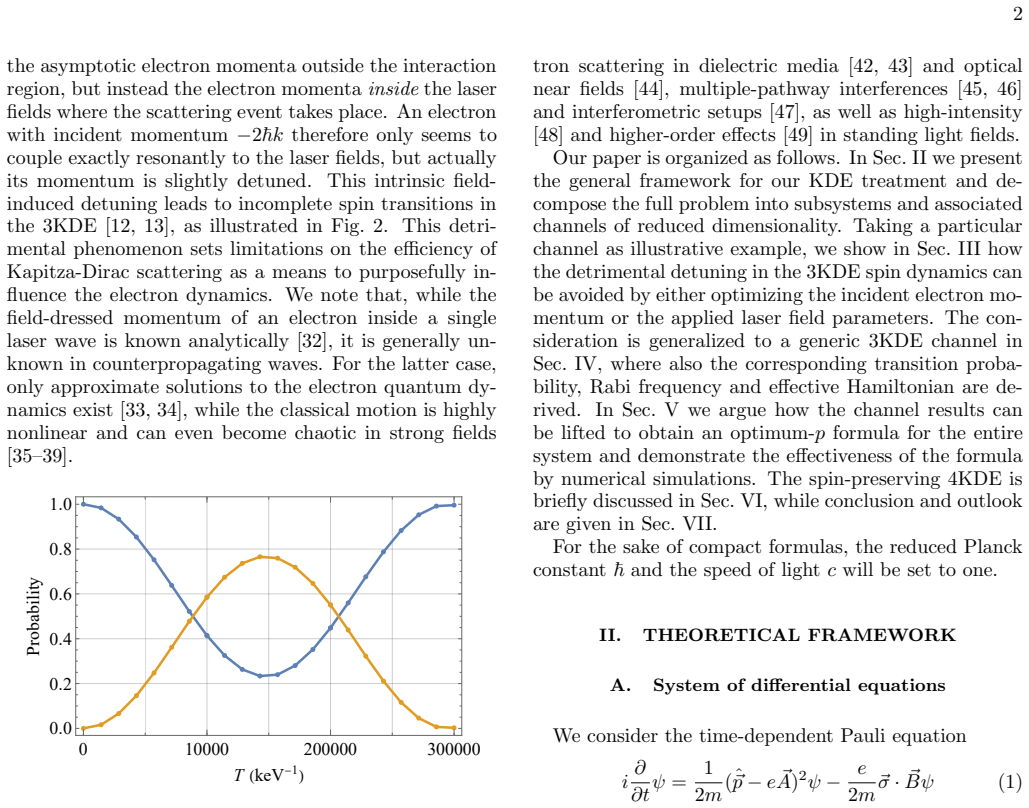
- At the field parameters tested, applying the optimum offset lifts the peak three-photon scattering probability from about 30% at $p_z=0$ to a fully developed Rabi oscillation at $p_z\approx0.363$ eV.
- For a single three-photon channel, the optimum offset raises the maximum transfer from 64% to complete oscillation, with $p_z\approx0.0012$ keV in the example.
- There are special laser-parameter relations—$e^4a_1^4=16e^2a_2^2\omega^2$ for the 3KDE and $a_1^2=4a_2^2$ for the 4KDE—at which no momentum offset is needed at all.
- The analytic detuned-Rabi formula $|c^\downarrow_{2,\mathrm{3KDE}}(t)|^2=(\Omega_{\mathrm{3KDE}}/\Omega^{(\delta)}_{\mathrm{3KDE}})^2\sin^2(\tfrac12\Omega^{(\delta)}_{\mathrm{3KDE}}t)$, with $\Omega^{(\delta)}_{\mathrm{3KDE}}=\sqrt{\Omega_{\mathrm{3KDE}}^2+(\Delta_{\mathrm{3KDE}}-4\omega p_z/m)^2}$, reproduces the full resonance curve, so the scattering probability at any offset can be predicted w
- Channel Rabi frequencies add to the full-system Rabi frequency, recovering the earlier perturbative result $\Omega_{\mathrm{3KDE}}\approx -e^3 a_1^2 a_2\omega/(2m^3)$.
Reading between the lines
- If the additive-summation rule survives the inclusion of "backward loops," the same channel-by-channel recipe should produce optimum momentum offsets for higher-order $N$-photon Kapitza-Dirac processes, where more channels contribute more shift terms.
- Because the detuning is cast as an avoided crossing of dressed states, the compensation strategy is not specific to this geometry: analogous incident-momentum tuning should remove field-induced resonance offsets in other free-electron diffraction settings, such as scattering from optical near-fields or standing-wave gratings.
- The formulas suggest a practical alignment protocol: rather than relying on a theoretical prediction of absolute field intensities, one could scan $p_z$ for the Lorentzian peak of the scattered signal and treat that measured offset as the experimental optimum.
- For spin-dependent three-photon scattering, the restored complete Rabi oscillation implies that a spin-polarizing beam splitter built on this process could run at near-unit efficiency, limited only by the neglected higher-order channels.
Signed reviews
Editorial analysis
A structured set of objections, weighed in public.
Referee Report
Summary. The paper studies nonrelativistic Kapitza-Dirac scattering of electrons from counterpropagating bichromatic laser fields in the resonant Bragg regime, including the electron spin. Starting from the Pauli equation and a discrete plane-wave ansatz, it derives an infinite coupled system (Eq. (4)). The authors decompose the 3KDE into two subsystems and four channels, and construct finite-dimensional minimal models (Eqs. (17), (19), (73)). For a generic three-level channel (Eq. (35)), they derive an optimum incident momentum offset pg (Eq. (40)) that makes the two coupled-oscillator equations symmetric and hence restores full Rabi oscillations. They then add channel contributions to obtain optimum-momentum formulas for the full 3KDE model (Eq. (75)) and the 4KDE (Eq. (96)), derive effective Hamiltonians, detuned Rabi frequencies, and Lorentzian amplitude curves, and verify the predictions numerically on the truncated models. The paper concludes by noting that a full description of the infinite-dimensional system requires accounting for 'backward loops' that can add further energy shifts.
Significance. If the optimum-p formulas hold beyond the truncated models, they provide the first quantitative, analytic description of the field-induced detuning in few-photon Kapitza-Dirac scattering and a concrete experimental prescription for achieving resonant Bragg scattering. The derivations are parameter-free (no fitting constants), and the numerical simulations of the reduced models confirm the analytic Rabi frequencies and Lorentz curves. The channel decomposition and effective Hamiltonian are likely to be useful for future studies. However, the significance is presently tempered by the fact that the central claim is verified only on finite truncations; the paper's own Sec. VII flags backward-loop energy shifts that are not included in Eq. (75).
major comments (3)
- [Sec. VII and Eq. (75)] The paper's conclusion explicitly states that 'backward loops' of the form c↑_-2 → c↑_-4 → c↑_-2 can lead to additional energy shifts that need to be compensated by an adjusted momentum offset. These loops are second-order diagonal corrections of the same type as the field-induced dressing that the analysis compensates. Because Eq. (75) is built from the truncated matrix (73) and is verified only against simulations of that matrix (Figs. 7 and 8), the claim that the detuning 'can be compensated by a suitable adjustment of its incident momentum' (abstract) is not established for the full infinite-dimensional system (4). I request either a quantitative estimate of the omitted backward-loop contributions (for example, a second-order perturbative evaluation of the diagonal shifts from states n = ±4) or an explicit restriction of the claim to the reduced model, with the abstract and introduction reworded accordingly.
- [Sec. V, Eqs. (74)-(75)] The transition from single-channel results to the full 3KDE system rests on an additivity assumption introduced as an 'expectation' in the text. No derivation is given for why the energy shifts from the four potentials in matrix (73) combine linearly, nor for why the channel Rabi frequencies add (Eqs. (76)-(78)). The numerical confirmation in Fig. 7 validates this assumption only within the truncated space. Since Eq. (75) is the central quantitative result, the paper should either derive the effective Hamiltonian for the full model along the lines of Sec. IV.F or provide a separate numerical convergence test (e.g., including states n = ±4) to show that the optimum momentum is stable under extension of the basis.
- [Sec. VI, Eq. (96)] The 4KDE optimum-p formula is obtained by analyzing a single channel (Eq. (91)) and then doubling the channel result by the same additivity assumption as for the 3KDE. The same truncation concern applies: the numerical demonstration in Fig. 9 is for the truncated matrix (83), and no estimate is given for the effect of omitted states on the resonance position. The authors should either provide an estimate or state more cautiously that the formula applies to the minimal model.
minor comments (5)
- [Eq. (84)] The exponent of \tilde{V}_2 is missing the imaginary unit; it should read e^{-2iωt} instead of e^{-2ωt}.
- [Eqs. (55) and (58)] The expression '-U_1^2 - U_1^2' appears in the denominator of the Rabi frequency formula; based on the structure it should be '-U_1^2 - U_2^2'. Please correct this typo, which currently affects the readability of the general formula.
- [Sec. II B] The phrase 'uneven N' should be 'odd N' (and 'even N' is used correctly); consider consistent terminology throughout the manuscript.
- [Fig. 5 caption] The axis label 'Ω( eV)' is unclear; 'Rabi frequency (eV)' would be more explicit.
- [Sec. V, Eq. (73)] It would help to label the columns and rows with the corresponding spin-state components, as is done for the smaller matrices (17) and (19).
Circularity Check
No significant circularity: the optimum-momentum formulas are derived analytically from the coupled-oscillator symmetry condition, and the paper's own flagged truncation limitation is a correctness caveat, not an input-output equivalence.
full rationale
The central optimum-p formulas (Eqs. (25), (40), (75), (96)) are obtained by solving the algebraic condition A1 = A2 that makes the two second-order oscillator equations symmetric (Secs. III A and IV A). No parameter is fitted to the numerical curves that are later compared with the formulas; the simulations integrate the same truncated differential equations and serve as consistency checks of the analytic reduction. The lift from channels to the full model (Sec. V) uses an explicit additivity expectation, which is an unproven modeling assumption rather than a circular reduction. The paper itself states in Sec. VII that a full infinite-dimensional description would require accounting for backward loops such as c↑_-2 -> c↑_-4 -> c↑_-2, which can add energy shifts; this is an admitted limitation of the truncated model and therefore a correctness risk for the experimental claim, not an equivalence of the result to its inputs. Self-citations to Ref. [12] provide the known 3KDE Rabi frequency and a heuristic detuning Hamiltonian used for comparison; the channel-level derivation does not depend on these cited results, so the self-citations are not load-bearing.
Assumptions & free parameters
assumptions (4)
- domain assumption The Pauli equation with the bichromatic vector potential (2) describes nonrelativistic Kapitza-Dirac scattering with spin.
- ad hoc to paper The infinite-dimensional coupled system (4) can be truncated to the finite minimal models (17), (19), (73), and (83) without losing the relevant detuning shifts.
- domain assumption The approximations E_-2 ~ E_2 and E_i << omega_1 hold.
- standard math The spurious solutions introduced by the second-order reduction can be identified and discarded.
Cite this review
Pith. "Pith review of Optimizing the incident electron momentum for resonant few-photon Kapitza-Dirac scattering in bichromatic laser fields." pith.science (2026). https://pith.science/paper/ON7AS4JV
@misc{pith2026250706703,
  author       = {Pith},
  title        = {Pith review of: Optimizing the incident electron momentum for resonant few-photon Kapitza-Dirac scattering in bichromatic laser fields},
  year         = {2026},
  howpublished = {\url{https://pith.science/paper/ON7AS4JV}},
  note         = {Machine review of arXiv:2507.06703}
}
read the original abstract
Nonrelativistic Kapitza-Dirac scattering of electrons from counterpropagating bichromatic laser waves is studied in the resonant Bragg regime, taking the electron spin into account. We show that the intrinsic field-induced detuning, which arises in the Rabi oscillation dynamics between initial and scattering state of the electron, can be compensated by a suitable adjustment of its incident momentum. Analytical formulas of the optimized electron momentum for spin-dependent three-photon and spin-independent four-photon Kapitza-Dirac scattering are obtained from simplified model systems in reduced dimensionality, which preserve the characteristic properties of the process.
Figures


Figures from the paper (6 more)


Reference graph
Works this paper leans on
-
[1]
P. L. Kapitza and P. A. M. Dirac, Math. Proc. Cambridge Philos. Soc. 29, 297 (1933)
work page 1933
-
[2]
has been removed here from the diagonal entries via a phase transformation. Equivalently, we can construct a minimal model for subsystem II as i ˙⃗ cII(t) = E−2 ˜V2 ˜W1 0 ˜V ∗ 2 E1 0 ˜W1 ˜W ∗ 1 0 E−1 ˜V1 0 ˜W ∗ 1 ˜V ∗ 2 E2 ⃗ cII(t) (19) with ⃗ cII = (c↑ −2(t), c↑ 1(t), c↓ −1(t), c↓ 2(t)) and ˜V2 = e2a1a2 4m e−iωt, ˜W1 = ea1ω 4m eiωt . (20) We ...
- [3]
-
[4]
D. L. Freimund and H. Batelaan, Phys. Rev. Lett. 89, 283602 (2002)
work page 2002
-
[5]
M. V. Fedorov, Progr. Quant. Electron. 7, 73 (1981)
work page 1981
-
[6]
M. Koz´ ak, T. Eckstein, N. Sch¨ onenberger, and P. Hom- melhoff, Nat. Phys. 14, 121 (2018)
work page 2018
-
[7]
P. H. Bucksbaum, D. W. Schumacher, and M. Bashkan- sky, Phys. Rev. Lett. 61, 1182 (1988); P. L. Gould, G. A. Ruff, and D. E. Pritchard, ibid. 56, 827 (1986); P. J. Mar- tin, B. G. Oldaker, A. H. Miklich, and D. E. Pritchard, ibid. 60, 515 (1988); S. Eilzer, H. Zimmermann, and U. Eichmann, ibid. 112, 113001 (2014)
work page 1988
-
[8]
D. L. Freimund, K. Aflatooni, and H. Batelaan, Nature (London) 413, 142 (2001)
work page 2001
Show all 56 references
-
[9]
Smirnova, D
O. Smirnova, D. L. Freimund, H. Batelaan, and M. Ivanov, Phys. Rev. Lett. 92, 223601 (2004)
2004
-
[10]
D. L. Freimund and H. Batelaan, Laser Phys. 13, 892 (2003)
2003
-
[11]
K. Lin, S. Eckart, H. Liang, A. Hartung, S. Jacob, Q. Ji, L. Ph. H. Schmidt, M. S. Sch¨ offler, T. Jahnke, M. Ku- nitski, and R. D¨ orner, Science383, 1467 (2024)
2024
-
[12]
M. M. Dellweg, H. M. Awwad, and C. M¨ uller, Phys. Rev. A 94, 022122 (2016)
2016
-
[13]
M. M. Dellweg and C. M¨ uller, Phys. Rev. A 95, 042124 (2017)
2017
-
[14]
McGregor, W
S. McGregor, W. C.-W. Huang, B. A. Shadwick, and H. Batelaan, Phys. Rev. A 92, 023834 (2015)
2015
-
[15]
Erhard and H
R. Erhard and H. Bauke, Phys. Rev. A 92, 042123 (2015); H. Bauke, S. Ahrens, and R. Grobe, Phys. Rev. A 90, 052101 (2014)
2015
-
[16]
Ahrens, Phys
S. Ahrens, Phys. Rev. A 96, 052132 (2017)
2017
-
[17]
M. M. Dellweg and C. M¨ uller, Phys. Rev. Lett. 118, 070403 (2017)
2017
-
[18]
W. X. Tang, D. M. Paganin, and W. Wan, Phys. Rev. B 85, 064418 (2012)
2012
-
[19]
Ghazaryan, M
A. Ghazaryan, M. Lemeshko, and A. G. Volosniev, Com- mun. Phys. 3, 178 (2020)
2020
-
[20]
McGregor, R
S. McGregor, R. Bach, and H. Batelaan, New J. Phys. 13, 065018 (2011)
2011
-
[21]
J. Tian, F. Liu, X. Xiong, and Y. Huang, Nanophotonics 13, 3825 (2024)
2024
-
[22]
Pan and H
D. Pan and H. Xu, Phys. Rev. Lett. 130, 186901 (2023)
2023
-
[23]
Karimi, L
E. Karimi, L. Marrucci, V. Grillo, and E. Santamato, Phys. Rev. Lett. 108, 044801 (2012); V. Grillo, L. Mar- rucci, E. Karimi, R. Zanella, and E. Santamato, New J. Phys. 15, 093026 (2013)
2012
-
[24]
Ahrens, Z
S. Ahrens, Z. Liang, T. ˇCadeˇ z, and B. Shen, Phys. Rev. A 102, 033106 (2020); Y. Wang and S. Ahrens, Phys. Rev. A 109, 012212 (2024)
2020
-
[25]
Ahrens, Z
S. Ahrens, Z. Guan, and B. Shen, Phys. Rev. A 105, 053123 (2022)
2022
-
[26]
Ahrens, H
S. Ahrens, H. Bauke, C. H. Keitel, and C. M¨ uller, Phys. Rev. Lett. 109, 043601 (2012); Phys. Rev. A 88, 012115 (2013)
2012
-
[27]
Y.-F. Li, R. Shaisultanov, K. Z. Hatsagortsyan, F. Wan, C. H. Keitel, and J.-X. Li, Phys. Rev. Lett. 122, 154801 (2019)
2019
-
[28]
R.-T. Guo, Y. Wang, R. Shaisultanov, F. Wan, Z.-F. Xu, Y.-Y. Chen, K. Z. Hatsagortsyan, and J.-X. Li, Phys. Rev. Research 2, 033483 (2020)
2020
-
[29]
P. Ge, S. Ahrens, and B. Shen, Phys. Rev. A 109, 022240 (2024)
2024
-
[30]
Del Sorbo, D
D. Del Sorbo, D. Seipt, A. G. R. Thomas, and C. P. Ridgers, Plasma Phys. Control. Fusion 60, 064003 (2018)
2018
-
[31]
Seipt, D
D. Seipt, D. Del Sorbo, C. P. Ridgers, and A. G. R. Thomas, Phys. Rev. A 100, 061402(R) (2019)
2019
-
[32]
Zhuang, Y.-Y
K.-H. Zhuang, Y.-Y. Chen, Y.-F. Li, K. Z. Hatsagort- syan, and C. H. Keitel, Phys. Rev. D 108, 033001 (2023)
2023
-
[33]
Hu and J
H. Hu and J. Huang, Phys. Rev. A 92, 062105 (2015)
2015
-
[34]
King and H
B. King and H. Hu, Phys. Rev. D 94, 125010 (2016)
2016
-
[35]
D. M. Volkov, Z. Phys. 94, 250 (1935)
1935
-
[36]
A. E. Kaplan and A. L. Pokrovsky, Phys. Rev. Lett. 95, 053601 (2005). 14
2005
-
[37]
Lehmann and K
G. Lehmann and K. H. Spatschek, Phys. Rev. E 85, 056412 (2012)
2012
-
[38]
Bauer, P
D. Bauer, P. Mulser and W.-H. Steeb, Phys. Rev. Lett. 75, 4622 (1995)
1995
-
[39]
Q. Z. Lv, E. Raicher, C. H. Keitel, and K. Z. Hatsagort- syan, New J. Phys. 23, 065005 (2021)
2021
-
[40]
V. M. Haroutunian and H. K. Avetissian, Phys. Lett. A 51, 320 (1975)
1975
-
[41]
A. V. Bashinov, A. V. Kim, and A. M. Sergeev, Phys. Rev. E 92, 043105 (2015)
2015
-
[42]
Avetissian, Phys
H. Avetissian, Phys. Lett. A 58, 144 (1976)
1976
-
[43]
A. G. Hayrapetyan, K. K. Grigoryan, J. B. G¨ otte, and R. G. Petrosyan, New J. Phys. 17, 082002 (2015)
2015
-
[44]
M. V. Fedorov and J. K. McIver, Opt. Commun. 32, 179 (1980)
1980
-
[45]
M. M. Dellweg and C. M¨ uller, Phys. Rev. A 91, 062102 (2015)
2015
-
[46]
Vidil and B
P. Vidil and B. Chalopin, Phys. Rev. A 92, 062117 (2015)
2015
-
[47]
Feist, K
A. Feist, K. E. Echternkamp, J. Schauss, S. V. Yalunin, S. Sch¨ afer, and C. Ropers, Nature (London) 521, 200 (2015)
2015
-
[48]
subsystems
and higher-order effects [49] in standing light fields. Our paper is organized as follows. In Sec. II we present the general framework for our KDE treatment and de- compose the full problem into subsystems and associated channels of reduced dimensionality. Taking a particular ...
-
[49]
Koz´ ak, Phys
M. Koz´ ak, Phys. Rev. A98, 013407 (2018)
2018
-
[50]
Marzlin, Phys
K.-P. Marzlin, Phys. Rev. A 88, 043621 (2013)
2013
-
[51]
backward loops
or high-power x-ray free-electron lasers (XFELs) like the European XFEL (Hamburg, Germany) or the Linac Coherent Light Source (LCLS, Stanford, California) [52], which are able to produce brilliant x-ray pulses with pho- ton energies up to ∼ 10 keV at ∼ 1020 W/cm2 intensities a...
-
[52]
B¨ oning, W
B. B¨ oning, W. Paufler, and S. Fritzsche, Phys. Rev. A 101, 031401 (2020)
2020
-
[53]
Cohen-Tannoudji, B
C. Cohen-Tannoudji, B. Diu, and F. Lalo¨ e,Quantum Me- chanics, vol. 1 (Wiley, New York, 1992)
1992
-
[54]
R¨ odel, D
See, e.g., C. R¨ odel, D. an der Br¨ ugge, J. Bierbach, M. Ye- ung, T. Hahn, B. Dromey, S. Herzer, S. Fuchs, A. G. Pour, E. Eckner et al. , Phys. Rev. Lett. 109, 125002 (2012); M. Cerchez, A. L. Giesecke, C. Peth, M. Ton- cian, B. Albertazzi, J. Fuchs, O. Willi, and T. Toncian...
2012
-
[55]
For current information, see the websites available at http://www.xfel.eu and https://lcls.slac.stanford.edu
-
[56]
Ebadati, M
A. Ebadati, M. Vafaee, and B. Shokri, Phys. Rev. A 98, 032505 (2018)
2018
Reviewed August 6, 2026 · model on record in the stance chip above.
Discussion (0). Continue with ORCID to comment.