REVIEW 3 major objections 6 minor 100 references
Spatially resolved H$\alpha$ emission in B14-65666: compact starbursts, ionizing efficiency and gas kinematics in an advanced merger at the Epoch of Reionization
T0 review · 3 major / 6 minor · reviewed 2026-08-06 · deepseek-v4-flash
Pith's one-line read B14-65666 is an advanced major merger of two starbursting galaxies at z=7.15, resolved in Hα into an ultra-compact component and a tidal-tail component.
desk verdict First spatially resolved H-alpha in a z~7 merger: the merger/starburst story holds, but the dust corrections need work before the quantitative numbers are trusted. read the letter →
The pith
A machine-rendered reading of the paper's core claim, the machinery that carries it, and where it could break.
The reading
What carries the argument
The key machinery is the spatially resolved Hα line map and velocity field built from MIRI MRS Channel 1 (4.9–5.74 µm), which traces the ionized gas and the recent star formation. The authors combine this with NIRCam rest-frame UV and optical imaging to measure sizes and spectral energy distributions, with the NIRSpec Hβ narrow-component fluxes to form the Balmer decrement (the Hα/Hβ ratio used to derive the nebular extinction $A_V$), and with ALMA [O III] 88 µm and [C II] 158 µm data to cross-check the kinematics. Single-Gaussian fits to each Hα component give the flux, FWHM, and velocity offset; the rest-frame Hα equivalent width and the ionizing photon production efficiency $\log\zeta_{\mathrm{ion}}$ are derived from the extinction-corrected Hα and the 1500 Å luminosity. The merger interpretation is carried by the spatial separation, the velocity offset, the tidal-tail morphology of W, and the extreme compactness of E.
What would settle it
A matched-aperture, matched-resolution measurement of the Hα/Hβ ratio using only the narrow components of both lines would test the derived $A_V$ values (1.5 mag for E and 0.1 mag for W); if the true $A_V$ for W is closer to the SED-based value (about 1.6 mag), the star formation rates and $\log\zeta_{\mathrm{ion}}$ values would shift by amounts exceeding the quoted uncertainties and the $\zeta_{\mathrm{ion}}$–EW interpretation would need revision.
Extended reading notes
Core claim
The paper's central discovery is that the Hα-emitting gas in B14-65666 is dominated by two spatially resolved sources, E and W, at a projected separation of 0.4 arcsec (2.2 kpc) and a relative velocity of 175±28 km s$^{-1}$, establishing the system as an advanced major merger of two starbursting galaxies at z=7.15. Galaxy E is unresolved in the rest-frame UV, with an effective radius upper limit of 63 pc and a stellar mass surface density of about $6\times10^{4}\,M_\odot$ pc$^{-2}$, close to the values in the nuclei of low-redshift galaxies; galaxy W is extended with an effective radius of 348 pc and shows a clumpy elongated structure consistent with a tidal tail. The extinction-corrected Hα fluxes yield star formation rates of 76±8 $M_\odot$ yr$^{-1}$ (E) and 30±4 $M_\odot$ yr$^{-1}$ (W) at solar metallicity, with specific star formation rates of 40–50 Gyr$^{-1}$, placing both components in a starburst phase. The system is dominated by a stellar population younger than 10 Myr, and the ionizing photon production efficiencies ($\log\zeta_{\mathrm{ion}} = 25.1\pm0.1$ and $25.5\pm0.1$ Hz erg$^{-1}$) are within the range of normal star-forming galaxies at similar redshifts.
Load-bearing premise
The dust correction assumes that the narrow-component Hβ brightness measured by NIRSpec, after matching the apertures, comes from exactly the same gas as the MIRI Hα measurement; if the apertures do not line up, or if the broad Hβ component should not have been left out, the derived dust, star formation rates, and ionizing efficiencies all shift, and the paper's own mismatch between the UV and Balmer dust values for galaxy W shows this assumption is fragile.
Editorial extensions
If this is right
- If the merger interpretation holds, B14-65666 becomes a benchmark for how mergers concentrate gas and trigger starbursts in the Epoch of Reionization, with the ultra-compact galaxy E possibly an early protobulge.
- The measured ionizing photon production efficiencies ($\log\zeta_{\mathrm{ion}} = 25.1$ and $25.5$ Hz erg$^{-1}$) confirm that a major merger does not produce anomalously high ionizing efficiency, so such systems contribute to reionization roughly like normal star-forming galaxies at the same epoch.
- The specific star formation rates of 40–50 Gyr$^{-1}$ put both components well above the z=7 main sequence, implying short gas-depletion times and a possible rapid quenching for the compact component E.
- The 175 km s$^{-1}$ velocity offset and the different line widths seen in Hα, [C II], and [O III] indicate that the merger shapes the ionized, neutral, and highly ionized gas phases differently on kiloparsec scales.
- If the clumpy phase is short-lived (~50 Myr), as simulations suggest, the system should merge into a single more massive galaxy, showing that massive galaxies can assemble through starbursty mergers already at z>7.
Reading between the lines
- If the upper limit of 63 pc for galaxy E holds under higher-resolution imaging, the true effective radius may be smaller still, making E a candidate for the densest star-forming system at z>7 and strengthening the case that bulges form through clump coalescence.
- The paper's normal $\zeta_{\mathrm{ion}}$ values despite extreme sSFR suggest that merger-boosted star formation does not itself raise ionizing efficiency; comparing resolved mergers with isolated galaxies of the same mass in the $\zeta_{\mathrm{ion}}$–EW plane would separate age and metallicity effects from burstiness.
- If the inferred short (≈50 Myr) clumpy phase is correct, catching B14-65666 in this state implies either a high merger rate at z>7 or a longer-lived clumpy phase than simulations predict; a statistical census of resolved Hα mergers in JWST fields would directly constrain the phase lifetime.
Editorial analysis
A structured set of objections, weighed in public.
Referee Report
Summary. The paper presents MIRI/MRS and MIRIM observations of B14-65666 at z=7.15, reporting the first detection of spatially resolved Halpha emission in this system. The authors decompose the emission into two components, E and W, separated by 0.4 arcsec, and combine the MRS data with NIRCam photometry, ALMA line data, and literature Hbeta measurements to derive star formation rates (76±8 and 30±4 Msun/yr for E and W), rest-frame Halpha equivalent widths (832±100 and 536±78 Å), ionizing photon production efficiencies (log zeta_ion = 25.1±0.1 and 25.5±0.1 Hz/erg), dust attenuations, stellar masses, effective radii, and Halpha kinematics. The paper concludes that B14-65666 is an advanced major merger of two starbursting galaxies, with galaxy E extremely compact (re < 63 pc) and a relative velocity of 175±28 km/s between the components, consistent with ALMA measurements.
Significance. If the quantitative results hold, this is one of the first spatially resolved Halpha studies of a z>7 galaxy merger and provides direct measurements of current star formation, ionizing efficiency, and gas kinematics in the Epoch of Reionization. The data reduction is careful and detailed: pipeline versions and CRDS contexts are specified, PSF homogenization is described, Monte Carlo uncertainties are used, and the astrometric alignment is grounded in Gaia. The central merger interpretation is robust because it does not depend on the uncertain dust corrections: the two-component morphology, the 175 km/s velocity offset matching ALMA, the stellar masses near 1e9 Msun, and the morphological asymmetries all support the scenario. However, the quantitative SFR, EW0, and zeta_ion values are tied to a Balmer-decrement dust correction that is internally inconsistent with the SED attenuation, so these specific numbers should be treated as provisional until the systematic is addressed.
major comments (3)
- [Section 4.2, Table 2] The nebular A_V values derived from the Balmer decrement are not consistent with the SED attenuation under the adopted Calzetti law. For galaxy E, A_V(Halpha/Hbeta)=1.5±0.4, whereas the CIGALE A_FUV=1.5±0.2 implies A_V about 0.6 if A_FUV/A_V is about 2.5; for galaxy W, A_V=0.1(+0.5,-0.1) while A_FUV=1.6±0.2 implies A_V about 0.6. The two components therefore disagree in opposite directions: galaxy E is over-corrected and galaxy W is under-corrected. Because Sections 4.3 and 4.4 use these A_V values to correct SFR_Halpha, EW0(Halpha), and zeta_ion, the quoted quantitative results are not on a single consistent attenuation scale. I request that the authors recompute the extinction-corrected quantities using the SED-based A_V for both components and bracket the allowed differential nebular-to-stellar attenuation, reporting the resulting shifts in SFR and zeta_ion. This is a necessary step before the numerical values in the abstract and Table 2 can be taken at face value.
- [Section 4.2] The Halpha/Hbeta ratio combines MRS Halpha with narrow-component Hbeta fluxes from Jones et al. (2024) scaled to the MRS aperture with AC=1/0.79, while the Halpha flux is measured with a different PSF and a single-Gaussian fit. The broad Hbeta component is excluded because the broad Halpha component is not detected, but no upper limit on broad Halpha is provided. The paper should quantify the aperture-matching uncertainty and give a limit on the broad Halpha flux; without these, the Balmer-decrement A_V and all quantities derived from it carry an unquantified systematic floor from this cross-instrument combination.
- [Sections 3.4 and 4.7] The conclusion that galaxy E has an extreme stellar-mass surface density close to low-z galactic nuclei rests on an unresolved core with an upper-limit effective radius of 63 pc and on a CIGALE stellar mass of (15±9)x10^8 Msun. The surface density is therefore a lower limit, not a measured value, and the large mass uncertainty should be propagated into the mass-size and surface-density comparisons. The Conclusions bullet already uses the lower-limit wording ('>6x10^4 Msun/pc^2'), but the same caveat should also appear in Section 4.7 and in the abstract so that the compactness claim is not overstated.
minor comments (6)
- [Section 2.1.1] The text cites 'Álvarez-Márquez et al. 2023 and Álvarez-Márquez et al. 2023' for the customized MRS calibration; these should be distinguished as different works (e.g., 2023a and 2023b) or the duplicate citation should be removed.
- [Section 3.3] Section 3.4 establishes that the 63 pc size for galaxy E is an upper limit, but Section 3.3 refers to 'an estimated physical size of 63 pc'; the upper-limit nature should be stated consistently in both places.
- [Table 2] The A_V row is listed as a dash for the E+W column, while the text compares A_FUV with the total IRX-based value; adding the E+W A_FUV and clarifying which entries are nebular versus stellar attenuation would improve the table.
- [Footnote 3 and Section 4.5] The revised [C II] 158um FWHM for galaxy E is based on a private communication with the authors of Hashimoto et al. (2019); since this value enters the kinematic comparison, the basis for the revision should be documented in the main text rather than only in a footnote.
- [Section 4.5] The sentence 'These values agree within the uncertainties (from those measured) with the far-infrared emission lines' is syntactically unclear and should be rewritten for clarity.
- [References] The reference list contains two Hu et al. (2025) entries with different titles; these should be disambiguated with the appropriate arXiv identifiers or merged into a single entry if they refer to the same work.
Circularity Check
No significant circularity: the merger and starburst conclusions rest on new MRS observations and external datasets; self-citations are not load-bearing.
full rationale
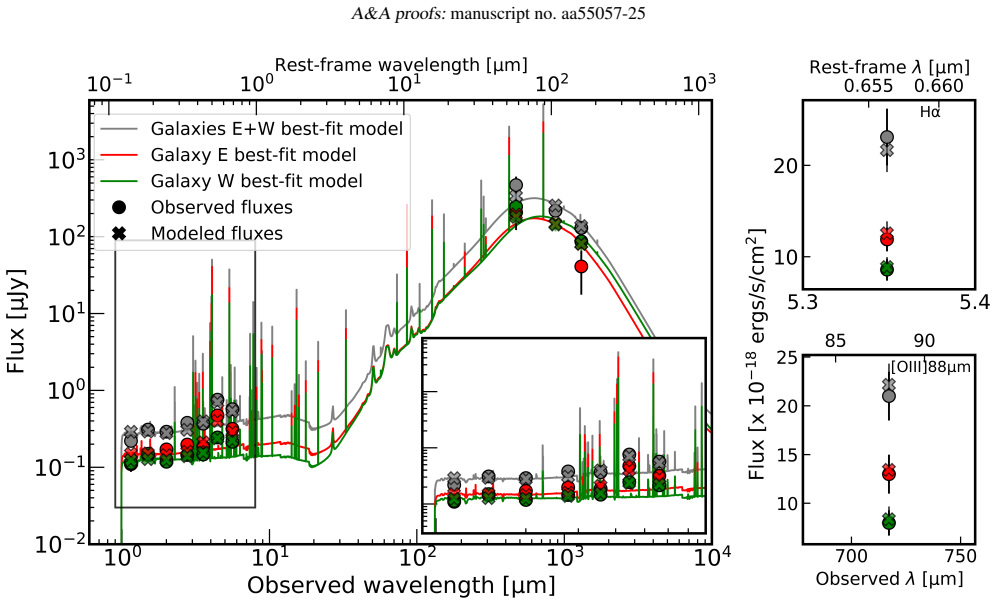
The central claims—two resolved H-alpha components, a 175 km/s velocity offset, a young (<10 Myr) dominant stellar population, and starburst-level sSFRs—are derived from new MIRI/MRS measurements combined with external datasets, not from quantities defined in terms of the claims. SFR_Halpha uses the Balmer-decrement extinction correction in Sect. 4.2, where the H-beta narrow-component flux comes from Jones et al. (2024), an independent team and an independent NIRSpec dataset, with explicitly stated aperture corrections; no equation reduces a derived quantity to a fit of itself. EW0(Halpha) and log zeta_ion are measured ratios (H-alpha/continuum and H-alpha/UV luminosity) that are compared with, not derived from, BPASS models and literature samples. The CIGALE SED fits take observed photometry and line fluxes as inputs, and the 'predicted fluxes' in Fig. 4 are goodness-of-fit displays rather than independent predictions. The under-10-Myr age conclusion is supported by the BPASS comparison, not solely by the CIGALE age grid, which is bounded at 10 Myr by construction. Self-citations (Hashimoto et al. 2019; Sugahara et al. 2025; Alvarez-Marquez et al. 2023, 2024) supply archival ALMA/NIRCam observations or data-reduction recipes; they are not invoked as uniqueness theorems, and the merger interpretation is independently supported by the two-component H-alpha detection, the ALMA [O III]/[C II] kinematics, the morphology, the velocity offset, and the stellar masses ~1e9 Msun. The internal inconsistency between Balmer A_V and SED-derived A_FUV is a measurement-robustness caveat rather than a circularity, and it does not change the qualitative merger or starburst classification within the quoted uncertainties. The derivation chain is therefore self-contained.
Assumptions & free parameters
free parameters (6)
- SED stellar mass =
E: 1.5e9 Msun, W: 8e8 Msun
- SED young stellar population age =
E: 6±3 Myr, W: 8±3 Myr
- SED mature population age =
E: 224±150 Myr, W: 158±155 Myr
- SED A_FUV =
E: 1.5±0.2, W: 1.6±0.2 mag
- Balmer A_V (nebular) =
E: 1.5±0.4, W: 0.1+0.5-0.1 mag
- Metallicity =
E: 0.24±0.12, W: 0.31±0.15 Zsun
assumptions (8)
- standard math Flat LCDM cosmology with Omega_m=0.310, H0=67.7 km/s/Mpc (Planck 2020)
- domain assumption Bruzual & Charlot (2003) stellar population models and Chabrier (2003) IMF
- domain assumption Calzetti et al. (2000) dust attenuation law
- domain assumption Case B recombination with T_e=1.5e4 K and n_e=1e3 cm-3 (theoretical H-alpha/H-beta=2.8)
- domain assumption Zero Lyman continuum escape fraction for zeta_ion
- domain assumption SFR conversion factors from Reddy et al. (2018) and Kennicutt & Evans (2012)
- ad hoc to paper Aperture corrections assume E and W are unresolved sources for the MRS PSF
- domain assumption Single Gaussian represents the H-alpha line profile
Cite this review
Pith. "Pith review of Spatially resolved H$\alpha$ emission in B14-65666: compact starbursts, ionizing efficiency and gas kinematics in an advanced merger at the Epoch of Reionization." pith.science (2026). https://pith.science/paper/7JYMSSUN
@misc{pith2026250706793,
  author       = {Pith},
  title        = {Pith review of: Spatially resolved H$\alpha$ emission in B14-65666: compact starbursts, ionizing efficiency and gas kinematics in an advanced merger at the Epoch of Reionization},
  year         = {2026},
  howpublished = {\url{https://pith.science/paper/7JYMSSUN}},
  note         = {Machine review of arXiv:2507.06793}
}
abstract
We present MIRI/JWST medium resolution spectroscopy (MRS) and imaging (MIRIM) of B14-65666, a Lyman-break and interacting galaxy at redshift $z$=7.15. We detect the H$\alpha$ line emission in this system, revealing a spatially-resolved structure of the H$\alpha$ emitting gas, which consists of two distinct galaxies, E and W, at a projected distance of 0.4". Galaxy E is very compact in the rest-frame UV, while W galaxy is more extended, showing a clumpy structure reminiscent of a tidal tail. The total H$\alpha$ luminosity implies that the system is forming stars at a Star Formation Rate (SFR) of 76$\pm$8 M$_{\odot}$ yr$^{-1}$ and 30$\pm$4 M$_{\odot}$ yr$^{-1}$ for E and W, respectively. The ionizing photon production efficiency is within the range measured in galaxies at similar redshifts. The high values derived for the H$\alpha$ equivalent widths (EW) and the distinct locations of the E and W galaxies in the $\log(\zeta_\mathrm{ion}$) $-$ EW (H$\alpha$) plane, indicate that the system is dominated by a young (less than 10 Myr) stellar population. The overall spectral energy distribution suggests that in addition to a young stellar population, the two galaxies may have mature stellar population and very different dust attenuation. The derived SFR and stellar masses identify the two galaxies as going through a starburst phase. The kinematics of the ionized gas traced by the H$\alpha$ line show a velocity difference of 175 $\pm$ 28 km s$^{-1}$ between the two components of B14-65666. The in-depth study of systems like B14-65666 reveal how galaxy mergers in the early Universe drive intense star formation, shape the interstellar medium, and influence the buildup of stellar mass, just 700 $-$ 800 Myr after the Big Bang.
Figures


Figures from the paper (5 more)


Reference graph
Works this paper leans on
-
[1]
D., Vanzella, E., et al
Adamo, A., Bradley, L. D., Vanzella, E., et al. 2024, Nature, 632, 513
2024
-
[2]
A., Toft, S., et al
Allen, N., Oesch, P. A., Toft, S., et al. 2025, A&A, 698, A30 Álvarez-Márquez, J., Colina, L., Crespo Gómez, A., et al. 2024, A&A, 686, A85 Álvarez-Márquez, J., Crespo Gómez, A., Colina, L., et al. 2025, A&A, 695, A250 Álvarez-Márquez, J., Crespo Gómez, A., Colina, L., et al. 2023, A&A, 671, A105
2025
-
[3]
R., et al
Argyriou, I., Glasse, A., Law, D. R., et al. 2023, A&A, 675, A111
2023
-
[4]
2024, A&A, 688, A146
Arribas, S., Perna, M., Rodríguez Del Pino, B., et al. 2024, A&A, 688, A146
2024
-
[5]
J., et al
Atek, H., Labbé, I., Furtak, L. J., et al. 2024, Nature, 626, 975
2024
-
[6]
Baggen, J. F. W., van Dokkum, P., Labbé, I., et al. 2023, ApJ, 955, L12
2023
-
[7]
J., Geller, M
Barton, E. J., Geller, M. J., & Kenyon, S. J. 2000, ApJ, 530, 660
2000
-
[8]
2013, A&A, 557, A59
Bellocchi, E., Arribas, S., Colina, L., & Miralles-Caballero, D. 2013, A&A, 557, A59
2013
Show all 100 references
-
[9]
2022, A&A, 664, A60
Bellocchi, E., Pereira-Santaella, M., Colina, L., et al. 2022, A&A, 664, A60
2022
-
[10]
2019, Astronomy & Astrophysics, 622, A103
Boquien, M., Burgarella, D., Roehlly, Y ., et al. 2019, Astronomy & Astrophysics, 622, A103
2019
-
[11]
O., et al
Bouchet, P., García-Marín, M., Lagage, P. O., et al. 2015, PASP, 127, 612
2015
-
[12]
2014, Monthly Notices of the Royal Astronomical Society, 440, 2810
Bowler, A., Dunlop, J., McLure, R., et al. 2014, Monthly Notices of the Royal Astronomical Society, 440, 2810
2014
-
[13]
Bowler, R. A. A., Bourne, N., Dunlop, J. S., McLure, R. J., & McLeod, D. J. 2018, Monthly Notices of the Royal Astronomical Society, 481, 1631
2018
-
[14]
Bowler, R. A. A., Dunlop, J. S., McLure, R. J., et al. 2012, Monthly Notices of the Royal Astronomical Society, 426, 2772
2012
-
[15]
Bowler, R. A. A., Dunlop, J. S., McLure, R. J., & McLeod, D. J. 2017, MNRAS, 466, 3612
2017
-
[16]
J., Curtis-Lake, E., et al
Boyett, K., Bunker, A. J., Curtis-Lake, E., et al. 2024, MNRAS, 535, 1796
2024
-
[17]
2022, astropy/photutils: 1.5.0
Bradley, L., Sip˝ocz, B., Robitaille, T., et al. 2022, astropy/photutils: 1.5.0
2022
-
[18]
& Charlot, S
Bruzual, G. & Charlot, S. 2003, MNRAS, 344, 1000
2003
-
[19]
2024, JWST Calibration Pipeline
Bushouse, H., Eisenhamer, J., Dencheva, N., et al. 2024, JWST Calibration Pipeline
2024
-
[20]
A., Borne, K
Bushouse, H. A., Borne, K. D., Colina, L., et al. 2002, The Astrophysical Journal Supplement Series, 138, 1
2002
-
[21]
1997, in American Institute of Physics Conference Series, V ol
Calzetti, D. 1997, in American Institute of Physics Conference Series, V ol. 408, The ultraviolet universe at low and High redshift, ed. W. H. Waller (AIP), 403–412
1997
-
[22]
2013, in Secular Evolution of Galaxies, ed
Calzetti, D. 2013, in Secular Evolution of Galaxies, ed. J. Falcón-Barroso & J. H. Knapen, 419
2013
-
[23]
C., et al
Calzetti, D., Armus, L., Bohlin, R. C., et al. 2000, ApJ, 533, 682
2000
-
[24]
I., Deshmukh, S., Ashby, M
Caputi, K. I., Deshmukh, S., Ashby, M. L. N., et al. 2017, ApJ, 849, 45
2017
-
[25]
A., Clayton, G
Cardelli, J. A., Clayton, G. C., & Mathis, J. S. 1989, ApJ, 345, 245
1989
-
[26]
2020, MNRAS, 499, 5136 Catalán-Torrecilla, C., Gil de Paz, A., Castillo-Morales, A., et al
Carniani, S., Ferrara, A., Maiolino, R., et al. 2020, MNRAS, 499, 5136 Catalán-Torrecilla, C., Gil de Paz, A., Castillo-Morales, A., et al. 2015, A&A, 584, A87
2020
-
[27]
Ceverino, D., Glover, S. C. O., & Klessen, R. S. 2017, MNRAS, 470, 2791
2017
-
[28]
2003, PASP, 115, 763
Chabrier, G. 2003, PASP, 115, 763
2003
-
[29]
2023, MNRAS, 520, 2180
Claeyssens, A., Adamo, A., Richard, J., et al. 2023, MNRAS, 520, 2180
2023
-
[30]
J., Bershady, M
Conselice, C. J., Bershady, M. A., Dickinson, M., & Papovich, C. 2003, AJ, 126, 1183 De Looze, I., Cormier, D., Lebouteiller, V ., et al. 2014, A&A, 568, A62
2003
-
[31]
G., Shivaei, I., et al
Dicken, D., Marín, M. G., Shivaei, I., et al. 2024, A&A, 689, A5
2024
-
[32]
T., Aniano, G., Krause, O., et al
Draine, B. T., Aniano, G., Krause, O., et al. 2014, ApJ, 780, 172
2014
-
[33]
J., Li, Q., et al
Duan, Q., Conselice, C. J., Li, Q., et al. 2025, MNRAS
2025
-
[34]
J., et al
Duan, Q., Li, Q., Conselice, C. J., et al. 2024, arXiv e-prints, arXiv:2411.04944
2024
-
[35]
S., et al
Elbaz, D., Dickinson, M., Hwang, H. S., et al. 2011, A&A, 533, A119
2011
-
[36]
Eldridge, J. J. & Stanway, E. R. 2020, arXiv e-prints, arXiv:2005.11883
2020 arXiv
-
[37]
P., Whitler, L., et al
Endsley, R., Stark, D. P., Whitler, L., et al. 2023, MNRAS, 524, 2312
2023
-
[38]
L., Schaerer, D., Lemaux, B
Faisst, A. L., Schaerer, D., Lemaux, B. C., et al. 2020, ApJS, 247, 61
2020
-
[39]
2020, A&A, 643, A30
Franco, M., Elbaz, D., Zhou, L., et al. 2020, A&A, 643, A30
2020
-
[40]
E., Izbicki, R., Lee, A
Freeman, P. E., Izbicki, R., Lee, A. B., et al. 2013, Monthly Notices of the Royal Astronomical Society, 434, 282
2013
-
[41]
Furusawa, H., Kashikawa, N., Kobayashi, M. A. R., et al. 2016, The Astrophys- ical Journal, 822, 46 Gaia Collaboration, Vallenari, A., Brown, A. G. A., et al. 2023, A&A, 674, A1
2016
-
[42]
P., Mather, J
Gardner, J. P., Mather, J. C., Abbott, R., et al. 2023, PASP, 135, 068001 Giménez-Arteaga, C., Fujimoto, S., Valentino, F., et al. 2024, A&A, 686, A63 Grudi´c, M. Y ., Hopkins, P. F., Quataert, E., & Murray, N. 2019, MNRAS, 483, 5548
2023
-
[43]
2018, ApJ, 859, 84
Harikane, Y ., Ouchi, M., Shibuya, T., et al. 2018, ApJ, 859, 84
2018
-
[44]
S., et al
Harshan, A., Tripodi, R., Martis, N. S., et al. 2024, ApJ, 977, L36
2024
-
[45]
2023, ApJ, 955, L2
Hashimoto, T., Álvarez-Márquez, J., Fudamoto, Y ., et al. 2023, ApJ, 955, L2
2023
-
[46]
K., Mawatari, K., et al
Hashimoto, T., Inoue, A. K., Mawatari, K., et al. 2019, Publications of the As- tronomical Society of Japan, 71
2019
-
[47]
K., Sugahara, Y ., et al
Hashimoto, T., Inoue, A. K., Sugahara, Y ., et al. 2023, The Astrophysical Journal, 952, 48
2023
-
[48]
2018, Nature, 557, 392
Hashimoto, T., Laporte, N., Mawatari, K., et al. 2018, Nature, 557, 392
2018
-
[49]
E., Brammer, G
Heintz, K. E., Brammer, G. B., Giménez-Arteaga, C., et al. 2023, Nature Astron- omy, 7, 1517
2023
-
[50]
2025, arXiv e-prints, arXiv:2503.04032
Hu, W., Papovich, C., Shen, L., et al. 2025, arXiv e-prints, arXiv:2503.04032
2025 arXiv
-
[51]
2025, Circumgalactic Enrichment by a Multi-Galaxy Merger at Redshift 6.7
Hu, W., Papovich, C., Shen, L., et al. 2025, Circumgalactic Enrichment by a Multi-Galaxy Merger at Redshift 6.7
2025
-
[52]
C., Bowler, R., Bunker, A
Jones, G. C., Bowler, R., Bunker, A. J., et al. 2024, arXiv e-prints, arXiv:2412.15027
2024
-
[53]
C., Álvarez-Márquez, J., Sloan, G
Jones, O. C., Álvarez-Márquez, J., Sloan, G. C., et al. 2023, MNRAS, 523, 2519
2023
-
[54]
J., Saxena, A., et al
Katz, H., Cameron, A. J., Saxena, A., et al. 2024, arXiv e-prints, arXiv:2408.03189
2024 arXiv
-
[55]
Kennicutt, R. C. & Evans, N. J. 2012, ARA&A, 50, 531
2012
-
[56]
C., Hao, C.-N., Calzetti, D., et al
Kennicutt, R. C., Hao, C.-N., Calzetti, D., et al. 2009, The Astrophysical Journal, 703, 1672
2009
-
[57]
2024, A&A, 685, A72
Kohandel, M., Pallottini, A., Ferrara, A., et al. 2024, A&A, 685, A72
2024
-
[58]
I., Greene, J
Kokorev, V ., Caputi, K. I., Greene, J. E., et al. 2024, ApJ, 968, 38
2024
-
[59]
2021, A&A, 656, A57 Article number, page 15 of 16 A&A proofs:manuscript no
Labiano, A., Argyriou, I., Álvarez-Márquez, J., et al. 2021, A&A, 656, A57 Article number, page 15 of 16 A&A proofs:manuscript no. aa55057-25
2021
-
[60]
J., Labbé, I., et al
Lam, D., Bouwens, R. J., Labbé, I., et al. 2019, A&A, 627, A164
2019
- [61]
- [62]
-
[63]
D., Morrison, J
Law, D. D., Morrison, J. E., Argyriou, I., et al. 2023, AJ, 166, 45 Le Fèvre, O., Béthermin, M., Faisst, A., et al. 2020, A&A, 643, A1
2023
-
[64]
K., Schinnerer, E., Hughes, A., et al
Leroy, A. K., Schinnerer, E., Hughes, A., et al. 2021, ApJS, 257, 43
2021
-
[65]
2024, Publications of the Astro- nomical Society of the Pacific, 136, 034502
Libralato, M., Argyriou, I., Dicken, D., et al. 2024, Publications of the Astro- nomical Society of the Pacific, 136, 034502
2024
-
[66]
V ., Bacon, R., Lam, D., et al
Maseda, M. V ., Bacon, R., Lam, D., et al. 2020, MNRAS, 493, 5120
2020
-
[67]
2017, MNRAS, 465, 3637
Matthee, J., Sobral, D., Best, P., et al. 2017, MNRAS, 465, 3637
2017
-
[68]
R., Heckman, T
Meurer, G. R., Heckman, T. M., & Calzetti, D. 1999, ApJ, 521, 64
1999
-
[69]
Mihos, J. C. & Hernquist, L. 1996, ApJ, 464, 641
1996
-
[70]
2024, Nature, 636, 332
Mowla, L., Iyer, K., Asada, Y ., et al. 2024, Nature, 636, 332
2024
-
[71]
P., Oesch, P
Naidu, R. P., Oesch, P. A., Brammer, G., et al. 2025, arXiv e-prints, arXiv:2505.11263
2025
-
[72]
2024, ApJ, 975, 238
Nakazato, Y ., Ceverino, D., & Yoshida, N. 2024, ApJ, 975, 238
2024
-
[73]
R., Burgasser, A., et al
Nardiello, D., Bedin, L. R., Burgasser, A., et al. 2022, MNRAS, 517, 484
2022
-
[74]
I., et al
Navarro-Carrera, R., Rinaldi, P., Caputi, K. I., et al. 2024, arXiv e-prints, arXiv:2410.23249
2024 arXiv
-
[75]
2023, ApJ, 944, L1
Ning, Y ., Cai, Z., Jiang, L., et al. 2023, ApJ, 944, L1
2023
-
[76]
2009, Astronomy & Astrophysics, 507, 1793 Östlin, G., Pérez-González, P
Noll, S., Burgarella, D., Giovannoli, E., et al. 2009, Astronomy & Astrophysics, 507, 1793 Östlin, G., Pérez-González, P. G., Melinder, J., et al. 2025, A&A, 696, A57
2009
-
[77]
Y ., Ho, L
Peng, C. Y ., Ho, L. C., Impey, C. D., & Rix, H.-W. 2002, AJ, 124, 266 Pérez-González, P. G., Barro, G., Rieke, G. H., et al. 2024a, ApJ, 968, 4 Pérez-González, P. G., Barro, G., Rieke, G. H., et al. 2024b, ApJ, 968, 4 Pérez-González, P. G., D‘Eugenio, F., Rodríguez del Pino, ...
2002 arXiv
-
[78]
A., et al
Prieto-Lyon, G., Strait, V ., Mason, C. A., et al. 2023, A&A, 672, A186 Puskás, D., Tacchella, S., Simmonds, C., et al. 2025, MNRAS, 540, 2146
2023
-
[79]
A., Shapley, A
Reddy, N. A., Shapley, A. E., Sanders, R. L., et al. 2018, ApJ, 869, 92
2018
-
[80]
H., Wright, G
Rieke, G. H., Wright, G. S., Böker, T., et al. 2015, PASP, 127, 584
2015
-
[81]
J., Kelly, D
Rieke, M. J., Kelly, D. M., Misselt, K., et al. 2023, Publications of the Astro- nomical Society of the Pacific, 135, 028001
2023
-
[82]
H., et al
Rinaldi, P., Bonaventura, N., Rieke, G. H., et al. 2024a, arXiv e-prints, arXiv:2411.14383
-
[83]
I., Costantin, L., et al
Rinaldi, P., Caputi, K. I., Costantin, L., et al. 2023, ApJ, 952, 143
2023
-
[84]
I., et al
Rinaldi, P., Navarro-Carrera, R., Caputi, K. I., et al. 2025, ApJ, 981, 161
2025
-
[85]
F., Lotz, J
Rodriguez-Gomez, V ., Snyder, G. F., Lotz, J. M., et al. 2019, MNRAS, 483, 4140
2019
-
[86]
E., Hodge, J., Bouwens, R., et al
Rowland, L. E., Hodge, J., Bouwens, R., et al. 2024, MNRAS, 535, 2068
2024
-
[87]
2020, A&A, 643, A3
Schaerer, D., Ginolfi, M., Béthermin, M., et al. 2020, A&A, 643, A3
2020
-
[88]
S., Steinhardt, C
Speagle, J. S., Steinhardt, C. L., Capak, P. L., & Silverman, J. D. 2014, ApJS, 214, 15
2014
-
[89]
S., Hayward, C
Spilker, J. S., Hayward, C. C., Marrone, D. P., et al. 2022, ApJ, 929, L3
2022
-
[90]
S., Phadke, K
Spilker, J. S., Phadke, K. A., Aravena, M., et al. 2023, Nature, 618, 708
2023
-
[91]
Stanway, E. R. & Eldridge, J. J. 2023, MNRAS, 522, 4430
2023
-
[92]
R., Eldridge, J
Stanway, E. R., Eldridge, J. J., & Becker, G. D. 2016, MNRAS, 456, 485
2016
-
[93]
J., Illingworth, G
Stefanon, M., Bouwens, R. J., Illingworth, G. D., et al. 2022, ApJ, 935, 94
2022
-
[94]
2025, ApJ, 981, 135
Sugahara, Y ., Álvarez-Márquez, J., Hashimoto, T., et al. 2025, ApJ, 981, 135
2025
-
[95]
K., Hashimoto, T., et al
Sugahara, Y ., Inoue, A. K., Hashimoto, T., et al. 2021, The Astrophysical Journal, 923, 5
2021
-
[96]
2023, ApJ, 953, 53
Sun, F., Egami, E., Pirzkal, N., et al. 2023, ApJ, 953, 53
2023
-
[97]
& Toomre, J
Toomre, A. & Toomre, J. 1972, ApJ, 178, 623
1972
-
[98]
W., Glasse, A., et al
Wells, M., Pel, J. W., Glasse, A., et al. 2015, PASP, 127, 646
2015
-
[99]
S., Rieke, G
Wright, G. S., Rieke, G. H., Glasse, A., et al. 2023, PASP, 135, 048003
2023
-
[100]
S., Wright, D., Goodson, G
Wright, G. S., Wright, D., Goodson, G. B., et al. 2015, PASP, 127, 595 1 Centro de Astrobiología (CAB), CSIC-INTA, Ctra. de Ajalvir km 4, Torrejón de Ardoz, E-28850, Madrid, Spain e-mail:cprieto@cab.inta-csic.es 2 Departamento de Física de la Tierra y Astrofísica, Facultad de ...
2015
Reviewed August 6, 2026 · model on record in the stance chip above.
Discussion (0). Continue with ORCID to comment.