Structure-preserving space discretization of differential and nonlocal constitutive relations for port-Hamiltonian systems
Pith reviewed 2026-05-19 06:03 UTC · model grok-4.3
The pith
A structure-preserving finite element discretization of port-Hamiltonian systems with Stokes-Lagrange structure preserves enstrophy and kinetic energy evolution in the nonlinear 2D incompressible Navier-Stokes equations at both semi-discret
A machine-rendered reading of the paper's core claim, the machinery that carries it, and where it could break.
Core claim
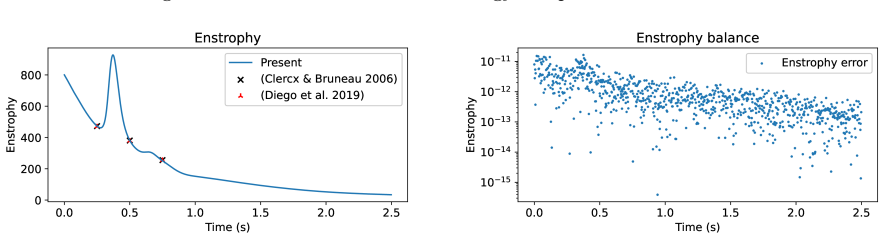
The nonlinear 2D incompressible Navier-Stokes equations are first recast as a port-Hamiltonian system defined with a Stokes-Lagrange structure along with a modulated Stokes-Dirac structure. A careful structure-preserving space discretization is then performed, leading to a finite-dimensional port-Hamiltonian system. Theoretical and numerical results show that both enstrophy and kinetic energy evolutions are preserved both at the semi-discrete and fully-discrete levels.
What carries the argument
The Stokes-Lagrange structure, which encodes differential constitutive relations together with boundary energy ports so that a structure-preserving finite element method can reduce them exactly to a finite-dimensional Lagrange subspace of a port-Hamiltonian system.
If this is right
- The discretization exactly preserves boundary energy ports for systems that admit a Stokes-Lagrange structure.
- Both the one-dimensional nanorod and shear beam models are shown to possess such a structure naturally.
- The resulting finite-dimensional system remains a port-Hamiltonian system.
- Enstrophy and kinetic energy evolutions are conserved at the semi-discrete level and remain conserved after time discretization.
Where Pith is reading between the lines
- The same reduction technique may apply directly to other differential constitutive relations arising in continuum mechanics beyond the fluid example.
- Because the preservation holds at the fully discrete level, the method offers a route to structure-preserving time integrators that keep the same invariants.
- The approach suggests that structure preservation can be achieved for nonlocal relations by first embedding them in a suitable Stokes-Lagrange form.
Load-bearing premise
The constitutive relations of the considered systems admit a Stokes-Lagrange structure along with boundary energy ports that can be exactly preserved by the chosen finite element discretization.
What would settle it
A numerical simulation of the discretized 2D Navier-Stokes system in which the computed rate of change of enstrophy or kinetic energy deviates from the exact evolution law derived from the continuous Stokes-Lagrange structure would falsify the preservation claim.
Figures






read the original abstract
We study the structure-preserving space discretization of port-Hamiltonian (pH) systems defined with differential constitutive relations. Using the concept of Stokes-Lagrange structure to describe these relations, these are reduced to a finite-dimensional Lagrange subspace of a pH system thanks to a structure-preserving Finite Element Method. To illustrate our results, the 1D nanorod case and the shear beam model are considered, which are given by differential and implicit constitutive relations for which a Stokes-Lagrange structure along with boundary energy ports naturally occur. Then, these results are extended to the nonlinear 2D incompressible Navier-Stokes equations written in a vorticity-stream function formulation. It is first recast as a pH system defined with a Stokes-Lagrange structure along with a modulated Stokes-Dirac structure. A careful structure-preserving space discretization is then performed, leading to a finite-dimensional pH system. Theoretical and numerical results show that both enstrophy and kinetic energy evolutions are preserved both at the semi-discrete and fully-discrete levels.
Editorial analysis
A structured set of objections, weighed in public.
Referee Report
Summary. The manuscript develops a structure-preserving finite element discretization for port-Hamiltonian systems with differential and nonlocal constitutive relations, using the Stokes-Lagrange structure to obtain finite-dimensional Lagrange subspaces. It first illustrates the method on the 1D nanorod and shear beam models, which admit natural Stokes-Lagrange structures with boundary energy ports. The approach is then extended to the nonlinear 2D incompressible Navier-Stokes equations in vorticity-stream function form, recast as a pH system incorporating a Stokes-Lagrange structure and a modulated Stokes-Dirac structure. A structure-preserving space discretization yields a finite-dimensional pH system, with theoretical identities and numerical experiments demonstrating exact preservation of enstrophy and kinetic energy evolutions at both semi-discrete and fully-discrete levels.
Significance. If the central claims hold, the work provides a systematic framework for discretizing pH systems with differential constitutive relations while exactly inheriting conservation of quadratic invariants. The explicit construction of discrete Dirac structures and the algebraic pH form for the nonlinear Navier-Stokes system is a concrete contribution to structure-preserving methods for incompressible flows. The combination of theoretical energy-balance identities with supporting numerical confirmation strengthens the case for applicability to long-time stable simulations.
major comments (2)
- [Navier-Stokes discretization section] The section extending the method to the 2D incompressible Navier-Stokes equations: the central claim that enstrophy and kinetic energy are exactly preserved at the semi-discrete level rests on the discrete Stokes-Lagrange structure and modulated Stokes-Dirac structure inheriting the continuous balance without residual terms; however, the manuscript provides only high-level assertions rather than the explicit algebraic verification of how the chosen finite-element spaces and discrete operators ensure this exact cancellation for the nonlinear terms.
- [Fully-discrete results] The fully-discrete preservation claim: while the semi-discrete energy identities are asserted, the interaction between the space discretization and the specific time-stepping scheme (and its compatibility with the modulated structure) is load-bearing for the fully-discrete result; details on the time integrator and the resulting discrete balance equations are needed to confirm that no artificial dissipation is introduced.
minor comments (2)
- [Abstract] The abstract and introduction could more explicitly separate the linear 1D examples from the nonlinear NS extension to improve readability for readers focused on fluid applications.
- [Discrete pH formulation] Notation for the discrete port variables and the modulation map in the Stokes-Dirac structure should be introduced with a clear table or diagram to avoid ambiguity when comparing continuous and discrete forms.
Simulated Author's Rebuttal
We thank the referee for the careful reading and constructive feedback on our manuscript. We address each major comment below and indicate the revisions planned for the next version.
read point-by-point responses
-
Referee: [Navier-Stokes discretization section] The section extending the method to the 2D incompressible Navier-Stokes equations: the central claim that enstrophy and kinetic energy are exactly preserved at the semi-discrete level rests on the discrete Stokes-Lagrange structure and modulated Stokes-Dirac structure inheriting the continuous balance without residual terms; however, the manuscript provides only high-level assertions rather than the explicit algebraic verification of how the chosen finite-element spaces and discrete operators ensure this exact cancellation for the nonlinear terms.
Authors: We agree that an explicit algebraic verification strengthens the presentation. The preservation follows directly from the structure-preserving properties of the chosen finite-element spaces and the discrete operators that replicate the continuous Stokes-Lagrange and modulated Stokes-Dirac structures. In the revised manuscript we will add a dedicated subsection (or appendix) that carries out the explicit computation for the nonlinear convective term, showing term-by-term cancellation in the discrete enstrophy and kinetic-energy balances using the algebraic relations satisfied by the discrete curl, gradient, and divergence operators. revision: yes
-
Referee: [Fully-discrete results] The fully-discrete preservation claim: while the semi-discrete energy identities are asserted, the interaction between the space discretization and the specific time-stepping scheme (and its compatibility with the modulated structure) is load-bearing for the fully-discrete result; details on the time integrator and the resulting discrete balance equations are needed to confirm that no artificial dissipation is introduced.
Authors: We acknowledge that the fully-discrete result depends on the compatibility of the time integrator with the modulated structure. The numerical experiments employ a discrete-gradient time-stepping method that is known to preserve the port-Hamiltonian structure at the fully discrete level. In the revision we will explicitly name the integrator, state its order and structure-preserving properties, and derive the corresponding fully discrete balance equations for both enstrophy and kinetic energy, confirming the absence of artificial dissipation. revision: yes
Circularity Check
No significant circularity detected
full rationale
The derivation begins by explicitly recasting the vorticity-stream function form of the 2D incompressible Navier-Stokes equations as a port-Hamiltonian system equipped with a Stokes-Lagrange structure plus modulated Stokes-Dirac structure; this recasting is presented with the relevant differential constitutive relations and boundary ports. A structure-preserving finite-element discretization is then defined on explicit discrete spaces that inherit the Dirac structure, yielding an algebraic finite-dimensional pH system. Preservation of enstrophy and kinetic energy follows directly from the resulting discrete energy-balance identities at both semi-discrete and fully-discrete levels, which are stated and verified independently of any fitted parameters. The approach invokes standard pH and Stokes-Dirac concepts from the broader literature rather than reducing the claimed invariants to quantities defined or fitted inside the present manuscript; no self-definitional loop, fitted-input prediction, or load-bearing self-citation chain is present in the central chain.
Axiom & Free-Parameter Ledger
axioms (1)
- domain assumption Constitutive relations with differential or nonlocal character can be represented by a Stokes-Lagrange structure.
Lean theorems connected to this paper
-
IndisputableMonolith/Cost/FunctionalEquation.leanwashburn_uniqueness_aczel unclear?
unclearRelation between the paper passage and the cited Recognition theorem.
It is first recast as a pH system defined with a Stokes-Lagrange structure along with a modulated Stokes-Dirac structure. ... both enstrophy and kinetic energy evolutions are preserved both at the semi-discrete and fully-discrete levels.
-
IndisputableMonolith/Foundation/AbsoluteFloorClosure.leanabsolute_floor_iff_bare_distinguishability unclear?
unclearRelation between the paper passage and the cited Recognition theorem.
Stokes-Lagrange structures ... implicit constitutive relations
What do these tags mean?
- matches
- The paper's claim is directly supported by a theorem in the formal canon.
- supports
- The theorem supports part of the paper's argument, but the paper may add assumptions or extra steps.
- extends
- The paper goes beyond the formal theorem; the theorem is a base layer rather than the whole result.
- uses
- The paper appears to rely on the theorem as machinery.
- contradicts
- The paper's claim conflicts with a theorem or certificate in the canon.
- unclear
- Pith found a possible connection, but the passage is too broad, indirect, or ambiguous to say the theorem truly supports the claim.
Reference graph
Works this paper leans on
-
[1]
Hamiltonian systems discrete-time approximation: Losslessness, passivity and composability
Said Aoues, Michael Di Loreto, Damien Eberard, and Wilfrid Marquis-Favre. Hamiltonian systems discrete-time approximation: Losslessness, passivity and composability. Systems & Control Letters, 110:9–14, 2017. 32
work page 2017
- [2]
-
[3]
Franck Assous, Patrick Ciarlet, and Simon Labrunie.Mathematical foundations of computational elec- tromagnetism. Springer, 2018
work page 2018
-
[4]
Linear port-Hamiltonian de- scriptor systems
Christopher Beattie, Volker Mehrmann, Hongguo Xu, and Hans Zwart. Linear port-Hamiltonian de- scriptor systems. Mathematics of Control, Signals, and Systems, 30:1–27, 2018
work page 2018
-
[5]
Antoine Bendimerad-Hohl, Ghislain Haine, Laurent Lefèvre, and Denis Matignon. Implicit port- Hamiltonian systems: structure-preserving discretization for the nonlocal vibrations in a viscoelastic nanorod, and for a seepage model.IFAC-PapersOnLine, 56(2):6789–6795, 2023
work page 2023
-
[6]
Antoine Bendimerad-Hohl, Ghislain Haine, Laurent Lefèvre, and Denis Matignon. Stokes-Lagrange and Stokes-Dirac representations ofN-dimensional port-Hamiltonian systems for modeling and control. Communications in Analysis and Mechanics, 17(2):474–519, 2025
work page 2025
-
[7]
Antoine Bendimerad-Hohl, Ghislain Haine, and Denis Matignon. Structure-preserving discretization of the cahn-hilliard equations recast as a port-hamiltonian system. In International Conference on Geometric Science of Information, pages 192–201. Springer, 2023
work page 2023
-
[8]
Structure- preserving discretization of a coupled allen-cahn and heat equation system
Antoine Bendimerad-Hohl, Ghislain Haine, Denis Matignon, and Bernhard Maschke. Structure- preserving discretization of a coupled allen-cahn and heat equation system. IFAC-PapersOnLine, 55(18):99–104, 2022
work page 2022
-
[9]
Antoine Bendimerad-Hohl, Denis Matignon, Ghislain Haine, and Laurent Lefèvre. On Stokes-Lagrange and Stokes-Dirac representations for 1D distributed port-Hamiltonian systems.IFAC-PapersOnLine, 58(17):238–243, 2024. 26th International Symposium on Mathematical Theory of Networks and Systems MTNS 2024
work page 2024
-
[10]
Mixed Finite Element Methods and Applications
Daniele Boffi, Franco Brezzi, and Michel Fortin. Mixed Finite Element Methods and Applications. Springer, Berlin, Heidelberg, 2015
work page 2015
-
[11]
Franck Boyer and Pierre Fabrie.Mathematical Tools for the Study of the Incompressible Navier-Stokes Equations andRelated Models, volume 183. Springer, 2012
work page 2012
-
[12]
Andrea Brugnoli, Daniel Alazard, Valérie Pommier-Budinger, and Denis Matignon. port-Hamiltonian formulation and symplectic discretization of plate models Part II: Kirchhoff model for thin plates. Applied Mathematical Modelling, 75:961–981, 2019
work page 2019
-
[13]
Andrea Brugnoli, Daniel Alazard, Valérie Pommier-Budinger, and Denis Matignon. A port-hamiltonian formulation of linear thermoelasticity and its mixed finite element discretization.Journal of Thermal Stresses, 44(6):643–661, 2021
work page 2021
-
[14]
Andrea Brugnoli, Ghislain Haine, and Denis Matignon. Stokes-Dirac structures for distributed param- eter port-Hamiltonian systems: An analytical viewpoint.Communications in Analysis and Mechanics, 15(3):362–387, 2023
work page 2023
-
[15]
Andrea Brugnoli and Volker Mehrmann. On the discrete equivalence of Lagrangian, Hamiltonian and mixed finite element formulations for linear wave phenomena.IFAC-PapersOnLine, 58(6):95–100, 2024. 8th IFAC Workshop on Lagrangian and Hamiltonian Methods for Nonlinear Control LHMNC 2024
work page 2024
-
[16]
Andrea Brugnoli, Ramy Rashad, Federico Califano, Stefano Stramigioli, and Denis Matignon. Mixed finite elements for port-hamiltonian models of von kármán beams.IFAC-papersonline, 54(19):186–191, 2021
work page 2021
-
[17]
Andrea Brugnoli, Ramy Rashad, and Stefano Stramigioli. Dual field structure-preserving discretization of port-Hamiltonian systems using finite element exterior calculus.Journal of Computational Physics, 471:111601, 2022. 33
work page 2022
-
[18]
Flávio Luiz Cardoso-Ribeiro, Ghislain Haine, Yann Le Gorrec, Denis Matignon, and Hector Ramirez. port-Hamiltonian formulations for the modeling, simulation and control of fluids.Computers & Fluids, 283:106407, 2024
work page 2024
-
[19]
Flávio Luiz Cardoso-Ribeiro, Ghislain Haine, Laurent Lefèvre, and Denis Matignon. Rotational shallow water equations with viscous damping and boundary control: structure-preserving spatial discretization. Mathematics of Control, Signals, and Systems, 37(2):361–394, 2025
work page 2025
-
[20]
Flávio Luiz Cardoso-Ribeiro, Denis Matignon, and Laurent Lefèvre. A partitioned finite element method for power-preserving discretization of open systems of conservation laws.IMA Journal of Mathematical Control and Information, 38(2):493–533, 6 2021
work page 2021
-
[21]
Energy-Preserving and Passivity-Consistent Numerical Discretization of Port-Hamiltonian Systems
Elena Celledoni and Eirik Hoel Høiseth. Energy-preserving and passivity-consistent numerical dis- cretization of port-hamiltonian systems.arXiv preprint arXiv:1706.08621, 2017
work page internal anchor Pith review Pith/arXiv arXiv 2017
-
[22]
Elena Celledoni and James Jackaman. Discrete conservation laws for finite element discretisations of multisymplectic PDEs.Journal of Computational Physics, 444:110520, 2021
work page 2021
-
[23]
The normal and oblique collision of a dipole with a no-slip boundary
Herman JH Clercx and C-H Bruneau. The normal and oblique collision of a dipole with a no-slip boundary. Computers & fluids, 35(3):245–279, 2006
work page 2006
-
[24]
Gonzalo Gonzalez de Diego, Artur Palha, and M Gerritsma. Inclusion of no-slip boundary conditions in the meevc scheme.Journal of Computational Physics, 378:615–633, 2019
work page 2019
-
[25]
Michele Ducceschi and Stefan Bilbao. Linear stiff string vibrations in musical acoustics: Assessment and comparison of models.The Journal of the Acoustical Society of America, 140(4):2445–2454, 10 2016
work page 2016
-
[26]
Michele Ducceschi and Stefan Bilbao. Conservative finite difference time domain schemes for the pre- stressed Timoshenko, shear and Euler–Bernoulli beam equations.Wave Motion, 89:142–165, 2019
work page 2019
-
[27]
Vincent Duindam, Alessandro Macchelli, Stefano Stramigioli, and Herman Bruyninckx.Modeling and control of complex physical systems: the port-Hamiltonian approach. Springer, 2009
work page 2009
-
[28]
E. S. Dzektser. Generalization of the equation of motion of ground waters with free surface.Dokl. Akad. Nauk SSSR, 202(5):1031–1033, 1972
work page 1972
-
[29]
Structure preserving approximation of dissipative evolution problems
Herbert Egger. Structure preserving approximation of dissipative evolution problems. Numerische Mathematik, 143:85–106, 2019
work page 2019
-
[30]
A Cemal Eringen. On differential equations of nonlocal elasticity and solutions of screw dislocation and surface waves.Journal of Applied Physics, 54(9):4703–4710, 1983
work page 1983
-
[31]
A port-Hamiltonian finite-element formu- lation for the Maxwell equations
O Farle, D Klis, M Jochum, O Floch, and R Dyczij-Edlinger. A port-Hamiltonian finite-element formu- lation for the Maxwell equations. In2013 International Conference on Electromagnetics in Advanced Applications (ICEAA), pages 324–327. IEEE, 2013
work page 2013
-
[32]
Giuseppe Ferraro, Michel Fournié, and Ghislain Haine. Simulation and control of interactions in multi- physics, a python package for port-hamiltonian systems.IFAC-PapersOnLine, 58(6):119–124, 2024
work page 2024
-
[33]
Constitutive equations and reciprocity
Anthony F Gangi. Constitutive equations and reciprocity. Geophysical Journal International, 143(2):311–318, 2000
work page 2000
-
[34]
Extension theory via boundary triplets for infinite-dimensional implicit port-hamiltonian systems
Hannes Gernandt, Friedrich Philipp, Till Preuster, and Manuel Schaller. Extension theory via boundary triplets for infinite-dimensional implicit port-hamiltonian systems. arXiv preprint arXiv:2503.17874, 2025. 34
-
[35]
On the equivalence of geometric and descriptor representations of linear port-Hamiltonian systems
Hannes Gernandt, Friedrich M Philipp, Till Preuster, and Manuel Schaller. On the equivalence of geometric and descriptor representations of linear port-Hamiltonian systems. InSystems Theory and PDEs, pages 149–165. Springer, 2022
work page 2022
-
[36]
Hamiltonian discretiza- tion of boundary control systems.Automatica, 40(5):757–771, 2004
Goran Golo, Viswanath Talasila, Arjan Van Der Schaft, and Bernhard Maschke. Hamiltonian discretiza- tion of boundary control systems.Automatica, 40(5):757–771, 2004
work page 2004
-
[37]
Time integration and discrete Hamiltonian systems
Oscar Gonzalez. Time integration and discrete Hamiltonian systems. Journal of Nonlinear Science, 6:449–467, 1996
work page 1996
-
[38]
OliverGuillet, AnthonyTWeaver, XavierVasseur, YannMichel, SergeGratton, andSelimeGürol. Mod- elling spatially correlated observation errors in variational data assimilation using a diffusion operator on an unstructured mesh.Quarterly Journal of the Royal Meteorological Society, 145(722):1947–1967, 2019
work page 1947
-
[39]
Ghislain Haine and Denis Matignon. Incompressible Navier-Stokes Equation as port-Hamiltonian sys- tem: velocity formulation versus vorticity formulation.IFAC-PapersOnLine, 54(19):161–166, 2021
work page 2021
-
[40]
Ghislain Haine, Denis Matignon, and Florian Monteghetti. Structure-preserving discretization of maxwell’s equations as a port-hamiltonian system.IFAC-PapersOnLine, 55(30):424–429, 2022
work page 2022
-
[41]
Ghislain Haine, Denis Matignon, and Anass Serhani. Numerical analysis of a structure-preserving space- discretization for an anisotropic and heterogeneous boundary controlledN-dimensional wave equation as a port-Hamiltonian system.International Journal of Numerical Analysis and Modeling, 20(1):92–133, 2023
work page 2023
-
[42]
Port-Hamiltonian modelling of nonlocal longitudinal vibrations in a vis- coelastic nanorod
Hanif Heidari and H Zwart. Port-Hamiltonian modelling of nonlocal longitudinal vibrations in a vis- coelastic nanorod. Mathematical and Computer Modelling of Dynamical Systems, 25(5):447–462, 2019
work page 2019
-
[43]
Nonlocal longitudinal vibration in a nanorod, a system theoretic analysis
Hanif Heidari and Hans Zwart. Nonlocal longitudinal vibration in a nanorod, a system theoretic analysis. Mathematical Modelling of Natural Phenomena, 17:24, 2022
work page 2022
-
[44]
R.R. Hiemstra, D. Toshniwal, R.H.M. Huijsmans, and M.I. Gerritsma. High order geometric methods with exact conservation properties.Journal of Computational Physics, 257:1444–1471, 2014
work page 2014
-
[45]
On solvability of dissipative partial differential-algebraic equations
Birgit Jacob and Kirsten Morris. On solvability of dissipative partial differential-algebraic equations. IEEE Control Systems Lett., 6:3188–3193, 2022
work page 2022
-
[46]
Birgit Jacob and Hans J Zwart.Linear port-Hamiltonian systems on infinite-dimensional spaces, volume
-
[47]
Springer Science, 2012
work page 2012
-
[48]
Philipp L Kinon, Riccardo Morandin, and Philipp Schulze. Discrete gradient methods for port- hamiltonian differential-algebraic equations.arXiv preprint arXiv:2505.18810, 2025
-
[49]
Paul Kotyczka and Laurent Lefevre. Discrete-time port-hamiltonian systems: A definition based on symplectic integration.Systems & Control Letters, 133:104530, 2019
work page 2019
-
[50]
Paul Kotyczka, Bernhard Maschke, and Laurent Lefèvre. Weak form of Stokes–Dirac structures and geometric discretization of port-Hamiltonian systems.Journal of Computational Physics, 361:442–476, 2018
work page 2018
-
[51]
Port-Hamiltonian systems with energy and power ports
Kaja Krhač, Bernhard Maschke, and Arjan van der Schaft. Port-Hamiltonian systems with energy and power ports. IFAC-PapersOnLine, 58(6):280–285, 2024
work page 2024
-
[52]
Dirac structures and their composition on Hilbert spaces
Mikael Kurula, Hans Zwart, Arjan van der Schaft, and Jussi Behrndt. Dirac structures and their composition on Hilbert spaces. Journal of mathematical analysis and applications, 372(2):402–422, 2010. 35
work page 2010
-
[53]
Lagnese.Boundary stabilization of thin plates
J. Lagnese.Boundary stabilization of thin plates. Number vol. 10 in SIAM studies in applied mathemat- ics. Society for Industrial and Applied Mathematics (SIAM, 3600 Market Street, Floor 6, Philadelphia, PA 19104), 1989
work page 1989
-
[54]
Yann Le Gorrec, Hans Zwart, and Bernhard Maschke. Dirac structures and boundary control sys- tems associated with skew-symmetric differential operators.SIAM journal on control and optimization, 44(5):1864–1892, 2005
work page 2005
-
[55]
Julien Lequeurre and Alexandre Munnier. Vorticity and Stream Function Formulations for the 2D Navier–Stokes Equations in a Bounded Domain.Journal of Mathematical Fluid Mechanics, 22(2):15, June 2020
work page 2020
-
[56]
Bernhard Maschke and Arjan van der Schaft. Linear boundary port-Hamiltonian systems with implicitly defined energy.arXiv preprint arXiv:2305.13772, 2023
-
[57]
Geometric integration using discrete gradients
Robert I McLachlan, G Reinout W Quispel, and Nicolas Robidoux. Geometric integration using discrete gradients. Philosophical Transactions of the Royal Society of London. Series A: Mathematical, Physical and Engineering Sciences, 357(1754):1021–1045, 1999
work page 1999
-
[58]
Structure-preserving discretization for port-hamiltonian descriptor systems
Volker Mehrmann and Riccardo Morandin. Structure-preserving discretization for port-hamiltonian descriptor systems. In2019 IEEE 58th Conference on Decision and Control (CDC), pages 6863–6868. IEEE, 2019
work page 2019
-
[59]
Control of port-Hamiltonian differential-algebraic systems and applications
Volker Mehrmann and Benjamin Unger. Control of port-Hamiltonian differential-algebraic systems and applications. Acta Numerica, 32:395–515, 2023
work page 2023
-
[60]
I Mirouze and AT Weaver. Representation of correlation functions in variational assimilation using an implicit diffusion operator.Quarterly Journal of the Royal Meteorological Society, 136(651):1421–1443, 2010
work page 2010
- [61]
-
[62]
Arch W Naylor and George R Sell.Linear operator theory in engineering and science. Springer, 1982
work page 1982
-
[63]
Artur Palha and Marc Gerritsma. A mass, energy, enstrophy and vorticity conserving (meevc) mimetic spectral element discretization for the 2d incompressible navier–stokes equations.Journal of Computa- tional Physics, 328:200–220, 2017
work page 2017
-
[64]
Ramkrishna Pasumarthy, VR Ambati, and AJ van der Schaft. Port-Hamiltonian discretization for open channel flows.Systems & control letters, 61(9):950–958, 2012
work page 2012
-
[65]
Cristobal Ponce, Yongxin Wu, Yann Le Gorrec, and Hector Ramirez. A systematic methodology for port-hamiltonianmodelingofmultidimensionalflexiblelinearmechanicalsystems. Applied Mathematical Modelling, 134:434–451, 2024
work page 2024
-
[66]
Ramy Rashad, Federico Califano, Arjan J van der Schaft, and Stefano Stramigioli. Twenty years of distributed port-Hamiltonian systems: a literature review.IMA Journal of Mathematical Control and Information, 37(4):1400–1422, 2020
work page 2020
-
[67]
Dietmar Rempfer. On Boundary Conditions for Incompressible Navier-Stokes Problem.Applied Me- chanics Reviews, 59(3):107–125, 05 2006
work page 2006
-
[68]
Yves Renard and Konstantinos Poulios. GetFEM: Automated FE modeling of multiphysics problems based on a generic weak form language.ACM Transactions on Mathematical Software (TOMS), 47(1):1– 31, 2020. 36
work page 2020
-
[69]
Nonlocal elasticity in nanobeams: the stress-driven integral model
Giovanni Romano and Raffaele Barretta. Nonlocal elasticity in nanobeams: the stress-driven integral model. International Journal of Engineering Science, 115:14–27, 2017
work page 2017
-
[70]
David Roze, Mathis Raibaud, and Thibault Geoffroy. Passive-guaranteed modeling and simulation of a finite element nonlinear string model.IFAC-PapersOnLine, 58(6):226–231, 2024
work page 2024
-
[71]
Anisotropic heterogeneous nd heat equation with boundary control and observation: Ii
Anass Serhani, Ghislain Haine, and Denis Matignon. Anisotropic heterogeneous nd heat equation with boundary control and observation: Ii. structure-preserving discretization. IFAC-PapersOnLine, 52(7):57–62, 2019
work page 2019
-
[72]
Marko Seslija, Arjan van der Schaft, and Jacquelien MA Scherpen. Discrete exterior geometry approach to structure-preserving discretization of distributed-parameter port-hamiltonian systems. Journal of Geometry and Physics, 62(6):1509–1531, 2012
work page 2012
-
[73]
Vincent Trenchant, Hector Ramirez, Yann Le Gorrec, and Paul Kotyczka. Finite differences on stag- gered grids preserving the port-hamiltonian structure with application to an acoustic duct.Journal of Computational Physics, 373:673–697, 2018
work page 2018
-
[74]
Port-Hamiltonian systems theory: An introductory overview
Arjan van der Schaft, Dimitri Jeltsema, et al. Port-Hamiltonian systems theory: An introductory overview. Foundations and Trends® in Systems and Control, 1(2-3):173–378, 2014
work page 2014
-
[75]
Generalized port-Hamiltonian DAE systems.Systems & Control Letters, 121:31–37, 2018
Arjan van der Schaft and Bernhard Maschke. Generalized port-Hamiltonian DAE systems.Systems & Control Letters, 121:31–37, 2018
work page 2018
-
[76]
Dirac and Lagrange algebraic constraints in nonlinear port-Hamiltonian systems
Arjan van der Schaft and Bernhard Maschke. Dirac and Lagrange algebraic constraints in nonlinear port-Hamiltonian systems. Vietnam Journal of Mathematics, 48:929–939, 2020
work page 2020
-
[77]
Arjan J van der Schaft and Bernhard Maschke. Hamiltonian formulation of distributed-parameter systems with boundary energy flow.Journal of Geometry and Physics, 42(1-2):166–194, 2002
work page 2002
-
[78]
Benjamin Vincent, Françoise Couenne, Laurent Lefèvre, and Bernhard Maschke. Port hamiltonian systems with moving interface: a phase field approach.IFAC-PapersOnLine, 53(2):7569–7574, 2020
work page 2020
-
[79]
A structured control model for the thermo-magneto-hydrodynamics of plasmas in tokamaks
Ngoc Minh Trang Vu, Laurent Lefevre, and Bernhard Maschke. A structured control model for the thermo-magneto-hydrodynamics of plasmas in tokamaks. Mathematical and computer modelling of dynamical systems, 22(3):181–206, 2016
work page 2016
-
[80]
Ngoc Minh Trang Vu, Laurent Lefèvre, Rémy Nouailletas, and Sylvain Brémond. Symplectic spatial integration schemes for systems of balance equations.Journal of Process Control, 51:1–17, 2017
work page 2017
discussion (0)
Sign in with ORCID, Apple, or X to comment. Anyone can read and Pith papers without signing in.