Antisymmetric Raman response
Pith reviewed 2026-05-19 05:12 UTC · model grok-4.3
The pith
Antisymmetric Raman response isolates cross-susceptibilities of two Raman operators without any intraband contributions.
A machine-rendered reading of the paper's core claim, the machinery that carries it, and where it could break.
Core claim
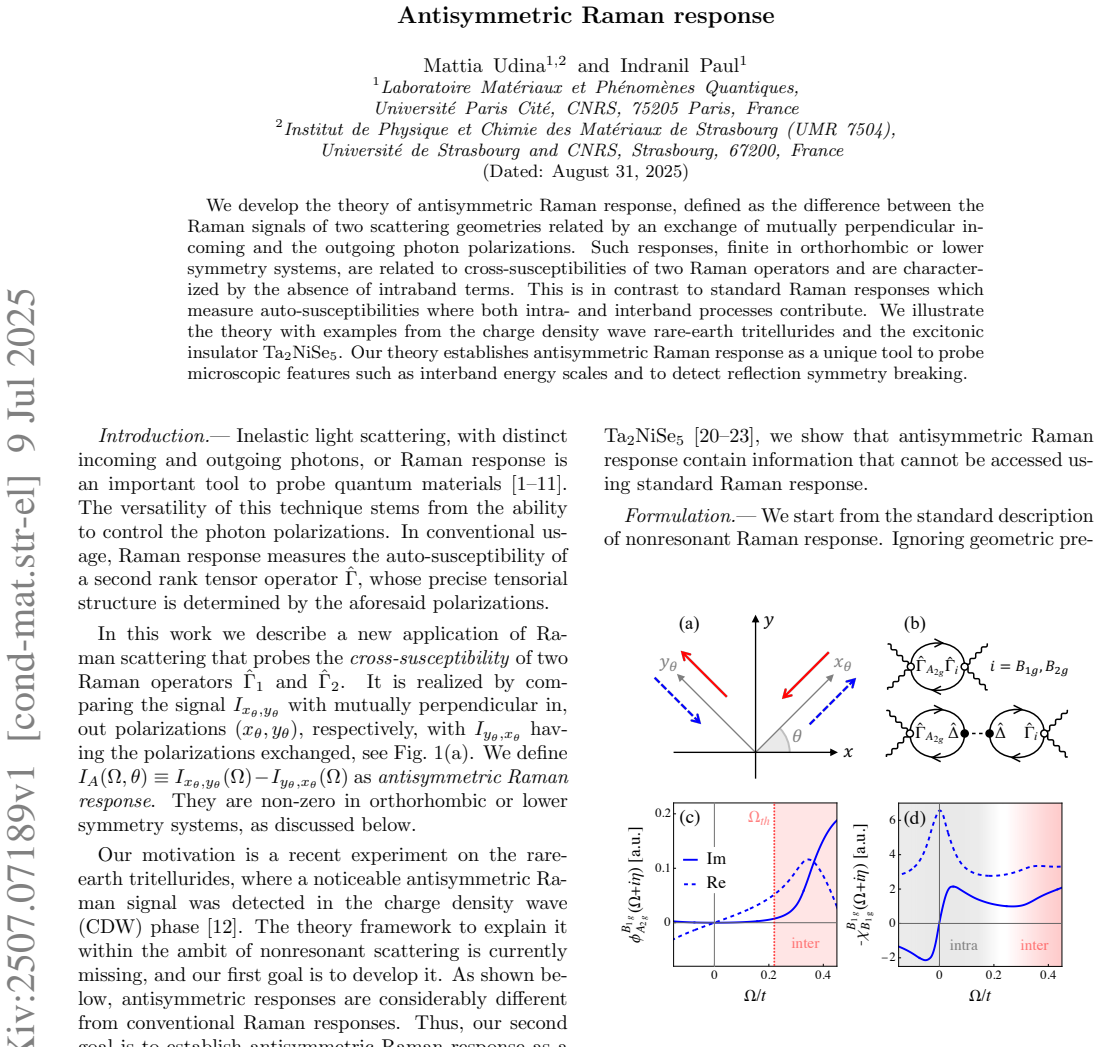
Antisymmetric Raman response is defined as the difference of the Raman signals of two scattering geometries related by an exchange of mutually perpendicular incoming and outgoing photon polarizations. Such responses, finite in orthorhombic or lower symmetry systems, are related to cross-susceptibilities of two Raman operators and are characterized by the absence of intraband terms. This is in contrast to standard Raman responses which measure auto-susceptibilities where both intra- and interband processes contribute.
What carries the argument
Antisymmetric Raman response, the difference between Raman signals from two geometries obtained by swapping mutually perpendicular incoming and outgoing photon polarizations, which isolates cross-susceptibilities.
If this is right
- It provides a direct probe of interband energy scales without intraband contamination.
- It can detect reflection symmetry breaking in materials with orthorhombic or lower symmetry.
- In rare-earth tritellurides it isolates features specific to the charge density wave state.
- In Ta2NiSe5 it distinguishes excitonic insulator properties through interband cross terms.
Where Pith is reading between the lines
- The method could be tested on other low-symmetry crystals undergoing electronic phase transitions to separate scattering channels.
- It offers a possible route to quantify reflection symmetry breaking in a wider range of ordered states.
- Comparison with optical conductivity data on the same samples would check whether the extracted interband scales agree.
Load-bearing premise
The difference of the two Raman geometries exactly isolates the cross-susceptibility and eliminates all intraband contributions.
What would settle it
A calculation or measurement in an orthorhombic system that finds nonzero intraband terms remaining in the antisymmetric combination, or a mismatch between the measured antisymmetric signal and the computed cross-susceptibility in Ta2NiSe5.
Figures


read the original abstract
We develop the theory of antisymmetric Raman response, defined as the difference between the Raman signals of two scattering geometries related by an exchange of mutually perpendicular incoming and the outgoing photon polarizations. Such responses, finite in orthorhombic or lower symmetry systems, are related to cross-susceptibilities of two Raman operators and are characterized by the absence of intraband terms. This is in contrast to standard Raman responses which measure auto-susceptibilities where both intra- and interband processes contribute. We illustrate the theory with examples from the charge density wave rare-earth tritellurides and the excitonic insulator Ta$_2$NiSe$_5$. Our theory establishes antisymmetric Raman response as a unique tool to probe microscopic features such as interband energy scales and to detect reflection symmetry breaking.
Editorial analysis
A structured set of objections, weighed in public.
Referee Report
Summary. The manuscript develops the theory of antisymmetric Raman response, defined as the difference between Raman signals in two scattering geometries related by exchanging mutually perpendicular incoming and outgoing photon polarizations. The authors claim that in orthorhombic or lower symmetry systems this isolates the cross-susceptibility between two distinct Raman operators and is free of intraband contributions, unlike conventional Raman responses that measure auto-susceptibilities containing both intra- and interband terms. The framework is illustrated with calculations for charge-density-wave systems in rare-earth tritellurides and the excitonic insulator Ta2NiSe5, positioning the antisymmetric response as a probe of interband energy scales and reflection symmetry breaking.
Significance. If the central derivations are robust, the work introduces a potentially distinctive spectroscopic tool for low-symmetry correlated materials. The claimed absence of intraband terms could enable cleaner extraction of interband physics, which is relevant for CDW and excitonic systems; the concrete material examples add applicability, though this hinges on verification that the cancellation survives band reconstruction.
major comments (1)
- [Theory section and illustrations for RTe3 and Ta2NiSe5] The claim that the antisymmetric combination exactly isolates the cross-susceptibility chi(R1,R2) - chi(R2,R1) while eliminating all intraband terms is load-bearing for the abstract and the overall utility argument. In the effective-mass limit this follows from symmetry of the inverse-mass tensor, but the illustrated systems involve CDW (RTe3) and excitonic order (Ta2NiSe5) that reconstruct bands and impart additional k-dependence to the Raman vertices gamma1(k) and gamma2(k). The resulting intraband bubble contributions proportional to gamma1(k) gamma2(k) times a relaxation factor need not cancel under polarization exchange; explicit verification of this cancellation (or its absence) is required in the derivations for these materials.
minor comments (2)
- Clarify the precise operator definitions and the mathematical expression for the antisymmetric response (e.g., R_as = R(e_i,e_o) - R(e_o,e_i)) early in the text to aid readability.
- [Illustrations] In the material-specific sections, include a direct side-by-side comparison of the intraband versus interband channels in both symmetric and antisymmetric responses to make the cancellation explicit.
Simulated Author's Rebuttal
We thank the referee for their careful reading of our manuscript and for identifying a key point that merits explicit clarification. We address the major comment below and will revise the manuscript to incorporate additional verification while preserving the original conclusions.
read point-by-point responses
-
Referee: The claim that the antisymmetric combination exactly isolates the cross-susceptibility chi(R1,R2) - chi(R2,R1) while eliminating all intraband terms is load-bearing for the abstract and the overall utility argument. In the effective-mass limit this follows from symmetry of the inverse-mass tensor, but the illustrated systems involve CDW (RTe3) and excitonic order (Ta2NiSe5) that reconstruct bands and impart additional k-dependence to the Raman vertices gamma1(k) and gamma2(k). The resulting intraband bubble contributions proportional to gamma1(k) gamma2(k) times a relaxation factor need not cancel under polarization exchange; explicit verification of this cancellation (or its absence) is required in the derivations for these materials.
Authors: We thank the referee for highlighting this important aspect. Our general derivation shows that the antisymmetric response isolates χ(R₁,R₂) − χ(R₂,R₁). The intraband bubble diagram takes the form of an integral over γ₁(k)γ₂(k) multiplied by a relaxation kernel that depends only on the quasiparticle energies and is symmetric under interchange of the two vertices. Because γ₁(k) and γ₂(k) are ordinary scalar functions of momentum for any given band structure, their product is invariant under exchange: γ₁(k)γ₂(k) = γ₂(k)γ₁(k). Consequently the intraband contributions to χ(R₁,R₂) and χ(R₂,R₁) are identical and cancel exactly in the difference, independent of any k-dependence introduced by CDW or excitonic reconstruction. This symmetry argument applies directly to the RTe₃ and Ta₂NiSe₅ models. To make the cancellation fully transparent, we will add an explicit evaluation of the intraband term for both materials in the revised theory section. revision: yes
Circularity Check
Antisymmetric Raman response defined by polarization exchange; derivation self-contained with no reduction to inputs
full rationale
The paper introduces the antisymmetric Raman response explicitly as the difference of two standard Raman scattering geometries related by polarization exchange. This definition directly yields the relation to cross-susceptibilities and the absence of intraband terms via the symmetry properties of the response functions, without any fitted parameters, self-citations that bear the central load, or renaming of prior results. The derivation chain for the claimed properties (finite in orthorhombic symmetry, probes interband scales, detects reflection breaking) follows from the bubble-diagram structure and effective-mass or reconstructed-band vertices as stated, remaining independent of the target claims themselves. No step reduces by construction to the inputs.
Axiom & Free-Parameter Ledger
axioms (1)
- domain assumption The response is finite only in orthorhombic or lower symmetry systems.
Reference graph
Works this paper leans on
-
[1]
A. A. Abrikosov and L. A. Falkovskii, Sov. Phys. JETP 13, 179 (1961)
work page 1961
-
[2]
A. A. Abrikosov and V. M. Genkin, Sov. Phys. JETP 38, 417 (1961)
work page 1961
-
[3]
M. V. Klein, Phys. Rev. B 25, 7192 (1982)
work page 1982
- [4]
-
[5]
M. V. Klein and S. B. Dierker, Phys. Rev. B 29, 4976 (1984)
work page 1984
-
[6]
B. S. Shastry and B. I. Shraiman, Phys. Rev. Lett. 65, 1068 (1990)
work page 1990
-
[7]
B. S. Shastry and B. I. Shraiman, Int. J. Mod. Phys. 5, 365 (1991)
work page 1991
-
[8]
W. Hayes and R. Loudon, Scattering of Light by Crystals, Dover Publications, 2004
work page 2004
-
[9]
for a review see, e.g., T. P. Devereaux and R. Hackl, Rev. Mod. Phys. 79, 175 (2007)
work page 2007
- [10]
- [11]
-
[12]
Y. Wang, I. Petrides, G. McNamara, M. M. Hosen, S. Lei, Y.-C. Wu, J. L. Hart, H. Lv, J. Yan, D. Xiao, J. J. Cha, P. Narang, L M. Schoop, and K. S. Burch, Nat. 606, 896 (2022)
work page 2022
-
[13]
B. Singh, G. McNamara, K.-M. Kim, S. Siddique, S. D. Funni, W. Zhang, X. Luo, P. Sakrikar, E. M. Kenney, R. Singha, S. Alekseev, S. A. A. Ghorashi, T. J. Hicken, C. Baines, H. Luetkens, Y. Wang, V. M. Plisson, M. Geiwitz, C. A. Occhialini, R. Comin, M. J. Graf, L. Zhao, J. Cano, R. M. Fernandes, J. J. Cha, L. M. Schoop, and K. S. Burch, arXiv:2411.08322
-
[14]
D. Wulferding, J. Park, T. Tohyama, S. R. Park, and C. Kim, Nat. Commun. 16, 114 (2025)
work page 2025
-
[15]
M. Lavagnini, H. -M. Eiter, L. Tassini, B. Muschler, R. Hackl, R. Monnier, J. -H. Chu, I. R. Fisher, and L. De- giorgi, Phys. Rev. B 81, 081101(R) (2010)
work page 2010
- [16]
- [17]
-
[18]
R. G. Moore, V. Brouet, R. He, D. H. Lu, N. Ru, J. -H. Chu, I. R. Fisher, Z. -X. Shen, Phys. Rev. B 81, 073102 (2010)
work page 2010
-
[19]
A. Gallo-Frantz, A. A. Sinchenko, D. Ghoneim, L. Or- tega, P. Godard, P.-O. Renault, P. Grigoriev, A. Hadj- Azzem, P. Monceau, D. Thiaudi` ere, E. Bellec, V. L. R. Jacques, D. Le Bolloc’h, Nat. Comm 15, 3665 92024)
-
[20]
F. D. Salvo, C. Chen, R. Fleming, J. Waszczak, R. Dunn, S. Sunshine, and J. A. Ibers, J. Less Common Metals 116, 51 (1986)
work page 1986
-
[21]
Y. F. Lu, H. Kono, T. I. Larkin, A. W. Rost, T. Takayama, A. V. Boris, B. Keimer, and H. Takagi, Nat. Comm. 8, 14408 (2017)
work page 2017
- [22]
-
[23]
for a review see, e.g., T. Kaneko and Y. Ohta, J. Phys. Soc. Jpn. 94, 012001 (2025)
work page 2025
-
[24]
C. S. Farias, M.-A. M´ easson, A. Ferraz, and S. Burdin, Phys. Rev. B 101, 205114 (2020)
work page 2020
-
[25]
E. Riccardi, O. Kashuba, M. Cazayous, M.-A. M´ easson, A. Sacuto, and Y. Gallais, Phys. Rev. Materials3, 014002 (2019)
work page 2019
- [26]
-
[27]
Y. Gallais, R. M. Fernandes, I. Paul, L. Chauviere, Y. -X. Yang, M. -A. Measson, M. Cazayous, A. Sacuto, D. Col- son, and A. Forget, Phys. Rev. Lett. 111, 267001 (2013)
work page 2013
-
[28]
H. F. Yang, K. Y. He, J. Koo, S. W. Shen, S. H. Zhang, G. Liu, Y. Z. Liu, C. Chen, A. J. Liang, K. Huang, M. X. Wang, J. J. Gao, X. Luo, L. X. Yang, J. P. Liu, Y. P. Sun, S. C. Yan, B. H. Yan, Y. L. Chen, X. Xi, and Z. K. Liu, Phys. Rev. Lett. 129, 156401 (2022)
work page 2022
-
[29]
W. Qi, J. Dong S. Ponzoni, G. Huitric, R. Grasset, Y. Laplace, L. Cario, M. Marsi, E. Papalazarou, A. Zobelli, A. Alekhin, Y. Gallais, A. Bendounan, and L. Perfetti, Nano Lett. 24, 13134 92024)
-
[30]
H. Yao, J. A. Robertson, E.-A. Kim, and S. A. Kivelson, Phys. Rev. B 74, 245126 (2006)
work page 2006
-
[31]
H. -M. Eiter, M. Lavagnini, R. Hackl, E. A. Nowadnick, A. F. Kemper, T. P. Devereaux, J. -H. Chu, J. G. Ana- lytis, I. R. Fisher, and L. Degiorgi, PNAS 110, 64 (2013)
work page 2013
-
[32]
S. Alekseev, S. A. A. Ghorashi, R. M. Fernandes, and J. Cano, Phys. Rev. B 110, 205103 (2024)
work page 2024
- [33]
-
[34]
P. A. Lee, T. M. Rice, and P. W. Anderson, Solid State Comm. 14, 703 (1974)
work page 1974
- [35]
- [36]
-
[37]
M. Maschek, S. Rosenkranz, R. Heid, A. H. Said, P. Giraldo-Gallo, I. R. Fisher, and F. Weber, Phys. Rev. B 91, 235146 (2015)
work page 2015
-
[38]
R. Grasset, T. Cea, Y. Gallais, M. Cazayous, A. Sacuto, L. Cario, L. Benfatto, and M.-A. M´ easson, Phys. Rev. B 97, 094502 (2018)
work page 2018
-
[39]
Y. Gallais, I. Paul, L. Chauviere, and J. Schmalian, Phys. Rev. Lett. 116, 017001 (2016). 1 SUPPLEMENT AR Y INFORMA TION Derivation of Eq. (1) In general, the Raman matrix element is given by MF,I = X α,β (ei,αe∗ f,β) " ⟨F |ˆvαβ|I⟩ + X M ⟨F |ˆvα|M ⟩⟨M |ˆvβ|I⟩ EI − EM − ωf + ⟨F |ˆvβ|M ⟩⟨M |ˆvα|I⟩ EI − EM + ωi , (S1) where Ω = ωi − ωf is the Raman shift, ωi...
work page 2016
discussion (0)
Sign in with ORCID, Apple, or X to comment. Anyone can read and Pith papers without signing in.