REVIEW 4 major objections 6 minor 35 references
The interscale behaviour of uncertainty in three-dimensional Navier-Stokes turbulence
T0 review · 4 major / 6 minor · reviewed 2026-08-06 · deepseek-v4-flash
Pith's one-line read Uncertainty in three-dimensional turbulence grows through a self-similar equilibrium cascade of decorrelation, predominantly inverse and driven by compressions of the reference flow's relative deformation tensor, predicting $\langle…
desk verdict The budget equation is the substantive contribution; the new t^{2/3} scaling is clearly labeled speculation that should not be taken as established. read the letter →
The pith
A machine-rendered reading of the paper's core claim, the machinery that carries it, and where it could break.
The reading
What carries the argument
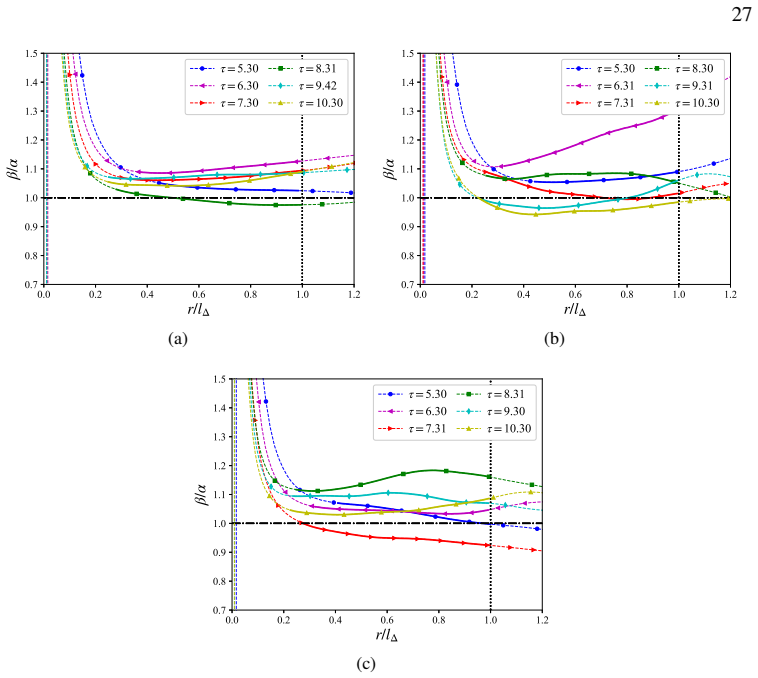
The carrying object is the scale-by-scale uncertainty energy budget, a K\'arm\'an-Howarth-Monin-Hill-type equation for $|\delta\boldsymbol{w}|^2$ with a spherical average over scales. Its four interscale transfer rates are $\Pi_{\delta,\mathrm{ref}}$ and $\Pi_{\delta,\mathrm{err}}$ (reference-field and self-induced two-point transfers) and $I_\delta^{\uparrow}$, $I_\delta^{\downarrow}$ (production-related transfers coupling the uncertainty half-sum and half-difference). All three linear rates are governed by the reference field's relative deformation tensor $\Xi^{(1)}_{ij}=\tfrac12(\delta u^{(1)}_i e_j/r + \delta u^{(1)}_j e_i/r)$, whose eigenvalues are one compressive, one zero, and one stretching; the sign of each transfer is set by whether compressions or stretchings dominate. The equilibrium approximation $\partial\langle A_\delta\rangle/\partial t\approx 0$ for $r<l_\Delta$ converts the budget into equation (3.4), the self-similar equilibrium cascade, and the bold assumption that correlations make the linear transfer rates scale as $U^{(1)}\langle E_\Delta\rangle/l_\Delta$ yields the power laws.
What would settle it
Measure the sphere-averaged transfer rates in (3.4) in a higher-Reynolds identical-forcing DNS and test whether their sum is independent of $r$ in $l_\lambda^{(1)}\ll r\ll l_\Delta$ and whether $\langle P_\Delta\rangle$ and $\langle\varepsilon_\Delta\rangle$ scale as $U^{(1)}\langle E_\Delta\rangle/l_\Delta$ rather than $\langle E_\Delta\rangle^{3/2}/l_\Delta$; a failure of the $r$-independence or a collapse onto the $\langle E_\Delta\rangle^{3/2}/l_\Delta$ scaling would falsify the self-similar equilibrium cascade's specific prediction.
Extended reading notes
Core claim
The central claim is that uncertainty in statistically stationary homogeneous turbulence does not merely grow chaotically; once its integral scale exceeds the Taylor scale, it sustains a self-similar equilibrium cascade of decorrelation. Equation (3.4) expresses this balance: the difference between average dissipation and production of uncertainty equals the sum of four interscale transfer rates, and that sum is independent of scale $r$ in the range $l_\lambda^{(1)}\ll r\ll l_\Delta$. The cascade is predominantly inverse: uncertainty produced at small scales by one-point compressions of the reference strain rate is carried to larger scales by two-point compressions of the reference field's relative deformation tensor, aligned with the uncertainty half-sum. Two forward linear transfers and one weak nonlinear inverse transfer coexist. From the equilibrium scalings, with the assumption that reference-field correlations make the linear transfers scale as $U^{(1)}\langle E_\Delta\rangle/l_\Delta$, the paper derives $\langle E_\Delta\rangle \sim (\varepsilon U^{(1)} t)^{2/3}$ and $l_\Delta\sim U^{(1)} t$, and the DNS of identical-forcing flows supports these over the classical $\varepsilon t$ and $t^{3/2}$ laws.
Load-bearing premise
The power-law predictions rest on the assumption that correlations between the two velocity fields make the reference-field transfer rates at scale $l_\Delta$ scale with the large-scale r.m.s. velocity $U^{(1)}$ instead of the Kolmogorov-scale velocity $(\varepsilon l_\Delta)^{1/3}$; if that scaling is wrong, the predicted laws revert to the classical ones.
Editorial extensions
If this is right
- If the equilibrium cascade is correct, the classical linear growth $\langle E_\Delta\rangle\sim\varepsilon t$ and $l_\Delta\sim t^{3/2}$ applies only when the two flows are forced independently; with identical forcing, contamination reaches larger scales faster, as $l_\Delta\sim U^{(1)} t$.
- The scale-by-scale budget (2.9) provides a direct diagnostic: in the stochastic regime, the sum of the four interscale transfer rates is independent of $r$ between the Taylor scale and $l_\Delta$, so simulations and experiments can identify the regime by checking that plateau.
- Since the three linear transfer rates are all controlled by compressions of the reference field's relative deformation tensor, compression statistics and alignment of the uncertainty field with the compressive eigenvector become measurable predictors of predictability loss.
- The necessary condition for a dual-cascade decomposition, $\langle P_\Delta\rangle/\langle\varepsilon_\Delta\rangle \approx -(\langle\Pi_{\delta,\mathrm{err}}\rangle+\langle I_\delta^{\uparrow}\rangle)/(\langle\Pi_{\delta,\mathrm{ref}}\rangle+\langle I_\delta^{\downarrow}\rangle)$, holds in the DNS; the full dual cascade may require higher Reynolds numbers to verify.
Reading between the lines
- If the $t^{2/3}$ law holds at higher Reynolds number, earlier linear-growth measurements may have been contaminated by forcing-generated uncertainty, meaning that the intrinsic stochastic cascade is distinguishable only when the forcing is shared between realisations.
- The same relative-deformation-tensor decomposition could be applied to passive scalar uncertainty or to Lagrangian predictability, where alignment statistics with compressive eigenframes may again set the error-growth rate.
- The equilibrium assumption $\partial\langle A_\delta\rangle/\partial t\approx 0$ is only approached as time grows within the power-law window; if the window is too short, the fitted exponents may mix transient and equilibrium behaviour, a testable concern for future simulations.
Editorial analysis
A structured set of objections, weighed in public.
Referee Report
Summary. The paper derives a scale-by-scale (KHMH-type) budget equation for the uncertainty energy of the velocity-difference field between two nearby Navier-Stokes realisations in statistically stationary homogeneous turbulence. The budget identifies four interscale transfer rates, expresses them through the eigenvalues and eigenvectors of the reference field's relative deformation tensor, and attributes the dominant inverse transfer to compressions of the reference flow aligned with the uncertainty half-sum field. In the stochastic power-law regime the authors propose a self-similar equilibrium cascade, Eq. (3.4), in which the sum of the transfer rates is independent of scale and equal to the production-dissipation difference. From this equilibrium they obtain two alternative sets of scaling laws: the classical ones (⟨EΔ⟩∼εt, lΔ∼ε^{1/2}t^{3/2}) and new ones (⟨EΔ⟩∼(εU^(1)t)^{2/3}, lΔ∼U^(1)t), the latter resting on a stated 'bold assumption' about the scaling of reference-field correlations. DNS with identical forcing (F2) and with independent forcing (F1) are used to argue for the new laws, including finite-size Lyapunov exponent analysis and scatter plots of production and dissipation against the two candidate scalings.
Significance. If the central claims hold, the paper makes a substantive contribution: the two-point uncertainty budget of Section 2 is a parameter-free derivation from the Navier-Stokes equations, and the identification of reference-field relative-deformation compressions as the driver of inverse uncertainty transfer is a concrete physical mechanism that goes beyond previous single-point analyses. The paper also provides falsifiable predictions for the stochastic regime under identical forcing, a clean F1/F2 contrast, and useful exact checks at r=0 (⟨Dδ⟩=⟨εΔ⟩ and ⟨Iδ↑⟩=−⟨PΔ⟩) that anchor the DNS diagnostics. The main value of the contribution is therefore the new budget and the precise formulation of the competing scalings; the empirical support for the new power laws is suggestive but, as argued in the major comments, not yet conclusive.
major comments (4)
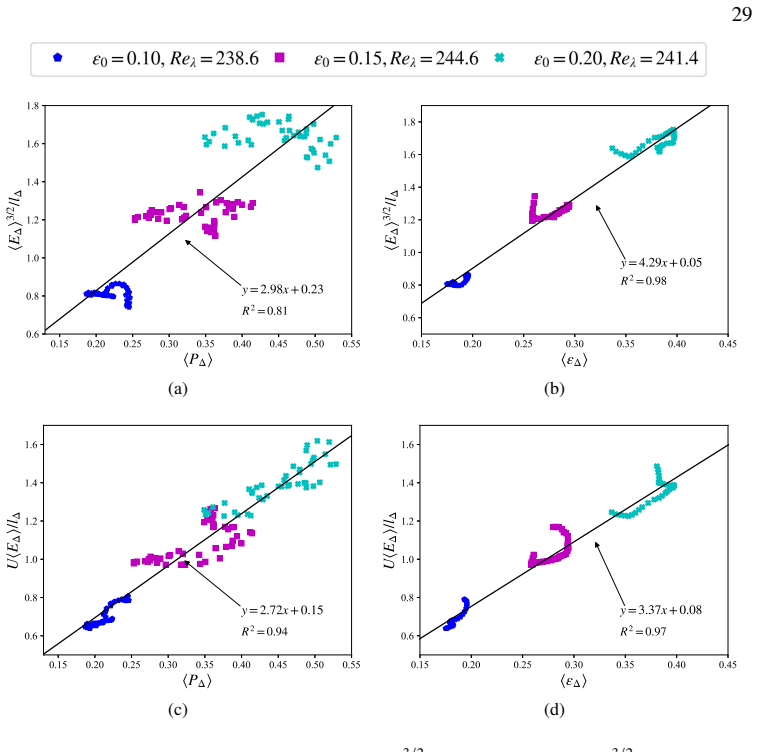
- [§3, before Eqs. (3.6a,b)] The new growth laws (3.6a,b) are not consequences of the derived budget alone: they depend on the 'bold assumption' stated just before Eqs. (3.6a,b) that the linear reference-field contributions to ⟨Πδ,ref⟩, ⟨Iδ↑⟩ and ⟨Iδ↓⟩ at r≈lΔ scale as U(1)⟨EΔ⟩/lΔ rather than (εlΔ)^{1/3}⟨EΔ⟩/lΔ. The authors explicitly describe this as 'a simple naive attempt' and defer its derivation to future work, and if the alternative scaling is correct the derivation reproduces the classical laws (⟨EΔ⟩∼εt, lΔ∼ε^{1/2}t^{3/2}) instead. The DNS in §5.4 does not close this gap: Figures 16(c,d) regress ⟨PΔ⟩ and ⟨εΔ⟩ against U(1)⟨EΔ⟩/lΔ, which tests the consequences of the assumption through the balance (3.4), but the assumed object is the scaling of the transfer-rate sum itself at r≈lΔ, and that sum is not directly regressed against the two candidate quantities. I recommend adding a direct regression of (⟨Πδ,ref⟩+⟨Πδ,err⟩+⟨Iδ↑⟩+⟨Iδ↓⟩) at r≈lΔ, and ideally of each term, against U(1)⟨EΔ⟩/lΔ and (εlΔ)^{1/3}⟨EΔ⟩/lΔ, or a derivation of the correlation scaling from the statistics of 𝚵(1).
- [§3, Eq. (3.3)] The equilibrium step ∂⟨Aδ⟩/∂t≈0 for r<lΔ is the foundation of Eq. (3.4), but it is introduced via the idealized complete-decorrelation cartoon (3.2), and the DNS evidence in Figs. 9(c,d) is presented only as a 'tendency' rather than a converged balance. The size of the residual time-derivative relative to the transfer terms is not quantified, and because the self-similar cascade and all subsequent scalings inherit this approximation, the manuscript should report, for example, the ratio |∂⟨Aδ⟩/∂t| to the dominant right-hand-side term in Eq. (3.1) as a function of τ and r/lΔ, and estimate the resulting correction to the predicted power laws.
- [§5.1, Figs. 3, 4, 6, 7] The empirical discrimination between the two candidate scalings is weaker than the text suggests. The power-law fits in Figs. 3 and 6 use the interval τ∈[4,10], roughly a factor of two in time, with three free parameters (a, b, c), so the difference between exponent 1 and 2/3 in ⟨EΔ⟩, and between 3/2 and 1 in lΔ, corresponds to only a modest factor of growth. The FSLE plots in Figs. 4(b) and 7(b) are more convincing, but they still cover a limited range, only the ε0=0.1 case is ensemble-averaged, and the F1/F2 comparison rests on a single F1 realisation. Reporting confidence intervals for the fitted exponents, or bootstrapping over the six F2 realisations, would substantially strengthen the central claim that the data 'coherently favour' the new laws.
- [§5.4, Fig. 16] The scatter regressions in Fig. 16 pool serially correlated samples from the same trajectories and plot quantities that share the same growing factors ⟨EΔ⟩ and lΔ, so the reported R² values overstate the significance of the difference between the two candidate scalings. The authors should report log-log slopes with confidence intervals, account for autocorrelation in the time series, or use well-separated independent snapshots from the stochastic regime before concluding that the data favour scalings (3.6) over (3.5).
minor comments (6)
- [Throughout] The manuscript contains several typographical errors, including 'stange attractors', 'tems', 'exponental', 'uncerainty', 'aligments', 'baring', and 'the the'; these should be corrected during revision.
- [Fig. 16 caption] The caption refers to 'all six cases', but the paper presents three F2 cases (one of them ensemble-averaged over six realisations); the wording should be corrected to describe the actual data sets being pooled.
- [Eq. (2.8)] Please check the index structure of the final term in Eq. (2.8); as written, the last term mixes the summation indices in a way that appears inconsistent with the preceding derivation, even though the term is later dropped by homogeneity.
- [Fig. 1] The typesetting of 'kΔ /uni223C 1/lΔ' contains raw LaTeX/Unicode artifacts and should be rendered as kΔ ∼ 1/lΔ.
- [Table 2] The time ranges in Table 2 are stated to be the same for all three F2 cases; please specify whether these boundaries were determined from the ε0=0.1 ensemble alone or from each case separately, and give the associated uncertainties.
- [Manuscript formatting] The journal-format markers 'Focus on Fluids articles must not exceed this page length' and 'Rapids articles must not exceed this page length' should be removed before submission.
Circularity Check
Core budget derivation is parameter-free and self-contained; the novel power laws rest on an openly labeled 'bold assumption' (a robustness risk, not circularity); the Section 5.4 confirmation of scalings (3.6) partly restates the Section 5.1 time-dependence fits, giving a mild in-sample circularity.
-
fitted input called prediction
[Section 5.4 ('Uncertainty production and dissipation scalings'), Figure 16 and surrounding text, pages 28-29]
"The scatter plot of ⟨PΔ⟩ and ⟨EΔ⟩3/2/lΔ in figure 16(a) does not support the linear relation between these two quantities advocated by the scalings (3.5). On the other hand, the scatter plot of ⟨PΔ⟩ and U(1)⟨EΔ⟩/lΔ in figure 16(c) does return a much better linear relation and supports the scaling ⟨PΔ⟩∼U(1)⟨EΔ⟩/lΔ in (3.6)."
This 'support' for (3.6) is not independent of the Section 5.1 power-law fits: the same F2 runs were used both to fit ⟨EΔ⟩≈a(τ−b)^{2/3}+c and lΔ≈a(τ−b)+c (Figs 3, 6) and to build the Fig 16 scatter plots. Given the input cartoon relation εlΔ∼⟨EΔ⟩^{3/2} used to derive the candidate laws, the fitted laws imply ⟨EΔ⟩^{3/2}/lΔ≈const while U(1)⟨EΔ⟩/lΔ∼t^{−1/3}; and by (1.1) with measured ⟨PΔ⟩/⟨εΔ⟩≈1.17, ⟨PΔ⟩≈(κ/(κ−1))d⟨EΔ⟩/dt∼t^{−1/3}. Hence the better R² for the U-scaled regression (0.94 vs 0.81) is a restatement of the already-fitted t^{2/3}/t laws, not a direct regression of the transfer-rate sum in (3.4) against the two candidate scalings. The paper itself frames Fig 16 as 'truly coherent' - a consistency check - rather than an independent test.
full rationale
The central derivation chain is self-contained and parameter-free. Equations (2.9)-(3.4) follow from the incompressible Navier-Stokes equations under stated assumptions (homogeneity, periodicity, identical forcing, equilibrium ∂⟨Aδ⟩/∂t≈0), with no fitted parameters: the budget (3.4) is an exact consequence of (3.1) and the equilibrium assumption, and the 'self-similar' r-independence of the transfer-rate sum is a deduction from the r-independence of ⟨εΔ⟩−⟨PΔ⟩, not an independent postulate. The paper is also transparent about its limitations: it explicitly labels the U(1)-scaling as 'the bold assumption', calls it 'a simple naive attempt to qualitatively account for significant correlations', and states 'whilst we must leave the task of exploring how these correlations shape scalings for a future study' and 'This is an important issue which requires substantial future research.' That the novel power laws collapse to the classical ⟨EΔ⟩∼εt, lΔ∼ε^{1/2}t^{3/2} under the alternative (εlΔ)^{1/3} scaling is a genuine robustness risk, not circularity: the assumption logically precedes and is independent of the predictions, and the DNS tests use fixed predicted exponents. Self-citation of Ge et al. (2023) is present but not load-bearing: the single-point equation (1.1) is re-derived here via the |r|→∞ limit of (2.9), the regime classification is re-verified in the authors' own Figure 2, and ⟨PΔ⟩/⟨εΔ⟩≈const is re-measured in Figure 8. The dual-cascades hypothesis (5.3)-(5.4) is tested against DNS and honestly reported as not validated, with only its necessary condition (5.5) confirmed - behavior inconsistent with forcing conclusions by construction. The only mild circularity is the Section 5.4 confirmation, whose discriminating power is largely inherited from the Section 5.1 fits of the same data (as detailed in the step above). This does not reduce the central claim, so the score is 2.
Assumptions & free parameters
free parameters (3)
- Power-law fit offsets a, b, c =
reported per case in figures 3 and 6
- Stochastic time range boundaries (τ_s, 10) =
τ_s ∈ [4,5], end at 10
- Ratio ⟨PΔ⟩/⟨εΔ⟩ =
1.17±0.08 (ε0=0.10), 1.19±0.16, 1.15±0.11
assumptions (6)
- domain assumption Navier-Stokes equations in incompressible form for both reference and perturbed fields, with identical external forcing in the F2 setup
- domain assumption Statistical homogeneity and periodicity of the reference turbulence and of the uncertainty field
- ad hoc to paper Cartoon model of complete decorrelation below lΔ and perfect correlation above lΔ (equation 3.2)
- domain assumption Equilibrium approximation ∂⟨Aδ⟩/∂t ≈ 0 for r < lΔ in the stochastic time range (equation 3.3)
- ad hoc to paper Bold assumption that reference-field contributions to the linear transfer rates scale as U^(1)⟨EΔ⟩/lΔ rather than (ε lΔ)^{1/3}⟨EΔ⟩/lΔ
- domain assumption Quasi-constant proportionality between uncertainty production and dissipation in the stochastic regime
Cite this review
Pith. "Pith review of The interscale behaviour of uncertainty in three-dimensional Navier-Stokes turbulence." pith.science (2026). https://pith.science/paper/QBJGDA3E
@misc{pith2026250707314,
  author       = {Pith},
  title        = {Pith review of: The interscale behaviour of uncertainty in three-dimensional Navier-Stokes turbulence},
  year         = {2026},
  howpublished = {\url{https://pith.science/paper/QBJGDA3E}},
  note         = {Machine review of arXiv:2507.07314}
}
read the original abstract
We derive the scale-by-scale uncertainty energy budget equation and demonstrate theoretically and computationally the presence of a self-similar equilibrium cascade of decorrelation in an inertial range of scales during the time range of power law growth of uncertainty in statistically stationary homogeneous turbulence. This cascade is predominantly inverse and driven by compressions of the reference field's relative deformation tensor and their aligments with the uncertainty velocity field. Three other subdominant cascade mechanisms are also present, two of which are forward and also dominated by compressions and one of which, the weakest and the only non-linear one of the four, is inverse. The uncertainty production and dissipation scalings which may follow from the self-similar equilibrium cascade of decorrelation lead to power law growths of the uncertainty integral scale and the average uncertainty energy which are also investigated. Compressions are not only key to chaoticity, as previously shown, but also to stochasticity.
Figures


Figures from the paper (13 more)



Reference graph
Works this paper leans on
-
[1]
, " * write output.state after.block = add.period write newline
ENTRY address author booktitle chapter edition editor howpublished institution journal key month note number organization pages publisher school series title type volume year eprint label extra.label sort.label short.list INTEGERS output.state before.all mid.sentence after.sentence after.block FUNCTION init.state.consts #0 'before.all := #1 'mid.sentence ...
-
[2]
write newline
" write newline "" before.all 'output.state := FUNCTION n.dashify 't := "" t empty not t #1 #1 substring "-" = t #1 #2 substring "--" = not "--" * t #2 global.max substring 't := t #1 #1 substring "-" = "-" * t #2 global.max substring 't := while if t #1 #1 substring * t #2 global.max substring 't := if while FUNCTION word.in bbl.in capitalize " " * FUNCT...
-
[3]
Alves Portela, F. , Papadakis, G. & Vassilicos, J. C. 2017 The turbulence cascade in the near wake of a square prism . J. Fluid Mech. 825 , 315--352
work page 2017
-
[4]
Apostolidis, A. , Laval, J. & Vassilicos, J. C. 2023 Turbulent cascade in fully developed turbulent channel flow . J. Fluid Mech. 967 , A22
work page 2023
-
[5]
Aurell, E. , Boffetta, G. , Crisanti, A. , Paladin, G. & Vulpiani, A. 1997 Predictability in the large: an extension of the concept of Lyapunov exponent . J. Phys. A Math. Theor. 30 (1), 1
work page 1997
-
[6]
Beaumard, P. , Bragan c a, P. , Cuvier, C. , Steiros, K. & Vassilicos, J. C. 2024 Scale-by-scale non-equilibrium with kolmogorov-like scalings in non-homogeneous stationary turbulence . J. Fluid Mech. 984 , A35
work page 2024
-
[7]
Berera, A. & Ho, R.D.J.G. 2018 Chaotic properties of a turbulent isotropic fluid . Phys. Rev. Lett. 120 (2), 024101
work page 2018
-
[8]
Boffetta, Guido , Cencini, Massimo , Falcioni, Massimo & Vulpiani, Angelo 2002 Predictability: a way to characterize complexity . Phys. Rep. 356 (6), 367--474
work page 2002
Show all 35 references
-
[9]
& Musacchio, S
Boffetta, G. & Musacchio, S. 2017 Chaos and predictability of homogeneous-isotropic turbulence . Phys. Rev. Lett. 119 (5), 054102
2017
-
[10]
Chen, J. G. & Vassilicos, J. C. 2022 Scalings of scale-by-scale turbulence energy in non-homogeneous turbulence . J. Fluid Mech. 938 , A7
2022
-
[11]
, Angelis, E
Cimarelli, A. , Angelis, E. , Jimenez, J. & Casciola, C. M. 2016 Cascades and wall-normal fluxes in turbulent channel flows . J. Fluid Mech. 796 , 417--436
2016
-
[12]
, Krawczynski, J
Danaila, L. , Krawczynski, J. F. , Thiesset, F. & Renou, B. 2012 Yaglom-like equation in axisymmetric anisotropic turbulence . Phys. D: Nonlinear Phenom. 241 (3), 216--223
2012
-
[13]
1986 Is navier--stokes turbulence chaotic? Phys
Deissler, R.G. 1986 Is navier--stokes turbulence chaotic? Phys. Fluids 29 (5), 1453--1457
1986
-
[14]
, Rolland, J
Ge, J. , Rolland, J. & Vassilicos, J. C. 2023 The production of uncertainty in three-dimensional navier–stokes turbulence . J. Fluid Mech. 977 , A17
2023
-
[15]
2007 A direct relation between the filtered subgrid stress and the second order structure function
Germano, M. 2007 A direct relation between the filtered subgrid stress and the second order structure function . Phys. Fluids 19 (3)
2007
-
[16]
2008 Chaos: Making a new science\/
Gleick, J. 2008 Chaos: Making a new science\/ . Penguin
2008
-
[17]
Hill, R. J. 2002 Exact second-order structure-function relationships . J. Fluid Mech. 468 , 317--326
2002
-
[18]
, Armua, A
Ho, R.D.J.G. , Armua, A. & Berera, A. 2020 Fluctuations of lyapunov exponents in homogeneous and isotropic turbulence . Phys. Rev. Fluids 5 (2), 024602
2020
-
[19]
& Howarth, L
K \'a rm \'a n, T. & Howarth, L. 1938 On the statistical theory of isotropic turbulence . Proc. R. Soc. A 164 (917), 192--215
1938
-
[20]
1970 Instability in fully developed turbulence
Kraichnan, R.H. 1970 Instability in fully developed turbulence . Phys. Fluids 13 (3), 569--575
1970
-
[21]
1971 Atmospheric predictability and two-dimensional turbulence
Leith, C.E. 1971 Atmospheric predictability and two-dimensional turbulence . J. Atmos. Sci. 28 (2), 145--161
1971
-
[22]
& Kraichnan, R.H
Leith, C.E. & Kraichnan, R.H. 1972 Predictability of turbulent flows . J. Atmos. Sci. 29 (6), 1041--1058
1972
-
[23]
1987 Turbulence in fluids: stochastic and numerical modelling\/
Lesieur, M. 1987 Turbulence in fluids: stochastic and numerical modelling\/ . Nijhoff Boston, MA
1987
-
[24]
1963 Deterministic nonperiodic flow
Lorenz, E.N. 1963 Deterministic nonperiodic flow . J. Atmos. Sci. 20 (2), 130--141
1963
-
[25]
1969 The predictability of a flow which possesses many scales of motion
Lorenz, E.N. 1969 The predictability of a flow which possesses many scales of motion . Tellus 21 (3), 289--307
1969
-
[26]
, Casciola, C
Marati, N. , Casciola, C. M. & Piva, R. 2004 Energy cascade and spatial fluxes in wall turbulence . J. Fluid Mech. 521 , 191--215
2004
-
[27]
& Lesieur, M
M \'e tais, O. & Lesieur, M. 1986 Statistical predictability of decaying turbulence . J. Atmos. Sci. 43 (9), 857--870
1986
-
[28]
, Fitzsimmons, N
Mohan, P. , Fitzsimmons, N. & Moser, R.D. 2017 Scaling of Lyapunov exponents in homogeneous isotropic turbulence . Phys. Rev. Fluids 2 (11), 114606
2017
-
[29]
Monin, A. S. & Yaglom, A. M. 2013 Statistical fluid mechanics, volume II: mechanics of turbulence\/ , , vol. 2 . Courier Corporation
2013
-
[30]
, Bec, J
Thalabard, S. , Bec, J. & Mailybaev, A. A. 2020 From the butterfly effect to spontaneous stochasticity in singular shear flows . Commun. Phys. 3 (1), 122
2020
-
[31]
, Cimarelli, A
Togni, R. , Cimarelli, A. & De Angelis, E. 2015 Physical and scale-by-scale analysis of rayleigh--b \'e nard convection . J. Fluid Mech. 782 , 380--404
2015
-
[32]
Valente, P. C. & Vassilicos, J. C. 2015 The energy cascade in grid-generated non-equilibrium decaying turbulence . Phys. Fluids 27 (4), 045103
2015
-
[33]
& Meneguzzi, M
Vincent, A. & Meneguzzi, M. 1991 The spatial structure and statistical properties of homogeneous turbulence . J. Fluid Mech. 225 , 1--20
1991
-
[34]
& Vassilicos, J
Yasuda, T. & Vassilicos, J. C. 2018 Spatio-temporal intermittency of the turbulent energy cascade . J. Fluid Mech. 853 , 235--252
2018
-
[35]
2013 Investigation of the transfer and dissipation of energy in isotropic turbulence
Yoffe, S.R. 2013 Investigation of the transfer and dissipation of energy in isotropic turbulence . arXiv preprint arXiv:1306.3408
2013 arXiv
Reviewed August 6, 2026 · model on record in the stance chip above.
Discussion (0). Continue with ORCID to comment.