REVIEW 3 major objections 4 minor 69 references
PHandover: Parallel Handover in Mobile Satellite Network
T0 review · 3 major / 4 minor · reviewed 2026-08-06 · deepseek-v4-flash
Pith's one-line read Plan-based, parallel handover cuts LEO satellite handover latency to 8.8 ms, about 21 times faster than the standard 5G NTN procedure.
desk verdict A plausible parallel-handover architecture for LEO NTN with real new components, but the central latency claim rests on unverified core-network modifications and no released code. read the letter →
The pith
A machine-rendered reading of the paper's core claim, the machinery that carries it, and where it could break.
The reading
What carries the argument
The Satellite Synchronized Function (SSF) is the load-bearing component: a new network function that sits on the core side, receives the handover plan from the source S-gNB in the preparation phase, stores the UE's NGAP IDs and the scheduled path-switch time, and at that time sends a standard Path Switch Request while pretending to be the source S-gNB. Two supporting mechanisms make the plan trustworthy: a hybrid signal-strength predictor that combines a 3GPP channel model with a neural network and residual shortcut, so handover timing can be predicted without real-time measurement reports, and a scheduling algorithm that compares predicted access-satellite sets at two future time points separated by $\Delta t=5$ s and uses binary search to pinpoint the handover instant to about 10 ms. A similar-direction access-satellite selection constraint cuts inter-satellite transfer delay by avoiding reverse-direction switches.
What would settle it
Instrument the prototype's NGAP interface and compare timestamps: record when the SSF emits the Path Switch Request, when the AMF acknowledges it, when the UE completes RRC reconfiguration, and when the UPF actually switches the downlink path. If the downlink path switch completes only after RRC reconfiguration completes, or if the AMF rejects a request whose sending node identity does not match a registered gNB, then the claimed concurrency is absent and the 21x figure will not reproduce on an unmodified core.
Extended reading notes
Core claim
The central claim is that handover latency in mobile satellite networks can be reduced by decoupling the handover execution from the core network's real-time involvement. In standard 5G NTN handover, the UE first completes the RRC switch at the access layer, then the target S-gNB triggers a Path Switch Request to the core network, and only then is the downlink data path moved; in a LEO constellation these access-core exchanges traverse inter-satellite links and can take hundreds of milliseconds. The paper's procedure splits the handover into a preparation phase, during which the SSF pre-stores the signaling and the target S-gNB pre-assigns the NGAP identity, and an execution phase in which the SSF, masquerading as the source S-gNB, sends the Path Switch Request at the scheduled time while the UE simultaneously performs the RRC reconfiguration to the target S-gNB. The result is that uplink and downlink path switches run in parallel, and the access network never waits for the core during the handover itself. The paper argues this is compatible with the existing 5G core because the SSF presents standard NGAP signaling.
Load-bearing premise
The whole latency reduction rests on the standard 5G core accepting a Path Switch Request sent by the SSF masquerading as the source S-gNB before the UE has finished attaching to the target S-gNB; if the AMF or UPF rejects, delays, or logs that request as invalid, the parallel execution and the 8.8 ms figure do not materialize.
Editorial extensions
If this is right
- Handover latency drops from hundreds of milliseconds to single-digit milliseconds, so the delay that LEO satellite handover injects into latency-sensitive applications largely disappears.
- The access network no longer depends on real-time measurement reports to make handover decisions; predicted signal strength replaces them, which suits NTN scenarios where cell signals look similar across the satellite's visibility window.
- The core network remains standard, because the SSF sends ordinary NGAP signaling and can be added without modifying AMF or UPF functions.
- Handover failure probability and user-plane packet loss both fall because the shorter handover window leaves less time for the user to move out of the target satellite's coverage area.
- TCP stalling time is reduced by roughly one third relative to standard NTN handover, with the remaining delay explained by inter-satellite propagation rather than by the handover procedure itself.
Reading between the lines
- The paper does not pursue it, but the same access/core decoupling should transfer to any mobility event whose future point is predictable from trajectory information, including terrestrial high-speed-rail handovers; the gain would depend on how much of the delay sits in access-core signaling rather than in the radio switch itself.
- If the SSF masquerade is accepted on production cores, the paper's numbers imply that the gain shrinks as the core moves closer to the radio access network; the 21x figure is a property of the satellite geometry, not of parallel execution alone.
- The reported 18% abnormal-handover probability for a stationary airplane user after 10 minutes suggests that the scheme's robustness depends on fresh orbit information, so a real deployment would likely need automated, minute-level ephemeris updates as part of the SSF logic.
Editorial analysis
A structured set of objections, weighed in public.
Referee Report
Summary. The paper proposes PHandover, a parallel handover scheme for LEO satellite networks. The design introduces a Satellite Synchronized Function (SSF) that sends a Path Switch Request to the core network in parallel with the RRC-level handover, replacing measurement-based handover with a plan-based one driven by satellite ephemeris and a machine-learning signal-strength prediction model. The authors build a prototype by modifying UERANSIM and Open5GS, drive it with Starlink and Kuiper traces, and report that the proposed scheme reduces handover latency to 8.8 ms on average compared with 250 ms for the standard NTN handover, along with improved prediction accuracy and lower failure and packet-loss rates. The central claim is that this latency reduction is achieved without modification to the 5G core network, because the SSF masquerades as the source S-gNB and triggers the path switch before the UE completes RRC attachment to the target S-gNB.
Significance. If the core-compatibility claim holds, PHandover is a valuable and plausibly deployable contribution: it targets the dominant access-core interaction delay in satellite handover, exploits the predictability of LEO orbits to avoid real-time measurements, and compares four handover schemes systematically across two constellations and two access-selection strategies. The signal-strength predictor is evaluated on external NOAA satellite data, and the overhead estimates in Section IV-F are concrete. However, the empirical centerpiece is a laptop-based emulation with undisclosed Open5GS modifications, and the headline latency-reduction factor is inconsistent across the abstract, the results section, and the conclusion. The paper does not release code or data. The idea is significant if the missing core-network verification is supplied, but that verification is load-bearing for the paper's main claim.
major comments (3)
- [§IV-A, §V-A] The parallelism and the 8.8 ms result depend on the SSF sending a Path Switch Request to the AMF (step b.1 in Fig. 5) before the UE completes RRC attachment to the target S-gNB, with the SSF 'disguis[ing] itself as the S-gNB.' The prototype description in Section V-A states that 'modified UERANSIM and Open5GS' were used, but only the UERANSIM modification for Xn-based handover is described; the Open5GS changes are never enumerated. Without evidence that a stock AMF/UPF accepts this early, masqueraded Path Switch Request and the pre-assigned NGAP ID described in Section IV-A, the claimed elimination of access-core interaction may be an artifact of undisclosed core patches rather than of the published design. Please test against an unmodified core or specify and justify the core changes.
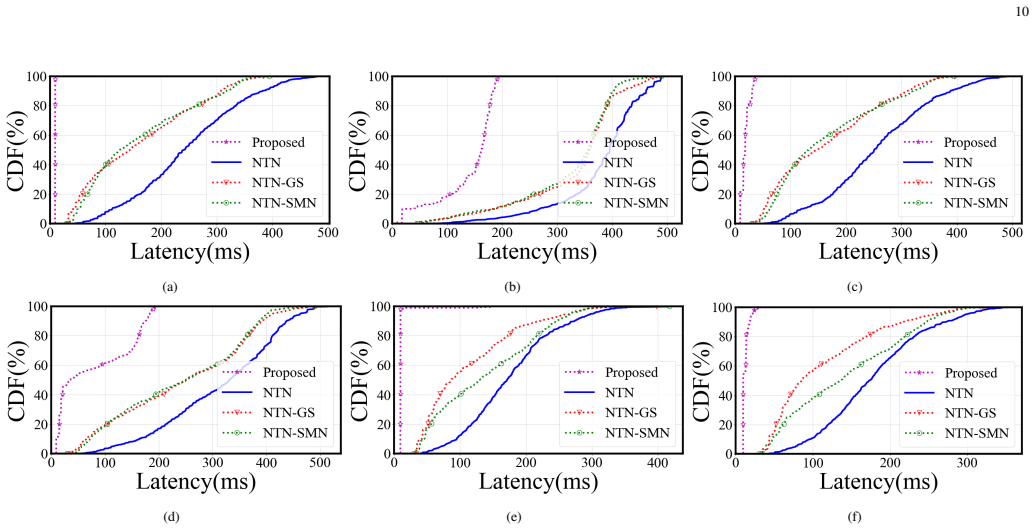
- [§V-B vs Abstract/Conclusion] The reported latency-improvement factor is not self-consistent. The abstract and introduction claim 21×; Section V-B reports 8.8 ms for PHandover versus 250 ms for NTN, which is 28.4×, and versus 153 ms and 158.5 ms for NTN-GS and NTN-SMN, which are 17.4× and 18.0×; Section VIII concludes with 10×. Since the paper's headline result is quantitative, these numbers must be reconciled in a single consistent reporting convention.
- [§V-A, §V-B] The prototype is a laptop-based emulation that uses skyfield-generated constellation dynamics and modified UERANSIM/Open5GS, but the paper does not explain how the measured latencies incorporate the inter-satellite-link and satellite-ground propagation delays that Fig. 3 identifies as the dominant handover cost, nor does it validate the SSF-to-core signaling path against a realistic network delay model. As a result, the absolute 8.8 ms value and the reported failure and packet-loss rates are not reproducible from the manuscript alone. Please provide the measurement methodology, the traces, and ideally release the code and data.
minor comments (4)
- [Throughout] There are several typos and inconsistent terms, including 'eqiupments' in Section I, 'OOn average' in Section II-B, 'chem schemes' in the references, 'Hurry' in Section VIII, and inconsistent capitalization of Phandover/PHandover.
- [§V-B] The baseline signal-strength predictor is introduced as based on the 3GPP channel model [24], but the text and Fig. 10 repeatedly call it the 'ITU model'; please clarify whether the baseline is an ITU or a 3GPP model.
- [§V-B] In the network-stability paragraph, the text says 'the proposed scheme reduces the handover failure rate by more than 2 times' immediately after reporting packet-loss rates; check whether the metric should be failure rate or packet-loss rate and make the numbers consistent.
- [§IV-A] The mechanism by which the SSF obtains the UE's NGAP ID and the target S-gNB's pre-assigned NGAP ID before handover execution is not fully specified; a short sequence-diagram explanation would help the reader verify the compatibility claim.
Circularity Check
No circular derivation: the latency and prediction results come from a new prototype and external data, with only a non-load-bearing self-citation to prior work.
full rationale
The paper's central claim, an 8.8 ms handover latency versus 250 ms for the NTN baseline, is obtained from a newly built prototype combining modified UERANSIM and Open5GS driven by real Starlink and Kuiper traces. No equation or procedure in the paper defines this latency improvement in terms of a fitted parameter or reuses the authors' prior INFOCOM result as an input. The signal-strength prediction model is trained on historical measurements and evaluated against external NOAA satellite data; the handover scheduling algorithm uses orbit geometry and binary search, and the ML accuracy is reported separately from the latency measurement. The only self-citation is the background reference to the authors' earlier prediction-based scheme [1], which is used to motivate a new conditional-handover-compatible design rather than to supply evidence for the present result. The unverified assumption that a stock 5G core accepts the SSF's early, masqueraded Path Switch Request is a validation gap, not a circular reduction, since the paper does not derive the latency from that assumption analytically. The internal inconsistency between the abstract's 21x reduction and the conclusion's 10x reduction is a reporting concern, not circularity. No circular step can be exhibited from the paper's own text, so the score reflects only the minor, non-load-bearing self-citation.
Assumptions & free parameters
free parameters (2)
- Update interval Δt =
5 seconds
- ML signal strength model parameters =
Not reported
assumptions (4)
- domain assumption The 3GPP path loss model in Eqs. (1)-(6) is an adequate physical prior for satellite-to-ground signal strength.
- domain assumption Satellite positions are predictable from ephemeris with error small enough to plan handovers (centimeter-level with minute-level updates).
- domain assumption The update interval Δt is shorter than the minimum satellite service time, so at most one handover occurs per UE between predictions.
- ad hoc to paper An unmodified 5G core will accept a PathSwitchRequest sent by SSF on behalf of the source S-gNB without extra UE context setup.
invented entities (1)
-
Satellite Synchronized Function (SSF)
Cite this review
Pith. "Pith review of PHandover: Parallel Handover in Mobile Satellite Network." pith.science (2026). https://pith.science/paper/DANG7ZIG
@misc{pith2026250707437,
  author       = {Pith},
  title        = {Pith review of: PHandover: Parallel Handover in Mobile Satellite Network},
  year         = {2026},
  howpublished = {\url{https://pith.science/paper/DANG7ZIG}},
  note         = {Machine review of arXiv:2507.07437}
}
read the original abstract
The construction of Low Earth Orbit (LEO) satellite constellations has recently attracted tremendous attention from both academia and industry. The 5G and 6G standards have identified LEO satellite networks as a key component of future mobile networks. However, due to the high-speed movement of satellites, ground terminals often experience frequent and high-latency handovers, which significantly deteriorate the performance of latency-sensitive applications. To address this challenge, we propose a parallel handover mechanism for mobile satellite networks that can considerably reduce handover latency. The main idea is to employ plan-based handovers instead of measurement-based handovers to avoid interactions between the access and core networks, thereby eliminating the significant time overhead associated with traditional handover procedures. Specifically, we introduce a novel network function named the Satellite Synchronized Function (SSF), which is designed to be fully compliant with the standard 5G core network. In addition, we propose a machine learning model for signal strength prediction, coupled with an efficient handover scheduling algorithm. We have conducted extensive experiments, and the results demonstrate that our proposed handover scheme can reduce handover latency by 21\times compared to the standard NTN handover scheme and two other existing handover approaches, along with significant improvements in network stability and user-level performance.
Figures


Figures from the paper (9 more)




Reference graph
Works this paper leans on
-
[1]
Accelerating handover in mobile satellite network,
J. Wu, S. Su, X. Wang, J. Zhang, and Y . Gao, “Accelerating handover in mobile satellite network,” in IEEE INFOCOM 2024 - IEEE Conference on Computer Communications , 2024, pp. 531–540
work page 2024
- [2]
-
[3]
Fedsn: A federated learning framework over heterogeneous leo satellite networks,
Z. Lin, Z. Chen, Z. Fang, X. Chen, X. Wang, and Y . Gao, “Fedsn: A federated learning framework over heterogeneous leo satellite networks,” IEEE Transactions on Mobile Computing , 2024
work page 2024
-
[4]
J. Peng, J. Duan, Z. Lin, H. Yuan, Y . Gao, and Z. Chen, “SigChord: Sniffing Wide Non-Sparse Multiband Signals for Terrestrial and Non- Terrestrial Wireless Networks,” arXiv preprint arXiv:2504.06587 , 2025
arXiv 2025
-
[5]
SatSense: Multi-Satellite Collaborative Framework for Spectrum Sensing,
H. Yuan, Z. Chen, Z. Lin, J. Peng, Z. Fang, Y . Zhong, Z. Song, and Y . Gao, “SatSense: Multi-Satellite Collaborative Framework for Spectrum Sensing,” IEEE Trans. Cogn. Commun. Netw. , 2025
work page 2025
-
[6]
LEO Satellite Networks Assisted Geo-Distributed Data Processing,
Z. Zhao, Z. Chen, Z. Lin, W. Zhu, K. Qiu, C. You, and Y . Gao, “LEO Satellite Networks Assisted Geo-Distributed Data Processing,” IEEE Wireless Commun. Lett. , 2024
work page 2024
-
[7]
LEO-Split: A Semi-Supervised Split Learning Framework over LEO Satellite Networks
Z. Lin, Y . Zhang, Z. Chen, Z. Fang, C. Wu, X. Chen, Y . Gao, and J. Luo, “LEO-Split: A Semi-Supervised Split Learning Framework over LEO Satellite Networks,” arXiv preprint arXiv:2501.01293 , 2025
work page Pith review arXiv 2025
-
[8]
Graph Learning for Multi-Satellite Based Spectrum Sensing,
H. Yuan, Z. Chen, Z. Lin, J. Peng, Z. Fang, Y . Zhong, Z. Song, X. Wang, and Y . Gao, “Graph Learning for Multi-Satellite Based Spectrum Sensing,” in Proc. IEEE Int. Conf. Commun. Technol. (ICCT) , 2023, pp. 1112–1116
work page 2023
Show all 69 references
-
[9]
SUMS: Sniffing Unknown Multiband Signals under Low Sampling Rates,
J. Peng, Z. Chen, Z. Lin, H. Yuan, Z. Fang, L. Bao, Z. Song, Y . Li, J. Ren, and Y . Gao, “SUMS: Sniffing Unknown Multiband Signals under Low Sampling Rates,” IEEE Trans. Mobile Comput. , 2024
2024
-
[10]
Satfed: A resource-efficient leo satellite-assisted heterogeneous federated learning framework,
Y . Zhang, Z. Lin, Z. Chen, Z. Fang, W. Zhu, X. Chen, J. Zhao, and Y . Gao, “Satfed: A resource-efficient leo satellite-assisted heterogeneous federated learning framework,” arXiv preprint arXiv:2409.13503 , 2024
2024 arXiv
-
[11]
Constructing 4D Radio Map in LEO Satellite Networks with Limited Samples,
H. Yuan, Z. Chen, Z. Lin, J. Peng, Y . Zhong, X. Hu, S. Xue, W. Li, and Y . Gao, “Constructing 4D Radio Map in LEO Satellite Networks with Limited Samples,” IEEE INFOCOM , 2025
2025
-
[12]
TS 23.501,System Architecture for the 5G System,
3GPP, “TS 23.501,System Architecture for the 5G System,” 2023
2023
-
[13]
TS 23.502,procedures for the 5G system,
——, “TS 23.502,procedures for the 5G system,” 2023
2023
-
[14]
White Paper on 6G Vision and Candidate Technologies,
“White Paper on 6G Vision and Candidate Technologies,” IMT-2030 (6G) Promotion Group, Tech. Rep., 2018
2018
-
[15]
T-Mobile takes coverage above and beyond with SpaceX
“T-Mobile takes coverage above and beyond with SpaceX.” [Online]. Available: https://www.t-mobile.com/news/un-carrier/t-mobile- takes-coverage-above-and-beyond-with-spacex
-
[16]
Optus and Elon Musk’s Starlink to Offer Mobile Connectivity via Satellite
“Optus and Elon Musk’s Starlink to Offer Mobile Connectivity via Satellite.” [Online]. Available: https://gizmodo.com.au/2023/07/optus- starlink-mobile-connectivity-satellite/
2023
-
[17]
TS 38.821,solutions for NR to support non-terrestrial networks (NTN),
3GPP, “TS 38.821,solutions for NR to support non-terrestrial networks (NTN),” 2024
2024
-
[18]
A case for stateless mobile core network functions in space,
Y . Li, H. Li, W. Liu, L. Liu, Y . Chen, J. Wu, Q. Wu, J. Liu, and Z. Lai, “A case for stateless mobile core network functions in space,” in Proceeding of ACM SIGCOMM . Association for Computing Machinery, 2022, p. 298–313
2022
-
[19]
TTP develops 5G NTN test environment with Keysight tools
TTP, “TTP develops 5G NTN test environment with Keysight tools.” [Online]. Available: https://www.ttp.com/news/ttp-develops-5g-ntn-test- environment-with-keysight-tools/
-
[20]
Project kuiper,
“Project kuiper,” https://www.aboutamazon.com/what-we-do/devices- services/project-kuiper
-
[21]
Investing in Space: Is SpaceX’s Starlink growing satellite internet market share, or taking it?
CNBC, “Investing in Space: Is SpaceX’s Starlink growing satellite internet market share, or taking it?” https://cnb.cx/42Pa8jd, Mar 2023
2023
-
[22]
Laser intersatellite links in a Starlink constellation: A classification and analysis,
A. U. Chaudhry and H. Yanikomeroglu, “Laser intersatellite links in a Starlink constellation: A classification and analysis,” IEEE V ehicular Technology Magazine, vol. 16, no. 2, pp. 48–56, 2021
2021
-
[23]
Sateliot — Space · Connecting · 5G Satellite IoT
“Sateliot — Space · Connecting · 5G Satellite IoT.” [Online]. Available: https://sateliot.space/en/
-
[24]
TS 38811, study on new radio (NR) to support non-terrestrial networks,
3GPP, “TS 38811, study on new radio (NR) to support non-terrestrial networks,” 2023
2023
-
[25]
Handover chemes in satellite networks: state-of-the-art and future research directions,
P. K. Chowdhury, M. Atiquzzaman, and W. Ivancic, “Handover chemes in satellite networks: state-of-the-art and future research directions,” IEEE Communications Surveys & Tutorials , vol. 8, no. 4, pp. 2–14, 2006
2006
-
[26]
Satellite handover techniques for LEO networks,
E. Papapetrou, S. Karapantazis, G. Dimitriadis, and F.-N. Pavlidou, “Satellite handover techniques for LEO networks,” International Journal of Satellite Communications and Networking , vol. 22, no. 2, pp. 231– 245, 2004
2004
-
[27]
Unveiling beamforming strategies of starlink LEO satellites,
M. Neinavaie and Z. M. Kassas, “Unveiling beamforming strategies of starlink LEO satellites,” in Proceedings of the 35th International Technical Meeting of the Satellite Division of The Institute of Navigation , 2022, pp. 2525–2531
2022
-
[28]
Interactions of the space debris environment with mega constellations—using the example of the oneweb constellation,
J. Radtke, C. Kebschull, and E. Stoll, “Interactions of the space debris environment with mega constellations—using the example of the oneweb constellation,” Acta Astronautica, vol. 131, pp. 55–68, 2017
2017
-
[29]
Analysis of inter-satellite link paths for LEO mega-constellation networks,
Q. Chen, G. Giambene, L. Yang, C. Fan, and X. Chen, “Analysis of inter-satellite link paths for LEO mega-constellation networks,” IEEE Transactions on V ehicular Technology, vol. 70, no. 3, pp. 2743–2755, 2021
2021
-
[30]
Enabling low-latency-capable satellite-ground topology for emerging LEO satellite networks,
Y . Zhang, Q. Wu, Z. Lai, and H. Li, “Enabling low-latency-capable satellite-ground topology for emerging LEO satellite networks,” in Proceeding of IEEE INFOCOM . IEEE, 2022, pp. 1329–1338
2022
-
[31]
A hybrid analytical- machine learning approach for LEO satellite orbit prediction,
J. Haidar-Ahmad, N. Khairallah, and Z. M. Kassas, “A hybrid analytical- machine learning approach for LEO satellite orbit prediction,” in Pro- 14 ceeding of 25th International Conference on Information Fusion , 2022, pp. 1–7
2022
-
[32]
Real-time LEO satellite orbits based on batch least-squares orbit determination with short-term orbit prediction,
K. Wang, J. Liu, H. Su, A. El-Mowafy, and X. Yang, “Real-time LEO satellite orbits based on batch least-squares orbit determination with short-term orbit prediction,” Remote Sensing , vol. 15, no. 1, 2023. [Online]. Available: https://www.mdpi.com/2072-4292/15/1/133
2023
-
[33]
Celestrak,
“Celestrak,” https://celestrak.com/
-
[34]
Starlink Status,
“Starlink Status,” https://starlinkstatus.space/
-
[35]
Skyfield - documentation,
“Skyfield - documentation,” https://rhodesmill.org/skyfield/
-
[36]
L2D2: Low latency distributed downlink for LEO satellites,
D. Vasisht, J. Shenoy, and R. Chandra, “L2D2: Low latency distributed downlink for LEO satellites,” in Proceedings of the 2021 ACM SIG- COMM 2021 Conference , 2021, pp. 151–164
2021
-
[37]
UERANSIM,
“UERANSIM,” https://github.com/aligungr/UERANSIM/
-
[38]
open5gs.org,
“open5gs.org,” https://open5gs.org/
-
[39]
Research on mobility management strategy based on the mobile foreign agent domain in satellite networks,
D. Yanlei, L. Dong’ang, L. Qin, W. Chunting, and S. Keyi, “Research on mobility management strategy based on the mobile foreign agent domain in satellite networks,” Journal of Xidian University , vol. 45, no. 156-162, 2018
2018
-
[40]
Distributed mobility management in IP/LEO satellite networks,
W. Han, B. Wang, Z. Feng, B. Zhao, and W. Yu, “Distributed mobility management in IP/LEO satellite networks,” in International Conference on Systems and Informatics , 2016, pp. 691–695
2016
-
[41]
Space mobile networks: Satellite as core and access networks for B5G,
J. Kim, J. Lee, H. Ko, T. Kim, and S. Pack, “Space mobile networks: Satellite as core and access networks for B5G,” IEEE Communications Magazine, vol. 60, no. 4, pp. 58–64, 2022
2022
-
[42]
Long short-term memory,
S. Hochreiter and J. Schmidhuber, “Long short-term memory,” Neural Comput., vol. 9, no. 8, p. 1735–1780, Nov. 1997. [Online]. Available: https://doi.org/10.1162/neco.1997.9.8.1735
1997 doi
-
[43]
Topology virtualization and dynamics shielding method for LEO satellite networks,
Q. Chen, J. Guo, L. Yang, X. Liu, and X. Chen, “Topology virtualization and dynamics shielding method for LEO satellite networks,” IEEE Communications Letters , vol. 24, no. 2, pp. 433–437, 2020
2020
-
[44]
Application of time-varying graph theory over the space information networks,
T. Zhang, J. Li, H. Li, S. Zhang, P. Wang, and H. Shen, “Application of time-varying graph theory over the space information networks,” IEEE Network, vol. 34, no. 2, pp. 179–185, 2020
2020
-
[45]
5G New Radio mobility performance in LEO-based non-Terrestrial networks,
E. Juan, M. Lauridsen, J. Wigard, and P. E. Mogensen, “5G New Radio mobility performance in LEO-based non-Terrestrial networks,” in Proceeding of IEEE Globecom Workshops , 2020, pp. 1–6
2020
-
[46]
How to allocate resources in cloud native networks towards 6G,
J. Wu, Y . Gao, L. Wang, J. Zhang, and D. O. Wu, “How to allocate resources in cloud native networks towards 6G,” IEEE Network , pp. 1–7, 2023
2023
-
[47]
Handover strategy for LEO satellite networks using bipartite graph and hysteresis margin,
S. Eydian, M. Hosseini, and G. Karabulut Kurt, “Handover strategy for LEO satellite networks using bipartite graph and hysteresis margin,” IEEE Open Journal of the Communications Society , vol. 6, pp. 1470– 1484, 2025
2025
-
[48]
AI-based handover decision algorithm for conditional handover in non-terrestrial networks (NTNs),
H. Gupta, N. Srivastava, and L. Borman, “AI-based handover decision algorithm for conditional handover in non-terrestrial networks (NTNs),” 2025 Workshop on Computing, Networking and Communications (CNC) , 2025
2025
-
[49]
Channel- aware handover management for space-air-ground integrated networks,
C. Nuo, S. Zhili, S. Yujie, C. Yue, X. Xu, and A. B. Sali, “Channel- aware handover management for space-air-ground integrated networks,” China Communications , vol. 22, no. 2, pp. 62–76, 2025
2025
-
[50]
SEHAP: Secure and efficient handover authentication protocol in LEO satellite non-terrestrial networks,
Y . Guo, J. Wang, K. Geng, Z. Li, F. Li, and L. Fang, “SEHAP: Secure and efficient handover authentication protocol in LEO satellite non-terrestrial networks,” in ICASSP 2025 - 2025 IEEE International Conference on Acoustics, Speech and Signal Processing (ICASSP) , 2025, pp. 1–5
2025
-
[51]
Adaptsfl: Adaptive Split Federated Learning in Resource-Constrained Edge Networks,
Z. Lin, G. Qu, W. Wei, X. Chen, and K. K. Leung, “Adaptsfl: Adaptive Split Federated Learning in Resource-Constrained Edge Networks,” IEEE Trans. Netw. , 2024
2024
-
[52]
Hi- erarchical Split Federated Learning: Convergence Analysis and System Optimization,
Z. Lin, W. Wei, Z. Chen, C.-T. Lam, X. Chen, Y . Gao, and J. Luo, “Hi- erarchical Split Federated Learning: Convergence Analysis and System Optimization,” IEEE Trans. Mobile Comput. , 2025
2025
-
[53]
Accelerating Federated Learning with Model Segmentation for Edge Networks,
M. Hu, J. Zhang, X. Wang, S. Liu, and Z. Lin, “Accelerating Federated Learning with Model Segmentation for Edge Networks,” IEEE Trans. Green Commun. Netw. , 2024
2024
-
[54]
Fedac: An adaptive clustered federated learning framework for heterogeneous data,
Y . Zhang, H. Chen, Z. Lin, Z. Chen, and J. Zhao, “Fedac: An adaptive clustered federated learning framework for heterogeneous data,” arXiv preprint arXiv:2403.16460, 2024
2024 arXiv
-
[55]
Efficient Parallel Split Learning over Resource-Constrained Wireless Edge Networks,
Z. Lin, G. Zhu, Y . Deng, X. Chen, Y . Gao, K. Huang, and Y . Fang, “Efficient Parallel Split Learning over Resource-Constrained Wireless Edge Networks,” IEEE Trans. Mobile Comput. , vol. 23, no. 10, pp. 9224–9239, 2024
2024
-
[56]
Rf-based human activity recognition using signal adapted convolutional neural network,
Z. Chen, C. Cai, T. Zheng, J. Luo, J. Xiong, and X. Wang, “Rf-based human activity recognition using signal adapted convolutional neural network,” IEEE Transactions on Mobile Computing , vol. 22, no. 1, pp. 487–499, 2021
2021
-
[57]
Optimal resource allocation for u-shaped parallel split learning,
S. Lyu, Z. Lin, G. Qu, X. Chen, X. Huang, and P. Li, “Optimal resource allocation for u-shaped parallel split learning,” in 2023 IEEE Globecom Workshops (GC Wkshps) , 2023, pp. 197–202
2023
-
[58]
HASFL: Heterogeneity- Aware Split Federated Learning over Edge Computing Systems,
Z. Lin, Z. Chen, X. Chen, W. Ni, and Y . Gao, “HASFL: Heterogeneity- Aware Split Federated Learning over Edge Computing Systems,” arXiv preprint arXiv:2506.08426, 2025
2025 arXiv
-
[59]
LCFed: An Efficient Clustered Federated Learning Framework for Heterogeneous Data,
Y . Zhang, H. Chen, Z. Lin, Z. Chen, and J. Zhao, “LCFed: An Efficient Clustered Federated Learning Framework for Heterogeneous Data,” arXiv preprint arXiv:2501.01850 , 2025
2025 arXiv
-
[60]
Split Learning in 6G Edge Networks,
Z. Lin, G. Qu, X. Chen, and K. Huang, “Split Learning in 6G Edge Networks,” IEEE Wirel. Commun. , 2024
2024
-
[61]
Chatgpt for good? on opportunities and challenges of large language models for education,
E. Kasneci, K. Seßler, S. K ¨uchemann, M. Bannert, D. Dementieva, F. Fischer, U. Gasser, G. Groh, S. G ¨unnemann, E. H ¨ullermeier et al. , “Chatgpt for good? on opportunities and challenges of large language models for education,” Learning and individual differences , vol. 10...
2023
-
[62]
Automated Federated Pipeline for Parameter-Efficient Fine-Tuning of Large Lan- guage Models,
Z. Fang, Z. Lin, Z. Chen, X. Chen, Y . Gao, and Y . Fang, “Automated Federated Pipeline for Parameter-Efficient Fine-Tuning of Large Lan- guage Models,” arXiv preprint arXiv:2404.06448 , 2024
2024 arXiv
-
[63]
HSplitLoRA: A Heterogeneous Split Parameter- Efficient Fine-Tuning Framework for Large Language Models,
Z. Lin, Y . Zhang, Z. Chen, Z. Fang, X. Chen, P. Vepakomma, W. Ni, J. Luo, and Y . Gao, “HSplitLoRA: A Heterogeneous Split Parameter- Efficient Fine-Tuning Framework for Large Language Models,” arXiv preprint arXiv:2505.02795, 2025
2025 arXiv
-
[64]
Ifvit: Interpretable fixed-length representation for fingerprint matching via vision transformer,
Y . Qiu, H. Chen, X. Dong, Z. Lin, I. Y . Liao, M. Tistarelli, and Z. Jin, “Ifvit: Interpretable fixed-length representation for fingerprint matching via vision transformer,” IEEE Transactions on Information F orensics and Security , 2024
2024
-
[65]
Large language models on graphs: A comprehensive survey,
B. Jin, G. Liu, C. Han, M. Jiang, H. Ji, and J. Han, “Large language models on graphs: A comprehensive survey,” IEEE Transactions on Knowledge and Data Engineering , 2024
2024
-
[66]
Pushing Large Language Models to the 6G Edge: Vision, Challenges, and Opportunities,
Z. Lin, G. Qu, Q. Chen, X. Chen, Z. Chen, and K. Huang, “Pushing Large Language Models to the 6G Edge: Vision, Challenges, and Opportunities,” arXiv preprint arXiv:2309.16739 , 2023
2023 arXiv
-
[67]
Give us the facts: Enhancing large language models with knowledge graphs for fact- aware language modeling,
L. Yang, H. Chen, Z. Li, X. Ding, and X. Wu, “Give us the facts: Enhancing large language models with knowledge graphs for fact- aware language modeling,” IEEE Transactions on Knowledge and Data Engineering, vol. 36, no. 7, pp. 3091–3110, 2024
2024
-
[68]
SplitLoRA: A Split Parameter-Efficient Fine-Tuning Framework for Large Language Models,
Z. Lin, X. Hu, Y . Zhang, Z. Chen, Z. Fang, X. Chen, A. Li, P. Vepakomma, and Y . Gao, “SplitLoRA: A Split Parameter-Efficient Fine-Tuning Framework for Large Language Models,” arXiv preprint arXiv:2407.00952, 2024
2024 arXiv
-
[69]
A survey on evaluation of large language models,
Y . Chang, X. Wang, J. Wang, Y . Wu, L. Yang, K. Zhu, H. Chen, X. Yi, C. Wang, Y . Wang et al. , “A survey on evaluation of large language models,” ACM transactions on intelligent systems and technology , vol. 15, no. 3, pp. 1–45, 2024
2024
Reviewed August 6, 2026 · model on record in the stance chip above.
Discussion (0). Sign in to comment.