REVIEW 2 major objections 7 minor 104 references
Detecting Galactic Rings in the DESI Legacy Imaging Surveys with Semi-Supervised Deep Learning
T0 review · 2 major / 7 minor · reviewed 2026-08-06 · deepseek-v4-flash
Pith's one-line read Using a semi-supervised GAN trained on 5,173 expert-confirmed rings, this paper reports 62,962 ringed-galaxy candidates in the DESI Legacy Imaging Surveys, the largest catalog to date.
desk verdict A large new ringed-galaxy catalog whose headline precision hasn't been shown to transfer to the prediction sample; the paper's own caveat admits the gap. read the letter →
The pith
A machine-rendered reading of the paper's core claim, the machinery that carries it, and where it could break.
The reading
What carries the argument
The load-bearing object is GC-SWGAN, a semi-supervised generative adversarial network in which the classifier and the discriminator share a feature-extraction backbone. This sharing lets unlabeled real images and generator-produced fake images train the feature space that the classifier uses, so the model learns ring morphology from only 5,173 labeled positive examples. The generator, discriminator, and classifier losses are combined, with a Wasserstein distance and gradient penalty stabilizing training. This architecture is what converts scarce expert labels into a survey-scale classifier that can score 750,000 images in under fifteen minutes.
What would settle it
Take a random sample of a few hundred galaxies from the 62,962 candidates, have an independent morphologist classify them without knowing the model's output probabilities, and compare the confirmed-ring fraction with the claimed 94% precision; if the confirmed fraction falls well below that, the transferability assumption fails. The same test could be applied to the 0.9-threshold subsample to check whether higher thresholds truly deliver higher purity.
Extended reading notes
Core claim
The central discovery is that a semi-supervised GAN-based classifier, GC-SWGAN, can identify galactic rings in DESI Legacy Imaging Surveys images well enough to build the largest ringed-galaxy catalog to date. The model combines a semi-supervised GAN with a Wasserstein GAN with gradient penalty; its discriminator and classifier share a feature-extraction backbone, so unlabeled images improve the classifier without needing labels. Trained on 5,173 ringed galaxies from the CSRG and GZ2-CNRG catalogs, 15,000 non-ringed galaxies, and 15,000 unlabeled images, the model reaches an MCC of 0.91, an AU-ROC of 0.9921, and an AU-PRC of 0.9794 for rings on the test set. Applying it to 748,601 galaxies yields 62,962 ring candidates at a 0.5 threshold and 37,508 at a 0.9 threshold. The paper argues this is the largest sample of ringed galaxies to date.
Load-bearing premise
The 94% precision measured on a held-out test set, which is a random split from the same expert catalogs used for training, is assumed to carry over to the full 748,601-galaxy prediction sample, where true rings are rarer, galaxies are fainter and more distant, and many morphologies are ambiguous.
Editorial extensions
If this is right
- If the test-set precision of roughly 94% holds on the full prediction sample, about 59,000 of the 62,962 candidates would be true ringed galaxies, giving a catalog an order of magnitude larger than previous expert-verified collections.
- The implied ring fraction among bright nearby galaxies is about 8.4%, lower than earlier estimates from the Galaxy Zoo DECaLS and HSC samples; the authors attribute this difference to their stricter expert-based training labels.
- Raising the classification threshold to 0.9 trades away nearly half the candidates for a higher-purity subsample of 37,508 galaxies, which can serve as a conservative core catalog.
- Compared with a control sample matched in redshift and r-band absolute magnitude, the predicted ringed galaxies concentrate in the green valley of g-r color and specific star formation rate, consistent with rings marking a transitional star-formation phase.
- The model's probability output decreases and becomes more uncertain toward fainter magnitudes and higher redshifts, so the catalog is most complete for low-redshift, high-luminosity rings.
Reading between the lines
- Because the paper reports no independent visual or external-catalog validation of the 62,962 predictions, the true precision on the full prediction sample is unmeasured; a small validation campaign on a few hundred candidates would test the 94% claim directly.
- The observed probability trends with magnitude and redshift imply that downstream evolution studies should model catalog incompleteness as a function of brightness and distance rather than treat the selection as flat.
- The same shared-feature semi-supervised recipe could be applied to other rare morphological features, such as tidal tails, shells, or galactic lenses, where expert catalogs are similarly small.
- A head-to-head comparison with transfer-learning classifiers trained on the same labels would clarify whether the semi-supervised advantage comes from the unlabeled images or from the shared feature architecture.
Editorial analysis
A structured set of objections, weighed in public.
Referee Report
Summary. The paper trains a GC-SWGAN semi-supervised classifier to detect ringed galaxies in DESI Legacy Imaging Survey images. The labeled training set comprises 5,173 ringed galaxies from the CSRG and GZ2-CNRG catalogs and 15,000 strictly selected non-ringed galaxies from GZ2, with 15,000 unlabeled DESI images; images are preprocessed and split 80:20 into training and test sets. On the test set, the model achieves 97% accuracy, 94% precision and 93% recall for rings at a 0.5 probability threshold. The trained model is applied to 748,601 galaxies with r<17.0 and 0.0005<z<0.25, yielding 62,962 ring candidates (8.4% of the input), which the authors describe as the largest ringed-galaxy catalog to date. A comparison of g-r color and specific star formation rate between the predicted ringed sample and a control sample indicates that ringed galaxies preferentially populate the green valley.
Significance. If the reported test-set precision transfers to the full prediction sample, the resulting catalog of 62,962 ringed galaxies would be a valuable resource for studying ring formation and evolution, and the semi-supervised approach would be a useful tool for rare-morphology searches in large imaging surveys. The paper has notable strengths: the training labels are expert-verified (CSRG and GZ2-CNRG), the non-ring selection is strict (zero ring votes), the model code is publicly available on GitHub, and the application to 748,601 galaxies demonstrates a scalable pipeline. The green-valley analysis with a redshift- and luminosity-matched control sample is a sensible first application. However, the central catalog claim currently rests on test-set metrics measured on a random split of the same expert catalogs used for training, with no independent validation of the predicted sample; this is the main gap that must be addressed.
major comments (2)
- [§6, Table 1] The 94% precision and 93% recall for ringed galaxies are computed on a random 20% split (Section 3) of the same expert catalogs used for training, where the ringed fraction is 1,028/4,024 ≈ 25.5%. The prediction sample has a ringed fraction of only 62,962/748,601 ≈ 8.4%. Precision is prevalence-dependent: even if the test-set TPR (0.928) and FPR (derived from the non-ring recall of 0.9786, i.e., FPR ≈ 0.0214) were exactly preserved, the expected precision at 8.4% prevalence would be only about 80%, not 94%. More importantly, the prediction sample contains fainter and higher-redshift galaxies and many ambiguous morphologies, as the paper itself acknowledges in Section 6 and Section 8. The paper provides no independent visual or external-catalog validation of the 62,962 candidates, and its own caveat for the threshold-0.9 catalog — 'this accuracy is based on the training set and may not reflect the true performance of the model without further validation using independent datasets and true class labels' — applies equally to the threshold-0.5 catalog that defines the headline sample. This transferability gap is load-bearing for the central claim of a 94%-precision catalog of 62,962 galaxies.
- [§7, Figure 9] The green-valley and SSFR analysis uses the same unvalidated candidate list as the catalog. Because the control sample is drawn from the same prediction pool, any classifier bias — for example, false positives or false negatives correlated with image size, brightness, or concentration — will directly imprint on the color and SSFR distributions being compared. The paper states that ringed galaxies 'are more likely to reside in the green valley' based on this comparison, but without quantifying the contamination or repeating the analysis on a verified subsample (e.g., a visually inspected random subset or the high-confidence prob>0.9 catalog), this physical conclusion is not yet established. The authors should show that the green-valley excess persists under stricter thresholds or after independent visual verification.
minor comments (7)
- [§3] The claim that cropping from 256×256 to 192×192 reduces computational resource consumption by 'approximately 32%' is inconsistent with the pixel counts: (256^2 - 192^2)/256^2 ≈ 43.8%. Please correct the percentage.
- [§5, Eq. (3)] In the text following Eq. (3), 'samples predicted as positive (non-ringed galaxies)' should read 'samples predicted as positive (ringed galaxies)'; the parenthetical currently misstates the positive class.
- [§6] When introducing the threshold-0.9 catalog, the text states 'During the evaluation on the training set, this threshold corresponds to an accuracy of approximately 98%'; the evaluation is on the test set, not the training set. The same wording appears earlier in the paragraph on the threshold-0.5 catalog ('Based on the evaluation results from the training set'). Please correct both.
- [§4.1] The claim that GC-SWGAN 'significantly reduced reliance on extensive annotated data' is supported only by a citation to Luo et al. (2025a); this paper does not include an ablation comparing GC-SWGAN to a fully supervised baseline trained on the same labeled data for this specific ring-detection task. A brief comparison or a clear statement that the advantage is inherited from the method paper would strengthen the presentation.
- [§7] The concentration index C is used to describe the control-sample construction of Fernandez et al. but is never defined. Please provide a definition or reference.
- [Table 2] The full catalog is essential for the paper's central contribution, but the manuscript provides only a 30-row preview. The full machine-readable catalog should be made available (e.g., as a data release or supplementary file) rather than promised as 'available online' without a persistent link.
- [Throughout] There are several typographical errors, including 'adpoted' and 'dection' in Section 1. A careful proofreading pass is recommended.
Circularity Check
No significant circularity: the catalog is an application of an independently trained and evaluated model, with test metrics measured rather than fitted.
full rationale
The paper's central claim is an empirical catalog produced by applying a trained model to new images, not a derivation that reduces to its own inputs by construction. The training labels come from external expert catalogs (CSRG and GZ2-CNRG), the non-ring labels come from Galaxy Zoo 2 strict vote thresholds, and the model is evaluated on a held-out random split of the labeled data in Section 5, where precision, recall, F1, AU-ROC, and AU-PRC are directly measured rather than imposed. The self-citations to Luo et al. (2025a) for the GC-SWGAN architecture and to Luo et al. (2025b) for image-size choices are present, but they are not load-bearing circularity: this paper retrains and independently evaluates the model on the ring-detection task, so the catalog result rests on the in-paper test metrics and the model's actual outputs on the 748,601-galaxy prediction sample. The extrapolation of test-set precision to the lower-prevalence prediction set is a genuine external-validity concern, and the paper itself flags this limitation when discussing the threshold-0.9 catalog ('this accuracy is based on the training set and may not reflect the true performance of the model without further validation using independent datasets and true class labels'), but that is a generalization or correctness issue, not a definitional or self-referential circularity. No equation, fitted parameter, or cited uniqueness theorem forces the 62,962-galaxy result, so the circularity score is 0.
Assumptions & free parameters
free parameters (5)
- Classification probability threshold =
0.5 (0.9 for high-confidence subset)
- Selection cuts r<17.0 and 0.0005<z<0.25 =
r<17.0, 0.0005<z<0.25
- Non-ringed selection criterion =
zero votes for ring feature in GZ2
- Image crop size =
192x192 pixels
- Training hyperparameters =
learning rate 0.0001, decay factor 1/1.000004, batch size 64, 100,000 iterations
assumptions (4)
- domain assumption The CSRG and GZ2-CNRG catalogs are accurate ground truth for ringed galaxies.
- ad hoc to paper The 8:2 random split of the labeled catalogs yields a test set representative of the full DESI prediction sample.
- ad hoc to paper The semi-supervised GC-SWGAN framework improves classification over fully supervised training with the same labeled data.
- domain assumption Galaxy Zoo DESI photometric redshifts and magnitudes are sufficiently accurate for the r<17 and 0.0005<z<0.25 selection.
Cite this review
Pith. "Pith review of Detecting Galactic Rings in the DESI Legacy Imaging Surveys with Semi-Supervised Deep Learning." pith.science (2026). https://pith.science/paper/JQAR7CAW
@misc{pith2026250707552,
  author       = {Pith},
  title        = {Pith review of: Detecting Galactic Rings in the DESI Legacy Imaging Surveys with Semi-Supervised Deep Learning},
  year         = {2026},
  howpublished = {\url{https://pith.science/paper/JQAR7CAW}},
  note         = {Machine review of arXiv:2507.07552}
}
read the original abstract
The ring structures of disk galaxies are vital for understanding galaxy evolution and dynamics. However, due to the scarcity of ringed galaxies and challenges in their identification, traditional methods often struggle to efficiently obtain statistically significant samples. To address this, this study employs a novel semi-supervised deep learning model, GC-SWGAN, aimed at identifying galaxy rings from high-resolution images of the DESI Legacy Imaging Surveys. We selected over 5,000 confirmed ringed galaxies from the Catalog of Southern Ringed Galaxies (CSRG) and the Northern Ringed Galaxies from the GZ2 catalog (GZ2-CNRG), both verified by morphology expert R. J. Buta, to create an annotated training set. Additionally, we incorporated strictly selected non-ringed galaxy samples from the Galaxy Zoo 2 dataset and utilized unlabelled data from DESI Legacy Surveys to train our model. Through semi-supervised learning, the model significantly reduced reliance on extensive annotated data while enhancing robustness and generalization. On the test set, it demonstrated exceptional performance in identifying ringed galaxies. With a probability threshold of 0.5, the classification accuracy reached 97\%, with precision and recall for ringed galaxies at 94\% and 93\%, respectively. Building on these results, we predicted 750,000 galaxy images from the DESI Legacy Imaging Surveys with r-band apparent magnitudes less than 17.0 and redshifts in the range 0.0005 < z < 0.25, compiling the largest catalog of ringed galaxies to date, containing 62,962 galaxies with ring structures. This catalog provides essential data for subsequent research on the formation mechanisms and evolutionary history of galaxy rings.
Figures


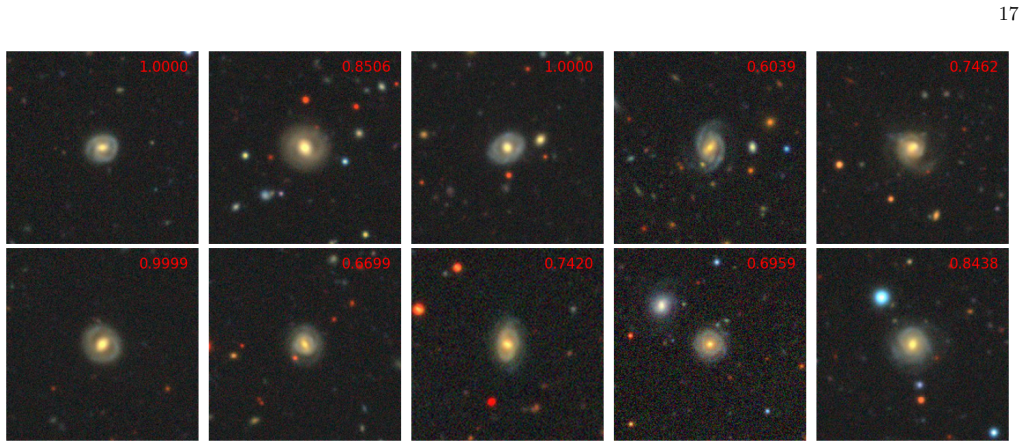
Figures from the paper (6 more)



Reference graph
Works this paper leans on
-
[1]
, " * write output.state after.block = add.period write newline
ENTRY address archivePrefix author booktitle chapter doi edition editor eprint howpublished institution journal key month number organization pages publisher school series title misctitle type volume year version url label extra.label sort.label short.list INTEGERS output.state before.all mid.sentence after.sentence after.block FUNCTION init.state.consts ...
-
[2]
write newline
" write newline "" before.all 'output.state := FUNCTION format.url url empty "" new.block "" url * "" * if FUNCTION format.eprint eprint empty "" archivePrefix empty "" archivePrefix "arXiv" = new.block " " eprint * " " * new.block " " eprint * " " * if if if FUNCTION format.doi doi empty "" " " doi * " " * if FUNCTION format.pid doi empty eprint empty ur...
-
[3]
[gϞŮk FysyꫯL^ O<Q S p9--펜_DD &(( ' Xf/ X 2qD|||4iRe^z q ]ڵk2V^MV 5j ѭ6֭ QQQxyy p!>3 XdI]v _ iذ!cǎ_&33Pn ,]<w 7^9 > :(^0 i&nvťKnɥ
thebibliography [1] 20pt to REFERENCES 6pt =0pt \@twocolumntrue 12pt -12pt 10pt plus 3pt =0pt =0pt =1pt plus 1pt =0pt =0pt -12pt =13pt plus 1pt =20pt =13pt plus 1pt \@M =10000 =-1.0em =0pt =0pt 0pt =0pt =1.0em @enumiv\@empty 10000 10000 `\.\@m \@noitemerr \@latex@warning Empty `thebibliography' environment \@ifnextchar \@reference \@latexerr Missing key o...
2017
-
[4]
2016, in 12th USENIX symposium on operating systems design and implementation (OSDI 16), 265--283
Abadi, M., Barham, P., Chen, J., et al. 2016, in 12th USENIX symposium on operating systems design and implementation (OSDI 16), 265--283
2016
-
[5]
Abbott , T. M. C., Adam \'o w , M., Aguena , M., et al. 2021, title The Dark Energy Survey Data Release 2 , , 255, 20, 10.3847/1538-4365/ac00b3
-
[6]
K., et al
Abraham, L., Abraham, S., Kembhavi, A. K., et al. 2025, title Automated detection of galactic rings from sloan digital sky survey images, The Astrophysical Journal, 978, 137
2025
-
[7]
K., Philip, N., & Vaghmare, K
Abraham, S., Aniyan, A., Kembhavi, A. K., Philip, N., & Vaghmare, K. 2018, title Detection of bars in galaxies using a deep convolutional neural network, Monthly Notices of the Royal Astronomical Society, 477, 894
2018
-
[8]
Adler, J., & Lunz, S. 2018, title Banach wasserstein gan, Advances in neural information processing systems, 31, 6755. 1806.06621
work page Pith review arXiv 2018
Show all 104 references
-
[9]
S., Morales-Luis, A., Mu \ n oz-Tu \ n \'o n, C., et al
Almeida, J. S., Morales-Luis, A., Mu \ n oz-Tu \ n \'o n, C., et al. 2014, title Metallicity inhomogeneities in local star-forming galaxies as a sign of recent metal-poor gas accretion, The Astrophysical Journal, 783, 45
2014
-
[10]
Alonso, S., Mesa, V., Padilla, N., & Lambas, D. G. 2012, title Galaxy interactions-II. High density environments, Astronomy & Astrophysics, 539, A46
2012
-
[11]
1996, title Collisional ring galaxies, Fundamentals of Cosmic Physics, 16, 18
Appleton, P., & Struck-Marcell, C. 1996, title Collisional ring galaxies, Fundamentals of Cosmic Physics, 16, 18
1996
-
[12]
2017, in Proceedings of Machine Learning Research, Vol
Arjovsky, M., Chintala, S., & Bottou, L. 2017, in Proceedings of Machine Learning Research, Vol. 70, Proceedings of the 34th International Conference on Machine Learning, ed. D. Precup & Y. W. Teh (PMLR), 214--223. https://proceedings.mlr.press/v70/arjovsky17a.html
2017
-
[13]
2009 a , title Rings and spirals in barred galaxies--II
Athanassoula, E., Romero-G \'o mez, M., Bosma, A., & Masdemont, J. 2009 a , title Rings and spirals in barred galaxies--II. Ring and spiral morphology, Monthly Notices of the Royal Astronomical Society, 400, 1706
2009
-
[14]
2010, title Rings and spirals in barred galaxies--III
Athanassoula, E., Romero-G \'o mez, M., Bosma, A., & Masdemont, J. 2010, title Rings and spirals in barred galaxies--III. Further comparisons and links to observations, Monthly Notices of the Royal Astronomical Society, 407, 1433
2010
-
[15]
2009 b , title Rings and spirals in barred galaxies--I
Athanassoula, E., Romero-G \'o mez, M., & Masdemont, J. 2009 b , title Rings and spirals in barred galaxies--I. Building blocks, Monthly Notices of the Royal Astronomical Society, 394, 67
2009
-
[16]
J., et al
Banerji, M., Lahav, O., Lintott, C. J., et al. 2010, title Galaxy Zoo: reproducing galaxy morphologies via machine learning, Monthly Notices of the Royal Astronomical Society, 406, 342
2010
-
[17]
1990, title Weakly barred early-type ringed galaxies
Buta, R. 1990, title Weakly barred early-type ringed galaxies. III-The remarkable outer-ringed S0+ galaxy NGC 7020, Astrophysical Journal, Part 1 (ISSN 0004-637X), vol. 356, June 10, 1990, p. 87-99., 356, 87
1990
-
[18]
1995, title The catalog of southern ringed galaxies, Astrophysical Journal Supplement Series (ISSN 0067-0049), vol
Buta, R. 1995, title The catalog of southern ringed galaxies, Astrophysical Journal Supplement Series (ISSN 0067-0049), vol. 96, no. 1, p. 39-116, 96, 39
1995
-
[19]
1996, title Galactic Rings, Fundamentals of Cosmic Physics, 17, 95
Buta, R., & Combes, F. 1996, title Galactic Rings, Fundamentals of Cosmic Physics, 17, 95
1996
-
[20]
Buta, R. J. 2013, title Galaxy Morphology, Planets, Stars and Stellar Systems. Volume 6: Extragalactic Astronomy and Cosmology, 6, 1
2013
-
[21]
Buta, R. J. 2017, title Galactic rings revisited--I. CVRHS classifications of 3962 ringed galaxies from the Galaxy Zoo 2 Database, Monthly Notices of the Royal Astronomical Society, 471, 4027
2017
-
[22]
K., Bekki, K., & Groves, B
Cavanagh, M. K., Bekki, K., & Groves, B. A. 2021, title Morphological classification of galaxies with deep learning: comparing 3-way and 4-way CNNs, Monthly Notices of the Royal Astronomical Society, 506, 659
2021
-
[23]
\'C iprijanovi \'c , A., Lewis, A., Pedro, K., et al. 2023, title DeepAstroUDA: semi-supervised universal domain adaptation for cross-survey galaxy morphology classification and anomaly detection, Machine Learning: Science and Technology, 4, 025013
2023
-
[24]
Collaboration:, D. E. S., Abbott, T., Abdalla, F., et al. 2016, title The Dark Energy Survey: more than dark energy--an overview, Monthly Notices of the Royal Astronomical Society, 460, 1270
2016
-
[25]
2023, title Astroformer: More data might not be all you need for classification, arXiv preprint arXiv:2304.05350
Dagli, R. 2023, title Astroformer: More data might not be all you need for classification, arXiv preprint arXiv:2304.05350
2023 arXiv
-
[26]
B., et al
Dark Energy Survey Collaboration , Abbott , T., Abdalla , F. B., et al. 2016, title The Dark Energy Survey: more than dark energy - an overview , , 460, 1270, 10.1093/mnras/stw641
2016 doi
-
[27]
T., Verdoes Kleijn, G
de Jong, J. T., Verdoes Kleijn, G. A., Kuijken, K. H., et al. 2013, title The kilo-degree survey, Experimental Astronomy, 35, 25
2013
-
[28]
2024, title Detecting galaxy tidal features using self-supervised representation learning, Monthly Notices of the Royal Astronomical Society, 531, 4070
Desmons, A., Brough, S., & Lanusse, F. 2024, title Detecting galaxy tidal features using self-supervised representation learning, Monthly Notices of the Royal Astronomical Society, 531, 4070
2024
-
[29]
2016, in Ground-based and Airborne Instrumentation for Astronomy VI, Vol
Dey, A., Rabinowitz, D., Karcher, A., et al. 2016, in Ground-based and Airborne Instrumentation for Astronomy VI, Vol. 9908, SPIE, 750--757
2016
-
[30]
J., Lang, D., et al
Dey, A., Schlegel, D. J., Lang, D., et al. 2019, title Overview of the DESI legacy imaging surveys, The Astronomical Journal, 157, 168
2019
-
[31]
W., & Dambre, J
Dieleman, S., Willett, K. W., & Dambre, J. 2015, title Rotation-invariant convolutional neural networks for galaxy morphology prediction, Monthly notices of the royal astronomical society, 450, 1441
2015
-
[32]
2018, title Improving galaxy morphologies for SDSS with Deep Learning, Monthly Notices of the Royal Astronomical Society, 476, 3661
Dom \' nguez S \'a nchez, H., Huertas-Company, M., Bernardi, M., Tuccillo, D., & Fischer, J. 2018, title Improving galaxy morphologies for SDSS with Deep Learning, Monthly Notices of the Royal Astronomical Society, 476, 3661
2018
-
[33]
D., Wong, O
Elagali, A., Lagos, C. D., Wong, O. I., et al. 2018, title Ring galaxies in the EAGLE hydrodynamical simulations, Monthly Notices of the Royal Astronomical Society, 481, 2951
2018
-
[34]
1992, title The influence of environment on outer rings and pseudo-rings in galaxies, Astronomy and Astrophysics (ISSN 0004-6361), vol
Elmegreen, D., Elmegreen, B., Combes, F., & Bellin, A. 1992, title The influence of environment on outer rings and pseudo-rings in galaxies, Astronomy and Astrophysics (ISSN 0004-6361), vol. 257, no. 1, p. 17-23., 257, 17
1992
-
[35]
2024, title Revealing ringed galaxies in group environments, Astronomy & Astrophysics, 683, A32
Fernandez, J., Alonso, S., Mesa, V., & Duplancic, F. 2024, title Revealing ringed galaxies in group environments, Astronomy & Astrophysics, 683, A32
2024
-
[36]
2021, title Properties of galaxies with ring structures, Astronomy & Astrophysics, 653, A71
Fernandez, J., Alonso, S., Mesa, V., Duplancic, F., & Coldwell, G. 2021, title Properties of galaxies with ring structures, Astronomy & Astrophysics, 653, A71
2021
-
[37]
2015, title The dark energy camera, The Astronomical Journal, 150, 150
Flaugher, B., Diehl, H., Honscheid, K., et al. 2015, title The dark energy camera, The Astronomical Journal, 150, 150
2015
-
[38]
1977, title A0035 ‘the cartwheel’a large southern ring galaxy, Monthly Notices of the Royal Astronomical Society, 178, 473
Fosbury, R., & Hawarden, T. 1977, title A0035 ‘the cartwheel’a large southern ring galaxy, Monthly Notices of the Royal Astronomical Society, 178, 473
1977
-
[39]
1996, title The sloan Digital Sky Survey photometric system, , 111, 1748
Fukugita, M., Ichikawa, T., Gunn, J., et al. 1996, title The sloan Digital Sky Survey photometric system, , 111, 1748
1996
-
[40]
2020, title Data augmentation in fault diagnosis based on the Wasserstein generative adversarial network with gradient penalty, Neurocomputing, 396, 487
Gao, X., Deng, F., & Yue, X. 2020, title Data augmentation in fault diagnosis based on the Wasserstein generative adversarial network with gradient penalty, Neurocomputing, 396, 487
2020
-
[41]
2020, title A catalog of broad morphology of pan-starrs galaxies based on deep learning, The Astrophysical Journal Supplement Series, 251, 28
Goddard, H., & Shamir, L. 2020, title A catalog of broad morphology of pan-starrs galaxies based on deep learning, The Astrophysical Journal Supplement Series, 251, 28
2020
-
[42]
J., Pouget-Abadie, J., Mirza, M., et al
Goodfellow, I. J., Pouget-Abadie, J., Mirza, M., et al. 2014, title Generative adversarial nets, Advances in neural information processing systems, 27
2014
-
[43]
D., Buta, R., Salo, H., & Laurikainen, E
Grouchy, R. D., Buta, R., Salo, H., & Laurikainen, E. 2010, title Ring Star Formation Rates in Barred and Nonbarred Galaxies, The Astronomical Journal, 139, 2465
2010
-
[44]
Gulrajani, I., Ahmed, F., Arjovsky, M., Dumoulin, V., & Courville, A. C. 2017, title Improved training of wasserstein gans, Advances in neural information processing systems, 30
2017
-
[45]
2015, title Catalogue of the morphological features in the Spitzer Survey of Stellar Structure in Galaxies (S4G), Astronomy & Astrophysics, 582, A86
Herrera-Endoqui, M., D \' az-Garc \' a, S., Laurikainen, E., & Salo, H. 2015, title Catalogue of the morphological features in the Spitzer Survey of Stellar Structure in Galaxies (S4G), Astronomy & Astrophysics, 582, A86
2015
-
[46]
H., Martin, C
Ho, S. H., Martin, C. L., & Turner, M. L. 2019, title How Gas Accretion Feeds Galactic Disks, The Astrophysical Journal, 875, 54
2019
-
[47]
Hoag, A. A. 1950, title A peculiar object in Serpens., The Astronomical Journal, 55, 170
1950
-
[48]
Huertas-Company, M., Sarmiento, R., & Knapen, J. H. 2023, title A brief review of contrastive learning applied to astrophysics, RAS Techniques and Instruments, 2, 441
2023
-
[49]
M., Tyson , J
Ivezi \'c , Z ., Kahn , S. M., Tyson , J. A., et al. 2019, title LSST: From Science Drivers to Reference Design and Anticipated Data Products , , 873, 111, 10.3847/1538-4357/ab042c
2019 doi
-
[50]
M., White, S
Kauffmann, G., Heckman, T. M., White, S. D., et al. 2003 a , title The dependence of star formation history and internal structure on stellar mass for 105 low-redshift galaxies, Monthly Notices of the Royal Astronomical Society, 341, 54
2003
-
[51]
M., White, S
Kauffmann, G., Heckman, T. M., White, S. D., et al. 2003 b , title Stellar masses and star formation histories for 105 galaxies from the Sloan Digital Sky Survey, Monthly Notices of the Royal Astronomical Society, 341, 33
2003
-
[52]
J., & Brunner, R
Kim, E. J., & Brunner, R. J. 2016, title Star-galaxy classification using deep convolutional neural networks, Monthly Notices of the Royal Astronomical Society, stw2672
2016
-
[53]
Kingma, D. P. 2014, title Adam: A method for stochastic optimization, arXiv preprint arXiv:1412.6980
2014 arXiv
-
[54]
Kodi Ramanah, D., Charnock, T., Villaescusa-Navarro, F., & Wandelt, B. D. 2020, title Super-resolution emulator of cosmological simulations using deep physical models, Monthly Notices of the Royal Astronomical Society, 495, 4227
2020
-
[55]
1979, title A morphological survey of bar, lens, and ring components in galaxies Secular evolution in galaxy structure, Astrophysical Journal, Part 1, vol
Kormendy, J. 1979, title A morphological survey of bar, lens, and ring components in galaxies Secular evolution in galaxy structure, Astrophysical Journal, Part 1, vol. 227, Feb. 1, 1979, p. 714-728., 227, 714
1979
-
[56]
Krishnakumar, H., & Kalmbach, J. B. 2024, title Analysis of Ring Galaxies Detected Using Deep Learning with Real and Simulated Data, The Astronomical Journal, 168, 191
2024
-
[57]
G., Alonso, S., Mesa, V., & O’Mill, A
Lambas, D. G., Alonso, S., Mesa, V., & O’Mill, A. L. 2012, title Galaxy interactions-I. Major and minor mergers, Astronomy & Astrophysics, 539, A45
2012
-
[58]
G., Tissera, P
Lambas, D. G., Tissera, P. B., Alonso, M. S., & Coldwell, G. 2003, title Galaxy pairs in the 2dF survey—I. Effects of interactions on star formation in the field, Monthly Notices of the Royal Astronomical Society, 346, 1189
2003
-
[59]
2022, title Deep-SWIM: A few-shot learning approach to classify Solar WInd Magnetic field structures, arXiv preprint arXiv:2203.01184
Lamdouar, H., Sundaresan, S., Jungbluth, A., et al. 2022, title Deep-SWIM: A few-shot learning approach to classify Solar WInd Magnetic field structures, arXiv preprint arXiv:2203.01184
2022 arXiv
- [60]
-
[61]
2015, title Deep learning, nature, 521, 436
LeCun, Y., Bengio, Y., & Hinton, G. 2015, title Deep learning, nature, 521, 436
2015
-
[62]
1995, title Convolutional networks for images, speech, and time series, The handbook of brain theory and neural networks, 3361, 1995
LeCun, Y., Bengio, Y., et al. 1995, title Convolutional networks for images, speech, and time series, The handbook of brain theory and neural networks, 3361, 1995
1995
-
[63]
A., et al
Li, Y., Ni, Y., Croft, R. A., et al. 2021, title AI-assisted superresolution cosmological simulations, Proceedings of the National Academy of Sciences, 118, e2022038118
2021
- [64]
-
[65]
2025 a , title Galaxy Morphology Classification via Deep Semi-Supervised Learning with Limited Labeled Data, arXiv preprint arXiv:2504.00500, 10.48550/arXiv.2504.00500
Luo, Z., Chen, J., Zhang, S., et al. 2025 a , title Galaxy Morphology Classification via Deep Semi-Supervised Learning with Limited Labeled Data, arXiv preprint arXiv:2504.00500, 10.48550/arXiv.2504.00500
-
[66]
Luo, Z., Zhang, S., Chen, J., et al. 2025 b , title Cross-survey Image Transformation: Enhancing SDSS and DECaLS Images to Near-HSC Quality for Advanced Astronomical Analysis, The Astrophysical Journal Supplement Series, 277, 22
2025
-
[67]
Luo, Z.-J., Shu, C.-G., & Jia-Sheng, H. 2007, title The differences of star formation history between merging galaxies and field galaxies in the early data release of the SDSS, Publications of the Astronomical Society of Japan, 59, 541
2007
-
[68]
1976, title On the interpretation of ring galaxies: the binary ring system II Hz 4., Astrophysical Journal, Vol
Lynds, R., & Toomre, A. 1976, title On the interpretation of ring galaxies: the binary ring system II Hz 4., Astrophysical Journal, Vol. 209, p. 382-388, 209, 382
1976
-
[69]
2020, title Detecting outliers in astronomical images with deep generative networks, Monthly Notices of the Royal Astronomical Society, 496, 2346
Margalef-Bentabol, B., Huertas-Company, M., Charnock, T., et al. 2020, title Detecting outliers in astronomical images with deep generative networks, Monthly Notices of the Royal Astronomical Society, 496, 2346
2020
-
[70]
Mesa, V., Duplancic, F., Alonso, S., Coldwell, G., & Lambas, D. G. 2014, title Interacting galaxies: corotating and counter-rotating systems with tidal tails, Monthly Notices of the Royal Astronomical Society, 438, 1784
2014
-
[71]
2023, title The HI in Ring Galaxies Survey (HI-RINGS)—Effects of the bar on the HI gas in ring galaxies, Publications of the Astronomical Society of Australia, 40, e018
Murugeshan, C., D z ud z ar, R., Bagge, R., et al. 2023, title The HI in Ring Galaxies Survey (HI-RINGS)—Effects of the bar on the HI gas in ring galaxies, Publications of the Astronomical Society of Australia, 40, e018
2023
-
[72]
2016, title Semi-supervised learning with generative adversarial networks, arXiv preprint arXiv:1606.01583
Odena, A. 2016, title Semi-supervised learning with generative adversarial networks, arXiv preprint arXiv:1606.01583
2016 arXiv
-
[73]
2009, title Building a control sample for galaxy pairs, Monthly Notices of the Royal Astronomical Society, 397, 748
Perez, J., Tissera, P., & Blaizot, J. 2009, title Building a control sample for galaxy pairs, Monthly Notices of the Royal Astronomical Society, 397, 748
2009
-
[74]
2015, title Unsupervised representation learning with deep convolutional generative adversarial networks, arXiv preprint arXiv:1511.06434
Radford, A., Metz, L., & Chintala, S. 2015, title Unsupervised representation learning with deep convolutional generative adversarial networks, arXiv preprint arXiv:1511.06434
2015 arXiv
-
[75]
C., Kacprzak, T., Lucchi, A., et al
Rodriguez, A. C., Kacprzak, T., Lucchi, A., et al. 2018, title Fast cosmic web simulations with generative adversarial networks, Computational Astrophysics and Cosmology, 5, 1
2018
-
[76]
2008, title Stellar disks of collisional ring galaxies
Romano, R., Mayya, Y., & Vorobyov, E. 2008, title Stellar disks of collisional ring galaxies. I. New multiband images, radial intensity and color profiles, and confrontation with N-body simulations, The Astronomical Journal, 136, 1259
2008
-
[77]
2015, title Imagenet large scale visual recognition challenge, International journal of computer vision, 115, 211
Russakovsky, O., Deng, J., Su, H., et al. 2015, title Imagenet large scale visual recognition challenge, International journal of computer vision, 115, 211
2015
-
[78]
2023, title Morphological classification of radio galaxies with Wasserstein generative adversarial network-supported augmentation, RAS Techniques and Instruments, 2, 264
Rustige, L., Kummer, J., Griese, F., et al. 2023, title Morphological classification of radio galaxies with Wasserstein generative adversarial network-supported augmentation, RAS Techniques and Instruments, 2, 264
2023
-
[79]
2014, title Green valley galaxies, Serbian Astronomical Journal, 1
Salim, S. 2014, title Green valley galaxies, Serbian Astronomical Journal, 1
2014
-
[80]
1981, title The response of gas in a galactic disk to bar forcing, Astrophysical Journal, Part 1, vol
Schwarz, M. 1981, title The response of gas in a galactic disk to bar forcing, Astrophysical Journal, Part 1, vol. 247, July 1, 1981, p. 77-88., 247, 77
1981
-
[81]
K., Jedrzejewski, R., & Giovanelli, R
Schweizer, F., Ford Jr, W. K., Jedrzejewski, R., & Giovanelli, R. 1987, title The structure and evolution of Hoag's object, Astrophysical Journal, Part 1 (ISSN 0004-637X), vol. 320, Sept. 15, 1987, p. 454-463., 320, 454
1987
-
[82]
C., & Rubin, V
Schweizer, F., Whitmore, B. C., & Rubin, V. 1983, title Colliding and merging galaxies. II-S0 galaxies with polar rings, Astronomical Journal (ISSN 0004-6256), vol. 88, July 1983, p. 909-925., 88, 909
1983
-
[83]
2021, title Statistically-informed deep learning for gravitational wave parameter estimation, Machine Learning: Science and Technology, 3, 015007
Shen, H., Huerta, E., O’Shea, E., Kumar, P., & Zhao, Z. 2021, title Statistically-informed deep learning for gravitational wave parameter estimation, Machine Learning: Science and Technology, 3, 015007
2021
-
[84]
2022, title Passive spiral galaxies deeply captured by Subaru Hyper Suprime-Cam, Publications of the Astronomical Society of Japan, 74, 612
Shimakawa, R., Tanaka, M., Bottrell, C., et al. 2022, title Passive spiral galaxies deeply captured by Subaru Hyper Suprime-Cam, Publications of the Astronomical Society of Japan, 74, 612
2022
-
[85]
2024, title GALAXY CRUISE: Spiral and ring classifications for bright galaxies at z= 0.01--0.3, Publications of the Astronomical Society of Japan, 76, 191
Shimakawa, R., Tanaka, M., Ito, K., & Ando, M. 2024, title GALAXY CRUISE: Spiral and ring classifications for bright galaxies at z= 0.01--0.3, Publications of the Astronomical Society of Japan, 76, 191
2024
-
[86]
in the wild
Slijepcevic, I. V., Scaife, A. M., Walmsley, M., & Bowles, M. 2022, title Learning useful representations for radio astronomy" in the wild" with contrastive learning, arXiv preprint arXiv:2207.08666
2022 arXiv
-
[87]
V., Scaife, A
Slijepcevic, I. V., Scaife, A. M., Walmsley, M., et al. 2024, title Radio galaxy zoo: towards building the first multipurpose foundation model for radio astronomy with self-supervised learning, RAS Techniques and Instruments, 3, 19
2024
-
[88]
1990, title The varieties of symmetric stellar rings and radial caustics in galaxy disks, Astrophysical Journal, Part 1 (ISSN 0004-637X), vol
Struck-Marcell, C., & Lotan, P. 1990, title The varieties of symmetric stellar rings and radial caustics in galaxy disks, Astrophysical Journal, Part 1 (ISSN 0004-637X), vol. 358, July 20, 1990, p. 99-115., 358, 99
1990
-
[89]
Szegedy, C., Ioffe, S., Vanhoucke, V., & Alemi, A. 2017, title Inception-v4, inception-resnet and the impact of residual connections on learning, Proceedings of the AAAI conference on artificial intelligence (AAAI-17), 31, 1, 10.1609/aaai.v31i1.11231
2017 doi
-
[90]
2023, title GALAXY CRUISE: Deep insights into interacting galaxies in the local Universe, Publications of the Astronomical Society of Japan, 75, 986
Tanaka, M., Koike, M., Naito, S., et al. 2023, title GALAXY CRUISE: Deep insights into interacting galaxies in the local Universe, Publications of the Astronomical Society of Japan, 75, 986
2023
-
[91]
1977, title Ring galaxies
Theys, J., & Spiegel, E. 1977, title Ring galaxies. II, Astrophysical Journal, Part 1, vol. 212, Mar. 15, 1977, p. 616-619, 621-633., 212, 616
1977
-
[92]
C., & Spiegel, E
Theys, J. C., & Spiegel, E. 1976, title Ring galaxies. I, Astrophysical Journal, vol. 208, Sept. 15, 1976, pt. 1, p. 650-661., 208, 650
1976
-
[93]
2023, title The origin of star-forming rings in S0 galaxies, The Astrophysical Journal, 942, 48
Tous, J., Dom \' nguez-S \'a nchez, H., Solanes, J., & Perea, J. 2023, title The origin of star-forming rings in S0 galaxies, The Astrophysical Journal, 942, 48
2023
-
[94]
G., et al
Vega-Ferrero, J., Costantin, L., P \'e rez-Gonz \'a lez, P. G., et al. 2024, title On the nature of disks at high redshift seen by JWST/CEERS with contrastive learning and cosmological simulations, The Astrophysical Journal, 961, 51
2024
-
[95]
Vollmer, B., Soida, M., Beck, R., et al. 2013, title Large-scale radio continuum properties of 19 Virgo cluster galaxies-The influence of tidal interactions, ram pressure stripping, and accreting gas envelopes, Astronomy & Astrophysics, 553, A116
2013
-
[96]
M., Lintott, C., et al
Walmsley, M., Scaife, A. M., Lintott, C., et al. 2022 a , title Practical galaxy morphology tools from deep supervised representation learning, Monthly Notices of the Royal Astronomical Society, 513, 1581
2022
-
[97]
Walmsley, M., Lintott, C., G \'e ron, T., et al. 2022 b , title Galaxy Zoo DECaLS: Detailed visual morphology measurements from volunteers and deep learning for 314 000 galaxies, Monthly Notices of the Royal Astronomical Society, 509, 3966
2022
-
[98]
2023, title Galaxy Zoo DESI: Detailed morphology measurements for 8.7 M galaxies in the DESI Legacy Imaging Surveys, Monthly Notices of the Royal Astronomical Society, 526, 4768
Walmsley, M., G \'e ron, T., Kruk, S., et al. 2023, title Galaxy Zoo DESI: Detailed morphology measurements for 8.7 M galaxies in the DESI Legacy Imaging Surveys, Monthly Notices of the Royal Astronomical Society, 526, 4768
2023
-
[99]
2022, title Unsupervised galaxy morphological visual representation with deep contrastive learning, Publications of the Astronomical Society of the Pacific, 134, 114508
Wei, S., Li, Y., Lu, W., et al. 2022, title Unsupervised galaxy morphological visual representation with deep contrastive learning, Publications of the Astronomical Society of the Pacific, 134, 114508
2022
-
[100]
W., Lintott, C
Willett, K. W., Lintott, C. J., Bamford, S. P., et al. 2013, title Galaxy Zoo 2: detailed morphological classifications for 304 122 galaxies from the Sloan Digital Sky Survey, Monthly Notices of the Royal Astronomical Society, 435, 2835
2013
-
[101]
G., Olszewski, E., Lesser, M
Williams, G. G., Olszewski, E., Lesser, M. P., & Burge, J. H. 2004, in Ground-based Instrumentation for Astronomy, Vol. 5492, SPIE, 787--798
2004
-
[102]
G., Adelman , J., Anderson , John E., J., et al
York , D. G., Adelman , J., Anderson , John E., J., et al. 2000, title The Sloan Digital Sky Survey: Technical Summary , , 120, 1579, 10.1086/301513
2000 doi
-
[103]
Zhan, H. 2021, title The wide-field multiband imaging and slitless spectroscopy survey to be carried out by the Survey Space Telescope of China Manned Space Program, Chinese Science Bulletin, 66, 1290
2021
-
[104]
2020, title A comprehensive survey on transfer learning, Proceedings of the IEEE, 109, 43
Zhuang, F., Qi, Z., Duan, K., et al. 2020, title A comprehensive survey on transfer learning, Proceedings of the IEEE, 109, 43
2020
Reviewed August 6, 2026 · model on record in the stance chip above.
Discussion (0). Continue with ORCID to comment.