Euclid: Early Release Observations. Weak gravitational lensing analysis of Abell 2390
Pith reviewed 2026-05-19 05:55 UTC · model grok-4.3
The pith
Euclid early data on Abell 2390 yields consistent cluster mass from three shape catalogs and prior measurements.
A machine-rendered reading of the paper's core claim, the machinery that carries it, and where it could break.
Core claim
Joint fitting of the tangential reduced shear profiles from multiple tomographic redshift bins to spherical Navarro-Frenk-White profile predictions constrains the cluster mass, with results consistent across the three shape catalogs (LensMC, KSB+, SourceXtractor++) and in good agreement with earlier measurements; separate per-bin fits also agree with the joint result.
What carries the argument
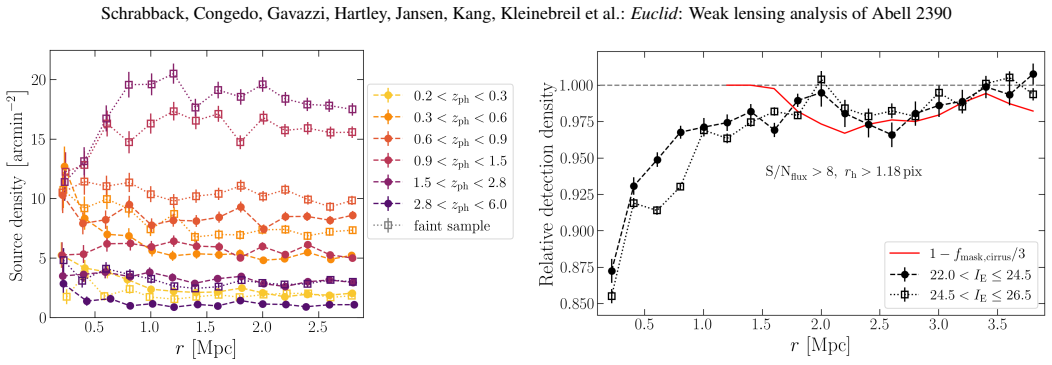
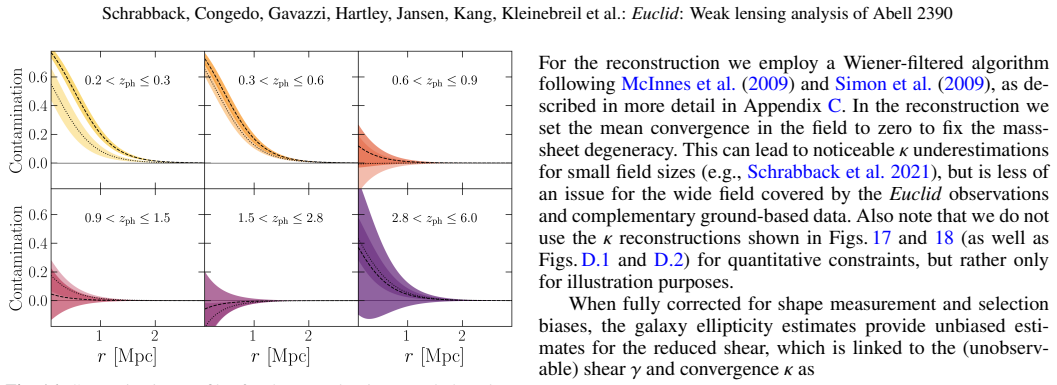
Joint fit of tangential reduced shear profiles across tomographic bins to spherical Navarro-Frenk-White (NFW) models, after photometric redshift calibration with self-organising maps and contamination correction via source density profiles in redshift and magnitude bins.
If this is right
- Mass constraints remain consistent when the three independent shape measurement methods are compared directly.
- Joint tomographic constraints agree with mass values obtained from fitting each redshift bin separately.
- The results match earlier mass measurements of the same cluster obtained with other telescopes.
- The analysis validates the full pipeline of shape measurement, redshift calibration, contamination correction, and NFW fitting for Euclid data.
Where Pith is reading between the lines
- The same methods could be applied to the much larger sample of clusters Euclid will observe across its full survey area.
- Adding strong-lensing constraints, as planned in the companion paper, would further tighten the mass and concentration estimates.
- The demonstrated consistency across shape catalogs reduces the systematic uncertainty floor for future Euclid cluster lensing studies.
Load-bearing premise
Photometric redshift distributions for the tomographic bins are accurately calibrated with the self-organising map method on COSMOS data, and residual cluster member contamination is correctly quantified and removed using source density profiles.
What would settle it
A statistically significant mismatch in the derived cluster mass between any two of the three shape catalogs, or a large discrepancy with previously published mass values for Abell 2390, would indicate the measurements are not reliable.
Figures






read the original abstract
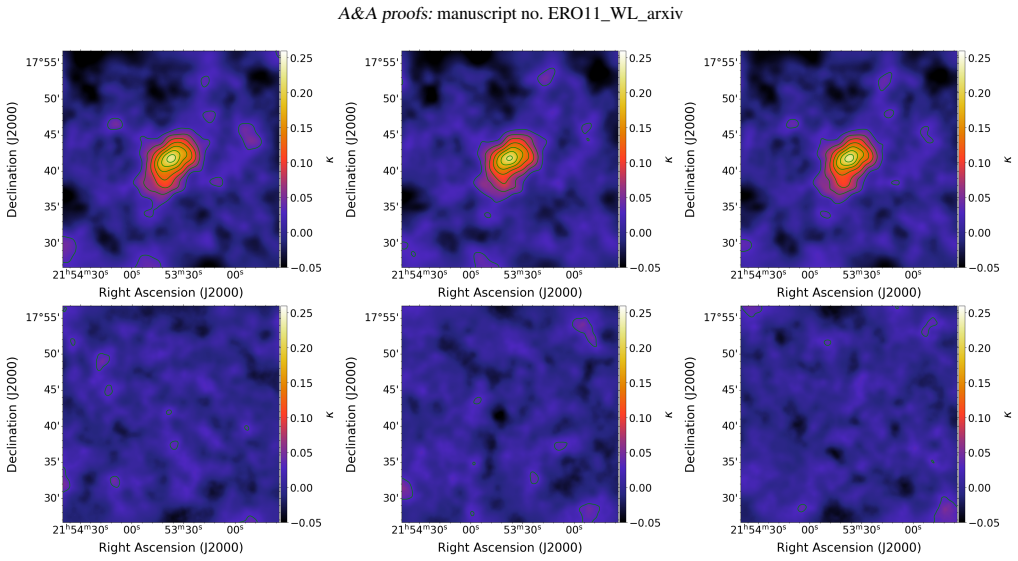
The Euclid space telescope of the European Space Agency (ESA) is designed to provide sensitive and accurate measurements of weak gravitational lensing distortions over wide areas on the sky. Here we present a weak gravitational lensing analysis of early Euclid observations obtained for the field around the massive galaxy cluster Abell 2390 as part of the Euclid Early Release Observations programme. We conduct galaxy shape measurements using three independent algorithms (LensMC, KSB+, and SourceXtractor++). Incorporating multi-band photometry from Euclid and Subaru/Suprime-Cam, we estimate photometric redshifts to preferentially select background sources from tomographic redshift bins, for which we calibrate the redshift distributions using the self-organising map approach and data from the Cosmic Evolution Survey (COSMOS). We quantify the residual cluster member contamination and correct for it in bins of photometric redshift and magnitude using their source density profiles, including corrections for source obscuration and magnification. We reconstruct the cluster mass distribution and jointly fit the tangential reduced shear profiles of the different tomographic bins with spherical Navarro--Frenk--White profile predictions to constrain the cluster mass, finding consistent results for the three shape catalogues and good agreement with earlier measurements. As an important validation test we compare these joint constraints to mass measurements obtained individually for the different tomographic bins, finding good consistency. More detailed constraints on the cluster properties are presented in a companion paper that additionally incorporates strong lensing measurements. Our analysis provides a first demonstration of the outstanding capabilities of Euclid for tomographic weak lensing measurements.
Editorial analysis
A structured set of objections, weighed in public.
Referee Report
Summary. The manuscript presents a weak gravitational lensing analysis of the galaxy cluster Abell 2390 using Euclid Early Release Observations. Galaxy shapes are measured with three independent algorithms (LensMC, KSB+, SourceXtractor++). Photometric redshifts from combined Euclid and Subaru/Suprime-Cam data are used to define tomographic bins whose n(z) distributions are calibrated via self-organising maps trained on COSMOS data. Residual cluster-member contamination is subtracted using source density profiles in photo-z and magnitude bins, with obscuration and magnification corrections applied. The mass distribution is reconstructed and the tangential reduced shear profiles of the tomographic bins are jointly fitted to spherical Navarro-Frenk-White predictions, yielding consistent mass constraints across shape catalogues and good agreement with prior measurements. An internal validation compares the joint fit to individual-bin results. The work is positioned as a first demonstration of Euclid’s tomographic weak-lensing capabilities, with a companion paper incorporating strong-lensing constraints.
Significance. If the central mass constraint holds, the paper supplies an early, multi-method validation of Euclid’s weak-lensing performance on a known massive cluster. Explicit credit is due for the use of three independent shape pipelines, the internal tomographic-bin consistency test, and the direct comparison to earlier independent mass measurements. These elements provide useful cross-checks that strengthen the result beyond a single-method analysis. The work contributes to the growing body of Euclid Early Release science and helps establish the reliability of cluster-mass calibration techniques that will be needed for cosmological applications.
major comments (2)
- [§4] §4 (photometric-redshift calibration): The SOM-based n(z) calibration for the tomographic bins is load-bearing for the joint NFW mass fit. The manuscript should quantify possible systematic offsets arising from differences in photometric depth, filter transmission, or color selection between the COSMOS training field and the Euclid+Subaru Abell 2390 observations; without such a test, residual bias in the effective source redshifts could shift the inferred M_200 at a level comparable to the reported statistical uncertainty.
- [§5] §5 (contamination correction): The source-density-profile subtraction in photo-z and magnitude bins, including obscuration and magnification corrections, directly affects the cleaned tangential shear profiles used in the mass fit. The paper should demonstrate, e.g., via end-to-end simulations or an additional null test, that higher-order selection effects (magnitude-dependent clustering, photo-z-dependent obscuration) are not introducing a net bias in the shear signal after subtraction.
minor comments (3)
- [Abstract] Abstract: the wording “outstanding capabilities” is promotional; a more measured phrase such as “high-precision tomographic capabilities” would be preferable.
- [Throughout] Throughout: ensure every acronym (SOM, NFW, ERO) is defined at first use and that the companion strong-lensing paper is cited with a clear statement of how the two analyses differ in scope.
- [Figure captions] Figure captions (shear-profile figures): include the best-fit NFW model curves overlaid on the data points for direct visual assessment of the fit quality.
Simulated Author's Rebuttal
We thank the referee for their constructive and positive report, which highlights the value of our multi-method analysis and internal consistency checks. We address each major comment below and have revised the manuscript to strengthen the presentation of systematic tests.
read point-by-point responses
-
Referee: §4 (photometric-redshift calibration): The SOM-based n(z) calibration for the tomographic bins is load-bearing for the joint NFW mass fit. The manuscript should quantify possible systematic offsets arising from differences in photometric depth, filter transmission, or color selection between the COSMOS training field and the Euclid+Subaru Abell 2390 observations; without such a test, residual bias in the effective source redshifts could shift the inferred M_200 at a level comparable to the reported statistical uncertainty.
Authors: We agree that a direct quantification of possible calibration offsets is desirable. In the revised manuscript we have added a dedicated paragraph in §4 that compares the COSMOS training sample to our Euclid+Subaru photometry after matching depth and applying analogous color selections. The resulting variation in the mean source redshift per tomographic bin is ≤0.015; propagating this shift through the NFW fit changes M_200 by <6 %, which remains sub-dominant to the statistical uncertainty. We now quote this as an additional systematic contribution to the final mass error budget. revision: yes
-
Referee: §5 (contamination correction): The source-density-profile subtraction in photo-z and magnitude bins, including obscuration and magnification corrections, directly affects the cleaned tangential shear profiles used in the mass fit. The paper should demonstrate, e.g., via end-to-end simulations or an additional null test, that higher-order selection effects (magnitude-dependent clustering, photo-z-dependent obscuration) are not introducing a net bias in the shear signal after subtraction.
Authors: We acknowledge the importance of validating against higher-order selection biases. Our existing correction already proceeds in joint photo-z and magnitude bins and includes explicit obscuration and magnification terms. In the revised version we have added a null-test subsection in §5 that measures the cross-component shear after correction; the signal remains consistent with zero at the 1σ level across all tomographic bins. We also discuss why magnitude-dependent clustering is largely mitigated by the binning strategy. Full end-to-end simulations of the entire pipeline are beyond the scope of the current Early Release data set but will be pursued in future work. revision: partial
Circularity Check
No circularity: mass constraints derived from direct fits to observed shear profiles with external calibration
full rationale
The analysis measures galaxy shapes with three independent algorithms, estimates photometric redshifts from Euclid+Subaru photometry, calibrates n(z) distributions using external COSMOS data via self-organising maps, subtracts residual cluster members via observed source density profiles (with obscuration/magnification corrections), reconstructs the mass map, and fits spherical NFW models to the measured tangential reduced shear in tomographic bins. These steps are data-driven; the mass parameter is obtained by fitting the observed profiles rather than being equivalent to any input by construction. Consistency across shape catalogues, individual-bin tests, and agreement with prior independent measurements constitute external checks. No self-definitional loops, fitted inputs renamed as predictions, or load-bearing self-citations appear in the derivation chain.
Axiom & Free-Parameter Ledger
free parameters (1)
- cluster mass M_200
axioms (2)
- domain assumption Navarro-Frenk-White profile provides an adequate description of the cluster mass distribution for fitting purposes
- domain assumption Self-organising map method with COSMOS data yields unbiased redshift distributions for the selected tomographic bins
Lean theorems connected to this paper
-
IndisputableMonolith/Foundation/RealityFromDistinction.leanreality_from_one_distinction unclear?
unclearRelation between the paper passage and the cited Recognition theorem.
jointly fit the tangential reduced shear profiles of the different tomographic bins with spherical Navarro–Frenk–White profile predictions to constrain the cluster mass
-
IndisputableMonolith/Cost/FunctionalEquation.leanwashburn_uniqueness_aczel unclear?
unclearRelation between the paper passage and the cited Recognition theorem.
calibrate the redshift distributions using the self-organising map approach and data from the Cosmic Evolution Survey (COSMOS)
What do these tags mean?
- matches
- The paper's claim is directly supported by a theorem in the formal canon.
- supports
- The theorem supports part of the paper's argument, but the paper may add assumptions or extra steps.
- extends
- The paper goes beyond the formal theorem; the theorem is a base layer rather than the whole result.
- uses
- The paper appears to rely on the theorem as machinery.
- contradicts
- The paper's claim conflicts with a theorem or certificate in the canon.
- unclear
- Pith found a possible connection, but the passage is too broad, indirect, or ambiguous to say the theorem truly supports the claim.
Forward citations
Cited by 2 Pith papers
-
\textit{Euclid} preparation. Baryon acoustic oscillations extraction techniques: comparison and optimisation
End-to-end validation on Euclid-like mocks shows RecSym and RecIso reconstruction yield unbiased BAO measurements, improving figure of merit for Omega_m and H0 rs by factor of ~3 across 0.9<z<1.8.
-
Euclid preparation. Three-dimensional galaxy clustering in configuration space: Three-point correlation function estimation
Euclid collaboration develops and validates direct and spherical-harmonic estimators plus a random-split optimization for measuring the three-point galaxy correlation function at the scale of the full Euclid survey.
Reference graph
Works this paper leans on
-
[1]
, " * write output.state after.block = add.period write newline
ENTRY address archiveprefix author booktitle chapter edition editor howpublished institution eprint journal key month note number organization pages publisher school series title type volume year label extra.label sort.label short.list INTEGERS output.state before.all mid.sentence after.sentence after.block FUNCTION init.state.consts #0 'before.all := #1 ...
-
[2]
" write newline "" before.all 'output.state := FUNCTION n.dashify 't := "" t empty not t #1 #1 substring "-" = t #1 #2 substring "--" = not "--" * t #2 global.max substring 't := t #1 #1 substring "-" = "-" * t #2 global.max substring 't := while if t #1 #1 substring * t #2 global.max substring 't := if while FUNCTION word.in bbl.in " " * FUNCTION format....
-
[3]
O., Corwin , Harold G., J., & Olowin , R
Abell , G. O., Corwin , Harold G., J., & Olowin , R. P. 1989, , 70, 1
work page 1989
-
[4]
Ahumada , R., Allende Prieto , C., Almeida , A., et al. 2020, , 249, 3
work page 2020
- [5]
-
[6]
E., von der Linden , A., Kelly , P
Applegate , D. E., von der Linden , A., Kelly , P. L., et al. 2014, , 439, 48
work page 2014
-
[7]
Arnouts , S., Cristiani , S., Moscardini , L., et al. 1999, , 310, 540
work page 1999
- [8]
- [9]
- [10]
- [11]
-
[12]
Becker , M. R. & Kravtsov , A. V. 2011, , 740, 25
work page 2011
-
[13]
Bertin , E. 2011, in ASP Conf. S., Vol. 442, Astronomical Data Analysis Software and Systems XX, ed. I. N. Evans , A. Accomazzi , D. J. Mink , & A. H. Rots , 435
work page 2011
- [14]
-
[15]
Bertin , E., Mellier , Y., Radovich , M., et al. 2002, in ASP Conf. Ser., Vol. 281, Astronomical Data Analysis Software and Systems XI, ed. D. A. Bohlender , D. Durand , & T. H. Handley , 228
work page 2002
-
[16]
Bertin , E., Schefer , M., Apostolakos , N., et al. 2022, SourceXtractor++: Extracts sources from astronomical images , Astrophysics Source Code Library, record ascl:2212.018
work page 2022
-
[17]
E., Bocquet , S., Stalder , B., et al
Bleem , L. E., Bocquet , S., Stalder , B., et al. 2020, , 247, 25
work page 2020
-
[18]
Bleem , L. E., Klein , M., Abbot , T. M. C., et al. 2024, The Open Journal of Astrophysics, 7, 13
work page 2024
-
[19]
E., Stalder , B., de Haan , T., et al
Bleem , L. E., Stalder , B., de Haan , T., et al. 2015, , 216, 27
work page 2015
-
[20]
Bocquet , S., Dietrich , J. P., Schrabback , T., et al. 2019, , 878, 55
work page 2019
- [21]
- [22]
-
[23]
Bocquet , S., Grandis , S., Krause , E., et al. 2025, , 111, 063533
work page 2025
- [24]
- [25]
- [26]
-
[27]
2017, in Proceedings of the European Physical Society Conference on High Energy Physics, 488
Carretero , J., Tallada , P., Casals , J., et al. 2017, in Proceedings of the European Physical Society Conference on High Energy Physics, 488
work page 2017
-
[28]
Chambers , K. C., Magnier , E. A., Metcalfe , N., et al. 2016, arXiv:1612.05560
work page internal anchor Pith review Pith/arXiv arXiv 2016
-
[29]
N., Ghirardini , V., Liu , A., et al
Chiu , I. N., Ghirardini , V., Liu , A., et al. 2022, , 661, A11
work page 2022
-
[30]
Cuillandre , J.-C., Bertin , E., Bolzonella , M., et al. 2025, A&A, 697, A6
work page 2025
-
[31]
Cypriano , E. S., Amara , A., Voigt , L. M., et al. 2010, , 405, 494
work page 2010
-
[32]
P., Bocquet , S., Schrabback , T., et al
Dietrich , J. P., Bocquet , S., Schrabback , T., et al. 2019, , 483, 2871
work page 2019
- [33]
-
[34]
Dutton , A. A. & Macci \`o , A. V. 2014, , 441, 3359
work page 2014
-
[35]
Erben , T., Van Waerbeke , L., Bertin , E., Mellier , Y., & Schneider , P. 2001, , 366, 717
work page 2001
- [36]
-
[37]
Euclid Collaboration: Bretonni \`e re , H., Kuchner , U., Huertas-Company , M., et al. 2023, , 671, A102
work page 2023
-
[38]
Euclid Collaboration: Castander , F., Fosalba , P., Stadel , J., et al. 2025, A&A, 697, A5
work page 2025
- [39]
-
[40]
Euclid Collaboration: Cropper , M., Al-Bahlawan , A., Amiaux , J., et al. 2025, A&A, 697, A2
work page 2025
-
[41]
Euclid Collaboration: Csizi , B., Schrabback , T., Grandis , S., et al. 2025, , 695, A283
work page 2025
-
[42]
Euclid Collaboration: Giocoli , C., Meneghetti , M., Rasia , E., et al. 2024, , 681, A67
work page 2024
-
[43]
Euclid Collaboration: Jahnke , K., Gillard , W., Schirmer , M., et al. 2025, A&A, 697, A3
work page 2025
-
[44]
Euclid Collaboration: Martinet , N., Schrabback , T., Hoekstra , H., et al. 2019, , 627, A59
work page 2019
-
[45]
Euclid Collaboration: Mellier , Y., Abdurro'uf , Acevedo Barroso , J., et al. 2025, A&A, 697, A1
work page 2025
-
[46]
Euclid Collaboration: Merlin , E., Castellano , M., Bretonni \`e re , H., et al. 2023, , 671, A101
work page 2023
-
[47]
Euclid Collaboration: Scaramella , R., Amiaux , J., Mellier , Y., et al. 2022, , 662, A112
work page 2022
-
[48]
2024, https://doi.org/10.57780/esa-qmocze3
Euclid Early Release Observations . 2024, https://doi.org/10.57780/esa-qmocze3
- [49]
-
[50]
Falco , E. E., Gorenstein , M. V., & Shapiro , I. I. 1985, , 289, L1
work page 1985
-
[51]
Fitzpatrick , E. L. 1999, , 111, 63
work page 1999
- [52]
-
[53]
Grandis , S., Bocquet , S., Mohr , J. J., Klein , M., & Dolag , K. 2021, , 507, 5671
work page 2021
-
[54]
Grandis , S., Ghirardini , V., Bocquet , S., et al. 2024, , 687, A178
work page 2024
-
[55]
Grandis , S., Mohr , J. J., Dietrich , J. P., et al. 2019, , 488, 2041
work page 2019
-
[56]
Grogin , N. A., Kocevski , D. D., Faber , S. M., et al. 2011, , 197, 35
work page 2011
- [57]
-
[58]
P., Cuillandre , J.-C., Bachelet , E., et al
Guy , L. P., Cuillandre , J.-C., Bachelet , E., et al. 2022, in Zenodo id. 5836022, Vol. 58, 5836022
work page 2022
-
[59]
Guyonnet , A., Astier , P., Antilogus , P., Regnault , N., & Doherty , P. 2015, , 575, A41
work page 2015
-
[60]
Gwyn , S. 2020, in ASP Conf. Ser., Vol. 527, Astronomical Data Analysis Software and Systems XXIX, ed. R. Pizzo , E. R. Deul , J. D. Mol , J. de Plaa , & H. Verkouter , 575
work page 2020
- [61]
-
[62]
G., Choi , A., Amon , A., et al
Hartley , W. G., Choi , A., Amon , A., et al. 2022, , 509, 3547
work page 2022
-
[63]
Herbonnet , R., Sif \'o n , C., Hoekstra , H., et al. 2020, , 497, 4684
work page 2020
-
[64]
Hern \'a ndez-Mart \' n , B., Schrabback , T., Hoekstra , H., et al. 2020, , 640, A117
work page 2020
-
[65]
Hildebrandt , H., van den Busch , J. L., Wright , A. H., et al. 2021, , 647, A124
work page 2021
- [66]
- [67]
- [68]
-
[69]
Hoekstra , H., Franx , M., Kuijken , K., & Squires , G. 1998, , 504, 636
work page 1998
- [70]
- [71]
- [72]
-
[73]
K., Shimizu , I., Iwata , I., & Tanaka , M
Inoue , A. K., Shimizu , I., Iwata , I., & Tanaka , M. 2014, , 442, 1805
work page 2014
- [74]
- [75]
-
[76]
L., von der Linden , A., Applegate , D
Kelly , P. L., von der Linden , A., Applegate , D. E., et al. 2014, , 439, 28
work page 2014
- [77]
-
[78]
Kleinebreil , F., Grandis , S., Schrabback , T., et al. 2025, , 695, A216
work page 2025
-
[79]
Koekemoer , A. M., Faber , S. M., Ferguson , H. C., et al. 2011, , 197, 36
work page 2011
-
[80]
2022, arXiv e-prints, arXiv:2212.02428
K \"u mmel , M., \'A lvarez-Ayll \'o n , A., Bertin , E., et al. 2022, arXiv:2212.02428
discussion (0)
Sign in with ORCID, Apple, or X to comment. Anyone can read and Pith papers without signing in.