REVIEW 4 major objections 6 minor 1 cited by
Intraseasonal Equatorial Kelvin and Rossby Waves in Modern AI-ML Models
T0 review · 4 major / 6 minor · reviewed 2026-08-06 · deepseek-v4-flash
Pith's one-line read Modern AI weather models reproduce the three-dimensional structure of intraseasonal Kelvin waves, but all four fail on the vertical structure of equatorial Rossby waves, where temperature anomalies point opposite to vertical motion.
desk verdict Useful first multi-model benchmark of intraseasonal wave structure in AI weather models, but the headline Rossby-wave finding is likely contaminated by the kinematically derived vertical velocity. read the letter →
The pith
A machine-rendered reading of the paper's core claim, the machinery that carries it, and where it could break.
The reading
What carries the argument
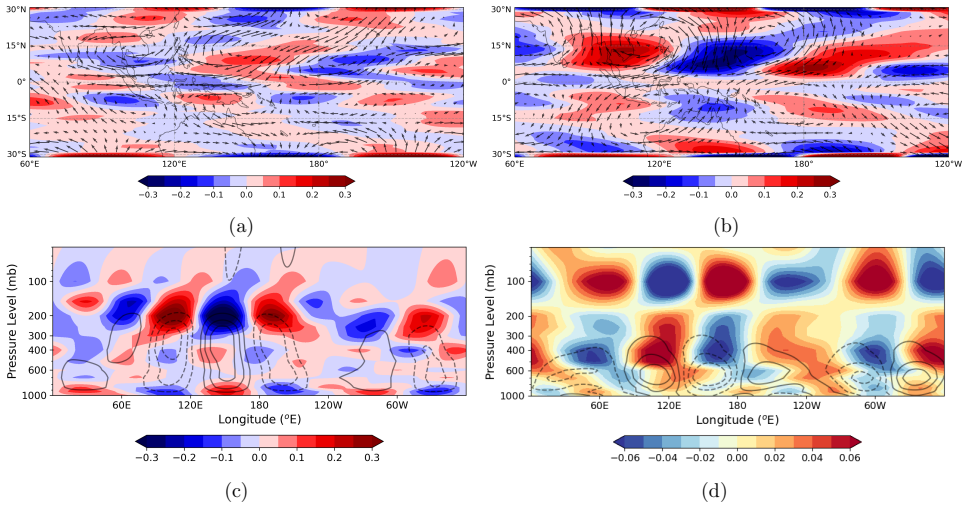
The method is a space-time spectral filter and event-compositing pipeline applied to free runs of the four models. Wavenumber-frequency diagrams of symmetric and antisymmetric zonal wind are compared with theoretical dispersion curves for shallow-water equivalent depths of 12, 25 and 50 m to identify Kelvin and Rossby bands; events are selected where zonal wind variance for Kelvin waves, or geopotential height variance for Rossby waves, exceeds one standard deviation above the climatological mean in specified tropical boxes; composites of divergence, horizontal wind, temperature, humidity and pressure velocity are then examined in horizontal maps and vertical cross-sections. This machinery lets the authors isolate the wave signature from chaotic variability and compare each field's structure against reanalysis-based expectations.
What would settle it
Run the same four models in a short-lead configuration, for example 15-day forecasts starting from reanalysis states, filter the Rossby band, and composite temperature and vertical velocity; if temperature anomalies align with vertical velocity in any model at short lead, the claim that all four models fail on Rossby vertical structure would be an artifact of free-run drift rather than a learned deficiency.
Extended reading notes
Core claim
The paper's central claim is that all four AI-ML models capture the three-dimensional structure of intraseasonal Kelvin waves, including lower-level convergence and upper-level divergence, westward tilt of anomalies with height up to roughly 200 mb and eastward tilt above, and the observed phase relationship between temperature and vertical velocity, while none of them represents the vertical structure of equatorial Rossby waves correctly. In the Rossby composites, the upper-level cyclonic and anticyclonic gyres are present, but the temperature anomaly is of the wrong sign for the sense of vertical motion in all four models, and the divergence field shows an anomalous mid-tropospheric bias and unexpected tilts. The moisture field is much closer to observations, and only GraphCast and FourCastNet show the simultaneous build-up of moisture and deep vertical motion. The authors interpret this as evidence that the models have learned the more divergent Kelvin mode well but have not learned the physical consistency among thermodynamic and dynamical fields required for the more rotational Rossby mode.
Load-bearing premise
The load-bearing premise is that four-month free runs of these forecasting models produce physically realistic intraseasonal variability that can be meaningfully compared with reanalysis; the paper checks red spectra and decorrelation times but does not directly verify that model climatology, variances, or wave activity levels remain stable through the runs.
Editorial extensions
If this is right
- Free-running AI-ML models can serve as testbeds for intraseasonal tropical variability, because their spectra already show Kelvin and Rossby bands with observed equivalent depths.
- The Kelvin wave composites, including vertical tilts and phase relationships, provide a benchmark that many traditional GCMs have struggled to reach.
- Since all four models share the Rossby temperature-vertical velocity sign error, the flaw is likely common to the way these models represent rotational large-scale flow, not specific to one architecture.
- The diagnostic of wavenumber-frequency filtering plus vertical compositing can be reused to evaluate future AI-ML models, including foundation models, before they are used for subseasonal prediction.
Reading between the lines
- A testable extension would be to compute the same Rossby composites over the first month of each free run rather than the full four months; if the temperature sign error disappears, the failure is a drift artifact rather than a learned property.
- The temperature-vertical velocity inconsistency in the Rossby waves resembles a form of geostrophic or hydrostatic imbalance; if so, adding balance constraints during training or post-processing could improve rotational mode structure.
- The same composite pipeline could be applied to the MJO or to mixed Rossby-gravity waves once longer free runs with more events become available.
- The contrast between good moisture and bad temperature in Rossby composites suggests the models may be learning moisture-dynamics coupling but not the thermodynamic energy balance that ties temperature to vertical motion.
Editorial analysis
A structured set of objections, weighed in public.
Referee Report
Summary. The paper examines intraseasonal equatorial Kelvin and Rossby waves in four AI-ML weather models (PanguWeather, GraphCast, FourCastNet, Aurora) through free runs of up to four months. It presents wavenumber-frequency spectra, composite horizontal maps and vertical cross-sections, and Hovmöller diagrams for Kelvin and Rossby waves, comparing them with theory and with reanalysis-based structures from the literature. The authors report that all four models capture the basic Kelvin wave structure including convergence-divergence patterns, vertical tilts, and temperature-vertical velocity phase relations, but that all four models fail to represent the vertical structure of Rossby waves, with temperature anomalies inconsistent with the vertical velocity. The paper is a pure diagnostic study with no parameter fitting and treats the models as black boxes.
Significance. If the main conclusions are robust, this is a useful and timely contribution: it provides one of the first systematic comparisons of intraseasonal equatorial wave structure in modern AI-ML weather models, using multiple models and free runs rather than a single architecture. The Kelvin wave results are encouraging and, if confirmed with appropriate uncertainty quantification, would be a meaningful positive result for the field. The reported Rossby wave temperature-vertical velocity inconsistency is potentially important for the evaluation of physical consistency in data-driven models. The study is self-contained in its use of external benchmarks (shallow-water dispersion curves, reanalysis composites) and does not fit parameters. The authors also deserve credit for transparently describing the kinematic derivation of vertical velocity and for noting that some model differences exist, even if the analysis lacks formal statistical support.
major comments (4)
- [Section 2 (Models and Methodology)] The paper's most novel claim—that in all four models Rossby-wave temperature anomalies are inconsistent with the vertical velocity—rests on an omega field whose provenance is not documented. Section 2 states that for models that do not provide pressure velocity, omega is computed kinematically by integrating the continuity equation from the surface with omega_sfc=0, but no section states which models output native omega and which use the derived estimate, nor how the two diagnostics compare. Because the kinematic integral accumulates divergence bias and omits surface-pressure tendency, derived omega can be decorrelated from the model's own temperature field even in an internally consistent model. The abstract's statement 'the temperature anomaly was inconsistent with the nature of the vertical velocity' therefore cannot yet be attributed to a model deficiency. Please report omega provenance per model and add an ERA5 control processed with the identical kinematic omega derivation and identical filtering/compositing, so that the reference comparison is apples-to-apples.
- [Section 3 (Wavenumber Frequency Diagrams)] The wavenumber-frequency diagrams and the accompanying 'equivalent depths in accord with observations' claim are based on one run per model, despite the ten four-month runs described in Section 2. With only one realization there is no measure of run-to-run spread, and the qualitative statement that all four models show Kelvin/Rossby bands cannot be separated from sampling variability. Please show at least the run-to-run spread (e.g., mean spectrum with inter-run envelope) or state explicitly why one run is representative.
- [Sections 4 and 5 (composites)] The composite comparisons—including the model-difference statements such as weak PanguWeather convergence, GraphCast's upright Kelvin tilt, and FourCastNet's 'cleanest' Rossby humidity—are made without event counts, significance tests, or confidence intervals. The composites may be based on very few events, in which case the visual differences (and even the sign of some anomalies) could be sampling noise. Please include event counts for each model and wave type and add a statistical significance assessment (e.g., bootstrap confidence intervals or field significance on the composites) for the key sign and tilt claims.
- [Section 2 (free runs) and Section 6] The entire comparison assumes that four-month free runs of forecast-trained models produce physically realistic intraseasonal variability. The paper provides only indirect evidence—red background spectra and decorrelation timescales—and does not quantify whether model climatology, variances, or wave activity levels drift over the four months, or whether any runs become unstable. If a run drifts to an unrealistic mean state, the composites and even the spectral bands could be artifacts. Please add time series or maps of key variables (e.g., equatorial zonal wind, temperature, precipitation) over the runs, and a comparison of model climatology and variance to ERA5 over the same period.
minor comments (6)
- [Acknowledgements] The Acknowledgements section spells 'Aurora' as 'Auroa'; please correct the typo.
- [Section 5] The text refers to '200 mbar flow' for the Rossby gyres while the composite maps are labeled 250 mbar; please reconcile the level references.
- [References] Several reference entries are malformed or incomplete (e.g., the Guo et al. entry lists 'WM Guo, J Waliser' and the Wheeler and Kiladis entry has broken text); please supply a careful reference cleanup.
- [Section 5] The order in which Rossby-wave figures are discussed (Figure 8, then Figure 10, then Figure 9, then Figure 11) is confusing; please renumber or reorder the figures so they appear in the order discussed.
- [Section 3] The phrase 'as is observed in from real-world data' appears to contain a typo; please revise to 'as is observed in real-world data.'
- [Sections 4 and 5 (Hovmöller diagrams)] The phase speeds estimated from the Hovmöller diagrams are quoted without uncertainty estimates; at minimum, please give the range across runs or state that these are single-composite estimates.
Circularity Check
No circularity: the paper is an external diagnostic evaluation of four black-box AI-ML models against reanalysis and theoretical benchmarks.
full rationale
The paper is a diagnostic evaluation rather than a derivation. It runs four pretrained AI-ML models freely, constructs wavenumber-frequency spectra, filters symmetric and antisymmetric components, and composites model fields around Kelvin and Rossby wave events. No parameter is fitted to any subset of the data and then renamed as a prediction; the theoretical dispersion curves (Matsuno 1966; Wheeler and Kiladis 1999) and reanalysis/observation composites (Straub and Kiladis 2003; Nakamura and Takayabu 2022) are external benchmarks, not outputs of the models or of the authors' own prior work. Citations to the authors' own papers (Suhas and Sukhatme 2020; Suhas et al. 2021; Thakur et al. 2024) appear only as background on shallow-water spectra and Hadley-cell contributions and are not load-bearing for the wave-structure conclusions. The kinematic derivation of pressure velocity for models that do not output it natively (Section 2: 'compute pressure velocity using the kinematic method... integrating the continuity equation from the surface... assuming the pressure velocity at the surface is zero') is a methodological caveat that could affect the Rossby temperature-omega sign comparison, but it is not circular: the derived omega is a deterministic diagnostic based on the model's own divergence field, and the reported inconsistency with temperature is an observed property of the composites, not an input that is reintroduced as an output. No equation in the paper reduces to its own input, and no fitted quantity is presented as an independent prediction. Therefore the circularity score is 0.
Assumptions & free parameters
assumptions (4)
- standard math Equatorial wave dispersion relations (Matsuno 1966) provide the theoretical curves against which spectral peaks are identified as Kelvin and Rossby waves.
- domain assumption The kinematic method for computing pressure velocity from the continuity equation, assuming zero surface pressure velocity, yields accurate enough vertical motion anomalies for composite analysis.
- domain assumption The four-month free runs of the AI models remain physically realistic and statistically stationary enough to represent intraseasonal variability.
- domain assumption The event selection criterion (variance exceeding one standard deviation above the climatological mean in specified regions) yields representative composites of the target waves.
Cite this review
Pith. "Pith review of Intraseasonal Equatorial Kelvin and Rossby Waves in Modern AI-ML Models." pith.science (2026). https://pith.science/paper/CD2QYKFL
@misc{pith2026250707952,
  author       = {Pith},
  title        = {Pith review of: Intraseasonal Equatorial Kelvin and Rossby Waves in Modern AI-ML Models},
  year         = {2026},
  howpublished = {\url{https://pith.science/paper/CD2QYKFL}},
  note         = {Machine review of arXiv:2507.07952}
}
read the original abstract
We examine the structure of large-scale convectively coupled Kelvin and Rossby waves in a suite of modern AI-ML models. In particular, multiple runs of PanguWeather, GraphCast, FourCastNet and Aurora are performed to assess the structure of the aforementioned waves. Wavenumber-frequency diagrams of zonal winds from all models show a clear signature of Rossby and Kelvin waves with equivalent depths that are in accord with observations and reanalysis. Composites of Kelvin waves show correct lower and upper troposphere horizontal convergence patterns, vertical tilts in temperature, humidity and vertical velocity as well as the phase relation between temperature and vertical velocity anomalies. Though, differences between models are notable such as smaller vertical tilts and incorrect surface temperature anomalies in GraphCast and relatively weak convergent flows in PanguWeather. The models had much more difficulty with Rossby waves; while the horizontal gyres were captured, the vertical structure of temperature and divergence was incorrect. Apart from unexpected tilts in various fields, the temperature anomaly was inconsistent with the nature of the vertical velocity in all four models. Curiously, moisture and vertical velocity anomalies were much closer to observations. Further, only two models (GraphCast and FourCastNet) captured the simultaneous generation of deep vertical motion with moisture anomalies. In all, while the representation of these large-scale waves is encouraging, issues with the structure of Rossby waves and especially the inconsistency among fields require further investigation.
Figures


Figures from the paper (9 more)




Forward citations
Cited by 1 Pith paper
-
Spatial Generalization Tests for Machine Learning-based Weather Models to Assess Physical Consistency
Rotating or reversing the simulated planet reveals that GraphCast and NeuralGCM encode present-day geography rather than spatially invariant physics, while a traditional GCM passes the same tests to numerical precision.
Reference graph
Works this paper leans on
-
[1]
Miloud Bessafi and Matthew C Wheeler. Modulation of south indian ocean tropical cyclones by the madden--julian oscillation and convectively coupled equatorial waves. Mon. Weather Rev., 134 0 (2): 0 638--656, 2006. doi:10.1175/MWR3087.1
-
[2]
The aqua-planet experiment (ape): Control sst simulation
M Blackburn et al. The aqua-planet experiment (ape): Control sst simulation. Journal of the Meteorological Society of Japan. Ser. II, 91: 0 17--56, 2013. doi:10.2151/jmsj.2013-A02
-
[3]
A foundation model for the earth system
C Bodnar et al. A foundation model for the earth system. Nature, 641, 2025. doi:10.1038/s41586-025-09005-y
-
[4]
The computation of equivalent potential temperature
David Bolton. The computation of equivalent potential temperature. Monthly weather review, 108 0 (7): 0 1046--1053, 1980
work page 1980
-
[5]
On some limitations of current machine learning weather prediction models
M Bonavita. On some limitations of current machine learning weather prediction models. Geophysical Research Letters, 51, 2024. doi:10.1029/2023GL107377
-
[6]
A note on large-scale motions in the tropics
JG Charney. A note on large-scale motions in the tropics. Journal of the Atmospheric Sciences, 20, 1963. doi:10.1175/1520-0469(1963)020<0607:ANOLSM>2.0.CO;2
-
[7]
A machine learning model that outperforms conventional global subseasonal forecast models
L Chen et al. A machine learning model that outperforms conventional global subseasonal forecast models. Nature Communications, 15, 2024. doi:10.1038/s41467-024-50714-1
-
[8]
Mesoscale convective systems modulated by convectively coupled equatorial waves
Y Cheng et al. Mesoscale convective systems modulated by convectively coupled equatorial waves. Geophysical review Letters, 50, 2023. doi:10.1029/2023gl103335
Show all 66 references
-
[9]
Low-frequency intraseasonal variability in a zonally symmetric aquaplanet model
S Das et al. Low-frequency intraseasonal variability in a zonally symmetric aquaplanet model. Meteorology and Atmospheric Physics, 2016. doi:10.1007/s00703-016-0448-y
2016 doi
-
[10]
The role of convectively coupled equatorial waves in sub-seasonal predictions
J Dias et al. The role of convectively coupled equatorial waves in sub-seasonal predictions. Geophysical Research Letters, 50, 2023. doi:10.1029/2023GL106198
2023 doi
-
[11]
Overview of the coupled model intercomparison project phase 6 (cmip6) experimental design and organization
Veronika Eyring, Sandrine Bony, Gerald A Meehl, Catherine A Senior, Bjorn Stevens, Ronald J Stouffer, and Karl E Taylor. Overview of the coupled model intercomparison project phase 6 (cmip6) experimental design and organization. Geoscientific Model Development, 9 0 (5): 0 1937...
1937 doi
-
[12]
Linking extreme precipitation in southeast asia to equatorial waves
S Ferrett et al. Linking extreme precipitation in southeast asia to equatorial waves. Quarterly Journal of the Royal Meteorological Society, 146, 2020. doi:10.1002/qj.3699
2020 doi
-
[13]
The role of tropical waves in tropical cyclogenesis
WM Frank and PE Roundy. The role of tropical waves in tropical cyclogenesis. Monthly Weather Review, 2006. doi:10.1175/MWR3204.1
2006 doi
-
[14]
Convectively coupled kelvin waves in an idealized moist general circulation model
DMW Frierson. Convectively coupled kelvin waves in an idealized moist general circulation model. Journal of the atmospheric sciences, 64 0 (6): 0 2076--2090, 2007. doi:10.1175/JAS3945.1
2007 doi
-
[15]
Tropical background and wave spectra: contribution of wave–wave interactions in a moderately nonlinear turbulent flow
C Garfinkel et al. Tropical background and wave spectra: contribution of wave–wave interactions in a moderately nonlinear turbulent flow. Journal of the Atmospheric Sciences, 2021. doi:10.1175/JAS-D-20-0284.1
2021 doi
-
[16]
A systematic relationship between the representations of convectively coupled equatorial wave activity and the madden–julian oscillation in climate model simulations
WM Guo, J Waliser, and X Jiang. A systematic relationship between the representations of convectively coupled equatorial wave activity and the madden–julian oscillation in climate model simulations. Journal of Climate, 28, 2015. doi:10.1175/JCLI-D-14-00485.1
2015 doi
-
[17]
Dynamical tests of a deep learning weather prediction model
GJ Hakim and S Masanam. Dynamical tests of a deep learning weather prediction model. Artificial Intelligence for the Earth Systems, 3, 2024. doi:10.1175/AIES-D-23-0090.1
2024 doi
-
[18]
Some space-time spectral analyses of tropical convection and planetary-scale waves
HH Hendon and MC Wheeler. Some space-time spectral analyses of tropical convection and planetary-scale waves. Journal of the Atmospheric Sciences, 2008. doi:10.1175/2008JAS2675.1
2008 doi
-
[19]
The era5 global reanalysis
Hans Hersbach, Bill Bell, Paul Berrisford, Shoji Hirahara, Andr \'a s Hor \'a nyi, Joaqu \' n Mu \ n oz-Sabater, Julien Nicolas, Carole Peubey, Raluca Radu, Dinand Schepers, et al. The era5 global reanalysis. Quarterly Journal of the Royal Meteorological Society, 146 0 (730): ...
1999 doi
-
[20]
An introduction to dynamic meteorology, volume 88
James R Holton and Gregory J Hakim. An introduction to dynamic meteorology, volume 88. Academic press, 2013
2013
-
[21]
Subseasonal forecasts of convectively coupled equatorial waves and the mjo: Activity and predictive skill
WM Janiga et al. Subseasonal forecasts of convectively coupled equatorial waves and the mjo: Activity and predictive skill. Monthly Weather Review, 2018. doi:10.1175/MWR-D-17-0261.1
2018 doi
-
[22]
Atmospheric predictability of the tropics, middle latitudes, and polar regions explored through global storm resolving simulations
F Judt. Atmospheric predictability of the tropics, middle latitudes, and polar regions explored through global storm resolving simulations. Journal of the Atmospheric Sciences, 71, 2020. doi:10.1175/JAS-D-19-0116.1
2020 doi
-
[23]
The boreal summer intraseasonal oscillation (bsiso): A review
Kazuyoshi Kikuchi. The boreal summer intraseasonal oscillation (bsiso): A review. Journal of the Meteorological Society of Japan. Ser. II, 99 0 (4): 0 933--972, 2021. doi:10.2151/jmsj.2021-045
2021 doi
-
[24]
Convectively coupled equatorial waves
GN Kiladis et al. Convectively coupled equatorial waves. Reviews of Geophysics, 47 0 (2), 2009. doi:10.1029/2008RG000266
2009 doi
-
[25]
Horizontal and vertical structure of observed tropospheric equatorial rossby waves
GW Kiladis and M Wheeler. Horizontal and vertical structure of observed tropospheric equatorial rossby waves. Journal of Geophysical Research - Atmospheres, 100, 2005. doi:10.1029/95JD02415
2005 doi
-
[26]
A systematic relationship between intraseasonal variability and mean state bias in agcm simulations
D Kim et al. A systematic relationship between intraseasonal variability and mean state bias in agcm simulations. Journal of Climate, 24, 2011. doi:10.1175/2011JCLI4177.1
2011 doi
-
[27]
Fourcastnet: Accelerating global high-resolution weather forecasting using adaptive fourier neural operators
T Kurth et al. Fourcastnet: Accelerating global high-resolution weather forecasting using adaptive fourier neural operators. Proceedings of the Platform for Advanced Scientific Computing Conference, 2023. doi:10.1145/3592979.3593412
2023
-
[28]
Learning skillful medium-range global weather forecasting
R Lam et al. Learning skillful medium-range global weather forecasting. Science, 382, 2023. doi:10.1126/science.adi2336
2023 doi
-
[29]
Equatorial waves triggering extreme rainfall and floods in southwest sulawesi, indonesia
B Latos et al. Equatorial waves triggering extreme rainfall and floods in southwest sulawesi, indonesia. Monthly Weather Review, 149, 2021. doi:10.1175/mwr-d-20-0262.1
2021 doi
-
[30]
Accurate medium-range global weather forecasting with 3d neural networks
K Li et al. Accurate medium-range global weather forecasting with 3d neural networks. Nature, 619, 2023. doi:10.1038/s41586-023-06185-3
2023 doi
-
[31]
Tropical intraseasonal variability in 14 ipcc ar4 climate models
J-L Lin et al. Tropical intraseasonal variability in 14 ipcc ar4 climate models. part i: Convective signals. Journal of Climate, 19, 2006. doi:10.1175/JCLI3735.1
2006 doi
-
[32]
Global extreme heat forecasting using neural weather models
I Lomez-Gopez et al. Global extreme heat forecasting using neural weather models. Artificial Intelligence for the Earth Systems, 2, 2023. doi:10.1175/AIES-D-22-0035.1
2023 doi
-
[33]
The modulating influence of convectively coupled equatorial waves (ccews) on the variability of tropical precipitation
SW Lubis and C Jacobi. The modulating influence of convectively coupled equatorial waves (ccews) on the variability of tropical precipitation. International Journal of Climatology, 35, 2015. doi:10.1002/joc.4069
2015 doi
-
[34]
Convectively coupled global rossby modes in an idealized moist gcm
CG MacDonald et al. Convectively coupled global rossby modes in an idealized moist gcm. Journal of the Atmospheric Sciences, 82, 2025. doi:10.1175/JAS-D-24-0081.1
2025 doi
-
[35]
Quasi-geostrophic motions in the equatorial area
T Matsuno. Quasi-geostrophic motions in the equatorial area. Journal of the Meteorological Society of Japan. Ser. II, 44 0 (1): 0 25--43, 1966. doi:10.2151/jmsj1965.44.1_25
1966 doi
-
[36]
Tropical cyclogenesis within an equatorial rossby wave packet
John Molinari, Kelly Lombardo, and David Vollaro. Tropical cyclogenesis within an equatorial rossby wave packet. J. Atmos. Sci., 64: 0 1301--1317, 2007. doi:10.1175/JAS3902.1
2007 doi
-
[37]
Convective couplings with equatorial rossby waves and equatorial kelvin waves
Y Nakamura and YN Takayabu. Convective couplings with equatorial rossby waves and equatorial kelvin waves. part i: Coupled wave structures. Journal of the Atmospheric Sciences, 79, 2022. doi:10.1175/JAS-D-21-0080.1
2022 doi
-
[38]
The ncar command language (version 6.6.2), 2025
NCAR . The ncar command language (version 6.6.2), 2025. URL http://dx.doi.org/10.5065/D6WD3XH5
2025 doi
-
[39]
Isolating the effects of moisture entrainment on convectively coupled equatorial waves in an aquaplanet gcm
SC Peatman, J Methven, and SJ Woolnough. Isolating the effects of moisture entrainment on convectively coupled equatorial waves in an aquaplanet gcm. Journal of the Atmospheric Sciences, 75, 2018. doi:10.1175/JAS-D-18-0098.1
2018 doi
-
[40]
MERRA: NASA's modern-era retrospective analysis for research and applications
Michele M Rienecker, Max J Suarez, Ronald Gelaro, Ricardo Todling, Julio Bacmeister, Emily Liu, Michael G Bosilovich, Siegfried D Schubert, Lawrence Takacs, Gi-Kong Kim, et al. MERRA: NASA's modern-era retrospective analysis for research and applications . Journal of Climate, ...
2011
-
[41]
Three-dimensional structure of convectively coupled equatorial waves in aquaplanet experiments with resolved or parameterized convection
R Rios-Berrios et al. Three-dimensional structure of convectively coupled equatorial waves in aquaplanet experiments with resolved or parameterized convection. Journal of Climate, 36, 2023. doi:10.1175/JCLI-D-22-0422.1
2023 doi
-
[42]
Nonlinear wave--wave interactions in a one-layer reduced-gravity model on the equatorial plane
P Ripa. Nonlinear wave--wave interactions in a one-layer reduced-gravity model on the equatorial plane. Journal of Physical Oceanography, 12 0 (1): 0 97--111, 1982. doi:10.1175/1520-0485(1982)012<0097:NWIIAO>2.0.CO;2
1982 doi
-
[43]
A systematic comparison of tropical waves over northern africa
A Schlueter et al. A systematic comparison of tropical waves over northern africa. part i: Influence on rainfall. Journal of Climate, 32, 2019. doi:10.1175/jcli-d-18-0173.1
2019 doi
-
[44]
Kelvin waves and tropical cyclogenesis: A global survey
CJ Schreck. Kelvin waves and tropical cyclogenesis: A global survey. Monthly Weather Review, 143, 2015. doi:10.1175/mwr-d-15-0111.1
2015 doi
-
[45]
Sources of tropical subseasonal skill in the cfsv2
CJ Schreck, MA Janiga, and S Baxter. Sources of tropical subseasonal skill in the cfsv2. Monthly Weather Review, 2020. doi:10.1175/MWR-D-19-0289.1
2020 doi
-
[46]
Turbulence and equatorial waves in moist and dry shallow-water flow, excited through mesoscale stochastic forcing
J Schr\" o ttle et al. Turbulence and equatorial waves in moist and dry shallow-water flow, excited through mesoscale stochastic forcing. Quarterly Journal of the Royal Meteorological Society, 2021. doi:10.1002/qj.4220
2021 doi
-
[48]
An analysis of convectively coupled kelvin waves in 20 wcrp cmip3 global coupled climate models
KH Straub, PH Haertel, and GW Kiladis. An analysis of convectively coupled kelvin waves in 20 wcrp cmip3 global coupled climate models. Journal of Climate, 23, 2010. doi:10.1175/2009JCLI3422.1
2010 doi
-
[49]
Moist shallow-water response to tropical forcing: initial value problems
DL Suhas and J Sukhatme. Moist shallow-water response to tropical forcing: initial value problems. Quarterly Journal of the Royal Meteorological Society, 146: 0 3695--3714, 2020. doi:10.1002/qj.3867
2020 doi
-
[50]
Dry and moist atmospheric circulation with uniform sea-surface temperature
DL Suhas, J Sukhatme, and N Harnik. Dry and moist atmospheric circulation with uniform sea-surface temperature. Quarterly Journal of the Royal Meteorological Society, 2021. doi:10.1002/qj.4191
2021 doi
-
[51]
Large-scale cloud disturbances associated with equatorial waves
YN Takayabu. Large-scale cloud disturbances associated with equatorial waves. part i: spectral features of the cloud disturbances. Journal of the Meteorological Society of Japan, 1994. doi:10.2151/jmsj1965.72.3_433
1994 doi
-
[52]
Observed wavenumber-frequency spectrum of global, normal mode function decomposed, fields: a possible evidence for nonlinear effects on the wave dynamics
ASW Teruya et al. Observed wavenumber-frequency spectrum of global, normal mode function decomposed, fields: a possible evidence for nonlinear effects on the wave dynamics. Weather and Climate Dynamics, 2021. doi:10.5194/wcd-2021-21
2021 doi
-
[53]
Investigating the role of tropical and extratropical waves in the hadley circulation via present-day earth-like to globally uniform sea-surface temperature forcing
ABS Thakur, J Sukhatme, and N Harnik. Investigating the role of tropical and extratropical waves in the hadley circulation via present-day earth-like to globally uniform sea-surface temperature forcing. Quarterly Journal of the Royal Meteorological Society, 2024. doi:10.1002/qj.4784
2024 doi
-
[54]
Tropical moist convection as an important driver of atlantic hadley circulation variability
L Tomassini and G-Y Yang. Tropical moist convection as an important driver of atlantic hadley circulation variability. Quarterly Journal of the Royal Meteorological Society, 2022. doi:10.1002/qj.4359
2022 doi
-
[55]
Impacts of convectively coupled kelvin waves on environmental conditions for atlantic tropical cyclogenesis
M Ventrice, Thorncroft CD, and Schreck CJ. Impacts of convectively coupled kelvin waves on environmental conditions for atlantic tropical cyclogenesis. Monthly Weather Review, 140, 2012. doi:10.1175/mwr-d-11-00305.1
2012 doi
-
[56]
The sub-seasonal to seasonal prediction project (s2s) and the prediction of extreme events
F Vitart and AW Robertson. The sub-seasonal to seasonal prediction project (s2s) and the prediction of extreme events. npj Clim Atmos Sci, 1, 2018. doi:10.1038/s41612-018-0013-0
2018 doi
-
[57]
Atmospheric science: an introductory survey, volume 92
John M Wallace and Peter V Hobbs. Atmospheric science: an introductory survey, volume 92. Elsevier, 2006
2006
-
[58]
Convectively coupled kelvin waves in cmip5 coupled climate models
DL Wang and T Li. Convectively coupled kelvin waves in cmip5 coupled climate models. Climate Dynamics, 2017. doi:10.1007/s00382-016-3109-4
2017 doi
-
[59]
Sub-seasonal forecasting with a large ensemble of deep-learning weather prediction models
JA Weyn et al. Sub-seasonal forecasting with a large ensemble of deep-learning weather prediction models. J. Adv. Model. Earth Syst, 13, 2021. doi:10.1029/2021MS002502
2021 doi
-
[60]
Convectively coupled equatorial waves: Analysis of clouds and temperature in the wavenumber--frequency domain
M Wheeler and GN Kiladis. Convectively coupled equatorial waves: Analysis of clouds and temperature in the wavenumber--frequency domain. Journal of the Atmospheric Sciences, 56 0 (3): 0 374--399, 1999. doi:10.1175/1520-0469(1999)056<0374:CCEWAO>2.0.CO;2
1999 doi
-
[61]
Large-scale dynamical fields associated with convectively coupled equatorial waves
M Wheeler, GN Kiladis, and PJ Webster. Large-scale dynamical fields associated with convectively coupled equatorial waves. Journal of the Atmospheric Sciences, 57 0 (5): 0 613--640, 2000. doi:10.1175/1520-0469(2000)057<0613:LSDFAW>2.0.CO;2
2000 doi
-
[62]
Convectively coupled equatorial waves: A new methodology for identifying wave structures in observational data
G-Y Yang, BJ Hoskins, and J Slingo. Convectively coupled equatorial waves: A new methodology for identifying wave structures in observational data. Journal of the Atmospheric Sciences, 2003. doi:10.1175/1520-0469(2003)060<1637:CCEWAN>2.0.CO;2
2003 doi
-
[63]
Convectively coupled equatorial waves
G-Y Yang, BJ Hoskins, and J Slingo. Convectively coupled equatorial waves. part i: Horizontal and vertical structures. Journal of the Atmospheric Sciences, 2007. doi:10.1175/JAS4017.1
2007 doi
-
[64]
Convectively coupled equatorial waves in high-resolution hadley centre climate models
G-Y Yang, BJ Hoskins, and J Slingo. Convectively coupled equatorial waves in high-resolution hadley centre climate models. Journal of Climate, 22, 2009. doi:10.1175/2008JCLI2630.1
2009 doi
-
[65]
Seasonal and interannual variation of equatorial waves in era5 and glosea5
G-Y Yang, X Feng, and K Hodges. Seasonal and interannual variation of equatorial waves in era5 and glosea5. Quarterly Journal of the Royal Meteorological Society, 149, 2023. doi:10.1002/qj.4460
2023 doi
-
[66]
Differences between more divergent and more rotational types of convectively coupled equa- torial waves
K Yasunaga and BE Mapes. Differences between more divergent and more rotational types of convectively coupled equa- torial waves. part ii: composite analysis based on space-time filtering. Journal of the Atmospheric Sciences, 69, 2012. doi:10.1175/JAS-D-11-034.1
2012 doi
-
[67]
Madden-julian oscillation
C Zhang. Madden-julian oscillation. Reviews of Geophysics, 43 0 (2), 2005. doi:10.1029/2004RG000158
2005 doi
Reviewed August 6, 2026 · model on record in the stance chip above.
Discussion (0). Sign in to comment.